

Consumer Insights
Uncover trends and behaviors shaping consumer choices today
Procurement Insights
Optimize your sourcing strategy with key market data
Industry Stats
Stay ahead with the latest trends and market analysis.
The global heart failure therapeutics market was valued at USD 6.81 Billion in 2025 and is projected to reach USD 14.43 Billion by 2035, growing at a CAGR of 7.80% during 2026-2035. The large installed treatment base and generic erosion of sacubitril/valsartan and dapagliflozin moderate growth, while new drug classes and devices add value. Growth is supported by ageing populations, guideline-driven quadruple therapy, HFpEF treatments and amyloid cardiomyopathy agents.
Patent activity has expanded steadily, with filings clustered around neurohormonal modulators, SGLT2 and metabolic therapies, incretin-based HFpEF treatments, cardiac myosin modulators, gene therapies and implantable monitoring devices. Regulatory validation arrived through finerenone's 2025 heart failure label, tafamidis, acoramidis and vutrisiran approvals for ATTR cardiomyopathy, and tirzepatide data in obesity-related HFpEF.
This Heart Failure Therapeutics Patent Landscape Analysis Report maps assignees, jurisdictions, technology clusters and filing trends to support R&D, licensing and portfolio decisions.
The heart failure therapeutics market is experiencing strong growth, driven by ageing populations with rising heart failure prevalence, label expansion of SGLT2 inhibitors and mineralocorticoid receptor antagonists, and new drug classes and devices for HFpEF and amyloid cardiomyopathy. The FDA extended finerenone to heart failure with LVEF of 40% or higher in July 2025, adding a third guideline-supported drug class for HFpEF and HFmrEF alongside SGLT2 inhibitors and incretin therapies.
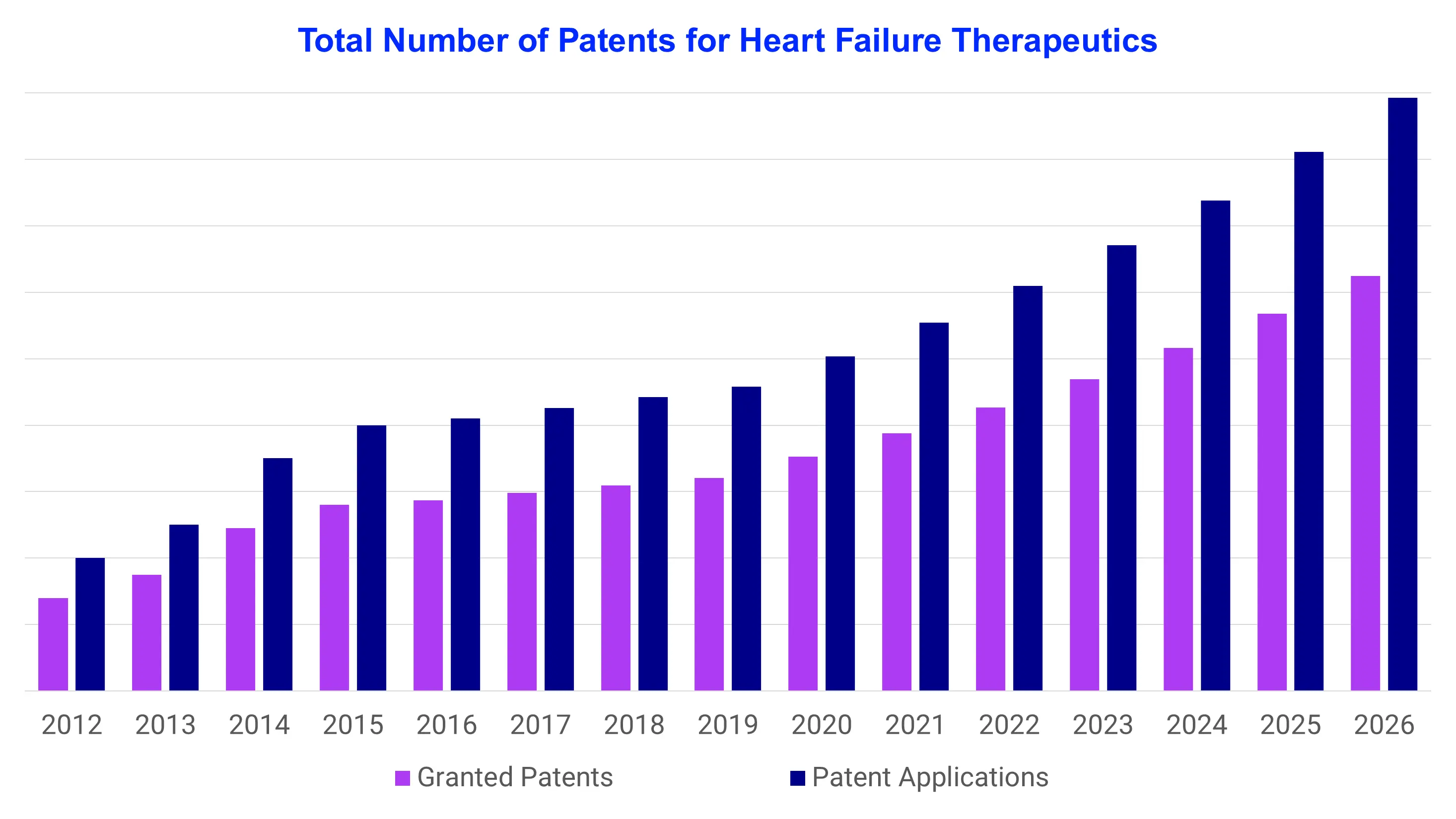
Patent activity is accelerating, with 90+ heart failure therapeutics patents granted in 2025, reflecting strong innovation momentum in SGLT2 inhibitor and neurohormonal combination regimens, incretin-based therapies for HFpEF, cardiac myosin modulators and gene therapies, and implantable haemodynamic monitoring and mechanical support.
Top assignees in the heart failure therapeutics patent landscape include Novartis, AstraZeneca, Boehringer Ingelheim, Medtronic, and Bayer, with the United States, China, and Europe as the dominant patent jurisdictions.
Heart failure affects an estimated 64 million people worldwide, and about 6.7 million adults in the United States live with the condition. Ageing, hypertension, diabetes, obesity and improved survival after myocardial infarction expand the prevalent population.
North America leads the market, supported by high diagnosis rates, early adoption of SGLT2 inhibitors and established reimbursement for implantable devices. The United States FDA approval of finerenone for heart failure with LVEF of 40% or higher in 2025 widened the treated HFpEF pool. Asia Pacific grows fastest as China and India broaden access to guideline-directed therapy.
The growth rate sits below the sector norm because the base is large and mature. Generic sacubitril/valsartan and dapagliflozin lower net prices, while new classes offset the erosion: acoramidis (approved in 2024) and vutrisiran (approved for ATTR cardiomyopathy in 2025), tirzepatide for obesity-related HFpEF, and finerenone. Devices add volume, with CardioMEMS pulmonary artery sensors, cardiac resynchronisation systems and HeartMate 3 left ventricular assist devices in routine use.
Read more about this report - REQUEST FREE SAMPLE COPY IN PDF
Heart failure patent filings span pharmaceuticals, medical devices and digital monitoring. Drug filings concentrate on crystalline forms, fixed-dose combinations, new-use claims for HFpEF and cardiorenal conditions, and RNA-based therapies for amyloid disease.
The analysis identifies more than 13,000+ patent families, with filing peaks in 2019 to 2021 after SGLT2 inhibitor outcome trials and again in 2023 to 2024 as incretin, gene therapy and myosin modulator applications grew. Device filings remain steady, led by haemodynamic sensors and left ventricular support pumps.
Rising prevalence and the clinical shift towards combination therapy convert directly into continuation filings, new-use claims and device improvements across the sector.
The report covers granted patents and published applications related to heart failure drugs, biologics, gene and cell therapies, implantable devices and remote monitoring systems. Coverage spans reduced, mildly reduced and preserved ejection fraction, transthyretin amyloid cardiomyopathy and acute decompensated heart failure.
Patent data are consolidated at family level and mapped to therapy type, mechanism and indication. Assignee names are normalised across subsidiaries and acquired entities, and legal status is reviewed for key jurisdictions.
The report profiles pharmaceutical companies, medical device manufacturers, biotechnology developers, universities and research institutes holding heart failure patent assets.
The report will cover the following sections in detail:
Analysis by Therapy
Analysis by Mechanism
Analysis by Indication
Heart Failure Therapeutics Patent Filing Trend Analysis
Heart failure filings grew at an estimated 6% to 8% annually during 2020 to 2024. Growth followed the DAPA-HF and EMPEROR-Reduced outcome trials, which opened SGLT2 inhibitor combination and formulation claims.
Filings in incretin therapies for HFpEF, ATTR cardiomyopathy silencers and cardiac gene therapy rose faster than the sector average after tirzepatide, vutrisiran and acoramidis data. Established neurohormonal classes show flat to declining new filings as originator patents mature.
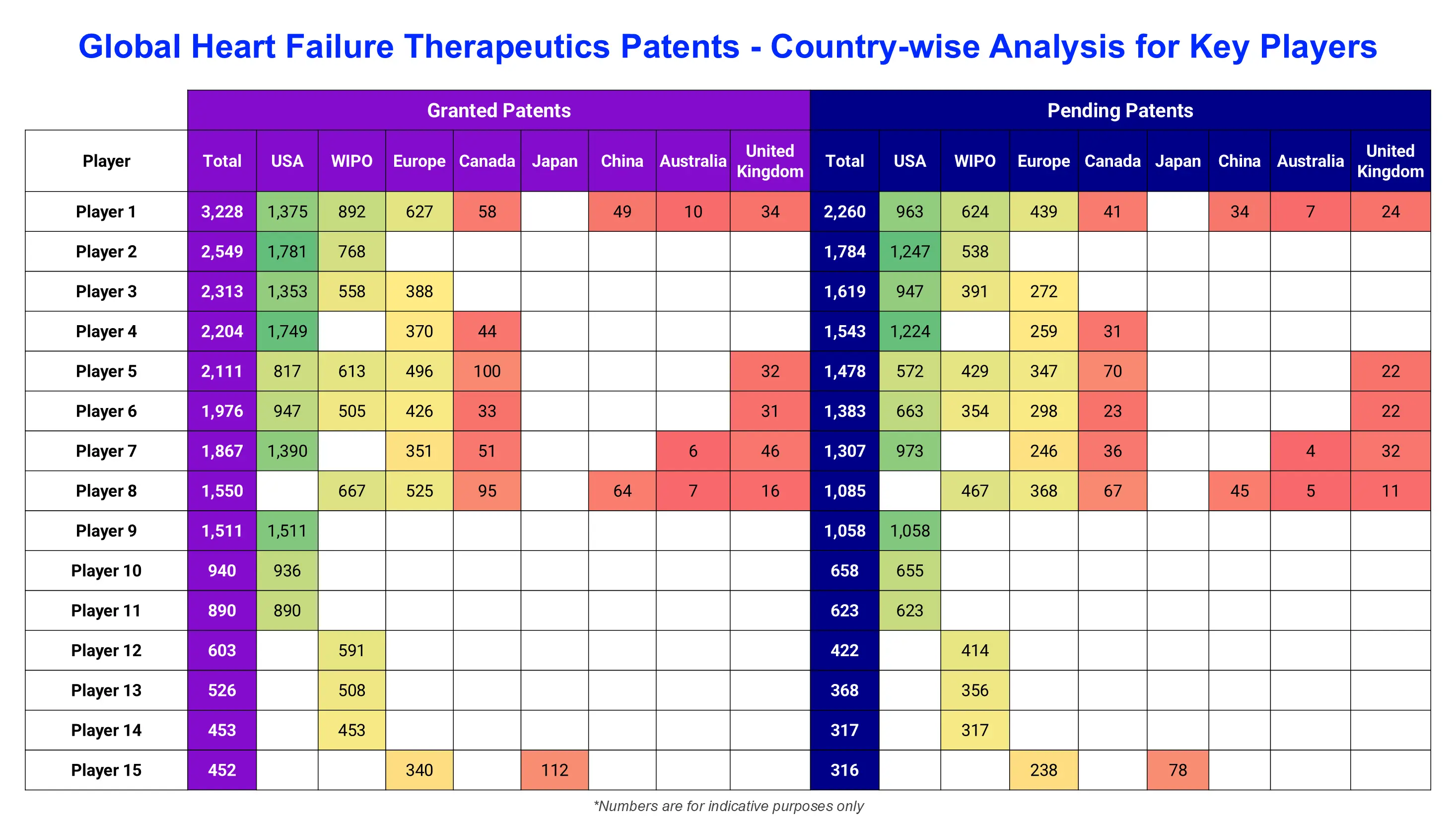
Among the players with heart failure therapeutics patent families, new entrants have been identified, which can be either established companies or startups developing novel technology in the field. Some of the major companies mentioned in this report (a non-exhaustive list) are as follows:
Novartis holds the largest heart failure portfolio, built around the sacubitril/valsartan angiotensin receptor-neprilysin inhibitor family and its salt-complex, formulation and paediatric dosing patents. Entresto received FDA approval in 2015 and extended labelling to a broader heart failure population in 2021. Following US generic entry in 2025, the company has shifted R&D towards newer cardiovascular assets, including abelacimab from its Anthos acquisition and pacibekitug from Tourmaline, alongside RNA-based programmes. Its IP strategy combines secondary patents, new-use claims and continuation filings across the United States, Europe, China and Japan. Commercially, the company positions heart failure as a mature franchise that funds lipid-lowering and RNA-based cardiovascular pipelines.
AstraZeneca's heart failure portfolio centres on dapagliflozin (Farxiga), the first SGLT2 inhibitor approved for heart failure with reduced ejection fraction in 2020 and extended to preserved ejection fraction in 2023. Patent filings cover crystalline forms, combination regimens, paediatric use and cardiorenal indications, with newer claims in acute heart failure and post-myocardial infarction settings. The company also advances balcinrenone with dapagliflozin as a fixed-dose combination in Phase III trials for heart failure. Its approach pairs lifecycle extension of Farxiga with novel mineralocorticoid receptor modulation and RNA-based cardiometabolic assets. Generic dapagliflozin entry in several markets is directing emphasis towards combinations and new indications.
Other companies include Boehringer Ingelheim, Medtronic, and Bayer.
Portfolio ownership is moderately concentrated. The top five assignees together hold an estimated 25% to 30% of families, with Novartis and AstraZeneca leading in drugs and Medtronic leading in devices. A long tail of universities, biotechnology firms and Chinese pharmaceutical companies accounts for the remainder.
*Please note that this is only a partial list; the complete list of key players is available in the full report. Additionally, the list of key players can be customized to better suit your needs.*
The report assesses patent activity across major jurisdictions, including:
The United States leads filing volume, supported by a large innovator base and a broad device market. China ranks second, with rapid growth in academic and domestic pharmaceutical filings. Europe follows, anchored by the European Patent Office and strong portfolios from German and Swiss assignees.
Read more about this report - REQUEST FREE SAMPLE COPY IN PDF
The technology segmentation covers the following therapy and mechanism areas:
Among these, small molecule drug filings account for the largest share, reflecting the SGLT2, ARNI and MRA families.
Competition combines large pharmaceutical groups holding drug franchises with device manufacturers holding sensor, pacing and pump portfolios. Novartis, AstraZeneca and Boehringer Ingelheim defend franchises through combination and new-indication filings. Medtronic and Abbott build device positions in monitoring and mechanical support.
Companies are focusing on:
Emerging innovation themes include obesity-linked HFpEF therapies, fixed-dose SGLT2 and MRA combinations, cardiac gene therapy, siRNA for amyloid cardiomyopathy and artificial intelligence-guided haemodynamic monitoring. Digital titration tools for guideline-directed therapy also attract new filings.
The landscape shows large expiring franchises alongside new mechanisms. Generic entry for sacubitril/valsartan and dapagliflozin pushes originators towards combinations and new indications. Smaller developers focus on myosin modulation, gene delivery and amyloid depletion.
Technology segments, assignee portfolios and jurisdictional trends are mapped to commercial opportunity. The report provides actionable intelligence supporting:
Patent data were gathered from the USPTO, EPO, WIPO, CNIPA, JPO and national databases using keyword and classification strategies. Queries combined CPC classes A61K31, A61K38, A61K48, A61P9/04, A61N1/362 and A61M60 with heart failure terminology.
Records were screened for relevance, deduplicated and consolidated at family level. Legal status, priority dates and assignee ownership were verified for the leading portfolios.
The market perspective draws on regulatory filings, company disclosures, clinical trial registries and peer-reviewed literature. Estimates of filing growth and patent counts are rounded approximations.
Heart Failure Epidemiology Forecast
Acute Decompensated Heart Failure (ADHF) Pipeline Analysis Report


Upto 15% Off
USD
$2699 $2429
$4299 $3869
$5799 $4949
$6999 $5949


*While we strive to always give you current and accurate information, the numbers depicted on the website are indicative and may differ from the actual numbers in the main report. At Expert Market Research, we aim to bring you the latest insights and trends in the market. Using our analyses and forecasts, stakeholders can understand the market dynamics, navigate challenges, and capitalize on opportunities to make data-driven strategic decisions.*
EMR’s Heart Failure Therapeutics Patent Landscape Analysis provides a comprehensive assessment of patent filings, innovation clusters, assignee portfolios, and geographic filing patterns across the heart failure therapeutics landscape. The report identifies 13,000+ patent families, evaluates leading jurisdictions including the United States, China, and Europe, and profiles the top assignees by portfolio size.
The global heart failure therapeutics market was valued at USD 6.81 Billion in 2025. The market is projected to reach USD 14.43 Billion by 2035, expanding at a CAGR of 7.80% during 2026 - 2035.
The report analyses approximately 13,000+ patent families related to heart failure therapeutics. These include filings from the United States, China, Europe, and international WIPO filings.
Key companies operating within the landscape include Novartis, AstraZeneca, Boehringer Ingelheim, Medtronic, and Bayer, among others. These organisations collectively account for a significant portion of patent activity analysed in this report.
The report evaluates patent activity across the United States, Europe, China, Japan, South Korea, India, and international WIPO filings. The United States leads heart failure patent activity, accounting for an estimated 30% to 35% of filings.
Yes. The report scope can be customised based on geography, technology segment, assignee selection, time period, or specific innovation cluster focus. Please connect with the EMR team to define the customisation scope.
Patent landscape analysis helps organisations understand innovation trends, competitive activity, technology whitespace, and IP risk across a defined domain. For heart failure therapeutics, this report supports strategic decisions in R&D prioritisation, licensing evaluation, competitive benchmarking, and market entry planning.
Explore our key highlights of the report and gain a concise overview of key findings, trends, and actionable insights that will empower your strategic decisions.
|
Scope of the Report |
Details |
|
Analysis by Therapy |
|
|
Analysis by Mechanism |
|
|
Analysis by Indication |
|
|
Analysis by End User |
|
|
Key Players Mentioned |
|
|
Geographies Covered |
|
Mini Report
One User
USD 2,699
USD 2,429
tax inclusive*
Single User License
One User
USD 4,299
USD 3,869
tax inclusive*
Five User License
Five User
USD 5,799
USD 4,949
tax inclusive*
Corporate License
Unlimited Users
USD 6,999
USD 5,949
tax inclusive*
*Please note that the prices mentioned below are starting prices for each bundle type. Kindly contact our team for further details.*
Flash Bundle
Small Business Bundle
Growth Bundle
Enterprise Bundle
*Please note that the prices mentioned below are starting prices for each bundle type. Kindly contact our team for further details.*
Flash Bundle
Number of Reports: 3
20%
tax inclusive*
Small Business Bundle
Number of Reports: 5
25%
tax inclusive*
Growth Bundle
Number of Reports: 8
30%
tax inclusive*
Enterprise Bundle
Number of Reports: 10
35%
tax inclusive*
How To Order

Select License Type
Choose the right license for your needs and access rights.

Click on ‘Buy Now’
Add the report to your cart with one click and proceed to register.

Select Mode of Payment
Choose a payment option for a secure checkout. You will be redirected accordingly.
Strategic Solutions for Informed Decision-Making
Gain insights to stay ahead and seize opportunities.

Get insights & trends for a competitive edge.

Track prices with detailed trend reports.

Analyse trade data for supply chain insights.

Leverage cost reports for smart savings

Enhance supply chain with partnerships.

Connect For More Information
Our expert team of analysts will offer full support and resolve any queries regarding the report, before and after the purchase.
Our expert team of analysts will offer full support and resolve any queries regarding the report, before and after the purchase.
We employ meticulous research methods, blending advanced analytics and expert insights to deliver accurate, actionable industry intelligence, staying ahead of competitors.
Our skilled analysts offer unparalleled competitive advantage with detailed insights on current and emerging markets, ensuring your strategic edge.
We offer an in-depth yet simplified presentation of industry insights and analysis to meet your specific requirements effectively.




