

Consumer Insights
Uncover trends and behaviors shaping consumer choices today
Procurement Insights
Optimize your sourcing strategy with key market data
Industry Stats
Stay ahead with the latest trends and market analysis.
The prenatal monitoring devices market was valued at USD 5.10 Billion in 2025 and is expected to reach USD 11.43 Billion by 2035, expanding at a CAGR of 8.40% during 2026-2035. Growth is supported by rising maternal age, higher rates of gestational hypertension and diabetes, and the shift of non-stress testing from clinics to the home.
Patent filing has strengthened since 2020, led by non-invasive fetal ECG electrodes, adhesive wearable sensors, and machine-learning models that classify fetal heart rate traces. Regulatory clearances for wireless and home-capable systems between 2021 and 2025 have confirmed the commercial value of these clusters.
This Prenatal Monitoring Devices Patent Landscape Analysis Report maps assignees, jurisdictions, technology segments and filing trends to support R&D, licensing and freedom-to-operate decisions.
The prenatal monitoring devices market is experiencing strong growth, driven by rising high-risk pregnancy rates, expansion of remote obstetric care, and adoption of wireless and wearable fetal sensors. Wireless fetal-maternal systems such as GE HealthCare's Novii and the Nuvo Group INVU platform have received FDA 510(k) clearances, which moved non-invasive fetal ECG and remote non-stress testing from trials into routine obstetric workflows.
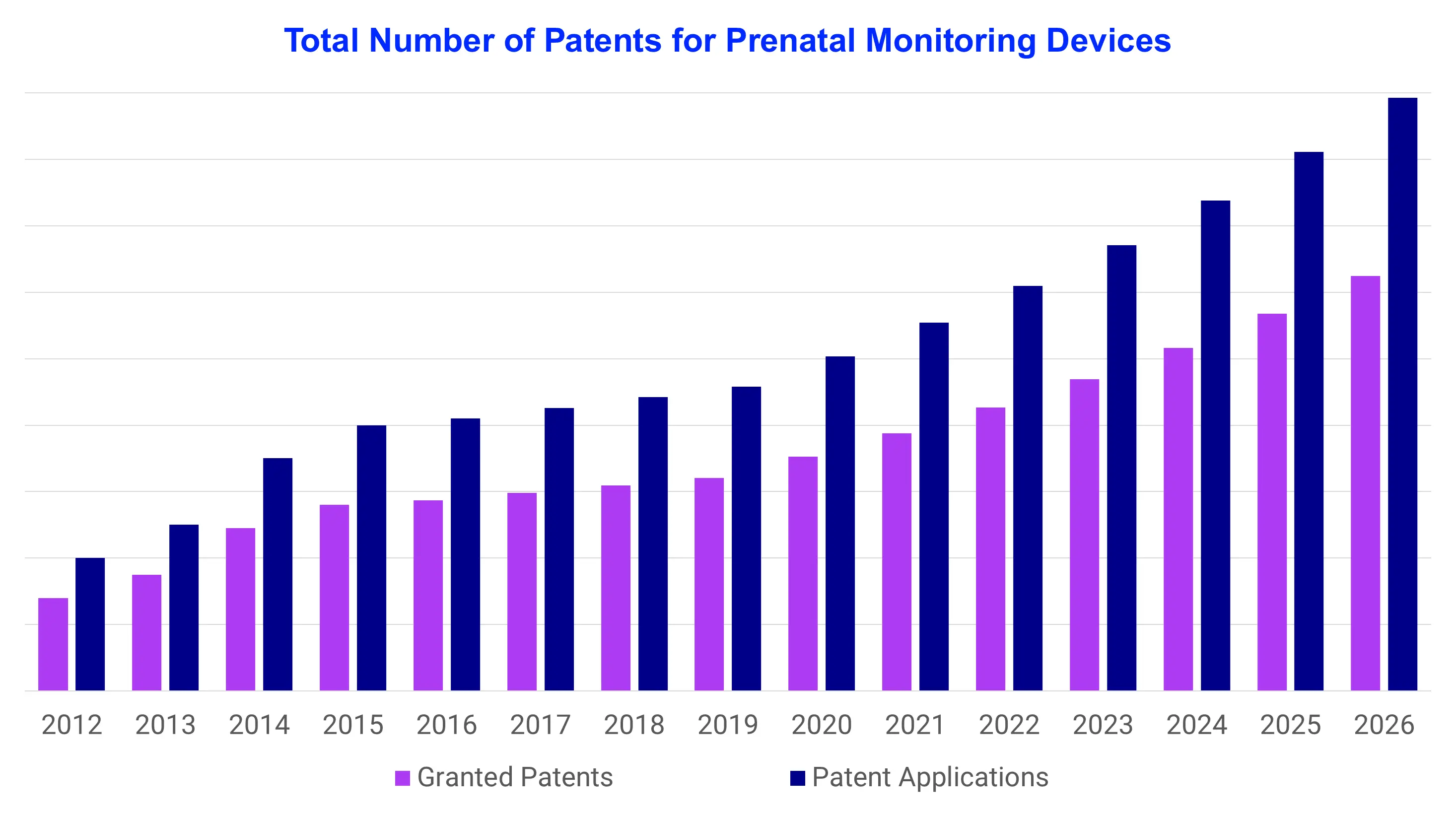
Patent activity is accelerating, with 380+ prenatal monitoring devices patents granted in 2025, reflecting strong innovation momentum in non-invasive fetal ECG sensing, wearable patch-based maternal-fetal monitors, AI interpretation of fetal heart traces, and remote and home prenatal monitoring platforms.
Top assignees in the prenatal monitoring devices patent landscape include GE HealthCare, Koninklijke Philips, Nuvo Group, Arjo, and Edan, with China, the United States, and Europe as the dominant patent jurisdictions.
Market growth is driven by the rising share of high-risk pregnancies, which raises the number of women needing continuous fetal heart rate and maternal vital sign surveillance. Hypertensive disorders affect roughly 5 to 10 percent of pregnancies worldwide, and the WHO estimates that around 2 million stillbirths occur each year.
North America holds the leading regional position because reimbursement for remote and non-stress testing is established and electronic fetal monitoring is used in nearly all US hospital births. This high baseline use creates steady replacement demand for wireless and patch-based systems that free patients from belts and cables. Asia Pacific records the fastest adoption as China and India expand maternity infrastructure, which explains why filings from that region are rising.
Installed-base evidence points to a shift toward wireless hardware. The FDA clearance of the Nuvo INVU system for remote non-stress testing and of GE HealthCare's Novii for wireless monitoring shows that regulators accept signal quality from abdominal sensors. Hospitals that adopt these systems gain shorter set-up time and fewer repeat attachments, and this raises demand for the sensor and algorithm patents described in this report.
Read more about this report - REQUEST FREE SAMPLE COPY IN PDF
Prenatal monitoring devices attract steady patent filing from medical technology majors, ultrasound specialists, wearable start-ups and university spin-outs. Filings concentrate on electrode design, signal separation of fetal and maternal ECG, ultrasound transducer arrays and cloud-connected interpretation software.
The dataset contains more than 11,500 patent families, with filing activity peaking between 2021 and 2024. Growth in that window reflects the pandemic-era push toward remote obstetric care and the maturing of machine-learning methods for trace analysis.
Rising demand for home and wireless fetal surveillance has translated directly into patent filings for wearable sensors and automated interpretation.
The report covers patents on fetal heart rate monitors, cardiotocography systems, Doppler ultrasound transducers, non-invasive fetal ECG, wearable and patch-based maternal-fetal monitors and remote home prenatal monitoring kits. It also covers maternal vital sign and preeclampsia monitoring devices used during pregnancy and labour.
Software claims on fetal heart trace classification, decision support and tele-obstetrics platforms fall inside the scope. Invasive intrapartum devices such as fetal scalp electrodes are included where claims relate to signal acquisition.
Assignees analysed include medical technology companies, ultrasound and patient monitoring manufacturers, digital health start-ups, universities and research institutes, and hospital groups holding granted patents and pending applications.
The report will cover the following sections in detail:
Analysis by Technology
Analysis by Application
Analysis by Monitoring Mode
Prenatal Monitoring Devices Patent Filing Trend Analysis
Annual patent filings in prenatal monitoring devices grew at an estimated 9 to 11 percent per year between 2020 and 2024. Remote care adoption, miniaturised analogue front-end chips and the availability of labelled fetal heart rate datasets drove this increase.
Grants in 2025 exceeded 380, with a rising share covering AI-based trace interpretation and adhesive sensor patches. Publication lags of 18 months mean that 2025 and 2026 filings continue to appear in the data.
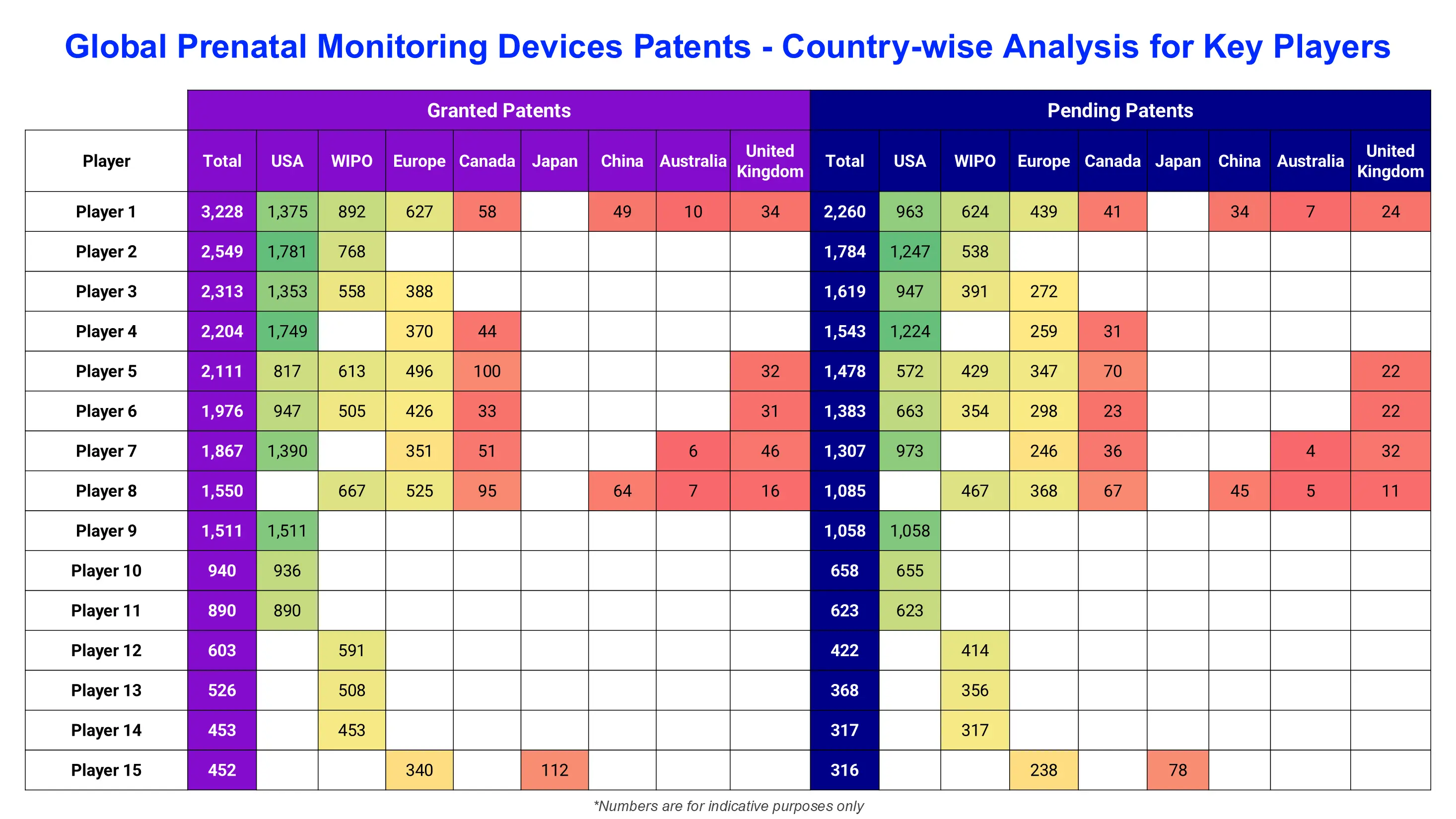
Among the players with prenatal monitoring devices patent families, new entrants have been identified, which can be either established companies or startups developing novel technology in the field. Some of the major companies mentioned in this report (a non-exhaustive list) are as follows:
GE HealthCare holds one of the largest portfolios in prenatal monitoring devices, built on the Corometrics fetal monitor line and the Novii wireless patch system. Its filings cover cardiotocography signal processing, fetal ECG extraction from abdominal electrodes, and maternal-fetal heart rate discrimination. Novii received FDA clearance for use in most eligible births, and the company pairs it with the Centricity Perinatal and Mural surveillance software. The IP strategy combines hardware sensor patents with software and analytics claims, protected across the United States, Europe and China. Commercial positioning centres on labour and delivery units in large hospital networks.
Koninklijke Philips maintains a broad prenatal monitoring portfolio around the Avalon FM series of fetal and maternal monitors and the Avalon CL cordless transducer system. Its patents address ultrasound Doppler transducers, telemetry, uterine activity sensing and the integration of maternal vital signs with fetal heart rate. The Avalon platform carries CE marking and FDA clearance, and links to the IntelliSpace Perinatal information system. Philips files in a continuing-family pattern that extends core transducer claims across successive generations. Commercial positioning targets hospital maternity departments and central surveillance in labour wards.
Other companies include Nuvo Group, Arjo, and Edan.
The five leading assignees together hold an estimated 30 to 35 percent of patent families, which indicates a moderately concentrated field with a long tail of start-ups and universities. GE HealthCare and Koninklijke Philips lead through long-standing hospital monitor lines, while Nuvo Group holds a focused wearable portfolio.
*Please note that this is only a partial list; the complete list of key players is available in the full report. Additionally, the list of key players can be customized to better suit your needs.*
The report assesses patent activity across major jurisdictions, including:
China leads in filing volume, supported by a large domestic manufacturer base including Edan and a high national birth count. The United States follows with the highest share of granted software and wearable claims, and Europe ranks third with strong activity from Philips, Arjo and university groups.
Read more about this report - REQUEST FREE SAMPLE COPY IN PDF
The report segments patent activity by the following technology clusters:
Among these, cardiotocography and Doppler ultrasound hold the largest share of patent families because of the large installed base of hospital monitors.
Competition combines hospital monitor incumbents with focused digital health entrants. GE HealthCare, Koninklijke Philips, Arjo (Huntleigh Sonicaid) and Edan defend transducer and telemetry claims, while Nuvo Group and Bistos build around patches and handheld formats. Mindray has extended its position through the Neoventa fetal ECG ST analysis portfolio.
Companies are focusing on:
Emerging innovation themes include multi-sensor patches that combine fetal ECG, maternal blood pressure and oxygen saturation, and explainable models that flag abnormal decelerations in real time. Smartphone-linked home kits for gestational hypertension follow-up and passive acoustic fetal sensing are also gaining claims.
The patent field is moving from hospital-bound cardiotocography toward wearable, connected and algorithm-led monitoring. Incumbents protect transducer and telemetry claims, and newer entrants file on sensors and software, which creates both licensing opportunities and overlap risk in fetal ECG and AI interpretation.
Technology segments, assignee portfolios and jurisdiction trends are analysed across the full dataset. The report provides actionable intelligence supporting:
Patent data were collected from the USPTO, EPO, WIPO PATENTSCOPE, CNIPA, JPO and KIPO databases, with family consolidation based on priority claims. Queries combined CPC classes A61B 5/344, A61B 5/02411, A61B 8/0866, A61B 5/4362 and G16H 50/20 with keyword sets for fetal, maternal and prenatal monitoring.
Records were screened by title, abstract and claims to remove general ultrasound, neonatal and adult cardiac patents. Assignee names were normalised for subsidiaries and acquisitions, and counts were rounded to reflect search uncertainty.
The market side draws on regulatory databases such as FDA 510(k) and EUDAMED, company filings, clinical trial registries and peer-reviewed obstetrics literature. These inputs confirm commercial relevance for each technology cluster.


Upto 15% Off
USD
$2699 $2429
$4299 $3869
$5799 $4949
$6999 $5949


*While we strive to always give you current and accurate information, the numbers depicted on the website are indicative and may differ from the actual numbers in the main report. At Expert Market Research, we aim to bring you the latest insights and trends in the market. Using our analyses and forecasts, stakeholders can understand the market dynamics, navigate challenges, and capitalize on opportunities to make data-driven strategic decisions.*
EMR’s Prenatal Monitoring Devices Patent Landscape Analysis provides a comprehensive assessment of patent filings, innovation clusters, assignee portfolios, and geographic filing patterns across the prenatal monitoring devices landscape. The report identifies 11,500+ patent families, evaluates leading jurisdictions including China, the United States, and Europe, and profiles the top assignees by portfolio size.
The global prenatal monitoring devices market was valued at USD 5.10 Billion in 2025. The market is projected to reach USD 11.43 Billion by 2035, expanding at a CAGR of 8.40% during 2026 - 2035.
The report analyses approximately 11,500+ patent families related to prenatal monitoring devices. These include filings from China, the United States, Europe, and international WIPO filings.
Key companies operating within the landscape include GE HealthCare, Koninklijke Philips, Nuvo Group, Arjo, and Edan, among others. These organisations collectively account for a significant portion of patent activity analysed in this report.
The report evaluates patent activity across the United States, Europe, China, Japan, South Korea, India, and international WIPO filings. China leads in filing volume, with an estimated 30 percent of prenatal monitoring devices patent families, followed by the United States and Europe.
Yes. The report scope can be customised based on geography, technology segment, assignee selection, time period, or specific innovation cluster focus. Please connect with the EMR team to define the customisation scope.
Patent landscape analysis helps organisations understand innovation trends, competitive activity, technology whitespace, and IP risk across a defined domain. For prenatal monitoring devices, this report supports strategic decisions in R&D prioritisation, licensing evaluation, competitive benchmarking, and market entry planning.
Explore our key highlights of the report and gain a concise overview of key findings, trends, and actionable insights that will empower your strategic decisions.
|
Scope of the Report |
Details |
|
Analysis by Technology |
|
|
Analysis by Application |
|
|
Analysis by Monitoring Mode |
|
|
Analysis by End User |
|
|
Key Players Mentioned |
|
|
Geographies Covered |
|
Mini Report
One User
USD 2,699
USD 2,429
tax inclusive*
Single User License
One User
USD 4,299
USD 3,869
tax inclusive*
Five User License
Five User
USD 5,799
USD 4,949
tax inclusive*
Corporate License
Unlimited Users
USD 6,999
USD 5,949
tax inclusive*
*Please note that the prices mentioned below are starting prices for each bundle type. Kindly contact our team for further details.*
Flash Bundle
Small Business Bundle
Growth Bundle
Enterprise Bundle
*Please note that the prices mentioned below are starting prices for each bundle type. Kindly contact our team for further details.*
Flash Bundle
Number of Reports: 3
20%
tax inclusive*
Small Business Bundle
Number of Reports: 5
25%
tax inclusive*
Growth Bundle
Number of Reports: 8
30%
tax inclusive*
Enterprise Bundle
Number of Reports: 10
35%
tax inclusive*
How To Order

Select License Type
Choose the right license for your needs and access rights.

Click on ‘Buy Now’
Add the report to your cart with one click and proceed to register.

Select Mode of Payment
Choose a payment option for a secure checkout. You will be redirected accordingly.
Strategic Solutions for Informed Decision-Making
Gain insights to stay ahead and seize opportunities.

Get insights & trends for a competitive edge.

Track prices with detailed trend reports.

Analyse trade data for supply chain insights.

Leverage cost reports for smart savings

Enhance supply chain with partnerships.

Connect For More Information
Our expert team of analysts will offer full support and resolve any queries regarding the report, before and after the purchase.
Our expert team of analysts will offer full support and resolve any queries regarding the report, before and after the purchase.
We employ meticulous research methods, blending advanced analytics and expert insights to deliver accurate, actionable industry intelligence, staying ahead of competitors.
Our skilled analysts offer unparalleled competitive advantage with detailed insights on current and emerging markets, ensuring your strategic edge.
We offer an in-depth yet simplified presentation of industry insights and analysis to meet your specific requirements effectively.




