

Consumer Insights
Uncover trends and behaviors shaping consumer choices today
Procurement Insights
Optimize your sourcing strategy with key market data
Industry Stats
Stay ahead with the latest trends and market analysis.
The renal denervation devices market was valued at USD 0.31 Billion in 2025 and is projected to reach USD 2.73 Billion by 2035, growing at a CAGR of 24.30% during 2026 - 2035. The growth is supported by the large hypertension population, US regulatory approvals in 2023, Medicare coverage in 2025 and a maturing body of sham-controlled trial evidence.
More than 3,000 patent families cover renal denervation devices, with filing concentrated in radiofrequency catheters, ultrasound systems and alcohol-mediated injection devices. Commercial validation from approved systems and active litigation between leading assignees signals the strategic value placed on this intellectual property.
This Renal Denervation Devices Patent Landscape Analysis Report maps assignees, jurisdictions, technology clusters and filing trends to support R&D, licensing and freedom-to-operate decisions.
The renal denervation devices market is experiencing strong growth, driven by rising uncontrolled hypertension, expanding regulatory approvals and coverage, and growing sham-controlled trial evidence. The November 2023 FDA approvals of the Symplicity Spyral and Paradise systems, followed by a 2025 national coverage decision from the Centers for Medicare and Medicaid Services, opened a reimbursed pathway for patients with uncontrolled hypertension in the United States.
Patent activity is accelerating, with 190+ renal denervation devices patents granted in 2025, reflecting strong innovation momentum in radiofrequency ablation catheters, ultrasound-based denervation systems, alcohol-mediated perivascular injection devices, and patient selection and procedural planning software.
Top assignees in the renal denervation devices patent landscape include Medtronic, Recor Medical, Boston Scientific, Ablative Solutions, and Abbott, with the United States, China, and Europe as the dominant patent jurisdictions.
The market growth is driven by the arrival of reimbursed, FDA-approved catheter systems that give physicians a procedural option for patients whose blood pressure stays elevated on medication. Hypertension affects roughly 1.3 billion adults worldwide according to the World Health Organization, and fewer than one in five have it under control. Resistant hypertension is estimated to affect 10 to 15 percent of treated patients.
The growth rate is high because the base is small. Commercial sales began in earnest only after the November 2023 FDA approvals of the Symplicity Spyral and Paradise systems, so each newly reimbursed procedure adds a large percentage to a low starting value. The 2025 national coverage decision from the Centers for Medicare and Medicaid Services extended payment to eligible Medicare patients, which removes the main barrier to hospital adoption in the United States.
Sham-controlled trials such as SPYRAL HTN-ON MED and RADIANCE II showed average office systolic reductions of several mmHg beyond sham, and these results gave guideline bodies the evidence to endorse the procedure. Positive evidence led to wider operator training and more catheterisation laboratories offering treatment. A larger procedure volume in turn raises demand for next-generation catheters, planning software and patient selection tools, which sustains patent filing.
Read more about this report - REQUEST FREE SAMPLE COPY IN PDF
Patent filing in renal denervation devices began in the mid-2000s with radiofrequency catheters and expanded after the first sham-controlled trial readouts. Early families addressed electrode design and energy delivery. Later filings added ultrasound transducers, alcohol-based perivascular injection and procedural planning.
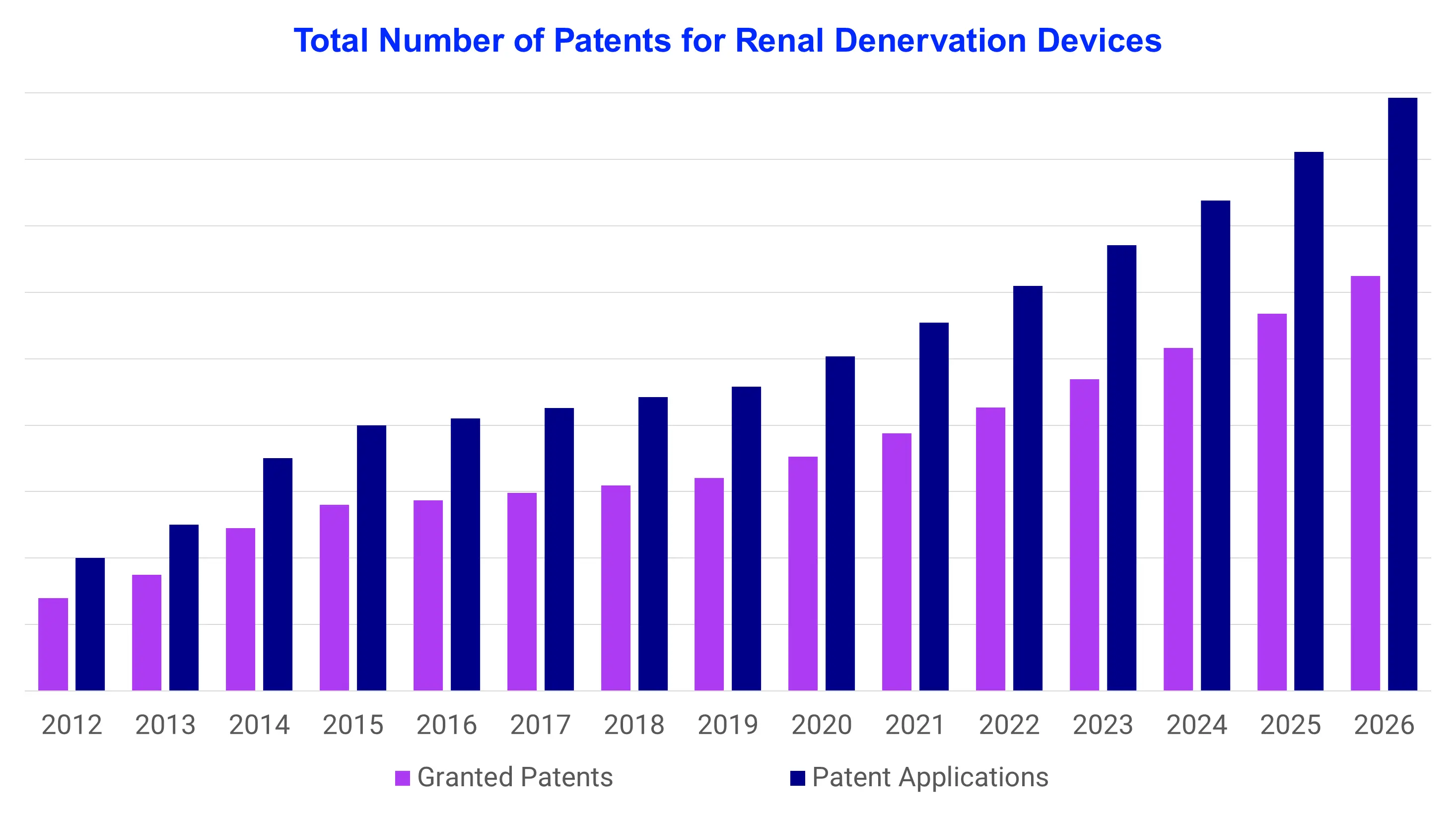
The field holds more than 3,000 patent families, with filing peaks in 2012 to 2014 and again in 2021 to 2024. The second peak followed the neutral and positive trial readouts and the move toward regulatory approval. Granted patents for 2025 are in the low hundreds, which reflects a more selective prosecution environment.
Rising hypertension prevalence and new Medicare coverage push developers to protect catheter designs and delivery methods before commercial volumes scale.
The analysis covers patents on radiofrequency, ultrasound and alcohol-mediated catheter systems used to ablate renal sympathetic nerves. It includes electrode and transducer design, generators, delivery catheters, sheaths and balloon cooling features.
Patents on procedural planning, renal anatomy imaging, patient selection and response prediction are included, along with methods supporting sham-controlled trial design. The population of interest is adults with uncontrolled or resistant hypertension, together with comorbid cardiometabolic groups.
Assignees include medical device manufacturers, pharmaceutical groups with device subsidiaries, start-ups, universities and hospital research institutes. Patent offices covered include the United States Patent and Trademark Office, the European Patent Office, the China National Intellectual Property Administration, the Japan Patent Office and the World Intellectual Property Organization.
The report will cover the following sections in detail:
Analysis by Technology
Analysis by Application
Analysis by Technical Focus
Renal Denervation Devices Patent Filing Trend Analysis
Filings grew at an estimated annual rate of 9 to 11 percent over 2020 to 2024, led by multi-electrode radiofrequency designs, ultrasound refinements and alcohol-mediated delivery. Regulatory approvals in 2023 and strong trial evidence supported this pace.
Chinese applicants raised their share of new filings during the period, driven by domestic radiofrequency and balloon catheter programmes. Software and patient selection filings increased as developers sought to improve responder identification. Continuation filings by established assignees extended protection around approved platforms.
Among the players with renal denervation devices patent families, new entrants have been identified, which can be either established companies or startups developing novel technology in the field. Some of the major companies mentioned in this report (a non-exhaustive list) are as follows:
Medtronic holds the largest renal denervation devices portfolio, built around the Symplicity radiofrequency platform that began with the Ardian acquisition in 2011. The Symplicity Spyral multi-electrode catheter and Symplicity G3 generator received FDA approval in November 2023 and carry CE Mark. Claims cover catheter electrode geometry, energy delivery algorithms, vessel mapping and treatment of distal branch vessels. The company defends its position through continuation filings and active enforcement, including its dispute with Recor Medical. Medtronic positions the system in a large installed base of cardiac and vascular accounts, supported by the 2025 Medicare coverage decision.
Recor Medical, a subsidiary of Otsuka Medical Devices, owns the second-largest portfolio, centred on ultrasound-based denervation. Its Paradise system uses a balloon-cooled ultrasound transducer to deliver circumferential energy to the renal artery wall and received FDA approval in November 2023. Patent families address transducer design, balloon cooling, energy dosing and procedural methods, with support from the RADIANCE sham-controlled trial programme. Otsuka acquired the business in 2021 and funds international expansion in Europe and Asia. Recor pursues broad claims on ultrasound ablation and defends them in litigation with Medtronic.
Other companies include Boston Scientific, Ablative Solutions, and Abbott.
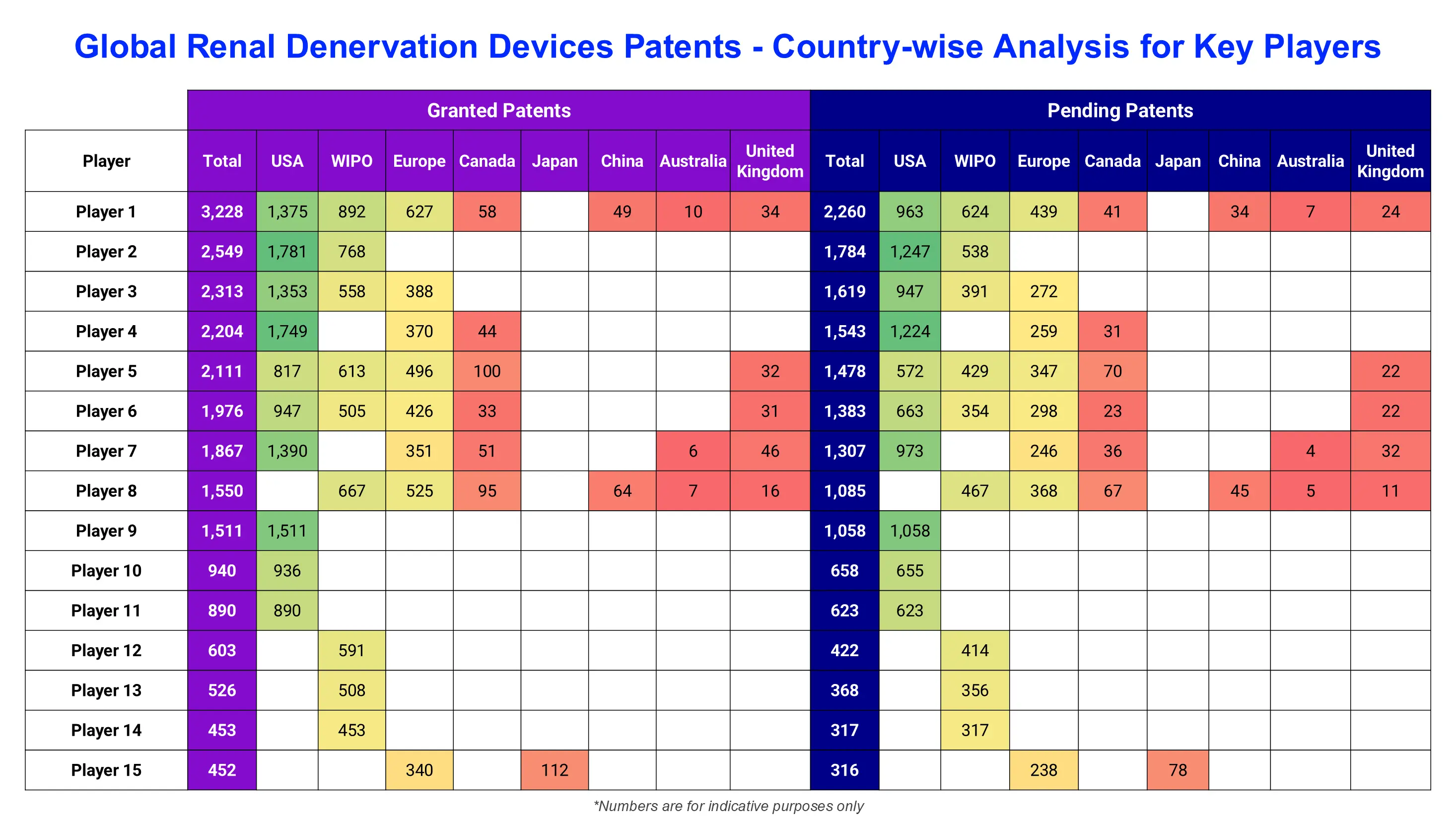
The top five assignees hold an estimated 40 to 45 percent of all patent families, with Medtronic and Recor Medical together accounting for roughly one quarter. Boston Scientific, which gained ultrasound technology through its 2025 acquisition of SoniVie, and Ablative Solutions, developer of the Peregrine alcohol-mediated catheter, hold mid-sized portfolios. A long tail of start-ups and universities accounts for the rest.
*Please note that this is only a partial list; the complete list of key players is available in the full report. Additionally, the list of key players can be customized to better suit your needs.*
The report assesses patent activity across major jurisdictions, including:
The United States leads in filing volume and in granted patents on commercial platforms, supported by the 2023 approvals and 2025 coverage decision. China ranks second, driven by domestic device developers and a large hypertensive population. Europe follows, with filings tied to CE-marked systems and clinical sites in Germany, the United Kingdom and France.
Read more about this report - REQUEST FREE SAMPLE COPY IN PDF
The report segments patent activity into the following technology areas:
Among these, radiofrequency ablation catheters account for the largest share of patent families, reflecting the early start of the Symplicity programme and many follow-on electrode designs.
Medtronic and Recor Medical lead the field with the two FDA-approved platforms, and their portfolios cover radiofrequency and ultrasound energy respectively. Boston Scientific and Abbott bring broad cardiovascular catheter portfolios, while Ablative Solutions focuses on perivascular alcohol delivery. Litigation between Medtronic and Recor Medical over catheter claims shows how closely held this intellectual property has become.
Companies are focusing on:
Emerging innovation themes include non-invasive and focused ultrasound denervation, renal nerve mapping to guide energy delivery, and biomarkers to predict blood pressure response. Developers also file on lower-cost single-use catheters for emerging markets and on combined use with antihypertensive drug regimens. Interest in treating atrial fibrillation and heart failure through sympathetic modulation adds new application claims.
The competitive field combines two leading approved platforms, large cardiovascular device groups entering through acquisition, and start-ups pursuing differentiated energy sources. Medicare coverage in 2025 increases the commercial value of claims on approved systems. Assignees with ultrasound and alcohol-mediated portfolios hold distinct positions against the radiofrequency incumbent.
Technology segments, jurisdictions and assignee portfolios in this report support decisions across R&D, licensing and market entry. The report provides actionable intelligence supporting:
Patent data was collected from the United States Patent and Trademark Office, the European Patent Office, the China National Intellectual Property Administration, the Japan Patent Office and the World Intellectual Property Organization. Search queries combined keywords with Cooperative Patent Classification codes such as A61B 18, A61N 7 and A61M 25, along with A61B 2018 sub-classes for renal nerve ablation.
Results were screened manually for relevance to renal denervation devices and consolidated into patent families to remove duplicate filings across jurisdictions. Assignee names were normalised to account for subsidiaries and acquisitions. Legal status, filing year and jurisdiction were coded for each family.
The market side draws on regulatory filings, company disclosures, clinical trial registries and peer-reviewed literature. Figures for patent counts and shares are analyst estimates based on sampled database results.


Upto 15% Off
USD
$2699 $2429
$4299 $3869
$5799 $4949
$6999 $5949


*While we strive to always give you current and accurate information, the numbers depicted on the website are indicative and may differ from the actual numbers in the main report. At Expert Market Research, we aim to bring you the latest insights and trends in the market. Using our analyses and forecasts, stakeholders can understand the market dynamics, navigate challenges, and capitalize on opportunities to make data-driven strategic decisions.*
EMR’s Renal Denervation Devices Patent Landscape Analysis provides a comprehensive assessment of patent filings, innovation clusters, assignee portfolios, and geographic filing patterns across the renal denervation devices landscape. The report identifies 3,000+ patent families, evaluates leading jurisdictions including the United States, China, and Europe, and profiles the top assignees by portfolio size.
The global renal denervation devices market was valued at USD 0.31 Billion in 2025. The market is projected to reach USD 2.73 Billion by 2035, expanding at a CAGR of 24.30% during 2026 - 2035.
The report analyses approximately 3,000+ patent families related to renal denervation devices. These include filings from the United States, China, Europe, and international WIPO filings.
Key companies operating within the landscape include Medtronic, Recor Medical, Boston Scientific, Ablative Solutions, and Abbott, among others. These organisations collectively account for a significant portion of patent activity analysed in this report.
The report evaluates patent activity across the United States, Europe, China, Japan, South Korea, India, and international WIPO filings. The United States leads renal denervation devices patent activity, accounting for an estimated 35 to 40 percent of filings.
Yes. The report scope can be customised based on geography, technology segment, assignee selection, time period, or specific innovation cluster focus. Please connect with the EMR team to define the customisation scope.
Patent landscape analysis helps organisations understand innovation trends, competitive activity, technology whitespace, and IP risk across a defined domain. For renal denervation devices, this report supports strategic decisions in R&D prioritisation, licensing evaluation, competitive benchmarking, and market entry planning.
Explore our key highlights of the report and gain a concise overview of key findings, trends, and actionable insights that will empower your strategic decisions.
|
Scope of the Report |
Details |
|
Analysis by Technology |
|
|
Analysis by Application |
|
|
Analysis by Technical Focus |
|
|
Analysis by End User |
|
|
Key Players Mentioned |
|
|
Geographies Covered |
|
Mini Report
One User
USD 2,699
USD 2,429
tax inclusive*
Single User License
One User
USD 4,299
USD 3,869
tax inclusive*
Five User License
Five User
USD 5,799
USD 4,949
tax inclusive*
Corporate License
Unlimited Users
USD 6,999
USD 5,949
tax inclusive*
*Please note that the prices mentioned below are starting prices for each bundle type. Kindly contact our team for further details.*
Flash Bundle
Small Business Bundle
Growth Bundle
Enterprise Bundle
*Please note that the prices mentioned below are starting prices for each bundle type. Kindly contact our team for further details.*
Flash Bundle
Number of Reports: 3
20%
tax inclusive*
Small Business Bundle
Number of Reports: 5
25%
tax inclusive*
Growth Bundle
Number of Reports: 8
30%
tax inclusive*
Enterprise Bundle
Number of Reports: 10
35%
tax inclusive*
How To Order

Select License Type
Choose the right license for your needs and access rights.

Click on ‘Buy Now’
Add the report to your cart with one click and proceed to register.

Select Mode of Payment
Choose a payment option for a secure checkout. You will be redirected accordingly.
Strategic Solutions for Informed Decision-Making
Gain insights to stay ahead and seize opportunities.

Get insights & trends for a competitive edge.

Track prices with detailed trend reports.

Analyse trade data for supply chain insights.

Leverage cost reports for smart savings

Enhance supply chain with partnerships.

Connect For More Information
Our expert team of analysts will offer full support and resolve any queries regarding the report, before and after the purchase.
Our expert team of analysts will offer full support and resolve any queries regarding the report, before and after the purchase.
We employ meticulous research methods, blending advanced analytics and expert insights to deliver accurate, actionable industry intelligence, staying ahead of competitors.
Our skilled analysts offer unparalleled competitive advantage with detailed insights on current and emerging markets, ensuring your strategic edge.
We offer an in-depth yet simplified presentation of industry insights and analysis to meet your specific requirements effectively.




