

Consumer Insights
Uncover trends and behaviors shaping consumer choices today
Procurement Insights
Optimize your sourcing strategy with key market data
Industry Stats
Stay ahead with the latest trends and market analysis.
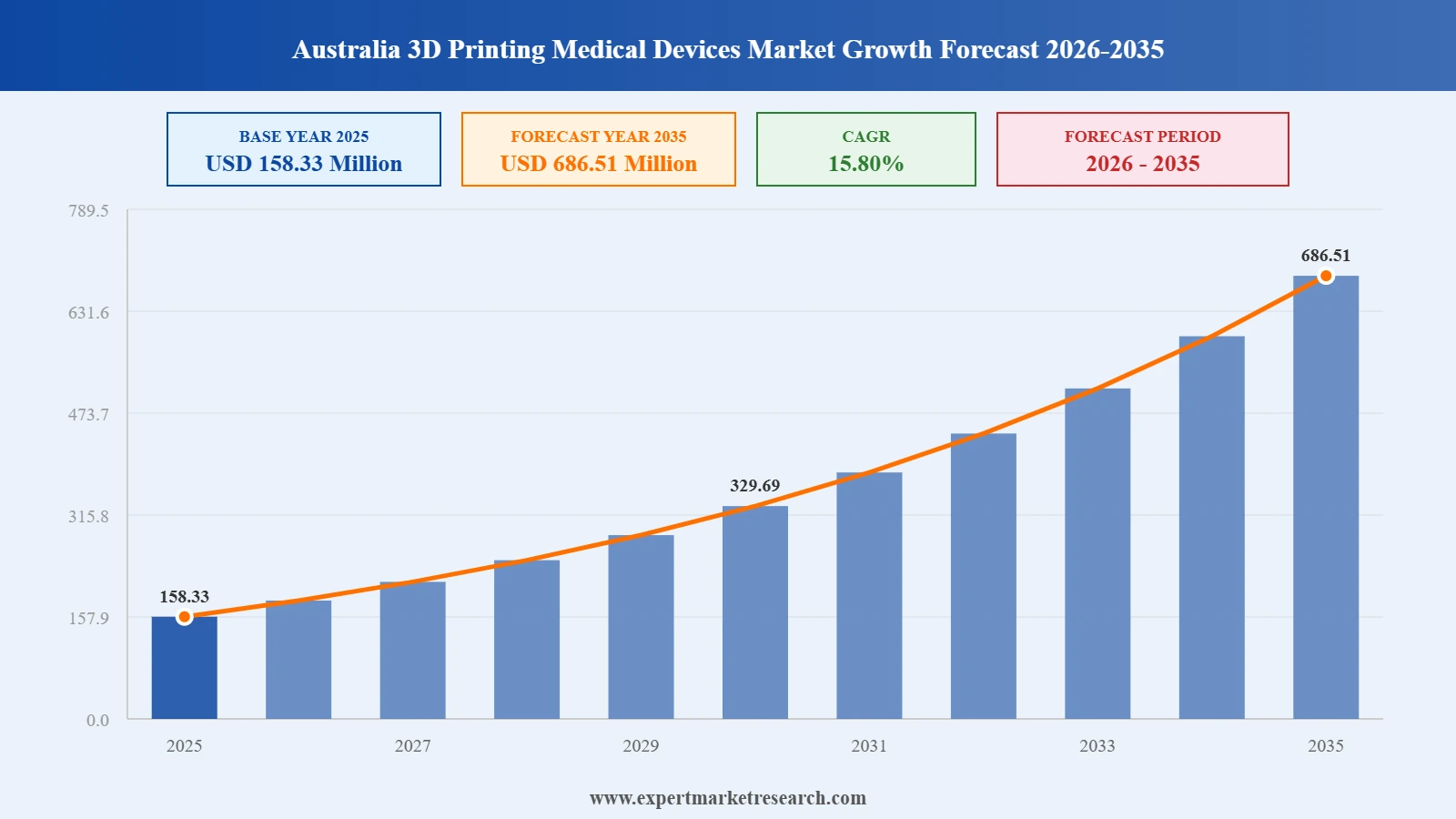
The Australia 3D printing medical devices market was valued at USD 158.33 Million in 2025, driven are the growing demand for patient-specific implants and prosthetics and increasing government and private investments in healthcare innovation and additive manufacturing in the region. The market is anticipated to grow at a CAGR of 15.80% during the forecast period of 2026-2035, with the values likely to reach USD 686.51 Million by 2035. The market is further supported by the increasing adoption of personalized healthcare solutions and integration of 3D printing in surgical planning. Advancements in biocompatible materials and rising collaboration between research institutions and medtech firms are expected to fuel growth during the forecast period.
Australia’s aging population and growing prevalence of chronic diseases have created demand for customized implants and prosthetics that enhance patient comfort and reduce surgical complications. 3D printing allows clinicians to produce anatomically accurate devices tailored to individual patients, improving treatment outcomes, particularly in orthopedics, maxillofacial surgery, and dental applications. In addition, Australian hospitals are integrating 3D printing technologies into pre-surgical planning, enabling surgeons to rehearse complex procedures using 3D-printed anatomical models. These models improve accuracy, reduce operation times, and enhance patient safety, thereby boosting market growth.
Read more about this report - REQUEST FREE SAMPLE COPY IN PDF
The market is primarily driven by the growing demand for patient-specific implants, prosthetics, and surgical tools, as well as rising investments from both government and private sectors in healthcare innovation and additive manufacturing capabilities. In Australia, the 3D printing medical devices market has grown steadily due to rising healthcare innovation, supportive regulations, and increasing demand for personalized treatment. In 2025, the market was valued at USD 158.33 Million, reflecting strong adoption and investment. Continued technological advancements and clinical integration are expected to drive further expansion in the coming years.
Rising Osteoarthritis Prevalence to Elevate the Market Growth
The growing incidence of osteoarthritis in Australia is a major growth driver for the 3D printing medical devices market. According to the Australian Institute of Health and Welfare, approximately 2.1 million Australians, or 8.3% of the population, were living with osteoarthritis in 2022, with a higher prevalence among females, with 10%, compared to males, with 6.1%. Osteoarthritis, a degenerative joint disease, often requires personalized treatment solutions such as custom implants and prosthetics. The ability of 3D printing technology to produce patient-specific medical devices with enhanced precision and faster turnaround times is increasingly meeting this demand. Consequently, the rising osteoarthritis patient population is expected to significantly propel market growth for 3D printing medical devices in the coming years.
The University of Melbourne announced that its start-up Meablex was developing Australia’s first fully integrated bionic arm. The system combines a lightweight 3D-printed prosthetic hand with a sensorised socket that detects subtle muscle movement using magnetic sensors. Meablex received A$470,000 through the Australian Economic Accelerator Ignite program to support development, clinical validation and commercialisation. Clinical trials are planned for later in 2026, with commercial launch targeted for early 2027 subject to regulatory approval. The project expands 3D printing from conventional prosthetic fabrication towards integrated, sensor-enabled personalised medical devices, creating opportunities for Australian medical-device manufacturers and digital-health developers.
Australia's Therapeutic Goods Administration (TGA) updated its guidance covering personalised medical devices, including 3D-printed devices. The updated framework clarifies requirements for patient-matched, adaptable and custom-made devices and introduces further information concerning Medical Device Production Systems (MDPS). The TGA is also reviewing point-of-care manufacturing because Australian hospitals are increasingly developing capabilities to manufacture devices such as patient-matched products using technologies including 3D printing. Greater regulatory clarity can support wider hospital-based production of patient-specific devices while establishing clearer compliance requirements for manufacturers and healthcare facilities.
Flinders University announced that its Medical Device Research Institute was collaborating with Australian company Additive Surgical on 3D-printed spinal implants. The implants are manufactured in Adelaide from 3D-printed titanium and incorporate biomimetic lattice structures designed to support bone integration. The work forms part of the federally backed Additive Manufacturing CRC, which secured A$270.5 million in funding from industry, research and government. Flinders reported that the programme aims to move additive manufacturing towards mainstream production of customised, high-performance components, thereby resulting in the Australia 3D printing medical devices market growth. The collaboration strengthens Australia's domestic capability for 3D-printed implant manufacturing and supports the transition from prototyping towards clinically relevant, locally produced implants.
Researchers at Australia's University of New England published research on light-based 3D printing for personalised drug-delivery systems and medical devices. The work examined photopolymerisation approaches capable of producing customised structures with applications in drug delivery and medical-device development. The researchers highlighted 3D printing's ability to manufacture patient-specific products and complex geometries while reducing the constraints associated with conventional manufacturing. The research adds to Australia's development of advanced printing processes and materials for personalised healthcare applications. Advances in light-based printing broaden the material and design options available to Australian medical-device developers, particularly for customised drug-delivery and patient-specific devices.
Australia is on the way to manufacture some specific patient-matched medical devices near the point of their need. For example, the TGA highlighted point-of-care manufacturing (PoCM) as an emerging field that includes technologies like 3D printing and hospitals may be able to produce personalized devices for individual patients. The regulatory framework is aimed at regulating personalized devices including patient-matched, adaptable and custom-made devices. It is important as 3D printing can convert CT scan results and other data about patients into physical devices without any conventional tooling. The trend is therefore shifting additive manufacturing from centralised production towards controlled, clinically integrated manufacturing environments within Australian healthcare institutions.
Australian manufacturers of medical devices are employing 3D printing technology to produce porous and lattice titanium implants, whereby additive manufacturing presents design possibilities which cannot be easily achieved through machining processes. Research in collaboration between Flinders University and Additive Surgical, located in Adelaide, has involved the development of 3D printed spinal implants featuring biomimetic lattice structure that promotes bone ingrowth. This technique is especially pertinent to the field of spinal and orthopedic devices since lattices within implants can be configured to affect their weight and rigidity. Australia's development of these structures demonstrates a move towards 3D printing as a means of producing clinically functional implant architectures rather than simply creating prototypes.
The trend in Australian additive manufacturing research now involves the integration of 3D-printed hardware with electronics and sensors. Meablex, a spinout from the University of Melbourne, is working on a prototype bionic arm with a 3D-printed prosthesis and a socket embedded with sensors to detect muscle movements. It was funded with $470,000 through the Australian Economic Accelerator Ignite program. This represents a more advanced application than conventional cosmetic prostheses: the printed component becomes part of an integrated medical system. Consequently, Australian developers are using additive manufacturing to customize complex prosthetic structures while simultaneously integrating sensing and control technologies, thereby boosting the demand in the Australia 3D printing medical devices market.
The combination of medical imaging, digital modelling and additive manufacturing is creating a more personalised device-development workflow in Australia.It is possible for researchers and those making medical devices to use patient-specific data and create digital models and then produce complex geometries through 3D printing. This is especially useful in cases of implantation or prosthetic devices where there is huge variation in the size of the patients. Australia's TGA has recognised patient-matched devices within its personalised-medical-device framework, while Australian research programmes are developing additive-manufacturing capabilities for customised implants. The trend is consequently shifting medical-device production from standard dimensions towards data-driven fabrication, where patient anatomy becomes an input into the manufacturing process.
A notable change in Australia's 3D-printing ecosystem is the stronger emphasis on translation and commercialisation rather than research prototypes alone. The Additive Manufacturing CRC received A$270.5 million in combined government, industry and research funding, supporting development of advanced additive-manufacturing capabilities. Meanwhile, projects involving companies such as Additive Surgical are focused on taking 3D-printed implants towards practical medical applications. Government-backed programmes and university-industry collaborations are therefore helping bridge the gap between laboratory development, regulatory validation and commercial production. This creates a stronger domestic pipeline for Australian-made 3D-printed implants, prosthetics and other customised medical devices.
The market report offers a detailed analysis of the market based on the following segments:
Market Breakup by Component
Market Breakup by Technology
Market Breakup by Application
Market Breakup by End User
Read more about this report - REQUEST FREE SAMPLE COPY IN PDF
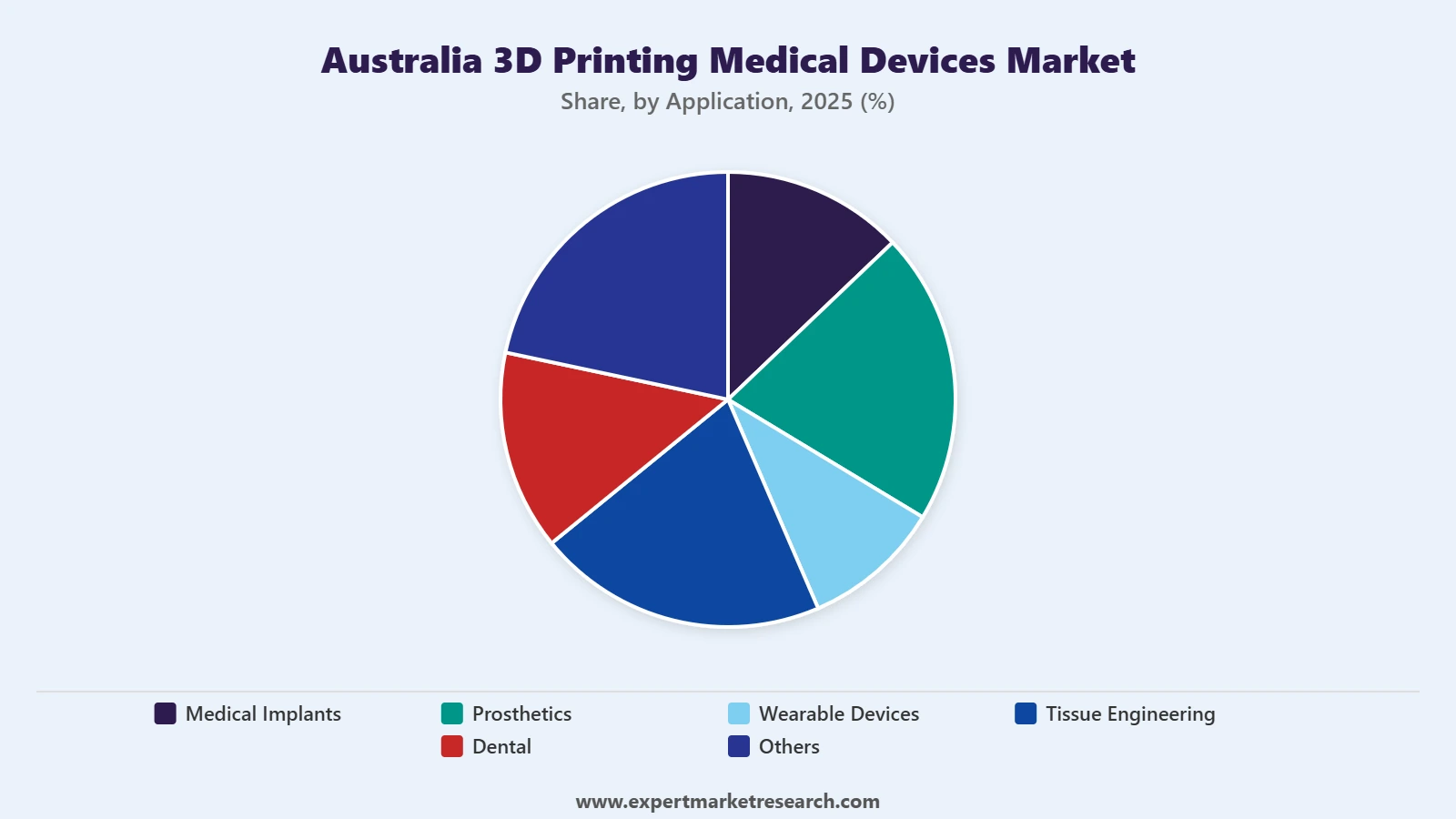
Medical Implants to Lead the Segmentation by Application
The medical implants segment is expected to lead the market, driven by breakthroughs in custom-made 3D printed bone scaffolds. For instance, in January 2025, clinicians at the University of Queensland (UQ) successfully used biocompatible, patient-specific 3D printed scaffolds to rebuild a man’s jawbone, eliminating the need for secondary surgeries. This innovation highlights the segment’s potential for personalized and effective treatment solutions. Other key application areas include prosthetics, wearable devices, tissue engineering, dental, and others, each contributing to market growth through technological advancements and increasing adoption. The demonstrated success of UQ’s polycaprolactone (PCL) scaffolds in dental reconstructive surgery also reinforces the expanding role of 3D printing in medical implants and regenerative medicine.
Read more about this report - REQUEST FREE SAMPLE COPY IN PDF
The key features of the market report comprise funding and investment analysis, and strategic initiatives by the leading players. The major companies in the market are as follows:
Koninklijke Philips N.V., established in 1891 and headquartered in the Netherlands, is a leading innovator in the 3D printing medical devices market. Through its Phillips Additives, the company offers advanced metal and composite 3D printing solutions, enabling the production of precise, durable medical device components. Philips collaborates with top additive manufacturing brands to enhance device manufacturing efficiency and complexity.
Headquartered in Chicago, Illinois, GE Healthcare is actively involved in the 3D printing medical devices market, focusing on advanced additive manufacturing technologies. In 2022, it partnered with Orchid Orthopedic Solutions to develop electron beam melting (EBM) systems for the accessible production of large joint orthopedic implants, enhancing precision and cost-effectiveness in implant manufacturing.
Stratasys is a leading company in the 3D printing medical devices market. It offers ISO 13485-certified 3D printing services for medical devices and anatomical models. Stratasys supports patient-specific device manufacturing using over 50 industrial-grade materials, enhancing precision and customization in medical applications globally, including Australia.
Founded in 2013 and headquartered in France, PRODWAYS GROUP specializes in 3D printing technologies for the dental industry. Their patented MOVINGLight technology enables efficient production of dental parts such as aligners, dentures, crowns, and bridges. PRODWAYS provides high-performance materials and printers designed to enhance precision and scalability, significantly advancing 3D printing medical devices worldwide.
*Please note that this is only a partial list; the complete list of key players is available in the full report. Additionally, the list of key players can be customized to better suit your needs.*
Other key players in the market include Nikon SLM Solutions AG, Materialise NV, CELLINK, Anatomics Pty Ltd., and Johnson & Johnson MedTech.
Australia's 3D printing medical devices market faces meaningful challenges centred on regulatory complexity and the evolving nature of the technology itself. The Therapeutic Goods Administration has acknowledged that its existing framework for medical device regulation may not always be appropriate for point-of-care manufacturing environments, where hospitals produce devices directly at clinical settings using 3D printing. Ensuring consistent quality, material biocompatibility, and validated manufacturing processes across both commercial and hospital-based production settings presents an ongoing technical and compliance challenge for manufacturers and healthcare providers alike.
Structural market restraints limit the pace of broader adoption. Australia's relatively small domestic market constrains the commercial scale at which manufacturers can offset the high capital investment required for advanced additive manufacturing equipment and regulatory certification. Limited Medicare reimbursement pathways for customised 3D-printed devices reduce the financial accessibility of these innovations within the public health system. Dependence on imported raw materials, including specialised polymers, resins, and metal powders, also introduces supply chain exposure and cost variability for domestic manufacturers.
Despite these constraints, significant growth opportunities are emerging. The Commonwealth government's AU$57.5 million investment in the Additive Manufacturing Cooperative Research Centre, complemented by over AU$200 million in partner commitments, is directing targeted resources toward medtech manufacturing and advanced materials development. World-first clinical trials in bioprinted skin and resorbable implants position Australia as a global leader in applied medical 3D printing, while TGA's planned public consultation on point-of-care manufacturing regulation signals a clearer, more supportive compliance pathway ahead.
India 3D Printing Medical Devices Market


Upto 15% Off
USD
$1999 $1799
$3099 $2789
$4599 $3909
$5999 $5099


*While we strive to always give you current and accurate information, the numbers depicted on the website are indicative and may differ from the actual numbers in the main report. At Expert Market Research, we aim to bring you the latest insights and trends in the market. Using our analyses and forecasts, stakeholders can understand the market dynamics, navigate challenges, and capitalize on opportunities to make data-driven strategic decisions.*
Explore our key highlights of the report and gain a concise overview of key findings, trends, and actionable insights that will empower your strategic decisions.
| REPORT FEATURES | DETAILS |
| Base Year | 2025 |
| Historical Period | 2019-2025 |
| Forecast Period | 2026-2035 |
| Scope of the Report |
Historical and Forecast Trends, Industry Drivers and Constraints, Historical and Forecast Market Analysis by Segment:
|
| Breakup by Component |
|
| Breakup by Technology |
|
| Breakup by Application |
|
| Breakup by End User |
|
| Market Dynamics |
|
| Supplier Landscape |
|
| Companies Covered |
|
Datasheet
One User
USD 1,999
USD 1,799
tax inclusive*
Single User License
One User
USD 3,099
USD 2,789
tax inclusive*
Five User License
Five User
USD 4,599
USD 3,909
tax inclusive*
Corporate License
Unlimited Users
USD 5,999
USD 5,099
tax inclusive*
*Please note that the prices mentioned below are starting prices for each bundle type. Kindly contact our team for further details.*
Flash Bundle
Small Business Bundle
Growth Bundle
Enterprise Bundle
*Please note that the prices mentioned below are starting prices for each bundle type. Kindly contact our team for further details.*
Flash Bundle
Number of Reports: 3
20%
tax inclusive*
Small Business Bundle
Number of Reports: 5
25%
tax inclusive*
Growth Bundle
Number of Reports: 8
30%
tax inclusive*
Enterprise Bundle
Number of Reports: 10
35%
tax inclusive*
How To Order

Select License Type
Choose the right license for your needs and access rights.

Click on ‘Buy Now’
Add the report to your cart with one click and proceed to register.

Select Mode of Payment
Choose a payment option for a secure checkout. You will be redirected accordingly.
Strategic Solutions for Informed Decision-Making
Gain insights to stay ahead and seize opportunities.

Get insights & trends for a competitive edge.

Track prices with detailed trend reports.

Analyse trade data for supply chain insights.

Leverage cost reports for smart savings

Enhance supply chain with partnerships.

Connect For More Information
Our expert team of analysts will offer full support and resolve any queries regarding the report, before and after the purchase.
Our expert team of analysts will offer full support and resolve any queries regarding the report, before and after the purchase.
We employ meticulous research methods, blending advanced analytics and expert insights to deliver accurate, actionable industry intelligence, staying ahead of competitors.
Our skilled analysts offer unparalleled competitive advantage with detailed insights on current and emerging markets, ensuring your strategic edge.
We offer an in-depth yet simplified presentation of industry insights and analysis to meet your specific requirements effectively.




