

Consumer Insights
Uncover trends and behaviors shaping consumer choices today
Procurement Insights
Optimize your sourcing strategy with key market data
Industry Stats
Stay ahead with the latest trends and market analysis.
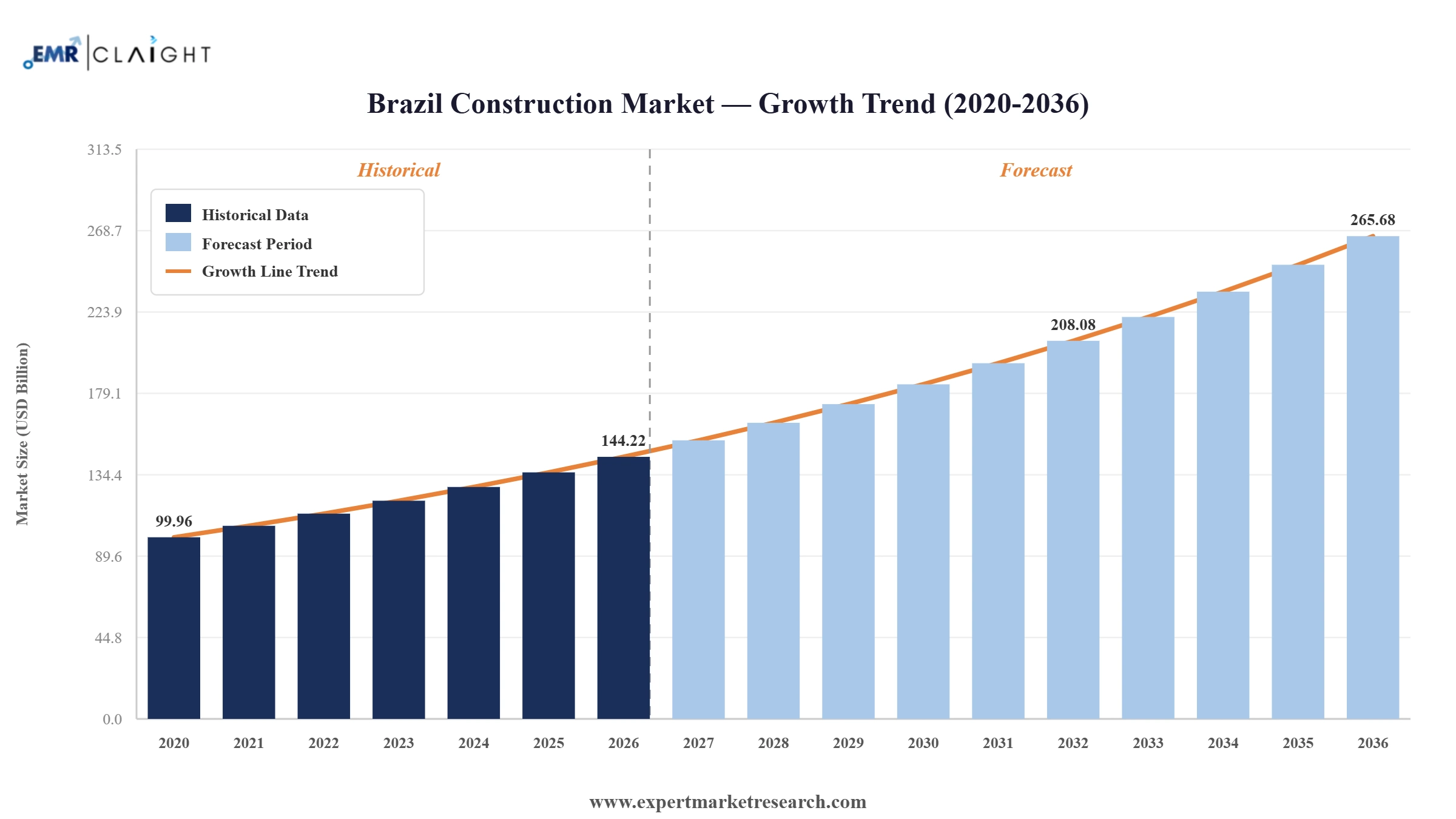
The Brazil construction market attained a value of USD 135.67 Billion in 2025 and is projected to expand at a CAGR of 6.30% through 2035. The market is further expected to reach USD 249.93 Billion by 2035. Rapid urban expansion, sustained affordable housing programmes, and expanding industrial investment are driving overall growth in the market, with government backed mortgage subsidies and public private infrastructure partnerships reshaping how developers and contractors approach residential and commercial building activity.
The Brazil construction market encompasses new construction and renovation activity serving commercial, residential, industrial, and institutional end users across the country. Sustained demand for affordable housing, expanding infrastructure investment, and rising industrial facility development continue to shape project pipelines, with new construction accounting for the largest activity share given continued urban expansion and government backed residential programmes across the market.
Higher income ceilings under Brazil's Minha Casa Minha Vida housing programme are letting more households access subsidised mortgages, widening the demand pool for established homebuilders. In March 2026, MRV's leadership outlined plans to accelerate operations across Brazil, targeting a higher sale over supply ratio after reporting its strongest quarterly gross margin in 26 quarters at the close of 2025.
Established Brazil construction companies are increasingly directing investment toward integrated urban mobility criteria and prefabricated building methods rather than relying solely on conventional site-built construction, reflecting a strategic shift toward efficiency as labour costs and project timelines come under pressure. Companies are pursuing parallel investment across affordable housing, industrial facilities, and mixed-use developments rather than remaining narrowly focused on a single project category, while strengthening partnerships across engineering, financing, and municipal planning bodies to accelerate delivery. Expanding programmes of this scale give homebuilders multiyear visibility into subsidised demand while drawing spill over work toward commercial, water, and road contractors.
Read more about this report - Request a Free Sample
Direcional Engenharia reported first half 2026 launches totalling 3.1 billion reais, a 9 percent increase over the same period last year, supported by projects developed in partnership with Moura Dubeux across Fortaleza and Natal. Partnerships of this kind let mid-sized homebuilders across the Brazil construction market extend geographic reach into new regional markets without bearing full project risk alone nationwide, regionally, locally, and beyond.
Odebrecht, operating under its Novonor parent group, secured its largest contract since the Lava Jato investigations, leading a consortium awarded lots 2 and 3 of Sao Paulo's future Line 19-Celeste metro extension worth 13.6 billion reais. Winning contracts across the Brazil construction market of this scale after years of restricted bidding access signals a broader industry return for firms previously excluded from major public tenders.
Andrade Gutierrez filed a formal appeal after placing third in bidding for a 20 billion reais lot of Sao Paulo's metro expansion programme, challenging alleged irregularities in the winning consortium's cost calculations. Contesting large tender outcomes through formal appeals remains a standard competitive tool for contractors across the Brazil construction market seeking to protect market share on major public infrastructure programmes nationwide and internationally.
GAFISA completed 605 million reais worth of residential projects during the fourth quarter of 2025 while raising 197 million reais in additional capital to support its ongoing deleveraging strategy. Capital raises paired with active project deliveries help mid-sized developers manage debt while maintaining momentum on committed construction pipelines, consistently, reliably, predictably, sustainably, and effectively over time.
Established Brazilian homebuilders across the Brazil construction market are increasingly reporting record annual sales figures, rather than steady incremental growth, as expanded subsidised mortgage eligibility widens the addressable buyer pool. This is helping developers plan larger, more confident project pipelines heading into subsequent years across every major metropolitan market. In January 2026, the government reported that Minha Casa Minha Vida had exceeded its 2025 targets, having attracted a record 180 billion reais in investment and contracted approximately 880,000 homes across every income tier.
Established mid-sized homebuilders across the Brazil construction market are increasingly forming joint development partnerships with regional players, rather than expanding into new territories independently, to share project risk and local market expertise. This is helping developers enter unfamiliar regional markets more efficiently across the country. In November 2025, the FGTS Board of Trustees approved a new multi-year plan for 2026 through 2029, increasing the Production Support credit line to 87 billion reais to sustain lending capacity nationwide and reliably.
Established urban transit authorities are increasingly advancing underground metro line construction, rather than relying solely on surface transport expansion, to ease congestion across dense metropolitan corridors. This is helping cities extend rail networks into previously underserved neighbourhoods. In July 2026, Sao Paulo Metro opened two new underground stations on Line 6, SESC Pompeia and Freguesia do O, advancing one of the city's largest active transit construction projects currently underway across the metropolitan region and surrounding districts.
Established Brazilian homebuilders across the Brazil construction market are increasingly achieving record gross margins, rather than prioritising volume alone, as improved supplier negotiation and productivity gains strengthen unit economics. This is helping developers convert strong sales momentum into stronger bottom-line profitability across every project category. In December 2025, the FGTS Board of Trustees approved updated subsidy rules for Band 1, raising the monthly income limit eligible for full housing subsidies across every qualifying household consistently.
Established government housing programmes across the Brazil construction market are increasingly expanding income eligibility thresholds, rather than maintaining static qualification criteria, to widen access to subsidised mortgage financing. This is helping more households qualify for affordable homeownership pathways previously out of reach. In April 2026, Brazil expanded Minha Casa Minha Vida's Faixa 4 tier to households earning up to 13,000 reais monthly, the largest single expansion of the programme since its 2009 creation consistently, and substantially.
The Expert Market Research's report titled “Brazil Construction Market Report and Forecast 2026-2035” offers a detailed analysis of the market based on the following segments:
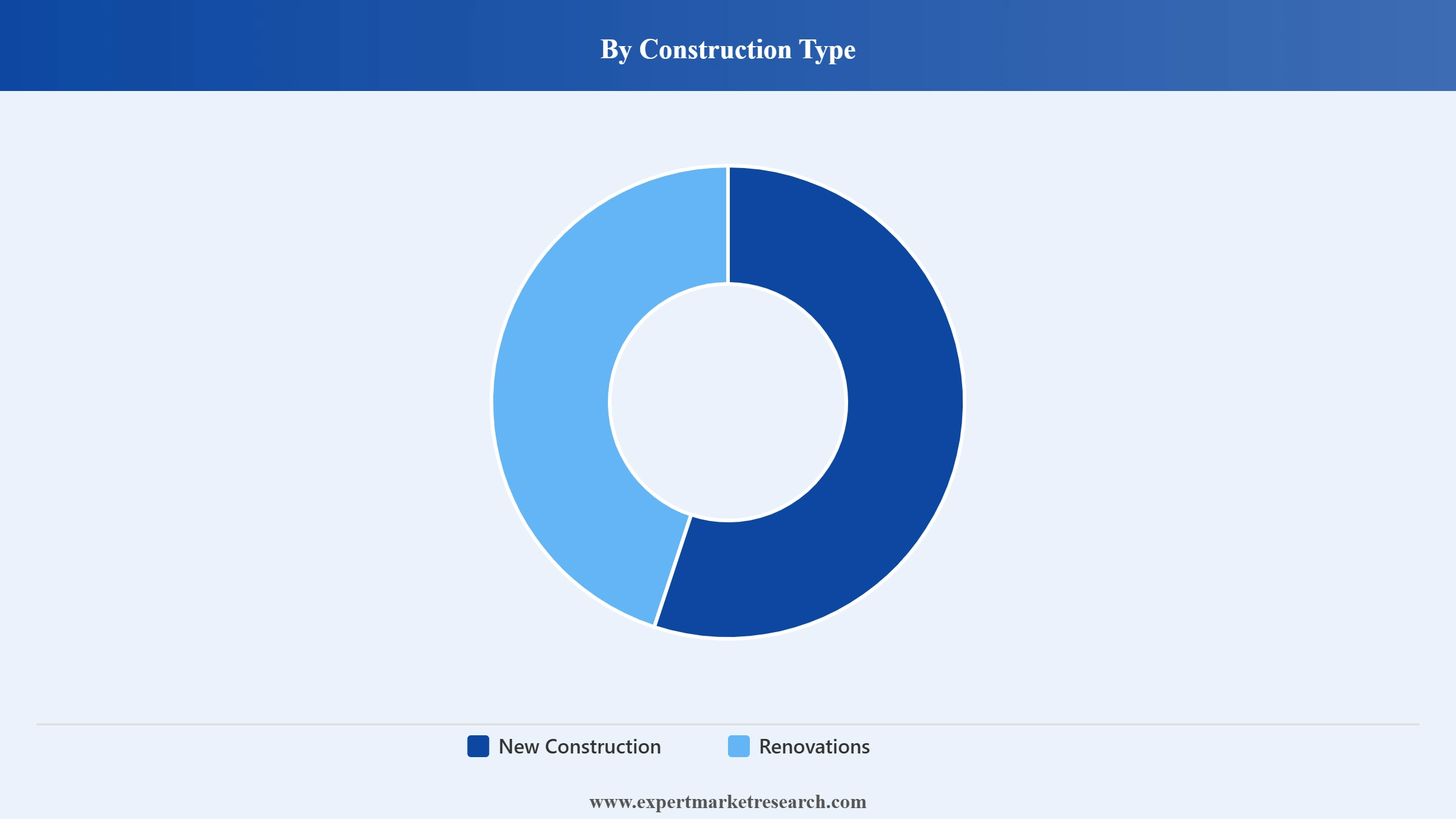
Market Breakup by Construction Type
Key Insight: Sustained residential and infrastructure development across major Brazilian cities keeps new construction as the largest activity category. Ageing building stock and rising urban redevelopment interest are lifting renovation activity toward faster growth, illustrated by Rio de Janeiro's December 2025 legislation relaxing building height limits for low-income housing developments to as much as five stores across most of the city.
Market Breakup by End Use
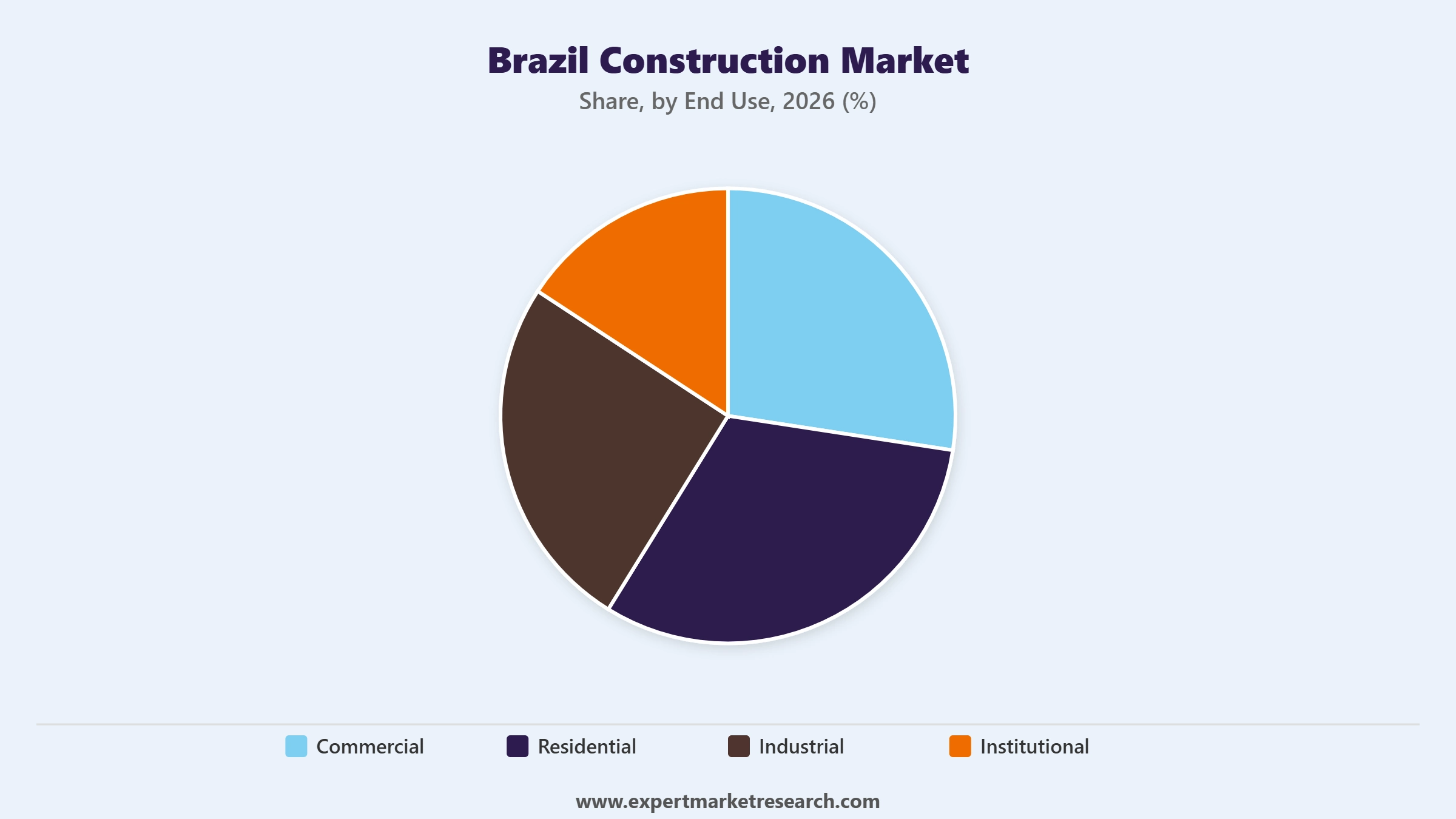
Key Insight: Expanded subsidised mortgage eligibility under government housing programmes keeps residential construction as the leading end use category across the Brazil construction market. Office, retail, and logistics development continues supporting commercial activity, while industrial construction benefits from manufacturing and distribution facility investment tied to nearshoring trends. Government infrastructure and public building programmes are pushing institutional construction toward the fastest growth as public spending accelerates.
Market Breakup by Region
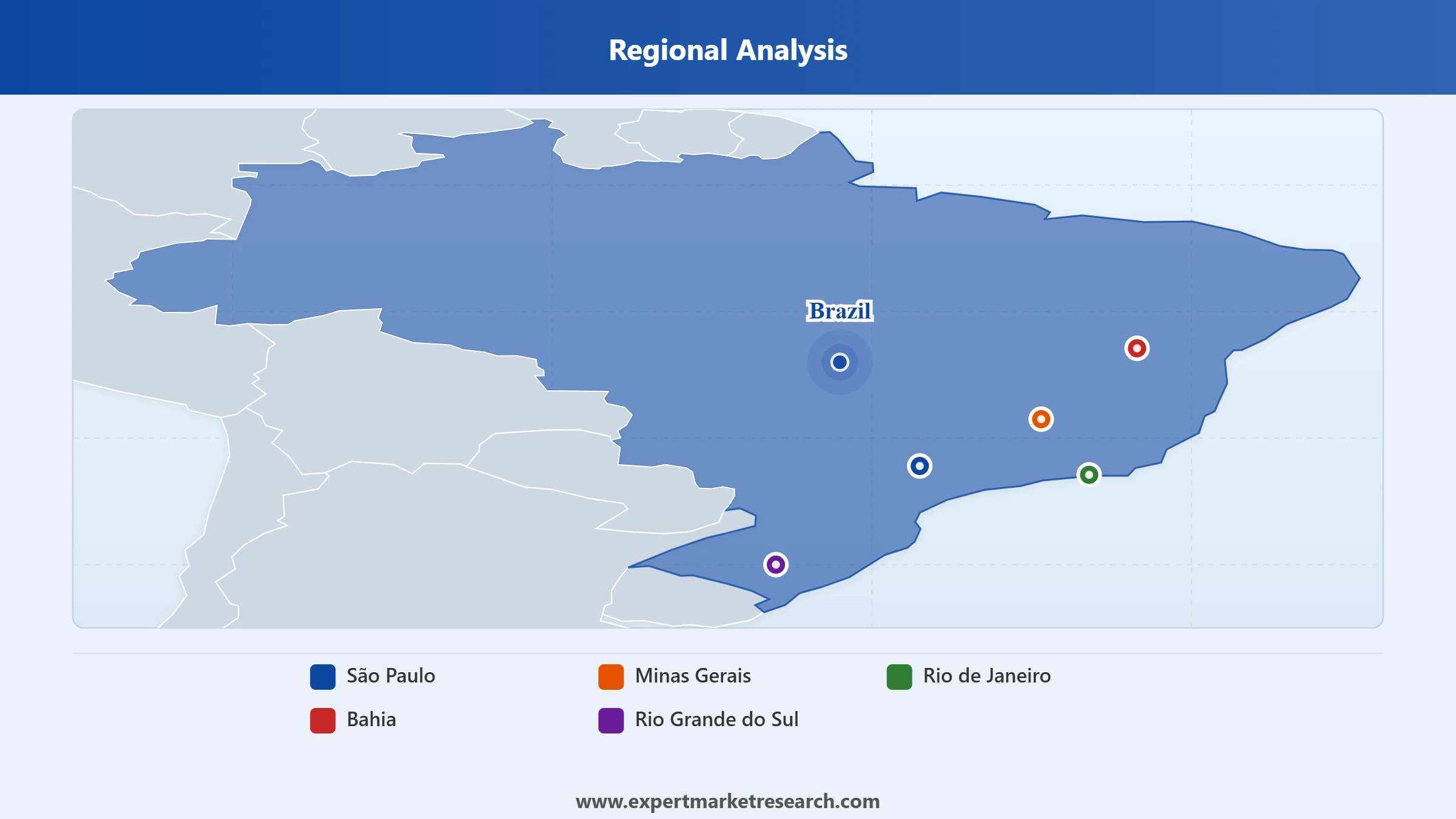
Key Insight: Regional dynamics in the Brazil construction market continue to shape competitive strategies. Concentrated corporate investment and dense population centres keep São Paulo at the front of regional demand, while Minas Gerais benefits from established homebuilder headquarters and industrial activity, illustrated by mining company Vale's 67 billion reais investment programme announced for the state through 2030. Rio de Janeiro sustains steady demand through tourism and commercial redevelopment, Rio Grande do Sul continues expanding through agricultural and industrial infrastructure, and coastal tourism investment is propelling Bahia toward the fastest regional growth in the market.
Read more about this report - Request a Free Sample
By construction type, new construction dominates the market through sustained residential and infrastructure development
New construction accounts for the largest activity share of the Brazil construction market, supported by sustained residential and infrastructure development across major Brazilian cities. In Salvador, Bahia, construction of a residential complex spanning 32.08 hectares was anticipated for completion by December 2025, reflecting the scale of new residential development underway. In July 2025, fifteen major construction groups, including Queiroz Galvão, visited the site of Sao Paulo's proposed 4-billion-dollar metro expansion, signalling strong contractor interest in the pipeline.
Read more about this report - Request a Free Sample
Renovations across the Brazil construction market are growing quickly as ageing building stock and rising urban redevelopment interest drive retrofit activity across established coastal cities. In December 2025, industry association FIESP reported that construction activity was recovering after a modest 2025, with government housing programmes remaining a central pillar supporting renovation and residential segments alike. Retrofit specialists are increasingly targeting older apartment blocks in São Paulo and Rio de Janeiro, where limited greenfield land availability makes renovation a more practical growth avenue than new build development.
By end use, residential dominates the market while institutional registers the fastest growth through accelerating public spending
Residential construction accounts for the largest end use share of the Brazil construction market, anchored by expanded subsidised mortgage eligibility under government housing programmes. The April 2026 Faixa 4 expansion alone brought an estimated 31,300 new families into Tier 3 eligibility and another 8,200 into Tier 4, directly widening the addressable buyer pool for residential developers. Established homebuilders continue prioritising affordable and mid income projects, aligning launch pipelines with the income brackets that qualify for the deepest government backed subsidies and preferential financing rates.
Read more about this report - Request a Free Sample
Institutional construction is registering the fastest growth in the Brazil construction market as government infrastructure and public building programmes accelerate spending. In March 2026, FIESP's construction industry department noted that recent updates to government housing and public programmes had made market participants more optimistic heading into the year. Established Brazil construction companies continue pursuing public sector contracts across schools, hospitals, and civic infrastructure, benefiting from multiyear budget commitments that provide more predictable revenue than cyclical private residential and commercial project pipelines.
Read more about this report - Request a Free Sample
Sao Paulo dominates the market through concentrated corporate investment and dense population centres
Sao Paulo leads the Brazil construction market, anchored by concentrated corporate investment and dense population centres across the country's largest metropolitan area. In April 2026, Chinese manufacturer Sany confirmed a new heavy equipment assembly unit in the Campinas region, with operations expected to begin in the second half of 2026. Established Brazil construction companies continue expanding project pipelines across the Sao Paulo metropolitan region, reinforcing its position as the country's primary demand centre for corporate, residential, and industrial construction activity alike.
Bahia is registering the fastest regional growth across the Brazil construction market as tourism related hospitality and residential development accelerate across the northeastern coast. As of June 2025, Section 2 of the West East Integration Railway, known as FIOL, remained under active construction across Bahia, forming part of a more than 1,500-kilometre freight corridor linking the state to national rail networks. Established Brazil construction companies continue expanding distribution networks and regional partnerships to capture accelerating demand across Bahia's growing coastal hospitality and residential markets.
The Brazil construction companies are becoming increasingly competitive as major Brazil construction companies invest in prefabricated building techniques, subsidised housing partnerships, and regional expansion to differentiate their portfolios across residential, commercial, and infrastructure categories. Companies are prioritising sales velocity, cost discipline, and capital management to appeal to lenders and investors seeking financially resilient construction partners. Established Brazil construction companies are also deepening joint development partnerships, urban mobility integration, and public sector project delivery to strengthen market positioning, while investing in operational efficiency to defend market share against rising interest rate pressure and material cost inflation.
Major Brazil construction market players are also focusing on record sales execution, and disciplined capital raises to capture growing demand across residential and institutional categories. Strategic emphasis on subsidised mortgage programme alignment and regional partnership models is allowing established companies to capture market share as government housing initiatives reshape competitive dynamics across the sector. The market players continue to pursue partnerships with regional developers and municipal authorities, particularly across the Northeast and Southeast regions, to diversify project pipelines beyond core metropolitan markets while smaller regional contractors compete on local execution expertise to retain municipal and provincial customers.
Founded in 1979 and headquartered in Belo Horizonte, Brazil, MRV is the country's largest homebuilder by revenue, specialising in affordable housing for middle- and low-income buyers across more than 150 cities. The company also operates Luggo, a build to rent apartment brand, and Urba, a land subdivision business, alongside its core Brazilian homebuilding operations.
Founded in 1981 and headquartered in Belo Horizonte, Brazil, Direcional Engenharia is a real estate development and construction company focused on large scale residential housing for the low-income segment. The company operates through multiple brands, with significant business presence across Rio de Janeiro, Sao Paulo, Rio Grande do Sul, Minas Gerais, Para, and Amazonas.
Founded in 1954 and headquartered in Sao Paulo, Brazil, GAFISA is a residential real estate development company with a history spanning more than seven decades in the Brazilian construction sector. In August 2025, the company reported second quarter gross sales up 10 percent year on year and received a design award recognising its high-end residential portfolio.
Founded in 1944 and headquartered in Salvador, Bahia, Brazil, Odebrecht, operating under its Novonor parent group, is one of Latin America's largest heavy engineering and construction conglomerates spanning transportation, energy, and industrial infrastructure. The company continues rebuilding its market position and contract backlog following the Lava Jato corruption investigations that restricted its access to public tenders for several years.
Other key players in the market include Andrade Gutierrez S.A., Queiroz Galvão S.A., Camargo Corrêa Construction Company, Construcap CCPS Engenharia and Comércio SA, Grupo A.R.G., and Racional Engenharia Ltda., among others.
*Please note that this is only a partial list; the complete list of key players is available in the full report. Additionally, the list of key players can be customized to better suit your needs.*
Unlock the latest insights with our Brazil construction market trends 2026 report. Discover regional growth patterns, construction type and end use economics, and key industry players. Stay ahead of competition with trusted data and expert analysis. Download your free sample report today and drive informed decisions in the market.


Upto 15% Off
USD
$2499 $2249
$3999 $3599
$4999 $4249
$5999 $5099


*While we strive to always give you current and accurate information, the numbers depicted on the website are indicative and may differ from the actual numbers in the main report. At Expert Market Research, we aim to bring you the latest insights and trends in the market. Using our analyses and forecasts, stakeholders can understand the market dynamics, navigate challenges, and capitalize on opportunities to make data-driven strategic decisions.*
In 2025, the market reached an approximate value of USD 135.67 Billion.
The market is projected to grow at a CAGR of 6.30% between 2026 and 2035.
The market is estimated to witness a healthy growth in the forecast period of 2026-2035 to reach USD 249.93 Billion by 2035.
The market is being driven due to rising urbanisation, increasing demand for smart homes, and rising institutional development.
Key trends aiding the market expansion include investment in industrial, transport, renewable energy, housing, and oil sectors, government's plan to increase domestic oil production, and government's focus to increase the production of green hydrogen.
Regions considered in the market are São Paulo, Minas Gerais, Rio de Janeiro, Bahia, Rio Grande do Sul.
Based on end use, the market segmentations include commercial, residential, industrial, and institutional.
New construction and renovations are considered in the report.
The key players in the market include Odebrecht Engineering and Construction S.A., Andrade Gutierrez S.A., Queiroz Galvão S.A., Camargo Corrêa Construction Company, MRV&CO Group, Construcap CCPS Engenharia and Comércio SA, Grupo A.R.G., Racional Engenharia Ltda., Direcional Engenharia, and GAFISA S/A, among others.
Sao Paulo dominates the market, supported by concentrated corporate investment and dense population centres.
New construction holds the largest share, supported by sustained residential and infrastructure development across major cities.
Explore our key highlights of the report and gain a concise overview of key findings, trends, and actionable insights that will empower your strategic decisions.
| REPORT FEATURES | DETAILS |
| Base Year | 2025 |
| Historical Period | 2019-2025 |
| Forecast Period | 2026-2035 |
| Scope of the Report |
Historical and Forecast Trends, Industry Drivers and Constraints, Historical and Forecast Market Analysis by Segment:
|
| Breakup by Construction Type |
|
| Breakup by End Use |
|
| Breakup by Region |
|
| Market Dynamics |
|
| Competitive Landscape |
|
| Companies Covered |
|
Datasheet
One User
USD 2,499
USD 2,249
tax inclusive*
Single User License
One User
USD 3,999
USD 3,599
tax inclusive*
Five User License
Five User
USD 4,999
USD 4,249
tax inclusive*
Corporate License
Unlimited Users
USD 5,999
USD 5,099
tax inclusive*
*Please note that the prices mentioned below are starting prices for each bundle type. Kindly contact our team for further details.*
Flash Bundle
Small Business Bundle
Growth Bundle
Enterprise Bundle
*Please note that the prices mentioned below are starting prices for each bundle type. Kindly contact our team for further details.*
Flash Bundle
Number of Reports: 3
20%
tax inclusive*
Small Business Bundle
Number of Reports: 5
25%
tax inclusive*
Growth Bundle
Number of Reports: 8
30%
tax inclusive*
Enterprise Bundle
Number of Reports: 10
35%
tax inclusive*
How To Order

Select License Type
Choose the right license for your needs and access rights.

Click on ‘Buy Now’
Add the report to your cart with one click and proceed to register.

Select Mode of Payment
Choose a payment option for a secure checkout. You will be redirected accordingly.
Strategic Solutions for Informed Decision-Making
Gain insights to stay ahead and seize opportunities.

Get insights & trends for a competitive edge.

Track prices with detailed trend reports.

Analyse trade data for supply chain insights.

Leverage cost reports for smart savings

Enhance supply chain with partnerships.

Connect For More Information
Our expert team of analysts will offer full support and resolve any queries regarding the report, before and after the purchase.
Our expert team of analysts will offer full support and resolve any queries regarding the report, before and after the purchase.
We employ meticulous research methods, blending advanced analytics and expert insights to deliver accurate, actionable industry intelligence, staying ahead of competitors.
Our skilled analysts offer unparalleled competitive advantage with detailed insights on current and emerging markets, ensuring your strategic edge.
We offer an in-depth yet simplified presentation of industry insights and analysis to meet your specific requirements effectively.




