

Consumer Insights
Uncover trends and behaviors shaping consumer choices today
Procurement Insights
Optimize your sourcing strategy with key market data
Industry Stats
Stay ahead with the latest trends and market analysis.
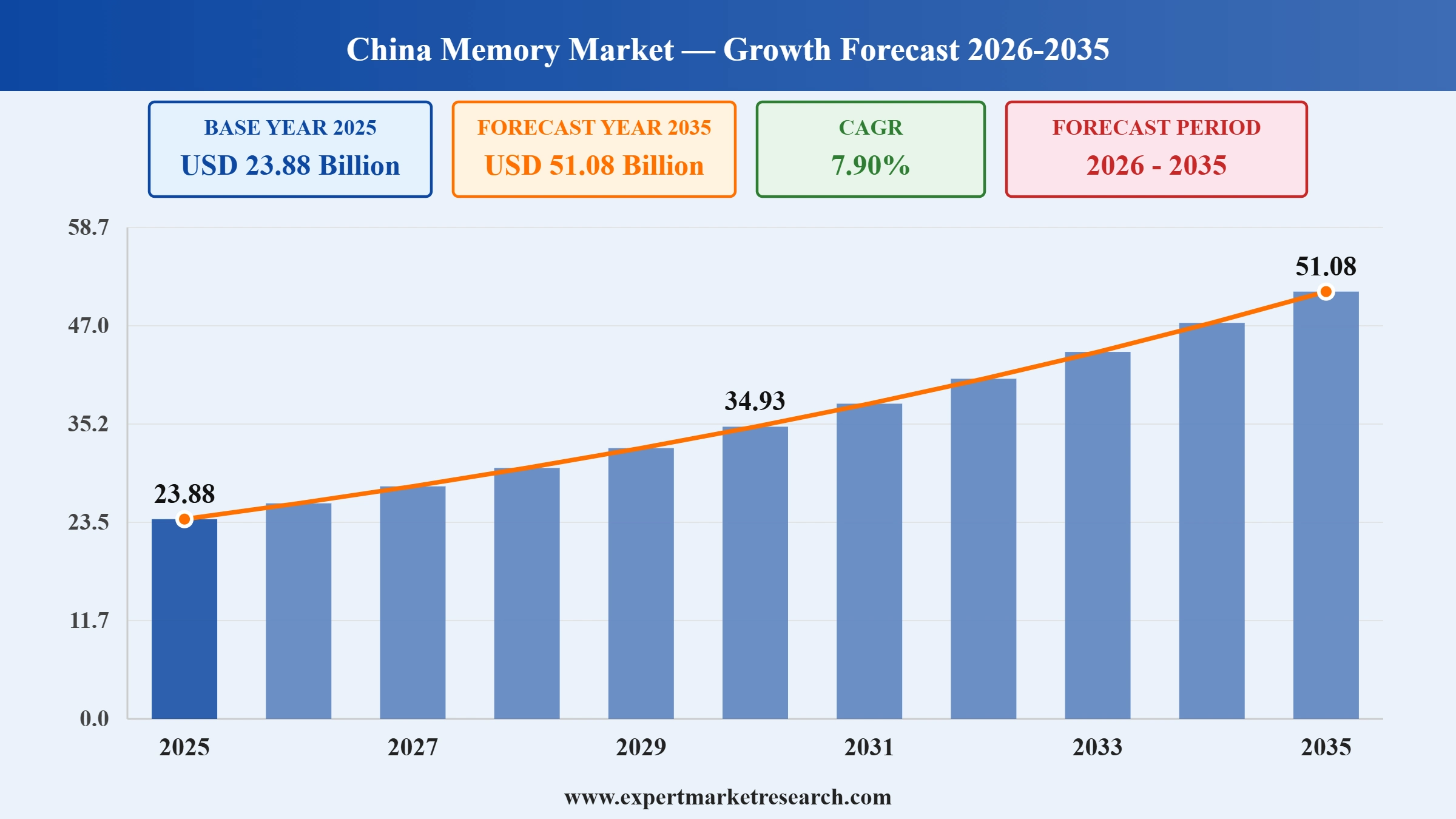
The China memory market attained a value of USD 23.88 Billion in 2025 and is projected to grow at a CAGR of 7.90% through 2035. The market is further expected to reach USD 51.08 Billion by 2035. Demand from smartphones, data centers, artificial intelligence servers, and connected vehicles, along with rising local chip production, is supporting growth in the market.
Demand for memory in China memory market rests on its large electronics industry, where smartphones, laptops, servers, and cars all need steady chip supply. Growth in cloud computing and artificial intelligence is adding pressure for higher capacity and faster memory, while local makers work to expand output of DRAM and NAND flash and lower reliance on outside suppliers.
At the same time, trade in chips is growing quickly. In July 2026, China Customs reported that integrated circuit exports in the first half of 2026 reached USD 177.28 billion, up more than 96% by value, which shows how strongly global demand for semiconductors is lifting production and shipments from Chinese plants and packaging facilities.
Leading memory makers and device brands are directing growth capital toward new fabs, advanced packaging, and long-term supply agreements rather than single products. Public listings, state backed investment, and partnerships between chip makers and cloud or phone companies are now central to competitive positioning in the China memory market, as firms seek secure supply and stronger technology.
Read more about this report - REQUEST FREE SAMPLE COPY IN PDF
| China Memory Market Report Summary | Description | Value |
| Base Year | USD Billion | 2025 |
| Historical Period | USD Billion | 2019-2025 |
| Forecast Period | USD Billion | 2026-2035 |
| Market Size 2025 | USD Billion | 23.88 |
| Market Size 2035 | USD Billion | 51.08 |
| CAGR 2019-2025 | Percentage | XX% |
| CAGR 2026-2035 | Percentage | 7.90% |
| CAGR 2026-2035 - Market by Region | Northwestern China | 8.5% |
| CAGR 2026-2035 - Market by Region | East China | 8.1% |
| CAGR 2026-2035 - Market by Type | NAND Flash | 8.8% |
| CAGR 2026-2035 - Market by Application | Data Center | 9.0% |
| 2025 Market Share by Region | Northwestern China | 6.2% |
SK hynix was reported in July 2026 to be restarting Dalian Fab 2 with a V8 line of 30,000 to 50,000 wafers a month, with equipment deliveries expected in the second half of 2026. Companies across the China memory market can leverage this trend by building capacity in Northeast China, which keeps supply close to customers, and supports steady NAND output for phones and servers.
YMTC planned two additional fabs of 100,000 wafers a month each in April 2026, alongside one near completion in Wuhan, Hubei, against about 200,000 wafers a month at its two existing fabs, with the new plant due to start in 2026. Companies across the China memory market can leverage this trend by adding local capacity early, which secures customers and lowers exposure to imported supply.
GigaDevice launched the GD25NX xSPI NOR flash series in November 2025, with a 1.8V core, octal SPI at 200 MHz, speeds of up to 400 MB/s, and 64 Mb and 128 Mb densities. Companies across the China memory market can leverage this trend by offering faster, lower power NOR flash, which suits automotive and industrial designers needing quick boot times and very low power draw.
Huawei launched the OceanDisk range of AI SSDs in September 2025, including a 245 TB model reading at 14.7 GB/s, aimed at easing reliance on costly high bandwidth memory. Companies can leverage this trend by designing high-capacity flash for AI servers, which opens new data center demand and reduces dependence on restricted components, imported parts, and costly supply routes.
Chinese memory makers across the China memory market are raising large sums from investors to pay for fabs and research. Strong debuts show how much investors value domestic supply. In July 2026, CXMT listed on the STAR Market in Shanghai, raising CNY 57.92 billion at 8.66 yuan a share and closing 466% on its first day. The proceeds can fund DRAM capacity in Hefei and a planned Shanghai plant. Investors gain a clearer view of company strategy through the disclosures required by the listing.
State capital is flowing into memory research and companies that supply it. Public funds are tying support to next generation technologies. In May 2026, Shanghai Fudan Microelectronics said a 12.96% stake would move to state owned Guosheng Investment, alongside a research centre with up to RMB 1 billion over five years covering FPGAs, artificial intelligence, and next generation memory. Backing of this kind reduces funding risk. Such programs help firms hire engineers, test new designs, and commercialize promising memory ideas.
Module makers and device brands across the China memory market are signing multiyear agreements to secure chips at predictable prices. Suppliers gain demand visibility for planning output. In June 2026, Biwin of Shenzhen signed a USD 1.8 billion NAND supply deal covering the third quarter of 2026 to the second quarter of 2028. Longer contracts help smaller makers avoid sudden shortages. Suppliers gain orders that justify investment in equipment and staff. Customers gain price certainty, though fixed prices can look costly if markets soften.
Cloud operators across the China memory market are passing higher hardware costs on to customers as servers need more memory. Price changes show how costs move through the chain. In March 2026, Alibaba Cloud announced price rises of 5% to 34% from April 2026, citing hardware costs and artificial intelligence demand. Customers are reviewing contract terms and workloads as memory costs flow into cloud services. Smaller companies may feel the pressure first, as they have less room to absorb higher costs. Some delay expansion projects.
Government plans are naming memory as a priority technology for the electronics supply chain. Targets cover high bandwidth flash, DRAM, and emerging memory types. In September 2026, the Ministry of Industry and Information Technology and the National Development and Reform Commission issued a 15th Five-Year Plan for electronic information manufacturing, covering ferroelectric memory and RRAM. Clear priorities guide investment and support domestic suppliers. Local governments are also offering land, power, and tax support to projects that fit the national plan.
The Expert Market Research's report titled "China Memory Market Report and Forecast 2026-2035" offers a detailed analysis of the China memory market based on the following segments:
Market Breakup by Type
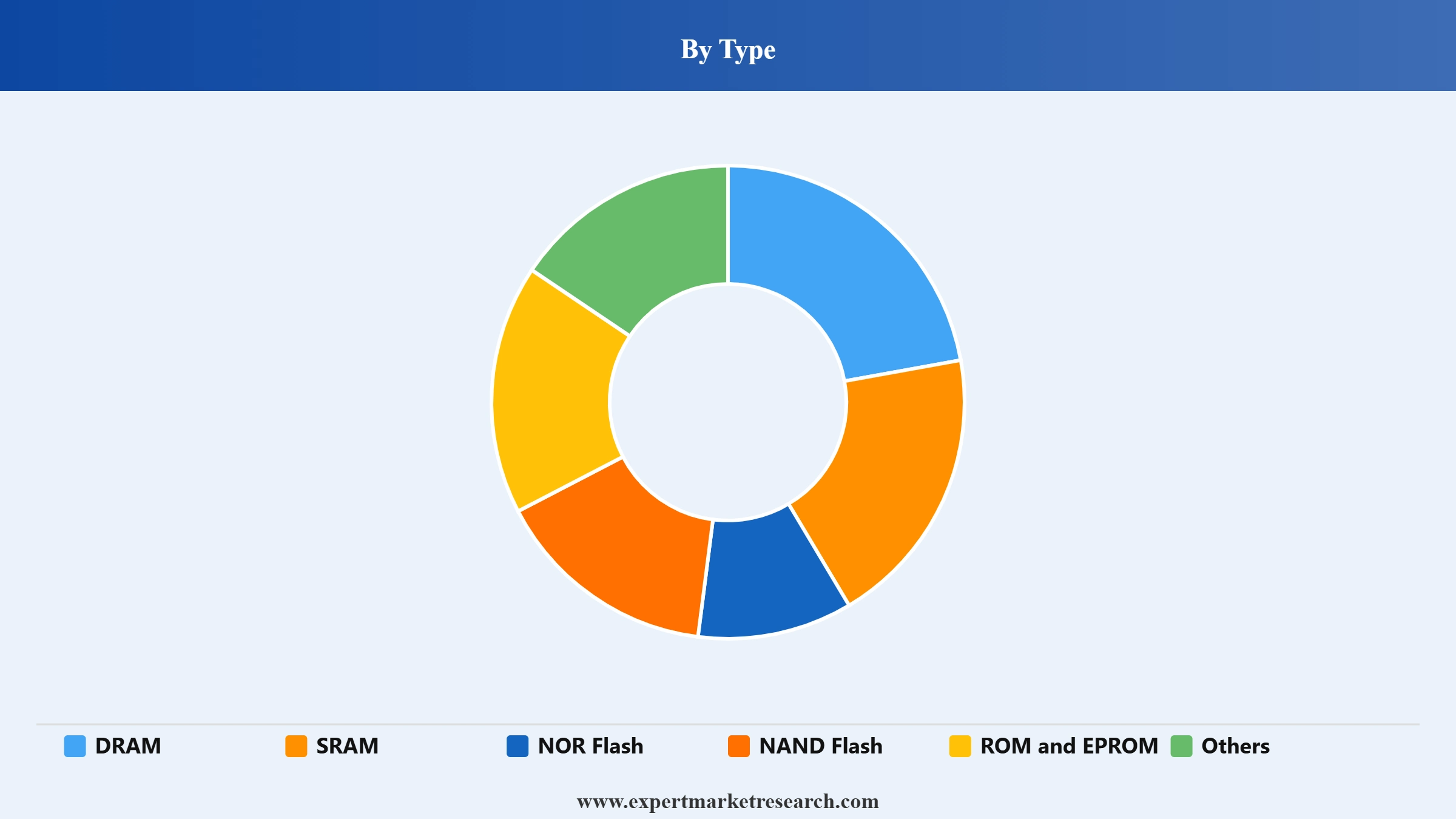
Key Insight: DRAM holds the largest share of the type segment in the China memory market, as servers, phones, and PCs all depend on it for working memory. NAND flash is the fastest growing type at 8.8% as storage needs rise across smartphones, solid state drives, and data centers. NOR flash serves code storage in cars and industrial devices, while SRAM, ROM, and EPROM serve niche uses. In July 2026, Dosilicon forecast first half net profit of CNY 640 million to 680 million, driven by SLC NAND. In July 2026, Macronix reported second quarter revenue of NT$19.125 billion with a gross margin of 64.4%. In August 2026, Winbond said its Kaohsiung expansion would begin construction in January 2027.
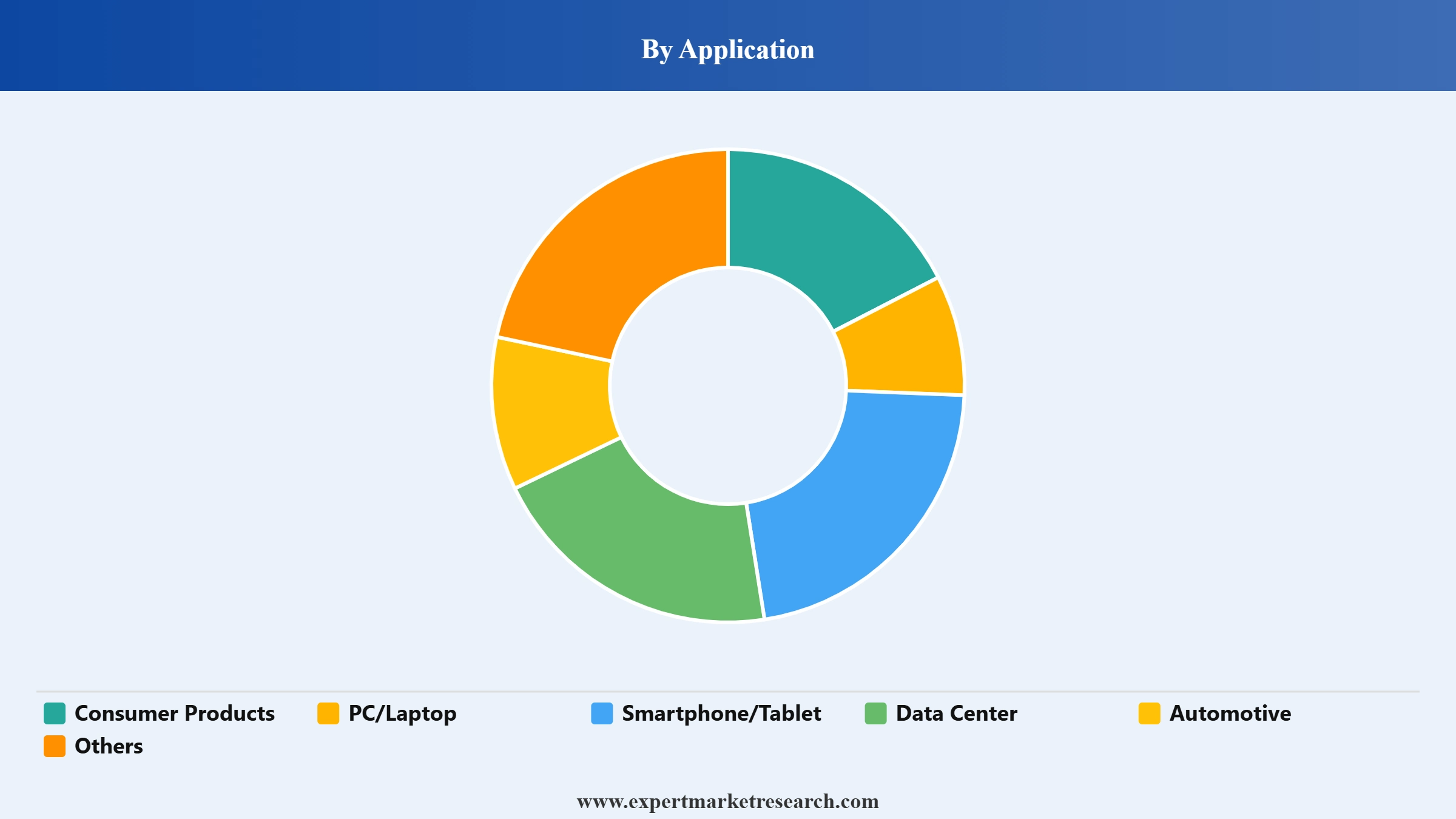
Market Breakup by Application
Key Insight: Smartphones and tablets hold the largest share of the application segment in the China memory market, as every handset needs memory for apps, photos, and artificial intelligence features. Data centers are the fastest growing application at 9.0% because cloud computing, artificial intelligence, and big data need large memory pools. Consumer products, PCs, and automotive systems add steady volumes. In March 2026, Xiaomi president Lu Weibing said memory prices were about four times higher than a year earlier.
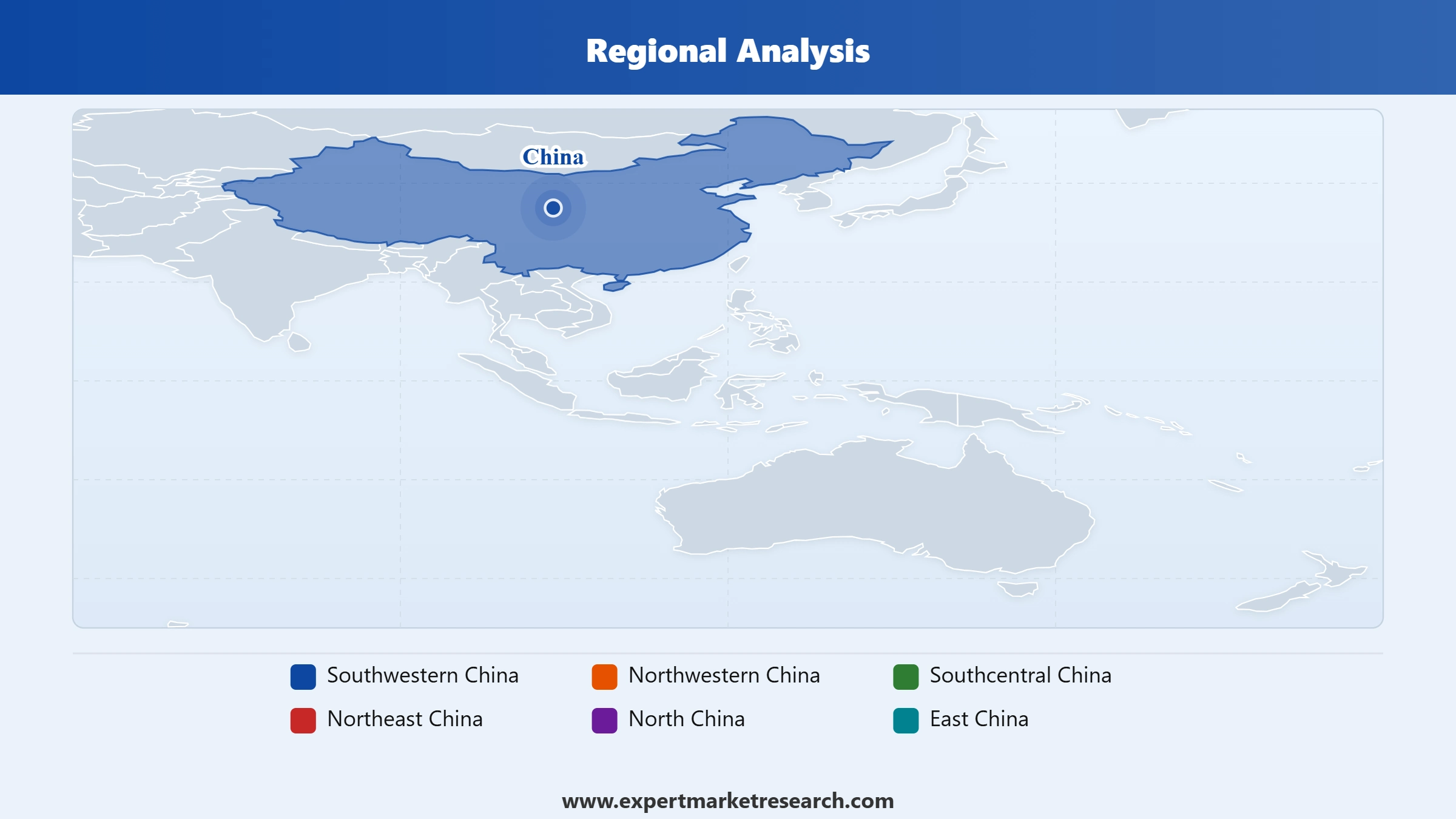
Market Breakup by Region
Key Insight: East China holds the largest regional share, supported by dense foundry, packaging, and electronics clusters around Shanghai, Wuxi, Hefei, and Nanjing. Northwestern China is the fastest growing region at 8.5%, followed by East China at 8.1%. Southcentral China adds capacity in Wuhan and Shenzhen, while Southwestern China, Northeast China, and North China contribute from smaller bases. In September 2026, Hua Hong reported first half revenue of USD 1,378.5 million, up 24.5%, with Wuxi Phase II equipment fully moved in by June. In August 2026, JCET planned a CNY 7.8 billion advanced packaging plant in Shanghai Lingang. In July 2026, Longsys forecast first half net profit of CNY 9.2 billion to 11 billion.
Read more about this report - REQUEST FREE SAMPLE COPY IN PDF
By type, DRAM dominates the China memory market owing to its role as working memory in servers and devices
DRAM holds the largest share of the type segment, because servers, phones, and PCs all depend on it for working memory, and demand rises with every increase in computing power. In April 2026, Nanya reported first quarter revenue of NT$49.1 billion, a gross margin of 67.9%, and earnings per share of NT$8.41. Strong margins show how tight DRAM supply has become. Higher prices are lifting profits at memory makers, which can fund new capacity and research for the years ahead.
Read more about this report - REQUEST FREE SAMPLE COPY IN PDF
NAND flash is registering the fastest growth within the type segment at 8.8%, as smartphones, solid state drives, and data centers need more storage. In June 2026, Kioxia said it was evaluating a new Kitakami fab for after 2029 and converting its K2 plant to 332-layer BiCS10 NAND. Higher layer counts raise storage density and lower cost per bit. Chinese makers are also moving to higher layer designs, as storage needs grow in phones and servers. Buyers want value.
By application, smartphone and tablet dominate the China memory market owing to large handset volumes and richer features
Smartphones and tablets hold the largest share of the application segment, because every handset needs memory and new camera and artificial intelligence features raise the amount per device. In March 2026, vivo and iQOO raised prices by 500 to 1,000 yuan on select models, citing the memory crunch. Brands are balancing specifications against rising chip costs. Many shoppers delay upgrades when prices rise, slowing unit sales. Brands respond with models at several price levels, matching memory sizes to each tier.
Read more about this report - REQUEST FREE SAMPLE COPY IN PDF
Data centers are registering the fastest growth within the application segment at 9.0%, as cloud computing and artificial intelligence expand demand for memory. In June 2026, Tencent was reported to have signed a domestic DRAM supply deal worth more than CNY 20 billion, running three to five years. Cloud buyers are securing domestic memory for future server builds. Operators plan server builds in advance, so signed contracts give memory makers a clear view of future orders. Local sourcing lowers risk.
East China commands the largest regional share of the China memory market, supported by dense foundry and packaging clusters
East China commands the largest regional share of the China memory market, supported by dense foundry, packaging, and electronics clusters around Shanghai, Wuxi, Hefei, and Nanjing. In August 2026, Huatian Technology announced a memory packaging plant in Nanjing with capacity of 430 million units a year and investment of CNY 3 billion. Nearby customers and suppliers shorten delivery times. Skilled engineers and equipment makers are also concentrated in these cities, which helps plants fix problems and update designs very quickly.
Read more about this report - REQUEST FREE SAMPLE COPY IN PDF
Northwestern China is registering the fastest growth among the regional markets at 8.5%, driven by new memory capacity in Xi'an and growing investment in the western provinces. In December 2025, the United States granted Samsung an annual 2026 license to ship equipment to its Xi'an NAND fab for maintenance only, with no extreme ultraviolet tools. Continued operation of the Xi'an fab keeps regional output steady. Lower land costs and local incentives also attract new projects to the inland western provinces.
The competitive landscape remains moderately concentrated, with established China memory companies competing on capacity, process technology, product reliability, and supply security across East China, Southcentral China, and the western provinces. Leading China memory companies continue to invest in new fabs, advanced packaging, and long-term customer contracts to retain loyal buyers while capturing demand from smartphone, data center, and automotive customers in faster growing regions.
Major China memory market players are also pursuing public listings, capacity expansions, and supply agreements to strengthen their footprint across both established and emerging regions. Continued emphasis on domestic supply, higher storage density, and energy efficient performance is allowing established brands to defend their position with buyers while building deeper presence in newer applications such as artificial intelligence servers.
Founded in 1969 and headquartered in Suwon, South Korea, Samsung Electronics Co. Ltd. supplies the market through DRAM and NAND flash produced at its NAND manufacturing site in Xi'an, alongside products made in Korea. The company sells to phone makers, server builders, and PC brands across China and serves global customers from its wider network.
Founded in 1983 and headquartered in Icheon, South Korea, SK Hynix Inc. supplies the market through DRAM made in Wuxi and NAND flash made in Dalian, alongside products made in Korea. The company sells to phone makers, server builders, and cloud customers across China and reaches wider customers through its global sales network.
Founded in 2016 and headquartered in Wuhan, Hubei, China, Yangtze Memory Technologies Co., Ltd. supplies the market with 3D NAND flash for solid state drives, phones, and servers. The company runs fabs in Wuhan and sells to domestic device makers and module brands seeking locally produced flash.
Founded in 2005 and headquartered in Beijing, China, GigaDevice Semiconductor Inc. supplies the market with NOR flash, NAND flash, and microcontrollers for consumer, industrial, and automotive customers. The company sells through distributors and direct sales across China and other Asian markets.
Other key players in the market include Infineon Technologies AG, Macronix International Co. Ltd., Xinxin Semiconductor Manufacturing Co., Ltd., Winbond Electronics Corp., Nanya Technology Corp., and Hua Hong Semiconductor Ltd., among others.
*Please note that this is only a partial list; the complete list of key players is available in the full report. Additionally, the list of key players can be customized to better suit your needs.*
Unlock the latest insights with our China memory market trends 2026 report. Discover regional growth patterns, type shifts, application trends, and key industry players. Stay ahead of competition with trusted data and expert analysis. Download your free sample report today and drive informed decisions in the market.


Upto 15% Off
USD
$2499 $2249
$3999 $3599
$4999 $4249
$5999 $5099


*While we strive to always give you current and accurate information, the numbers depicted on the website are indicative and may differ from the actual numbers in the main report. At Expert Market Research, we aim to bring you the latest insights and trends in the market. Using our analyses and forecasts, stakeholders can understand the market dynamics, navigate challenges, and capitalize on opportunities to make data-driven strategic decisions.*
The market reached a value of USD 23.88 Billion in 2025.
The market is projected to grow at a CAGR of 7.90% between 2026 and 2035, reaching USD 51.08 Billion by 2035.
The market is estimated to witness healthy growth in the forecast period of 2026-2035 to reach a value of around USD 51.08 Billion by 2035.
The major drivers of the market are government-imposed schemes, continuous rise in consumer electronics, and the rapid developments of data centers and cloud computing.
The key trends noticed in the China memory market report are advancements in 3D NAND and DRAM technology, growing demand in consumer electronics and automotive sectors, increasing government engagement and policy initiatives, and an increase of data centers and cloud infrastructure.
The major regions in the market are Southwestern China, Northwestern China, Southcentral China, North China, East China, and Northeast China.
The various types considered in the market report are DRAM, SRAM, NOR Flash, NAND Flash, ROM and EPROM, and others.
The applications considered in the market report are consumer products, PC/laptop, smartphone/tablet, data center, automotive, and others.
Key players in the market include Samsung Electronics Co. Ltd., SK Hynix Inc., Infineon Technologies AG, Yangtze Memory Technologies Co., Ltd., GigaDevice Semiconductor Inc., Macronix International Co. Ltd., Xinxin Semiconductor Manufacturing Co., Ltd., Winbond Electronics Corp., Nanya Technology Corp., and Hua Hong Semiconductor Ltd.
DRAM leads the market by type, while NAND flash is the fastest growing category.
East China leads the market by region, while Northwestern China is registering the fastest growth.
Explore our key highlights of the report and gain a concise overview of key findings, trends, and actionable insights that will empower your strategic decisions.
| REPORT FEATURES | DETAILS |
| Base Year | 2025 |
| Historical Period | 2019-2025 |
| Forecast Period | 2026-2035 |
| Scope of the Report |
Historical and Forecast Trends, Industry Drivers and Constraints, Historical and Forecast Market Analysis by Segment:
|
| Breakup by Type |
|
| Breakup by Application |
|
| Breakup by Region |
|
| Market Dynamics |
|
| Competitive Landscape |
|
| Companies Covered |
|
Datasheet
One User
USD 2,499
USD 2,249
tax inclusive*
Single User License
One User
USD 3,999
USD 3,599
tax inclusive*
Five User License
Five User
USD 4,999
USD 4,249
tax inclusive*
Corporate License
Unlimited Users
USD 5,999
USD 5,099
tax inclusive*
*Please note that the prices mentioned below are starting prices for each bundle type. Kindly contact our team for further details.*
Flash Bundle
Small Business Bundle
Growth Bundle
Enterprise Bundle
*Please note that the prices mentioned below are starting prices for each bundle type. Kindly contact our team for further details.*
Flash Bundle
Number of Reports: 3
20%
tax inclusive*
Small Business Bundle
Number of Reports: 5
25%
tax inclusive*
Growth Bundle
Number of Reports: 8
30%
tax inclusive*
Enterprise Bundle
Number of Reports: 10
35%
tax inclusive*
How To Order

Select License Type
Choose the right license for your needs and access rights.

Click on ‘Buy Now’
Add the report to your cart with one click and proceed to register.

Select Mode of Payment
Choose a payment option for a secure checkout. You will be redirected accordingly.
Strategic Solutions for Informed Decision-Making
Gain insights to stay ahead and seize opportunities.

Get insights & trends for a competitive edge.

Track prices with detailed trend reports.

Analyse trade data for supply chain insights.

Leverage cost reports for smart savings

Enhance supply chain with partnerships.

Connect For More Information
Our expert team of analysts will offer full support and resolve any queries regarding the report, before and after the purchase.
Our expert team of analysts will offer full support and resolve any queries regarding the report, before and after the purchase.
We employ meticulous research methods, blending advanced analytics and expert insights to deliver accurate, actionable industry intelligence, staying ahead of competitors.
Our skilled analysts offer unparalleled competitive advantage with detailed insights on current and emerging markets, ensuring your strategic edge.
We offer an in-depth yet simplified presentation of industry insights and analysis to meet your specific requirements effectively.




