

Consumer Insights
Uncover trends and behaviors shaping consumer choices today
Procurement Insights
Optimize your sourcing strategy with key market data
Industry Stats
Stay ahead with the latest trends and market analysis.
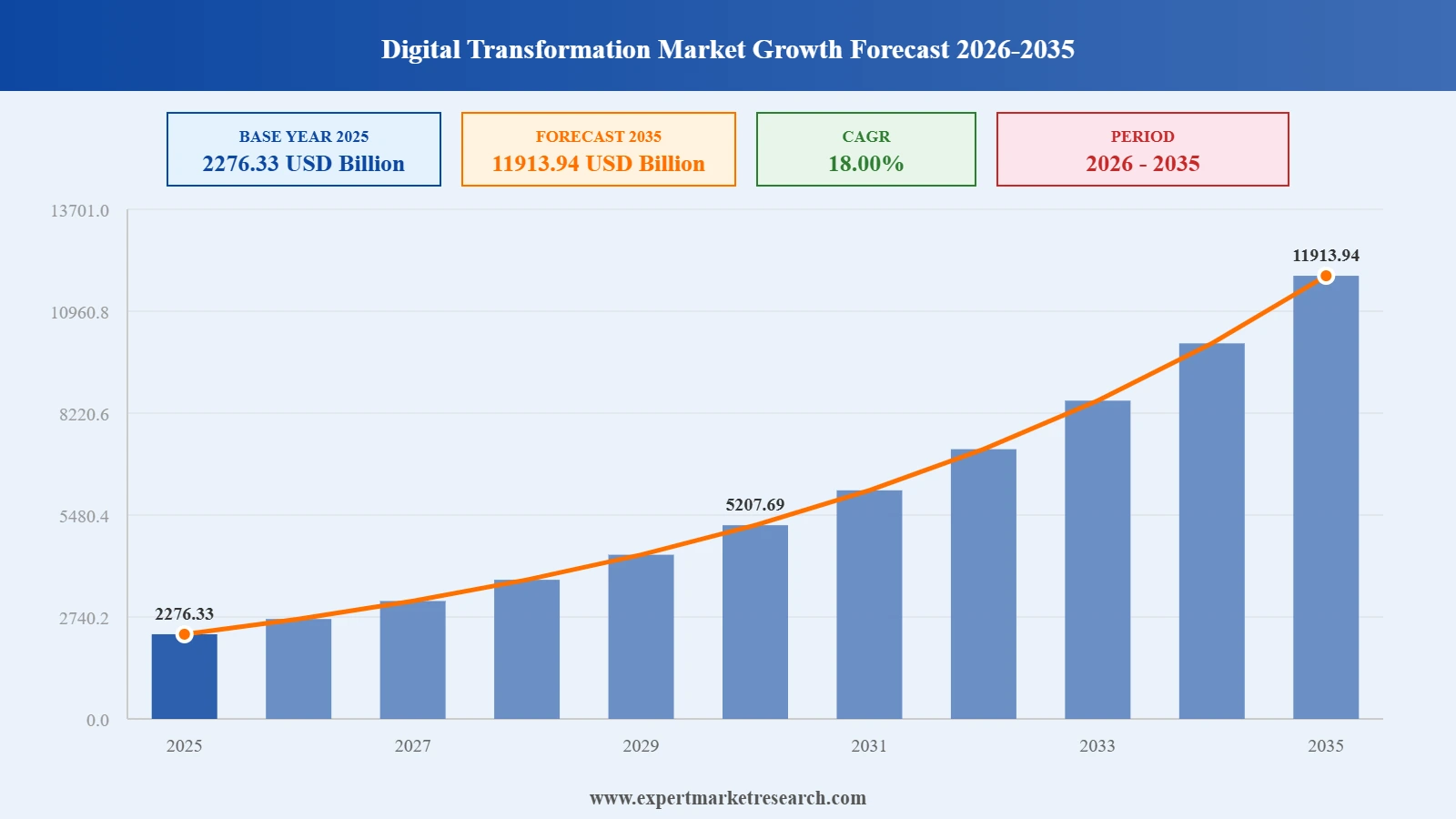
The global digital transformation market reached USD 2276.33 Billion in 2025 and is projected to grow at a compound annual growth rate CAGR of 18.00% during the forecast period of 2026 to 2035, reaching USD 11913.94 Billion by 2035, according to Expert Market Research. This exceptional growth trajectory reflects the deepening and broadening of enterprise technology adoption as organisations across every sector and geography accelerate the migration of core business processes, customer engagement systems, and operational infrastructure onto cloud-native, AI-augmented, and data-driven digital platforms. The digital transformation market is the broadest and most inclusive sector within global information technology spending, encompassing the technologies, services, strategies, and organisational change management capabilities that collectively enable businesses to fundamentally alter how they create value, serve customers, and compete in an increasingly digital-first global economy.
The digital transformation market serves organisations at every stage of their technology modernisation journey from large enterprises undertaking comprehensive multi-year cloud migration and AI integration programmes to small and medium-sized enterprises deploying cloud-based software-as-a-service applications for the first time. The market's scope encompasses cloud computing infrastructure and platform services, artificial intelligence and machine learning systems, Internet of Things connectivity and edge computing, big data analytics and business intelligence, cybersecurity and identity management, robotic process automation, blockchain, digital twin technology, enterprise resource planning and customer relationship management modernisation, and the professional and managed services ecosystems that deliver, implement, and operate these technology investments.
Read more about this report - REQUEST FREE SAMPLE COPY IN PDF
The digital transformation market refers to the global commercial ecosystem encompassing the technologies, consulting and professional services, implementation platforms, and managed service capabilities that organisations deploy to fundamentally alter their business models, operational processes, customer engagement strategies, and competitive positioning through the integration of digital technologies. Digital transformation, as a business discipline, extends beyond the deployment of individual technology products it represents the holistic reimagining of how an organisation creates and delivers value in a digital-first competitive environment, requiring simultaneous investment in technology infrastructure, process redesign, organisational culture change, workforce reskilling, and data governance architecture.
The digital transformation market is most precisely characterised by its six foundational technology pillars. Cloud computing including infrastructure-as-a-service (IaaS), platform-as-a-service (PaaS), and software-as-a-service (SaaS) provides the scalable, on-demand computing foundation that enables organisations to break free from the capital intensity and agility constraints of on-premise IT infrastructure. Artificial intelligence and machine learning, including the generative AI, large language model, and agentic AI systems that are reshaping enterprise productivity and decision-making in 2026, represent the intelligence layer that transforms data into autonomous action across enterprise workflows. Internet of Things connectivity and edge computing extend digital intelligence into the physical world, enabling real-time data collection and processing at the operational point of value creation. Big data analytics and business intelligence convert data assets into competitive insight. Cybersecurity and identity management protect the digital estate. Robotic process automation and workflow automation eliminate manual process friction. Digital twin technology creates virtual replicas of physical systems for simulation, monitoring, and optimisation collectively, these six pillars constitute the investable universe that defines the scope and growth opportunity of the global digital transformation market.
Stellantis selected Accenture to lead an AI-enabled digital twin transformation across its global manufacturing operations. The programme uses virtual factory models and connected data to simulate production lines, improve efficiency, and reduce downtime, marking one of the automotive sector's larger enterprise digitalisation moves and reinforcing digital twins as a core transformation technology.
OpenAI integrated its AI tools, including the Codex coding assistant, into Infosys's Topaz platform to accelerate enterprise digital transformation. The partnership targets software modernisation, workflow automation, and large-scale AI deployment, giving OpenAI distribution across Infosys clients in more than 60 countries and reflecting the deepening tie-up between AI developers and global IT service providers.
Accenture and Google Cloud inaugurated a Sovereign Cloud and AI Innovation Center in Brussels to support digital transformation for European governments and regulated industries. The facility helps public bodies and highly regulated organisations adopt secure, compliant cloud and AI systems while meeting data-residency requirements, underscoring the growing role of sovereignty in Europe's transformation agenda.
Accenture and Mistral AI formed a multi-year strategic agreement to advance sovereign artificial intelligence capabilities across Europe. The alliance combines Accenture's transformation expertise with Mistral's European-built models to help enterprises and public-sector bodies adopt secure, region-based AI, positioning sovereign AI as a defining theme within the region's digital transformation market.
Interoperable data fabrics and platform consolidation are driving faster digital transformation adoption. Siemens Insights Hub and major middleware vendors are helping enterprises unify OT and IT data streams into a single operational layer. Public programs such as Manufacturing USA and the EU GAIA-X initiative continue funding integration pilots and promoting shared data standards, accelerating the digital transformation market trends. In September 2025, Cisco announced the launch of Cisco Data Fabric, an architecture that is anticipated to empower organizations to harness the value of their machine data with AI. Companies now bundle low-code connectors and secure APIs, letting engineers focus on use cases rather than complex integrations.
Edge AI and distributed compute are transforming how manufacturers execute real-time decision makiing across production lines. Companies such as HPE, Schneider Electric, and NVIDIA are co-engineering validated edge stacks designed for predictive maintenance, vision inspection, and autonomous micro-adjustments on the line. National telecom regulators in Asia and Latin America continue offering private 5G rollouts, accelerating industrial edge adoption. For example, in December 2025, Fujitsu Limited announced the development of a multi-AI agent collaboration technology that enables secure collaboration and swift response to changing circumstances among AI agents from different companies and vendors within a supply chain. This trend in the digital transformation market helps teams shorten reaction times for anomalies and strengthens automation maturity.
Composable architectures and digital marketplaces are enabling firms to produce automation use cases faster. Microsoft, SAP, and other ecosystem players now publish certified connector packs and domain templates that help integrators deploy workflows with reduced engineering effort. In November 2025, Infosys announced the launch of Infosys Topaz Fabric. It is a stack of layered, composable, open and interoperable data infrastructure, models, agents, flows, and AI apps that help unify and accelerate IT service delivery across the enterprise landscape, thereby propelling the overall demand in the digital transformation market. This approach lowers time-to-value and enables targeted modular upgrades.
Cybersecurity is shifting from perimeter-only defense to integrated operational resilience. Automation suppliers release secure-by-design controllers with hardware roots of trust, encrypted firmware, and attestation tools. Regulators in critical sectors adopt stricter OT security rules, prompting companies to merge IT and OT telemetry for unified threat detection, driving the digital transformation market value. In November 2025, Rockwell Automation, Inc announced the launch of SecureOT solution suite, a comprehensive industrial cybersecurity offering designed to help manufacturers and critical infrastructure protect operations and build secure environments. Continuous firmware attestation and automated vulnerability scoring are now embedded into CI pipelines, supporting insurance and auditor requirements.
Sustainability is becoming a core driving factor of digital transformation as enterprises adopt carbon-aware workloads. Cloud vendors and automation platforms now expose emission APIs that map energy use to specific applications. Governments incentivize digital-ESG programs through tax credits and procurement scoring. Manufacturers optimize batch scheduling, edge computing placement, and model inferencing to reduce energy intensity without affecting SLAs. In October 2025, Greenly announced the launch of EcoPilot, its new platform aimed at simplifying and accelerating carbon accounting for companies, based on AI and language models technology, expanding the digital transformation market scope. Architects use low-carbon windows for computing tasks and rely on edge caching to avoid high-emission peaks. These practices tie operational efficiency directly to ESG accountability.
Read more about this report - REQUEST FREE SAMPLE COPY IN PDF
Generative artificial intelligence encompassing large language model applications, AI-powered code generation, natural language interfaces, automated content creation, and increasingly agentic AI systems that autonomously plan and execute multi-step business workflows has emerged as the single most powerful accelerant of enterprise digital transformation investment in 2026. The deployment of generative AI across enterprise workflows is not merely a technology upgrade but a fundamental reimagining of how work is structured, enabling organisations to automate complex cognitive tasks that previously required highly skilled human judgment. Microsoft's Copilot suite, Google Gemini enterprise applications, and a proliferating ecosystem of vertical-specific AI agents are enabling organisations to compress months of digital transformation implementation cycles into weeks, as AI-generated code, automated workflow design, and natural language business intelligence interfaces remove technical complexity barriers that historically slowed enterprise technology adoption.
Cloud computing encompassing public, private, hybrid, and multi-cloud infrastructure and platform services remains the foundational enabler of enterprise digital transformation, providing the scalability, flexibility, cost optimisation, and global availability characteristics that on-premise infrastructure cannot match for organisations competing in digital-first markets. The shift from single-cloud to multi-cloud and hybrid-cloud strategies is a defining enterprise architecture trend of 2026, as organisations seek to avoid hyperscaler dependency, optimise workload placement across cloud providers by price and performance, maintain data sovereignty across jurisdictions with varying regulatory requirements, and build resilience against cloud provider outages. Azure's 40% year-over-year growth, Google Cloud's 63% growth, and AWS's 28% growth rate in Q1 2026 collectively confirm that cloud infrastructure demand is supply-constrained a structural signal of the depth of enterprise cloud adoption acceleration underway.
Enterprises across all industry verticals are accelerating digital transformation investment in direct response to competitive pressure from digital-native competitors technology companies, platform businesses, and agile startups that have demonstrated the commercial superiority of data-driven, automated, and customer-experience-optimised digital business models over legacy operational approaches. Productivity and efficiency improvement is the primary stated benefit driving enterprise AI and digital transformation investment, with robotic process automation, intelligent document processing, AI-powered customer service, and predictive analytics among the most rapidly adopted technologies across BFSI, healthcare, retail, and manufacturing sectors, where operational efficiency gains directly translate to measurable margin improvement and customer satisfaction outcomes.
Read more about this report - REQUEST FREE SAMPLE COPY IN PDF
Government and public sector organisations globally are major and growing drivers of digital transformation market demand, as national digital government strategies, citizen services digitisation mandates, tax and regulatory reporting automation requirements, and healthcare system modernisation programmes collectively represent a substantial and structurally growing component of enterprise technology spending. The digitisation of regulatory compliance including KYC automation, anti-money-laundering detection, ESG reporting automation, and tax administration digital transformation is creating recurring technology investment requirements across financial services, energy, healthcare, and manufacturing sectors. Sovereign AI strategies national frameworks requiring that AI models used for sensitive government and enterprise applications be hosted on locally controlled infrastructure are emerging as a new regulatory driver, particularly in the European Union, India, and ASEAN markets where data localisation requirements are progressively tightening.
The progressive democratisation of enterprise-grade digital transformation capabilities through cloud-delivered SaaS applications, low-code/no-code development platforms, and API-enabled integration infrastructure is enabling small and medium-sized enterprises to access digital capabilities previously available only to large enterprises with dedicated technology budgets and engineering teams. CRM platforms, cloud-based ERP systems, AI-powered marketing automation, e-commerce infrastructure, and digital payment systems are among the digital transformation technologies seeing strongest SME adoption globally, with low implementation cost, subscription pricing models, and minimal on-premise infrastructure requirements making these platforms accessible to organisations of all sizes and technical sophistication levels.
Read more about this report - REQUEST FREE SAMPLE COPY IN PDF
The enterprise deployment of generative AI and agentic AI systems where AI agents autonomously execute complex, multi-step business processes with minimal human supervision represents the most consequential near-term technology development shaping the digital transformation market. Microsoft's framing of 2026 as "the agentic computing era" signals that the industry has moved beyond individual AI tool adoption toward the architectural integration of AI agency into enterprise workflow design. Agentic AI systems that autonomously draft legal documents, write and test software code, process insurance claims end-to-end, execute financial compliance workflows, and manage supply chain exception handling are being piloted or deployed at scale across leading organisations in every major industry vertical.
The modernisation of legacy on-premise enterprise systems including mainframe-based ERP, monolithic custom-built applications, and ageing data warehouse architectures representing decades of accumulated technical debt is one of the largest and most persistent sources of enterprise digital transformation spend globally. The complexity and risk of migrating critical business systems from legacy to cloud-native microservices and API-based architectures remain the most frequently cited technical barrier to digital transformation acceleration, as systems of record operational for 20 to 40 years carry deep integration dependencies, undocumented business logic, and skills dependencies on retiring workforces. Cloud-native transformation approaches including containerisation with Kubernetes, microservices decomposition, event-driven architecture adoption, and DevOps/continuous integration and delivery pipeline implementation are progressively being applied to legacy system modernisation, with AI-powered code analysis and automated migration tooling reducing the time and risk of complex legacy transformation programmes.
Read more about this report - REQUEST FREE SAMPLE COPY IN PDF
Cybersecurity and data privacy architecture have evolved from defensive cost centres into core strategic enablers of digital transformation, as the rapid expansion of enterprise digital surface area through cloud adoption, IoT device proliferation, API connectivity, third-party SaaS integration, and AI agent deployment simultaneously creates new competitive capabilities and new attack vectors requiring parallel security investment. Non-human identities AI agents, bots, and machine accounts are now a primary enterprise risk vector, and most enterprises lack a mature governance model for managing them at scale. Budgets are progressively shifting toward identity governance, zero-trust architecture, data security posture management, and AI-native threat detection capabilities, with organisations that embed security-by-design into their digital transformation architecture achieving faster time-to-deployment and stronger regulatory compliance outcomes.
Sovereign AI the principle that governments and enterprises should deploy and operate AI systems under their own jurisdictional laws, data governance frameworks, and infrastructure control is emerging as a defining regulatory and architectural constraint on enterprise digital transformation strategy in 2026. The European Union's AI Act, India's Digital Personal Data Protection Act, ASEAN data localisation requirements, and China's AI governance framework are collectively creating a complex patchwork of jurisdictional requirements that multinational enterprises must navigate in their cloud architecture, data residency, model deployment, and AI governance decisions. Organisations that proactively invest in modular, cloud-agnostic, data-sovereign digital transformation architectures are gaining significant competitive advantage in regulated industries including financial services, healthcare, and telecommunications.
Environmental, social and governance reporting requirements and corporate sustainability commitments are creating a substantial new wave of enterprise digital transformation investment, as organisations deploy technology infrastructure to collect, verify, report, and manage sustainability performance data required by emerging mandatory ESG disclosure frameworks including the EU's Corporate Sustainability Reporting Directive and the US Securities and Exchange Commission's climate disclosure rule. Digital ESG management platforms, carbon accounting software, IoT-enabled environmental monitoring, supply chain sustainability traceability systems, and AI-powered ESG data analytics represent a growing and structurally mandated sub-category of enterprise digital transformation spend, increasingly viewed as a core regulatory compliance and stakeholder accountability infrastructure requirement.
The global digital transformation market faces several significant challenges that moderate the pace of enterprise technology adoption relative to its ultimate potential. Legacy system integration complexity remains the most persistent technical challenge the majority of enterprise organisations globally operate core business systems on legacy infrastructure not designed for API connectivity, cloud integration, or real-time data streaming, requiring substantial investment in integration middleware, data harmonisation, and progressive modernisation before the full productivity benefits of new digital transformation technologies can be realised. Cybersecurity and data privacy risks including the expanded attack surface created by cloud migration, data exfiltration risks of AI training on sensitive enterprise data, and increasingly sophisticated AI-powered cyberattacks impose material cost and complexity on every digital transformation initiative. The talent shortage in AI and cloud engineering represents perhaps the most binding structural constraint on enterprise digital transformation velocity, with demand for AI engineers, data scientists, cloud architects, and cybersecurity specialists dramatically outstripping global supply a gap expected to persist through the entire 2026 to 2035 forecast period.
Several structural dynamics constrain the pace and quality of digital transformation adoption. The financial burden of simultaneously maintaining legacy systems while funding digital modernisation often described as "running two-speed IT" places disproportionate pressure on technology budgets, as organisations must fund ongoing legacy operational costs and new digital capital investment without being able to decommission legacy systems until migration is complete. Trust, ethics, and legal uncertainty around enterprise AI deployment particularly AI system governance, explainability, bias management, and liability allocation are creating risk-averse adoption patterns in regulated industries where these frameworks remain incompletely defined. The ROI measurement challenge where digital transformation initiatives typically require 18 to 36 months to deliver measurable business outcomes creates cyclical investment risk that can interrupt multi-year transformation programmes before their full benefit potential is realised.
The global digital transformation market presents exceptional commercial opportunities supporting the 18.00% CAGR through 2035. The convergence of generative AI, agentic workflow automation, and digital twin technology is creating new categories of enterprise value creation autonomous business decision-making, real-time operational optimisation, personalised customer interaction at population scale that will require new digital infrastructure investment layers beyond current cloud and SaaS adoption cycles. Emerging market digital transformation across India, Southeast Asia, Latin America, the Middle East, and Sub-Saharan Africa represents the longest-duration growth opportunity, as rising digital infrastructure investment, government e-governance programmes, mobile-first digital finance adoption, and technology leapfrogging of legacy infrastructure create structurally favourable conditions for compressed, high-velocity digital adoption. To access comprehensive opportunity sizing, technology-specific growth forecasts, industry vertical deep dives, and strategic investment frameworks across all geographies and digital transformation dimensions, explore Expert Market Research's complete Digital Transformation Market report.
The Expert Market Research’s report titled “Global Digital Transformation Market Report and Forecast 2026-2035” offers a detailed analysis of the market based on the following segments:
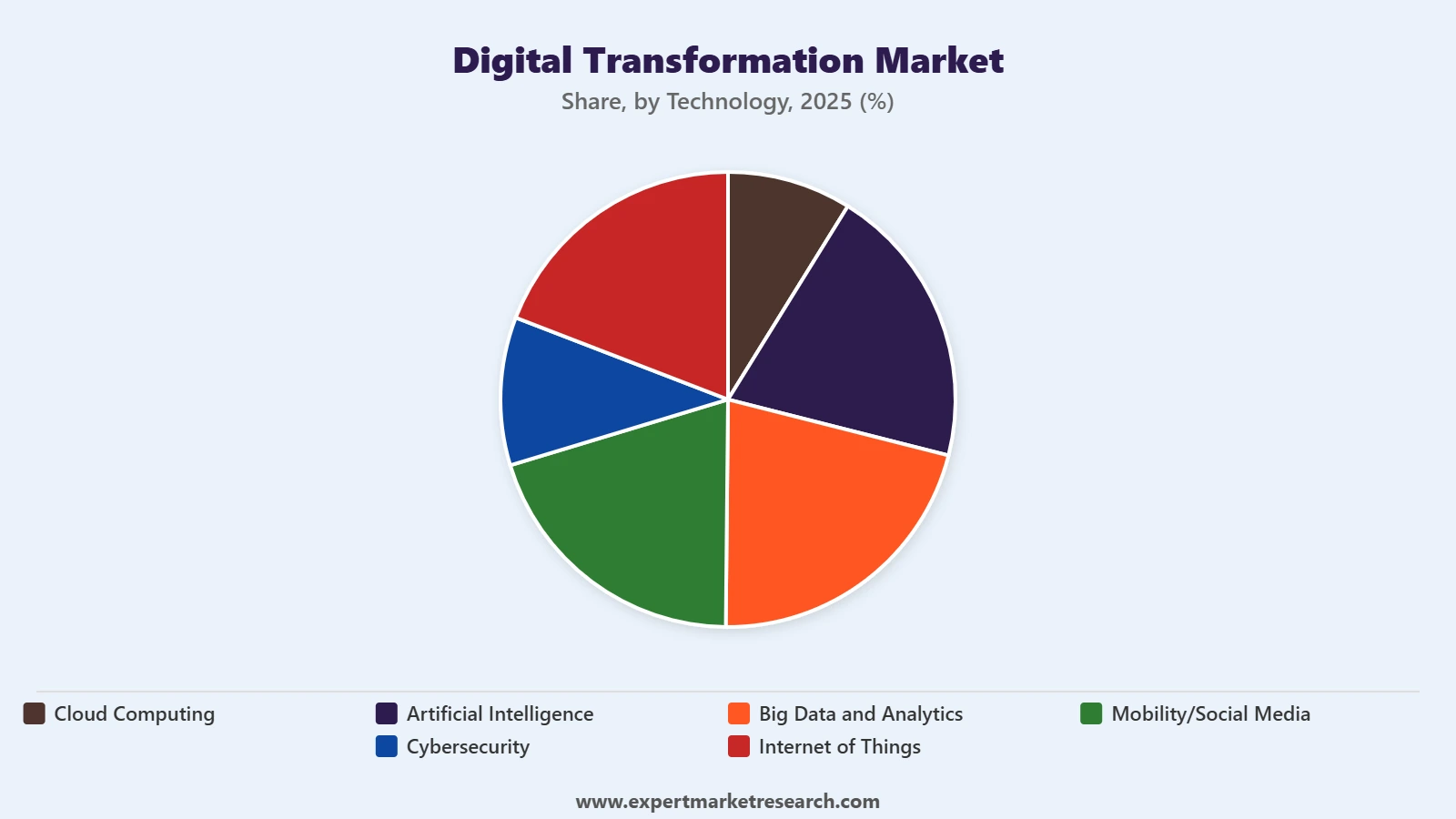
Market Breakup by Technology
Key Insight: Cloud computing is the largest segment, encompassing IaaS, PaaS, and SaaS services that underpin all other digital transformation technology layers, with multi-cloud and hybrid-cloud strategies driving sustained investment across public and private cloud infrastructure. AI and machine learning including generative AI, NLP, computer vision, and agentic AI systems is the fastest-growing segment, as confirmed by Azure's 40%, Google Cloud's 63%, and AWS's 28% revenue growth in Q1 2026. IoT and edge computing enable real-time data collection across manufacturing, logistics, healthcare, and smart city environments. Big data and analytics platforms including data lakes, stream processing, and cloud-native data warehouses convert operational data into competitive insight. Cybersecurity, encompassing zero-trust architecture, identity management, and AI-native threat detection, is the fastest-growing security investment category as enterprise digital surface area expands. Others includes robotic process automation, blockchain, digital twin platforms, and quantum computing.
Market Breakup by Deployment Type
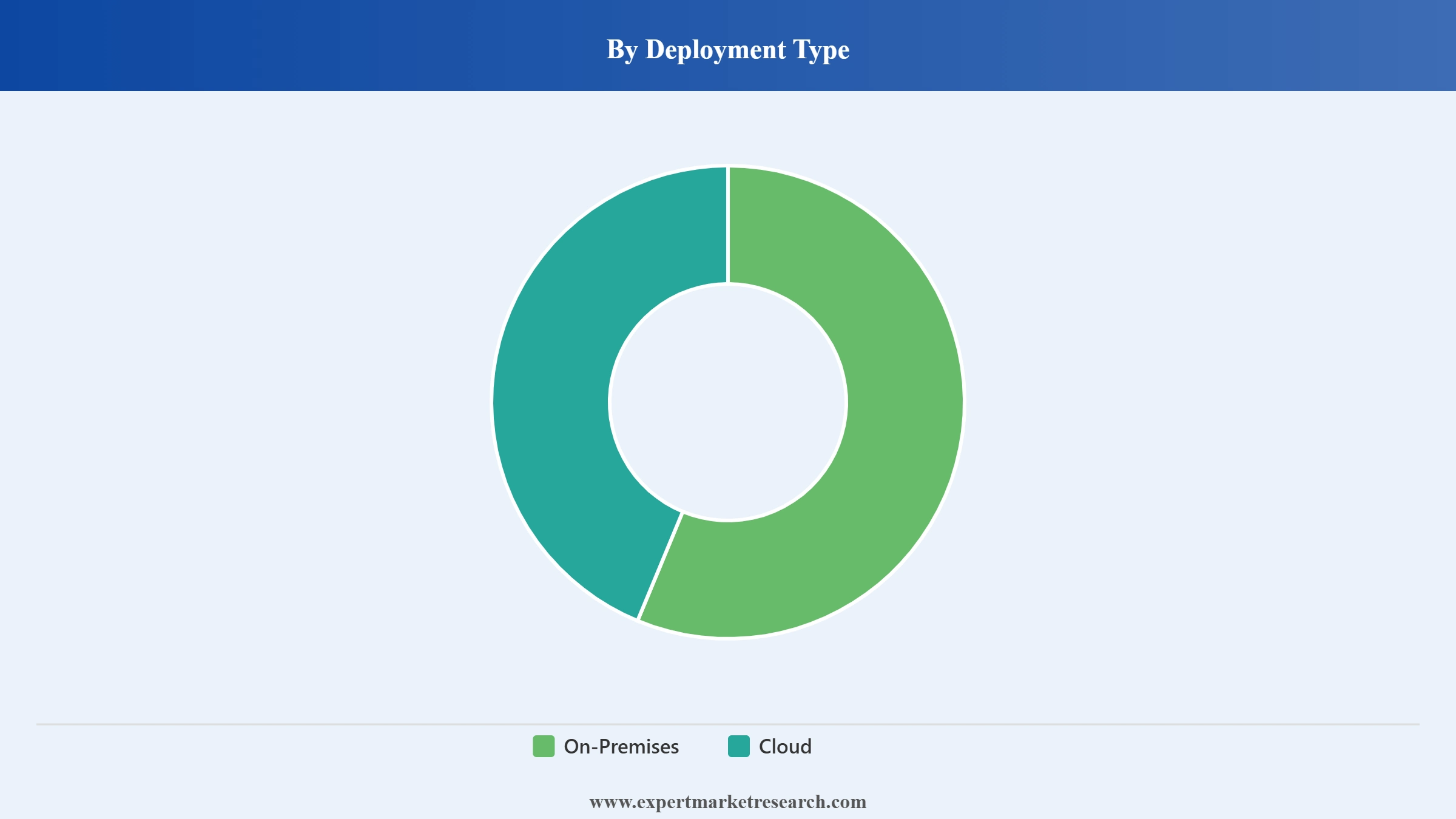
Key Insight: Cloud deployment is the dominant and fastest-growing segment, reflecting the progressive migration of enterprise workloads from on-premise data centres to public, private, and hybrid cloud environments across all organisation sizes and industry verticals. Cloud-delivered digital transformation solutions offer capex-to-opex conversion, elastic scalability, global availability, and continuous feature innovation delivery that on-premise alternatives cannot match at competitive economics. On-premise deployment retains a significant share in regulated industries including financial services, healthcare, and government, where data sovereignty requirements, regulatory compliance mandates, and legacy system integration dependencies create durable demand for private cloud and on-premise deployment alongside public cloud adoption.
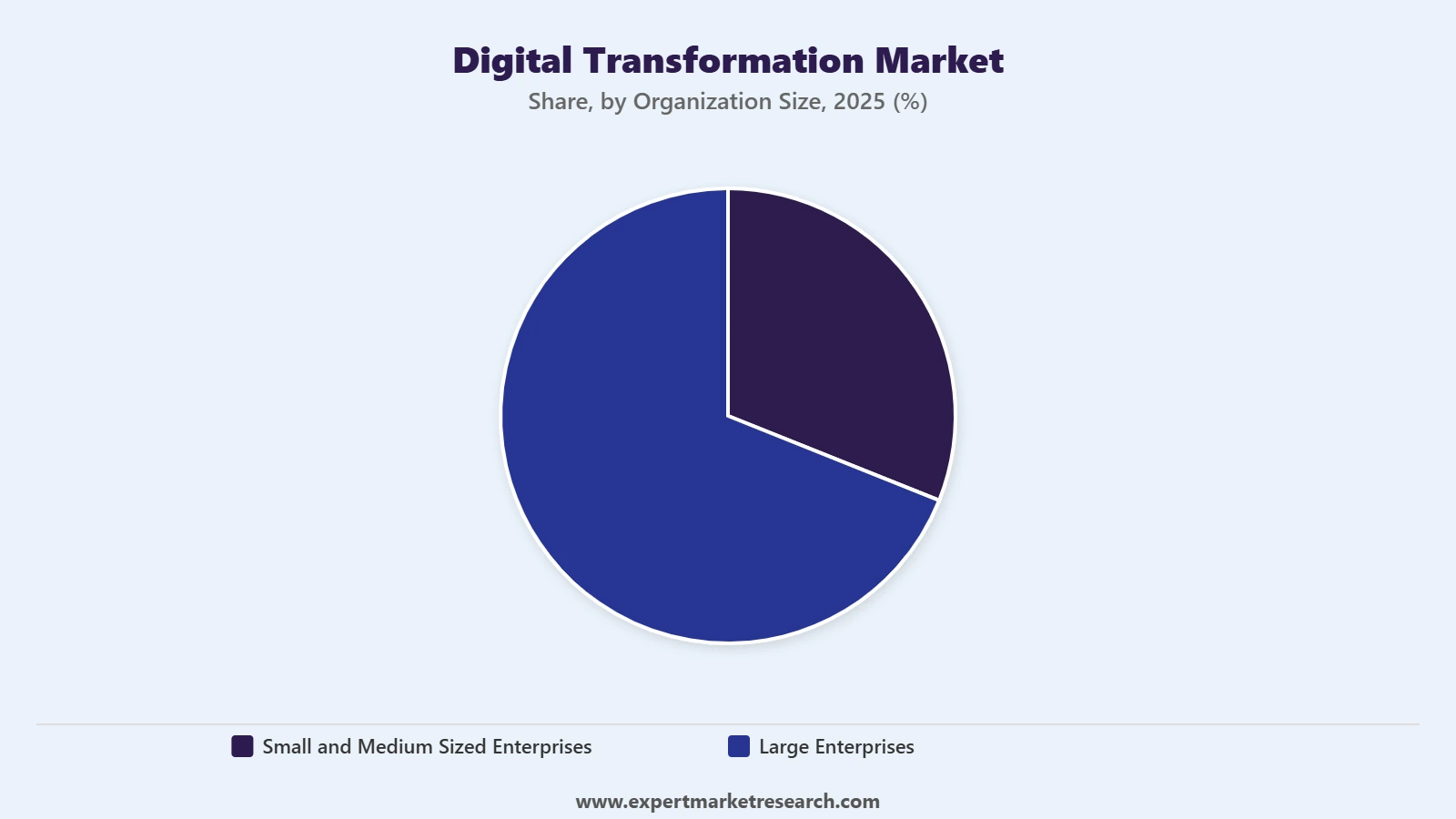
Market Breakup by Organization Size
Key Insight: Large enterprises currently account for the dominant share of digital transformation market revenue by value, given the scale of their technology budgets, the breadth of their transformation programmes, and their role as early adopters of new digital transformation technologies. Small and medium-sized enterprises represent the fastest-growing organisation size segment, as declining SaaS costs, low-code platforms, and managed service delivery models progressively bring enterprise-grade digital transformation capabilities within reach of smaller organisations that previously lacked the capital and technical expertise to access them.
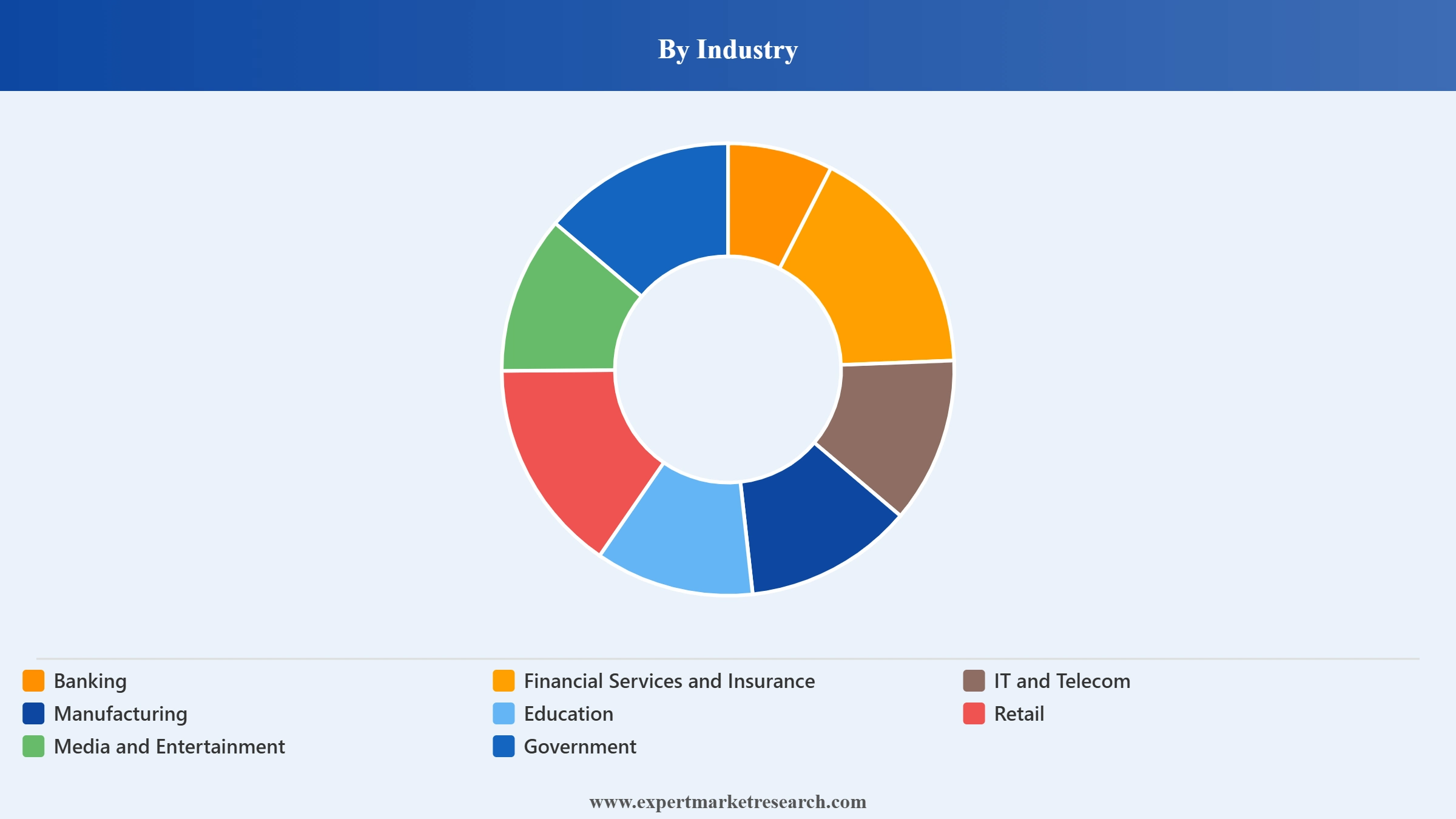
Market Breakup by Industry
Key Insight: BFSI is the largest vertical by digital transformation spending, driven by regulatory compliance digitisation, fraud detection AI, real-time payments infrastructure, and fintech disruption. Healthcare is the second-largest and fastest-growing vertical, encompassing electronic health record modernisation, AI-powered diagnostics, telemedicine, and clinical workflow automation. Retail is transforming across omnichannel experience, AI-powered demand forecasting, and e-commerce infrastructure. IT and telecom operators are deploying network virtualisation, 5G management, and AI-driven optimisation. Manufacturing is investing in digital twin technology, industrial IoT, and autonomous robotics. Government digital transformation spanning citizen services, tax administration, smart city infrastructure, and defence technology is a large and structurally growing vertical.
Market Breakup by Region
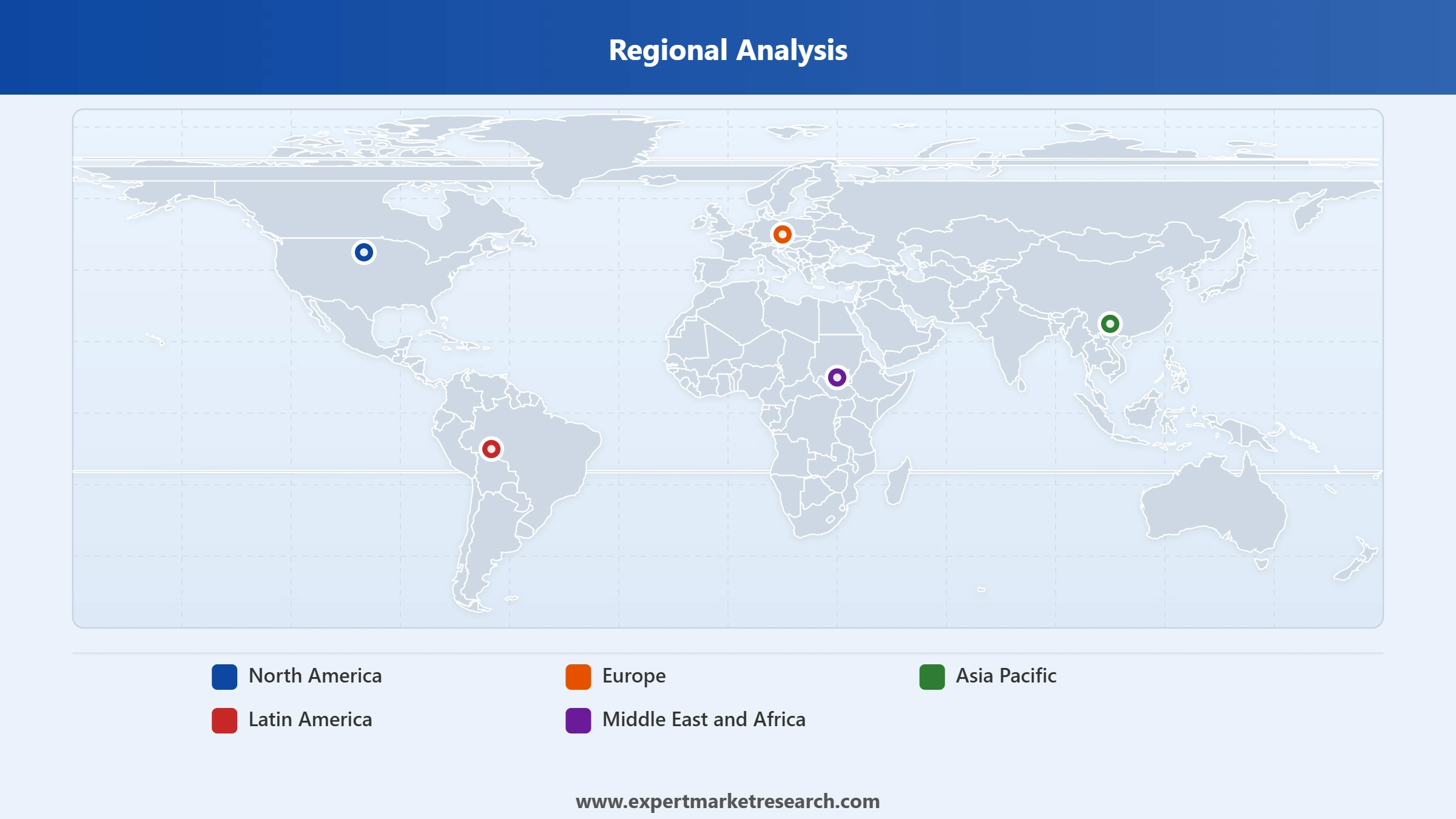
Key Insight: The digital transformation market in North America leads with advanced digital infrastructure. On the other hand, Europe emphasizes regulatory alignment and secure-by-design transformation projects. Asia Pacific expands through industrial automation, government-backed modernization, and mobile-first adoption. Latin America prioritizes operational efficiency and cloud migration. Middle East and Africa invest in smart cities, digital identity, and service automation.
Read more about this report - REQUEST FREE SAMPLE COPY IN PDF
North America is the world's largest digital transformation market, accounting for the largest share of global technology spending by value, anchored by the United States home to the world's leading hyperscaler cloud providers, enterprise software companies, AI research laboratories, and digital transformation consulting firms. Microsoft Azure, Amazon Web Services, and Google Cloud all headquartered in the US are experiencing their fastest revenue growth rates in years, driven by enterprise AI demand that is simultaneously a product of and a driver of accelerating US digital transformation investment. The region is characterised by advanced cloud adoption penetration across large enterprises, rapid GenAI deployment across financial services, healthcare, and technology sectors, and increasing government investment in federal IT modernisation and AI governance infrastructure.
The United States digital transformation market is the world's most advanced and largest national digital transformation investment ecosystem, encompassing the hyperscaler cloud infrastructure providers, enterprise software leaders, AI platform companies, digital transformation consultancies, and end-user enterprises across all major industry verticals that collectively define the frontier of global digital transformation practice. Microsoft's annualised AI revenue exceeding USD 37 billion, Azure's 40% growth, and the broader hyperscaler capex commitment of USD 630–650 billion across the four largest technology companies in 2026 collectively confirm the US as the world's most active AI and digital transformation investment market. Federal government digital transformation investment spanning cloud migration of legacy government IT systems, AI deployment in defence and intelligence, and citizen services digitisation represents a structurally significant and growing component of US digital transformation market demand.
Europe is the world's second-largest digital transformation market, characterised by a regulatory-forward environment shaping both the pace and architecture of enterprise digital transformation adoption across EU member states and the United Kingdom. The European Union's AI Act the world's first comprehensive legal framework governing AI system risk classification, transparency, and deployment requirements is creating significant enterprise compliance investment in AI governance infrastructure while establishing Europe as a global reference point for responsible AI deployment. The EU's Digital Decade targets, seeking 75% of EU enterprises adopting cloud services by 2030, and the European Data Act governing data sharing across the digital economy are collectively creating strong policy pull for enterprise digital transformation investment. Sovereign AI considerations data localisation, model governance, and AI infrastructure sovereignty are particularly acute in Europe, where GDPR precedent and cross-border data flow regulation are shaping cloud deployment model choices across enterprise digital transformation programmes.
Read more about this report - REQUEST FREE SAMPLE COPY IN PDF
Asia Pacific is the fastest-growing regional digital transformation market, driven by China's state-directed AI and industrial digitalisation programmes, India's rapidly scaling IT services industry and government Digital India initiative, Japan and South Korea's enterprise digitalisation investments, and Southeast Asia's emerging digital economy development across Indonesia, Vietnam, Thailand, and the Philippines. China's domestic AI model development including large language models from Baidu, Alibaba, and a growing ecosystem of Chinese AI startups is creating a parallel AI technology stack to Western alternatives. India's digital transformation market is one of the world's fastest-growing, driven by a vast digitally-enabled workforce, the government's Unified Payments Interface digital payments infrastructure, and a world-leading IT services industry delivering digital transformation for global enterprises.
The Middle East and Africa region is experiencing rapid digital transformation investment growth, led by Gulf Cooperation Council states' ambitious national digitalisation programmes including Saudi Arabia's Vision 2030 digital infrastructure investment, UAE Smart Government initiatives, and Qatar's National Digital Agenda channelling substantial sovereign wealth fund capital into AI, cloud infrastructure, smart city, and e-government technology platforms. Sub-Saharan Africa's digital transformation market is experiencing technology leapfrogging particularly in mobile-first digital financial services, agricultural data platforms, and e-government services creating organic digital transformation adoption demand driven by commercial opportunity rather than legacy system replacement.
Latin America's digital transformation market is in a sustained growth phase, with Brazil and Mexico as the region's anchor markets and Colombia, Chile, Argentina, and Peru as important secondary digital economies. Brazil's digital financial services ecosystem including the government-launched Pix instant payment system, digital bank proliferation, and open banking regulatory framework represents one of the world's most advanced financial services digital transformation case studies and is driving substantial enterprise technology investment across BFSI, retail, and logistics sectors. Mexico's proximity to the US and its established technology outsourcing sector create conditions for progressive enterprise cloud and AI adoption aligned with North American digital transformation trends.
Digital transformation market players are focusing on platform convergence, industry-specific AI, and secure edge deployments that deliver measurable ROI. Vendors are bundling observability, governance, and low-code automation to reduce integration friction for large enterprises. Strategic partnerships between cloud providers and system integrators are shortening deployment cycles and enabling standardized industry templates.
Infrastructure vendors are offering carbon-aware workload tools while automation suppliers package certified industrial templates for quick rollout. Opportunities can be found in managed transformation services, retrofit tools for brownfield sites, and AIops for continuous optimization. Digital transformation companies that combine domain IP, edge orchestration, and demonstrable cost savings are securing long-term contracts.
Microsoft Corporation, established in 1975 and headquartered in the United States, offers industry cloud platforms that combine Azure, Power Platform low-code, and sector AI. The company is targeting regulated industries with compliance accelerators, confidential computing, and carbon-aware scheduling to reduce cloud emissions.
Dell Inc., established in 1984 and headquartered in Texas, United States, supplies integrated edge-to-cloud infrastructure, validated systems for AI training, and private cloud appliances. Dell focuses on shrink-wrapped solutions that reduce deployment risk for transformation programs by combining storage, servers, and edge gateways. The company is adding containerized stacks and AI inference accelerators into industrial kits.
Adobe Inc., established in 1982 and headquartered in California, United States, is expanding digital experience platforms that integrate content supply chains, real-time personalization, and experience analytics. Adobe is targeting B2B marketers and commerce teams by combining Creative Cloud assets with customer data platforms to accelerate campaign velocity.
Accenture PLC, established in the year 1989 and headquartered in Dublin, Ireland, delivers end-to-end transformation services that combine strategy, systems integration, and operations. The firm’s focus on modular, cross-industry solution patterns also supports faster modernization for clients navigating complex, multi-vendor technology estates.
Other key players in the market include Genpact, among others.
*Please note that this is only a partial list; the complete list of key players is available in the full report. Additionally, the list of key players can be customized to better suit your needs.*
Unlock the latest insights with our digital transformation market trends 2026 report. Discover regional growth patterns, consumer preferences, and key industry players. Stay ahead of the competition with trusted data and expert analysis. Download your free sample report today and drive informed decisions in the market.


Upto 15% Off
USD
$2499 $2249
$3999 $3599
$4999 $4249
$5999 $5099


*While we strive to always give you current and accurate information, the numbers depicted on the website are indicative and may differ from the actual numbers in the main report. At Expert Market Research, we aim to bring you the latest insights and trends in the market. Using our analyses and forecasts, stakeholders can understand the market dynamics, navigate challenges, and capitalize on opportunities to make data-driven strategic decisions.*
In 2025, the market reached an approximate value of USD 2276.33 Billion.
The market is projected to grow at a CAGR of 18.00% between 2026 and 2035.
Enterprises are building composable stacks, adopting edge AI platforms, standardizing data contracts, embedding security-by-design, and partnering with SIs to industrialize transformation at scale across geographies rapidly.
Technological advancements, the rapid adoption of cloud computing, the increasing demand for automation in various end-use sectors, and the rise of the Internet of Behaviour (IoB) are the key trends guiding the market demand.
The major regions in the market are North America, Latin America, the Middle East and Africa, Europe, and the Asia Pacific.
The major technologies considered in the market report are cloud computing, artificial intelligence, big data and analytics, mobility/social media, cybersecurity, and internet of things.
The significant deployment types in the market are on-premises and cloud.
The different organisation sizes considered in the market report are small and medium sized enterprises and large enterprises.
The significant industries included in the market report are banking, financial services and insurance, IT and telecom, manufacturing, education, retail, media and entertainment, and government.
The key players in the market include Microsoft Corporation, Dell Inc., Adobe Inc., Accenture PLC, and Genpact, among others.
The market is estimated to witness a healthy growth in the forecast period of 2026-2035 to reach USD 11913.94 Billion by 2035.
Legacy system fragmentation, skills shortages, data privacy compliance, budget constraints, and integrating AI responsibly are constraining rollout speed and increasing implementation risk and complicating vendor selection.
Explore our key highlights of the report and gain a concise overview of key findings, trends, and actionable insights that will empower your strategic decisions.
| REPORT FEATURES | DETAILS |
| Base Year | 2025 |
| Historical Period | 2019-2025 |
| Forecast Period | 2026-2035 |
| Scope of the Report |
Historical and Forecast Trends, Industry Drivers and Constraints, Historical and Forecast Market Analysis by Segment:
|
| Breakup by Technology |
|
| Breakup by Deployment Type |
|
| Breakup by Organisation Size |
|
| Breakup by Industry |
|
| Breakup by Region |
|
| Market Dynamics |
|
| Competitive Landscape |
|
| Companies Covered |
|
| Report Price and Purchase Option | Explore our purchase options that are best suited to your resources and industry needs. |
| Delivery Format | Delivered as an attached PDF and Excel through email, with an option of receiving an editable PPT, according to the purchase option. |
Datasheet
One User
USD 2,499
USD 2,249
tax inclusive*
Single User License
One User
USD 3,999
USD 3,599
tax inclusive*
Five User License
Five User
USD 4,999
USD 4,249
tax inclusive*
Corporate License
Unlimited Users
USD 5,999
USD 5,099
tax inclusive*
*Please note that the prices mentioned below are starting prices for each bundle type. Kindly contact our team for further details.*
Flash Bundle
Small Business Bundle
Growth Bundle
Enterprise Bundle
*Please note that the prices mentioned below are starting prices for each bundle type. Kindly contact our team for further details.*
Flash Bundle
Number of Reports: 3
20%
tax inclusive*
Small Business Bundle
Number of Reports: 5
25%
tax inclusive*
Growth Bundle
Number of Reports: 8
30%
tax inclusive*
Enterprise Bundle
Number of Reports: 10
35%
tax inclusive*
How To Order

Select License Type
Choose the right license for your needs and access rights.

Click on ‘Buy Now’
Add the report to your cart with one click and proceed to register.

Select Mode of Payment
Choose a payment option for a secure checkout. You will be redirected accordingly.
Strategic Solutions for Informed Decision-Making
Gain insights to stay ahead and seize opportunities.

Get insights & trends for a competitive edge.

Track prices with detailed trend reports.

Analyse trade data for supply chain insights.

Leverage cost reports for smart savings

Enhance supply chain with partnerships.

Connect For More Information
Our expert team of analysts will offer full support and resolve any queries regarding the report, before and after the purchase.
Our expert team of analysts will offer full support and resolve any queries regarding the report, before and after the purchase.
We employ meticulous research methods, blending advanced analytics and expert insights to deliver accurate, actionable industry intelligence, staying ahead of competitors.
Our skilled analysts offer unparalleled competitive advantage with detailed insights on current and emerging markets, ensuring your strategic edge.
We offer an in-depth yet simplified presentation of industry insights and analysis to meet your specific requirements effectively.




