

Consumer Insights
Uncover trends and behaviors shaping consumer choices today
Procurement Insights
Optimize your sourcing strategy with key market data
Industry Stats
Stay ahead with the latest trends and market analysis.
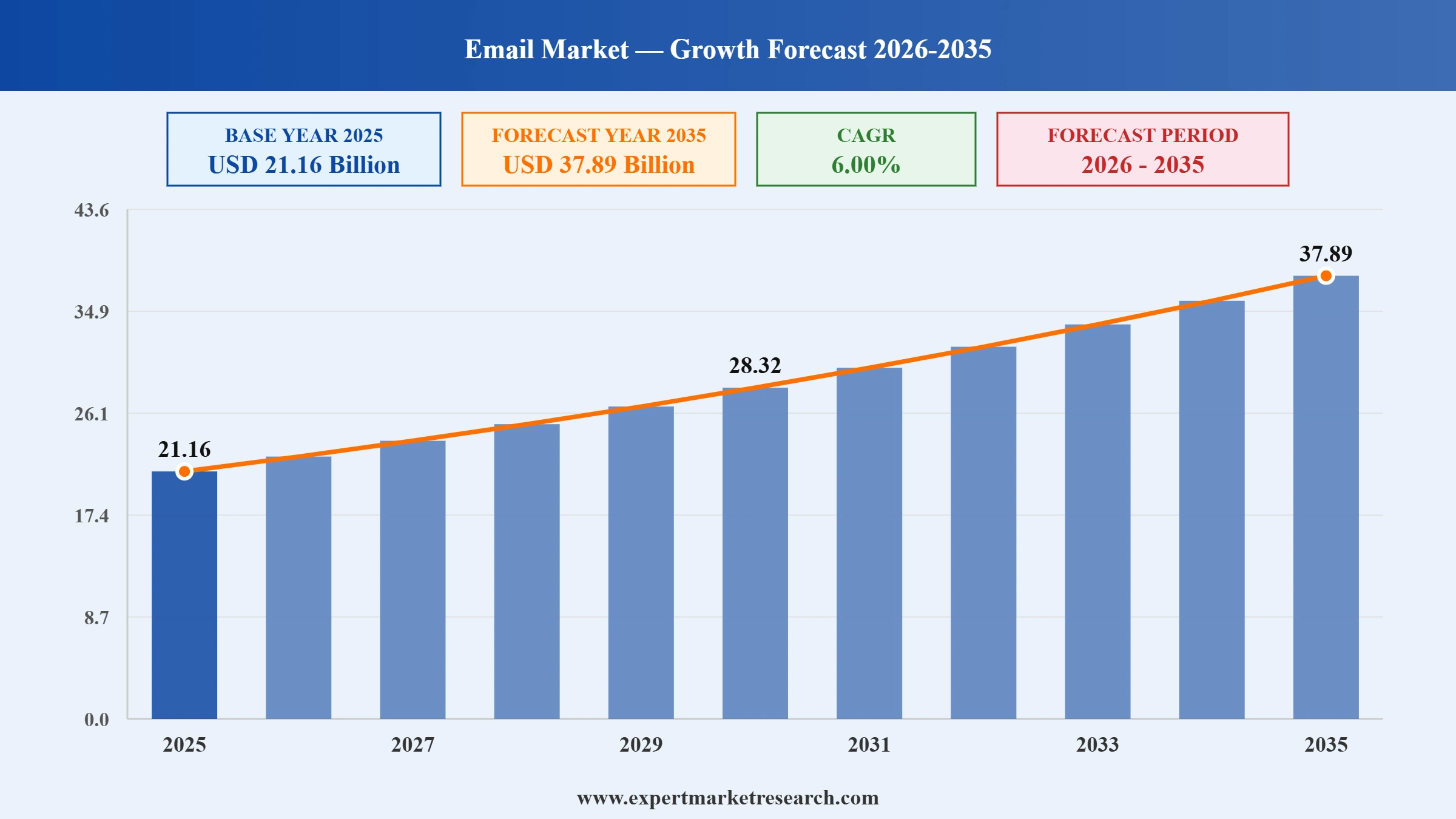
The global email market size reached approximately USD 21.16 Billion in 2025 and is projected to grow at a CAGR of 6.00% between 2026 and 2035, reaching nearly USD 37.89 Billion by 2035. according to Expert Market Research. This growth reflects the sustained centrality of electronic mail as the primary infrastructure for digital communication, commerce, and enterprise operations across every industry and geography worldwide.
The email market is not a niche or declining channel. It is a multi-layered commercial ecosystem encompassing cloud-hosted email platforms, enterprise mail server infrastructure, transactional delivery systems, anti-spam and phishing protection solutions, email security gateways, marketing automation suites, analytics platforms, and compliance management tools. Every business, institution, and individual engaged in digital communication is a participant in this market as a platform operator, technology vendor, service provider, or end user.
The email market refers to the complete ecosystem of platforms, services, infrastructure, and technologies enabling the creation, delivery, management, security, monetisation, and analysis of electronic mail communications. It spans consumer webmail services, enterprise email hosting, cloud-based productivity platforms, transactional email APIs, bulk email delivery infrastructure, anti-spam and phishing detection solutions, email security gateways, marketing automation tools, email analytics platforms, and compliance and data governance services supporting the email channel.
The scope of the email market is broader than most buyers realise. It is not limited to marketing email campaigns, which represent only one functional layer within a much larger technology and service ecosystem. Understanding the full scope of the email market is essential for investors, enterprise technology buyers, and strategic planners assessing the channel's long-term commercial potential.
Read more about this report - REQUEST FREE SAMPLE COPY IN PDF
| Global Email Market Report Summary | Description | Value |
| Base Year | USD Billion | 2025 |
| Historical Period | USD Billion | 2019-2025 |
| Forecast Period | USD Billion | 2026-2035 |
| Market Size 2025 | USD Billion | 21.16 |
| Market Size 2035 | USD Billion | 37.89 |
| CAGR 2019-2025 | Percentage | XX% |
| CAGR 2026-2035 | Percentage | 6.00% |
| CAGR 2026-2035 - Market by Region | Asia Pacific | 6.8% |
| CAGR 2026-2035 - Market by Country | India | 7.9% |
| CAGR 2026-2035 - Market by Country | China | 7.6% |
| CAGR 2026-2035 - Market by Channel | B2B | 6.7% |
| CAGR 2026-2035 - Market by Deployment | Cloud Based | 6.5% |
| Market Share by Country 2023 | UK | 4.5% |
A common point of confusion in industry analysis is the interchangeable use of "email market" and "email marketing market." These are distinct segments with different boundaries, buyer profiles, and growth dynamics. The email market covers the entire ecosystem infrastructure, hosting, security, compliance, transactional delivery, and marketing automation. The email marketing market is a specific commercial sub-segment focused exclusively on campaign management platforms, subscriber engagement tools, and marketing automation workflows. Expert Market Research's Email Market report covers the full ecosystem, providing a more comprehensive and commercially accurate view of the industry's total value, addressable opportunity, and long-term growth trajectory.
Cloud Infrastructure Adoption Across Organisations
The migration from on-premise to cloud-based email infrastructure is the most consistent long-running structural driver of the email market. As per market analysis, 67% of the entire enterprise infrastructure can be cloud-based, 82% of the organisation's workload is expected to reside on cloud, and startups and SMBs adopting cloud report an 80% improvement in their operational workflow. Cloud deployment delivers zero-maintenance infrastructure management, elastic capacity scaling, automatic security patch deployment, and consumption-based pricing that aligns operational cost with business scale fundamentally changing the economics of email operations for organisations of every size. Over 90% of startups and over 60% of mid-sized companies in the United States use Gmail as their primary email platform, illustrating the completeness of cloud email displacement in commercial adoption.
Rising E-Commerce and Transactional Email Demand
The sustained global growth of digital commerce creates direct and proportional demand for transactional email infrastructure. Order confirmations, shipping notifications, return authorisations, payment receipts, account security alerts, and subscription management communications are all delivered exclusively through email. The total addressable market for transactional delivery infrastructure scales automatically with e-commerce transaction volume, making this sub-segment one of the most reliable growth anchors within the broader email market across both developed and emerging economies.
Escalating Enterprise Spending on Email Security
Email security represents the fastest-growing functional sub-segment within the email market, driven by the documented escalation of email-based cybercrime and its direct financial consequences. According to the FBI's 2024 Internet Crime Complaint Center Annual Report, Business Email Compromise (BEC) caused USD 2.77 billion in losses across 21,442 reported incidents in 2024 alone, representing more than 17% of all cybercrime financial losses reported to the FBI. The FBI's IC3 report confirmed that email continues to be the single largest conduit for cybercrime, both in terms of frequency and financial impact. These verified losses are directly driving enterprise procurement of anti-BEC detection platforms, secure email gateways, phishing simulation training tools, and AI-powered threat intelligence solutions all expanding the email security sub-market at rates significantly above the aggregate email market CAGR.
AI and Automation Enhancing Email Operations
Artificial intelligence has become operational infrastructure across every tier of the email market. At the platform level, Gmail's security infrastructure blocks 15 billion spam emails and stops 100 million phishing emails daily representing the scale and speed at which machine learning models must operate to maintain inbox hygiene for a global user base. At the enterprise and marketing automation level, AI drives subject line optimisation, audience segmentation, behavioural trigger personalisation, deliverability prediction, and content generation capabilities that directly improve commercial ROI and create clear pricing differentiation between commodity and premium platform tiers.
First-Party Data Strategy Elevating Email's Role
The progressive restriction of third-party tracking identifiers including the deprecation of browser cookies and tightening of mobile advertising ID access under Apple's App Tracking Transparency has materially elevated email's strategic value within enterprise customer engagement stacks. Email is the primary channel through which brands maintain direct, consent-based, first-party audience relationships that are immune to third-party platform policy changes. This structural positioning is driving increased organisational investment in email list quality, subscriber acquisition, permission-based data enrichment, and preference centre development all contributing to sustained growth in email platform adoption and per-account revenue.
Generative AI in Email Platform Workflows
The embedding of large language model capabilities into email management interfaces is the most significant near-term innovation reshaping the competitive landscape of the email market. Generative AI is applied to draft email body copy, generate and test subject line variations, automate personalised content blocks, analyse audience engagement patterns, and surface optimisation recommendations compressing the time from campaign brief to deployment while simultaneously expanding creative testing capacity. For enterprise inbox management, AI-powered triage and automated response suggestions are reducing the operational burden of high-volume communication workflows.
BIMI, DMARC, and Sender Authentication Standards
Brand Indicators for Message Identification (BIMI), combined with the mandatory enforcement of DMARC, DKIM, and SPF authentication by major inbox providers, has fundamentally raised the compliance floor for all commercial email operations. Organisations with verified sender identities and strong authentication records gain measurable inbox placement advantages and the ability to display brand logos alongside messages in supporting email clients. Those that fail to implement these standards face increasingly aggressive spam classification and deliverability deterioration. This dynamic is creating sustained demand for email authentication advisory services, BIMI implementation tooling, and deliverability monitoring platforms.
AMP for Email and Interactive Inbox Experiences
AMP for Email enables senders to embed functional interactivity forms, product carousels, real-time price displays, appointment scheduling, and survey responses directly within the inbox without requiring recipients to click through to a web page. Supported by Gmail, Yahoo, and Outlook, this technology fundamentally changes the email value proposition from static content delivery to an interactive engagement surface. Brands implementing AMP-powered emails report measurable improvements in completion rates for high-intent actions, reduced conversion path abandonment, and significantly higher engagement with dynamic content.
Mobile-First Design and Engagement Patterns
Between 75% and 85% of Gmail opens occur on mobile devices, reflecting the global consolidation of email consumption on smartphones. This has driven investment in responsive email template design, mobile-optimised preview rendering, touch-friendly interactive elements, and send-time algorithms that account for device-specific and geographic usage patterns. Email platforms that cannot guarantee consistent, visually accurate mobile rendering across the dominant device types and operating systems are increasingly disadvantaged in enterprise procurement evaluation.
Zero-Party Data Collection via Email
As consent-based marketing frameworks become regulatory standard globally, the email preference centre has evolved from a compliance requirement into a strategic zero-party data collection mechanism. Organisations use email interactions to capture subscriber preferences, product category interests, communication frequency choices, and demographic attributes building legally robust, commercially valuable audience profiles that do not depend on third-party tracking infrastructure and therefore remain resilient to privacy regulation changes.
The global email market faces compounding operational and regulatory challenges that require sustained investment and expertise to navigate effectively. Email is the single largest conduit for cybercrime globally in both frequency and financial impact, and BEC alone caused USD 2.77 billion in documented losses in 2024 according to the FBI's official IC3 Annual Report placing email security at the centre of enterprise risk management agendas and escalating the technical requirements for compliant, secure commercial email operations. Major inbox providers including Google, Microsoft, Apple, and Yahoo continuously update sender policy requirements, bulk sender thresholds, and spam classification algorithms, making deliverability management a specialised, continuously evolving discipline rather than a set-and-forget configuration. Organisations operating across multiple markets must simultaneously comply with CAN-SPAM, GDPR, CASL, and a proliferating landscape of national and state-level privacy regulations, each with distinct consent requirements, data residency obligations, and enforcement actions creating compliance overhead that is particularly burdensome for mid-market and emerging market operators without dedicated legal and technical resources. These challenges are not temporary; they intensify as email volumes grow, threat actors sophisticate, and regulators raise standards.
On the restraints side, several structural dynamics temper near-term growth for specific market participants. On-premise email infrastructure faces accelerating revenue decline as cloud alternatives achieve feature parity at materially lower total cost of ownership yet regulated sectors including central banking, classified government, and certain healthcare institutions retain compliance-driven on-premise dependencies that are costly and time-consuming to resolve. While 67% of enterprise infrastructure overall can move to cloud, and 82% of workloads are expected to migrate, the remaining on-premise-committed segment represents a structural ceiling for cloud vendors targeting regulated enterprise. The concentration of inbox reach among Google, Microsoft, and Apple creates systemic vulnerability for commercial senders any policy change by these three providers can alter deliverability outcomes at scale with limited advance notice. Additionally, subscriber acquisition costs are rising globally as consent regulations tighten, reducing the speed at which organisations can build commercially productive engaged email audiences and constraining list growth rates for email-dependent businesses.
Despite these headwinds, the email market presents substantial, expanding, and well-documented opportunities for growth across multiple vectors. The email security sub-segment represents the most immediate high-growth opportunity, with enterprise security budgets allocating increasing share to email-specific threat detection, BEC prevention, and phishing protection following record cybercrime losses. According to Expert Market Research, the Asia Pacific region is expected to grow at a CAGR of 6.8% through 2035, driven by rapidly expanding e-commerce ecosystems in India, Indonesia, Vietnam, and the Philippines markets where email infrastructure buildout is in relatively earlier stages compared to North America and Europe, providing significant greenfield adoption opportunity. The convergence of AI, customer data platforms, and zero-party data strategies is enabling a new generation of premium email capabilities commanding higher contract values and longer client retention directly improving the per-account economics of enterprise email platform businesses. Interactive email formats, mobile-first personalisation, and BIMI-enabled brand authentication create additional differentiation opportunities for vendors capable of serving both the marketing effectiveness and security assurance requirements of enterprise buyers within a unified offering.




Read more about this report - REQUEST FREE SAMPLE COPY IN PDF
The EMR’s report titled “Global Email Market Report and Forecast 2026-2035” offers a detailed analysis of the market based on the following segments:
Breakup by Channel
Breakup by Deployment
Cloud-Based Email commands the dominant and growing share of global email market revenue. As per market analysis, 67% of the entire enterprise infrastructure can be cloud-based, and 82% of the organisation's workload is expected to reside on cloud reflecting the comprehensive migration of email operations from legacy on-premise installations to cloud-native platforms. Cloud deployment delivers zero-maintenance infrastructure management, elastic capacity scaling, automatic security updates, and seamless integration with productivity and CRM ecosystems, making it the default choice for startups, SMEs, and an increasing proportion of large enterprise deployments. This segment encompasses consumer webmail services, Google Workspace and Microsoft 365 business email, cloud-native transactional email APIs, and cloud-hosted marketing automation platforms.
On-Premises Email Infrastructure retains strategic relevance in highly regulated sectors where data sovereignty, air-gapped security architectures, and internal IT governance policies preclude public cloud dependencies. Central banks, national defence contractors, classified government agencies, and certain regulated healthcare institutions maintain on-premise email infrastructure that must meet security certifications and data isolation requirements that cloud platforms cannot yet fully satisfy in all jurisdictions. This segment maintains meaningful absolute revenue from enterprise licence fees, hardware maintenance, and professional services, even as its proportional market share declines over the forecast period.
Breakup by Enterprise Size
Breakup by Application
Email Lead Generation represents one of the primary commercial value propositions of email platform investment, encompassing subscriber acquisition workflows, opt-in list management, welcome sequences, and multi-step nurture automation designed to convert prospects into buyers. This application category drives significant platform adoption among SMEs and D2C brands where email is the primary customer acquisition channel.
Customer Management applications cover the full subscriber lifecycle onboarding sequences, engagement programmes, loyalty communications, retention triggers, win-back campaigns, and churn prevention workflows. This category represents the core operational function of email platforms for established businesses with existing customer bases.
Sales Reporting and Reporting and Analytics applications provide campaign performance measurement, conversion attribution, revenue tracking, and audience engagement analysis. AI-powered insight generation is increasingly standard within this application category, translating raw engagement data into prioritised optimisation recommendations.
Template Management platforms enable consistent, brand-compliant, mobile-responsive creative production across distributed teams and multi-brand corporate structures, reducing production time while ensuring visual quality and multi-client rendering reliability.
Breakup by Industry
BFSI organisations are high-value email market participants, using email for regulatory disclosures, fraud alert notifications, product cross-selling communications, and account management all subject to strict compliance requirements driving demand for specialised secure and auditable email solutions.
IT and Telecommunications companies rely on email for developer communications, product update announcements, enterprise sales outreach, and trial-to-paid conversion nurturing across complex, multi-stakeholder procurement processes.
Retail and E-Commerce is the largest single end-use vertical by transactional email volume, with order confirmations, shipping updates, promotional campaigns, cart abandonment recovery, and loyalty communications delivered exclusively through email infrastructure at massive scale.
Healthcare adoption is accelerating, driven by patient engagement programmes, appointment scheduling automation, and the growing availability of HIPAA-compliant email platforms designed for the sector's specific regulatory environment and data handling requirements.
Consumer Goods and Travel and Transportation complete the major vertical segments, with airlines, hospitality groups, and consumer brands among the most sophisticated users of behavioural trigger automation and real-time personalisation within the email channel.
Breakup by Region
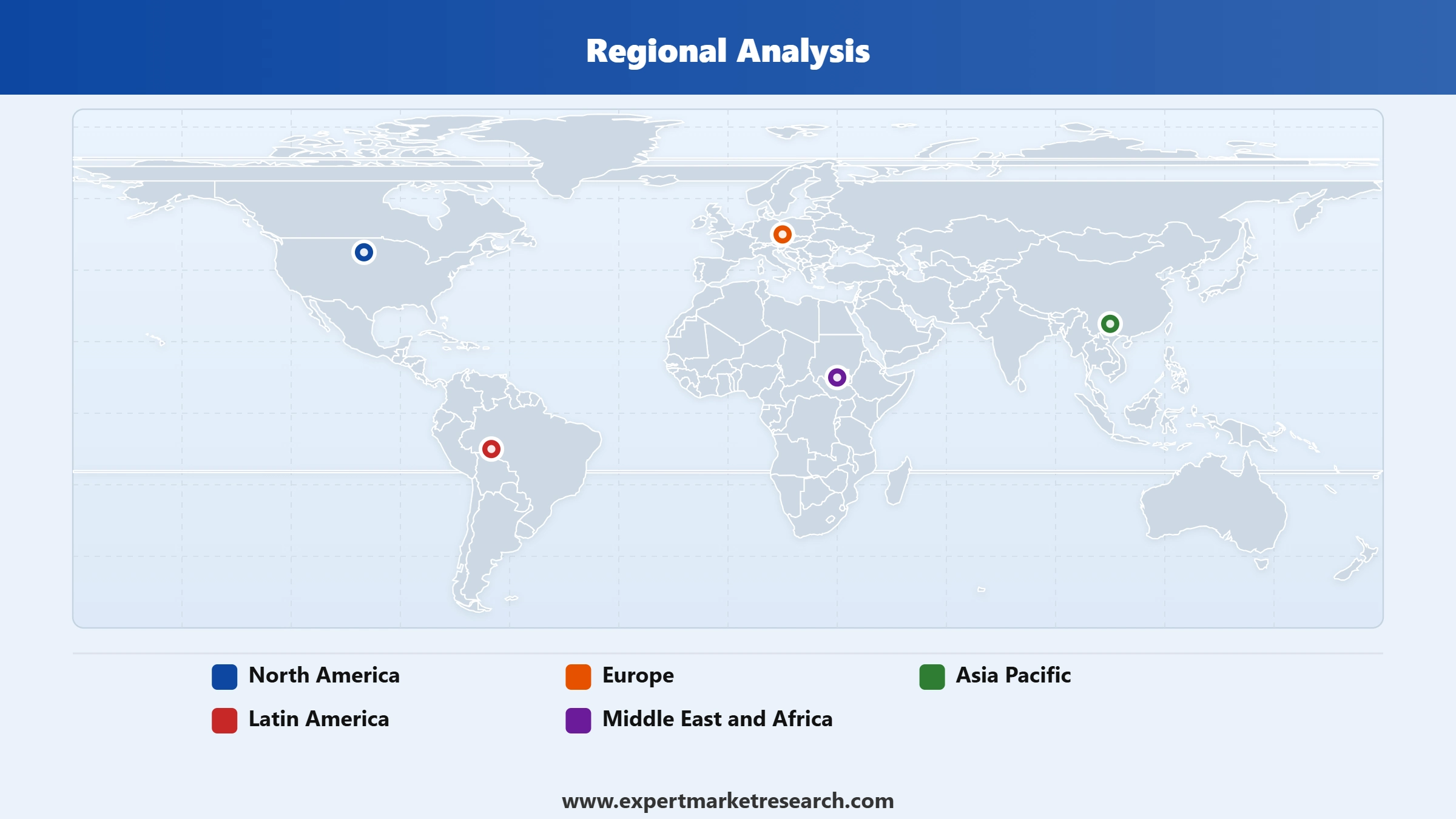
North America leads the global email market, supported by the world's highest concentration of email technology vendors, the most mature enterprise adoption of cloud infrastructure, and a regulatory environment that balances sender accountability with operational flexibility. The United States accounts for the dominant share of regional revenue, anchored by the headquarters presence of major email platform companies and the most developed commercial email ecosystem globally.
Europe is characterised by strong enterprise demand and the most demanding regulatory environment globally under GDPR. Compliance obligations have driven substantial investment in consent management infrastructure, data residency solutions, and privacy-first subscriber acquisition strategies. The United Kingdom, Germany, and France are the primary revenue contributors, with GDPR compliance creating a specialised vendor ecosystem serving the region's distinctive data governance requirements.
Asia Pacific is the fastest-growing regional market, driven by e-commerce expansion across China, India, Indonesia, Vietnam, and the Philippines, rising digital marketing investment among regional enterprise brands, and increasing internet and smartphone penetration creating new email-addressable populations across emerging economies at scale.
Latin America is an emerging growth market anchored by Brazil and Mexico, where e-commerce digitalisation is accelerating and demand for both email infrastructure and anti-fraud solutions is growing among domestic and multinational commercial operators.
Middle East and Africa represents the earliest-stage but highest long-term potential regional segment, with email adoption growing alongside mobile internet expansion, the formalisation of digital commerce ecosystems, and increasing enterprise technology investment across the Gulf Cooperation Council and major Sub-Saharan African markets.
Read more about this report - REQUEST FREE SAMPLE COPY IN PDF
Major email service providers are using AI-based tools for improving user defences against phishing attacks and spam mails. This is creating a favourable email market outlook.
Upland Software, Inc. is a software development company which was founded in 2010 and is headquartered in Texas, United States. It specialises in providing email and SMS automation services, apart from account-based selling and digital transformation services.
Rackspace Technology was founded in 1998 and is headquartered in Texas, United States. It is an IT services and consulting company engaged in providing numerous services such as database administration and enterprise application management, among others.
VerticalResponse, LLC was founded in 2001 and is headquartered in Florida, United States. As per email market analysis, it is engaged in providing social media and email marketing solutions for nonprofit organisations and numerous small-size businesses.
Constant Contact, Inc. was founded in 1995 and is headquartered in Massachusetts, United States. It is engaged in providing email marketing, contact management, and numerous other digital marketing services to small size businesses.
Other players included in the email market report are AWeber Systems, Inc., BlueTie, Inc., Drip Global, Inc., Salesforce, Inc., Zoho Corporation Pvt. Ltd., and Polaris Software, LLC, among others. Leading organisations are prioritising AI integration, enhanced deliverability infrastructure, customer data platform connectivity, security capability expansion, and API-first architecture to maintain competitive differentiation. Acquisition activity remains consistent as larger vendors consolidate specialised capabilities in analytics, security, and data management to build comprehensive platform offerings that reduce the multi-vendor complexity of enterprise email stack management.
*Please note that this is only a partial list; the complete list of key players is available in the full report. Additionally, the list of key players can be customized to better suit your needs.*


Upto 15% Off
USD
$2499 $2249
$3999 $3599
$4999 $4249
$5999 $5099


*While we strive to always give you current and accurate information, the numbers depicted on the website are indicative and may differ from the actual numbers in the main report. At Expert Market Research, we aim to bring you the latest insights and trends in the market. Using our analyses and forecasts, stakeholders can understand the market dynamics, navigate challenges, and capitalize on opportunities to make data-driven strategic decisions.*
The global email market reached approximately USD 21.16 Billion in 2025, according to Expert Market Research.
The email market is projected to grow at a CAGR of 6.00% between 2026 and 2035.
The different regions covered in the email market report are North America, Europe, the Asia Pacific, Latin America, and the Middle East and Africa.
The email market covers the full ecosystem including hosting, security, infrastructure, transactional delivery, and marketing automation. The email marketing market is a narrower sub-segment covering only campaign management and marketing automation platforms.
The different industries using email include BFSI, IT and telecommunication, retail, healthcare, consumer goods, and travel and transportation, among others.
The different applications of email include email lead generation, sales reporting, customer management, template management, and reporting and analytics, among others.
Key players include Upland Software, Rackspace Technology, VerticalResponse, AWeber Systems, Constant Contact, BlueTie, Drip Global, Salesforce, and Zoho Corporation, among others.
North America leads the global email market with the highest revenue share, supported by the world's highest concentration of email technology companies and most mature enterprise cloud email adoption.
According to Expert Market Research, the global email market is forecast to reach nearly USD 37.89 Billion by 2035.
The email market is segmented by deployment type (cloud-based, on-premises), application (lead generation, customer management, sales reporting, template management, analytics), and industry vertical (BFSI, IT and telecom, retail, healthcare, consumer goods, travel).
Approximately 424 billion emails are expected to be sent daily globally in 2026, with Gmail alone processing 121 billion emails per day.
Explore our key highlights of the report and gain a concise overview of key findings, trends, and actionable insights that will empower your strategic decisions.
| REPORT FEATURES | DETAILS |
| Base Year | 2025 |
| Historical Period | 2019-2025 |
| Forecast Period | 2026-2035 |
| Scope of the Report |
Historical and Forecast Trends, Industry Drivers and Constraints, Historical and Forecast Market Analysis by Segment:
|
| Breakup by Channel |
|
| Breakup by Deployment |
|
| Breakup by Enterprise Size |
|
| Breakup by Application |
|
| Breakup by Industry |
|
| Breakup by Region |
|
| Market Dynamics |
|
| Competitive Landscape |
|
| Companies Covered |
|
Datasheet
One User
USD 2,499
USD 2,249
tax inclusive*
Single User License
One User
USD 3,999
USD 3,599
tax inclusive*
Five User License
Five User
USD 4,999
USD 4,249
tax inclusive*
Corporate License
Unlimited Users
USD 5,999
USD 5,099
tax inclusive*
*Please note that the prices mentioned below are starting prices for each bundle type. Kindly contact our team for further details.*
Flash Bundle
Small Business Bundle
Growth Bundle
Enterprise Bundle
*Please note that the prices mentioned below are starting prices for each bundle type. Kindly contact our team for further details.*
Flash Bundle
Number of Reports: 3
20%
tax inclusive*
Small Business Bundle
Number of Reports: 5
25%
tax inclusive*
Growth Bundle
Number of Reports: 8
30%
tax inclusive*
Enterprise Bundle
Number of Reports: 10
35%
tax inclusive*
How To Order

Select License Type
Choose the right license for your needs and access rights.

Click on ‘Buy Now’
Add the report to your cart with one click and proceed to register.

Select Mode of Payment
Choose a payment option for a secure checkout. You will be redirected accordingly.
Strategic Solutions for Informed Decision-Making
Gain insights to stay ahead and seize opportunities.

Get insights & trends for a competitive edge.

Track prices with detailed trend reports.

Analyse trade data for supply chain insights.

Leverage cost reports for smart savings

Enhance supply chain with partnerships.

Connect For More Information
Our expert team of analysts will offer full support and resolve any queries regarding the report, before and after the purchase.
Our expert team of analysts will offer full support and resolve any queries regarding the report, before and after the purchase.
We employ meticulous research methods, blending advanced analytics and expert insights to deliver accurate, actionable industry intelligence, staying ahead of competitors.
Our skilled analysts offer unparalleled competitive advantage with detailed insights on current and emerging markets, ensuring your strategic edge.
We offer an in-depth yet simplified presentation of industry insights and analysis to meet your specific requirements effectively.




