

Consumer Insights
Uncover trends and behaviors shaping consumer choices today
Procurement Insights
Optimize your sourcing strategy with key market data
Industry Stats
Stay ahead with the latest trends and market analysis.
The Europe Fruits and Vegetables Juice Market was valued at USD 38.90 Billion in 2025. The market is expected to grow at a CAGR of 4.50% during the forecast period of 2026-2035 to reach a value of USD 60.41 Billion by 2035, supported by rising demand for low-sugar, functional, and convenience-format juice products across the region.
The Europe fruits and vegetables juice market analysis reflects steady growth driven by sustained consumer demand for convenient, nutrient-rich beverages and continued reformulation toward lower added sugar. EU rules tightening sugar content thresholds for reduced-sugar juice claims are pushing manufacturers toward reformulation and premium 100 percent juice positioning, while national deposit return schemes in Germany, the Netherlands, and Ireland are shifting packaging preferences toward glass and high-recycled-content cartons. The region also benefits from an established base of branded and private label producers with strong retail relationships across supermarkets, discounters, and, increasingly, online grocery channels.
Market dynamics are further shaped by growing interest in vegetable-forward and fruit and vegetable blend formats, as functional and better-for-you positioning becomes a central battleground between branded manufacturers and private label suppliers. Premiumisation is also visible in the direct juice and smoothie segments, where established players are entering licensing and co-manufacturing arrangements to reach new retail categories, while private label bottlers continue to expand capacity and broaden their portfolios into adjacent better-for-you beverage categories to capture retailer demand for cost-competitive, high-quality supply.
Compound Annual Growth Rate
4.5%
Value in USD Billion
2026-2035
Read more about this report - Request a Free Sample
|
Europe Fruits and Vegetables Juice Market Report Summary |
Description |
Value |
|
Base Year |
USD Billion |
2025 |
|
Historical Period |
USD Billion |
2019-2025 |
|
Forecast Period |
USD Billion |
2026-2035 |
|
Market Size 2025 |
USD Billion |
38.90 |
|
Market Size 2035 |
USD Billion |
60.41 |
|
CAGR 2019-2025 |
Percentage |
3.9% |
|
CAGR 2026-2035 |
Percentage |
4.50% |
|
CAGR 2026-2035 - Market by Region |
United Kingdom |
6.5% |
|
CAGR 2026-2035 - Market by Type |
Vegetable Juices |
6.8% |
|
CAGR 2026-2035 - Market by Distribution Channel |
Online Retail |
9.6% |
|
2025 Market Share by Region |
Germany |
20.1% |
The Europe fruits and vegetables juice market is being reshaped by brand repositioning around fruit and vegetable nutrition, premium licensing partnerships, continued cross-border consolidation among independent bottlers, and sustained capacity investment by branded and private label manufacturers alike. Together, these shifts are widening the distance between mature, price-led juice drink categories and faster growing, functional, vegetable-forward and direct juice formats.
Innocent Drinks launched a new brand line and refreshed visual identity in March 2026, built around the line 'fruit and veg forever' and supported by a pan-European morning advertising campaign. The relaunch reaffirms the brand's long-standing positioning around fruit and vegetable-based nutrition, reinforcing category salience for the Europe fruits and vegetables juice market at a moment when several rivals are also refreshing packaging and communications around health credentials.
riha Wesergold Getranke GmbH & Co. KG was named the seventh licensing partner and producer for Movenpick Fine Food in August 2025, entering the premium 100 percent direct juice segment with a five-variety range supported by a dedicated launch and sampling campaign. The tie-up gives a private-label-focused manufacturer a foothold in the premium branded tier of the Europe fruits and vegetables juice market, illustrating how licensing partnerships are becoming a route to margin expansion for contract producers.
Refresco Group B.V. announced in May 2025 that it had agreed to acquire Telemark Kildevann Holding AS, a family-owned Norwegian beverage manufacturer with two production sites, as part of its continuing Buy and Build strategy. The deal, which brought over sixty employees into the Refresco network, extends the independent bottler's Nordic manufacturing base beyond its existing Finland footprint and strengthens its ability to service retailer and branded juice customers across Norway and Sweden.
Eckes-Granini Group GmbH introduced 'hohes C All-in-One' in May 2025, a functional juice range launched in three flavour variants and targeted at consumers seeking added vitamin and nutrient content alongside traditional fruit juice. The launch reflects a wider push among Europe's branded juice manufacturers to defend volumes in a mature category by moving into functional and fortified formats rather than competing purely on classic single-fruit juice lines.
Capri Sun Group Holding AG broke ground on a new production facility in Stargard, Poland, backed by an investment of more than seventy million euros and expected to create around one hundred and twenty jobs, giving the pouch-format juice drink specialist direct access to Central and Eastern European and Nordic markets from a second European site alongside its Eppelheim, Germany centre of excellence. The company also extended its portfolio into functional hydration with an electrolyte-added variant of its flagship pouch drink, broadening the appeal of the pouch packaging format within the Europe fruits and vegetables juice market beyond its traditional children's drinks base.
Following the completion of Carlsberg Group's acquisition of Britvic plc, the combined Carlsberg Britvic business has continued to invest in UK production capacity, including a twenty million pound canning line and building extension at its Rugby site aimed at expanding capacity for its portfolio of juice-adjacent soft drinks brands. Carlsberg has also confirmed that integrating Britvic strengthened its relationship with PepsiCo, with the enlarged group becoming PepsiCo's largest bottling partner in Europe, a structural shift that gives Britvic's brands wider distribution reach across the region's juice and juice drinks shelf space.
Rauch Fruchtsafte GmbH, the Austrian family-owned juice producer, reported record annual revenue of around 1.81 billion euros, an increase of just over two percent despite a challenging cost environment, while continuing to invest in production capacity at its Nuziders site in Austria, expected to add around one hundred and fifty jobs, and in a phased expansion of its integrated production campus at Baruth in Brandenburg, Germany. The company also pointed to continued international growth of its premium Happy Day brand, underlining how established family producers are reinvesting profits into capacity rather than relying solely on price increases to defend position in the Europe fruits and vegetables juice market.
Through its principal European bottling partner, Coca-Cola Europacific Partners, The Coca-Cola Company's system invested around one billion euros across its European operations in a recent financial year while cutting average sugar content per litre by roughly ten percent compared with 2019 and lifting the share of low- and no-calorie volume sold past fifty percent. That reformulation and investment programme spans the juice and juice drinks portfolio alongside carbonates, reflecting how the Coca-Cola system is using its European manufacturing scale to respond to sugar reduction regulation that is reshaping recipe and packaging choices across the Europe fruits and vegetables juice market.
Having transferred its Tropicana, Naked and related juice brands into a joint venture with private equity firm PAI Partners, PepsiCo Inc. continues to hold a minority, non-controlling interest in the resulting Tropicana Brands Group, giving it indirect financial exposure to fruit juice innovation and premium format development without carrying direct European manufacturing risk. The arrangement illustrates an alternative route by which a global beverage major can retain a stake in the fruit juice category's upside while a dedicated, more agile operator drives day-to-day brand and format decisions across Europe and North America.
The Expert Market Research report titled "Europe Fruits and Vegetables Juice Market Report and Forecast 2026-2035" provides a detailed analysis of the market, covering forecasts for 2026 to 2035. The study examines the market based on its segmentation into type, packaging type, distribution channel, and region, providing an analysis of the trends observed in each segment over the forecast period.
Market Breakup by Type
Key Insight: Fruit juices are the dominant type in the Europe fruits and vegetables juice market, accounting for the largest revenue share, supported by long-established brand equity among orange, apple, and multifruit variants across the region. Vegetable juices are the fastest-growing type in the market analysis, driven by rising demand for savoury, low-sugar, and functional formats among health-focused consumers, while fruit and vegetable blends are gaining share as manufacturers position them as a convenient route to daily fruit and vegetable intake.
Market Breakup by Packaging Type
Key Insight: Tetra Pak cartons remain the leading packaging type in the Europe fruits and vegetables juice market, valued by manufacturers for shelf stability, transport efficiency, and increasingly high recycled and renewable content. Pouches are the fastest-growing packaging format, benefiting from continued innovation in on-the-go and children's juice drink formats, while glass bottles retain a premium positioning niche in direct juice and gastronomy channels.
Market Breakup by Distribution Channel
Key Insight: Supermarkets and hypermarkets remain the dominant distribution channel in the Europe fruits and vegetables juice market, reflecting their ability to offer the widest range of brands, formats, and price points under one roof. Online retail is the fastest-growing distribution channel in the market analysis, as grocery delivery platforms expand chilled and ambient juice ranges and manufacturers invest in direct-to-consumer subscription models to reach health-conscious urban shoppers.
Market Breakup by Region
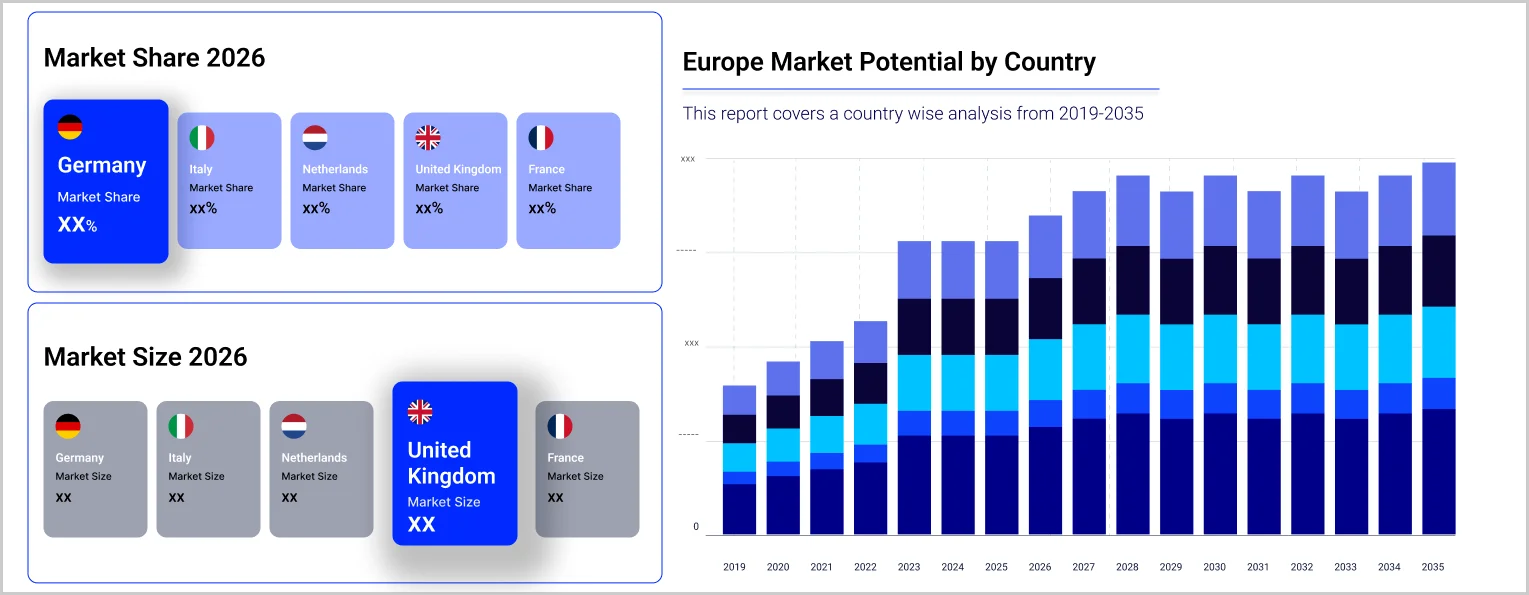
Key Insight: Germany is the leading national market in the Europe fruits and vegetables juice market analysis, supported by strong per-capita juice consumption, an established base of branded and private label producers, and a mature retail infrastructure. The United Kingdom is the fastest-growing national market, aided by strong private label penetration and rapid growth of online grocery channels, while France, Italy, and the Netherlands continue to see steady demand supported by both branded and private label supply.
By Type, fruit juices dominate the market due to long-established brand equity and broad retail availability across Europe
Fruit juices represent the dominant type in the Europe fruits and vegetables juice market scope, with orange, apple, and multifruit variants continuing to anchor retailer shelf space across supermarkets, discounters, and convenience formats.
Vegetable juices and fruit and vegetable blends represent the fastest-growing types and are the primary growth drivers for manufacturers seeking to capture demand for savoury, low-sugar, and functional juice formats among health-conscious European consumers.
By Packaging Type, Tetra Pak cartons lead due to shelf stability and strong recycled content credentials
Tetra Pak cartons represent the leading packaging format in the Europe fruits and vegetables juice market, supported by manufacturer investment in high-recycled-content and renewable carton formats that align with EU packaging and deposit return regulation.
Pouches are the fastest-growing packaging format and are the primary growth driver in the children's and on-the-go juice drink segment, reflecting continued product innovation from manufacturers such as Capri Sun Group Holding AG.
By Distribution Channel, supermarkets and hypermarkets lead due to broad format and brand availability
Supermarkets and hypermarkets represent the dominant distribution channel in the Europe fruits and vegetables juice market scope, with chilled and ambient juice aisles serving as a key battleground between branded and private label suppliers.
Online retail is the fastest-growing distribution channel and is the primary growth driver for direct-to-consumer and subscription-based juice models, as grocery delivery platforms expand chilled and ambient juice ranges across the region.
Read more about this report - Request a Free Sample
Germany dominates the market due to its established base of branded and private label juice producers and strong per-capita consumption
Germany leads the Europe fruits and vegetables juice market by consumption volume, supported by an established base of branded manufacturers, a mature retail infrastructure, and strong per-capita juice consumption relative to the rest of the region.
The United Kingdom is the fastest-growing national market in the Europe fruits and vegetables juice market analysis, driven by strong private label penetration and accelerating growth of online grocery channels, while France, Italy, and the Netherlands continue to post steady, broadly stable demand.
The Europe fruits and vegetables juice market players landscape is shaped by a mix of large branded manufacturers with strong pan-European portfolios and independent bottlers that produce private label and licensed juice ranges for retailers across the region. Competition is concentrated among a relatively small number of scaled branded producers, alongside a broader tier of national and regional manufacturers supplying private label and food service customers.
Europe fruits and vegetables juice market companies are differentiating through investment in reduced-sugar reformulation, functional and fortified product lines, premium direct juice ranges, and sustainable packaging formats. The market's structure means competitive dynamics are increasingly shaped by innovation speed, licensing partnerships with adjacent food and beverage brands, and the ability to supply retailers with cost-competitive private label ranges alongside recognised branded products.
Founded in 1857 and headquartered in Nieder-Olm, Germany, Eckes-Granini Group GmbH is one of Europe's leading branded fruit juice manufacturers, with a portfolio built around brands including Granini, hohes C, Pago, and Joker sold across more than two dozen European markets. The company continues to expand its functional juice offering, including its hohes C All-in-One range, and has grown through bolt-on acquisitions of regional juice producers. Key strength: Eckes-Granini's combination of internationally recognised premium brands with strong national brands in individual markets gives it broad shelf presence across both everyday and premium price tiers of the Europe fruits and vegetables juice market.
Founded in 1892 and headquartered in Atlanta, Georgia, United States, The Coca-Cola Company participates in the Europe fruits and vegetables juice market through its European bottling partners, most notably Coca-Cola Europacific Partners, and through its majority stake in smoothie and juice brand Innocent Drinks Ltd. The company has directed sustained capital investment toward sugar reduction and reformulation across its European beverage portfolio. Key strength: The Coca-Cola Company's global brand equity, combined with the manufacturing scale and route-to-market of its European bottling network, gives it exceptional distribution reach across supermarkets, convenience formats, and food service channels.
Founded in 1965 and headquartered in Purchase, New York, United States, PepsiCo Inc. retains indirect exposure to the Europe fruits and vegetables juice market through its non-controlling stake in Tropicana Brands Group, the joint venture formed with PAI Partners that holds the Tropicana and Naked juice brands. PepsiCo continues to supply juice-adjacent categories across Europe through its broader beverage and nutrition portfolio. Key strength: PepsiCo's global scale in beverage manufacturing and route-to-market, combined with its financial interest in a dedicated juice-focused joint venture, allows it to participate in category upside while limiting direct European manufacturing risk.
Founded in 2011 through the merger of several European bottlers and headquartered in Rotterdam, the Netherlands, Refresco Group B.V. is the world's largest independent bottler of private label and licensed beverages, including fruit and vegetable juices, for retailers and branded customers. The company continues to expand through its Buy and Build acquisition strategy, most recently adding Norwegian manufacturer Telemark Kildevann to its European production network. Key strength: Refresco's extensive European manufacturing footprint and private label expertise make it the preferred supply partner for retailers seeking cost-competitive, high-quality juice ranges across multiple national markets.
Other key players in the Europe Fruits and Vegetables Juice Market report include Capri Sun Group Holding AG, Britvic plc (Carlsberg Group), Innocent Drinks Ltd., Rauch Fruchtsäfte GmbH, and Riha WeserGold Getränke GmbH & Co. KG, among others.
*Please note that this is only a partial list; the complete list of key players is available in the full report. Additionally, the list of key players can be customized to better suit your needs.*
Explore the latest trends shaping the Europe Fruits and Vegetables Juice Market 2026-2035 with our in-depth report. Gain strategic insights, future forecasts, and key market developments that can help you stay competitive. Download a free sample report or contact our team for customised consultation on Europe fruits and vegetables juice market trends 2026.


Upto 15% Off
USD
$2499 $2249
$3999 $3599
$4999 $4249
$5999 $5099


*While we strive to always give you current and accurate information, the numbers depicted on the website are indicative and may differ from the actual numbers in the main report. At Expert Market Research, we aim to bring you the latest insights and trends in the market. Using our analyses and forecasts, stakeholders can understand the market dynamics, navigate challenges, and capitalize on opportunities to make data-driven strategic decisions.*
The Europe Fruits and Vegetables Juice Market was valued at USD 38.90 Billion in 2025.
The market is projected to grow at a CAGR of 4.50% between 2026 and 2035.
The key players include Eckes-Granini Group GmbH, The Coca-Cola Company, PepsiCo Inc., Refresco Group B.V., Capri Sun Group Holding AG, Britvic plc (Carlsberg Group), Innocent Drinks Ltd., Rauch Fruchtsäfte GmbH, and Riha WeserGold Getränke GmbH & Co. KG.
Key challenges include input cost volatility for fruit and vegetable concentrates, regulatory pressure on sugar content and labelling, packaging and deposit return compliance costs, and intensifying competition between branded and private label suppliers.
Key strategies include reduced-sugar reformulation, premium and functional juice launches, licensing partnerships for direct juice ranges, cross-border consolidation among independent bottlers, and continued investment in sustainable packaging capacity.
Explore our key highlights of the report and gain a concise overview of key findings, trends, and actionable insights that will empower your strategic decisions.
|
Report Features |
Details |
|
Base Year |
2025 |
|
Historical Period |
2019-2025 |
|
Forecast Period |
2026-2035 |
|
Scope of the Report |
Historical and Forecast Trends, Industry Drivers and Constraints, Historical and Forecast Market Analysis by Segment:
|
|
Breakup by Type |
|
|
Breakup by Packaging Type |
|
|
Breakup by Distribution Channel |
|
|
Breakup by Region |
|
|
Market Dynamics |
|
|
Competitive Landscape |
|
|
Companies Covered |
|
Datasheet
One User
USD 2,499
USD 2,249
tax inclusive*
Single User License
One User
USD 3,999
USD 3,599
tax inclusive*
Five User License
Five User
USD 4,999
USD 4,249
tax inclusive*
Corporate License
Unlimited Users
USD 5,999
USD 5,099
tax inclusive*
*Please note that the prices mentioned below are starting prices for each bundle type. Kindly contact our team for further details.*
Flash Bundle
Small Business Bundle
Growth Bundle
Enterprise Bundle
*Please note that the prices mentioned below are starting prices for each bundle type. Kindly contact our team for further details.*
Flash Bundle
Number of Reports: 3
20%
tax inclusive*
Small Business Bundle
Number of Reports: 5
25%
tax inclusive*
Growth Bundle
Number of Reports: 8
30%
tax inclusive*
Enterprise Bundle
Number of Reports: 10
35%
tax inclusive*
How To Order

Select License Type
Choose the right license for your needs and access rights.

Click on ‘Buy Now’
Add the report to your cart with one click and proceed to register.

Select Mode of Payment
Choose a payment option for a secure checkout. You will be redirected accordingly.
Strategic Solutions for Informed Decision-Making
Gain insights to stay ahead and seize opportunities.

Get insights & trends for a competitive edge.

Track prices with detailed trend reports.

Analyse trade data for supply chain insights.

Leverage cost reports for smart savings

Enhance supply chain with partnerships.

Connect For More Information
Our expert team of analysts will offer full support and resolve any queries regarding the report, before and after the purchase.
Our expert team of analysts will offer full support and resolve any queries regarding the report, before and after the purchase.
We employ meticulous research methods, blending advanced analytics and expert insights to deliver accurate, actionable industry intelligence, staying ahead of competitors.
Our skilled analysts offer unparalleled competitive advantage with detailed insights on current and emerging markets, ensuring your strategic edge.
We offer an in-depth yet simplified presentation of industry insights and analysis to meet your specific requirements effectively.




