

Consumer Insights
Uncover trends and behaviors shaping consumer choices today
Procurement Insights
Optimize your sourcing strategy with key market data
Industry Stats
Stay ahead with the latest trends and market analysis.
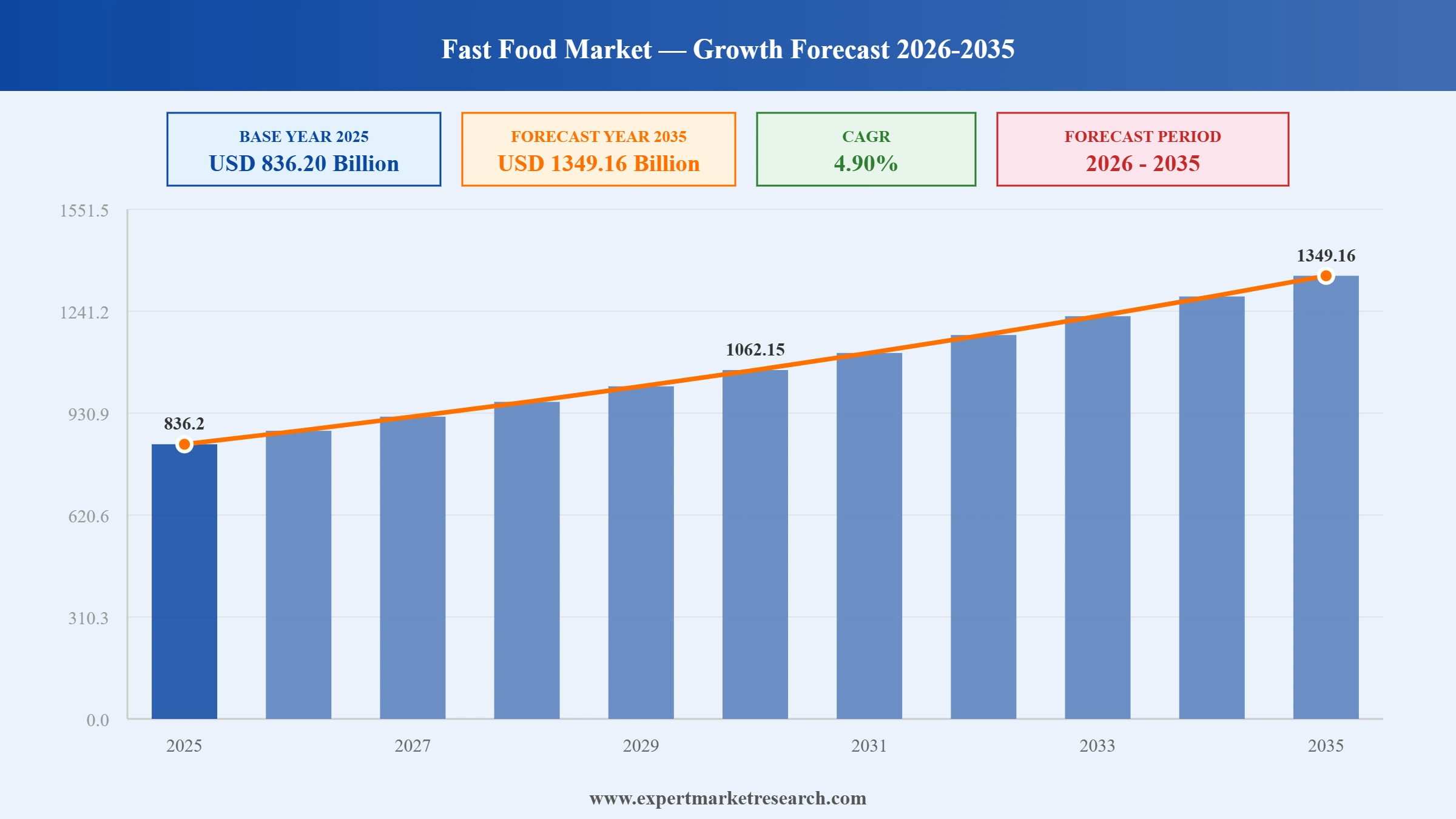
The global fast food market attained a value of USD 836.20 Billion in 2025 and is projected to expand at a CAGR of 4.90% through 2035. The market is further expected to achieve USD 1349.16 Billion by 2035. The use of online ordering systems, artificial intelligence-based management, and growth of specialized restaurants in terms of deliveries are boosting sales levels, improved productivity, and provided scalable avenues for growth among fast food restaurants.
One trend that can be observed in the global fast food market is McDonald's further expansion of its investments in AI-enabled restaurant operations system within key markets, announced in August 2025. The company is expanding its predictive kitchen management systems, its AI-enabled drive-thru system, and other technological tools aimed at improving the accuracy of orders and reducing their processing time. These moves reflect the growing expectations of customers regarding fast service. In May 2026, McDonald's revealed that the company's loyalty program currently serves over 175 million active users in over 60 different markets. Hence, such initiatives illustrate the approach used by major fast food brands to boost their competitiveness and profitability in a highly competitive market.
In the current fast food market dynamics, companies continue to invest in their menu, digital ordering, and expansion within urban regions. There is a clear tendency towards the launch of temporary products, high-end offerings, and regional menu items. For example, in August 2025, Zippy’s Restaurants partnered with Bottle Rocket to launch an advanced digital ordering platform, enhancing customer convenience and engagement. At the same time, restaurant chains tend to develop relationships with delivery partners as well as develop own applications.
Operators in the fast food market are now turning their focus to value-minded customers using various techniques like menu engineering and price reduction strategies. Companies like Yum! Brands and Restaurant Brands International are making use of data analysis in order to create promotional offers and drive repeat visits while maintaining profitability. Moreover, international expansion to tier-two and tier-three markets is also creating new sources of income, especially in countries in the Asia Pacific and Middle East regions.
Read more about this report - REQUEST FREE SAMPLE COPY IN PDF
| Global Fast Food Market Report Summary | Description | Value |
| Base Year | USD Billion | 2025 |
| Historical Period | USD Billion | 2019-2025 |
| Forecast Period | USD Billion | 2026-2035 |
| Market Size 2025 | USD Billion | 836.20 |
| Market Size 2035 | USD Billion | 1349.16 |
| CAGR 2019-2025 | Percentage | XX% |
| CAGR 2026-2035 | Percentage | 4.90% |
| CAGR 2026-2035 - Market by Region | Asia Pacific | 6.3% |
| CAGR 2026-2035 - Market by Country | India | 7.3% |
| CAGR 2026-2035 - Market by Country | Brazil | 6.1% |
| CAGR 2026-2035 - Market by Product Type | Pizza/Pasta | 5.5% |
| CAGR 2026-2035 - Market by End User | Full-Service Restaurants | 5.6% |
| Market Share by Country 2025 | China | 16.9% |
Global transformation efforts were undertaken by KFC through innovative boneless chicken products, unique sauces, modern restaurant concepts, and rebranding. The strategy seeks to boost consumer experience through digitized restaurant designs and innovative flavor-based menus that will further strengthen KFC’s competitiveness in the growing QSR market globally. Other brands in the fast food market could use experiential restaurant concepts, personalized menus, and digital engagement to appeal to younger customers.
Impresario Entertainment & Hospitality unveiled the Goodness To Go brand in India, with salads, soups, and poke bowls using a delivery-only concept. This is an illustration of the rising demand among consumers for health-based meal choices, which is why companies can create health-based cloud kitchen brands that would meet this demand.
CRAVIOS strengthened its presence in India’s premium fast-food segment by offering elevated menu experiences that combine quality ingredients, modern branding, and quick service. This is indicative of consumers becoming increasingly willing to invest in pre-immunized fast food that provides both convenience as well as an upgraded dining experience. Companies in the fast food market can therefore include their premium menu category and dining experience to generate stable revenue.
Swiggy introduced the Bolt platform which delivers food in ten minutes from nearby restaurants. The platform caters to quick-to-cook and ready-to-pack dishes in order to cater to rising consumer demands for speed as well as efficiency. Such developments encourage restaurant partners to generate more orders efficiently.
AI technologies are becoming a key factor influencing the development of the global fast food market. AI technologies might help to increase speed and efficiency at restaurants as chain restaurants look to improve their operations. These improvements include drive-thru AI systems, inventory prediction tools, and kitchen automation systems. As a case in point, the company Yum! Brands collaborated with the tech corporation NVIDIA in March 2025 to implement more advanced AI solutions in its subsidiaries Taco Bell, KFC, Pizza Hut, and Habit Burger.
The fast growth of delivery platforms is changing the overall fast food market trends and dynamics. Companies are starting to open more delivery-oriented restaurants, ghost kitchens, and even develop dedicated mobile apps. For example, companies like McDonald's, Domino's, and Burger King are strengthening their cooperation with delivery aggregators and their direct channels. The implementation of digital economy policies across various states is creating favorable conditions for restaurants to embrace digital technologies. For example, in May 2026, Papa Johns introduced Lou AI, an AI-powered ordering assistant that personalizes group food selections, simplifies decision-making, and recommends suitable menu combinations.
The rising trend in the fast food market is an increased emphasis on high-quality products, which can be described by limited-time offers. Currently, an increasing number of customers show their preference for unique flavor profiles, superior ingredients, and quality restaurant-like experience provided with the fast-food format. For instance, the company McDonald's announced its program called "Best Burger", in March 2024, which implied implementing operational changes and using better ingredients. Similarly, in June 2026, Burger King launched a seasonal menu featuring guest-inspired burgers, frozen beverages, and desserts, boosting customer engagement. At the same time, companies such as Wendy's and Shake Shack continue creating their premium menus for younger clients. Food safety and quality standards established by governmental authorities in Europe and North America are compelling companies to invest in better products to stand out among their competitors.
Currently, sustainability efforts are becoming a competitive advantage within the global fast food market. Many restaurants are turning to recyclable, compostable, and fiber-based packaging options as a result of environmental policies and regulations. Starbucks and McDonald's became participants in various sustainable packaging programs, which help reduce single-use waste. The European Union directive on single-use plastics is also leading to the implementation of alternative packaging materials in the food service industry. For example, in June 2026, KFC refreshed its United Kingdom and Ireland branding across packaging and digital channels, strengthening brand recognition and customer engagement.
Fast food chains operating around the world are becoming more focused on new urban areas characterized by increasing consumer spending power, expanding middle-class populations, and changing lifestyles that favor increased spending at restaurants. Companies such as Restaurant Brands International, Yum! Brands, and Domino's Pizza are expanding quickly within Asian, Middle Eastern, African, and Latin American markets. This includes rapid expansion plans made by chains such as Popeyes and Tim Hortons via franchise models. The development of infrastructure and transport systems, together with investments in business-related property developments, is aiding this process of internationalization. Aligning with this trend in the fast food market, in June 2026, Kolkata-based QSR startup Puchkaman achieved 150% annual growth and accelerated expansion across Eastern India and Canada, strengthening global street-food franchise opportunities.
The Expert Market Research's report titled “Global Fast Food Market Report and Forecast 2026-2035” offers a detailed analysis of the market based on the following segments:
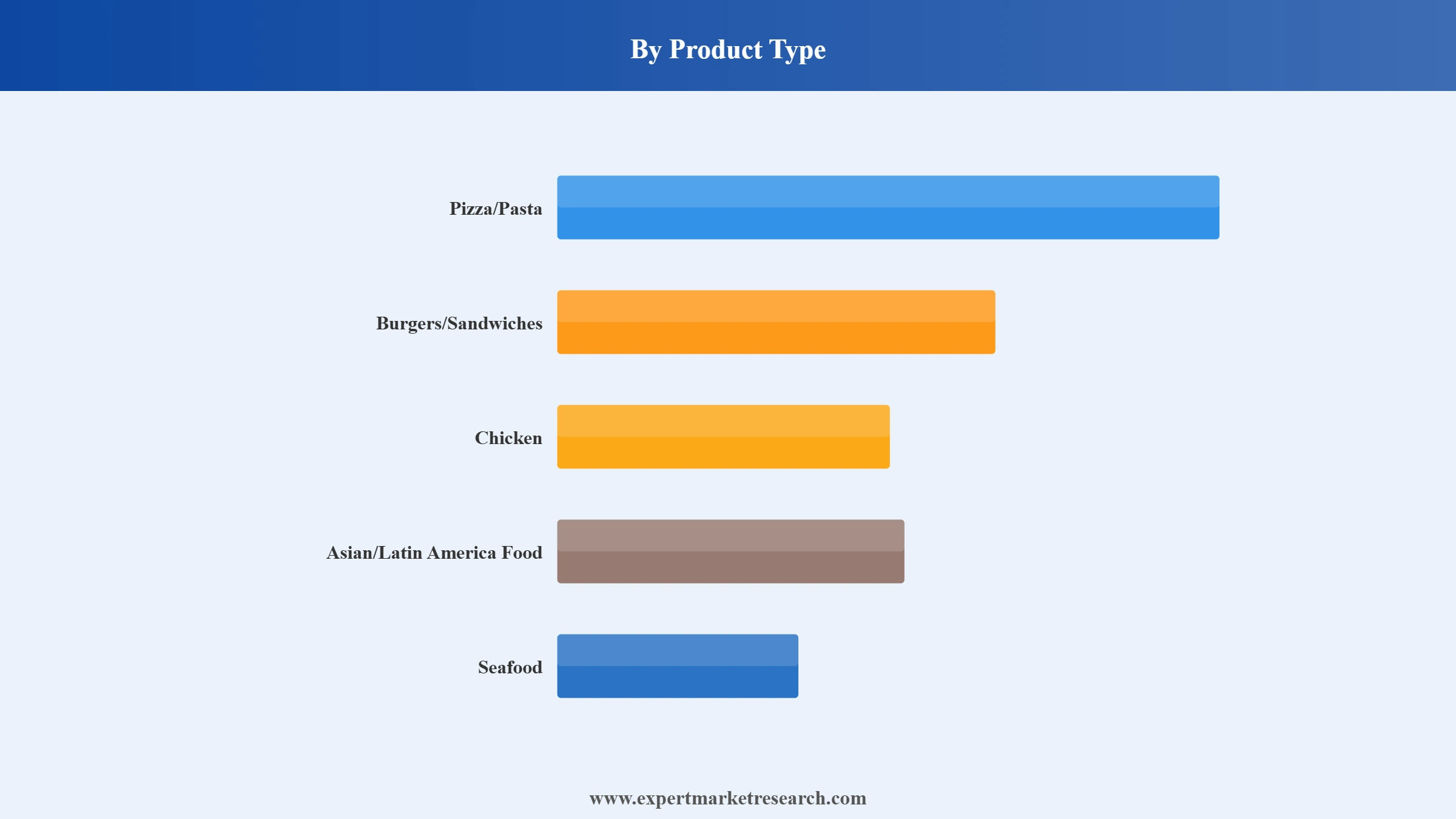
Market Breakup by Product Type
Key Insight: The type of products considered in the report indicates different customer preferences. Burgers/sandwiches dominate the fast food market on account of their effective production process, personalization options, and brand recognition. The popularity of pizza/pasta remains high due to its use within families and order among groups. Chicken continues to gain advantage due to people’s protein-centric diet. Asian/Latin America food emerges as one of the fastest-growing segments since there is an increasing desire for exotic cuisine. Seafood appeals to those looking for healthy meals and premium products, whereas other fast food types help in innovating by introducing niche concepts.
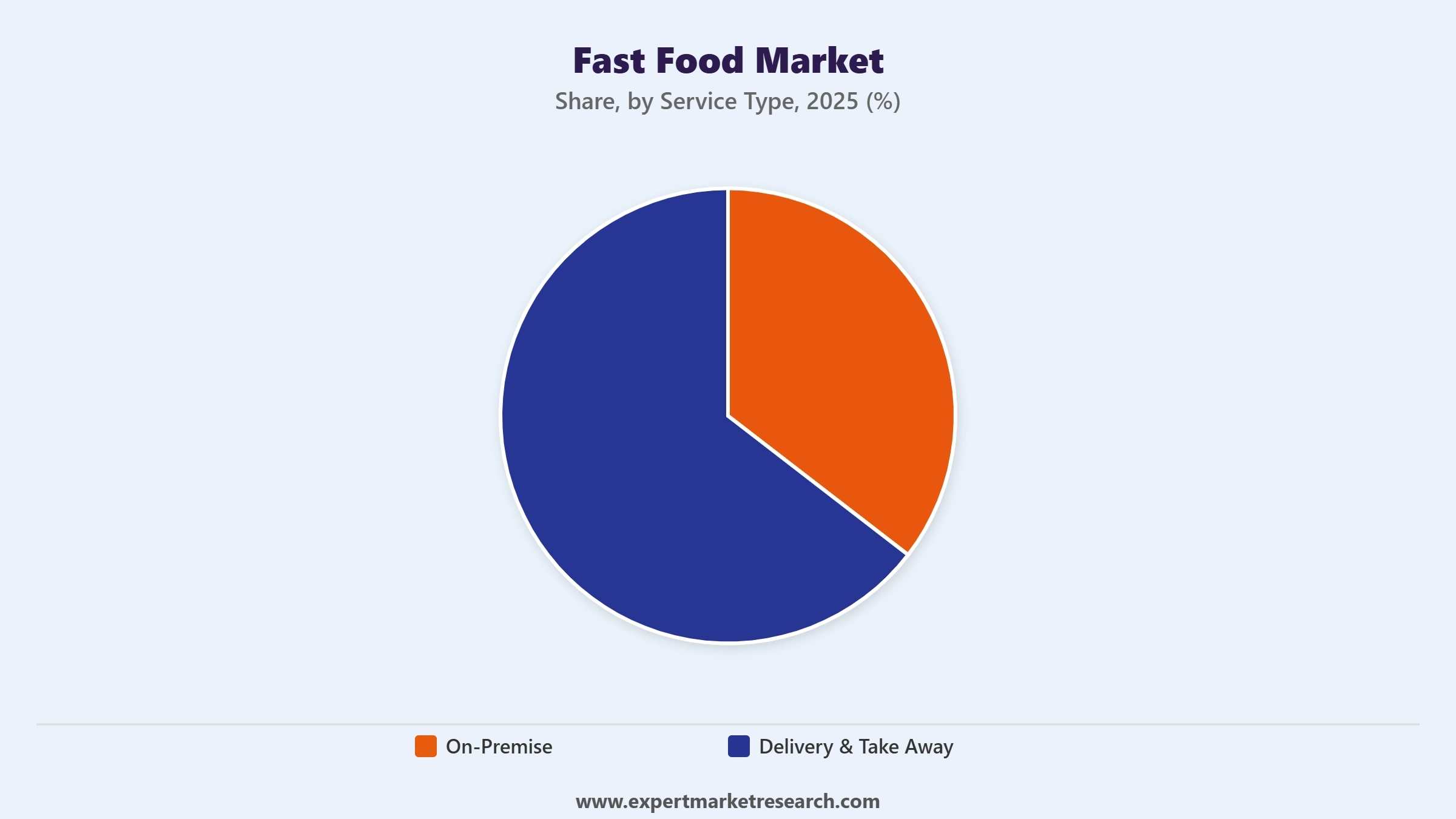
Market Breakup by Service Type
Key Insight: Models of service provision are continuously developing along with changes in customer behavior. Delivery and take away services continue to hold the dominant share of the fast food market due to factors such as convenience, increasing use of ordering platforms, and developing delivery capabilities. In addition, the on-premise segment is becoming increasingly popular as restaurants try to develop and upgrade their offerings by providing experience-based consumption. This creates the opportunity for companies to implement the hybrid business model where the focus is on efficient operations and customer satisfaction.
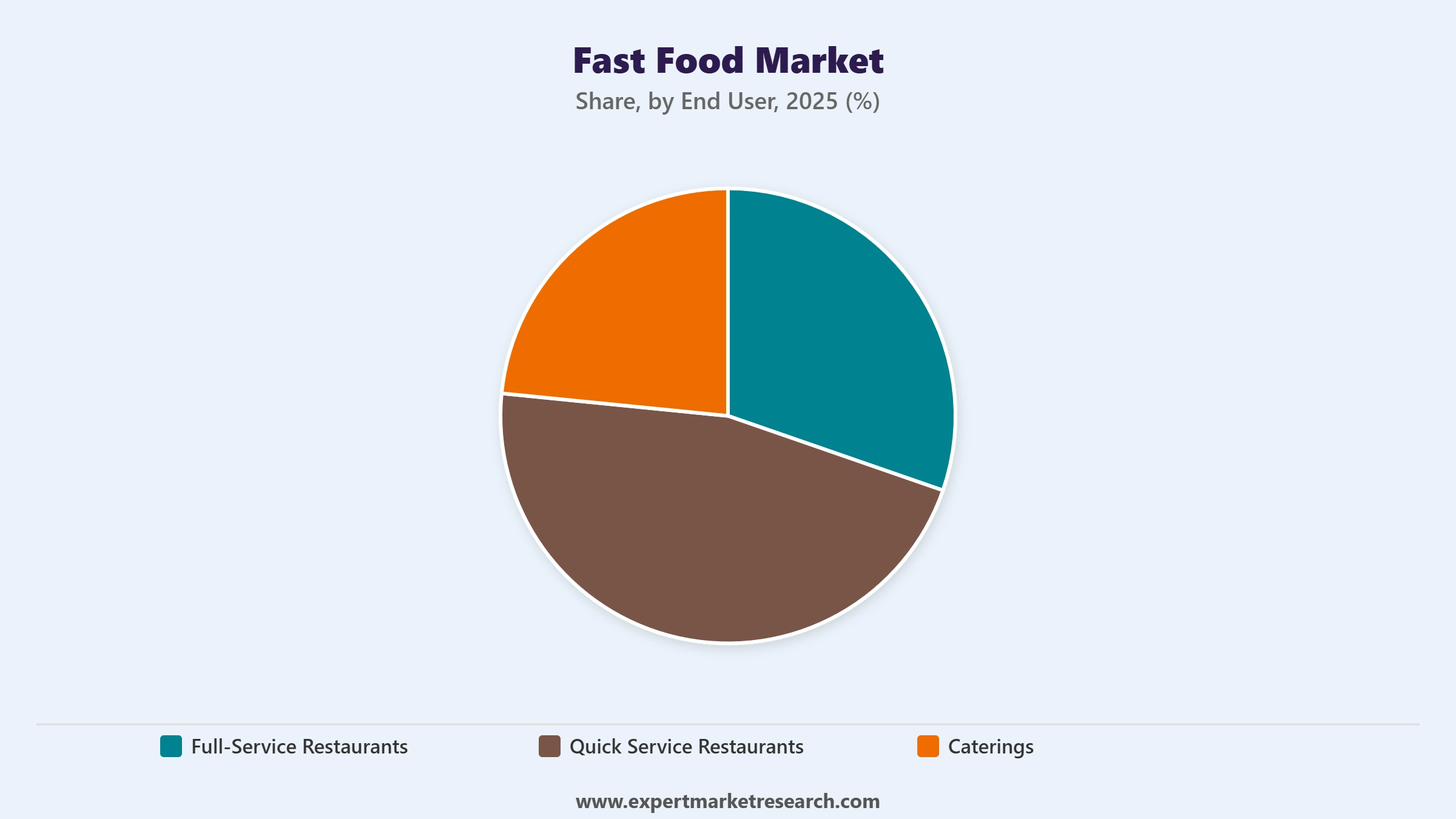
Market Breakup by End User
Key Insight: Consumer demand depends on various circumstances associated with the consumption occasion and operations. QSRs dominate the industry due to efficiency, recognition, and widespread geographical spread. The contribution made by full-service restaurants is through attracting consumers who are looking for an increased variety of food items and dining experience. The emerging trend in catering services comes from rising demand for structured meal provision. The rest of the end-user segments add diversity through unique concepts and localized approaches, expanding the fast food market scope. Overall, these groups provide several streams of income, thus addressing consumers' different demands.
Market Breakup by Region
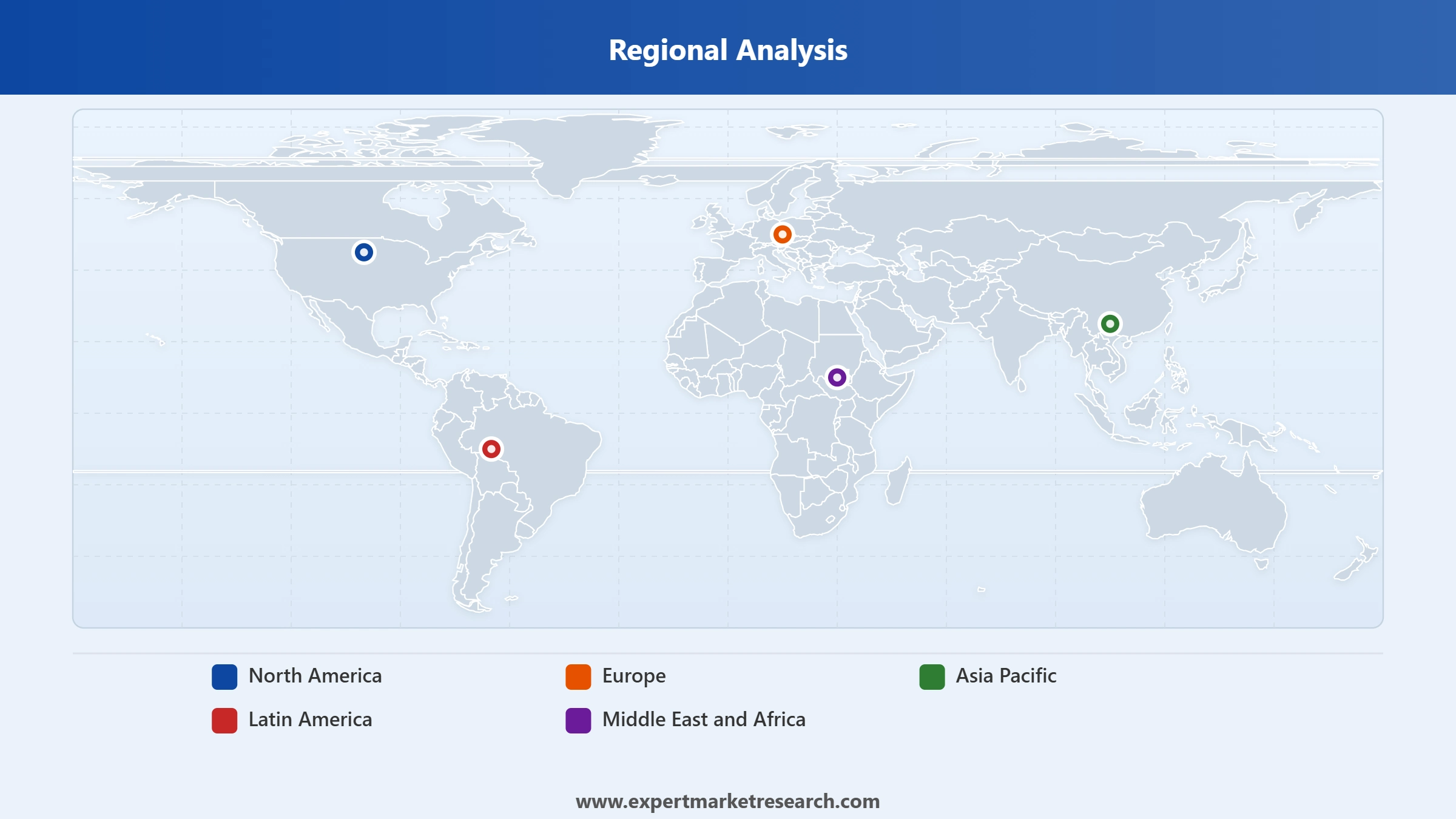
Key Insight: Regional fast food market performance depends on consumer characteristics, economic development, and infrastructure of restaurants. North America leads in terms of market share by virtue of franchise, technology, and brands. Premium products and sustainable consumption make Europe well-positioned to perform well. Asia Pacific is witnessing the highest rate of growth based on urbanization, digitization, and rise of middle classes. Latin American markets take advantage of increased penetration and changing consumer lifestyles. The Middle East and Africa remain attractive due to retail and international brands partnerships.
Read more about this report - REQUEST FREE SAMPLE COPY IN PDF
By product type, burgers/sandwiches register the largest share of the market due to menu versatility and strong global brand penetration
The burgers/sandwiches segment is currently leading the global fast food market owing to the continued investment made by companies to customize food products, premium food items, and value-based combos. Major chains operating in this sector operate in a highly standardized manner, making it possible to expand internationally. This sector fits well with current consumer trends that include a need for portable meals. Continuous innovation in menu choices, regional tastes, and strong franchise base ensure that operators can generate more transactions and higher levels of customer retention. In April 2026, Papa Johns launched oven-toasted sandwiches, expanding beyond pizza to capture lunch occasions and increase sales.
Fast food items inspired by Asian and Latin cuisines are witnessing massive growth in the fast food market due to the rising consumer interest in distinctive food items and novel flavors. Leading restaurant chains are adding menu items in the form of Korean, Japanese, Mexican, Thai, and Latin dishes for attracting young customers interested in experimenting with new tastes. Growth in multiracial societies, increased popularity of international food types, and premium sauces and regional spices are helping restaurant operators expand their margins while catering to consumers' preferences beyond the conventional fast food sector. In June 2026, Lawson launched limited-time oversized meal offerings, enhancing value perception, and driving higher customer traffic.
Read more about this report - REQUEST FREE SAMPLE COPY IN PDF
By service type, delivery and take away capture a substantial market share due to convenience-focused purchasing behavior
The take away segment is becoming the key service type that is motivating the fast food market revenue growth, powered by consumer preference for convenience and speed. Restaurants are increasingly developing collaborations with delivery platforms while working on building their own ordering applications. Takeaway services allow brands to expand their geographic scope without necessarily having to extend their dining space. Logistics improvements, order tracking, and the development of loyalty programs further drive customer engagement. This gives brands the opportunity to optimize operations and increase their order frequency. In February 2026, Rapido’s Ownly expanded food delivery across Bengaluru, India, targeting multi-city growth through zero-commission restaurant partnerships.
The on-premises category is becoming a rising trend as the fast food market is modernizing its dining spaces to provide better customer experience and engagement. New store designs, digital interfaces, open kitchens, and high-class seating options are increasing the amount of time that consumers stay in the restaurants' premises. Brands are further offering unique dining options and limited-edition menu items, which they do not offer via deliveries. Such initiatives help brands increase their ticket averages. In April 2025, Golden Corral launched a fast-casual concept focused on off-premise dining, enhancing convenience, and digital ordering.
Read more about this report - REQUEST FREE SAMPLE COPY IN PDF
Quick Service Restaurants account for the largest share of the market due to speed-focused operations and scalability
QSRs account for the major share of the market revenue owing to their efficiency, standardization, and effective franchise expansion strategies. Well-established international QSR brands rely on efficient kitchen operations, digital ordering methods, and wide-ranging logistics services to cater to huge numbers of customers regularly. Efficiency in introducing innovations while ensuring the efficiency of operations facilitates consistent growth. In addition, the current trends in the behavior of consumers seeking convenience further help QSRs grow as consumers are increasingly seeking fast-food services in urbanized settings. According to the fast food market research, Jersey Mike’s topped ACSI customer satisfaction rankings, ending Chick-fil-A’s 11-year leadership among quick-service restaurants, as of June 2026.
Fast food companies are witnessing tremendous growth in the catering sub-segment as organizations, schools, and social events continue to look for easy access to food services. Special packages that can satisfy large groups without compromising on quality or price are being designed by the fast food market players. The growth in the segment is further boosted by corporate events and workplace events. The availability of digital ordering and menu customizing makes catering a lucrative business line for market players.
Read more about this report - REQUEST FREE SAMPLE COPY IN PDF
North America secures the leading position of the market due to strong franchise networks and digital adoption
North America accounts for the largest regional fast food market due to its advanced ecosystem of quick-service restaurants, substantial per capita expenditure on convenience foods, and extensive use of ordering systems online. Large-scale multinational restaurant chains are constantly launching new technologies, loyalty programs, and new product lines in North America prior to implementing those elsewhere globally. The huge presence of franchises makes it easier to scale up with uniform operations. Besides, the efficient logistical system and integration into delivery services ensure continuous demand. Under these circumstances, it becomes possible for regional players to be ahead of others regarding innovation, customer interaction, and operational efficiency. In April 2026, Burger King launched a limited-time Mandalorian-themed menu, boosting engagement through entertainment-driven promotional offerings.
The Asia Pacific region witnesses the most intensive fast food market development because of rising purchasing power, increasing urbanization, and lifestyle changes that create the need for convenient dining solutions. Fast food brands from around the world are rapidly expanding into the region via franchising, at the same time offering menus designed for local taste. High adoption rates of smartphones and electronic payments encourage online ordering, while the youthful demographic interested in trying out foreign fast food brands fuels additional growth. In May 2026, Trimex Foods secured Panda Express franchise rights, planning 100 Indian outlets through INR 400 crore investment.
Read more about this report - REQUEST FREE SAMPLE COPY IN PDF
The global industry is seeing increased competition as fast food companies adopt digital ecosystems, AI-driven orders, restaurant automation, and innovation in its menus. The leading firms in the industry are concentrating on developing loyalty programs, enhancing deliveries, and analyzing data to increase efficiency. Premium products, flavors that are globally influenced, and localized menus are also being offered to customers to attract changing tastes.
Sustainability is becoming another area for investment in recyclable packaging and responsible sourcing. Some significant areas for investment and development include emerging urban markets, delivery-only business models, smart kitchens, and personalized marketing. Customer data is increasingly used by fast food market players to boost their promotional and retention strategies. Collaboration with tech suppliers, delivery aggregators, and cloud kitchen operators presents opportunities for growth.
Founded in 1940, McDonald's Corporation operates from its head office in California, United States, maintaining its position as a top multinational brand due to its network of franchises, advanced digital ordering systems, and artificial intelligence-operated restaurants. The company is continuing to invest in the development of loyalty ecosystems, automated drive-thru system, as well as localized menu innovations to enhance operational speed, increase customer interaction, improve digital sales results, and expand business in the international market segments of rapid growth.
Founded in 1965 and based in the United States, Subway IP LLC serves the fast food market with its customizable menu options, healthy, yet delicious, fast food. The company is implementing changes at restaurants, improving its digital order platform, developing chef-inspired menus, as well as focusing on expanding internationally by utilizing personalized strategies.
Founded in 1977 with its headquarters in Kentucky, United States, Yum Brands Inc. owns popular brands such as KFC, Pizza Hut, Taco Bell, and Habit Burger Grill. Yum Brands is rapidly increasing the adoption of artificial intelligence systems, online ordering options, and marketing strategies driven by data insights. By leveraging technological collaboration and introducing innovative menus, Yum Brands creates better experiences for customers and optimizes restaurant operations.
Founded in 2014 with its headquarters in Toronto, Canada, Restaurant Brands International Inc. owns Burger King, Tim Hortons, Popeyes, and Firehouse Subs. This corporation concentrates on updating its restaurants, extending loyalty programs, and implementing high-quality digital commerce. With effective investments in international expansion, unique menus, and technologically enhanced operations, the company is able to build long-term success through customer engagement.
Other key players in the fast food market include Taco Bell IP Holder, LLC, Auntie Anne’s Franchisor SPV LLC, Cinnabon Franchisor SPV LLC, Jubilant FoodWorks Ltd., Inspire Brands, Inc., Hardee's Restaurants LLC, Firehouse Restaurant Group, Inc., Burger King, Wendy's, Domino's, Pizza Hut, Papa John's International, Inc., Little Caesars, Chipotle Mexican Grill, Dunkin, Wallace, and Fujian Food Co., Ltd., among others.
*Please note that this is only a partial list; the complete list of key players is available in the full report. Additionally, the list of key players can be customized to better suit your needs.*
Unlock the latest insights with our fast food market trends 2026 report. Discover regional growth patterns, consumer preferences, and key industry players. Stay ahead of competition with trusted data and expert analysis. Download your free sample report today and drive informed decisions in the market.


Upto 15% Off
USD
$2499 $2249
$3999 $3599
$4999 $4249
$5999 $5099


*While we strive to always give you current and accurate information, the numbers depicted on the website are indicative and may differ from the actual numbers in the main report. At Expert Market Research, we aim to bring you the latest insights and trends in the market. Using our analyses and forecasts, stakeholders can understand the market dynamics, navigate challenges, and capitalize on opportunities to make data-driven strategic decisions.*
The global fast food market reached approximately USD 836.20 USD in 2025.
The market is projected to grow at a CAGR of 4.90% between 2026 and 2035.
The market is expected to reach a value of around USD 1349.16 Billion by 2035.
The trend of eating at restaurants, expansion of fast food chains, and continuous menu innovations aid the market for fast food products.
The major regions in the industry are North America, Latin America, the Middle East and Africa, Europe, and the Asia Pacific.
The significant product types include pizza/pasta, burgers/sandwiches, chicken, Asian/ Latin American food, and seafood, among others.
The major segments of the product based on end user include full-service restaurants, quick service restaurants, and caterings, among others.
Major players in the market are McDonald's Corporation, Subway IP LLC, Yum Brands Inc., Restaurant Brands International Inc., Taco Bell IP Holder, LLC, Auntie Anne’s Franchisor SPV LLC, Cinnabon Franchisor SPV LLC, Jubilant FoodWorks Ltd., Inspire Brands, Inc., Hardee's Restaurants LLC, Firehouse Restaurant Group, Inc., Burger King, Wendy's, Domino's, Pizza Hut, Papa John's International, Inc., Little Caesars, Chipotle Mexican Grill, Dunkin, Wallace, and Fujian Food Co., Ltd., among others.
McDonald's Corporation, Subway IP LLC, Starbucks, and KFC are some of the most popular fast food chains.
Economic downturns, stringent food safety regulations, and changing consumer preferences are some major challenges.
Fast food delivery services have significantly expanded the fast food market by increasing accessibility and convenience. Services like UberEats, DoorDash, and Grubhub enable consumers to order from multiple brands without leaving their homes, boosting sales and catering to a variety of customer needs.
The burger and sandwich segment is the leading product type in the market.
The key factor driving the market is the rising demand for convenience food and quick-service restaurants (QSRs).
North America held the highest market share due to high QSR penetration and consumer demand.
Factors driving adoption include changing consumer lifestyles, increasing disposable income, and technological advancements in food delivery services.
Explore our key highlights of the report and gain a concise overview of key findings, trends, and actionable insights that will empower your strategic decisions.
| REPORT FEATURES | DETAILS |
| Base Year | 2025 |
| Historical Period | 2019-2025 |
| Forecast Period | 2026-2035 |
| Scope of the Report |
Historical and Forecast Trends, Industry Drivers and Constraints, Historical and Forecast Market Analysis by Segment:
|
| Breakup by Product Type |
|
| Breakup by Service Type |
|
| Breakup by End User |
|
| Breakup by Region |
|
| Market Dynamics |
|
| Competitive Landscape |
|
| Companies Covered |
|
Datasheet
One User
USD 2,499
USD 2,249
tax inclusive*
Single User License
One User
USD 3,999
USD 3,599
tax inclusive*
Five User License
Five User
USD 4,999
USD 4,249
tax inclusive*
Corporate License
Unlimited Users
USD 5,999
USD 5,099
tax inclusive*
*Please note that the prices mentioned below are starting prices for each bundle type. Kindly contact our team for further details.*
Flash Bundle
Small Business Bundle
Growth Bundle
Enterprise Bundle
*Please note that the prices mentioned below are starting prices for each bundle type. Kindly contact our team for further details.*
Flash Bundle
Number of Reports: 3
20%
tax inclusive*
Small Business Bundle
Number of Reports: 5
25%
tax inclusive*
Growth Bundle
Number of Reports: 8
30%
tax inclusive*
Enterprise Bundle
Number of Reports: 10
35%
tax inclusive*
How To Order

Select License Type
Choose the right license for your needs and access rights.

Click on ‘Buy Now’
Add the report to your cart with one click and proceed to register.

Select Mode of Payment
Choose a payment option for a secure checkout. You will be redirected accordingly.
Strategic Solutions for Informed Decision-Making
Gain insights to stay ahead and seize opportunities.

Get insights & trends for a competitive edge.

Track prices with detailed trend reports.

Analyse trade data for supply chain insights.

Leverage cost reports for smart savings

Enhance supply chain with partnerships.

Connect For More Information
Our expert team of analysts will offer full support and resolve any queries regarding the report, before and after the purchase.
Our expert team of analysts will offer full support and resolve any queries regarding the report, before and after the purchase.
We employ meticulous research methods, blending advanced analytics and expert insights to deliver accurate, actionable industry intelligence, staying ahead of competitors.
Our skilled analysts offer unparalleled competitive advantage with detailed insights on current and emerging markets, ensuring your strategic edge.
We offer an in-depth yet simplified presentation of industry insights and analysis to meet your specific requirements effectively.




