

Consumer Insights
Uncover trends and behaviors shaping consumer choices today
Procurement Insights
Optimize your sourcing strategy with key market data
Industry Stats
Stay ahead with the latest trends and market analysis.
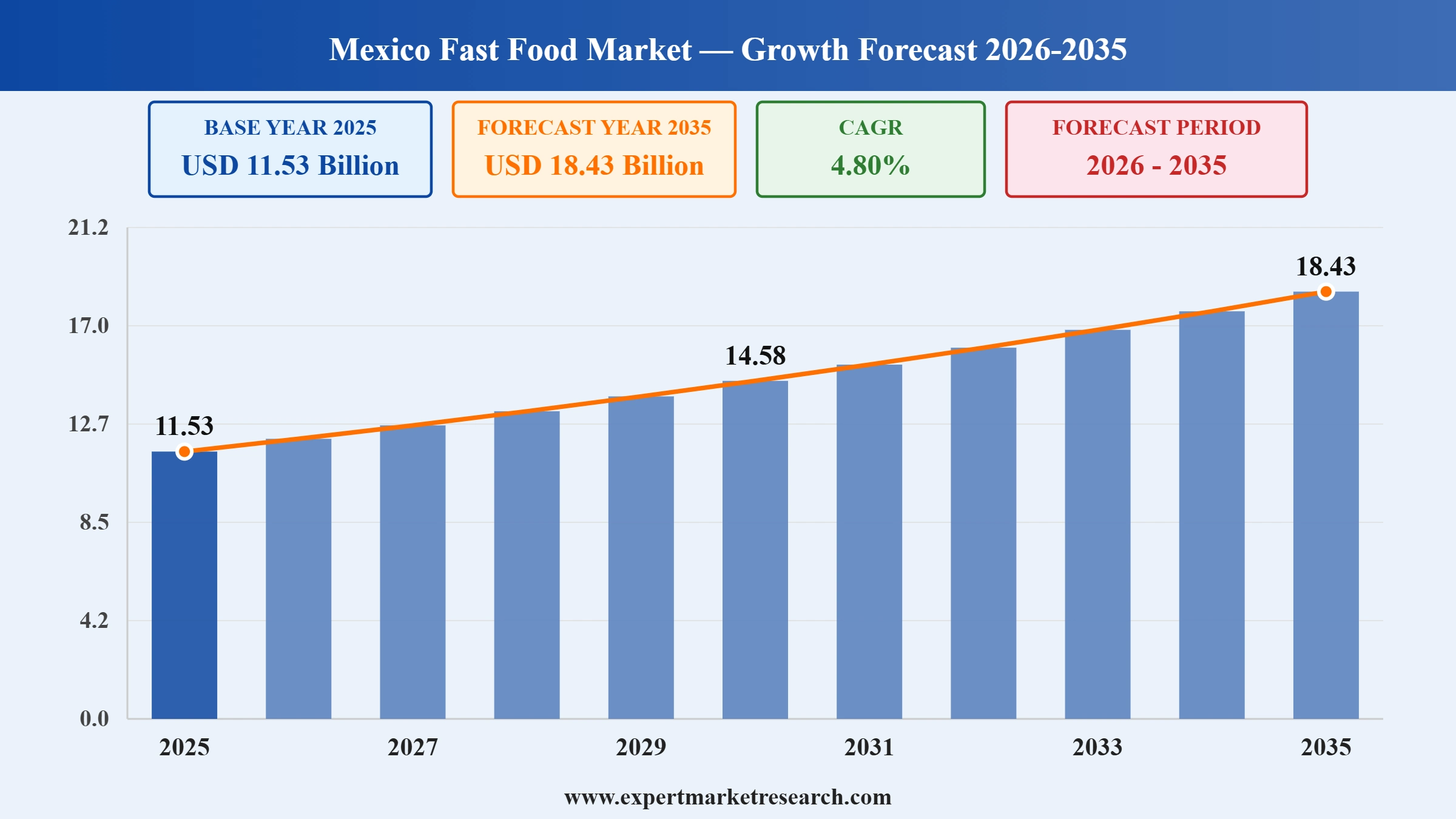
The Mexico fast food market size was a value of USD 11.53 Billion in 2025 and is projected to expand at a CAGR of 4.80% through 2035. The market is further expected to achieve USD 18.43 Billion by 2035. Rising penetration of third-party delivery apps is pushing chains to redesign menus, packaging, and prep flows. This has resulted in higher order density and new virtual brand launches without heavy capital spend.
Labor optimization and real estate strategy are also driving Mexico fast food market expansion. Automated beverage stations and self-ordering kiosks are reducing the number of in-house labor hours in high traffic stores. Meanwhile, fast food operators are prioritizing smaller footprints near transit hubs and mixed-use developments. Shorter leases and flexible layouts lower breakeven points. These factors allow faster payback cycles and make secondary cities financially viable for organized chains with disciplined capital deployment.
Further, the Mexico fast food market is being reshaped by Alsea’s March 2024 rollout of kitchen formats across the country, that was designed to serve delivery brands without dine in costs. This move reflects a shift toward asset-light expansion models, where menu engineering, packaging efficiency, and service speed are prioritized over large storefronts or prime physical locations. Competitors are closely watching margin performance from these compact formats before scaling similar concepts.
Beyond format innovation, the market is seeing aggressive premiumization in core menus. Urban consumers are consistently spending on fast food items despite inflation pressure. As per the Mexico fast food market analysis, food service prices rose over 5.99% in May 2024, yet transaction volumes in organized chains remained resilient. Brands are using product tiering and combo redesigns to protect margins while avoiding deep discounting. This approach is now shaping national rollout strategies. For example, in May 2025, the Firehouse Subs brand and Foodplay announced plans to develop and grow iconic Firehouse Subs in Mexico, with plans to open 100 restaurants in Monterrey and other major cities by 2030.
Read more about this report - REQUEST FREE SAMPLE COPY IN PDF
Alsea revealed a collaboration with Raising Cane’s, the well-known American chicken finger brand. Capitalizing on this development as a key Mexico fast food market trend, operators can fund single-protein concepts with simplified menus and high throughput economics in the region.
Popeyes announced new development agreements with local franchisees in Mexico. Such developments in the Mexico fast food market are opening opportunities for companies to invest in regional franchising, local sourcing, and commissary-backed rollout models to scale faster.
Guzman y Gomez revealed the launch of its seventh location in the Chicagoland area situated in Des Plaines. Such developments reinforce demand for fresh-positioned fast food, showing how brands can fund growth by blending speed with perceived quality to attract urban professionals.
Chipotle Mexican Grill entered the international market by opening a site in Mexico, introducing its tacos and burritos for the first time. This validates premium fast-food demand, signaling opportunities for players to fund higher-margin formats focused on ingredient transparency, limited menus, and strong brand storytelling.
Digital-first innovations are increasingly boosting Mexico fast food market growth opportunities. Large-scale chains are now focusing on digital brands and delivery kitchens to grow quickly and with less capital at risk. These strategies enable food chains to rapidly test new menu ideas, refine pricing, and modify product offerings by area. Firms are also investing in catering and menu engineering based on data to maintain profit margins. Wingstop, for instance, introduced their AI-enhanced Smart Kitchen in July 2025, boosting culinary forecasting and labor productivity.
Premium menu extensions are gaining traction as chains respond to changing urban consumption patterns. Brands like Yum Brands have focused on higher-priced Taco Bell bundles using localized proteins and sauces tailored for Mexican taste preferences. This Mexico fast food market trend is reinforced by controlled premiumization strategies. Suppliers who are able to capitalize on long-term contracts are focusing on differentiation of ingredients. Businesses such as Shake Shack are also introducing a 12-month calendar revolving around menu innovation. The industry is thus, focusing on profits from margin improvement as opposed to volume growth.
Labor efficiency has emerged as a structural trend in the fast-food industry in Mexico. Growing adoption of self-ordering kiosks, beverage dispensing systems, and streamlined kitchen operations by fast-food joints has become a major trend. Restaurant Brands International began using more self-service ordering kiosks at its Burger King units throughout Mexico since April 2024, with less staffing required at the front counters, driving the Mexico fast food market value. In August 2025, CAVA announced partnership with Chipotle Mexican Grill to invest in Hyphen, a foodservice tech firm leveraging a combination of robotics and AI for impactful digital order delivery. For the B2B supplier's category, the trend brings about new opportunities for equipment, software, or maintenance services tied to productivity, as opposed to headcount.
Fast food chains are recalibrating real estate strategies by shifting toward compact formats near transit hubs and mixed-use developments, accelerating the overall Mexico fast food industry growth. Brands such as Little Caesars and Domino’s Mexico are prioritizing smaller footprint stores with high delivery and takeaway ratios. These locations reduce rent exposure and shorten breakeven timelines. Product development trends are also changing, with menus optimized for speed and portability. This trend favors suppliers offering space-efficient kitchen equipment and packaging solutions designed for rapid service environments. In November 2024, FAT Brands Inc., parent company of Fatburger, announced a series of new Fatburger and Buffalo’s Express openings in Mexico.
Supply chain resilience is increasingly influencing product launch speed in the market. Major players are expanding local sourcing to reduce import dependency and volatility. RBI has strengthened poultry and bakery sourcing within Mexico to support faster rollout of Popeyes and Burger King menu innovations. Multi-year commissary agreements are also becoming common among regional chains, ensuring consistency and cost visibility. These arrangements enable faster regional menu customization while protecting margins, sustaining the demand in the Mexico fast food market. In July 2025, Chomps, America’s fastest-growing snack brand, opened a new 300,000 square foot manufacturing facility in Mexico, in partnership with Western Smokehouse Partners.
The EMR’s report titled “Mexico Fast Food Market Report and Forecast 2026-2035” offers a detailed analysis of the market based on the following segments:
Market Breakup by Product Type
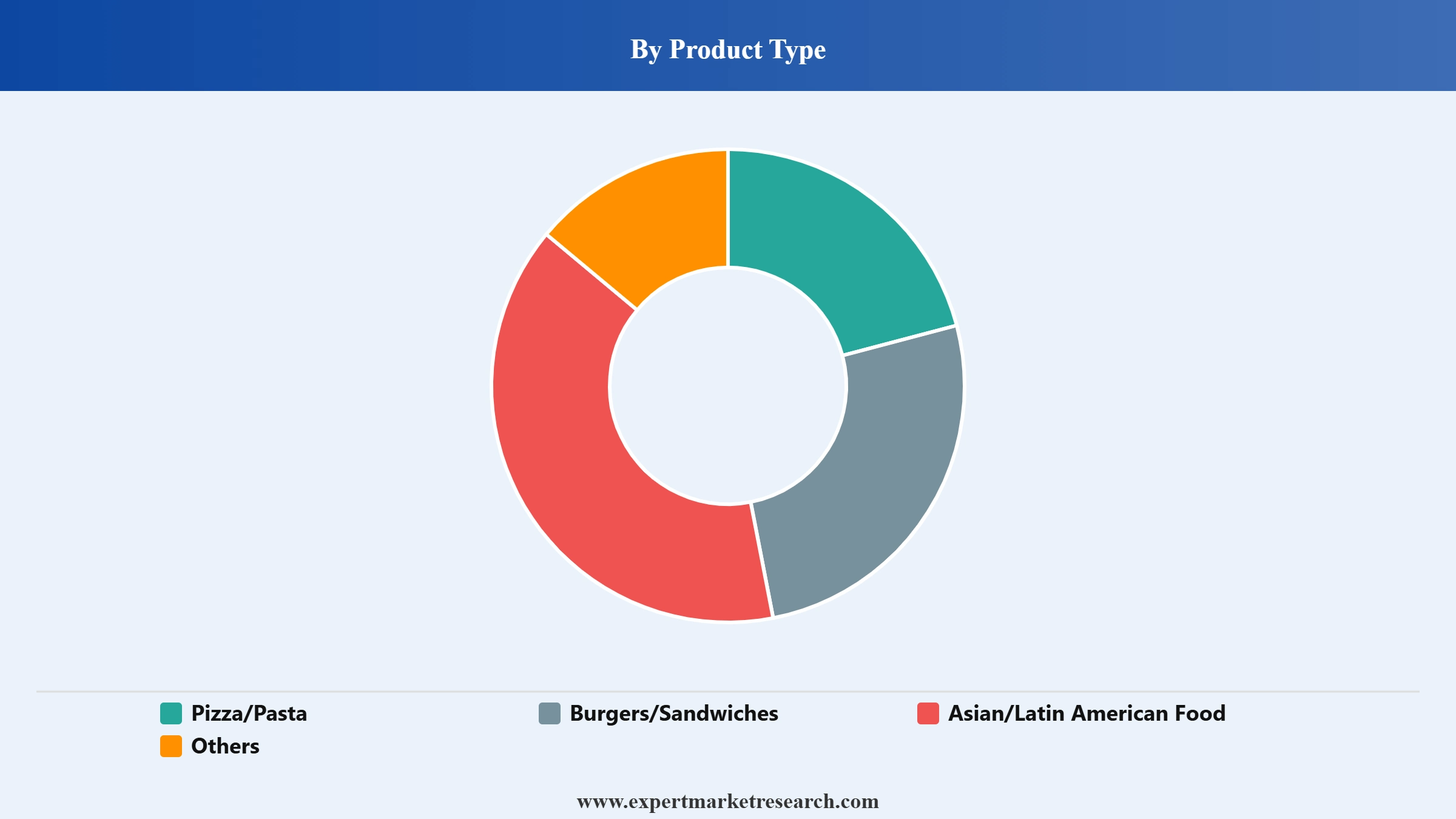
Key Insight: As per the Mexico fast food market report, burgers and sandwiches anchor scale and consistency. Pizza and pasta remain relevant for group consumption and delivery density. Asian and Latin American food is driving experimentation and premium positioning. Other formats serve niche demand and regional preferences. Operators balance these segments to manage risk, diversify menus, and optimize kitchen utilization. Product format decisions increasingly reflect delivery compatibility, prep time control, and ingredient standardization.
Market Breakup by End User
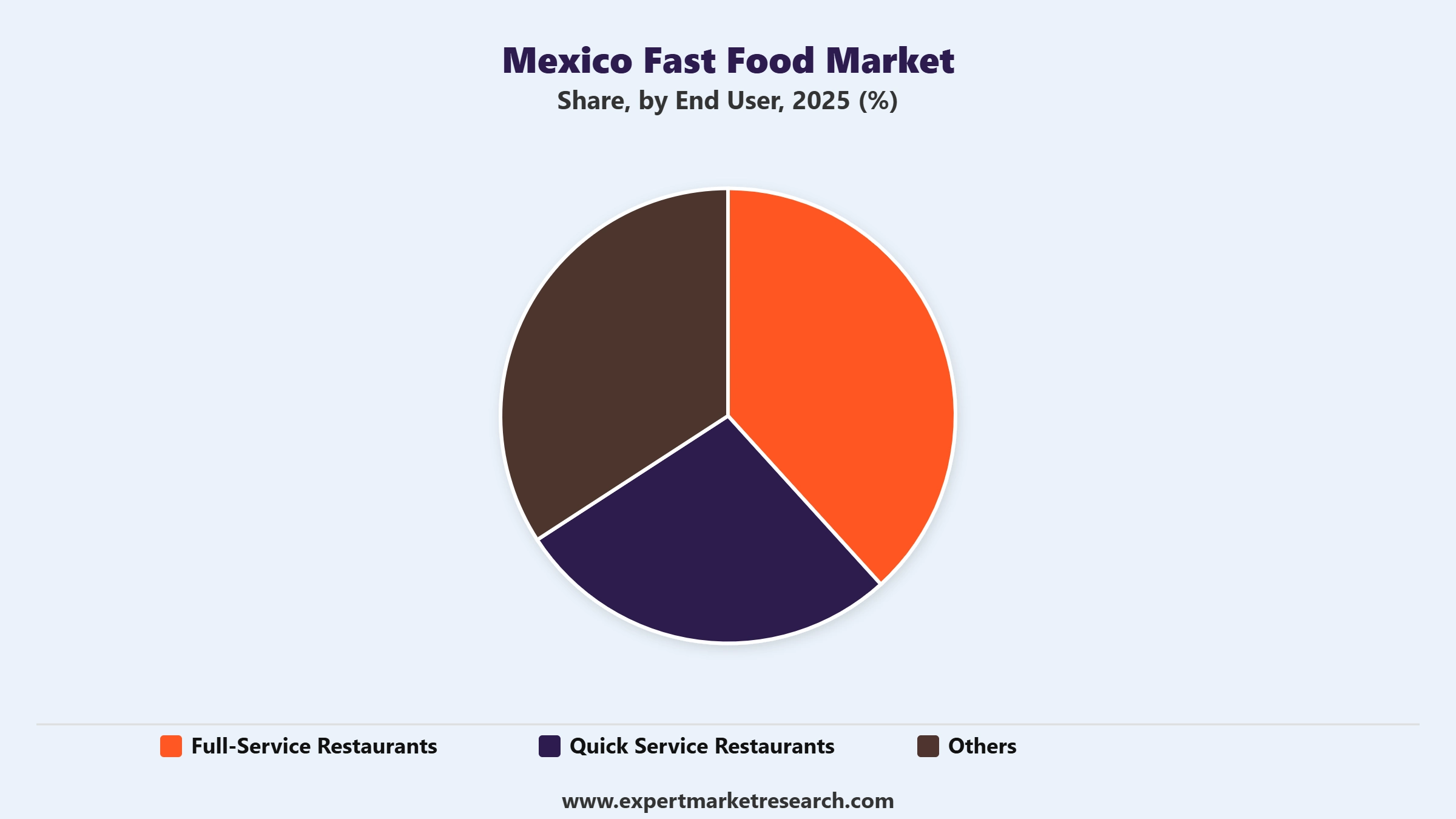
Key Insight: Quick service restaurants remain the core factor that is driving significant growth in the Mexico fast food market due to efficiency and scale. Market research shows that at the end of 2025, there were nearly 78,000 fast-food establishments in Mexico. Full-service operators are restructuring to stay competitive. Other formats serve specialized demand and regional consumption habits. Fast-food chains are focusing on location economics, labor availability, and consumer expectations. This flexibility is reshaping supplier relationships and operational planning.
Market Breakup by Region
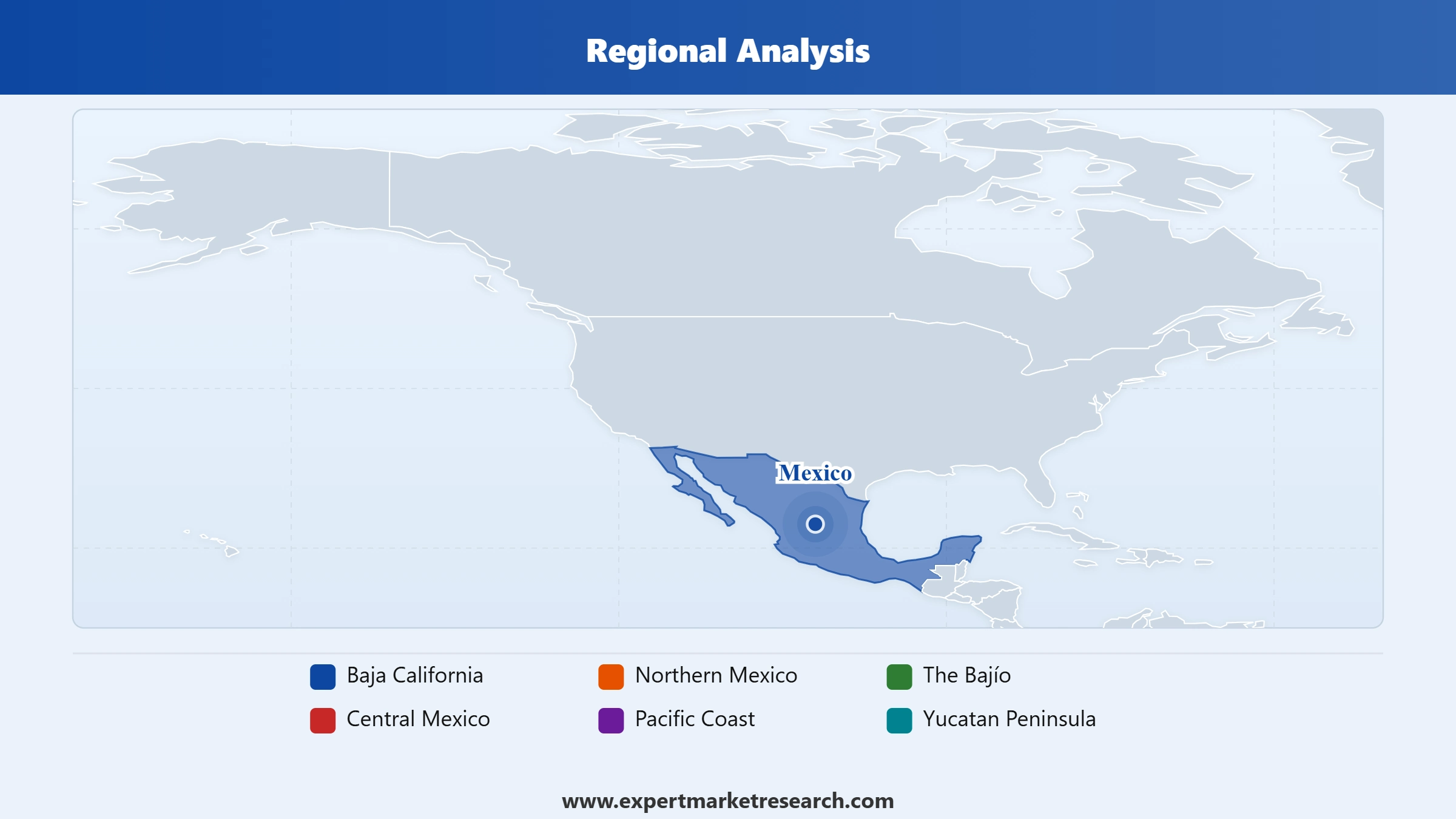
Key Insight: The Central Mexico fast food market anchors volume and innovation. Northern Mexico and Baja California reflect cross-border consumption patterns. The Bajío supports expansion-driven growth while the Pacific Coast regions benefit from tourism-linked demand. The Yucatán Peninsula combines seasonal consumption with localized menus. Chains align regional strategies with income levels, mobility patterns, and infrastructure readiness. These regional differences shape rollout timing, menu composition, and investment priorities across the market.
Read more about this report - REQUEST FREE SAMPLE COPY IN PDF
By product type, burgers and sandwiches dominate the market due to affordability, scale efficiency, and menu adaptability
Burgers and sandwiches continue to represent the dominant product type in the Mexico fast food market due to their operational simplicity and margin stability. Prominent chains rely on standardized inputs, centralized sourcing, and modular kitchen layouts, which support rapid replication across regions. Menu flexibility allows operators to rotate proteins, breads, and sauces without altering core preparation flows. This makes burgers highly compatible with delivery formats and high-demand locations. Major players also use burgers as anchor products to bundle higher margin add-ons. For example, in January 2026, Freddy’s Frozen Custard & Steakburgers launched the Smash Burger Taco starting at USD 3.49 alongside a new Hot Chocolate Frost beverage.
Read more about this report - REQUEST FREE SAMPLE COPY IN PDF
Asian and Latin American fast food formats are also contributing to the overall Mexico fast food market dynamics as chains push for differentiation through flavor depth and regional identity. Operators are introducing rice-based bowls, grilled proteins, and spice-forward sauces to attract urban consumers seeking variety beyond Western staples. These formats support premium pricing and smaller portion control, improving unit economics. Latin-inspired concepts also benefit from local ingredient familiarity, reducing sourcing friction.
Quick service restaurants lead the market due to standardized operations and faster capital recovery
Quick service restaurants largely contribute to the Mexico fast food market expansion because they offer predictable returns and scalable operating models. Chains benefit from limited menus, shorter service cycles, and high order turnover. These formats align well with digital ordering, delivery aggregation, and compact store layouts. Cost control remains stronger due to centralized procurement and simplified staffing requirements. QSR brands also adapt faster to pricing adjustments and menu rationalization during inflationary periods. In October 2024, La Casa de Toño introduced a fast-food service model at its new location, eliminating the need for waitstaff.
Read more about this report - REQUEST FREE SAMPLE COPY IN PDF
Full-service restaurants are evolving rapidly as operators adopt hybrid fast casual and limited-service concepts. Many brands are shortening menus, redesigning dining spaces, and integrating self-ordering to improve table turnover. These changes allow full-service players to retain brand positioning while improving margins. Consumers continue to value dine-in experiences, especially in urban commercial districts. Operators are using differentiated menus and localized sourcing to justify higher price points.
Central Mexico’s dominance in the market is supported by population density and organized retail presence
Dominance of the Central Mexico fast food market is driven by dense urban populations and mature commercial infrastructure. Mexico City and surrounding areas offer consistent foot traffic, high delivery penetration, and strong brand visibility. Fast food chains prioritize this region for pilot launches, menu testing, and digital format rollouts. Operators rely on refined pricing strategies and rapid service models to maintain share.
Read more about this report - REQUEST FREE SAMPLE COPY IN PDF
The Bajío region is emerging as the fastest-growing fast food market in Mexico due to industrial growth and rising disposable incomes. Cities such as Querétaro and León are attracting young working populations linked to manufacturing and logistics hubs. Fast food chains are expanding aggressively with mid-sized formats and delivery-oriented stores. This region offers strong expansion potential for suppliers seeking early entry into growing urban clusters with less saturation. In August 2025, Bajio-based La Lupita Taco & Mezcal announced its foray into the United States market with a Texas location.
The market remains highly competitive, with global chains focusing on format innovation, pricing control, and supply chain localization. Prominent Mexico fast food market players are prioritizing delivery-first kitchens, compact urban stores, and digitally engineered menus to defend profit margins. Competitive advantage is increasingly tied to how fast companies can localize flavors while maintaining standardized operations. There is also a rising focus on upstream control, especially in proteins, bakery inputs, and packaging, to reduce volatility.
Mexico fast food companies investing early in data-led site selection and modular kitchens are scaling faster. Current market dynamics indicate that product innovation is less about novelty and more about operational efficiency. Players that align menu development with labor-saving equipment and delivery demand are better positioned. Strategic partnerships with delivery platforms and commissary suppliers are becoming decisive differentiators.
Founded in 1960 and headquartered in Michigan, United States, Domino’s Pizza has built a strong presence in Mexico through a delivery-led operating model. The company emphasizes digital ordering, streamlined menus, and high-capacity kitchens. In Mexico, Domino’s focuses on pricing bundles and faster delivery times rather than dine-in expansion.
Established in 1997 and headquartered in Louisville, Kentucky, United States, Yum! Brands operate Taco Bell, KFC, and Pizza Hut in Mexico. The company is focusing on menu tiering and premium limited-time offerings to support higher ticket values. Yum! is also redesigning store formats to support delivery and takeaway dominance. Localization plays a major role, especially in protein selection and spice profiles.
Founded in 1940 and headquartered in California, United States, McDonald’s remains a dominant fast-food operator in Mexico. The company focuses on menu simplification, automated ordering, and supply chain integration. McDonald’s Mexico is prioritizing smaller footprint stores and drive-thru-heavy formats. Product development centers on locally relevant flavors within global frameworks.
Established in 1984 and headquartered in the United States, Papa John’s operates in Mexico with a quality-led pizza positioning. The company emphasizes dough quality, ingredient sourcing, and premium add-ons. In Mexico, Papa John’s is expanding delivery coverage and focusing on high-income urban clusters.
*Please note that this is only a partial list; the complete list of key players is available in the full report. Additionally, the list of key players can be customized to better suit your needs.*
Other key players in the market include Subway IP LLC, Restaurant Brands International Inc., Inspire Brands, Inc., Focus Brands LLC, Wendy’s International, LLC, and Little Caesar Enterprises, Inc., among others.
Unlock the latest insights with our Mexico fast food market trends 2026 report. Discover regional growth patterns, consumer preferences, and key industry players. Stay ahead of competition with trusted data and expert analysis. Download your free sample report today and drive informed decisions in the market.
United States Fast Food Market
Latin America Fast Food Market


Upto 15% Off
USD
$2499 $2249
$3999 $3599
$4999 $4249
$5999 $5099


*While we strive to always give you current and accurate information, the numbers depicted on the website are indicative and may differ from the actual numbers in the main report. At Expert Market Research, we aim to bring you the latest insights and trends in the market. Using our analyses and forecasts, stakeholders can understand the market dynamics, navigate challenges, and capitalize on opportunities to make data-driven strategic decisions.*
In 2025, the market reached an approximate value of USD 11.53 Billion.
The market is projected to grow at a CAGR of 4.80% between 2026 and 2035.
The market is assessed to witness a healthy growth in the forecast period to reach around USD 18.43 Billion in 2035.
The major end users of fast food include full-service restaurants and quick service restaurants, among others.
The different products considered in the market report are pizza/pasta, burgers/sandwiches, and Asian/Latin American food, among others.
The major regions in the market include Baja California, Northern Mexico, The Bajío, Central Mexico, Pacific Coast, and Yucatan Peninsula.
The key players in the market include Domino’s Pizza Inc., Yum! Brands, Inc., McDonald’s Corp., Papa John’s International, Inc., Subway IP LLC, Restaurant Brands International Inc., Inspire Brands, Inc., Focus Brands LLC, Wendy’s International, LLC, and Little Caesar Enterprises, Inc., among others.
Companies face rising labor costs, supply chain volatility, real estate pressure, delivery commission dependency, and intense competition, which together strain margins and slow aggressive expansion in highly saturated urban markets.
Stakeholders are optimizing store footprints, investing in automation, strengthening local sourcing, refining delivery menus, and expanding into emerging cities while balancing cost control with differentiated product positioning.
Explore our key highlights of the report and gain a concise overview of key findings, trends, and actionable insights that will empower your strategic decisions.
| REPORT FEATURES | DETAILS |
| Base Year | 2025 |
| Historical Period | 2019-2025 |
| Forecast Period | 2026-2035 |
| Scope of the Report |
Historical and Forecast Trends, Industry Drivers and Constraints, Historical and Forecast Market Analysis by Segment:
|
| Breakup by Product Type |
|
| Breakup by End User |
|
| Breakup by Region |
|
| Market Dynamics |
|
| Competitive Landscape |
|
| Companies Covered |
|
Datasheet
One User
USD 2,499
USD 2,249
tax inclusive*
Single User License
One User
USD 3,999
USD 3,599
tax inclusive*
Five User License
Five User
USD 4,999
USD 4,249
tax inclusive*
Corporate License
Unlimited Users
USD 5,999
USD 5,099
tax inclusive*
*Please note that the prices mentioned below are starting prices for each bundle type. Kindly contact our team for further details.*
Flash Bundle
Small Business Bundle
Growth Bundle
Enterprise Bundle
*Please note that the prices mentioned below are starting prices for each bundle type. Kindly contact our team for further details.*
Flash Bundle
Number of Reports: 3
20%
tax inclusive*
Small Business Bundle
Number of Reports: 5
25%
tax inclusive*
Growth Bundle
Number of Reports: 8
30%
tax inclusive*
Enterprise Bundle
Number of Reports: 10
35%
tax inclusive*
How To Order

Select License Type
Choose the right license for your needs and access rights.

Click on ‘Buy Now’
Add the report to your cart with one click and proceed to register.

Select Mode of Payment
Choose a payment option for a secure checkout. You will be redirected accordingly.
Strategic Solutions for Informed Decision-Making
Gain insights to stay ahead and seize opportunities.

Get insights & trends for a competitive edge.

Track prices with detailed trend reports.

Analyse trade data for supply chain insights.

Leverage cost reports for smart savings

Enhance supply chain with partnerships.

Connect For More Information
Our expert team of analysts will offer full support and resolve any queries regarding the report, before and after the purchase.
Our expert team of analysts will offer full support and resolve any queries regarding the report, before and after the purchase.
We employ meticulous research methods, blending advanced analytics and expert insights to deliver accurate, actionable industry intelligence, staying ahead of competitors.
Our skilled analysts offer unparalleled competitive advantage with detailed insights on current and emerging markets, ensuring your strategic edge.
We offer an in-depth yet simplified presentation of industry insights and analysis to meet your specific requirements effectively.




