

Consumer Insights
Uncover trends and behaviors shaping consumer choices today
Procurement Insights
Optimize your sourcing strategy with key market data
Industry Stats
Stay ahead with the latest trends and market analysis.
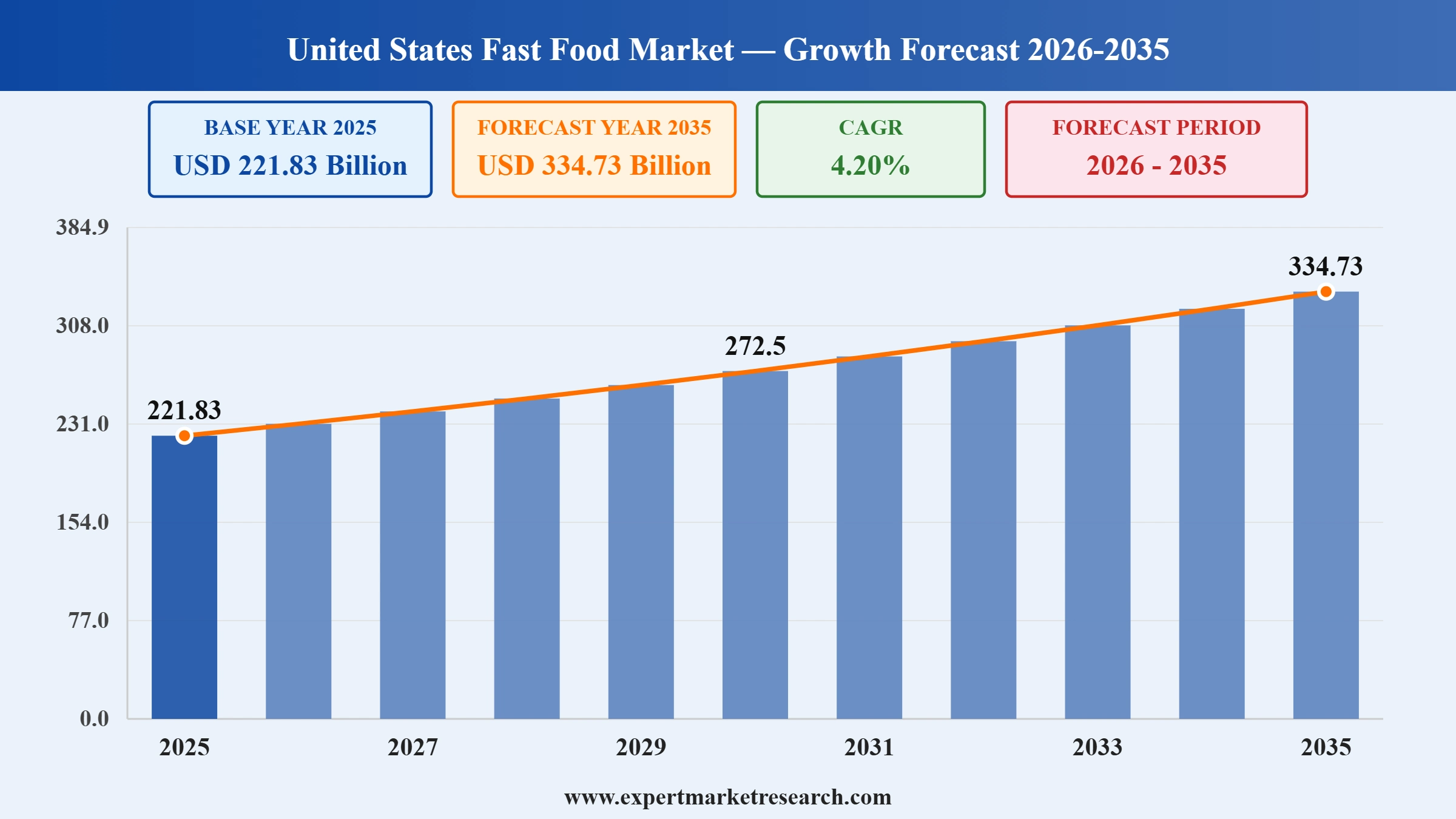
The United States fast food market attained a value of USD 221.83 Billion in 2025 and is projected to expand at a CAGR of 4.20% through 2035. The market is further expected to achieve USD 334.73 Billion by 2035. Growth in AI-powered operations, premium beverages, and omnichannel ordering systems is helping to drive efficiencies in operations, customer retention, profitability of franchises, and supplier relationships in the industry.
Fast growth in premium beverage platforms is leading to new revenue streams for United States fast food market players outside their normal mealtime offerings. The Live Más Café concept by Taco Bell and increased competition from Dutch Bros-style drinks are prompting fast food brands to broaden their offerings with functional beverages, cold coffees, and flavored drinks. At the same time, restaurants are investing in kitchen automation technology and predictive inventory management software.
The United States fast food market is constantly evolving due to the innovative efforts of the most influential restaurant chains to introduce new items, improve their ordering platforms, and provide more premium value offers to ensure higher consumer loyalty. A significant event happened in April 2025 when McDonald's released new McCrispy Strips together with its Creamy Chili Dip. Companies are aiming to enhance their menus and to compete in the rapidly growing chicken category.
Competitive dynamics between restaurants focus not only on price competition but also on technology-related consumer engagement and productivity. Operators implement artificial intelligence-based ordering system at drive-thru, predictive demand forecasting, and personalized loyalty program in order to boost operations and minimize the cost of labor. For example, in July 2026, Taco Bell expanded Omilia's AI voice ordering across 890+ drive-thrus in the country, enhancing speed, accuracy, and operational efficiency. Furthermore, players are redesigning the restaurant formats by installing dedicated digital pickup shelves, introducing double lane drive-thru, and automating kitchen processes in order to cater to the high demand of deliveries and mobile transactions.
Read more about this report - REQUEST FREE SAMPLE COPY IN PDF
Chicken Nuggets were launched by Jollibee in all United States-based restaurants, where the company expanded the line of chicken products by adding high-quality white meat along with several dipping sauces. Competing companies can use similar products with special regional tastes and family sets to attract customers, leveraging such trends in the United States fast food market.
Sbarro presented the limited-time menu with pepperoni and sausage from Hormel Foods. It represents the fast-food experience with spicy flavors of the whole world. The partnership shows the growing trend of consumers' interest in premium-quality and internationally oriented fast food. Participants in the United States fast food market can collaborate with ingredient creators in order to present the globally inspired limited-time menu at high price points.
Loaded Jalapeño and Club editions of Burger King’s Original Chicken Sandwich were unveiled in order to upgrade an old menu item based on customer feedback. Brands can leverage such advancements to modernize classic menu items through limited releases of new flavors tailored to consumer tastes.
Wonder started a partnership with Wing to introduce food delivery using drones in Texas starting January 2027, allowing for more efficient deliveries from different restaurant chains. This reveals increased interest in implementing automation to streamline last-mile logistics. Fast-food brands can therefore use autonomous delivery partners to decrease fulfilment times and increase delivery areas.
The United States fast food market is evolving rapidly as operators deploy artificial intelligence systems for processing orders, kitchen management, and labor scheduling purposes. Leading food chains deploy voice assistants, computer vision, and predictive analytics solutions to boost the speed of services and reduce operational expenses. For example, in March 2025, Yum! Brands extended collaboration with NVIDIA to speed up the implementation of AI solutions at Taco Bell, KFC, Pizza Hut, and Habit Burger restaurants for the purposes of voice ordering and real-time restaurant intelligence. At the same time, the company follows national strategies of AI adoption as promoted by the National Institute of Standards and Technology AI Risk Management Framework.
Chicken-oriented menu innovation is becoming a major strategy for growing customer frequency and increasing meal occasions, redefining the United States fast food market dynamics. Companies are focusing on developing premium chicken sandwiches, tenders, wraps, and limited flavors. For example, in July 2026, McDonald's introduced 10 new chicken menu items, expanding sandwiches, McCrispy Strips, and wings offerings to strengthen menu variety. The steady availability of poultry meat is allowing companies to accelerate the launch of their products and maintain pricing flexibility within nationwide franchise networks.
Premium beverages are becoming one of the most rapidly growing sources of revenue across the United States fast food market. Restaurants offer various specialty coffee drinks, refreshers, energy drinks, and fruit juices which motivate consumers to make additional purchases during the whole day. Taco Bell is experimenting with its Live Más Café concept and launching new restaurants that specialize in customizable beverages suitable for young consumers. At the same time, the United States Food and Drug Administration keeps updating food labeling and ingredients mandates and inspires businesses to create beverages that have clear nutritional positioning. Innovations in beverages help to increase the value of transactions as well as differentiate brands from competitors through non-meal products. Demonstrating this shift, in June 2026, Starbucks launched blended Refreshers, targeting afternoon demand with customizable fruit-based beverages to expand non-coffee sales and customer visits.
Restaurant brands are becoming stronger by creating digital ecosystems wherein loyalty programs, personalization opportunities, and mobile ordering systems are incorporated into customers' experiences. Data-driven marketing gives the ability to suggest personalized offers depending on buying history and motivates consumers to come back more often and spend more on every visit. Starbuck, McDonald's, Wendy's, and other major restaurant brands keep adding customers to their loyalty programs through exclusive app offers and rewards. Aligning with this trend in the United States fast food market, in July 2026, Thanx launched direct-to-POS first-party ordering for Square, streamlining restaurant orders, reducing integration complexity, and enhancing operational efficiency.
As restaurant companies innovate their packaging and become more resilient in their supply chains, sustainability programs are gaining importance across the United States fast food market scope. Many restaurant companies are taking steps to adopt packaging programs which are sustainable while meeting customer demands. For instance, in June 2025, Chick-fil-A made an announcement to use paper fiber cups in selected restaurants of the United States. Moreover, the Environmental Protection Agency is working on waste reduction and sustainable materials management through national recycling campaigns, providing opportunities for restaurant companies to adopt environmentally friendly packaging programs.
The EMR’s report titled “United States Fast Food Market Report and Forecast 2026-2035” offers a detailed analysis of the market based on the following segments:
Market Breakup by Product Type
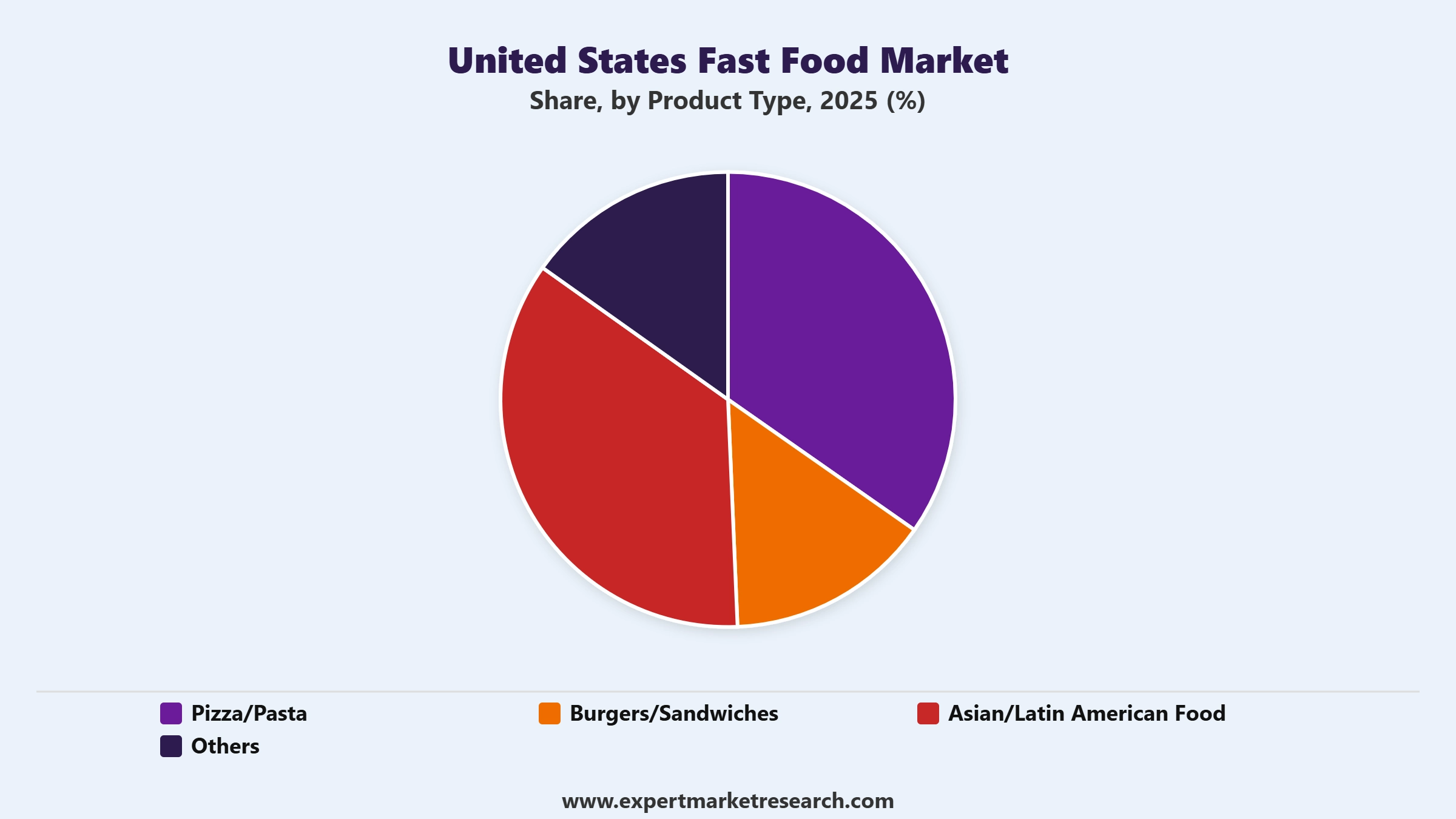
Key Insight: Burgers and sandwiches lead the United States fast food market growth due to their ease of operation, wide acceptance among consumers, and continuous menu innovation. The pizza and pasta segments continue to remain steady in terms of demand through the trends of family dining and delivery convenience. The Asian and Latin American foods are the fastest growing segments, and this is because changing consumer tastes are enabling them to appreciate international foods and flavors.
Market Breakup by End Use
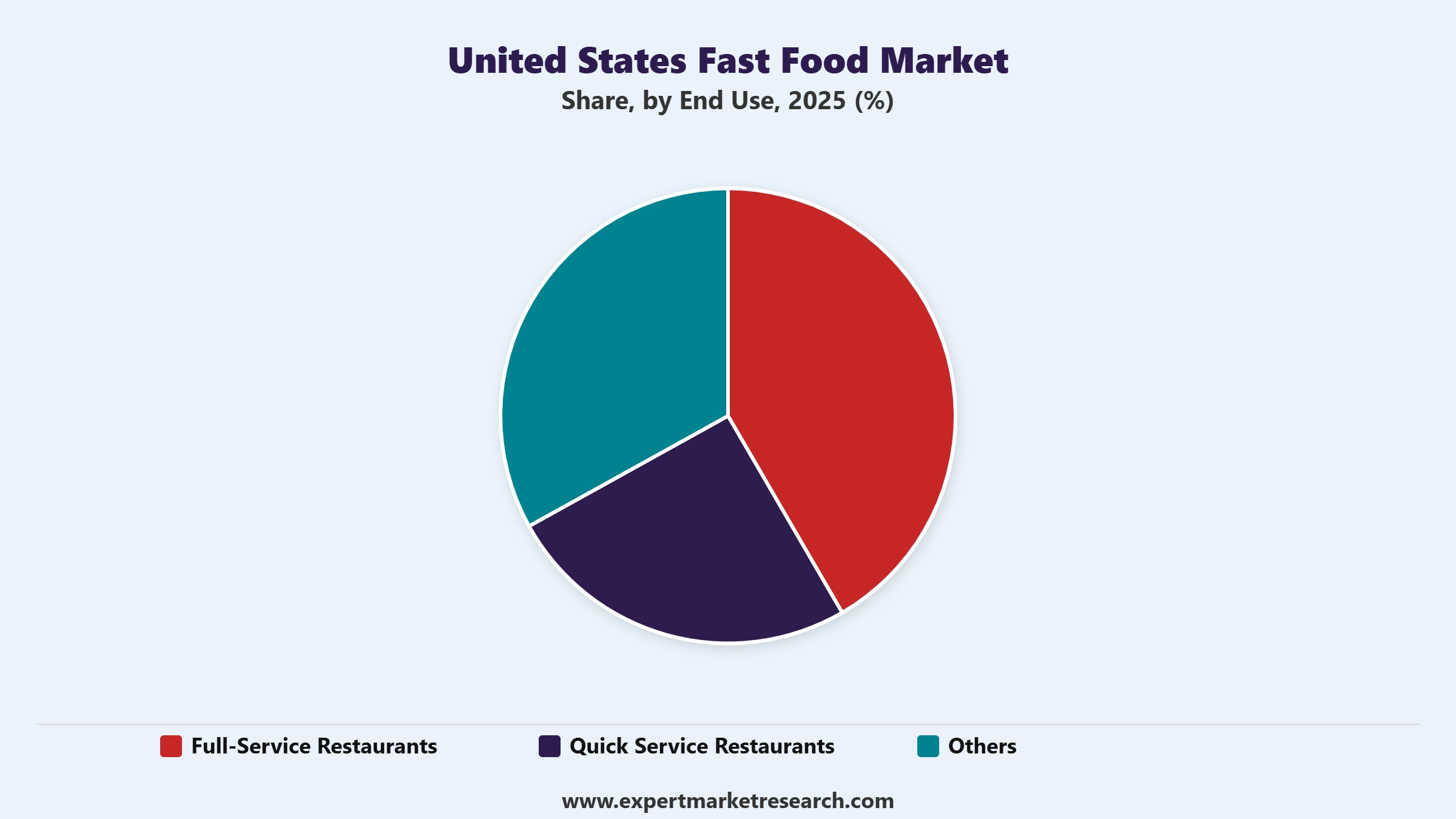
Key Insight: End-use segmentation considered in the United States fast food market report showcases the shifting operational strategies within the industry. Quick service restaurants are leading through their wide-reaching franchise chains, standardization, and consistent focus on providing digital conveniences for high volume transactions. Full-service restaurants are growing fast by merging customized dining experiences with ordering technology along with high-end menus. The 'others' category includes cafeterias, food courts, ghost kitchens, institutional catering companies, and other specialty places that contribute to the diversification of the market by catering to the requirements of consumers at specific locations.
Market Breakup by Region
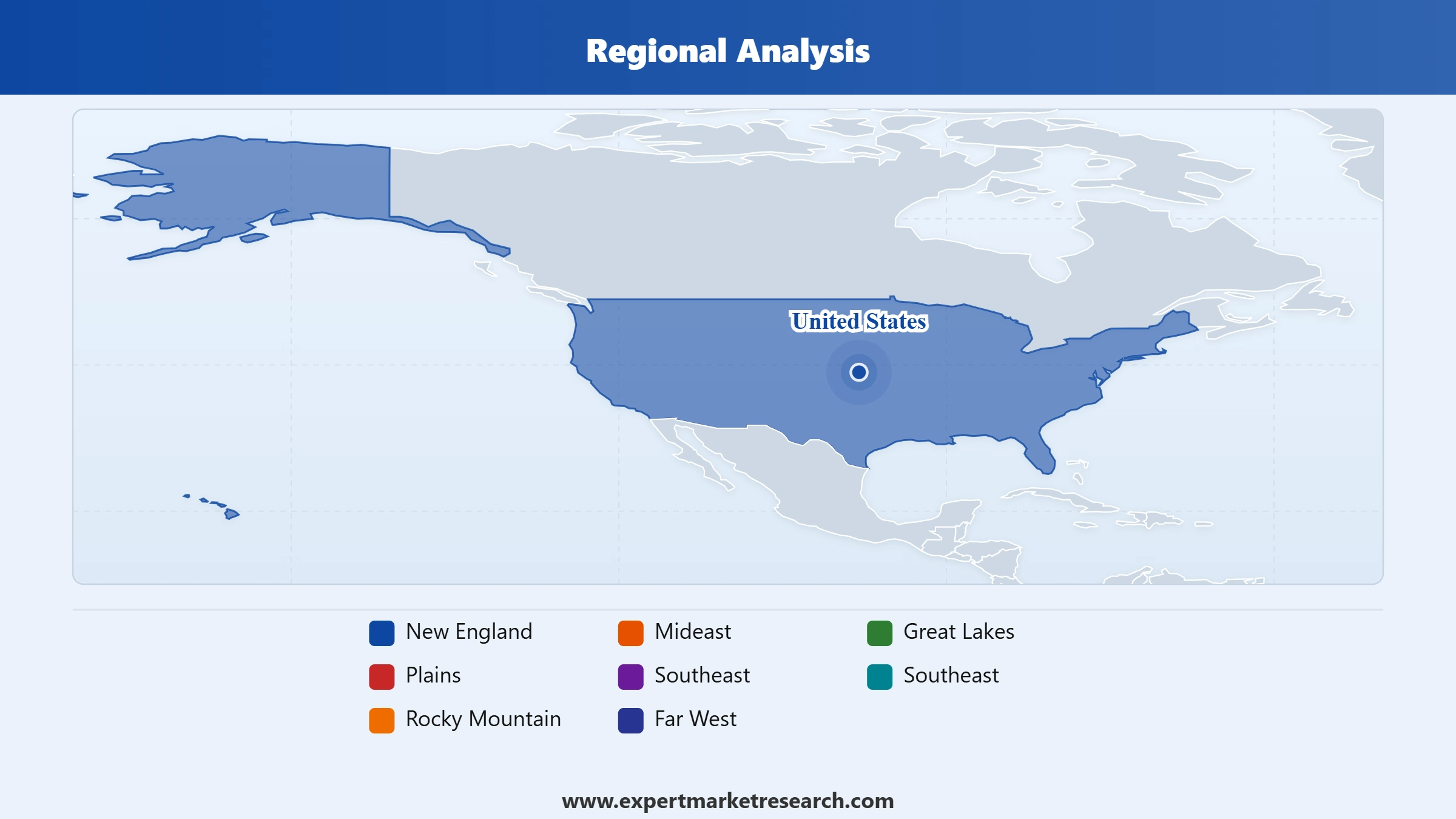
Key Insight: Different regions exhibit varied performances in relation to the demographics, urbanization, tourism, and purchasing behavior of consumers. For example, the New England region enjoys an increased disposable income and preference for premium dining, while the Mideast region benefits from its urbanized areas and digitization. On the other hand, the Great Lakes region ensures consistency in demand by way of the well-established restaurant chains and the value-based restaurants in the Plains region. The Southeast United States fast food market leads in terms of franchise and population growth while the Southwest is growing faster due to changing multi-cultural tastes.
Read more about this report - REQUEST FREE SAMPLE COPY IN PDF
By product type, burgers/sandwiches dominate the market owing to menu innovation and unmatched nationwide restaurant accessibility
Burgers and sandwiches dominate the United States fast food market owing to the combination of a wide variety of options available, efficiencies in operations and broad acceptance among consumers. Operators within dominant chains keep on adding new and high-quality elements, regional tastes, and special offers to retain customers. There are several other advantages offered by burgers and sandwiches, including effective logistics chains, scalability, and franchising opportunities. Investments into online orders, customization, and value packs help to improve customer retention and financial performance in all channels. In July 2026, researchers developed BurgerAI, creating healthier, sustainable burgers matching Big Mac taste through AI-designed recipes and consumer preference modelling.
Read more about this report - REQUEST FREE SAMPLE COPY IN PDF
The most rapidly growing type of fast food is the Asian and Latin American one due to the increasing demand for unique taste sensations and global cuisines. Restaurants are offering Korean, Japanese, Mexican, Vietnamese, and fusion-based concepts that are attractive to young people and various cultures. Increased interest in spicy, custom and protein foods lead companies to expand their menus beyond existing options. The category enjoys premium positioning, innovations in sauces and ingredients, sustaining demand in the United States fast food market. For example, in August 2025, Lotteria debuted its first United States restaurant in California, introducing Korean-style burgers to expand multicultural fast-food competition.
By end use, quick service restaurants lead the market through rapid service, digital convenience, and nationwide expansion
The quick service restaurant segment largely contributes to the United States fast food market value owing to its combination of value, speed, and efficiency along with high franchising presence. There is an increasing reliance on online ordering systems, improvements in drive-thrus, mobile apps, and loyalty programs to enhance customer convenience. Efforts are being made to automate kitchens and employ predictive analysis to ensure faster throughput and consistent services during peak hours. Quick service restaurants' ability to fast track new product launches and expansion of nationwide services makes them competitive among several customer demographics. Following this trend, in July 2026, Freddy's announced plans to open 60 restaurants in 2026, accelerating franchise expansion through flexible, efficiency-focused restaurant formats.
Read more about this report - REQUEST FREE SAMPLE COPY IN PDF
The United States fast food market observes an increase in growth of full-service restaurants as there is an adoption of hybrid services which are a combination of dine-in services with digital orders, takeaways, and deliveries. Customers are increasingly favoring an enhanced dining experience, premium ingredients, and customized menu options. The restaurant groups are optimizing their operations for better table turns and employing reservation technology and personalizing customer interactions. It enables the full-service restaurants to better compete against quick service restaurant brands.
Southeast clocks in the largest share of the market through dense restaurant networks and strong population growth
The Southeast United States fast food market is considered to be the key regional market because of its rising population, the booming tourism industry, and the presence of both national and regional restaurant chains. Rising urbanization, favorable business environment, and development of franchises continue providing a solid foundation for restaurant expansion within both metropolitan and suburban regions. Customer inclination toward convenience, drive-thru options, and delivery services is pushing restaurants to experiment with new formats. Similarly, in August 2025, Bojangles signed a 20-unit franchise agreement to re-enter New York City, accelerating Northeast expansion and strengthening its multi-unit growth strategy.
Read more about this report - REQUEST FREE SAMPLE COPY IN PDF
Southwest is currently becoming the fastest growing United States fast food market as a result of its rapidly growing population, economic growth, and cultural diversity. These factors are making innovations in fast food concept increasingly popular. Restaurant operators are developing innovations in beverages, menu design inspired by different cultures, and ordering through websites in order to attract young people. Favorable entrepreneurial climate and continuing development of businesses are resulting in the opening of new restaurants within metropolitan regions. In July 2026, Angry Chickz opened its first Palmdale restaurant, expanding Southern California presence and strengthening its rapid growth strategy.
The competition in the industry is intensifying as United States fast food companies are concerned about digitalization, AI-enabled restaurant management, high-quality menu innovations, and operational efficiency. The industry leaders are focusing on automation of kitchens, voice-based ordering, predictive inventory management, and personal loyalty programs to enhance customer experience while decreasing their operating costs.
Leading United States fast food market players are also broadening their beverage offerings, offering more healthy choices on their menus, and developing their delivery networks. Environmental sustainability is one more strategy that businesses use; operators are using environmentally-friendly packaging and responsible sourcing. Players are leveraging some growth areas associated with smaller-sized restaurants, development of more efficient drive-thrus, use of data-based marketing, and technological collaboration for improving franchise performance.
Founded in 1946 and having its headquarters in Georgia, United States, Chick-fil-A has continued fortifying its position through innovations in premium chicken menus, efficient drive-thrus, and effective customer services. Digital ordering platforms are being developed by the organization together with sustainable packaging, while supply chains and restaurants with improved operating models are being tested.
Founded in 1969 and based in Dublin, Ohio, United States, Wendy's International concentrates on fresh food items, AI-enabled drive-thru services, and menu diversifications. The loyalty program of the company is growing with limited-time premium menu items introduced, as well as with restaurant renovations in terms of digital ordering solutions.
Domino’s Pizza was founded in 1960 in Ann Arbor, Michigan, United States, and offers online pizza delivery with sophisticated ordering systems, GPS tracking services, and AI-based operational enhancements. The corporation focuses on delivering its products efficiently, expanding the chain of carryout locations, and partnering with technologies while fostering customer loyalty through promotions and digital purchases.
Founded in 1997 in Louisville, Kentucky, Yum! Brands operates Taco Bell, KFC, Pizza Hut and Habit Burger with the main emphasis being on AI restaurant management, voice orders, and predictive analytics. Yum! Brands continues partnering with technology companies to enhance its operations, introduce innovations in product range, and make restaurants more productive.
Other key players in the market include Papa John's International, Inc., Subway IP LLC, Restaurant Brands International Inc., Inspire Brands, Inc., Focus Brands LLC, Little Caesar Enterprises, Inc., and McDonald's Corp., among others.
*Please note that this is only a partial list; the complete list of key players is available in the full report. Additionally, the list of key players can be customized to better suit your needs.*
Unlock the latest insights with our United States fast food market trends 2026 report. Discover regional growth patterns, consumer preferences, and key industry players. Stay ahead of competition with trusted data and expert analysis. Download your free sample report today and drive informed decisions in the market.


Upto 15% Off
USD
$2499 $2249
$3999 $3599
$4999 $4249
$5999 $5099


*While we strive to always give you current and accurate information, the numbers depicted on the website are indicative and may differ from the actual numbers in the main report. At Expert Market Research, we aim to bring you the latest insights and trends in the market. Using our analyses and forecasts, stakeholders can understand the market dynamics, navigate challenges, and capitalize on opportunities to make data-driven strategic decisions.*
The market is estimated to be valued at USD 221.83 Billion in 2025.
The market is projected to grow at a CAGR of 4.20% between 2026 and 2035.
The revenue generated from the United States fast food market is expected to reach USD 334.73 Billion in 2035.
The fast-food market is categorised according to the product type, pizza/pasta, burgers, sandwiches, Asian/Latin American food, and others.
The United States fast food market key players are Chick-fil-A, Inc., Wendy’s International, LLC, Domino's Pizza Inc., Papa John's International, Inc., Yum! Brands, Inc., Subway IP LLC, Restaurant Brands International Inc., Inspire Brands, Inc., Focus Brands LLC, Little Caesar Enterprises, and McDonald's Corp. among others.
Based on the end use, the market is divided into full-service restaurants, quick-service restaurants, and others.
The major market areas include New England, Mideast, Great Lakes, Plains, Rocky Mountains, and Far West.
Rising labor costs, food inflation, supply chain disruptions, stricter nutrition regulations, technology integration expenses, and intense competition continue challenging profitability, operational consistency, franchise expansion, and customer retention strategies.
Stakeholders are investing in AI technologies, expanding premium menus, strengthening digital loyalty ecosystems, modernizing restaurant formats, improving sustainable sourcing, and developing strategic supplier partnerships to increasing operational efficiency.
Explore our key highlights of the report and gain a concise overview of key findings, trends, and actionable insights that will empower your strategic decisions.
| REPORT FEATURES | DETAILS |
| Base Year | 2025 |
| Historical Period | 2019-2025 |
| Forecast Period | 2026-2035 |
| Scope of the Report |
Historical and Forecast Trends, Industry Drivers and Constraints, Historical and Forecast Market Analysis by Segment:
|
| Breakup by Product Type |
|
| Breakup by End Use |
|
| Breakup by Region |
|
| Market Dynamics |
|
| Competitive Landscape |
|
| Companies Covered |
|
Datasheet
One User
USD 2,499
USD 2,249
tax inclusive*
Single User License
One User
USD 3,999
USD 3,599
tax inclusive*
Five User License
Five User
USD 4,999
USD 4,249
tax inclusive*
Corporate License
Unlimited Users
USD 5,999
USD 5,099
tax inclusive*
*Please note that the prices mentioned below are starting prices for each bundle type. Kindly contact our team for further details.*
Flash Bundle
Small Business Bundle
Growth Bundle
Enterprise Bundle
*Please note that the prices mentioned below are starting prices for each bundle type. Kindly contact our team for further details.*
Flash Bundle
Number of Reports: 3
20%
tax inclusive*
Small Business Bundle
Number of Reports: 5
25%
tax inclusive*
Growth Bundle
Number of Reports: 8
30%
tax inclusive*
Enterprise Bundle
Number of Reports: 10
35%
tax inclusive*
How To Order

Select License Type
Choose the right license for your needs and access rights.

Click on ‘Buy Now’
Add the report to your cart with one click and proceed to register.

Select Mode of Payment
Choose a payment option for a secure checkout. You will be redirected accordingly.
Strategic Solutions for Informed Decision-Making
Gain insights to stay ahead and seize opportunities.

Get insights & trends for a competitive edge.

Track prices with detailed trend reports.

Analyse trade data for supply chain insights.

Leverage cost reports for smart savings

Enhance supply chain with partnerships.

Connect For More Information
Our expert team of analysts will offer full support and resolve any queries regarding the report, before and after the purchase.
Our expert team of analysts will offer full support and resolve any queries regarding the report, before and after the purchase.
We employ meticulous research methods, blending advanced analytics and expert insights to deliver accurate, actionable industry intelligence, staying ahead of competitors.
Our skilled analysts offer unparalleled competitive advantage with detailed insights on current and emerging markets, ensuring your strategic edge.
We offer an in-depth yet simplified presentation of industry insights and analysis to meet your specific requirements effectively.




