

Consumer Insights
Uncover trends and behaviors shaping consumer choices today
Procurement Insights
Optimize your sourcing strategy with key market data
Industry Stats
Stay ahead with the latest trends and market analysis.
The Mexico toilet paper market was valued at USD 1351.68 Million in 2025 and is expected to grow at a CAGR of 4.50% during the forecast period 2026-2035, reaching a valuation of USD 2099.12 Million by 2035. The growing demand for personal care and hygiene, along with rising sustainability concerns, are key drivers of the market.
Compound Annual Growth Rate
4.5%
Value in USD Million
2026-2035
The growing importance of personal hygiene and health is driving the demand for toilet paper in the market in Mexico.
In Mexico, there is a growing utilisation of e-commerce channels for purchasing toilet paper. Mexico is considered the second largest e-commerce market in Latin America, with homecare Furthermore, the growth of urbanisation across Mexico is supporting the demand for higher-quality products. By 2030, it is projected that the number of cities in Mexico will increase to 747.
The increase in tourism activities in Mexico, and the subsequent expansion of hotels and restaurants, has led to Mexico toilet paper market development.
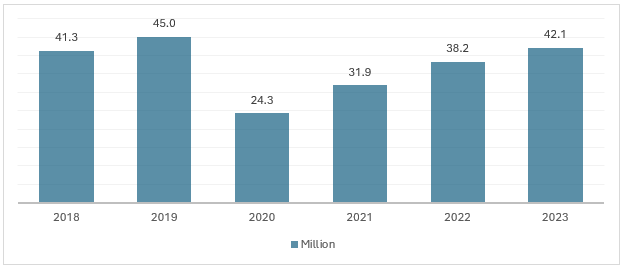
In 2024, Mexico witnessed 45.04 million international tourists reflecting a 7.4% compared to 2023.
In the hospitality sector, toilet paper acts as a crucial hygiene maintenance product in washroom to maintain hygeine.
In 2023, Mexico stood 4th in the global tourism ranking, welcoming 42.15 million tourists.
In 2023, around 42.1 million international tourists arrived by air in Mexico, a 46% increase compared to 2020. In 2023, over 29,000 hotel rooms were under construction throughout Mexico, of which over 11,000 were being constructed in popular areas like the Riviera Maya, Mexico City, and Baja California Sur. In 2022, the tourism sector accounted for 7.6% of the Mexico’s GDP.
Figure: Tourists Arrival in Mexico, Million, 2018-2023
The growth in digitalisation along with smartphone penetration has encouraged the e-commerce expansion in Mexico. In 2023, the share of internet users in Mexico accounted for 73.4% of the population along with a smartphone penetration of 74.8%.
During 2022-2027, online retail sales of physical goods is expected to generate about USD 68.2 billion in 2027 compared to USD 34.2 billion in 2022.
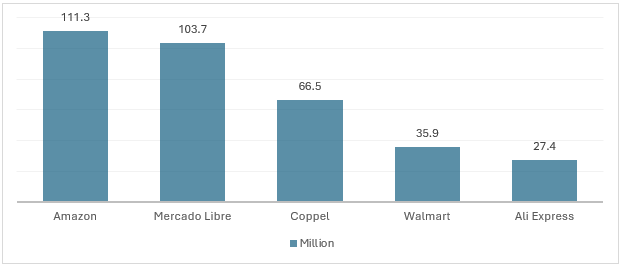
Figure: Leading E-commerce Stores in Mexico, based on Web Traffic (Million), 2024
Mexico's booming tourism and hospitality industry is driving a surge in toilet paper demand. As the country welcomes an increasing number of international visitors, hotels, resorts, and other hospitality establishments are experiencing a growing need for high-quality sanitary products, aiding the Mexico toilet paper market expansion. These businesses are placing a premium on maintaining excellent hygiene standards to cater to the expectations of both domestic and foreign travellers. The expansion of tourism not only fuels the demand for toilet paper in public facilities but also influences the adoption of premium and environmentally friendly options. As Mexico continues to attract more leisure and business travellers, the requirement for essential hygiene products in hospitality settings is on the rise. The focus on cleanliness and comfort in the hospitality sector has led to an increased emphasis on providing superior sanitary products, including toilet paper.
Valmet and a Mexican paper manufacturer launched a special-edition toilet paper product commemorating the 2026 FIFA World Cup. The product reached supermarket shelves in Mexico after its development and manufacturing cycle was completed in only nine weeks, using laser engraving technology for embossing. The initiative demonstrates how manufacturers can use major sporting events and rapid product development to create differentiated toilet-paper offerings, increase consumer engagement, and generate incremental retail demand.
Mexico City began installing smart public toilets ahead of the expected increase in tourism associated with the 2026 FIFA World Cup. The facilities provide toilet paper, soap, water and hand dryers and incorporate automated cleaning systems. The installations are intended to improve public sanitation infrastructure. Expansion of modern public facilities can increase institutional and commercial demand for toilet paper while creating opportunities for suppliers serving high-traffic public locations, transportation hubs, tourism areas, and municipal facilities.
Global hygiene-products producer Essity announced plans to raise prices to offset higher energy and input costs, following increased fuel prices and supply-chain disruption. The company also indicated that raw-material cost increases would affect costs with a delay of several months. Rising energy and raw-material expenses can place pressure on toilet-paper manufacturing and distribution costs in Mexico, potentially encouraging manufacturers and retailers to adjust pricing, optimize production efficiency, manage inventories more closely, and emphasise value-oriented product formats, thus boosting the Mexico toilet paper market growth.
Findings from Mexico’s Second National Survey on Menstrual Management 2025 highlighted continuing deficiencies in access to basic hygiene facilities, with 42% of surveyed girls reporting inadequate access to essentials such as soap and suitable bathrooms at school. Although the study primarily concerns menstrual hygiene, it underscores broader sanitation needs in institutional settings. Greater attention to hygiene infrastructure can support institutional demand for essential paper products, including toilet paper, particularly across schools, healthcare facilities and public buildings.
The consumer emphasis on price is becoming an increasingly prominent driver of the toilet paper market in Mexico, especially when taking into consideration that the budgets of households are still sensitive to the impact of inflation. Consumers are becoming increasingly interested in multipacks, value rolls, and products that offer increased value per package. This trend encourages retailers to build their assortments on a value proposition and allows manufacturers to compete on pack sizes, roll lengths, softness, and sheets per roll instead of brand positioning. Stronger demand for economical and bulk offerings is intensifying price competition, encouraging manufacturers to optimise production costs, packaging efficiency, and distribution strategies.
Apart from consumer demand for affordable products, Mexico is also undergoing a trend towards high-quality toilet papers that come with superior levels of softness, absorbency, strength, thickness, and comfort. Consumers with the ability to purchase have started being willing to spend money on items that will give them a better experience compared to opting for affordable products. The manufacturers have been producing products that offer distinct qualities such as improved texture, layering, embossment, among others. As a result of this, there has emerged a dual market where consumers compare the basic products on cost and the premium products on functionality and quality. Premiumisation can increase average selling values, encourage product innovation, and provide manufacturers with opportunities to protect margins despite intense competition in conventional toilet paper categories, hence propelling the Mexico toilet paper demand.
Environmental considerations are becoming increasingly relevant to purchasing and product-development decisions in Mexico’s tissue industry. Manufacturers are exploring greater use of recycled fibres, responsible sourcing, reduced packaging, and production methods designed to lower resource consumption. Globally, consumers are also becoming more attentive to the environmental credentials of disposable paper products, increasing interest in recycled-content and responsibly sourced alternatives. This trend is gradually influencing product positioning and communication within the Mexican market, particularly among environmentally conscious households and institutional buyers. Sustainability requirements are encouraging producers to reconsider fibre sourcing, manufacturing processes, packaging materials, and certification strategies, while creating opportunities for differentiated eco-positioned toilet paper products and potentially strengthening demand for recycled-fibre inputs.
The online purchasing of goods has become a very important channel for consumers to buy their household essentials, one of which is toilet paper. The ease of buying large items online includes price comparison, purchase of multi-packs, scheduling of repeat orders and receiving them straight at home. Additionally, e-commerce allows smaller or specialized brands to connect with consumers outside of traditional physical store distribution networks. The increased use of online shopping channels in combination with delivery services is changing the way consumers find out about and buy their tissue products. E-commerce growth is motivating manufacturers and retailers to change packaging for deliveries, offer multi-packs/subscriptions, boost online promotions and pricing, and offer consumers more variety of toilet paper products, thus bolstering the trends in the Mexico toilet paper market.
Demand for toilet paper is being driven by non-residential consumption to a growing extent, especially within hospitality, tourism, offices, medical institutions, restaurants, transport terminals, and other busy places. The increased tourism activities and development of tourism-related infrastructure in Mexico are adding significance to the availability of hygienic products. The institutional consumers tend to look for quality, economy, dispenser adaptability, roll size, and supply reliability rather than just branding for consumer market purposes. This is motivating manufacturers to produce products that are suitable for high-use and commercial dispensers. Growth in away-from-home consumption can create a stable bulk-purchasing channel, increasing demand for jumbo rolls, commercial-grade tissue, institutional packaging, and specialised distribution networks serving businesses and public facilities.
Read more about this report - REQUEST FREE SAMPLE COPY IN PDF
Urbanisation leads to smaller living spaces, creating a demand for compact washrooms with amenities. The growth in urbanisation and disposable income supports the Mexico toilet paper market. By 2035, the disposable income per capita in Mexico is anticipated to increase to USD 17,613, compared to USD 16,588 in 2022. By 2030, Mexico City, the most populated center in Mexico, is expected to have 24.1 million population compared to 21.3 million in 2015, thus, driving the demand for toilet paper.
The rising importance of environment safety and sustainability is creating a heightened demand for toilet paper that is 100% biodegradable and harmless. Enzyme-based toilet papers are gaining traction, due to their effectiveness in cleaning and disinfecting drains, while also helping to prevent blockages, obstructions, and odours.
The toilet paper industry in Mexico presents a significant opportunity for growth and innovation, driven by consumer demand for products that combine softness, absorption, effectiveness, performance, and resistance. Products that deliver superior functionality, such as enabling complete cleaning with a single sheet, align with consumer preferences for efficiency and quality in daily hygiene. This highlights the potential for brands to differentiate themselves by incorporating advanced technologies and innovative designs into their products, further impacting the Mexico toilet paper market revenue. By focusing on comfort and durability while maintaining affordability, companies can elevate the hygiene experience for users. Moreover, emphasizing sustainability through eco-friendly materials and production processes could further appeal to environmentally conscious consumers.
The adoption of non-wood fibers in Mexico toilet paper market presents a significant opportunity for sustainable growth. Materials such as bamboo, sugarcane bagasse, and wheat straw offer an eco-friendly alternative to traditional wood pulp, reducing deforestation and the environmental footprint of production. These fibers are abundant, regenerate quickly, and often utilise agricultural residues, aligning with circular economy principles. Mexico's growing emphasis on sustainability and hygiene awareness, coupled with increasing consumer demand for eco-friendly products, creates a fertile market for innovation. Additionally, non-wood fibers can lower production costs in the long term by diversifying raw material sources and reducing dependency on imported wood pulp. However, challenges such as supply chain development and consumer acceptance of alternative materials need to be addressed. By leveraging these innovations, manufacturers can align with global sustainability trends while catering to environmentally conscious consumers in Mexico's expanding market.
The toilet paper industry faces significant challenges due to the rise of smart toilets as a sustainable alternative, as well as other substitutes such as napkins, tissues, sponges, and bidets. Smart toilets present a transformative solution by reducing or eliminating the need for toilet paper. Equipped with features like bidets and air dryers, these devices enhance hygiene while significantly lowering environmental footprints. Smart toilets use minimal water; just one-eighth of a gallon per wash compared to the 37 gallons required for producing a roll of toilet paper; and reduce deforestation by cutting reliance on single-use paper products.
Surge in raw material expenses threatens the Mexico toilet paper market profitability. Simultaneously, the industry is expected to witness a growing environmental scrutiny due to its resource-intensive production processes, which contribute to deforestation, excessive water and energy use, and substantial carbon emissions. These ecological concerns not only raise ethical dilemmas but also leave manufacturers vulnerable to potential regulatory actions and evolving consumer preferences for eco-friendly products.
The Expert Market Research’s report titled “Mexico Toilet Paper Market Report and Forecast 2026-2035” offers a detailed analysis of the market based on the following segments:
Market Breakup by Type
Market Breakup by Distribution Channel
Market Breakup by Region
Market Analysis by Type
Wide adoption of 1 ply toilet paper in high-traffic areas:
1- ply toilet paper is widely adopted in airports, fast food joints, hospitals, and schools as it is broken down quickly, and is budget-friendly.
The presence of a significant number of hospitals in Mexico is supporting the market for toilet paper. As per 2023 records, according to the National Institute of Statistics and Geography (INEGI), Mexico had 2,874 private hospitals and clinics.
2-ply offers additional thickness and strength:
As per Mexico toilet paper market report, 2-ply toilet paper offers additional thickness and strength, increasing its use in places where quality, durability and absorbency are a must, such as restaurants, and office buildings. Moreover, 2-ply toilet papers are widely adopted in residential settings as it is softer and more absorbent, making it more comfortable for personal use.
In 2022, Mexico was home to 37 million households, reflecting an increase of 4.6 million compared to 2016. Simultaneously, in 2022, Mexico witnessed about 19 new corporate buildings totalling over 350,000 square meters of gross leasable area (GLA).
Market Analysis by Distribution Channel
The expansion of e-commerce and direct-to-consumer channels is profoundly transforming the Mexico toilet paper market. Online platforms enable consumers to purchase toilet paper in bulk, frequently offering subscription services and convenient delivery options. In January 2024, Mexico had 107.3 million internet users.
The growing hotel industry in Mexico, driven by increasing tourism, is fueling the demand for toilet paper, as it is crucial for maintaining cleanliness and ensuring guest comfort. Mexico’s hotel rooms grew by 87 thousand from 2019 to 2023, totalling 895 thousand rooms, indicating a strong growth potential for the market.
Furthermore, in 2024, restaurants and other eating places registered 723,285 economic units in Mexico.
In 2024, Baja California was home to around 3.9 million people and accounted for 3% of the Mexican population.
In November 2024, according to the Third Government Report presented to the State Congress’ Tourism and Investment Commission, Baja California welcomed 28.2 million visitors, achieved a 51.91% hotel occupancy rate, 70.43 million border crossings, and 1 million cruise passengers. The state ranked 7th in the nation for the highest contribution to the National Tourism GDP.
Bulk stocking of toilet paper is cost-effective and essential for the hospitality industry to ensure a positive guest experience. The development of new hotels in Northern Mexico is aiding the Mexico toilet paper market growth.
In January 2026, the Mexican Association of Hotels of Nuevo León (AMHNL) announced that 13 new hotels are set to open in Monterrey, Nuevo León, in 2025 and 2026, with investments totalling around USD 100 million. The new hotels will add 1,322 rooms to the city’s offerings.
In 2023, Guadalajara was home to a total of 2,038 hotels with a combined 75,422 rooms.
The hotel area surrounding Expo Guadalajara is one of the most important destinations in Mexico for the convention and business tourism industry. In the first 10 months of 2024, 800,000 guests stayed at the 19 hotels of the Expo Guadalajara Club, generating USD 34.4 million in revenue. Moreover, over the next two years, six new international hotels, with a total investment of USD 96.4 million, are set to open in the city primarily catering to business travelers with an average of 150 rooms each.
Key players in the Mexico toilet paper market distinguish themselves through innovation, product quality, service quality, and offering different brands under multiple product lines, among others. Innovation in raw materials, such as non-wood fibers and bamboo is intensifying competition in the Mexico toilet paper industry.
Founded in 1959, Kimberly-Clark de México is a subsidiary of Kimberly-Clark Corporation, manufactures, distributes and markets cleaning, care and personal hygiene products. Kimberly-Clark de México operates across 10 production plants, have a workforce of over 8,760 direct employees, and more than 10,000 indirect employees. This extensive workforce drives numerous production chains that benefit thousands of Mexican families.
Founded in 2001, Grupo Corporativo Papelera (GCP) is a leading Mexican company specialising in the development of private label tissue paper products. The company manufacture high-quality products, including toilet paper, napkins, kitchen towels, facial tissues, and specialty papers for distributors, wholesalers, and supermarkets.
Founded in 1980, San Francisco Paper Factory, S.A. DE CV offers paper products that meet established quality standards and applicable requirements. Further, the company offers private label manufacturing for both retail and away-from-home markets, including brand development, packaging design, and strategic sales.
Essity is a global leader in hygiene and health solutions. The company develops, produces, and sells products and solutions in various business areas, including Health and medical, Consumer Goods, and Professional Hygiene. Founded in 2017, Essity AB operates with a workforce of 36,000 employees and conducts sales in approximately 150 countries under its leading global brands, TENA and Tork in 2023.
*Please note that this is only a partial list; the complete list of key players is available in the full report. Additionally, the list of key players can be customized to better suit your needs.*
Other key players in the Mexico toilet paper market are Empresas CMPC S.A., and Pacific Paper Eco Line, among others.


Upto 15% Off
USD
$2499 $2249
$3999 $3599
$4999 $4249
$5999 $5099


*While we strive to always give you current and accurate information, the numbers depicted on the website are indicative and may differ from the actual numbers in the main report. At Expert Market Research, we aim to bring you the latest insights and trends in the market. Using our analyses and forecasts, stakeholders can understand the market dynamics, navigate challenges, and capitalize on opportunities to make data-driven strategic decisions.*
In 2025, the market reached an approximate value of USD 1351.68 Million.
The Mexico toilet paper market is assessed to grow at a CAGR of 4.50% between 2026 and 2035.
The market is estimated to witness healthy growth in the forecast period of 2026-2035 to reach a value of around USD 2099.12 Million by 2035.
The major drivers of the market are Increasing travel and tourism, rising e-commerce industry, improving living standards, and increasing number of working individuals.
The key trends of the market include consumer interest in eco-friendly toilet paper, increase in hotel occupancy rates, and growing emphasis on hygiene and cleanliness among the population.
The major regions in the market are Baja California, Northern Mexico, The Bajío, Central Mexico, Pacific Coast, and Yucatan Peninsula.
The various distribution channels considered in the market report are B2B and B2C.
The various types considered in the market report are 1 Ply and 2 Ply.
The major players in the market are Kimberly-Clark de México, S.A.B. de C.V., Grupo Corporativo Papelera S.A. De C.V., San Francisco Paper Factory, S.A. DE CV, Essity AB, Empresas CMPC S.A., and Pacific Paper Eco Line, among others.
Explore our key highlights of the report and gain a concise overview of key findings, trends, and actionable insights that will empower your strategic decisions.
| REPORT FEATURES | DETAILS |
| Base Year | 2025 |
| Historical Period | 2019-2025 |
| Forecast Period | 2026-2035 |
| Scope of the Report |
Historical and Forecast Trends, Industry Drivers and Constraints, Historical and Forecast Market Analysis by Segment:
|
| Breakup by Type |
|
| Breakup by Distribution Channel |
|
| Breakup by Region |
|
| Market Dynamics |
|
| Competitive Landscape |
|
| Companies Covered |
|
Datasheet
One User
USD 2,499
USD 2,249
tax inclusive*
Single User License
One User
USD 3,999
USD 3,599
tax inclusive*
Five User License
Five User
USD 4,999
USD 4,249
tax inclusive*
Corporate License
Unlimited Users
USD 5,999
USD 5,099
tax inclusive*
*Please note that the prices mentioned below are starting prices for each bundle type. Kindly contact our team for further details.*
Flash Bundle
Small Business Bundle
Growth Bundle
Enterprise Bundle
*Please note that the prices mentioned below are starting prices for each bundle type. Kindly contact our team for further details.*
Flash Bundle
Number of Reports: 3
20%
tax inclusive*
Small Business Bundle
Number of Reports: 5
25%
tax inclusive*
Growth Bundle
Number of Reports: 8
30%
tax inclusive*
Enterprise Bundle
Number of Reports: 10
35%
tax inclusive*
How To Order

Select License Type
Choose the right license for your needs and access rights.

Click on ‘Buy Now’
Add the report to your cart with one click and proceed to register.

Select Mode of Payment
Choose a payment option for a secure checkout. You will be redirected accordingly.
Strategic Solutions for Informed Decision-Making
Gain insights to stay ahead and seize opportunities.

Get insights & trends for a competitive edge.

Track prices with detailed trend reports.

Analyse trade data for supply chain insights.

Leverage cost reports for smart savings

Enhance supply chain with partnerships.

Connect For More Information
Our expert team of analysts will offer full support and resolve any queries regarding the report, before and after the purchase.
Our expert team of analysts will offer full support and resolve any queries regarding the report, before and after the purchase.
We employ meticulous research methods, blending advanced analytics and expert insights to deliver accurate, actionable industry intelligence, staying ahead of competitors.
Our skilled analysts offer unparalleled competitive advantage with detailed insights on current and emerging markets, ensuring your strategic edge.
We offer an in-depth yet simplified presentation of industry insights and analysis to meet your specific requirements effectively.




