

Consumer Insights
Uncover trends and behaviors shaping consumer choices today
Procurement Insights
Optimize your sourcing strategy with key market data
Industry Stats
Stay ahead with the latest trends and market analysis.
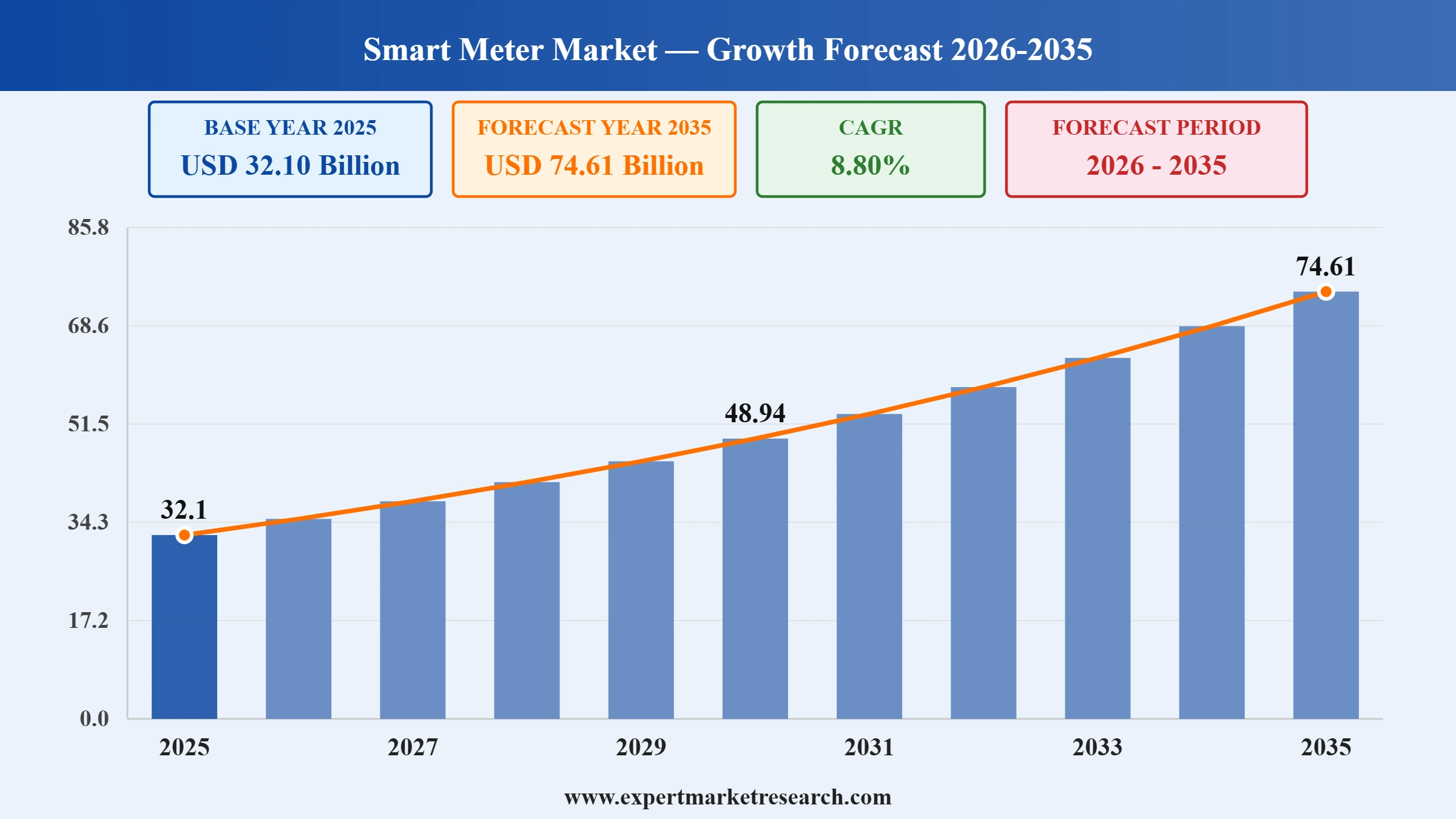
The global smart meter market attained a value of USD 32.10 Billion in 2025 and is projected to expand at a CAGR of 8.80% through 2035. The market is further expected to achieve USD 74.61 Billion by 2035. Utilities are accelerating smart meter deployment to improve billing accuracy, monitor consumption remotely, reduce distribution losses, and strengthen grid management. Government-backed programmes are providing substantial momentum; India, for instance, had installed 5.28 crore smart meters across various schemes by December 2025, while RDSS covers consumer, transformer, and feeder-level metering.
The global smart meter market is becoming an essential component of utility digitalization as electricity, gas, and water providers modernize ageing metering infrastructure and seek more accurate, automated consumption management. Smart meters enable two-way communication, remote readings, outage visibility, demand management, flexible tariffs, and data-driven grid operations, making them increasingly important as renewable generation, distributed energy resources, electric vehicles, and variable electricity demand place greater complexity on utility networks. In India, the Revamped Distribution Sector Scheme (RDSS) has sanctioned smart-metering projects covering 19.79 crore consumers, 52.53 lakh distribution transformers, and 2.05 lakh feeders, with 3.90 crore smart meters installed under RDSS by December 2025, thereby boosting the smart meter market value.
The smart meter market is increasingly shifting toward interoperable, multi-vendor metering ecosystems as utilities seek to modernize AMI infrastructure without becoming dependent on a single technology platform. Greater interoperability can simplify integration, improve deployment flexibility, and help utilities scale smart-meter programmes across diverse networks and meter types. A specific example came in March 2025, when Itron and CHINT Global announced a collaboration integrating Itron’s Meter Integration Services with CHINT’s smart metering portfolio. The initiative supported interoperability across multiple meter types, helping utilities streamline AMI integration. For companies, this strengthens technology partnerships, broadens deployment opportunities, and supports growth through scalable multi-vendor smart metering solutions.
Cybersecurity remains a major challenge in the smart meter market as connected meters and AMI networks create additional attack surfaces that can threaten customer data, utility operations, and grid reliability. Recent research has identified potential vulnerabilities in smart-meter communication channels. To overcome this challenge, market players are adopting defence-in-depth architectures, encrypted communications, network monitoring, secure authentication, vulnerability management, and incident-response mechanisms. Schneider Electric, for instance, promotes layered cybersecurity for smart-grid infrastructure, incorporating secure connected products, access controls, and cybersecurity measures aligned with industrial standards, thus aiming more towards the smart meter market developments.
Read more about this report - REQUEST FREE SAMPLE COPY IN PDF
DigitalBridge agreed to acquire Ausgrid’s Plus ES smart-metering business for approximately US$3 billion. Plus ES has around two million meters deployed across Australia and provides infrastructure connecting energy data between retailers, utilities, and network operators. The transaction highlights increasing investment in large-scale smart-meter infrastructure and strengthens the sector’s digital-grid expansion potential.
India’s Power Minister announced that West Bengal would begin a phased smart-meter rollout from July, targeting nearly two crore electricity consumers. Government offices and campuses were planned as the initial users, followed by large consumers and households. The programme is expected to improve billing efficiency, reduce distribution losses, and expand smart-meter deployment opportunities.
Adani Energy Solutions reported that it had successfully installed one crore electricity smart meters across distribution companies, becoming the first Indian player to reach the milestone. The company was installing around 25,000 meters daily and held an order book of 2.46 crore meters, demonstrating how large-scale deployment is accelerating smart-meter adoption and creating significant infrastructure growth opportunities.
Polaris Smart Metering secured approximately INR 710 crore from British International Investment to support deployment of 2.2 million smart meters in West Bengal. The financing is enabling expansion of digital energy infrastructure while supporting distribution reforms. The development benefits the market by providing capital for large-scale installations and accelerating smart-meter penetration.
Regulatory mandates and utility-modernization programmes remain among the strongest demand generators for smart meters. India's RDSS demonstrates the scale of public-sector procurement, with smart metering sanctioned across 28 States and Union Territories and 45 distribution utilities. By December 2025, India had installed 5.28 crore smart meters across various programmes. In March 2026, India's Ministry of Power reported that INR 1.31 lakh crore of smart-metering projects had been sanctioned under RDSS. Such programmes create sustained opportunities for meter manufacturers, AMI service providers, communications companies, and system integrators, thus affecting the smart meter market dynamics and trends.
Manufacturers are increasingly embedding computing, sensing, communications, and analytics capabilities into metering platforms. At DTECH 2026, Itron demonstrated edge AI/ML running directly on next-generation electric meters, including applications designed to identify grid risks and improve reliability. Itron also showcased metering platforms using NVIDIA Jetson edge-computing technology. This shift expands smart meters from billing instruments into distributed grid sensors capable of supporting predictive maintenance, power-quality monitoring, demand response, and faster outage detection.
Utilities are increasingly seeking integrated platforms capable of managing electricity, gas, and water metering through common architectures. Schneider Electric's EcoStruxure Grid Metering Operation supports electric, gas, and water meters and can manage millions of active meters through scalable architecture. Siemens similarly provides Gridscale X Meter Data Management for electricity, gas, and water utilities. This convergence supports cross-utility analytics while reducing duplicated infrastructure, encouraging vendors to offer interoperable AMI platforms rather than standalone metering hardware, thereby boosting the trends in the smart meter market.
Connected metering systems are being used by water companies to detect leaks, enhance visibility on consumption, and manage non-revenue water. Sensus smart metering project from Xylem, in partnership with Anglian Water, is expected to run until 2030 with 1,500 meters being installed daily between 2025 and 2030. In North America, the first certification was obtained by Badger Meter ORION Cellular endpoint under Ericsson and CTIA's IoT Network Certified for Smart Connected Infrastructure program in March 2025.
As smart meters become connected to grid assets, utilities increasingly require secure communications, remote configuration, interoperability, and long-term software support. Schneider Electric's metering platform supports multiple communication technologies, including PLC, RF, cellular, and NB-IoT, while its lifecycle architecture is designed for large-scale deployments. Siemens' cloud-based Gridscale X Meter Data Management SaaS similarly incorporates ongoing upgrades and cybersecurity updates, reflecting the industry's movement toward managed digital infrastructure rather than one-time meter procurement.
The Expert Market Research’s report titled "Smart Meter Market Report and Forecast 2026-2035” offers a detailed analysis of the market based on the following segments:
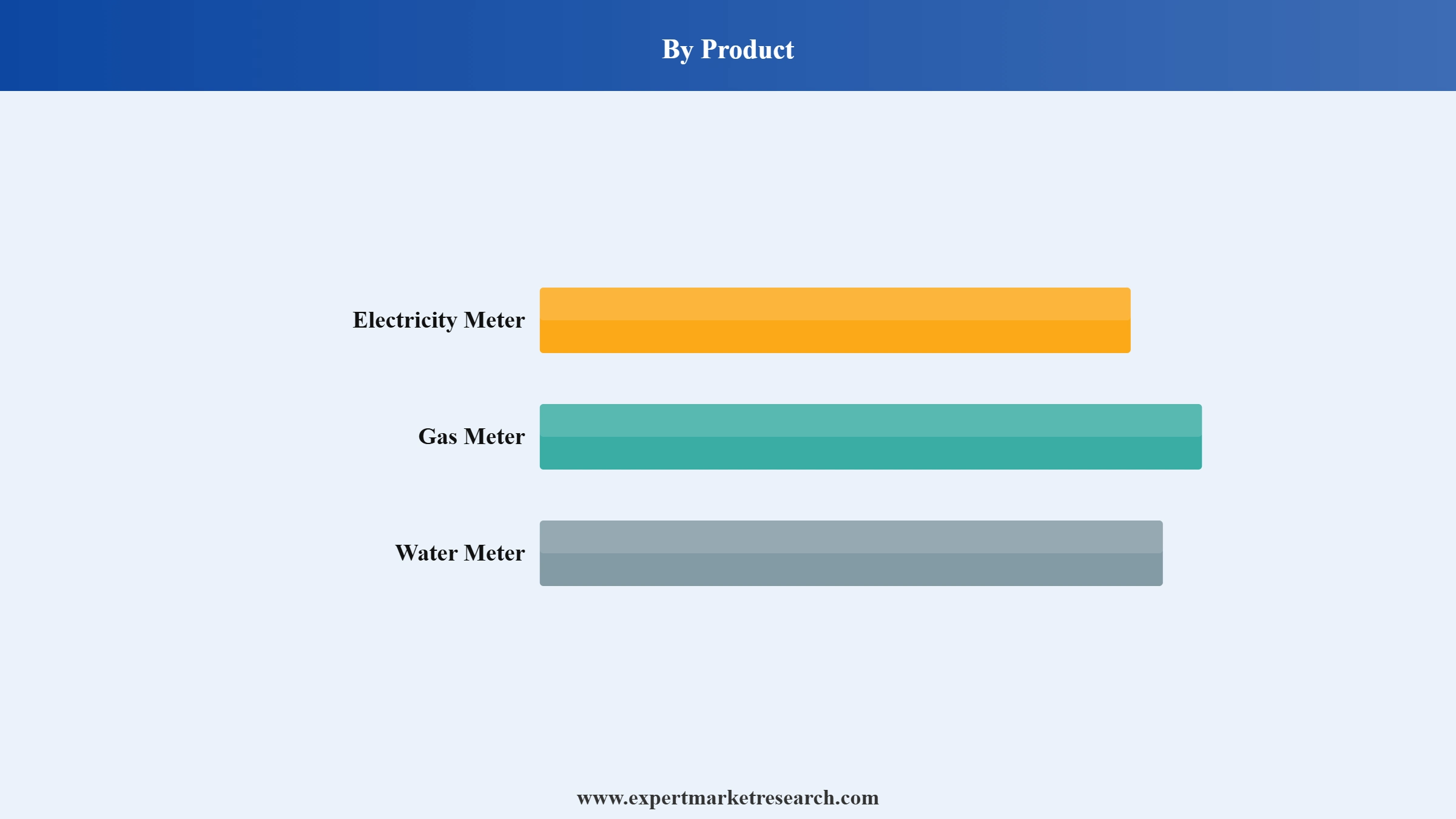
Market Breakup by Product
Key Insight: Electric meters are becoming increasingly popular as utilities upgrade their grids, embrace renewable energy, introduce pre-payment systems, and improve real-time consumption measurement. Gas meters are being embraced because of their ability to conduct automated meter reading, precise billing, remote monitoring, and analysis of consumption. Water meters are increasingly being utilized due to the issue of water shortage, wastage, and loss of water by cities due to leaks, among others. In all these sectors, AMI, Internet of Things (IoT), and data analytics are improving efficiency and fast-tracking the deployment of smart meters globally, thereby opening up new opportunities and boosting the growth of the smart meter market.
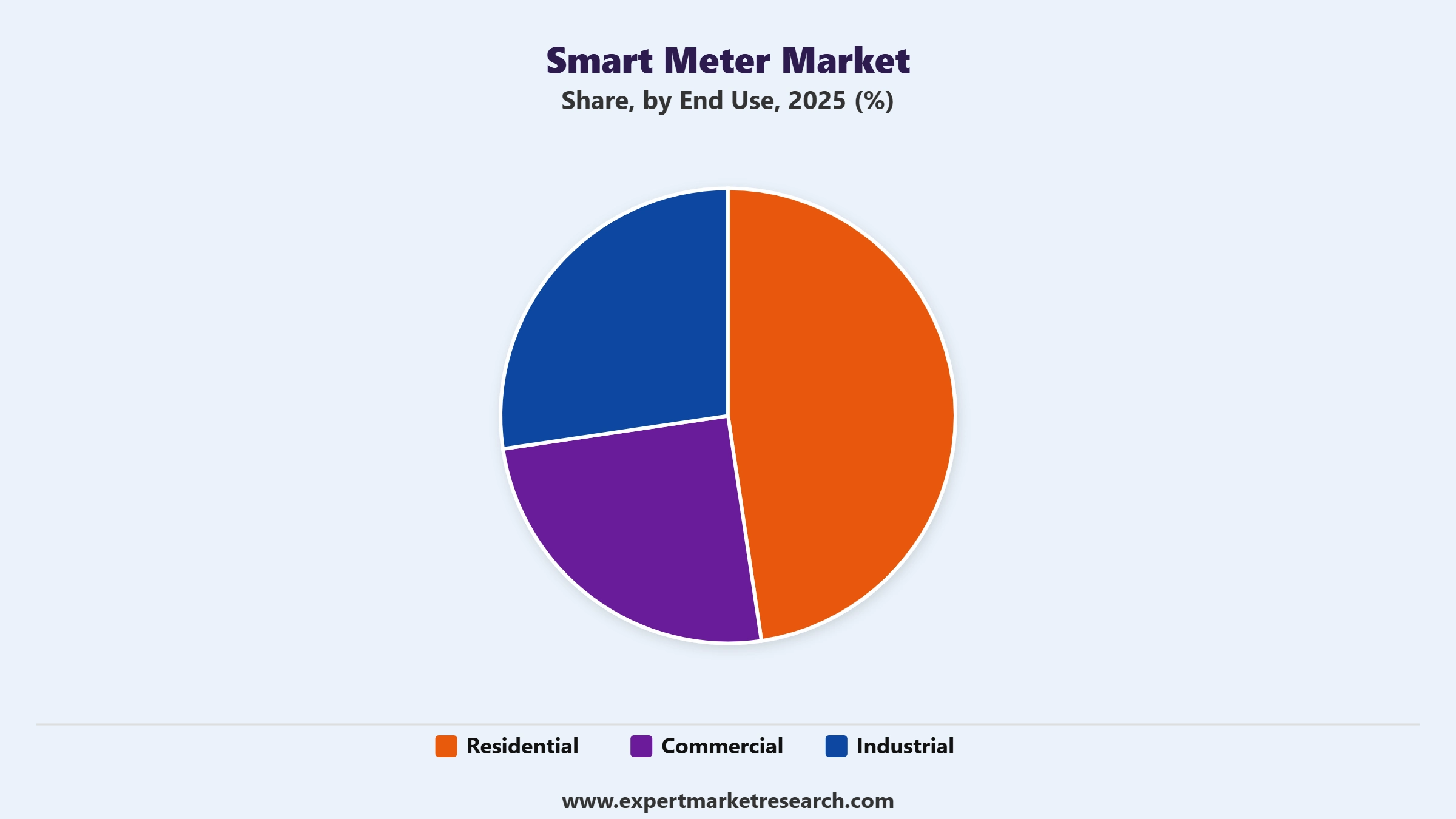
Market Breakup by End Use
Key Insight: The use of residential smart meters is gradually becoming popular through extensive rollouts of utilities, real-time monitoring of consumption, prepaid meters, and demand-response programs. Commercial consumers are also increasingly using smart meters for effective energy consumption optimization at offices, commercial buildings, hotels, and data centers. Industrial consumption is increasingly moving towards smart meters because industries need to analyze energy consumption, monitor loads automatically, manage loads, and connect to industrial control systems.
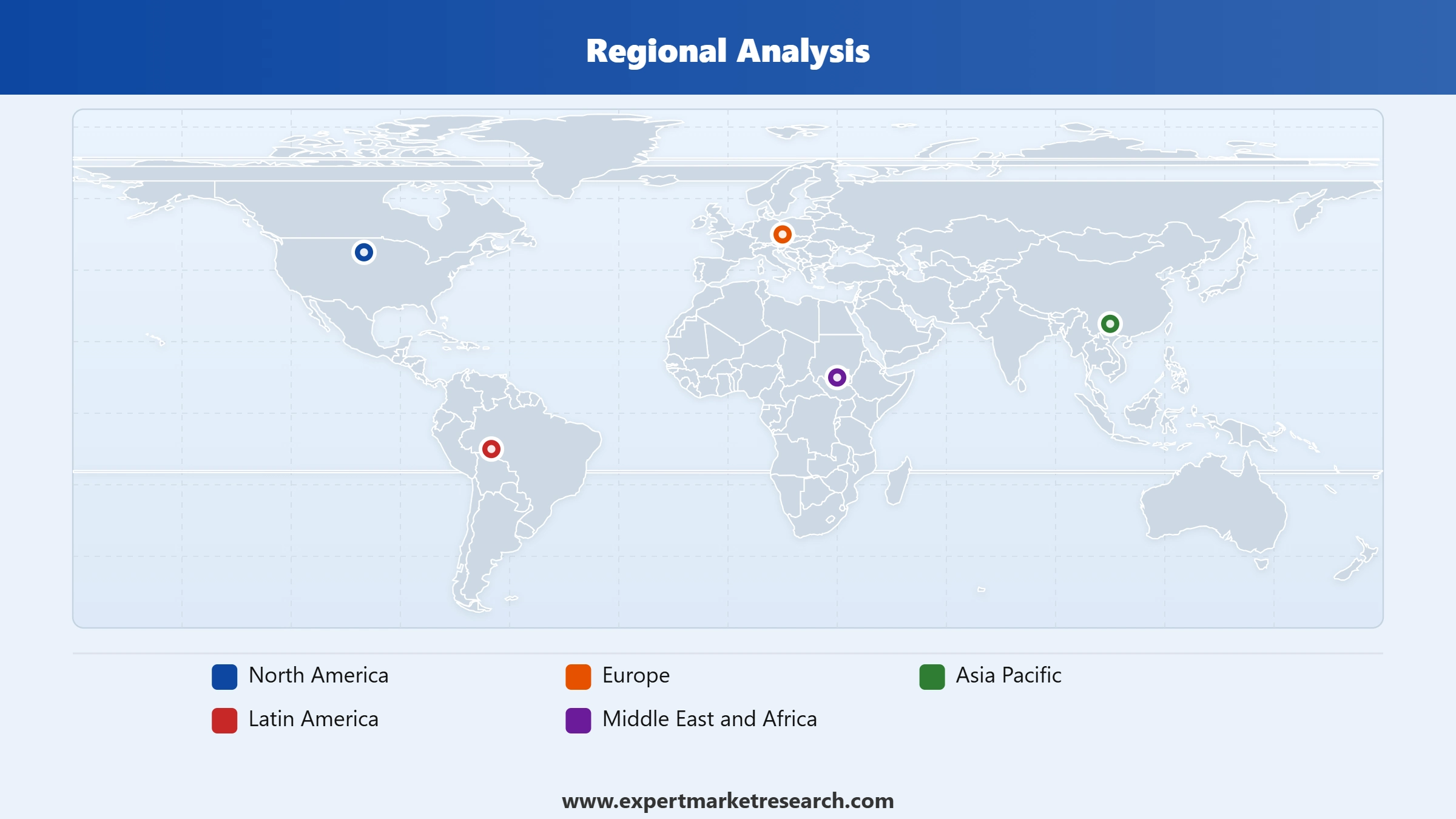
Market Breakup by Region
Key Insight: North America is gaining traction through continued AMI upgrades, grid modernization, and replacement of ageing meters, with utilities increasingly adopting advanced connectivity and grid-edge intelligence. Europe is expanding smart-meter deployment to support renewable integration, energy efficiency, dynamic pricing, and decarbonization objectives. Asia Pacific is experiencing strong momentum from large-scale utility rollouts, particularly in China and India, alongside efforts to reduce distribution losses and modernize grids. Latin America is emerging through utility modernization, remote monitoring, billing improvements, and non-technical loss reduction initiatives, particularly across Brazil and Mexico.




Read more about this report - REQUEST FREE SAMPLE COPY IN PDF
By product, Electricity Meter dominates due to large-scale grid modernization and utility deployments
Electricity meters remain the dominant product segment as utilities worldwide prioritise grid modernization, loss reduction, automated billing, and renewable energy integration. Large-scale deployments are reinforcing demand, particularly in emerging markets. For example, India had 5.28 crore smart meters installed across various schemes by December 2025, while Adani Energy Solutions reached 1 crore electricity smart meters delivered by February 2026. These large utility-led programmes demonstrate the strong deployment pipeline for electricity meters and their expanding role in digital distribution networks. Such developments will thus boost the smart meter market dynamics and trends in the long run.
Read more about this report - REQUEST FREE SAMPLE COPY IN PDF
Water meters are gaining momentum as municipalities and utilities increasingly address leakage, water scarcity, non-revenue water, and inefficient manual readings. Connected water meters provide granular consumption data that enables faster leak detection and resource management. The segment is benefiting from IoT-based connectivity and smart-city investments, particularly in urban markets. Growing pressure to improve water-use efficiency and reduce distribution losses is encouraging utilities to transition from conventional meters to remotely monitored systems, creating expanding opportunities for smart water-meter manufacturers and technology providers.
By end use, Residential dominates due to extensive household smart-meter rollout programmes globally
Smart meter adoption in homes can be facilitated through widespread utility programs, prepaid smart meters, remote billing processes, and consumer-oriented energy management apps. As per December 2025, India’s RDSS program alone had 5.28 crore smart meters installed in various programs, and residential users represent a large base for smart meter installations. Utilities are utilizing smart meters to enable greater consumption visibility, recharging options, low balance alerts, and accurate billing.
Read more about this report - REQUEST FREE SAMPLE COPY IN PDF
Industrial adoption is accelerating as energy-intensive facilities seek granular consumption data, automated monitoring, demand management, and improved operational efficiency. India’s RDSS specifically prioritises prepaid smart-meter deployment for commercial, industrial, government, and high-load consumers, while smart meters increasingly support digital grid management. Growing electrification, energy-cost optimization, and integration of distributed energy resources are encouraging industrial users to adopt connected metering technologies.
By region, Asia Pacific dominates due to large-scale deployments across China and India.
Asia Pacific remains the dominant regional market, supported by large-scale smart-meter deployments in China and India, grid modernization, electricity-loss reduction, and rising urbanization. China has maintained extensive utility-led deployment, while India’s national smart-meter programmes are accelerating installations. Australia, Japan, and South Korea are also expanding advanced metering infrastructure, reinforcing the region’s scale and technology adoption. Such factors are directly boosting the smart meter market regional growth.
Read more about this report - REQUEST FREE SAMPLE COPY IN PDF
Latin America is emerging as a high-growth region as utilities increasingly deploy smart meters to reduce electricity theft, improve billing accuracy, enable remote monitoring, and modernize distribution networks. Brazil and Mexico are leading adoption through utility digitalization and loss-reduction initiatives, while growing investment in connected infrastructure is creating opportunities for smart-meter manufacturers and AMI technology providers.
Smart meter market players are aiming to expand deployment across electricity, gas, and water utilities while strengthening advanced metering infrastructure (AMI) capabilities. Companies are investing in connected meters, two-way communication, cloud-based platforms, and data analytics to support remote monitoring, automated billing, outage detection, and demand management. Strategic partnerships with utilities, technology providers, and communication companies are also helping manufacturers broaden their customer base and accelerate large-scale deployments.
To attain scalability, smart meter companies, leading companies are focusing on interoperable platforms, cybersecurity, modular architectures, and integration with smart-grid infrastructure. Expansion into emerging markets, localization of manufacturing and service capabilities, and development of cellular and IoT-enabled solutions are further supporting long-term growth.
Honeywell International Inc. offers residential, commercial, and industrial electricity meters, along with smart gas and water metering solutions, communications, collectors, and AMI technologies. Its Next Generation Cellular Module enables legacy gas and water meters to become smart meters through cellular connectivity. Honeywell was established in 1906 and is headquartered in Charlotte, North Carolina, United States.
Schneider Electric SE provides smart metering solutions through its EcoStruxure platform, supporting energy monitoring, consumption analysis, connectivity, and data-based energy management for homes and businesses. Its solutions are designed for electricity consumption measurement and integration with broader energy management systems. Schneider Electric was established in 1836 and is headquartered in Rueil-Malmaison, France.
Itron Inc. offers smart electricity, natural gas, and water meters, supported by communication networks, modules, meter data management software, and AMI solutions. Its portfolio enables utilities to remotely collect and analyze consumption data while improving grid and resource management. Itron was established in 1977 and is headquartered in Liberty Lake, Washington, United States.
Siemens AG supports smart metering through its smart-grid and utility solutions, including technologies for metering, billing, energy management, and digital grid infrastructure. Its portfolio integrates smart-metering capabilities with broader utility systems to improve grid visibility and operational efficiency. Siemens was established in 1847 and is headquartered in Munich, Germany.
Other smart meter market key players include Badger Meter, Inc., Sensus (Xylem), Landis+Gyr AG, among others.
*Please note that this is only a partial list; the complete list of key players is available in the full report. Additionally, the list of key players can be customized to better suit your needs.*
Unlock opportunities in the global smart meter market with Expert Market Research. Leverage market forecasts, competitive insights, and industry trends to strengthen market positioning and make informed business decisions.


Upto 15% Off
USD
$2499 $2249
$3999 $3599
$4999 $4249
$5999 $5099


*While we strive to always give you current and accurate information, the numbers depicted on the website are indicative and may differ from the actual numbers in the main report. At Expert Market Research, we aim to bring you the latest insights and trends in the market. Using our analyses and forecasts, stakeholders can understand the market dynamics, navigate challenges, and capitalize on opportunities to make data-driven strategic decisions.*
In 2025, the market reached an approximate value of USD 32.10 Billion.
The market is projected to grow at a CAGR of 8.80% between 2026 and 2035.
The market is estimated to witness a healthy growth in the forecast period of 2026-2035 to reach USD 74.61 Billion by 2035.
Key strategies driving the smart meter market include utility-led grid modernization, advanced metering infrastructure deployment, cybersecurity enhancement, interoperability standardization, strategic technology partnerships, remote monitoring capabilities, data analytics integration, and expansion of smart grid investments.
The key trends guiding the growth of the market include new product launches by manufacturers to incorporate advanced features, rising gas and water consumption, growing technological advancements, rising electricity prices, and the increasing environmental consciousness.
The major regions in the market are North America, Latin America, the Middle East and Africa, Europe, and the Asia Pacific.
Electricity meter, gas meter, water meter are the leading types in the market.
The significant end uses of smart meters are residential, commercial, and industrial.
The key players in the market include Honeywell International Inc., Schneider Electric SE, Itron Inc., SIEMENS AG, Badger Meter, Inc., Sensus (Xylem), and Landis+Gyr AG, among others.
Key challenges in the smart meter market include high deployment and replacement costs, cybersecurity risks, data privacy concerns, interoperability issues, complex infrastructure integration, consumer resistance, and regulatory compliance requirements across regions.
Explore our key highlights of the report and gain a concise overview of key findings, trends, and actionable insights that will empower your strategic decisions.
| REPORT FEATURES | DETAILS |
| Base Year | 2025 |
| Historical Period | 2019-2025 |
| Forecast Period | 2026-2035 |
| Scope of the Report |
Historical and Forecast Trends, Industry Drivers and Constraints, Historical and Forecast Market Analysis by Segment:
|
| Breakup by Product |
|
| Breakup by End Use |
|
| Breakup by Region |
|
| Market Dynamics |
|
| Competitive Landscape |
|
| Companies Covered |
|
| Report Price and Purchase Option | Explore our purchase options that are best suited to your resources and industry needs. |
| Delivery Format | Delivered as an attached PDF and Excel through email, with an option of receiving an editable PPT, according to the purchase option. |
Datasheet
One User
USD 2,499
USD 2,249
tax inclusive*
Single User License
One User
USD 3,999
USD 3,599
tax inclusive*
Five User License
Five User
USD 4,999
USD 4,249
tax inclusive*
Corporate License
Unlimited Users
USD 5,999
USD 5,099
tax inclusive*
*Please note that the prices mentioned below are starting prices for each bundle type. Kindly contact our team for further details.*
Flash Bundle
Small Business Bundle
Growth Bundle
Enterprise Bundle
*Please note that the prices mentioned below are starting prices for each bundle type. Kindly contact our team for further details.*
Flash Bundle
Number of Reports: 3
20%
tax inclusive*
Small Business Bundle
Number of Reports: 5
25%
tax inclusive*
Growth Bundle
Number of Reports: 8
30%
tax inclusive*
Enterprise Bundle
Number of Reports: 10
35%
tax inclusive*
How To Order

Select License Type
Choose the right license for your needs and access rights.

Click on ‘Buy Now’
Add the report to your cart with one click and proceed to register.

Select Mode of Payment
Choose a payment option for a secure checkout. You will be redirected accordingly.
Strategic Solutions for Informed Decision-Making
Gain insights to stay ahead and seize opportunities.

Get insights & trends for a competitive edge.

Track prices with detailed trend reports.

Analyse trade data for supply chain insights.

Leverage cost reports for smart savings

Enhance supply chain with partnerships.

Connect For More Information
Our expert team of analysts will offer full support and resolve any queries regarding the report, before and after the purchase.
Our expert team of analysts will offer full support and resolve any queries regarding the report, before and after the purchase.
We employ meticulous research methods, blending advanced analytics and expert insights to deliver accurate, actionable industry intelligence, staying ahead of competitors.
Our skilled analysts offer unparalleled competitive advantage with detailed insights on current and emerging markets, ensuring your strategic edge.
We offer an in-depth yet simplified presentation of industry insights and analysis to meet your specific requirements effectively.




