

Consumer Insights
Uncover trends and behaviors shaping consumer choices today
Procurement Insights
Optimize your sourcing strategy with key market data
Industry Stats
Stay ahead with the latest trends and market analysis.
The global solar tracker market attained a value of USD 8.04 Billion in 2025 and is projected to expand at a CAGR of 28.10% through 2035. The market is further expected to achieve USD 95.66 Billion by 2035. Innovations in hybrid parks comprising solar and wind power sources are prompting tracker makers to come up with technologies capable of optimizing land use, ensuring grid reliability, and maximizing combined energy efficiencies.
Two key factors are driving the surging demand in the solar tracker market. The rising adoption of bifacial modules is increasing demand for single-axis trackers that optimize backside solar radiation capture. Secondly, the utility sector's emphasis on predictable generation makes it necessary for tracker companies to produce systems that adjust the position of panels based on weather conditions. This ensures that the power generated by solar plants corresponds to the hours of peak energy demand.
In September 2023, Nextracker launched advanced solar tech suite enhancing hail protection, terrain adaptability, and energy optimization, improving construction speed, reducing risks, and boosting project profitability. This follows a trend where project developers opt for challenging terrains to achieve better land utilization. In addition, according to the solar tracker market analysis, in 2024, 40% of new PV capacity was distributed while 60% was utility-scale, with wind and solar jointly accounting for 83% of total installed capacity.
The dynamics of the solar tracker market are further changing as a result of shifts in the project economics landscape and the expectations from the end-users. Solar utility-scale players are now demanding greater energy yield per acre through AI-based tracker algorithms, bifacial solar panel integration, and robustness against severe environmental conditions. For instance, in April 2026, Arctech launched all-terrain solar tracker enabling complex sites, boosting efficiency, reducing costs, and improving energy generation using AI and adaptive design. Furthermore, localized production techniques are becoming essential for complying with local domestic content policies in countries such as the United States and India. Such factors are enabling companies to generate profits while securing EPC contracts.
Compound Annual Growth Rate
28.1%
Value in USD Billion
2026-2035
TerraSmart launched PeakYield production package, providing optimized solar tracker performance, making it possible to improve power generation, simplify installation processes, and increase efficiency. These advancements provide opportunities for firms to consider investing in software optimized solar trackers that offer better performance and predictive analysis.
FTC Solar introduced Pioneer high-wind tracker, which is designed to withstand severe conditions, providing a stable source of solar energy. It allows companies to develop trackers capable of enduring harsh climatic conditions in their respective locations.
The Series 7 modules were launched by First Solar alongside Genius Tracker technology in India, boosting system efficiencies, optimally using the land, and increasing the capabilities of solar projects in the country. Companies in the solar tracker market can benefit from module-tracker integration, where companies benefit from economies of scale with regards to utility-scale solar projects.
Nextracker crossed the 10 GW mark in trackers installed in India, thereby enhancing market leadership, boosting local manufacturing, and building solar power infrastructure across the country. This indicates an opportunity for solar tracker market players to increase domestic manufacturing and take advantage of increased demand for utility-scale solar projects.
The latest trend in the solar tracker market is the use of AI in their control systems that adjust panel orientation based on cloud movement. For example, Soltec Power Holdings applies machine learning to determine tracker positions depending on cloud movement and changes in radiation. On the other hand, in May 2025, Solargik launched AI-powered SOMA Pro platform enabling real-time solar tracking diagnostics, improving performance, reducing losses, and optimizing energy output efficiently. The European governments are stimulating such inventions by offering digitalization awards under renewable transition programs to encourage companies to create intelligent control systems.
Tracker producers are currently moving toward localization due to existing incentives as well as potential supply risks. For instance, Indian policies within the Production Linked Incentive program push companies like Adani Solar to localize tracker production. Similarly, the United States Inflation Reduction Act requires the use of steel supplied locally to make trackers. This trend in the solar tracker market results in lowered logistics expenses and a quicker realization of projects. Tracker producers are building partnerships in different regions and securing the availability of raw materials needed for fast deliveries. For example, in January 2026, Nextpower Arabia announced plans to supply 2.25 GW smart solar trackers for Bisha project, supporting large-scale deployment, localized manufacturing, and Saudi renewable energy expansion goals.
Companies like Arctech Solar are designing their trackers to withstand wind speeds of up to 160 km per hour. These types of technologies are being applied in Australian projects to enhance their structural safety against weather events. Resilience requirements set by governments are pushing investors to use resilient and innovative tracking systems, which help improve terms of insurance services in such plants. Following this shift in the solar tracker market, in April 2026, Array announced plans to supply OmniTrack terrain-following trackers for 260MW Pekintas project, enhancing energy output, reducing grading costs, and enabling efficient deployment on complex terrains.
One key evolution in tracking technology is its increasing integration with energy storage systems. Tracker providers are collaborating with energy storage systems manufacturers to offer optimal positioning in line with battery charging cycles. For instance, since March 2024, Trina Solar is collaborating with storage companies to position their trackers accordingly. Countries like China are implementing new policies requiring solar plants to integrate their projects with energy storage systems. These actions are helping tracker providers transition to system optimization, accelerating the solar tracker market value. For example, in March 2026, Jackery launched SolarVault 3 series, integrating solar storage and smart energy management for efficient home power use.
The solar tracker market trend toward being more data-driven is changing the way in which the manufacturers interact with their customers. They are coming up with performance monitoring systems that will be capable of providing real-time data regarding energy production and mechanical efficiency. For example, GameChange Solar offers predictive fault detection software, which reduces maintenance expenses significantly. Solar parks in the Middle East are also deploying such technologies to help them handle their assets of several gigawatts capacity. On a similar note, in April 2026, kWh Analytics launched data-sharing program rewarding hail-resistant solar projects with lower insurance costs and improved risk management incentives.
Read more about this report - REQUEST FREE SAMPLE COPY IN PDF
The EMR’s report titled “Global Solar Tracker Market Report and Forecast 2026-2035” offers a detailed analysis of the market based on the following segments:
Market Breakup by Technology
Key Insight: Solar PV secures the largest share of the solar tracker market because of its capacity to scale up installations and standard engineering designs, while CPV is gaining more relevance in areas with high irradiation, where precise tracking systems are necessary. In July 2024, Soltec launched dual-axis tracker for concentrated photovoltaics, enhancing precision tracking, boosting energy efficiency, and enabling integration with high-performance micro-CPV modules. The CSP segment keeps on making use of special tracking systems needed for the thermal energy production and storage.
Market Breakup by Application
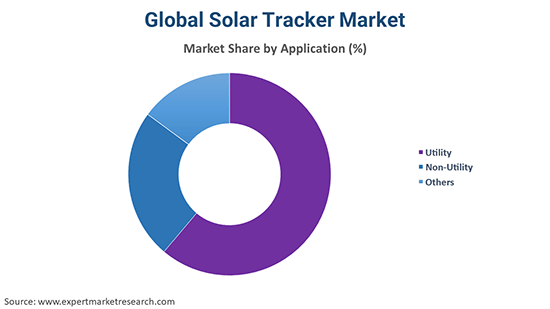
Key Insight: As per the solar tracker market report, utility-scale projects remain prevalent as a result of their potential to generate large amounts of power along with a consistent stream of income, while the number of non-utility projects is growing, driven by the needs of companies who seek control over energy production and costs. Other applications such as community solar farms or hybrid projects are also emerging. Firms customize their solar trackers according to their scale, complexity, and financial arrangements.
Market Breakup by Product
Key Insight: The segmentation of products is based on the balance between cost efficiency and the optimization of performance. It is observed that single axis trackers dominate the solar tracker market because they are economical and scalable for extensive use, while dual axis trackers are being increasingly used in projects that require maximizing the generation of electricity. In July 2025, Corrie Energy launched its Latitude40 fully patented dual-axis solar tracker designed to transform the economics of solar at United Kingdom latitudes. This indicates that producers continuously innovate their products according to the requirements of each project, such as adaptation to terrain and ease of maintenance.
Market Breakup by Region
Key Insight: Regional segmentation is influenced by differences in policies and levels of market maturity. North America tops the list, with well-regulated markets and existing infrastructure of solar energy; on the other hand, the Asia Pacific solar tracker market is also growing fast because of rising demand from industries and government programs. For example, in April 2026, Jupiter–Ampin JV launched integrated solar manufacturing unit in Odisha, boosting domestic production capacity, strengthening supply chains, and supporting India’s renewable energy expansion goals. Europe focuses on its sustainable nature and innovations in technology; Latin America and the MEA regions exhibit plenty of potential with emerging projects.
By technology, solar PV dominate the market due to scalable utility adoption and cost efficiencies
Solar PV modules dominate the current solar tracker market dynamics as developers prioritize scalable, bankable solutions that ensure predictable returns. Tracker suppliers are increasingly integrating their trackers with bifacial PV panels in order to optimize the output without necessarily raising the cost of solar farms. Moreover, tracker suppliers are designing modularity in order to ease installation processes, especially for large-scale gigawatt projects. For instance, in November 2025, Nextpower launched India-specific solar tracker foundation system, improving installation efficiency, reducing costs, and enabling faster deployment across diverse terrains.
The most promising sector in terms of growth in the solar tracker market is the CPV technology segment. The main advantage of CPV modules lies in their high efficiency levels in regions endowed with high Direct Normal Irradiance. The target areas of companies manufacturing CPV panels include desert locations which have low land requirements and are characterized by high levels of solar intensity. The development of precise dual-axis tracking systems optimized for CPV installations is now common among tracker companies.
By application, the utility segment leads the market due to large-scale project deployment and long-term contracts
The utility applications continue to dominate the solar tracker market revenue growth owing to the increasing use of such products within large-scale solar plants, due to their capacity to deliver high output levels. Suppliers in this industry focus on providing reliable products that can be used extensively in large-scale projects with lower maintenance needs. There is also the rising importance of integration of these products with the grid system to enable effective synchronization with energy demand. For example, in March 2026, TerraSmart launched PeakYield software upgrade optimizing solar trackers for utility and distributed projects, improving energy yield, reducing downtime, and enhancing performance across complex terrains.
Non-utility applications are expected to witness the fastest rate of growth in the solar tracker market due to the increasing uptake of captive solar systems by businesses in order to reduce expenses. Suppliers target small businesses by promoting products with smaller designs and flexible installation options. Businesses are increasingly seeking energy independence and sustainability compliance, driving demand for efficient tracking solutions. Suppliers are also offering customized financing and service models to attract mid-sized enterprises.
By product, single axis trackers account for the largest share of the market due to cost efficiency and widespread utility deployment
Single axis trackers claim the largest share of the solar tracker market as they provide an ideal combination of performance benefits and cost-efficiency. The technologies have become common in utility-scale installations that seek to boost performance while keeping investments low. Developers are increasingly becoming interested in improving structural longevity and simplifying the installation process, which is expected to speed up the implementation of tracking systems. In November 2025, Antaisolar launched AT-Spark single-axis tracker with enhanced strength, smart control, terrain adaptability, boosting efficiency, and reducing costs for utility-scale solar projects.
On the other hand, dual axis trackers are projected to be the most rapidly growing category of the tracker technology market owing to their capacity for maximizing the capture of sunlight via proper alignment. These tracking systems are used in space-constrained settings where maximizing performance gains is essential. Dual axis trackers continue to evolve in terms of design in order to become less mechanically complicated and expensive to maintain. These systems are also increasingly used in niche applications like CPV installations.




North America captures the leading market position due to policy incentives and large-scale solar investments
North America dominates the solar tracker market due to continued favorable policy measures and financial incentives, which facilitate utility-scale solar power generation. Manufacturers are planning their operations as per their domestic manufacturing criteria, especially in the United States, to capitalize on incentives available under government initiatives. Tracker providers are also concentrating on improving the durability of their products to ensure that the systems endure varying weather conditions within the region. For example, in August 2025, Array Technologies and OMCO Solar announced plans to supply United States-made trackers for solar projects across the country.
The solar tracker market in the Asia Pacific region boasts the highest growth rate as a result of ambitious renewable energy goals and growing industrial energy demand. Nations like China and India are witnessing large-scale solar power installation, thus requiring manufacturers of trackers to increase their production capacities to meet the rising demand for solar power in the region.
High competition levels are witnessed in the industry as solar tracker companies venture from hardware to performance-integrated solutions. The major areas of concern are the creation of trackers that are suitable for various terrains, utilization of AI for control purposes, and using corrosion-resistant material to enhance the performance of trackers. It can be noted that the trend is shifting toward bundling of products through the provision of software analytics and predictive maintenance, thus ensuring that revenue is achieved on a consistent basis.
Opportunities for solar tracker market players can be seen in hybrid renewable parks and hard-to-access areas, where low-cost deployment and minimal land preparation enhance feasibility and returns. Additionally, integrating trackers with energy storage and AI-driven monitoring can further optimize performance, improve reliability, and unlock value in remote installations.
SunPower Corporation was founded in 1985 in California, United States. The firm specializes in providing high-efficiency solar solutions with an emphasis on trackers to generate high-energy production among business customers and residential consumers. The company is linking trackers to its portfolio to optimize energy yield. Its approach involves an integrated hardware-software energy solution and energy services to enhance customer loyalty.
Array Technologies Inc. is established in 1989 in New Mexico, United States. The firm produces single axis trackers used primarily for utility scale projects. The firm is trying to simplify the mechanical structure to minimize failure points with digital monitoring features. The company’s solutions are deployed in solar farms, supported by long-term procurement agreements and strong relationships with EPC contractors.
Since its establishment in 2008, AllEarth Renewables, Inc., which has its headquarters in Vermont, United States, has been involved in the development of tracking systems in the distributed solar markets. The company specializes in providing plug-and-play solutions for installing trackers in smaller operations. These trackers are finding applications in commercial and agricultural fields due to increased requirements for energy production in limited spaces.
The organization Deger Energie GMBH & CO. KG was founded in 1999, and its headquarters are located in Germany. This company offers tracking systems based on sensors. It utilizes the technique of real-time solar tracking based on MLD technology. Such an approach allows for better energy production, especially in areas with changing weather.
*Please note that this is only a partial list; the complete list of key players is available in the full report. Additionally, the list of key players can be customized to better suit your needs.*
Other key players in the market include Nextracker Inc., PV Hardware Solutions, S.L.U., and Abengoa S.A., among others.
Unlock the latest insights with our solar tracker market trends 2026 report. Discover regional growth patterns, consumer preferences, and key industry players. Stay ahead of competition with trusted data and expert analysis. Download your free sample report today and drive informed decisions in the market.


Upto 15% Off
USD
$2499 $2249
$3999 $3599
$4999 $4249
$5999 $5099


*While we strive to always give you current and accurate information, the numbers depicted on the website are indicative and may differ from the actual numbers in the main report. At Expert Market Research, we aim to bring you the latest insights and trends in the market. Using our analyses and forecasts, stakeholders can understand the market dynamics, navigate challenges, and capitalize on opportunities to make data-driven strategic decisions.*
In 2025, the market reached an approximate value of USD 8.04 Billion.
The market is projected to grow at a CAGR of 28.10% between 2026 and 2035.
Investing in AI-driven tracker systems, forming EPC partnerships, localizing manufacturing, integrating storage compatibility, and expanding service-based models to improve margins, secure contracts, and strengthen long-term project pipelines.
The increasing need for solar cells or photovoltaic cells and solar tracker benefits such as improved cell performance is expected to be a key trend guiding the growth of the market.
The major regions in the market are North America, Latin America, the Middle East and Africa, Europe, and the Asia Pacific.
The technology-based classifications of solar trackers available are solar PV, concentrator photovoltaic (CPV), and concentrated solar power (CSP), amongst others.
Solar trackers find applications in utility, and non-utility, amongst others.
There are single axis and dual axis products for solar trackers.
The key players in the market include SunPower Corporation, Array Technologies Inc., AllEarth Renewables, Inc., Deger Energie GmbH & Co. KG, Nextracker Inc., PV Hardware Solutions, S.L.U., and Abengoa S.A., among others.
High upfront costs, supply chain volatility, land constraints, and mechanical reliability concerns are limiting adoption, while developers demanding performance guarantees are increasing pressure on manufacturers to deliver consistent output.
Explore our key highlights of the report and gain a concise overview of key findings, trends, and actionable insights that will empower your strategic decisions.
| REPORT FEATURES | DETAILS |
| Base Year | 2025 |
| Historical Period | 2019-2025 |
| Forecast Period | 2026-2035 |
| Scope of the Report |
Historical and Forecast Trends, Industry Drivers and Constraints, Historical and Forecast Market Analysis by Segment:
|
| Breakup by Technology |
|
| Breakup by Application |
|
| Breakup by Product |
|
| Breakup by Region |
|
| Market Dynamics |
|
| Competitive Landscape |
|
| Companies Covered |
|
| Report Price and Purchase Option | Explore our purchase options that are best suited to your resources and industry needs. |
| Delivery Format | Delivered as an attached PDF and Excel through email, with an option of receiving an editable PPT, according to the purchase option. |
Datasheet
One User
USD 2,499
USD 2,249
tax inclusive*
Single User License
One User
USD 3,999
USD 3,599
tax inclusive*
Five User License
Five User
USD 4,999
USD 4,249
tax inclusive*
Corporate License
Unlimited Users
USD 5,999
USD 5,099
tax inclusive*
*Please note that the prices mentioned below are starting prices for each bundle type. Kindly contact our team for further details.*
Flash Bundle
Small Business Bundle
Growth Bundle
Enterprise Bundle
*Please note that the prices mentioned below are starting prices for each bundle type. Kindly contact our team for further details.*
Flash Bundle
Number of Reports: 3
20%
tax inclusive*
Small Business Bundle
Number of Reports: 5
25%
tax inclusive*
Growth Bundle
Number of Reports: 8
30%
tax inclusive*
Enterprise Bundle
Number of Reports: 10
35%
tax inclusive*
How To Order

Select License Type
Choose the right license for your needs and access rights.

Click on ‘Buy Now’
Add the report to your cart with one click and proceed to register.

Select Mode of Payment
Choose a payment option for a secure checkout. You will be redirected accordingly.
Strategic Solutions for Informed Decision-Making
Gain insights to stay ahead and seize opportunities.

Get insights & trends for a competitive edge.

Track prices with detailed trend reports.

Analyse trade data for supply chain insights.

Leverage cost reports for smart savings

Enhance supply chain with partnerships.

Connect For More Information
Our expert team of analysts will offer full support and resolve any queries regarding the report, before and after the purchase.
Our expert team of analysts will offer full support and resolve any queries regarding the report, before and after the purchase.
We employ meticulous research methods, blending advanced analytics and expert insights to deliver accurate, actionable industry intelligence, staying ahead of competitors.
Our skilled analysts offer unparalleled competitive advantage with detailed insights on current and emerging markets, ensuring your strategic edge.
We offer an in-depth yet simplified presentation of industry insights and analysis to meet your specific requirements effectively.




