

Consumer Insights
Uncover trends and behaviors shaping consumer choices today
Procurement Insights
Optimize your sourcing strategy with key market data
Industry Stats
Stay ahead with the latest trends and market analysis.
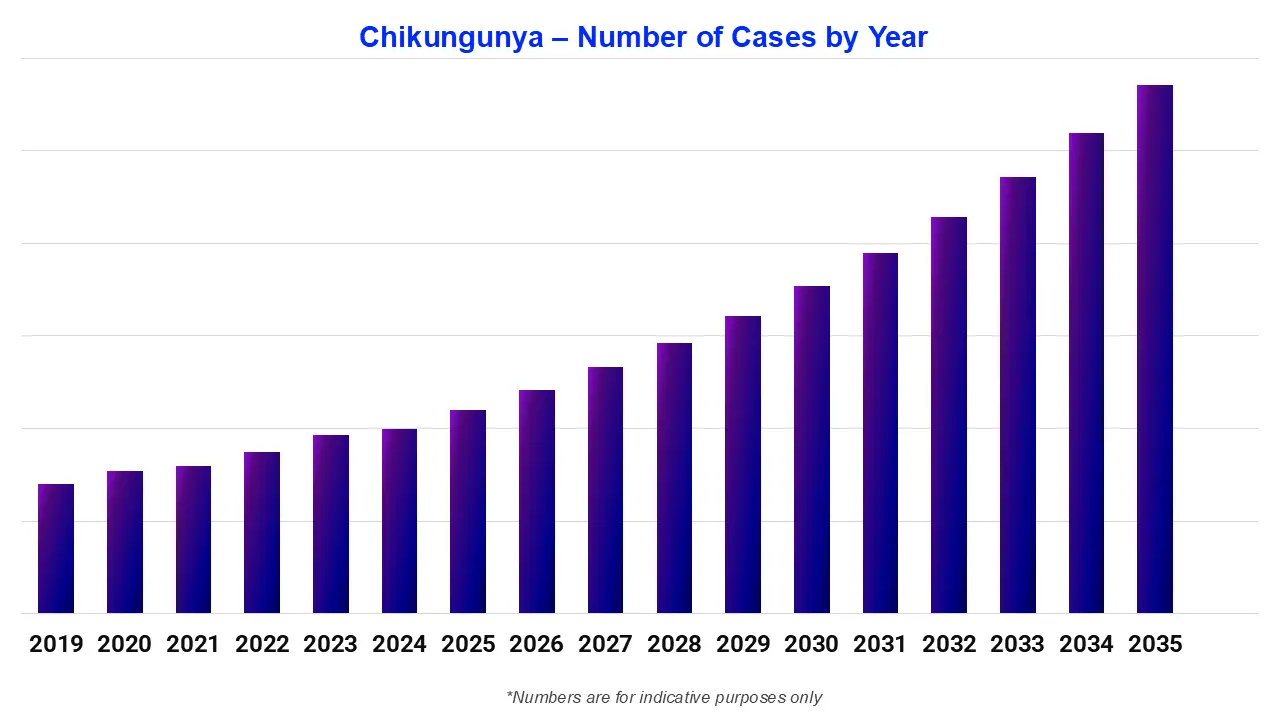
Chikungunya is a mosquito-borne viral disease caused by the chikungunya virus and characterized primarily by fever and severe joint pain. According to Sijia Wang et al. (2026), global incidence increased from 0.28 per 100,000 in 2004 to 11.13 per 100,000 in 2024, with the Americas recording 43.9 per 100,000. As per the chikungunya epidemiology forecast by Expert Market Research, arboviral disease surveillance remains important for assessing its evolving burden.
Base Year
Historical Period
Forecast Period
Read more about this report - Request a Free Sample
Expert Market Research's “Chikungunya Epidemiology Forecast Report 2026-2035” offers comprehensive information on the prevalence and demographics of chikungunya. It projects the future incidence and prevalence rates of chikungunya cases across various populations. The study covers age, gender, and type as major determinants of the chikungunya population. The report highlights patterns in the prevalence of chikungunya over time and projects future trends based on multiple variables.
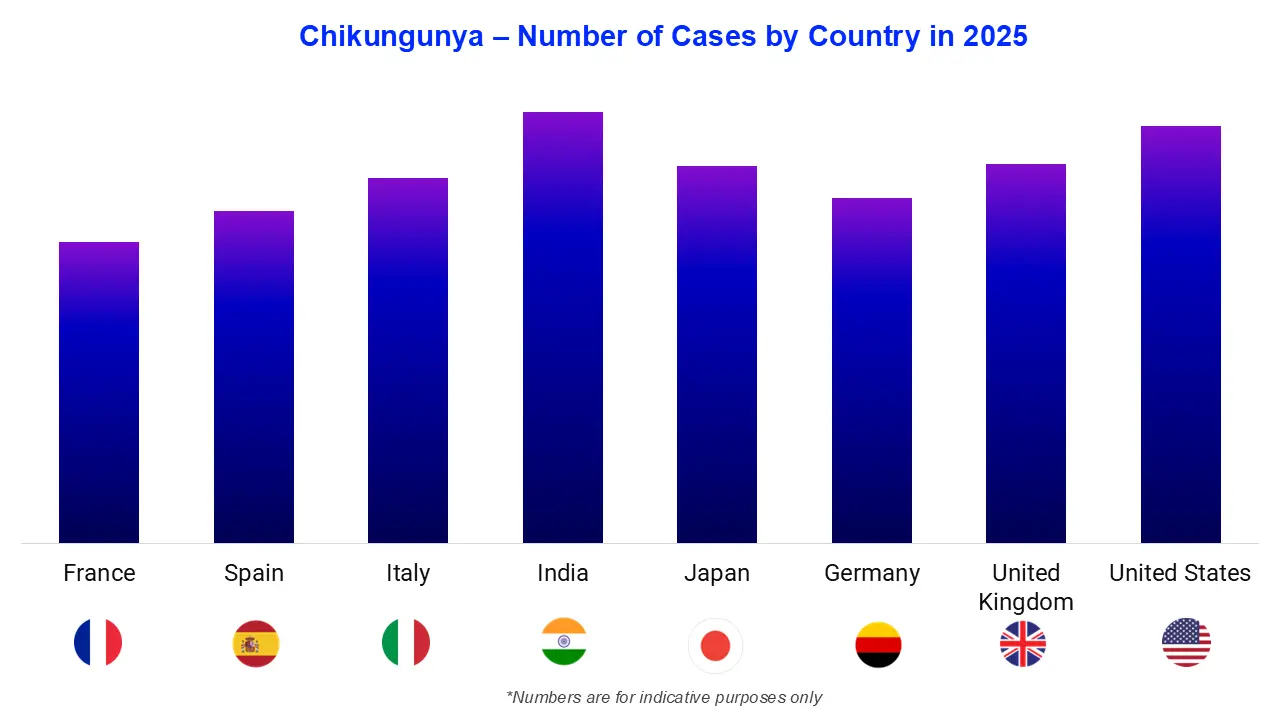
The report provides a comprehensive overview of the disease, as well as historical and projected data on the epidemiology of chikungunya in the 8 major markets.
Regions Covered
Chikungunya is a mosquito-borne viral disease caused by the chikungunya virus (CHIKV), an alphavirus primarily transmitted to humans through infected Aedes aegypti and Aedes albopictus mosquitoes. Infection commonly occurs after a mosquito bite and may produce sudden fever, severe joint pain, rash, headache, and muscle pain. Most patients develop an acute illness that resolves within days to weeks, although joint symptoms may persist for months or longer in some individuals. Chikungunya is generally classified as acute chikungunya infection and chronic or persistent chikungunya-associated arthralgia.
|
Parameter |
Insight |
|
Largest Patient Pool |
India |
|
Fastest Growing Country |
India |
|
High-Risk Population |
Older adults, infants, and individuals with underlying health conditions |
|
Key Diagnostic Method |
Reverse transcription polymerase chain reaction (RT-PCR) and serological testing |
|
Major Risk Factor |
Exposure to infected Aedes mosquitoes |
|
Major gap in the market |
Limited disease-specific antiviral and preventive treatment options |
The chikungunya epidemiology division offers information on the patient pool from history to the present as well as the projected trend for each of the 8 major markets. Expert Market Research provides both current and predicted trends for the chikungunya epidemiology scenario by examining a wide range of studies. Additionally, the report covers the diagnosed patient pool for chikungunya and their trends. The data is broken down into specific categories, such as total prevalent cases in males and females, and total diagnosed cases across different age groups and patient pools.
|
Epidemiology Segment |
Key Insights |
|
Diagnosed Prevalent Cases of the Disease |
According to Sijia Wang et al. (2026), the incidence of autochthonous chikungunya increased from 0.28 per 100,000 in 2004 to 11.13 per 100,000 in 2024. In 2024, the Americas recorded the highest incidence, at 43.9 per 100,000, corresponding to 431,305 cases. |
|
Gender-Specific Cases of the Disease |
As per Aline do Carmo Silva et al. (2023), chikungunya cases reviewed across Northeast Brazil predominantly affected females. Across the included studies, female representation ranged from 7.5% to 100.0%, indicating considerable variation in the gender distribution of reported cases. |
|
Age-Specific Cases of the Disease |
According to World Health Organization (2025), among locally reported chikungunya cases as of August 16, 2025, individuals aged 18–45 years represented 37.0% of cases, followed by those aged 46–60 years at 23.3% and 61–74 years at 15.2%. |
|
Ethnicity-Wise Cases of the Disease |
According to Vaneide Daciane Pedí et al. (2025), among 7,421 chikungunya hospitalizations recorded in Brazil during 2014–2024, 63.5% involved individuals identifying as brown or Black. This distribution provides an epidemiological perspective on ethnicity among hospitalized patients. |
|
Mortality and Survival Analysis of the Disease |
As per Vaneide Daciane Pedí et al. (2025), the overall in-hospital case-fatality rate among chikungunya hospitalizations in Brazil was 1.1%. Mortality increased substantially with age, reaching 11.5% among patients older than 90 years and 14.1% among men aged 85–89 years. |
Read more about this report - Request a Free Sample
The Chikungunya epidemiology data and findings for the United States, Germany, Spain, Italy, France, the United Kingdom, Japan, and India are also provided in the epidemiology section.
|
Country |
Key Insights |
|
United States |
According to William M. de Souza et al. (2024), chikungunya continues to circulate across the Americas, with 3.7 million suspected and laboratory-confirmed cases reported across 50 countries and territories since its emergence in the region in 2013. The available data demonstrate substantial regional epidemiological activity. |
|
Germany |
According to Qian Liu et al. (2025), Germany accounted for 14.5% of the 4,730 chikungunya cases documented across mainland Europe during 2007–2022. Most European infections were travel-related, while reported incidence varied by country and year and showed a seasonal pattern associated with summer travel. |
|
France |
As per Qian Liu et al. (2025), France accounted for 19.6% of chikungunya cases documented across mainland Europe during 2007–2022. Autochthonous outbreaks were reported in France in 2014 and 2017, while most infections across mainland Europe were travel-related. |
|
Italy |
According to Qian Liu et al. (2025), Italy represented 13.6% of the 4,730 chikungunya cases reported across mainland Europe during 2007–2022. Autochthonous transmission was documented in Italy in 2007, while travel-related infections constituted the majority of chikungunya cases reported across Europe. |
|
Spain |
As per Qian Liu et al. (2025), chikungunya epidemiology in mainland Europe demonstrated substantial variation in incidence between countries and years. Most infections were travel-related, with reported cases showing seasonal patterns associated primarily with summer vacation. Spain forms part of this broader European epidemiological pattern. |
|
United Kingdom |
According to Qian Liu et al. (2025), the United Kingdom accounted for 21.9% of the 4,730 chikungunya cases documented across mainland Europe during 2007–2022, representing the largest country-level share. Most European infections were travel-related and exhibited seasonal patterns associated with summer travel. |
|
Japan |
According to Sijia Wang et al. (2026), recurrent local chikungunya outbreaks occurred in several countries across the Western Pacific region. The study identified substantial regional heterogeneity in incidence, while chikungunya activity in temperate regions generally remained sporadic compared with higher-burden tropical regions. |
|
India |
According to Qian Liu et al. (2025), India was the most frequently reported origin of travel-related chikungunya infections documented in mainland Europe, accounting for 11.7% of infections acquired abroad. As per Sijia Wang et al. (2026), South-East Asia recorded 258,854 cases and an incidence of 14.3 per 100,000 in 2024. |
A major gap in the chikungunya disease landscape is the absence of a widely available disease-specific antiviral treatment, leaving clinical management largely supportive. Another important unmet need is timely and accurate diagnosis because chikungunya can present symptoms overlapping those of dengue and other febrile illnesses. Opportunities exist for improved molecular and serological diagnostics, particularly in regions with recurring outbreaks such as India. Continued development and uptake of preventive approaches, including vaccines and mosquito-control measures, may further address the disease burden. The growing recognition of persistent joint symptoms also creates opportunities for longer-term post-infection care.
There is currently no widely approved antiviral treatment specifically targeting chikungunya. Management is primarily supportive and focuses on reducing fever, relieving joint pain, maintaining hydration, and supporting recovery. Acetaminophen is generally used initially for fever and pain relief, while nonsteroidal anti-inflammatory drugs may be considered after dengue has been excluded because of the risk of bleeding associated with dengue infection. Adequate fluids and rest are also recommended. Patients with persistent joint symptoms may require medical evaluation and longer-term chikungunya arthritis management, including physical therapy and specialist-directed treatment.


Upto 15% Off
USD
$2699 $2429
$4299 $3869
$5799 $4949
$6999 $5949


*While we strive to always give you current and accurate information, the numbers depicted on the website are indicative and may differ from the actual numbers in the main report. At Expert Market Research, we aim to bring you the latest insights and trends in the market. Using our analyses and forecasts, stakeholders can understand the market dynamics, navigate challenges, and capitalize on opportunities to make data-driven strategic decisions.*
Explore our key highlights of the report and gain a concise overview of key findings, trends, and actionable insights that will empower your strategic decisions.
|
Report Features |
Details |
|
Base Year |
2025 |
|
Historical Period |
2019-2025 |
|
Forecast Period |
2026-2035 |
|
Epidemiology Statistics Provided |
|
|
Segmentation Provided |
|
|
Geographies Covered |
|
Datasheet
One User
USD 2,699
USD 2,429
tax inclusive*
Single User License
One User
USD 4,299
USD 3,869
tax inclusive*
Five User License
Five User
USD 5,799
USD 4,949
tax inclusive*
Corporate License
Unlimited Users
USD 6,999
USD 5,949
tax inclusive*
*Please note that the prices mentioned below are starting prices for each bundle type. Kindly contact our team for further details.*
Flash Bundle
Small Business Bundle
Growth Bundle
Enterprise Bundle
*Please note that the prices mentioned below are starting prices for each bundle type. Kindly contact our team for further details.*
Flash Bundle
Number of Reports: 3
20%
tax inclusive*
Small Business Bundle
Number of Reports: 5
25%
tax inclusive*
Growth Bundle
Number of Reports: 8
30%
tax inclusive*
Enterprise Bundle
Number of Reports: 10
35%
tax inclusive*
How To Order

Select License Type
Choose the right license for your needs and access rights.

Click on ‘Buy Now’
Add the report to your cart with one click and proceed to register.

Select Mode of Payment
Choose a payment option for a secure checkout. You will be redirected accordingly.
Strategic Solutions for Informed Decision-Making
Gain insights to stay ahead and seize opportunities.

Get insights & trends for a competitive edge.

Track prices with detailed trend reports.

Analyse trade data for supply chain insights.

Leverage cost reports for smart savings

Enhance supply chain with partnerships.

Connect For More Information
Our expert team of analysts will offer full support and resolve any queries regarding the report, before and after the purchase.
Our expert team of analysts will offer full support and resolve any queries regarding the report, before and after the purchase.
We employ meticulous research methods, blending advanced analytics and expert insights to deliver accurate, actionable industry intelligence, staying ahead of competitors.
Our skilled analysts offer unparalleled competitive advantage with detailed insights on current and emerging markets, ensuring your strategic edge.
We offer an in-depth yet simplified presentation of industry insights and analysis to meet your specific requirements effectively.




