

Consumer Insights
Uncover trends and behaviors shaping consumer choices today
Procurement Insights
Optimize your sourcing strategy with key market data
Industry Stats
Stay ahead with the latest trends and market analysis.
Yellow fever is an acute mosquito-borne viral disease that can cause fever, jaundice, bleeding, and liver or kidney failure. Its severity ranges from mild or asymptomatic infection to potentially fatal illness. France’s risk is limited to French Guiana, a recognized transmission-risk area. Santé publique France's 2024 vaccination assessment found yellow-fever vaccination coverage of 97% among adults aged 18-75 years in French Guiana, indicating high population protection in the territory. According to Yellow Fever Epidemiology Forecast by Expert Market Research, the main epidemiological concerns are imported infections, travel-related exposure, and the possibility of introduction into areas with competent mosquito vectors.
Base Year
Historical Period
Forecast Period
Read more about this report - Request a Free Sample
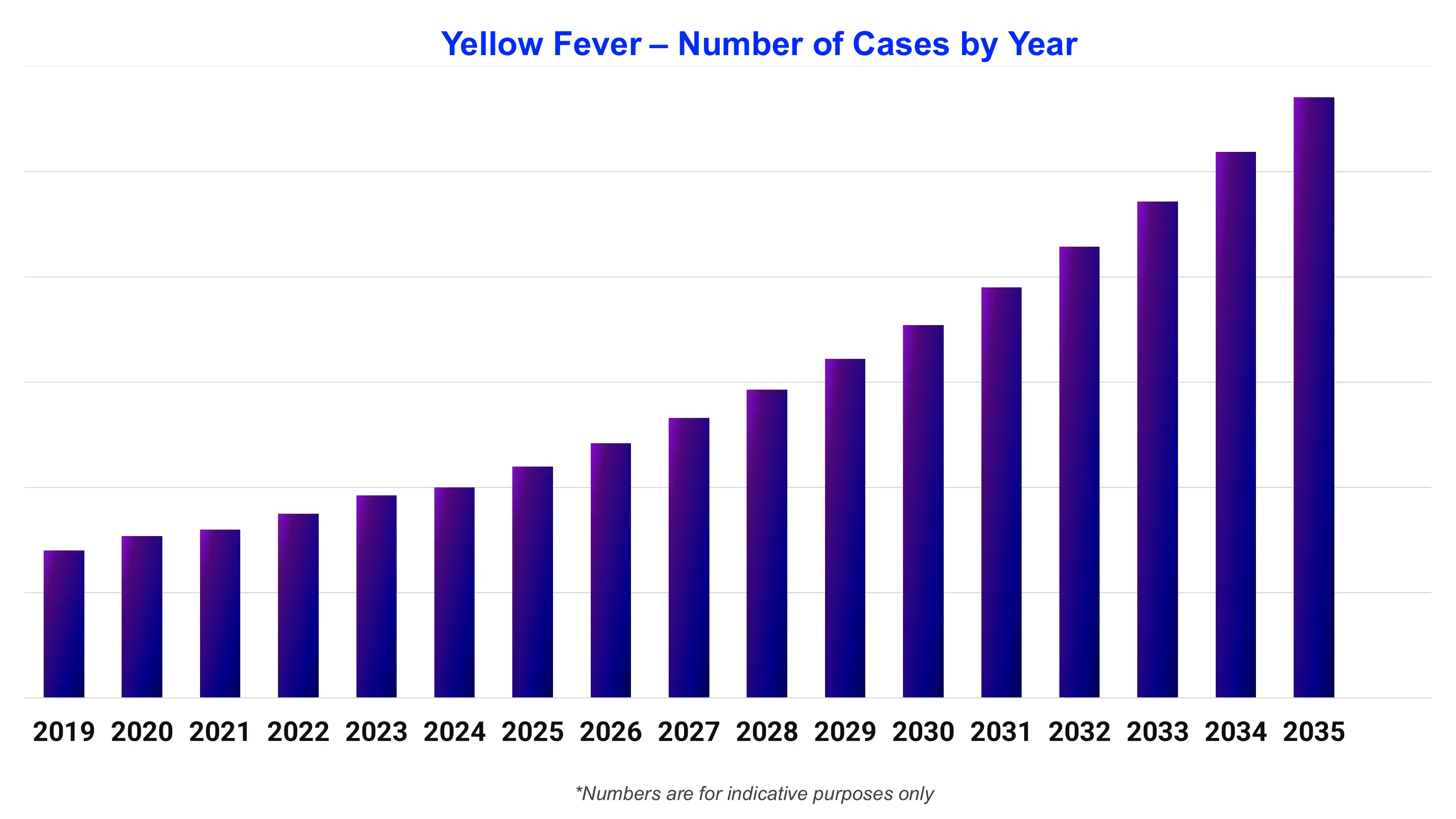
Expert Market Research's “Yellow Fever Epidemiology Forecast Report 2026-2035” offers comprehensive information on the prevalence and demographics of Yellow Fever. It projects the future incidence and prevalence rates of Yellow Fever cases across various populations. The study covers age, gender, and type as major determinants of the Yellow Fever population. The report highlights patterns in the prevalence of Yellow Fever overtime and projects future trends based on multiple variables.
The report provides a comprehensive overview of the disease, as well as historical and projected data on the epidemiology of Yellow Fever in the 8 major markets.
Regions Covered
Yellow fever is an acute, mosquito-borne viral disease that can cause fever, jaundice, bleeding, liver injury, and renal failure. Infection ranges from asymptomatic or mild illness to severe, potentially fatal disease. Transmission occurs through infected mosquitoes, and the virus circulates in sylvatic and urban transmission cycles. Among the eight countries considered here, the main epidemiological concerns are imported infections, travel-related exposure, and the possibility of introduction into areas with competent mosquito vectors. France requires particular care in interpretation because its overseas territory of French Guiana has a different epidemiological context from mainland France. Vaccination is the principal preventive measure, while surveillance, travel-health assessment, and prompt recognition of severe illness are essential for limiting disease risk.
|
Parameter |
Insight |
|
Largest Patient Pool |
France |
|
Fastest Growing Country |
France |
|
High-Risk Population |
Within the eight countries, the principal high-risk groups are unvaccinated travellers visiting yellow fever transmission-risk areas, people with prolonged exposure in forested or rural environments where infected mosquitoes circulate, and individuals whose travel or residence history places them at risk of infection. People with contraindications to live yellow fever vaccine require individualized travel-health assessment. |
|
Key Diagnostic Method |
Laboratory confirmation using molecular or serological testing is central to yellow fever diagnosis. Reverse-transcription polymerase chain reaction (RT-PCR) can detect viral RNA early in illness, while serological testing can identify yellow fever-specific antibodies later in the course. |
|
Major Risk Factor |
The principal risk factor is travel to or residence in an area with active yellow fever transmission without effective vaccination. In the eight markets, imported infections are the main concern in settings without established local transmission. Risk is influenced by travel destination, duration and type of outdoor exposure, mosquito activity, and vaccination status. |
|
Major gap in the market |
The principal gap is the limited comparability of recent country-specific case data and the low likelihood of detecting every imported infection promptly. Yellow fever is rare in most of the eight markets, so surveillance often relies on clinical suspicion, travel histories, and specialist laboratory confirmation. |
The Yellow Fever epidemiology division offers information on the patient pool from history to the present as well as the projected trend for each of the 8 major markets. Expert Market Research provides both current and predicted trends for the Yellow Fever epidemiology scenario by examining a wide range of studies. Additionally, the report covers the diagnosed patient pool for Yellow Fever and their trends. The data is broken down into specific categories, such as total prevalent cases in males and females, and total diagnosed cases across different age groups and patient pools.
|
Epidemiology Segment |
Key Insights |
|
Diagnosed Prevalent Cases of the Disease |
Yellow fever is an acute infection, so annual confirmed cases and place of acquisition are more meaningful epidemiological measures than conventional diagnosed prevalence. The UK Health Security Agency reported no yellow fever cases in England, Wales, and Northern Ireland in 2023 or 2024. |
|
Gender-Specific Cases of the Disease |
Comparable 2023-2026 sex-disaggregated yellow fever case counts were not identified across the eight countries. The small number of cases expected in non-endemic settings makes it difficult to infer meaningful sex-related differences from sporadic notifications. Risk is more directly associated with vaccination status, travel destination, exposure to infected mosquitoes, and relevant clinical factors than with sex alone. |
|
Age-Specific Cases of the Disease |
A comparable age-specific distribution of yellow fever cases was not established for the eight countries from 2023-2026 sources. In these settings, case numbers are shaped mainly by travel-related exposure and vaccination status, so sporadic cases cannot reliably establish a national age profile. Age remains clinically important when assessing vaccination eligibility and the risk of rare serious vaccine-associated adverse events. |
|
Ethnicity-Wise Cases of the Disease |
Ethnicity is not an appropriate substitute for individual exposure history: travel destination, residence in an area with transmission, vaccination status, and mosquito exposure are more relevant to risk assessment. Any differences in reported cases should be interpreted in the context of travel patterns, access to vaccination, and surveillance coverage rather than attributed to ethnicity without supporting evidence. |
|
Mortality and Survival Analysis of the Disease |
Severe yellow fever can progress to jaundice, haemorrhage, liver and kidney dysfunction, shock, and death. In clinical assessment, early recognition of severe disease and supportive hospital care are essential; mortality estimates from transmission-endemic regions should not be transferred to these countries. |
Read more about this report - Request a Free Sample
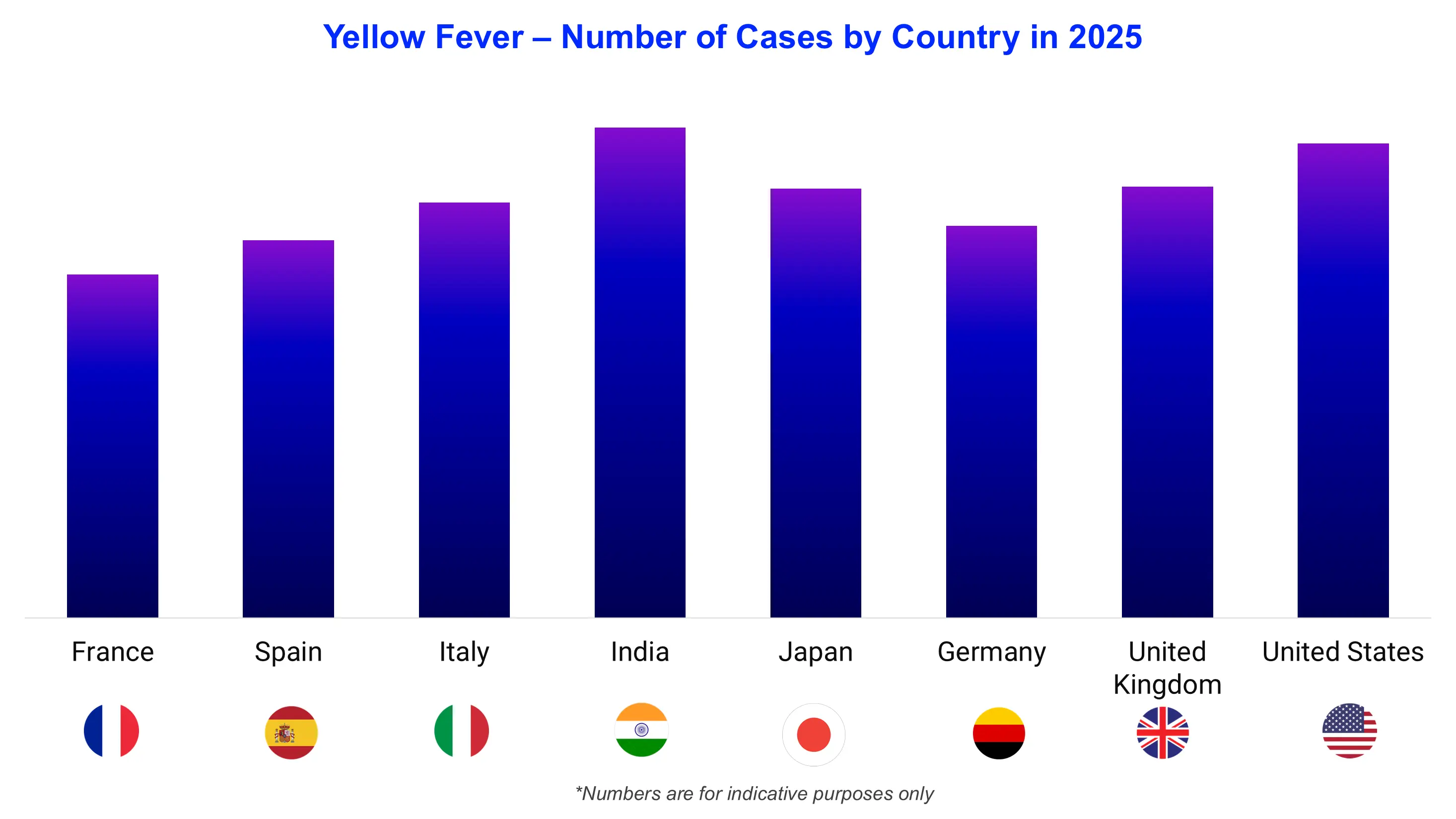
The Yellow Fever epidemiology data and findings for the United States, Germany, Spain, Italy, France, the United Kingdom, Japan, and India are also provided in the epidemiology section.
|
Country |
Key Insights |
|
United States |
Yellow fever is not an established source of ongoing domestic transmission in the country, and surveillance focuses on suspected and confirmed cases, including infections acquired during travel. The US National Notifiable Diseases Surveillance System publishes provisional case reports, but these should not be treated as a prevalence estimate without a verified annual total and a defined denominator. A numerical prevalence percentage is therefore not assigned. |
|
Germany |
In a setting without established local transmission, the relevant measures are confirmed imported cases, travel-related exposure, and access to vaccination before travel. No recent, nationally representative denominator-based estimate was verified for Germany, so a prevalence percentage or diagnosed-patient count would be unsupported. Surveillance should distinguish infections acquired abroad from any suspected locally acquired transmission. |
|
France |
Mainland France is primarily concerned with imported cases, while French Guiana has a different yellow fever exposure context. A comparable 2023-2026 population-prevalence estimate covering the requested French geography was not established from the reviewed sources. National reporting should specify the territory, place of acquisition, vaccination history, and denominator before any prevalence percentage is assigned. |
|
Italy |
In the absence of established ongoing local transmission, surveillance of travel-associated infections is more informative than a conventional prevalence measure. Any reported cases should be interpreted by year, laboratory confirmation, and probable place of acquisition. A national prevalence percentage or total infected population cannot be responsibly assigned without a recent, verified Italian surveillance source. |
|
Spain |
For epidemiological monitoring, confirmed imported cases and the location where infection was acquired are the relevant indicators; sporadic travel-related cases would not demonstrate sustained domestic transmission. A recent, nationally representative estimate with a defined population denominator was not verified, so no numerical prevalence is assigned. |
|
United Kingdom |
The UK Health Security Agency reported zero yellow fever cases in England, Wales, and Northern Ireland in both 2023 and 2024. Its 2024 travel-associated infection report, updated in March 2026, confirms that these figures concern reported confirmed and probable cases in the specified jurisdictions. They should not be interpreted as evidence of zero exposure risk or as a population-prevalence estimate. |
|
Japan |
Epidemiological monitoring is principally concerned with imported infection, vaccination of eligible travellers, and preventing introduction into areas where competent mosquito vectors may be present. No recent, verified national case count sufficient to calculate a prevalence rate was established in the reviewed evidence. Japan’s epidemiology entry should therefore state that a reliable current population-prevalence estimate is unavailable rather than assign a numerical value |
|
India |
The available evidence does not establish a current national burden of confirmed yellow fever cases, and a numerical prevalence should not be inferred from travel-related risk or vaccination requirements. For India, relevant surveillance priorities include prompt investigation of suspected imported cases, laboratory confirmation, and assessment of travel history and vaccination status. |
The principal gaps across the eight markets are limited comparable case data, potential delays in recognizing imported infections, and uneven availability of recent territory-specific surveillance. Opportunities include strengthening travel-health screening, improving access to authorized vaccination services, increasing clinician awareness of travel-associated febrile illness, and ensuring rapid referral for laboratory confirmation. France requires surveillance that distinguishes mainland France from French Guiana. Across the other countries, consistent reporting of travel history, vaccination status, clinical severity, and place of acquisition would improve epidemiological assessment and support preparedness for imported cases.
There is no specific antiviral treatment routinely recommended for yellow fever; management is supportive and guided by clinical severity. Mild cases require clinical assessment, hydration, and monitoring, while severe disease may require hospital or intensive-care support for hepatic and renal dysfunction, bleeding, shock, and other complications. Medicines that increase bleeding risk, including aspirin and non-steroidal anti-inflammatory drugs, should generally be avoided when yellow fever is suspected. Prevention relies on vaccination with a live attenuated vaccine when indicated and medically appropriate, alongside mosquito-bite prevention and travel-health advice. Because the vaccine has important contraindications and rare serious adverse events, eligibility should be assessed by a qualified vaccination provider.


Upto 15% Off
USD
$2699 $2429
$4299 $3869
$5799 $4949
$6999 $5949


*While we strive to always give you current and accurate information, the numbers depicted on the website are indicative and may differ from the actual numbers in the main report. At Expert Market Research, we aim to bring you the latest insights and trends in the market. Using our analyses and forecasts, stakeholders can understand the market dynamics, navigate challenges, and capitalize on opportunities to make data-driven strategic decisions.*
Explore our key highlights of the report and gain a concise overview of key findings, trends, and actionable insights that will empower your strategic decisions.
|
Report Features |
Details |
|
Base Year |
2025 |
|
Historical Period |
2019-2025 |
|
Forecast Period |
2026-2035 |
|
Epidemiology Statistics Provided |
|
|
Segmentation Provided |
|
|
Geographies Covered |
|
Datasheet
One User
USD 2,699
USD 2,429
tax inclusive*
Single User License
One User
USD 4,299
USD 3,869
tax inclusive*
Five User License
Five User
USD 5,799
USD 4,949
tax inclusive*
Corporate License
Unlimited Users
USD 6,999
USD 5,949
tax inclusive*
*Please note that the prices mentioned below are starting prices for each bundle type. Kindly contact our team for further details.*
Flash Bundle
Small Business Bundle
Growth Bundle
Enterprise Bundle
*Please note that the prices mentioned below are starting prices for each bundle type. Kindly contact our team for further details.*
Flash Bundle
Number of Reports: 3
20%
tax inclusive*
Small Business Bundle
Number of Reports: 5
25%
tax inclusive*
Growth Bundle
Number of Reports: 8
30%
tax inclusive*
Enterprise Bundle
Number of Reports: 10
35%
tax inclusive*
How To Order

Select License Type
Choose the right license for your needs and access rights.

Click on ‘Buy Now’
Add the report to your cart with one click and proceed to register.

Select Mode of Payment
Choose a payment option for a secure checkout. You will be redirected accordingly.
Strategic Solutions for Informed Decision-Making
Gain insights to stay ahead and seize opportunities.

Get insights & trends for a competitive edge.

Track prices with detailed trend reports.

Analyse trade data for supply chain insights.

Leverage cost reports for smart savings

Enhance supply chain with partnerships.

Connect For More Information
Our expert team of analysts will offer full support and resolve any queries regarding the report, before and after the purchase.
Our expert team of analysts will offer full support and resolve any queries regarding the report, before and after the purchase.
We employ meticulous research methods, blending advanced analytics and expert insights to deliver accurate, actionable industry intelligence, staying ahead of competitors.
Our skilled analysts offer unparalleled competitive advantage with detailed insights on current and emerging markets, ensuring your strategic edge.
We offer an in-depth yet simplified presentation of industry insights and analysis to meet your specific requirements effectively.




