

Consumer Insights
Uncover trends and behaviors shaping consumer choices today
Procurement Insights
Optimize your sourcing strategy with key market data
Industry Stats
Stay ahead with the latest trends and market analysis.
Zika virus disease (ZVD) is a mosquito-borne infection caused by Zika virus (ZIKV), primarily transmitted by infected Aedes aegypti and Aedes albopictus. Most infections are asymptomatic or mild, causing rash, fever, conjunctivitis, arthralgia, myalgia and headache. In India, 151 Zika cases were reported across Gujarat, Karnataka and Maharashtra during 2024, highlighting continued transmission within the country. According to the Zika virus epidemiology forecast by Expert Market Research, ZVD remains a public-health concern due to persistent transmission, potential re-emergence, reproductive complications and the lack of an approved vaccine or specific antiviral therapy.
Base Year
Historical Period
Forecast Period
Read more about this report - Request a Free Sample
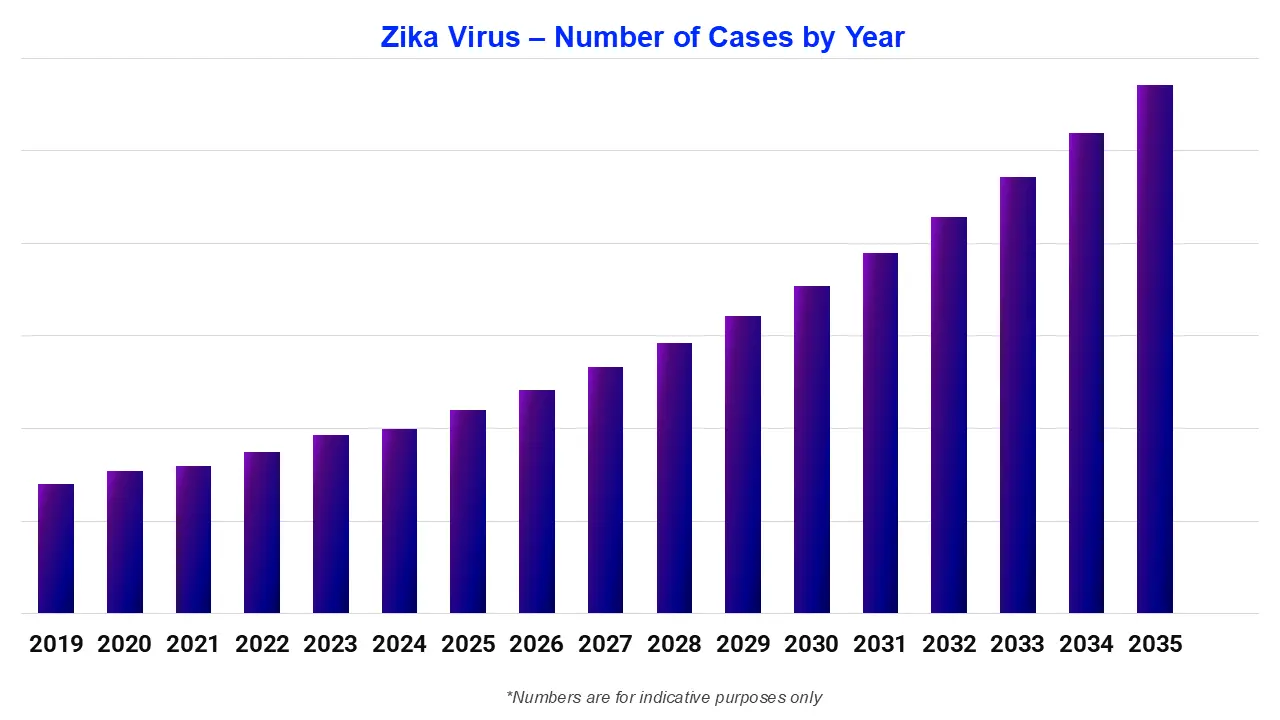
Expert Market Research's “Zika Virus Epidemiology Forecast Report 2026-2035” offers comprehensive information on the prevalence and demographics of Zika Virus. It projects the future incidence and prevalence rates of Zika Virus cases across various populations. The study covers age, gender, and type as major determinants of the Zika Virus population. The report highlights patterns in the prevalence of Zika Virus overtime and projects future trends based on multiple variables.
The report provides a comprehensive overview of the disease, as well as historical and projected data on the epidemiology of Zika Virus in the 8 major markets.
Regions Covered
Zika virus disease (ZVD) remains a mosquito-borne arboviral infection caused by Zika virus (ZIKV), a flavivirus transmitted predominantly by infected Aedes mosquitoes, particularly Aedes aegypti and Aedes albopictus. Infection is frequently asymptomatic or produces a mild self-limited illness characterized by rash, fever, conjunctivitis, arthralgia, myalgia and headache. Its principal public-health importance, however, arises from complications associated with infection during pregnancy and, less frequently, neurological disease including Guillain-Barré syndrome, neuropathy and myelitis.
|
Parameter |
Insight |
|
Largest Patient Pool |
United States |
|
Fastest Growing Region |
India |
|
High-Risk Population |
Pregnant individuals and their fetuses, newborns exposed in utero, and people living or travelling in areas with active Aedes transmission represent the principal high-risk populations because of congenital and neurological complications. |
|
Key Diagnostic Method |
Nucleic-acid amplification testing (NAAT/RT-PCR) during the period of detectable viraemia, supplemented where appropriate by serological testing for ZIKV IgM and confirmatory plaque-reduction neutralization testing. |
|
Major Risk Factor |
Exposure to infected Aedes mosquitoes in areas with current or previous ZIKV transmission is the principal risk factor. Pregnancy adds major clinical significance because maternal infection can result in fetal infection and congenital abnormalities. |
|
Major gap in the market |
Absence of an approved vaccine or antiviral, imperfect diagnostics caused by flavivirus cross-reactivity, underdiagnosis of asymptomatic infection, limited surveillance, uncertainty around long-term congenital outcomes and inadequate access to specialized pregnancy monitoring remain major gaps. |
The Zika Virus epidemiology division offers information on the patient pool from history to the present as well as the projected trend for each of the 8 major markets. Expert Market Research provides both current and predicted trends for the Zika Virus epidemiology scenario by examining a wide range of studies. Additionally, the report covers the diagnosed patient pool for Zika Virus and their trends. The data is broken down into specific categories, such as total prevalent cases in males and females, and total diagnosed cases across different age groups and patient pools.
|
Epidemiology Segment |
Key Insights |
|
Diagnosed Prevalent Cases of the Disease |
Unlike chronic diseases, Zika is an acute infectious disease, so incidence and reported case counts are more informative than prevalence. WHO's May 2026 global update documented evidence of current or previous autochthonous transmission in 97 countries and territories, while emphasizing that asymptomatic and mildly symptomatic infections are frequently missed. |
|
Gender-Specific Cases of the Disease |
Zika infection affects both males and females, and there is no established biological sex predominance for infection itself. Epidemiological importance differs by reproductive status because infection during pregnancy creates the principal risk for congenital disease. |
|
Age-Specific Cases of the Disease |
Zika infection can occur at any age. Clinical burden varies according to age and pregnancy status rather than reflecting a single high-incidence age group. The most consequential age-related population is the fetus and newborn exposed during pregnancy, because congenital infection can produce microcephaly, neurological abnormalities, ocular abnormalities, arthrogryposis and other developmental consequences. |
|
Ethnicity-Wise Cases of the Disease |
Contemporary surveillance does not support treating ethnicity as an independent biological risk factor for Zika infection. Apparent population differences primarily reflect geography, vector distribution, travel, exposure patterns, immunity and surveillance intensity. WHO's 2026 map demonstrates that transmission occurs across six WHO regions. |
|
Mortality and Survival Analysis of the Disease |
Zika disease is generally not fatal, and mortality is substantially less important than reproductive and neurological morbidity. Current WHO guidance emphasizes congenital Zika syndrome, fetal loss, neurological disease and Guillain-Barré syndrome as the principal severe outcomes. In its May 2026 update, WHO reported low current Zika incidence and identified sustained vigilance rather than high contemporary mortality as the principal public-health requirement. |
|
Disease Type |
Prevalence |
|
Asymptomatic Zika Infection |
The majority of ZIKV infections are believed to be asymptomatic or minimally symptomatic, creating a major surveillance problem because clinically silent infections can still contribute to sexual transmission and, when occurring during pregnancy, fetal exposure. WHO specifically notes that asymptomatic and mildly symptomatic infections are typically missed by surveillance systems. |
|
Uncomplicated Zika Virus Disease |
Symptomatic uncomplicated ZVD generally produces rash, fever, conjunctivitis, arthralgia, myalgia, malaise and headache, with illness usually resolving within several days. WHO's 2025 clinical-management guideline recommends supportive management and careful differentiation from dengue and chikungunya because of overlapping clinical presentations. |
|
Zika Virus Infection During Pregnancy |
Maternal infection represents the most clinically consequential disease category because ZIKV can cross the placenta and infect the developing fetus. Current CDC guidance recommends exposure-based testing and enhanced fetal assessment in appropriate pregnant patients. |
|
Congenital Zika Syndrome (CZS) |
Congenital Zika syndrome encompasses microcephaly, cerebral structural abnormalities, neurodevelopmental impairment, ocular abnormalities, arthrogryposis, feeding abnormalities and other congenital manifestations associated with fetal ZIKV infection. Contemporary mechanistic reviews continue to identify disruption of neural progenitor-cell development as a central pathogenic mechanism. |
Read more about this report - Request a Free Sample
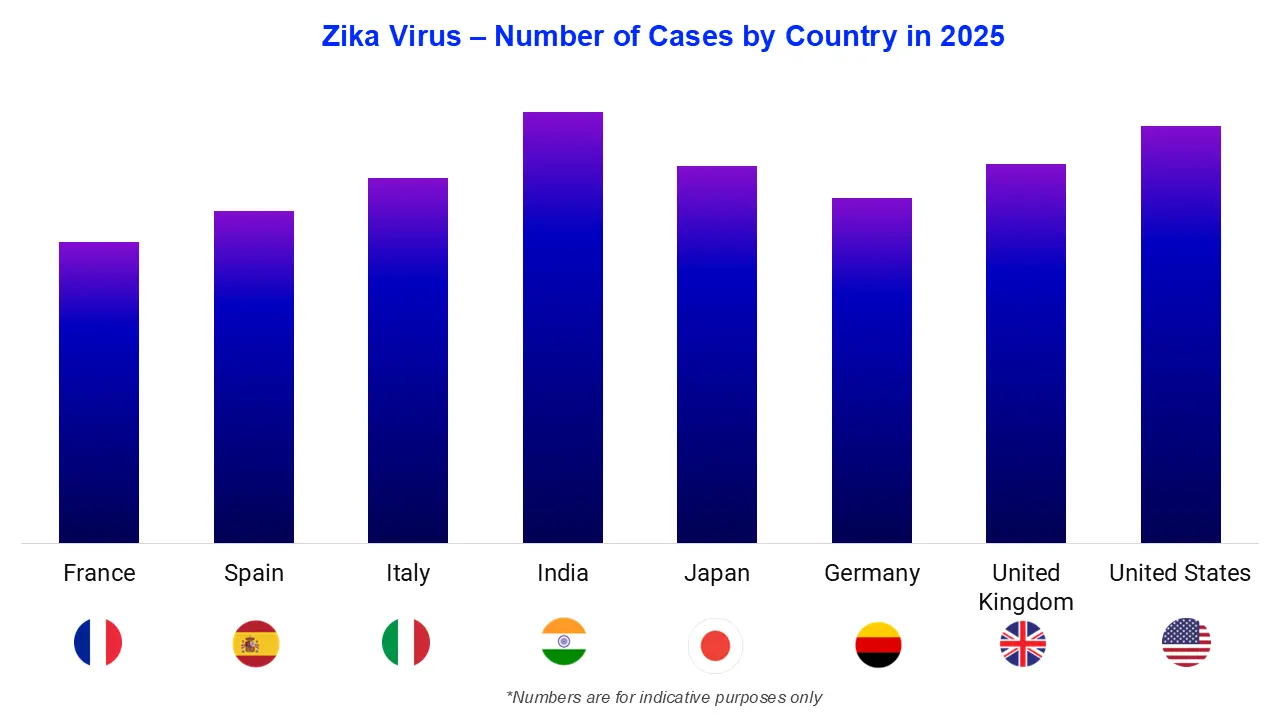
The Zika Virus epidemiology data and findings for the United States, Germany, Spain, Italy, France, the United Kingdom, Japan, and India are also provided in the epidemiology section.
|
Country |
Key Insights |
|
United States |
CDC surveillance current through 2 June 2026 recorded 7 travel-associated Zika cases in U.S. states in 2023, 22 in 2024 and 7 in 2025. The same dataset recorded 30 locally acquired cases in U.S. territories in 2023, 10 in 2024 and 1 in 2025; no confirmed Zika disease cases have been reported from U.S. territories since 2019 when interpreted under CDC's current classification framework. No locally acquired state cases were recorded during 2023–2025. |
|
Germany |
Germany has no established endemic Zika transmission in the contemporary surveillance period. ECDC surveillance identifies travel-associated Zika as the principal source of European cases, with reporting based on likely place of infection outside mainland EU/EEA. A robust Germany-specific 2023–2026 national case count was not identified in the reviewed evidence and is therefore not fabricated. |
|
France |
France remains epidemiologically relevant because its overseas territories contain environments suitable for Aedes transmission, while mainland cases are predominantly travel-associated. ECDC's 2024 travel-associated dataset explicitly separates mainland EU/EEA from outermost regions and includes French territories among the territories requiring distinct surveillance. No single mainland France 2023–2026 incidence estimate was identified in the reviewed sources. |
|
Italy |
Italy represents a predominantly travel-associated European Zika market in the current low-transmission period. Contemporary European surveillance continues to monitor imported infections because Aedes vectors are present in parts of Europe, creating a theoretical potential for local establishment under suitable conditions. A nationally representative Italian 2023–2026 Zika incidence estimate was not identified in the reviewed evidence. |
|
Spain |
Spain remains relevant because of travel-associated infections and the presence of Aedes vectors in some regions. ECDC's contemporary surveillance records travel-associated cases by likely place of infection and treats Zika as non-endemic in mainland Europe. No directly comparable Spain-wide 2023–2026 case estimate was identified. |
|
United Kingdom |
The UK primarily detects imported Zika infections associated with travel to affected tropical and subtropical regions. WHO's February 2026 arboviral update listed travellers returning to the UK from India, Sierra Leone and Thailand among recent Zika-associated travel exposures. A comprehensive national 2023–2026 case series was not identified in the reviewed sources. |
|
Japan |
Japan remains an important Asia-Pacific surveillance market because of international travel, Aedes vector ecology and its position within a region with ongoing Zika transmission. Contemporary WHO surveillance confirms continued Zika circulation in parts of Asia, although a Japan-specific national 2023–2026 case total was not identified in the reviewed sources. |
|
India |
India experienced a clear resurgence of reported Zika activity in 2024, with 151 Zika disease cases across Maharashtra, Karnataka and Gujarat. Maharashtra reported 140 cases, including 125 in Pune; Karnataka reported 10 and Gujarat 1. No microcephaly or Guillain-Barré syndrome associated with this outbreak had been reported by 31 December 2024. |
According to contemporary 2023–2026 evidence, major gaps remain in the epidemiological characterization, diagnosis, surveillance, prevention and therapeutic development of Zika virus disease. The principal challenge is that reported case counts substantially underestimate actual infection because a large proportion of infections are asymptomatic or mildly symptomatic. WHO's May 2026 update explicitly states that surveillance systems frequently miss these infections and therefore emphasize continued vigilance even during periods of low incidence.
A major opportunity therefore exists in enhanced molecular surveillance. Current public-health systems depend heavily on symptomatic case detection, routine laboratory capacity and notification
The management of Zika virus disease primarily focuses on supportive treatment, prevention of mosquito and sexual transmission, protection of pregnant individuals and fetuses, recognition of neurological complications and long-term monitoring of infants with congenital exposure. There are currently no specific antiviral treatment and no licensed vaccine for Zika prevention. CDC's 2024 treatment guidance recommends rest, adequate fluid intake and symptomatic medication such as acetaminophen for fever and pain. Aspirin and NSAIDs should be avoided until dengue have been excluded because of the risk of bleeding in dengue infection. The 2025 WHO arboviral clinical-management guideline provides the current international framework for Zika alongside dengue, chikungunya and yellow fever. It emphasizes that these diseases often have overlapping early clinical presentations, making laboratory differentiation particularly important.


Upto 15% Off
USD
$2699 $2429
$4299 $3869
$5799 $4949
$6999 $5949


*While we strive to always give you current and accurate information, the numbers depicted on the website are indicative and may differ from the actual numbers in the main report. At Expert Market Research, we aim to bring you the latest insights and trends in the market. Using our analyses and forecasts, stakeholders can understand the market dynamics, navigate challenges, and capitalize on opportunities to make data-driven strategic decisions.*
Explore our key highlights of the report and gain a concise overview of key findings, trends, and actionable insights that will empower your strategic decisions.
|
Report Features |
Details |
|
Base Year |
2025 |
|
Historical Period |
2019-2025 |
|
Forecast Period |
2026-2035 |
|
Epidemiology Statistics Provided |
|
|
Segmentation Provided |
|
|
Geographies Covered |
|
Datasheet
One User
USD 2,699
USD 2,429
tax inclusive*
Single User License
One User
USD 4,299
USD 3,869
tax inclusive*
Five User License
Five User
USD 5,799
USD 4,949
tax inclusive*
Corporate License
Unlimited Users
USD 6,999
USD 5,949
tax inclusive*
*Please note that the prices mentioned below are starting prices for each bundle type. Kindly contact our team for further details.*
Flash Bundle
Small Business Bundle
Growth Bundle
Enterprise Bundle
*Please note that the prices mentioned below are starting prices for each bundle type. Kindly contact our team for further details.*
Flash Bundle
Number of Reports: 3
20%
tax inclusive*
Small Business Bundle
Number of Reports: 5
25%
tax inclusive*
Growth Bundle
Number of Reports: 8
30%
tax inclusive*
Enterprise Bundle
Number of Reports: 10
35%
tax inclusive*
How To Order

Select License Type
Choose the right license for your needs and access rights.

Click on ‘Buy Now’
Add the report to your cart with one click and proceed to register.

Select Mode of Payment
Choose a payment option for a secure checkout. You will be redirected accordingly.
Strategic Solutions for Informed Decision-Making
Gain insights to stay ahead and seize opportunities.

Get insights & trends for a competitive edge.

Track prices with detailed trend reports.

Analyse trade data for supply chain insights.

Leverage cost reports for smart savings

Enhance supply chain with partnerships.

Connect For More Information
Our expert team of analysts will offer full support and resolve any queries regarding the report, before and after the purchase.
Our expert team of analysts will offer full support and resolve any queries regarding the report, before and after the purchase.
We employ meticulous research methods, blending advanced analytics and expert insights to deliver accurate, actionable industry intelligence, staying ahead of competitors.
Our skilled analysts offer unparalleled competitive advantage with detailed insights on current and emerging markets, ensuring your strategic edge.
We offer an in-depth yet simplified presentation of industry insights and analysis to meet your specific requirements effectively.




