

Consumer Insights
Uncover trends and behaviors shaping consumer choices today
Procurement Insights
Optimize your sourcing strategy with key market data
Industry Stats
Stay ahead with the latest trends and market analysis.
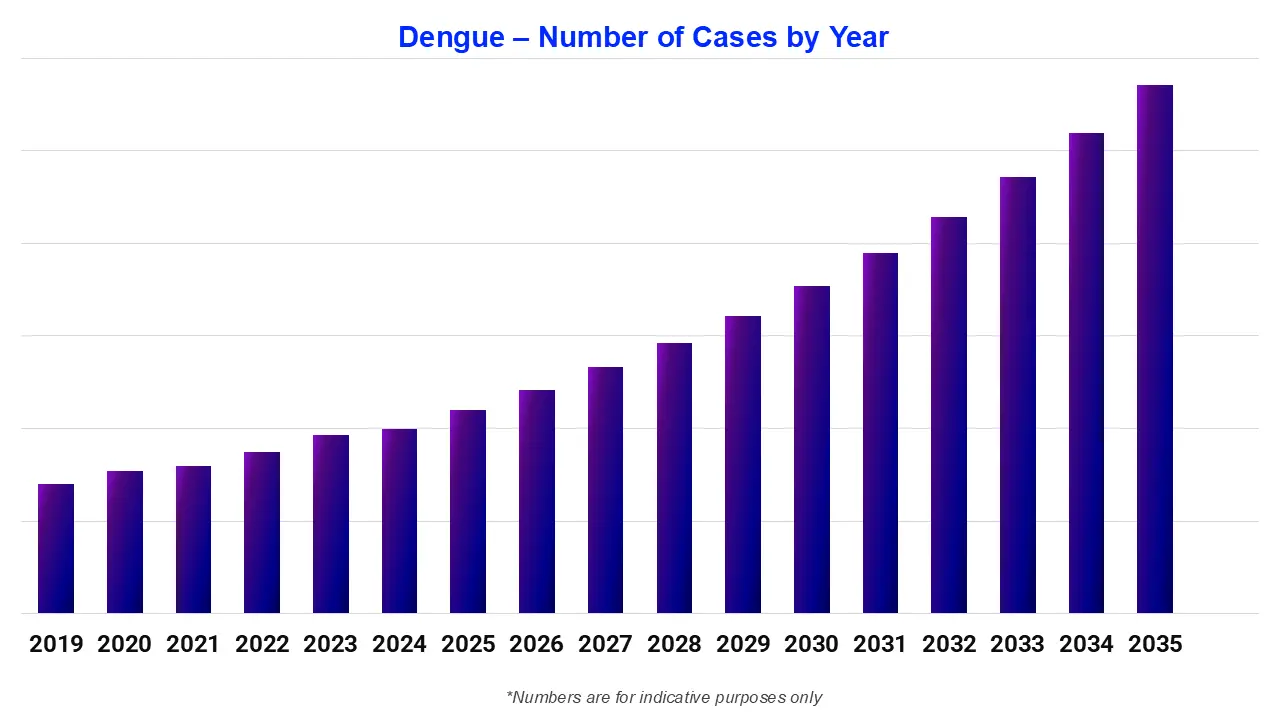
Dengue is a mosquito-borne viral disease caused by the dengue virus and transmitted primarily by Aedes mosquitoes. As per the World Health Organization, 14,434,584 dengue cases, including 7,718,585 laboratory-confirmed cases, 52,738 severe cases, and 11,201 deaths, were reported globally in 2024. According to the dengue epidemiology forecast by Expert Market Research, the disease burden is expected to remain substantial, supporting continued demand for surveillance and prevention.
Base Year
Historical Period
Forecast Period
Read more about this report - Request a Free Sample
Expert Market Research's “Dengue Epidemiology Forecast Report 2026-2035” offers comprehensive information on the prevalence and demographics of dengue. It projects the future incidence and prevalence rates of dengue cases across various populations. The study covers age, gender, and type as major determinants of the dengue population. The report highlights patterns in the prevalence of dengue over time and projects future trends based on multiple variables.
The report provides a comprehensive overview of the disease, as well as historical and projected data on the epidemiology of dengue in the 8 major markets.
Regions Covered
Dengue is a mosquito-borne viral infection caused by any of four closely related dengue virus serotypes: DENV-1, DENV-2, DENV-3, and DENV-4. It is primarily transmitted to humans through the bite of infected Aedes aegypti or Aedes albopictus mosquitoes. After an incubation period of approximately 4–10 days, infected individuals may develop high fever, headache, pain behind the eyes, muscle and joint pain, nausea, vomiting, and rash. Clinical illness ranges from asymptomatic or mild dengue to severe dengue, which can cause plasma leakage, severe bleeding, shock, or organ impairment.
|
Parameter |
Insight |
|
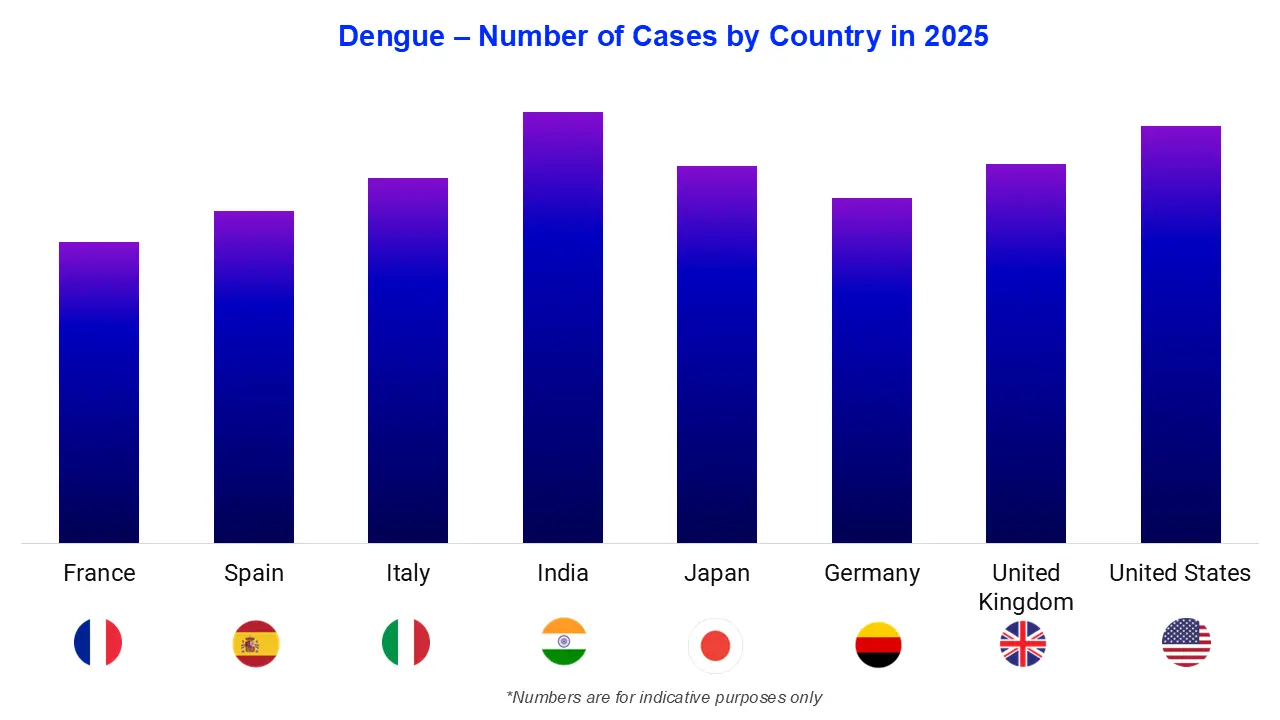
Largest Patient Pool |
India |
|
Fastest Growing Region |
United States |
|
High-Risk Population |
Travel-associated infections are particularly important in the United States and United Kingdom, while endemic transmission creates broader exposure in India. |
|
Key Diagnostic Method |
Acute dengue diagnosis may use nucleic acid amplification testing or NS1 antigen testing alongside IgM antibody testing, depending on the illness stage. |
|
Major Risk Factor |
Transmission is promoted by favorable temperature, rainfall, humidity, mosquito abundance, urbanization, and population movement. |
|
Major gap in the market |
Diagnostic access, laboratory capacity, surveillance quality, and recognition of warning signs remain important gaps, particularly where dengue transmission is increasing or newly emerging. |
The Dengue epidemiology division offers information on the patient pool from history to the present as well as the projected trend for each of the 8 major markets. Expert Market Research provides both current and predicted trends for the Dengue epidemiology scenario by examining a wide range of studies. Additionally, the report covers the diagnosed patient pool for Dengue and their trends. The data is broken down into specific categories, such as total prevalent cases in males and females, and total diagnosed cases across different age groups and patient pools.
|
Epidemiology Segment |
Key Insights |
|
Diagnosed Prevalent Cases of the Disease |
According to World Health Organization (2025), 14,434,584 dengue cases were reported globally in 2024, including 7,718,585 laboratory-confirmed cases, 52,738 severe cases, and 11,201 deaths across all six regions. |
|
Gender-Specific Cases of the Disease |
According to Dr. Ehsan Ahmad et al. (2025), males accounted for 56.5% of dengue-positive cases compared with 43.5% among females in the analyzed sample, indicating a modest male predominance within the evaluated population. |
|
Age-Specific Cases of the Disease |
According to Dania M. Rodriguez et al. (2024), adults aged 20 years and older represented 61.7% of dengue cases in Puerto Rico during 2023–2024, while adolescents aged 10–19 years accounted for 29.5%. |
|
Ethnicity-Wise Cases of the Disease |
According to World Health Organization (2025), dengue caused 11,201 deaths globally in 2024. Brazil reported more than 10 million cases and 6,321 deaths, representing a substantial share of the reported global mortality burden. |
|
Mortality and Survival Analysis of the Disease |
According to Dr. Ehsan Ahmad et al. (2025), dengue prevalence peaked between August and October, coinciding with the post-monsoon period. In Germany, incidence outside the COVID-19 pandemic years ranged from 1.4 to 2.5 per 100,000 persons annually. |
|
Disease Type |
Prevalence |
|
DENV-1 |
DENV-1 contributes to dengue transmission across endemic regions, with its epidemiological significance varying according to geographic distribution, seasonal transmission patterns, population immunity, and circulation of other dengue serotypes. |
|
DENV-2 |
DENV-2 contributes to the overall dengue disease burden and may circulate alongside other serotypes in endemic settings, with prevalence influenced by geographic location, transmission intensity, and changes in serotype dominance over time. |
|
DENV-3 |
DENV-3 contributes to dengue transmission in endemic and outbreak-prone regions. Its epidemiological distribution may vary over time and across populations depending on local transmission patterns and immunity to previously circulating serotypes. |
|
DENV-4 |
DENV-4 is one of the circulating dengue serotypes and contributes to the overall epidemiological burden in endemic areas. Its distribution varies geographically and may change over time as different serotypes circulate within populations. |
Read more about this report - Request a Free Sample
The Dengue epidemiology data and findings for the United States, Germany, Spain, Italy, France, the United Kingdom, Japan, and India are also provided in the epidemiology section.
|
Country |
Key Insights |
|
United States |
Dengue epidemiology in the United States includes transmission in U.S. territories. According to Dania M. Rodriguez et al. (2024), Puerto Rico recorded a shift toward older cases during 2023–2024, with 61.7% occurring among adults aged 20 years and older. |
|
Germany |
According to Christoph Lübbert et al. (2026), 887 dengue episodes were recorded among 10,151,240 insured persons from 2015–2023. Excluding pandemic years, annual incidence ranged from 1.4 to 2.5 per 100,000 persons. |
|
France |
According to World Health Organization (2025), France was among three European countries reporting dengue cases in 2024, contributing to the documented expansion of dengue transmission into European regions. French overseas territories also recorded substantial transmission. |
|
Italy |
According to World Health Organization (2025), Spain was one of three European countries reporting dengue cases to WHO in 2024, alongside France and Italy, reflecting the documented emergence of dengue transmission within parts of Europe. |
|
Spain |
Dengue epidemiology in Japan is influenced by the potential introduction of infections through travel and the suitability of local environments for Aedes mosquitoes. The provided data do not specify a country-level incidence or prevalence estimate for 2024. |
|
United Kingdom |
Dengue prevalence in the United Kingdom is characterized by the relevance of travel-associated exposure and imported infections, while the country is not identified among the locations with substantial autochthonous transmission in the provided data. |
|
Japan |
Dengue epidemiology in Japan is influenced by the potential introduction of infections through travel and the suitability of local environments for Aedes mosquitoes. |
|
India |
According to World Health Organization (2025), India reported 232,425 dengue cases in 2024 and was among the countries contributing substantially to more than 1 million cases reported collectively across the South-East Asia and Western Pacific regions. |
Dengue epidemiology across the selected regions presents opportunities for improved early diagnosis, surveillance, and clinical case management. India continues to face a substantial endemic disease burden, creating demand for scalable diagnostic and surveillance capabilities. In contrast, the United States and United Kingdom face a growing need for rapid recognition of travel-associated dengue, while locally acquired transmission has emerged periodically in parts of Southern Europe. Expansion of molecular and antigen-based diagnostics, strengthened mosquito surveillance, improved outbreak monitoring, and digital disease-reporting systems represent important opportunities. Climate variability, urbanization, and increasing international travel may further expand areas requiring dengue preparedness.
There is currently no specific antiviral treatment for dengue; management primarily focuses on symptom control, hydration, monitoring, and early recognition of complications. Patients with uncomplicated dengue are advised to rest, maintain adequate oral fluid intake, and use acetaminophen (paracetamol) for fever and pain. Aspirin and nonsteroidal anti-inflammatory drugs such as ibuprofen should be avoided because they can increase bleeding risk. Patients with warning signs require closer clinical monitoring and may need intravenous fluids, while severe dengue requires hospitalization and intensive supportive care to manage shock, bleeding, fluid imbalance, or organ involvement. Supportive care therefore remains the central treatment approach.


Upto 15% Off
USD
$2699 $2429
$4299 $3869
$5799 $4949
$6999 $5949


*While we strive to always give you current and accurate information, the numbers depicted on the website are indicative and may differ from the actual numbers in the main report. At Expert Market Research, we aim to bring you the latest insights and trends in the market. Using our analyses and forecasts, stakeholders can understand the market dynamics, navigate challenges, and capitalize on opportunities to make data-driven strategic decisions.*
Explore our key highlights of the report and gain a concise overview of key findings, trends, and actionable insights that will empower your strategic decisions.
|
Report Features |
Details |
|
Base Year |
2025 |
|
Historical Period |
2019-2025 |
|
Forecast Period |
2026-2035 |
|
Epidemiology Statistics Provided |
|
|
Segmentation Provided |
|
|
Geographies Covered |
|
Datasheet
One User
USD 2,699
USD 2,429
tax inclusive*
Single User License
One User
USD 4,299
USD 3,869
tax inclusive*
Five User License
Five User
USD 5,799
USD 4,949
tax inclusive*
Corporate License
Unlimited Users
USD 6,999
USD 5,949
tax inclusive*
*Please note that the prices mentioned below are starting prices for each bundle type. Kindly contact our team for further details.*
Flash Bundle
Small Business Bundle
Growth Bundle
Enterprise Bundle
*Please note that the prices mentioned below are starting prices for each bundle type. Kindly contact our team for further details.*
Flash Bundle
Number of Reports: 3
20%
tax inclusive*
Small Business Bundle
Number of Reports: 5
25%
tax inclusive*
Growth Bundle
Number of Reports: 8
30%
tax inclusive*
Enterprise Bundle
Number of Reports: 10
35%
tax inclusive*
How To Order

Select License Type
Choose the right license for your needs and access rights.

Click on ‘Buy Now’
Add the report to your cart with one click and proceed to register.

Select Mode of Payment
Choose a payment option for a secure checkout. You will be redirected accordingly.
Strategic Solutions for Informed Decision-Making
Gain insights to stay ahead and seize opportunities.

Get insights & trends for a competitive edge.

Track prices with detailed trend reports.

Analyse trade data for supply chain insights.

Leverage cost reports for smart savings

Enhance supply chain with partnerships.

Connect For More Information
Our expert team of analysts will offer full support and resolve any queries regarding the report, before and after the purchase.
Our expert team of analysts will offer full support and resolve any queries regarding the report, before and after the purchase.
We employ meticulous research methods, blending advanced analytics and expert insights to deliver accurate, actionable industry intelligence, staying ahead of competitors.
Our skilled analysts offer unparalleled competitive advantage with detailed insights on current and emerging markets, ensuring your strategic edge.
We offer an in-depth yet simplified presentation of industry insights and analysis to meet your specific requirements effectively.




