

Consumer Insights
Uncover trends and behaviors shaping consumer choices today
Procurement Insights
Optimize your sourcing strategy with key market data
Industry Stats
Stay ahead with the latest trends and market analysis.
The targeted protein degradation technologies market was valued at USD 11.60 Billion in 2025 and is projected to reach USD 29.54 Billion by 2035, advancing at a CAGR of 9.80%. Demand is shaped by a growing pipeline of clinical-stage degraders, including proteolysis-targeting chimeras, in breast cancer, prostate cancer and lymphoma, by rising licensing and collaboration income from large pharmaceutical partners, and by the extension of degradation chemistry into immune-mediated disease. Access to new E3 ligase ligands is widening the range of tractable targets. Growth is held to a moderate pace because generic erosion of legacy cereblon-modulating products offsets revenue from new launches.
Patent activity is concentrated in heterobifunctional proteolysis-targeting chimeras, molecular glue degraders, lysosome-targeting and autophagy-based degraders, and novel E3 ligase ligands beyond cereblon and VHL, with further growth in degrader-antibody conjugates and RNA-targeting degraders. Annual grants exceeded 450 in 2025, a sign that composition-of-matter filings from the late 2010s and early 2020s are now converting into issued rights. Validation comes from late-stage clinical results for an estrogen receptor degrader, early clinical data for an IRAK4 degrader in inflammatory skin disease, and multi-year collaborations between platform companies and large pharmaceutical groups.
This Targeted Protein Degradation Technologies Patent Landscape Analysis Report provides a structured view of patent filing trends, jurisdiction and assignee positions, technology clusters across degradation modalities, target protein classes and therapeutic areas, and company profiles for the leading degrader developers.
The targeted protein degradation technologies market is experiencing strong growth, driven by the expanding clinical pipeline of heterobifunctional degraders, rising pharmaceutical partnering activity, and the discovery of new E3 ligase ligands. Vepdegestrant, an estrogen receptor degrader developed by Arvinas and Pfizer, reported Phase 3 data in 2025, and dozens of other degraders are in clinical trials across oncology and immunology.
Patent activity is accelerating, with 450+ targeted protein degradation technologies patents granted in 2025, reflecting strong innovation momentum in heterobifunctional proteolysis-targeting chimeras, molecular glue degraders, lysosome-targeting and autophagy-based degraders, and novel E3 ligase ligands beyond cereblon and VHL.
Top assignees in the targeted protein degradation technologies patent landscape include Celgene Corporation, Arvinas, Novartis, Kymera Therapeutics, and Genentech, with the United States, China, and Europe as the dominant patent jurisdictions.
Targeted protein degradation technologies have moved from a laboratory concept to a clinical reality within roughly a decade, replacing occupancy-based inhibition with removal of the disease-causing protein itself. Heterobifunctional proteolysis-targeting chimeras recruit an E3 ubiquitin ligase to a target so that the proteasome clears it, while molecular glue degraders reshape an existing ligase surface to achieve the same result with smaller molecules. Interest is highest in oncology, where resistance to kinase and hormone receptor inhibitors keeps creating demand for new mechanisms, and in immunology, where scaffolding proteins and transcription factors have resisted conventional drug design. Revenue today still rests mainly on cereblon-modulating drugs for multiple myeloma, with collaboration and licensing income from platform companies adding a growing share.
Market growth is driven by the progression of clinical-stage degraders toward registration, which converts platform value into product revenue as the first heterobifunctional compounds reach regulators. Cereblon was identified as the molecular target of thalidomide in 2010, and the immunomodulatory drugs built on that finding still account for most current sales. Generic entry for lenalidomide, which began in volume-limited form in 2022, is eroding that base; new launches are therefore needed simply to hold revenue level, which explains the moderate expansion rate. Dozens of degraders are now in human trials, a count that indicates the pipeline is broad enough to offset losses over the forecast period.
The human genome encodes roughly 600 E3 ubiquitin ligases, yet only a handful have been used in clinical degraders, mostly cereblon and VHL. That narrow base explains the intensity of effort on new ligase ligands, because each additional ligase offers tissue-selective expression and a route around resistance mutations in cereblon. Breast and prostate cancer are the lead solid tumor settings, as estrogen and androgen receptors are well-validated targets with large treated populations and frequent resistance to endocrine therapy. In immunology, an IRAK4 degrader has produced early clinical data in hidradenitis suppurativa and atopic dermatitis, which indicates that the approach can reach scaffolding functions that inhibitors miss. Partnership terms with large pharmaceutical groups, often combining upfront payments with milestone structures, translate this clinical evidence into near-term income for platform companies.
Read more about this report - Request a Free Sample
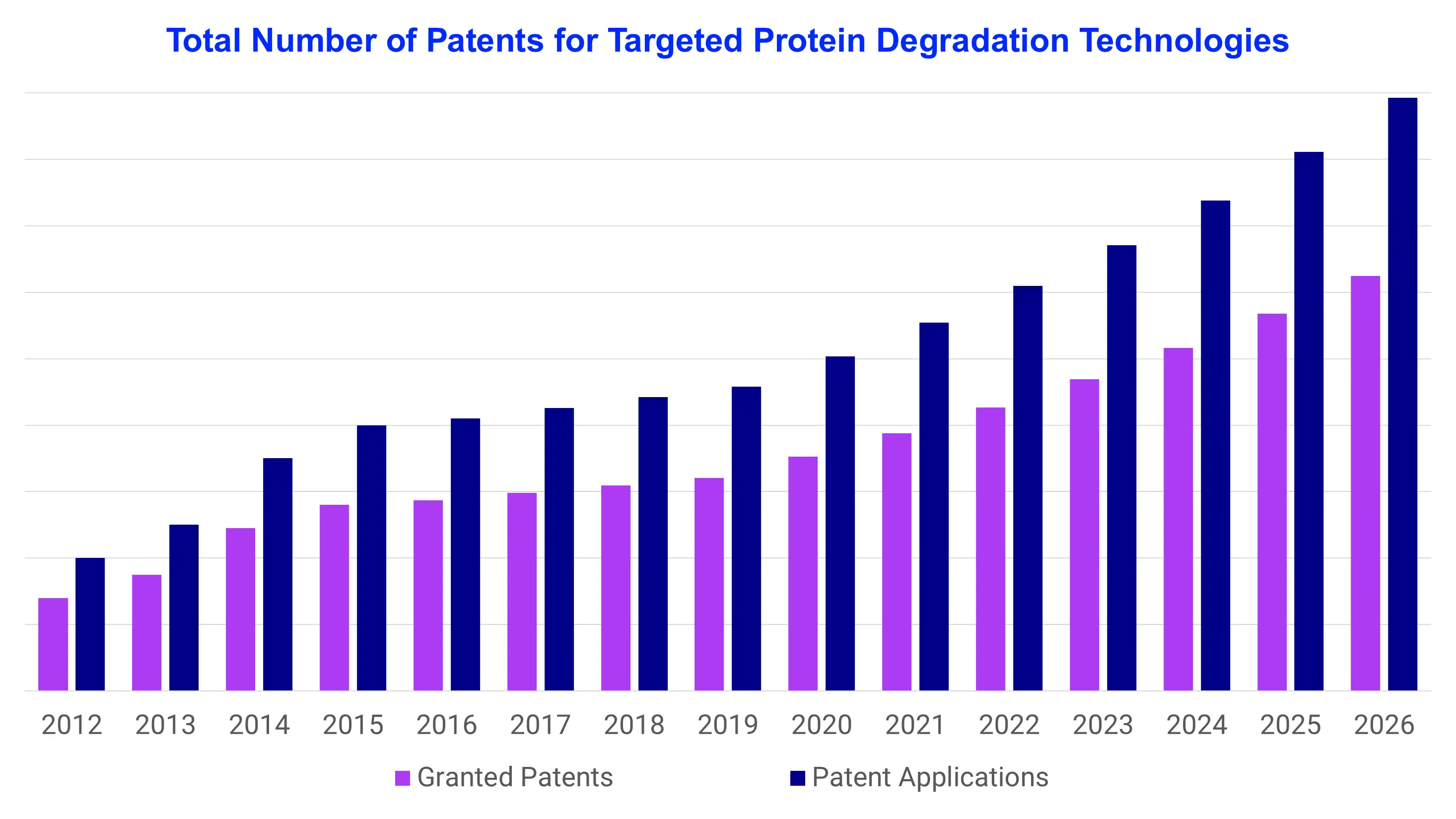
Filing intensity has followed commercial investment closely. After the first proteolysis-targeting chimera clinical program opened in 2019, platform companies raised substantial venture and public funding and used it to build broad composition-of-matter estates covering warheads, ligase binders and linkers. Large pharmaceutical groups then entered through licensing and acquisition, and several added in-house degrader chemistry teams, which lifted filings from corporate assignees alongside the academic base. A 2025 grant count above 450 shows that applications filed in the middle of this build-out are now maturing into enforceable rights, which sharpens freedom-to-operate questions for later entrants.
The landscape covers approximately 12,500 patent families. Filing peaked between 2021 and 2023, a period in which the first clinical readouts and large partnering deals raised confidence in the modality, although the most recent applications remain partly unpublished. Heterobifunctional proteolysis-targeting chimeras form the largest cluster, followed by molecular glue degraders, lysosome-targeting and autophagy-based degraders, and novel E3 ligase ligands beyond cereblon and VHL. Degrader-antibody conjugates and RNA-targeting degraders with hydrophobic tag systems are smaller, yet they are among the fastest growing clusters on a relative basis, reflecting a move toward extracellular and non-protein targets.
Rising clinical validation and sustained partnering demand for degradation platforms have driven patent expansion, as companies secure claims on ligases, linkers and target classes ahead of the first approvals.
This report covers patent families filed across the United States, China, Europe, Japan, South Korea, India and international applications under the Patent Cooperation Treaty administered by WIPO. Market coverage extends to the commercial base of cereblon-modulating drugs, collaboration and licensing revenue from degrader discovery platforms, and clinical-stage programs expected to reach registration within the forecast period. Filing data are reported on a patent family basis so that one invention filed in several countries is counted once, while jurisdiction counts reflect individual patents associated with each office. Granted-patent analysis uses the most recent full year of grant data.
Technology scope spans degradation modality, including proteolysis-targeting chimeras, molecular glue degraders, lysosome-targeting and autophagy-based degraders, degrader-antibody conjugates, and hydrophobic tagging and other degron systems. Target protein classes include nuclear hormone receptors, kinases, transcription factors and epigenetic regulators, immune signaling proteins, and aggregation-prone neuronal proteins. Therapeutic areas covered are solid tumors, hematologic malignancies, immunology and inflammation, neurodegenerative disorders, and viral and other diseases. Compositions, linker and ligand chemistries, screening methods, formulations and methods of treatment all fall within scope.
Entities covered include large pharmaceutical groups with in-house degrader programs, specialist degrader discovery companies, and venture-backed start-ups built around a single ligase or target class. Academic and clinical institutions are included because university laboratories originated the cereblon, VHL and lysosome-targeting concepts and continue to file on new ligases and autophagy mechanisms. Contract research and manufacturing organizations that supply degrader chemistry and ternary complex assays are also tracked, along with the oncology centers that run early-phase trials. Joint filings between industry and academic groups are treated as shared portfolios.
The report will cover the following sections in detail:
Analysis by Degradation Modality
Analysis by Target Protein Class
Analysis by Therapeutic Area
Targeted Protein Degradation Technologies Patent Filing Trend Analysis
Patent publication volumes have risen every year since 2017, with the steepest increase coming after the first clinical proof of concept for heterobifunctional degraders. Early filings concentrated on cereblon and VHL recruiting compounds against well-characterized targets such as the androgen receptor, estrogen receptor and BTK. Over time, claims have shifted toward new ligase binders, trivalent and conditional degraders, and delivery formats such as antibody conjugates. Granted patents lag filings by three to five years, so the more than 450 grants recorded in 2025 largely reflect applications made between 2019 and 2021.
Annual filing growth is estimated at approximately 14 percent between 2020 and 2024. Three factors drove that rate: the arrival of clinical data for androgen receptor and estrogen receptor degraders, the entry of large pharmaceutical groups through licensing agreements, and a wave of Chinese applicants filing on cereblon-based compounds and glue chemistry. The pace is expected to ease only slightly as filings on lysosome-targeting chimeras and degrader-antibody conjugates replace the maturing heterobifunctional cluster.
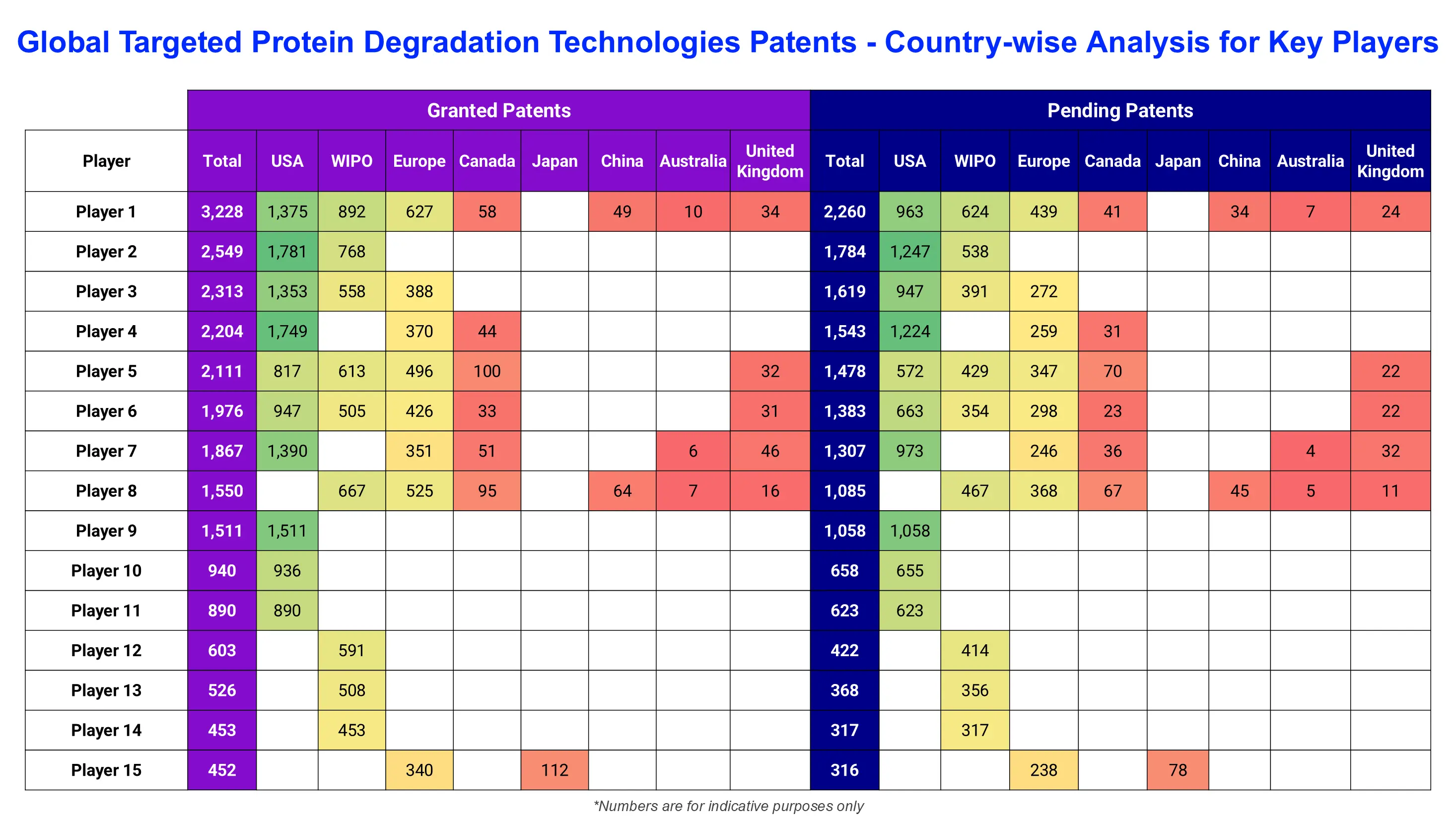
Among the players with targeted protein degradation technologies patent families, new entrants have been identified, which can be either established companies or startups developing novel technology in the field. Some of the major companies mentioned in this report (a non-exhaustive list) are as follows:
Celgene Corporation holds the foundational intellectual property on cereblon-binding immunomodulatory drugs, a portfolio that covers thalidomide, lenalidomide and pomalidomide and the later cereblon E3 ligase modulating compounds. Commercial products include Thalomid, Revlimid and Pomalyst, which are approved for multiple myeloma and related hematologic indications and form the largest revenue base in the field. Next-generation modulators such as iberdomide and mezigdomide are in late-stage clinical development for relapsed multiple myeloma. Celgene was acquired by Bristol Myers Squibb in 2019, and its patent estate is now managed within that group. Its IP strategy pairs composition-of-matter claims with extensive method-of-use, formulation and polymorph filings, which has extended exclusivity even as volume-limited generic lenalidomide entry began in 2022. In the landscape, the company is the reference proof that a degradation mechanism can support a multi-billion-dollar franchise.‑‑‑
Arvinas builds its portfolio around the PROTAC platform, with claims covering heterobifunctional degraders, E3 ligase binders, linker designs and target-specific compounds directed at the androgen and estrogen receptors. Vepdegestrant, developed with Pfizer for estrogen receptor-positive, HER2-negative breast cancer, reported Phase 3 results in 2025 and has advanced to regulatory submission, making it the most advanced heterobifunctional degrader in the field. ARV-766, an androgen receptor degrader for prostate cancer, was licensed to Novartis in 2024, and a LRRK2 degrader for neurodegeneration is in early clinical testing. The company was an early and consistent filer, securing broad platform claims before the clinical evidence had matured. Its commercial position rests on partnership income and potential royalties rather than product sales.
Other companies include Novartis, Kymera Therapeutics, and Genentech.
Portfolio concentration is moderate, with the five leading assignees holding a meaningful but not dominant share of families. Celgene Corporation, within Bristol Myers Squibb, holds the longest-standing cereblon estate and continues to add claims on next-generation modulators. Arvinas and Kymera Therapeutics are platform-led companies that file broadly on ligase binders, linkers and target-specific compounds, then monetize through collaborations. Novartis and Genentech represent the large pharmaceutical posture, combining in-house degrader chemistry with filings generated under partnerships and licensing agreements. Academic institutions and a growing set of Chinese biotechnology companies account for much of the remaining filing volume.
*Please note that this is only a partial list; the complete list of key players is available in the full report. Additionally, the list of key players can be customized to better suit your needs.*
The report assesses patent activity across major jurisdictions, including:
The United States leads filing and grant activity, supported by the concentration of platform companies in Massachusetts and California and by the largest pharmaceutical buyers. China ranks second and has grown fastest in recent years, driven by domestic degrader developers and academic groups filing on cereblon-based compounds, molecular glues and new ligase binders. Europe holds a smaller but stable position through the European Patent Office, with filings from Swiss, German and British assignees. South Korea shows steady activity from university and biotechnology applicants, while India contributes a small number of filings, mostly from research institutes and discovery service providers. WIPO filings under the Patent Cooperation Treaty provide the main route for assignees preserving rights across multiple markets.
Read more about this report - Request a Free Sample
Patent activity is organized into five technology segments:
Heterobifunctional proteolysis-targeting chimeras lead patent activity, supported by the largest number of clinical programs, a modular design that allows rapid analog generation, and clear regulatory precedent as the first compounds move toward registration. Molecular glue degraders follow closely and are gaining share because their lower molecular weight offers better oral properties and their discovery by phenotypic and proteomic screening opens a distinct claim space. Lysosome-targeting and autophagy-based degraders are earlier in development but address extracellular and membrane proteins that the proteasome route cannot reach.
Competition is organized around three groups. Platform companies such as Arvinas and Kymera Therapeutics compete on ligase access, linker design and the breadth of targets reached, and they sell that capability through partnerships. Large pharmaceutical groups, including Novartis and Genentech, build internal capacity while in-licensing clinical assets, which keeps pressure on smaller assignees to secure partners early. Celgene Corporation sits apart as the owner of the cereblon estate that underpins the established commercial products in the field. Newer entrants, many of them in China, differentiate through molecular glue libraries, new ligase binders and degrader-antibody conjugates.
Companies are focusing on:
Several themes are emerging at the edge of the landscape. Conditional and tissue-restricted degraders aim to limit systemic exposure by activating only in target tissue, and trivalent designs seek to engage two targets or two ligases at once. Lysosome-targeting chimeras and related autophagy approaches are extending degradation to secreted and membrane proteins, including immunoglobulins that drive autoimmune disease. Degrader-antibody conjugates deliver a degrader payload to antigen-expressing cells, which addresses the cell-selectivity gap of small molecules. RNA-targeting degraders, hydrophobic tag systems and computational ternary complex design form a smaller but rising group of filings.
The Targeted Protein Degradation Technologies patent landscape maps who owns which ligases, linkers, warheads and target classes, and how those positions line up with clinical progress. Overlap is highest in cereblon and VHL chemistry, where freedom-to-operate review is a routine step, and lowest in lysosome-targeting and novel ligase claims, where portfolios are young. Expiry of early foundational families begins to open space for follow-on compounds later in the decade. Read together, these features show where protection is crowded, where it is thin and where partnering is the faster route.
The landscape provides actionable intelligence for the following uses:
Patent research covered commercial and public patent databases, including national office records, the European Patent Office and WIPO international publications. Searches combined CPC classes for ubiquitin-proteasome and targeted degradation chemistry with keyword strings for degrader modalities, E3 ligases and target classes. Results were consolidated at the patent family level to remove duplicates across jurisdictions, and searches were repeated at intervals to capture late publications.
Records were screened by title, abstract and claims to remove filings that mention degradation only in passing, such as general protein stabilization or unrelated ubiquitin biology. Remaining families were classified by degradation modality, target protein class, therapeutic area, jurisdiction and assignee. Assignee names were standardized to merge subsidiaries and acquired entities, and academic and corporate co-filings were assigned to each named party.
Market analysis drew on company disclosures, clinical trial registries, regulatory databases and published deal terms to relate patent activity to commercial progress. Revenue from legacy cereblon-modulating drugs was separated from collaboration and licensing income so that the effect of generic erosion could be reflected in the growth outlook. Estimates were cross-checked against pipeline status and partnering activity for the leading assignees.


Upto 15% Off
USD
$2699 $2429
$4299 $3869
$5799 $4949
$6999 $5949


*While we strive to always give you current and accurate information, the numbers depicted on the website are indicative and may differ from the actual numbers in the main report. At Expert Market Research, we aim to bring you the latest insights and trends in the market. Using our analyses and forecasts, stakeholders can understand the market dynamics, navigate challenges, and capitalize on opportunities to make data-driven strategic decisions.*
EMR's Targeted Protein Degradation Technologies Patent Landscape Analysis provides a comprehensive assessment of patent filings, innovation clusters, assignee portfolios, and geographic filing patterns across the targeted protein degradation technologies landscape. The report identifies 12,500+ patent families, evaluates leading jurisdictions including the United States, China, and Europe, and profiles the top assignees by portfolio size.
The global targeted protein degradation technologies market was valued at USD 11.60 Billion in 2025. The market is projected to reach USD 29.54 Billion by 2035, expanding at a CAGR of 9.80% during 2026-2035.
The report analyses approximately 12,500+ patent families related to targeted protein degradation technologies. These include filings from the United States, China, Europe, and international WIPO filings.
Key companies operating within the landscape include Celgene Corporation, Arvinas, Novartis, Kymera Therapeutics, and Genentech, among others. These organisations collectively account for a significant portion of patent activity analysed in this report.
The report evaluates patent activity across the United States, Europe, China, Japan, South Korea, India, and international WIPO filings. The United States is the largest single jurisdiction for targeted protein degradation technologies, with more than 5,400 patents associated with it across the approximately 12,500 patent families analyzed.
Yes. The report scope can be customised based on geography, technology segment, assignee selection, time period, or specific innovation cluster focus. Readers can contact the EMR team through the report enquiry form to scope a customized study, such as a focused freedom-to-operate review or a landscape of a single degradation modality.
Patent landscape analysis helps organisations understand innovation trends, competitive activity, technology whitespace, and IP risk across a defined domain. For targeted protein degradation technologies, this report supports strategic decisions in R&D prioritisation, licensing evaluation, competitive benchmarking, and market entry planning.
Explore our key highlights of the report and gain a concise overview of key findings, trends, and actionable insights that will empower your strategic decisions.
|
Scope of the Report |
Details |
|
Analysis by Degradation Modality |
|
|
Analysis by Target Protein Class |
|
|
Analysis by Therapeutic Area |
|
|
Analysis by End User |
|
|
Key Players Mentioned |
|
|
Geographies Covered |
|
Mini Report
One User
USD 2,699
USD 2,429
tax inclusive*
Single User License
One User
USD 4,299
USD 3,869
tax inclusive*
Five User License
Five User
USD 5,799
USD 4,949
tax inclusive*
Corporate License
Unlimited Users
USD 6,999
USD 5,949
tax inclusive*
*Please note that the prices mentioned below are starting prices for each bundle type. Kindly contact our team for further details.*
Flash Bundle
Small Business Bundle
Growth Bundle
Enterprise Bundle
*Please note that the prices mentioned below are starting prices for each bundle type. Kindly contact our team for further details.*
Flash Bundle
Number of Reports: 3
20%
tax inclusive*
Small Business Bundle
Number of Reports: 5
25%
tax inclusive*
Growth Bundle
Number of Reports: 8
30%
tax inclusive*
Enterprise Bundle
Number of Reports: 10
35%
tax inclusive*
How To Order

Select License Type
Choose the right license for your needs and access rights.

Click on ‘Buy Now’
Add the report to your cart with one click and proceed to register.

Select Mode of Payment
Choose a payment option for a secure checkout. You will be redirected accordingly.
Strategic Solutions for Informed Decision-Making
Gain insights to stay ahead and seize opportunities.

Get insights & trends for a competitive edge.

Track prices with detailed trend reports.

Analyse trade data for supply chain insights.

Leverage cost reports for smart savings

Enhance supply chain with partnerships.

Connect For More Information
Our expert team of analysts will offer full support and resolve any queries regarding the report, before and after the purchase.
Our expert team of analysts will offer full support and resolve any queries regarding the report, before and after the purchase.
We employ meticulous research methods, blending advanced analytics and expert insights to deliver accurate, actionable industry intelligence, staying ahead of competitors.
Our skilled analysts offer unparalleled competitive advantage with detailed insights on current and emerging markets, ensuring your strategic edge.
We offer an in-depth yet simplified presentation of industry insights and analysis to meet your specific requirements effectively.




