

Consumer Insights
Uncover trends and behaviors shaping consumer choices today
Procurement Insights
Optimize your sourcing strategy with key market data
Industry Stats
Stay ahead with the latest trends and market analysis.
The pharmacogenomics technologies market reached USD 8.40 Billion in 2025 and is projected to reach USD 25.17 Billion by 2035, growing at a CAGR of 11.60%. Growth rests on drug labels that name actionable genes, the 2023 PREPARE trial result for pre-emptive panels, falling genotyping and sequencing costs, and decision support embedded in electronic health records.
Patent activity spans more than 12,500 families, with filings concentrated in multiplexed genotyping arrays, allele-specific PCR assays, mass spectrometry genotyping, sequencing-based calling of complex pharmacogenes and star allele software. Regulatory momentum around DPYD testing and the clinical use of CPIC guidelines are shifting claims toward workflow and interpretation layers.
This Pharmacogenomics Technologies Patent Landscape Analysis Report maps leading assignees, jurisdictions, technology clusters and emerging themes to support portfolio, partnership and freedom-to-operate decisions.
The pharmacogenomics technologies market is experiencing strong growth, driven by regulatory labelling that calls for genotyping before dosing, clinical evidence for pre-emptive multi-gene panels, and falling per-sample genotyping and sequencing costs. In February 2026 the United States Food and Drug Administration added a boxed warning to capecitabine and fluorouracil labels and advised DPYD variant testing before treatment, a step that moves genotyping from optional to routine in oncology pharmacies and laboratories.
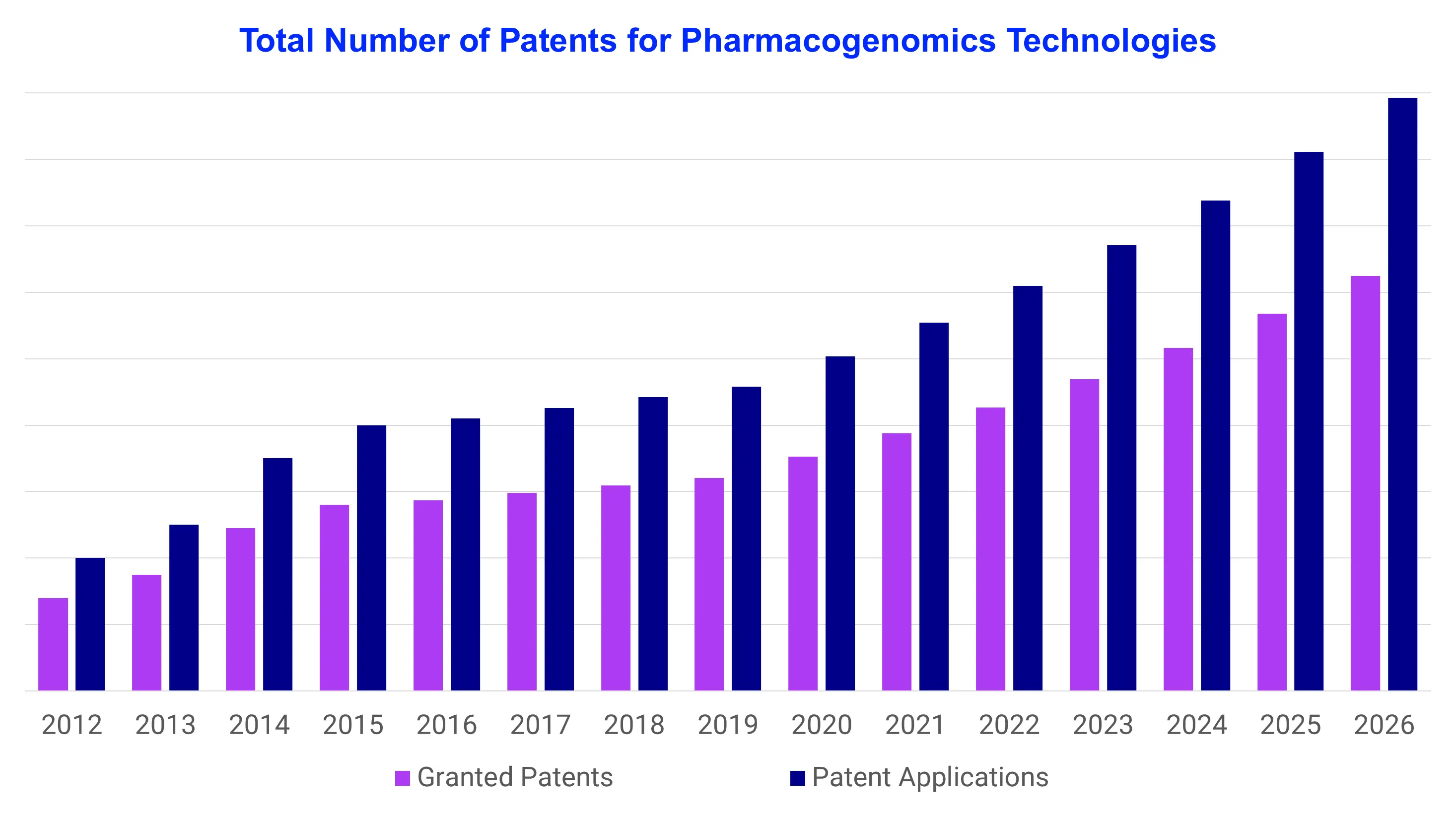
Patent activity is accelerating, with 1,150+ pharmacogenomics technologies patents granted in 2025, reflecting strong innovation momentum in multiplexed pharmacogene genotyping arrays, long-read sequencing of CYP2D6 structural variants, automated star allele calling software, and genotype-linked clinical decision support alerts.
Top assignees in the pharmacogenomics technologies patent landscape include Roche, Illumina, Thermo Fisher Scientific, Myriad Genetics, and Qiagen, with the United States, China, and Europe as the dominant patent jurisdictions.
Pharmacogenomics technologies match a patient's inherited variants in drug-metabolising enzymes, transporters, receptors and immune genes to the choice and dose of a medicine. Demand comes from psychiatry, oncology, cardiology, pain management and transplant care, where trial-and-error prescribing carries clinical and cost penalties. Laboratories, hospital systems and pharmacies adopt these tools to cut adverse drug reactions and shorten the time to an effective regimen. Technology supply runs from low-cost genotyping assays to whole-genome sequencing and interpretation software.
Market growth is driven by drug labels and guidelines that name actionable genes, which turn genotyping into a routine step before prescribing. Adverse drug reactions account for about 6.5% of hospital admissions in a large United Kingdom study, which gives payers a reason to fund prevention. The 2023 PREPARE trial (6,944 patients, seven European countries) found 30% fewer clinically relevant reactions with genotype-guided prescribing.
The February 2026 boxed warning on capecitabine and fluorouracil, with its advice to test for DPYD variants first, widens the volume of oncology tests that laboratories run. A federal court vacated the FDA rule on laboratory-developed tests in March 2025, which keeps the in-house panel route open. Reimbursement is uneven: after UnitedHealthcare ended multi-gene panel coverage in early 2025, Myriad Genetics reported GeneSight revenue down 17% for nine months while test volume rose 5%. Volume growth alongside price pressure holds the growth rate at a moderate double-digit level.
Read more about this report - Request a Free Sample
Patent filings in pharmacogenomics technologies concentrate on assay chemistry, array and panel design, variant calling and clinical interpretation. Allele-specific PCR and array claims for CYP2C19, CYP2D6, CYP2C9, VKORC1, DPYD and HLA alleles form the oldest cluster, while sequencing and software claims make up the fastest growing one.
The report tracks more than 12,500 patent families, with filings peaking in 2007 and 2008 during the first wave of microarray-based tests and rising again from 2019 as sequencing, structural-variant resolution of CYP2D6 and decision support software matured. Applicants file first in the United States and extend to Europe, China, Japan and South Korea.
Regulatory labelling and payer scrutiny push assignees to protect interpretation logic and workflow integration, since assay chemistry for common variants has become widely available.
The report covers patents on genotyping arrays and multiplex PCR assays for pharmacogenes, mass spectrometry genotyping, targeted and whole-genome sequencing panels, long-read resolution of complex loci, and star allele and diplotype calling software.
Clinical decision support tools, pre-emptive testing workflows and pharmacy-based sample collection are included where claims link to genotype-guided prescribing. Patents on tumour somatic profiling and companion diagnostics for single drugs appear only where claims address germline drug-response variants.
Assignees assessed include diagnostic and instrument manufacturers, clinical laboratories, health systems, universities and software developers, with subsidiaries consolidated under their parent companies.
The report will cover the following sections in detail:
Analysis by Technology
Analysis by Application
Analysis by Gene Target
Pharmacogenomics Technologies Patent Filing Trend Analysis
Annual filings in pharmacogenomics technologies grew at an estimated 7 to 9% per year over 2020-2024. Sequencing-based calling of hard-to-type genes such as CYP2D6 and the move of laboratories to multi-gene panels drove most of this increase.
Grants in 2025 reached roughly 1,150 patents, with a rising share covering software, interpretation algorithms and data integration. Array and PCR chemistry claims, many filed in the 2000s, are expiring, which opens room for lower-cost assay developers.
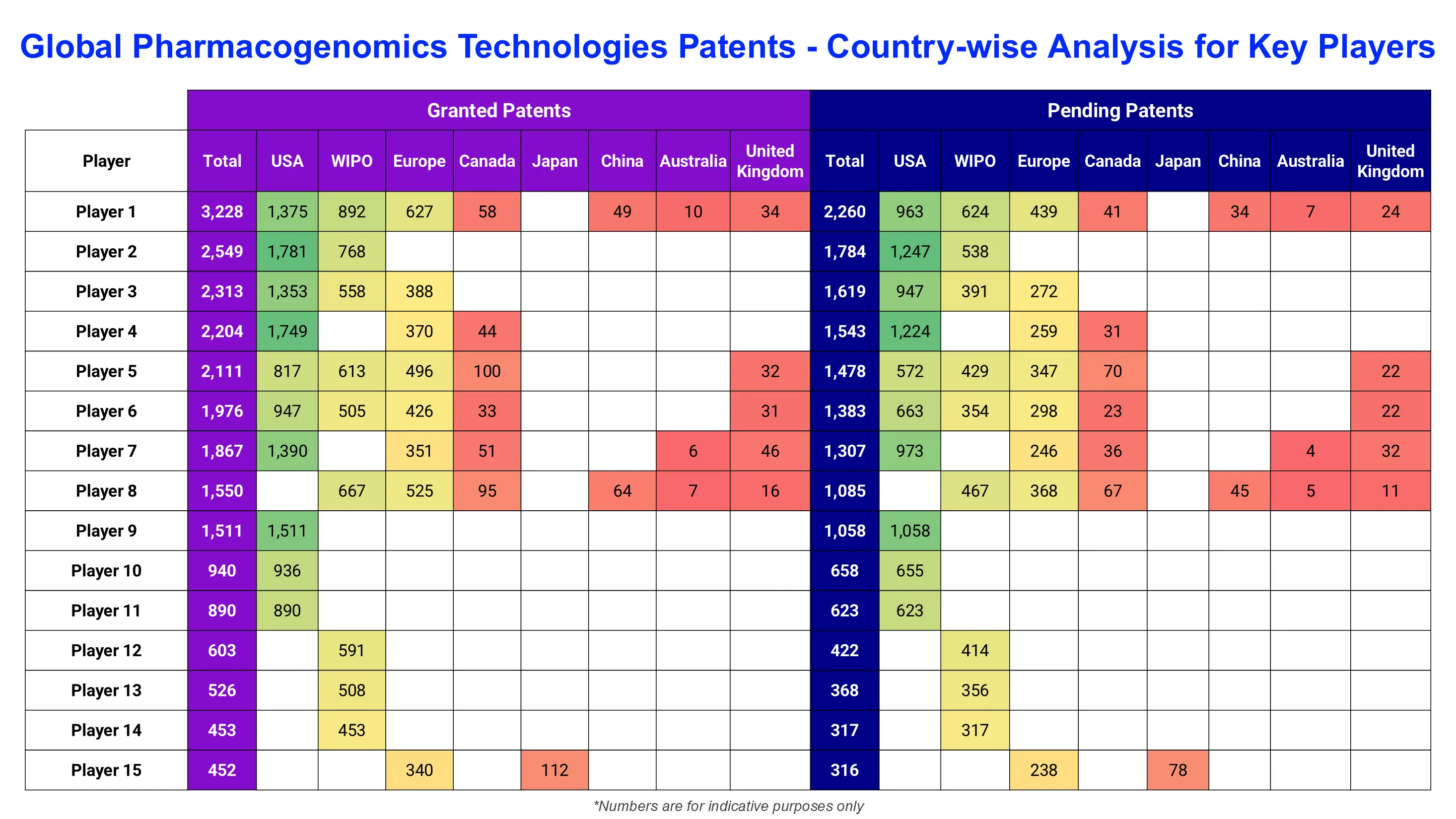
Among the players with pharmacogenomics technologies patent families, new entrants have been identified, which can be either established companies or startups developing novel technology in the field. Some of the major companies mentioned in this report (a non-exhaustive list) are as follows:
Roche holds one of the oldest and broadest portfolios in pharmacogenomics technologies, built on PCR and allele-specific amplification chemistries, microarray genotyping and, more recently, sequencing. The AmpliChip CYP450 test, developed with Affymetrix and cleared by the United States Food and Drug Administration in 2004, was among the first pharmacogenetic microarray tests to reach clinical use. The cobas molecular platforms give Roche an installed base of laboratory analysers that can host genotyping assays, and Genentech provides a steady stream of drug-linked biomarker filings. In February 2025 Roche unveiled its sequencing by expansion technology, which adds a new filing stream relevant to pharmacogene sequencing. Its IP approach pairs foundational amplification claims with companion-diagnostic co-development, and it positions itself as a platform supplier to hospital and reference laboratories.
Illumina builds its pharmacogenomics technologies portfolio on sequencing-by-synthesis chemistry, Infinium microarray design and informatics for variant calling. The Infinium Global Screening Array kit with enhanced pharmacogenomic content covers a curated set of pharmacogenes and serves research and laboratory-developed test workflows. NovaSeq X systems and DRAGEN secondary analysis software lower the cost and turnaround of whole-genome and panel sequencing, which supports pre-emptive testing programmes. Illumina files heavily on array design, library preparation, error correction and analysis pipelines, and it protects these layers with continuation filings in the United States, Europe and China. Its commercial position rests on being the instrument and consumables supplier behind many laboratory-developed pharmacogenomic panels.
Other companies include Thermo Fisher Scientific, Myriad Genetics, and Qiagen.
The top five assignees hold an estimated 25 to 30% of patent families, so the landscape stays moderately fragmented. Roche and Illumina lead through foundational amplification, array and sequencing claims, while clinical laboratories, universities and software developers account for a long tail of specialised filings.
*Please note that this is only a partial list; the complete list of key players is available in the full report. Additionally, the list of key players can be customized to better suit your needs.*
The report assesses patent activity across major jurisdictions, including:
The United States leads filing volume, supported by a large clinical laboratory sector and early guideline development by CPIC. China ranks second as domestic instrument makers and hospital genetics centres scale up genotyping for carbamazepine, clopidogrel and fluoropyrimidine safety. Europe follows, with filings tied to DPYD testing policy, the PREPARE programme and Dutch Pharmacogenetics Working Group guidance.
Read more about this report - Request a Free Sample
Patent activity is organised across the following technology segments:
Among these, genotyping arrays and PCR assays hold the largest share of patent families because of their long filing history, while sequencing and software segments record the fastest growth.
Competition in pharmacogenomics technologies spans instrument suppliers, assay developers and clinical laboratories. Roche, Illumina and Thermo Fisher Scientific hold broad platform claims, Myriad Genetics protects psychiatric decision-support methods tied to GeneSight, and Qiagen covers PCR-based kits for European laboratories. Specialist developers of star allele callers and clinical decision support compete on interpretation accuracy.
Companies are focusing on:
Emerging innovation themes include long-read sequencing for complex loci, machine learning models that predict drug response from combined genotype and clinical data, polygenic scores for treatment outcome, and pharmacogenomic alerts delivered inside prescribing systems. Population-specific allele panels for South Asian, East Asian and African ancestry groups are also gaining filings.
Assignees with sequencing and array platforms hold a structural advantage because they supply the instruments behind many laboratory-developed panels. Opportunities for newer entrants sit in interpretation software, ancestry-aware allele coverage and low-cost point-of-care genotyping, where claim density is lower. Licensing and partnership activity between laboratories and software developers is likely to increase as panels move into routine care.
Technology segments, assignee portfolios and jurisdiction trends are assessed to show where claims are dense and where gaps remain. The report provides actionable intelligence supporting:
The analysis draws on patent records from the United States Patent and Trademark Office, the European Patent Office, the China National Intellectual Property Administration, the Japan Patent Office, the Korean Intellectual Property Office and WIPO PATENTSCOPE. Records are searched by publication date through 2025.
Queries combine CPC classes C12Q 1/6883 and C12Q 1/6869, IPC class G16B 20/00 and G16H 20/10, with keywords for pharmacogene names, star alleles and drug-gene pairs. Results are screened manually, deduplicated and consolidated into patent families, with assignee names harmonised to parent companies.
The market side draws on regulatory labelling and clearances, company filings, clinical trial registries, CPIC and Dutch Pharmacogenetics Working Group guidelines, and peer-reviewed literature. Patent counts are rounded approximations.


Upto 15% Off
USD
$2699 $2429
$4299 $3869
$5799 $4949
$6999 $5949


*While we strive to always give you current and accurate information, the numbers depicted on the website are indicative and may differ from the actual numbers in the main report. At Expert Market Research, we aim to bring you the latest insights and trends in the market. Using our analyses and forecasts, stakeholders can understand the market dynamics, navigate challenges, and capitalize on opportunities to make data-driven strategic decisions.*
EMR’s Pharmacogenomics Technologies Patent Landscape Analysis provides a comprehensive assessment of patent filings, innovation clusters, assignee portfolios, and geographic filing patterns across the pharmacogenomics technologies landscape. The report identifies 12,500+ patent families, evaluates leading jurisdictions including the United States, China, and Europe, and profiles the top assignees by portfolio size.
The global pharmacogenomics technologies market was valued at USD 8.40 Billion in 2025. The market is projected to reach USD 25.17 Billion by 2035, expanding at a CAGR of 11.60% during 2026-2035.
The report analyses approximately 12,500+ patent families related to pharmacogenomics technologies. These include filings from the United States, China, Europe, and international WIPO filings.
Key companies operating within the landscape include Roche, Illumina, Thermo Fisher Scientific, Myriad Genetics, and Qiagen, among others. These organisations collectively account for a significant portion of patent activity analysed in this report.
The report evaluates patent activity across the United States, Europe, China, Japan, South Korea, India, and international WIPO filings. The United States leads with an estimated 35 to 40% of pharmacogenomics technologies patent filings, followed by China and Europe.
Yes. The report scope can be customised based on geography, technology segment, assignee selection, time period, or specific innovation cluster focus. Please connect with the EMR team to define the customisation scope.
Patent landscape analysis helps organisations understand innovation trends, competitive activity, technology whitespace, and IP risk across a defined domain. For pharmacogenomics technologies, this report supports strategic decisions in R&D prioritisation, licensing evaluation, competitive benchmarking, and market entry planning.
Explore our key highlights of the report and gain a concise overview of key findings, trends, and actionable insights that will empower your strategic decisions.
|
Scope of the Report |
Details |
|
Analysis by Technology |
|
|
Analysis by Application |
|
|
Analysis by Gene Target |
|
|
Analysis by End User |
|
|
Key Players Mentioned |
|
|
Geographies Covered |
|
Mini Report
One User
USD 2,699
USD 2,429
tax inclusive*
Single User License
One User
USD 4,299
USD 3,869
tax inclusive*
Five User License
Five User
USD 5,799
USD 4,949
tax inclusive*
Corporate License
Unlimited Users
USD 6,999
USD 5,949
tax inclusive*
*Please note that the prices mentioned below are starting prices for each bundle type. Kindly contact our team for further details.*
Flash Bundle
Small Business Bundle
Growth Bundle
Enterprise Bundle
*Please note that the prices mentioned below are starting prices for each bundle type. Kindly contact our team for further details.*
Flash Bundle
Number of Reports: 3
20%
tax inclusive*
Small Business Bundle
Number of Reports: 5
25%
tax inclusive*
Growth Bundle
Number of Reports: 8
30%
tax inclusive*
Enterprise Bundle
Number of Reports: 10
35%
tax inclusive*
How To Order

Select License Type
Choose the right license for your needs and access rights.

Click on ‘Buy Now’
Add the report to your cart with one click and proceed to register.

Select Mode of Payment
Choose a payment option for a secure checkout. You will be redirected accordingly.
Strategic Solutions for Informed Decision-Making
Gain insights to stay ahead and seize opportunities.

Get insights & trends for a competitive edge.

Track prices with detailed trend reports.

Analyse trade data for supply chain insights.

Leverage cost reports for smart savings

Enhance supply chain with partnerships.

Connect For More Information
Our expert team of analysts will offer full support and resolve any queries regarding the report, before and after the purchase.
Our expert team of analysts will offer full support and resolve any queries regarding the report, before and after the purchase.
We employ meticulous research methods, blending advanced analytics and expert insights to deliver accurate, actionable industry intelligence, staying ahead of competitors.
Our skilled analysts offer unparalleled competitive advantage with detailed insights on current and emerging markets, ensuring your strategic edge.
We offer an in-depth yet simplified presentation of industry insights and analysis to meet your specific requirements effectively.




