

Consumer Insights
Uncover trends and behaviors shaping consumer choices today
Procurement Insights
Optimize your sourcing strategy with key market data
Industry Stats
Stay ahead with the latest trends and market analysis.
The point-of-care diagnostics devices market was valued at USD 16.33 Billion in 2025 and is projected to reach USD 36.92 Billion by 2035, advancing at a CAGR of 8.50%. Growth is supported by rising diabetes and cardiovascular burden, faster infectious disease triage, wider CLIA-waived test menus and the shift of testing to pharmacies and homes.
Patent activity has expanded steadily since 2020, with filings concentrated in lateral flow assay chemistry, microfluidic cartridges, rapid molecular amplification and connected readers. Regulatory milestones in 2024 and 2025, including CLIA-waived hepatitis C and sexually transmitted infection tests and the first at-home multiplex sexual health test, show that these filings convert into marketed devices.
This Point-of-Care Diagnostics Devices Patent Landscape Analysis Report maps assignees, jurisdictions and technology clusters to support R&D, licensing and investment decisions.
The point-of-care diagnostics devices market is experiencing strong growth, driven by decentralised testing demand, chronic disease burden, and rapid molecular platform adoption. In March 2025 the US FDA authorised the first at-home test that detects chlamydia, gonorrhoea and trichomoniasis in women, moving a PCR-grade assay from clinic counters to consumers.
Patent activity is accelerating, with 3,200+ point-of-care diagnostics devices patents granted in 2025, reflecting strong innovation momentum in lateral flow assay chemistry, microfluidic cartridge design, rapid molecular amplification, and smartphone-based readout and connectivity.
Top assignees in the point-of-care diagnostics devices patent landscape include Abbott, Roche, Siemens Healthineers, Becton Dickinson, and Danaher, with the United States, China, and Europe as the dominant patent jurisdictions.
Point-of-care diagnostics devices deliver laboratory-grade results at the patient location within minutes. Demand spans emergency departments, physician offices, pharmacies, community health programmes and homes. Clinicians use these devices for triage, treatment initiation and chronic disease monitoring, and payers favour shorter diagnostic pathways. Regulatory frameworks such as CLIA waivers and over-the-counter authorisations continue to widen the range of settings where testing takes place.
Market growth is driven by the demand for rapid diabetes, cardiac and infectious disease testing outside central laboratories. The International Diabetes Federation estimates 589 million adults lived with diabetes in 2024, which keeps glucose and HbA1c devices in continuous demand. The WHO reported 10.8 million new tuberculosis cases in 2023, and that burden sustains purchases of near-patient molecular platforms in high-incidence countries.
North America holds the leading share of device demand because reimbursement, CLIA-waived test menus and retail pharmacy testing are well established. A 2024 FDA authorisation for a finger-stick hepatitis C RNA test shows how regulators now accept single-visit test-and-treat models, which raises device placements in community clinics. Asia Pacific records the fastest unit growth as national programmes in India and China fund decentralised screening, and local manufacturers add price-competitive lateral flow and glucose products. The growth rate reflects a mature glucose segment offset by faster expansion in molecular and cardiac devices.
Read more about this report - Request a Free Sample
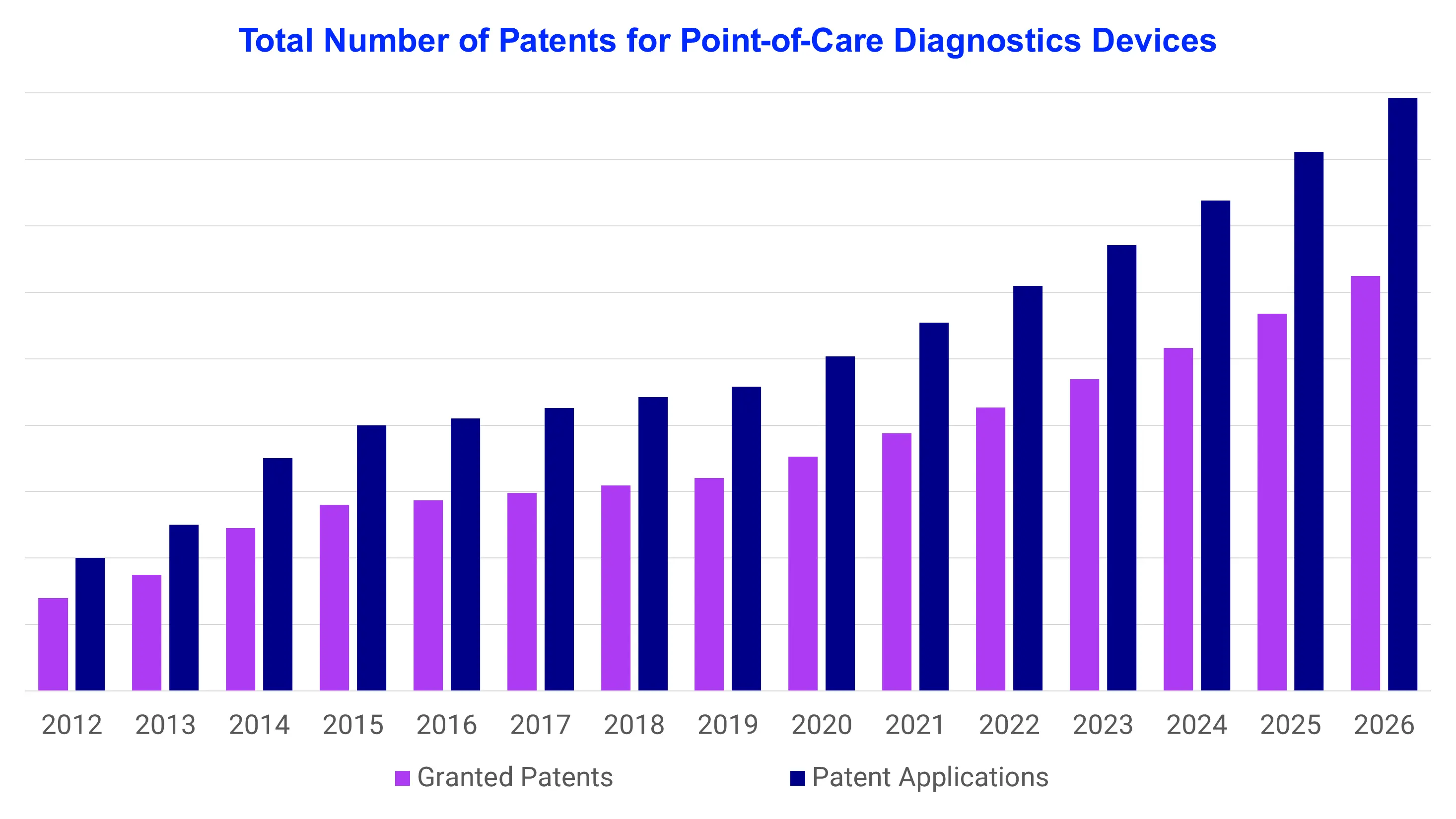
Patent filings for point-of-care diagnostics devices rose sharply during 2020 and 2021 as manufacturers filed on rapid antigen and compact molecular systems. Filing volume stayed above pre-2020 levels in 2023 and 2024, as companies shifted claims toward multiplex panels, sample-to-answer cartridges and home-use designs.
The dataset covers about 26,000 patent families, with peak filing years in 2021 and 2022. Granted patents reached roughly 3,200 in 2025, and the United States, China and the European Patent Office account for most of the grants.
Demand for decentralised testing in chronic disease and infection control translates directly into continuing filings on cartridge design, assay chemistry and connected readers.
The report analyses patents and published applications covering point-of-care diagnostics devices, including lateral flow strips, microfluidic cartridges, electrochemical sensors, rapid molecular analysers and optical or smartphone readers. Claims on assay reagents, sample collection hardware and device software are included when tied to a near-patient format.
Coverage extends from 2010 to 2025 and tracks filings, grants, legal status and citation links by family. Assignee ownership is normalised for subsidiaries and acquired entities, for example Alere assets under Abbott and LumiraDx technology under Roche.
The analysis profiles diagnostic manufacturers, glucose and cardiac meter makers, university spin-outs and contract developers, and maps their positions by technology, application and jurisdiction.
The report will cover the following sections in detail:
Analysis by Technology
Analysis by Application
Analysis by Device Format
Point-of-Care Diagnostics Devices Patent Filing Trend Analysis
Estimated annual growth in global family filings averaged 7 to 9 percent during 2020-2024, led by rapid molecular amplification and multiplex cartridge designs. Pandemic-era antigen and PCR programmes pulled forward inventive activity, and several companies kept the resulting platforms in development for respiratory, sexually transmitted and bloodborne infections.
Chinese applicants contributed a rising share of new filings, especially for lateral flow, chemiluminescence and compact microfluidic devices. Filings on smartphone readers, artificial intelligence-assisted interpretation and connected data management grew faster than the overall rate, reflecting the push toward home use and remote clinical oversight.
Among the players with point-of-care diagnostics devices patent families, new entrants have been identified, which can be either established companies or startups developing novel technology in the field. Some of the major companies mentioned in this report (a non-exhaustive list) are as follows:
Abbott holds the largest portfolio in point-of-care diagnostics devices, built on its own i-STAT, Afinion and ID NOW platforms and on the Alere assets it acquired in 2017 for about USD 5.3 billion. Its filings cover lateral flow immunoassay chemistry, cartridge-based blood analysis, isothermal nucleic acid amplification and handheld reader electronics. In April 2024 the US FDA cleared the i-STAT TBI whole blood cartridge, a bedside test that supports concussion assessment. BinaxNOW rapid antigen tests extend the portfolio into self-testing formats. Abbott files continuation families around cartridge sensors and reader architecture, which protects its installed analyser base. The company positions itself across hospitals, physician offices and retail channels.
Roche ranks second by portfolio size, with patents spanning cobas liat molecular analysers, cobas h 232 cardiac readers, CoaguChek coagulation meters and Accu-Chek glucose systems. In January 2025 the US FDA cleared the cobas liat CT/NG/MG and triplex sexually transmitted infection assays with CLIA waivers, which extends rapid PCR into clinic and pharmacy settings. The 2024 acquisition of the LumiraDx point-of-care technology added microfluidic strip and fluorescence readout families. Roche pairs device claims with assay reagent claims and pursues coverage in the United States, Europe and China. Its commercial position rests on linking decentralised analysers to central laboratory data systems.
Other companies include Siemens Healthineers, Becton Dickinson, and Danaher.
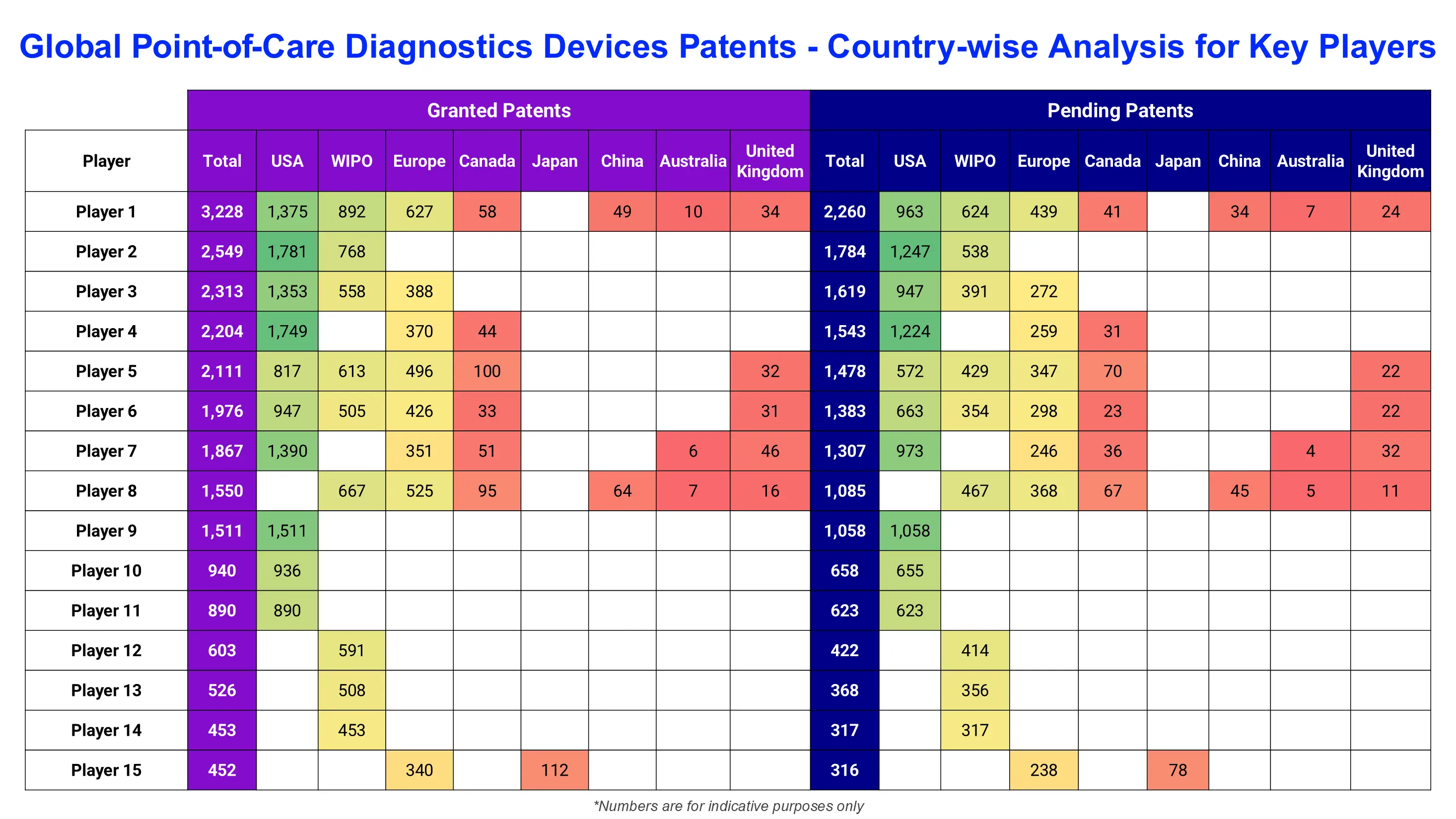
The five leading assignees hold an estimated 20 to 25 percent of global families, which indicates a moderately concentrated field with a long tail of specialist developers. Abbott and Roche lead on breadth across glucose, cardiac, coagulation and molecular formats. Danaher, through Cepheid, concentrates on cartridge-based molecular testing, while Siemens Healthineers focuses on blood gas and cardiac analysers.
*Please note that this is only a partial list; the complete list of key players is available in the full report. Additionally, the list of key players can be customized to better suit your needs.*
The report assesses patent activity across major jurisdictions, including:
The United States leads in filing volume and in grants for point-of-care diagnostics devices, supported by CLIA-waived pathways and a large commercial analyser base. China ranks second on application counts, driven by domestic diagnostic manufacturers and provincial screening programmes. Europe follows, with the European Patent Office receiving filings from Germany, Switzerland, the Netherlands and the United Kingdom.
Read more about this report - Request a Free Sample
The report segments patent activity across the following technology areas:
Among these, lateral flow immunoassay and microfluidic cartridge designs account for the largest share of families, because they apply across infectious disease, cardiac and women's health devices.
Abbott and Roche hold the broadest portfolios, with Siemens Healthineers, Becton Dickinson and Danaher following. Abbott concentrates on cartridge analysers and rapid tests, Roche on molecular and cardiac meters, and Danaher on GeneXpert-based molecular testing. Smaller developers such as Visby Medical and Sherlock Biosciences file narrower families on home-use molecular formats and are frequent licensing and acquisition targets.
Companies are focusing on:
Emerging innovation themes include multiplex molecular cartridges for home use, CRISPR-based detection chemistry, smartphone-readable lateral flow tests, wearable biosensors for sweat and interstitial fluid, and artificial intelligence-assisted result interpretation. Whole blood biomarkers for concussion and sepsis triage represent a further area of new filings.
Portfolios in point-of-care diagnostics devices are built around installed analyser platforms, with consumables and cartridges generating recurring revenue. Large assignees protect reader hardware and cartridge interfaces, and they extend assay menus through acquisitions such as the 2024 purchase of LumiraDx technology by Roche. Freedom-to-operate review is most active around CRISPR detection, isothermal amplification and home-use sample collection.
Technology segments, assignee positions and jurisdiction trends in point-of-care diagnostics devices are mapped to give actionable intelligence supporting:
Patent data were collected from the USPTO, the European Patent Office, the China National Intellectual Property Administration, the Japan Patent Office, WIPO PATENTSCOPE and Espacenet. Queries combined CPC classes G01N33/543, G01N33/558, G01N27/327, C12Q1/68, B01L3/00 and A61B5/145 with keyword strings for point-of-care, near-patient, handheld, cartridge and rapid test formats.
Records were screened for relevance, and applications were consolidated into simple families to remove duplicates across jurisdictions. Assignee names were harmonised for subsidiaries, mergers and acquisitions, and each family was classified by technology, application, device format and jurisdiction.
The market side draws on regulatory filings from the US FDA and the European Commission database, company annual reports, clinical trial registries and peer-reviewed literature. Patent trends were cross-checked against product launches, CLIA waiver announcements and licensing transactions.
Point of Care Coagulation Testing Devices Market


Upto 15% Off
USD
$2699 $2429
$4299 $3869
$5799 $4949
$6999 $5949


*While we strive to always give you current and accurate information, the numbers depicted on the website are indicative and may differ from the actual numbers in the main report. At Expert Market Research, we aim to bring you the latest insights and trends in the market. Using our analyses and forecasts, stakeholders can understand the market dynamics, navigate challenges, and capitalize on opportunities to make data-driven strategic decisions.*
EMR’s Point-of-Care Diagnostics Devices Patent Landscape Analysis provides a comprehensive assessment of patent filings, innovation clusters, assignee portfolios, and geographic filing patterns across the point-of-care diagnostics devices landscape. The report identifies 26,000+ patent families, evaluates leading jurisdictions including the United States, China, and Europe, and profiles the top assignees by portfolio size.
The global point-of-care diagnostics devices market was valued at USD 16.33 Billion in 2025. The market is projected to reach USD 36.92 Billion by 2035, expanding at a CAGR of 8.50% during 2026-2035.
The report analyses approximately 26,000+ patent families related to point-of-care diagnostics devices. These include filings from the United States, China, Europe, and international WIPO filings.
Key companies operating within the landscape include Abbott, Roche, Siemens Healthineers, Becton Dickinson, and Danaher, among others. These organisations collectively account for a significant portion of patent activity analysed in this report.
The report evaluates patent activity across the United States, Europe, China, Japan, South Korea, India, and international WIPO filings. The United States leads patent activity for point-of-care diagnostics devices, supported by CLIA-waived testing pathways, large analyser installed bases and active retail and home-test authorisations.
Yes. The report scope can be customised based on geography, technology segment, assignee selection, time period, or specific innovation cluster focus. Please connect with the EMR team to define the customisation scope.
Patent landscape analysis helps organisations understand innovation trends, competitive activity, technology whitespace, and IP risk across a defined domain. For point-of-care diagnostics devices, this report supports strategic decisions in R&D prioritisation, licensing evaluation, competitive benchmarking, and market entry planning.
Explore our key highlights of the report and gain a concise overview of key findings, trends, and actionable insights that will empower your strategic decisions.
|
Scope of the Report |
Details |
|
Analysis by Technology |
|
|
Analysis by Application |
|
|
Analysis by Device Format |
|
|
Analysis by End User |
|
|
Key Players Mentioned |
|
|
Geographies Covered |
|
Mini Report
One User
USD 2,699
USD 2,429
tax inclusive*
Single User License
One User
USD 4,299
USD 3,869
tax inclusive*
Five User License
Five User
USD 5,799
USD 4,949
tax inclusive*
Corporate License
Unlimited Users
USD 6,999
USD 5,949
tax inclusive*
*Please note that the prices mentioned below are starting prices for each bundle type. Kindly contact our team for further details.*
Flash Bundle
Small Business Bundle
Growth Bundle
Enterprise Bundle
*Please note that the prices mentioned below are starting prices for each bundle type. Kindly contact our team for further details.*
Flash Bundle
Number of Reports: 3
20%
tax inclusive*
Small Business Bundle
Number of Reports: 5
25%
tax inclusive*
Growth Bundle
Number of Reports: 8
30%
tax inclusive*
Enterprise Bundle
Number of Reports: 10
35%
tax inclusive*
How To Order

Select License Type
Choose the right license for your needs and access rights.

Click on ‘Buy Now’
Add the report to your cart with one click and proceed to register.

Select Mode of Payment
Choose a payment option for a secure checkout. You will be redirected accordingly.
Strategic Solutions for Informed Decision-Making
Gain insights to stay ahead and seize opportunities.

Get insights & trends for a competitive edge.

Track prices with detailed trend reports.

Analyse trade data for supply chain insights.

Leverage cost reports for smart savings

Enhance supply chain with partnerships.

Connect For More Information
Our expert team of analysts will offer full support and resolve any queries regarding the report, before and after the purchase.
Our expert team of analysts will offer full support and resolve any queries regarding the report, before and after the purchase.
We employ meticulous research methods, blending advanced analytics and expert insights to deliver accurate, actionable industry intelligence, staying ahead of competitors.
Our skilled analysts offer unparalleled competitive advantage with detailed insights on current and emerging markets, ensuring your strategic edge.
We offer an in-depth yet simplified presentation of industry insights and analysis to meet your specific requirements effectively.




