

Consumer Insights
Uncover trends and behaviors shaping consumer choices today
Procurement Insights
Optimize your sourcing strategy with key market data
Industry Stats
Stay ahead with the latest trends and market analysis.
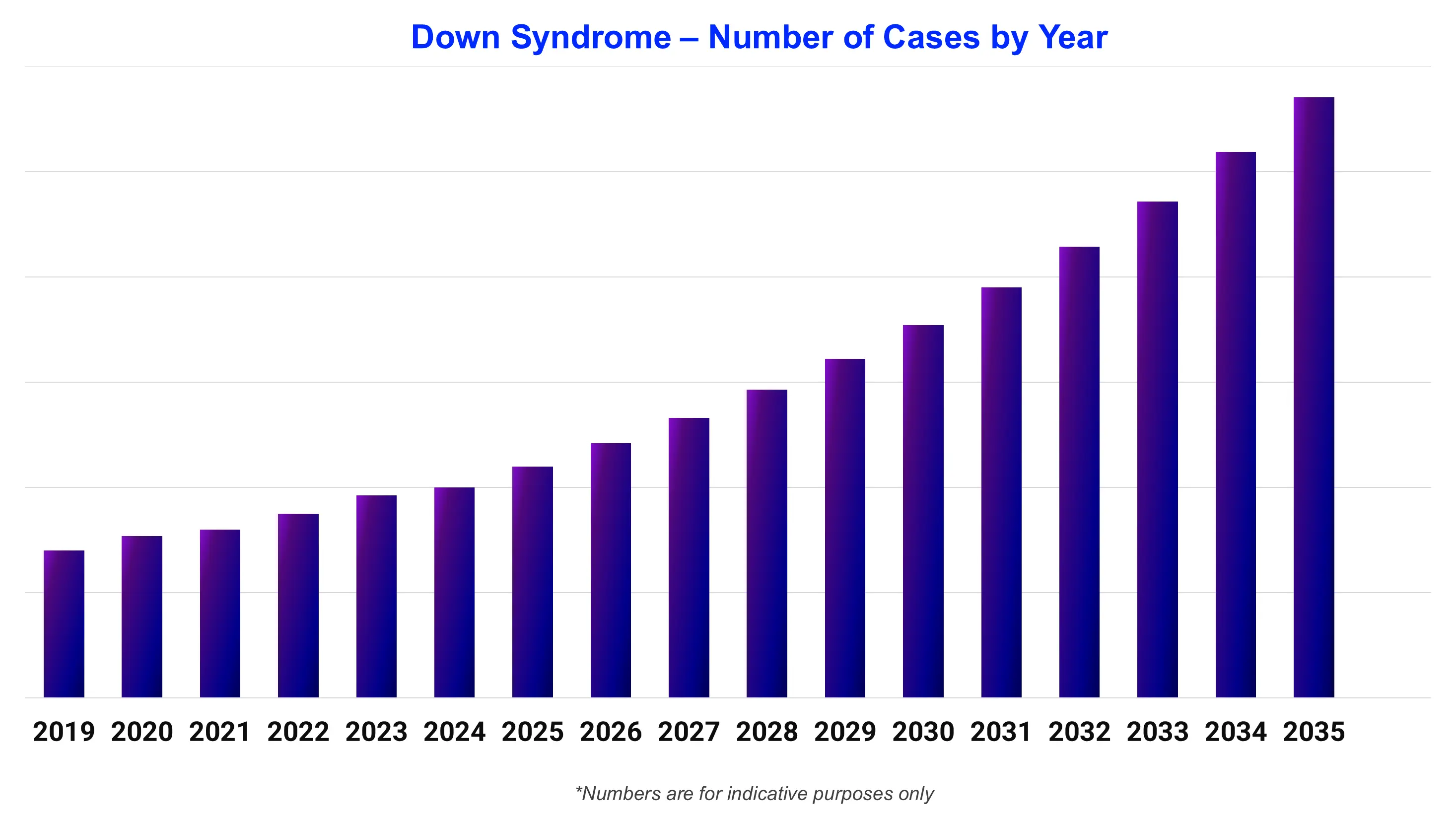
Down syndrome (DS), also known as trisomy 21, is a congenital chromosomal condition caused by the presence of an extra full or partial copy of chromosome 21. The CDC reported approximately 5,775 babies born with Down syndrome annually in the United States in its January 2026 overview. According to Down Syndrome Epidemiology Forecast by Expert Market Research (EMR), the disease represents a substantial, lifelong healthcare burden across 8MM countries.
Base Year
Historical Period
Forecast Period
Read more about this report - REQUEST FREE SAMPLE COPY IN PDF
Expert Market Research's “Down Syndrome Epidemiology Forecast Report 2026-2035” offers comprehensive information on the prevalence and demographics of Down Syndrome. It projects the future incidence and prevalence rates of Down Syndrome cases across various populations. The study covers age, gender, and type as major determinants of the Down Syndrome population. The report highlights patterns in the prevalence of Down Syndrome over time and projects future trends based on multiple variables.
The report provides a comprehensive overview of the disease, as well as historical and projected data on the epidemiology of Down Syndrome in the 8 major markets.
Regions Covered
Down syndrome (DS), also known as trisomy 21, is a congenital chromosomal condition caused by the presence of an extra full or partial copy of chromosome 21. This additional genetic material alters embryonic and postnatal development, producing a variable spectrum of intellectual disability, developmental delay, characteristic physical features, and associated medical complications. It is the most common chromosomal condition diagnosed in the United States and a leading genetic cause of intellectual disability. The severity of its clinical manifestations varies considerably between individuals.
|
Parameter |
Insight |
|
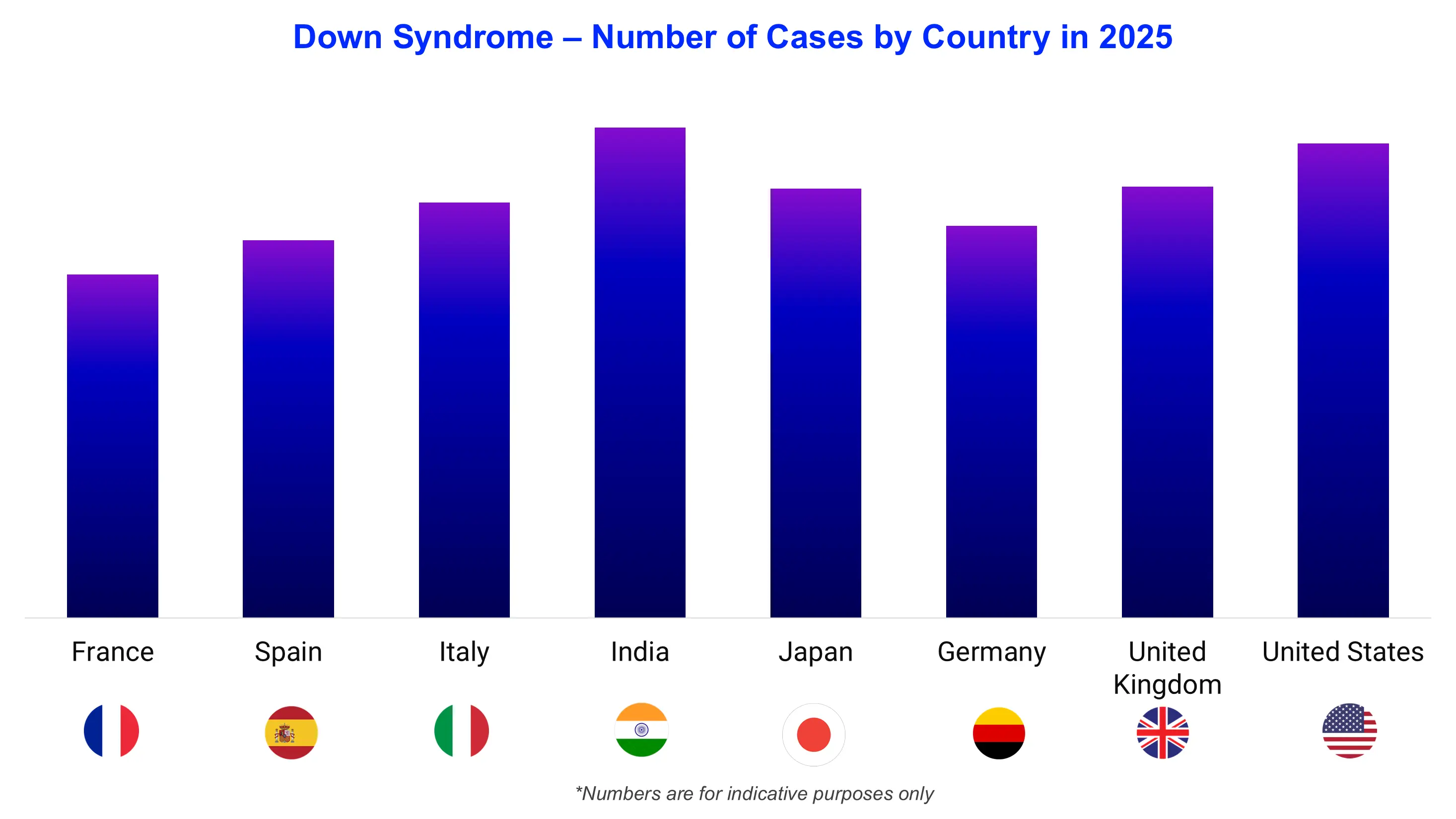
Largest Patient Pool |
United States |
|
Fastest Growing Country |
United Kingdom |
|
High-Risk Population |
The principal risk factor for Down syndrome is increasing maternal age, particularly among pregnancies in women aged 35 years and older, because the probability of chromosome 21 nondisjunction increases with age. |
|
Key Diagnostic Method |
Down syndrome is diagnosed through chromosomal analysis, with karyotyping serving as the definitive confirmatory method to identify trisomy 21 and distinguish full trisomy, translocation, and mosaic forms. |
|
Major Risk Factor |
Advanced maternal age is the principal established epidemiological risk factor for Down syndrome, with the probability of fetal trisomy 21 increasing as maternal age rises, particularly from 35 years onward. |
|
Major gap in the market |
A major unmet need in the Down syndrome healthcare market is the inadequate provision of evidence-based, lifelong healthcare for adults, particularly in preventive screening, age-specific clinical management, and the transition from pediatric to adult services. |
The Down Syndrome epidemiology division offers information on the patient pool from history to the present as well as the projected trend for each of the 8 major markets. Expert Market Research provides both current and predicted trends for the Down Syndrome epidemiology scenario by examining a wide range of studies. Additionally, the report covers the diagnosed patient pool for Down Syndrome and their trends. The data is broken down into specific categories, such as total prevalent cases in males and females, and total diagnosed cases across different age groups and patient pools.
|
Epidemiology Segment |
Key Insights |
|
Diagnosed Prevalent Cases of the Disease |
According to a 2025 analysis of the Global Burden of Disease 2021 database, approximately 1.57 million people worldwide were living with Down syndrome in 2021 (95% uncertainty interval: 1.31–1.86 million). This represents a modelled estimate of total prevalence, rather than a count of confirmed diagnoses. |
|
Gender-Specific Cases of the Disease |
According to a 2022 study published in Frontiers in Genetics, which analyzed Global Burden of Disease (GBD) estimates, approximately 875,710 males and 704,080 females were living with Down syndrome globally in 2019. Males accounted for approximately 55.4% of prevalent cases, compared with 44.6% among females. |
|
Age-Specific Cases of the Disease |
According to a 2022 study published in Frontiers in Genetics, based on the Global Burden of Disease (GBD) 2019 database, individuals aged 15-49 years constituted the largest age group of people living with Down syndrome globally in 2019, except in low sociodemographic-index regions, where the age distribution differed. The study categorized prevalent cases into four groups: children younger than 5 years, children aged 5-14 years, adults aged 15-49 years, and adults aged 50 years or older. |
|
Ethnicity-Wise Cases of the Disease |
A 2025 study analysing Texas registry data from 1999–2020 reported higher birth prevalence among Hispanic populations and increasing prevalence trends among Hispanic and non-Hispanic Black populations. The prevalence was highest among the combined category of American Indian/Alaska Native, Native Hawaiian/Pacific Islander, and other non-Hispanic groups, at 25.7 cases per 10,000 births, followed by Hispanic births at 19.1 per 10,000, non-Hispanic Black births at 11.9 per 10,000, non-Hispanic White births at 11.5 per 10,000, and non-Hispanic Asian births at 7.7 per 10,000. |
|
Mortality and Survival Analysis of the Disease |
A 2026 study published in the Journal of Applied Research in Intellectual Disabilities further found that respiratory diseases and infections were the leading causes of death among adults with Down syndrome aged 50 years and older, followed by cardiovascular and neuropsychiatric conditions. Mortality was approximately five times higher than among matched adults with intellectual disabilities without Down syndrome (hazard ratio 5.05; 95% CI: 3.10–7.47). |
Read more about this report - REQUEST FREE SAMPLE COPY IN PDF
The Down Syndrome epidemiology data and findings for the United States, Germany, Spain, Italy, France, the United Kingdom, Japan, and India are also provided in the epidemiology section.
|
Country |
Key Insights |
|
United States |
According to a December 2025 fact sheet by the Adult Down Syndrome Center, an estimated 220,186 people were living with Down syndrome in the United States in 2018, corresponding to a population prevalence of approximately 6.7 cases per 10,000 inhabitants, or 1 in 1,484 people. |
|
Germany |
A 2022 publication in Oral Health Care of People with Down Syndrome in Germany subsequently cited an estimated population of approximately 50,000 individuals living with the condition nationally. Although this provides a more recent published estimate, it is not a new prevalence measurement for 2022 or later. |
|
France |
A nationwide observational study published in Scientific Reports in December 2023, using data from the French National Health Database, identified 36,464 people living with Down syndrome in France in 2019, corresponding to a prevalence of approximately 0.055% of the total population, or 5.5 cases per 10,000 inhabitants. |
|
Italy |
More recent public-health reporting by the Italian National Institute of Health (Istituto Superiore di Sanità), updated in March 2026, estimates that approximately 40,000 people live with Down syndrome in Italy, with around 500 affected births annually, equivalent to approximately one birth per 1,200 live births. |
|
Spain |
More recent public reporting by Spain’s national Down syndrome organisation, DOWN España, cited an estimated 34,000 people living with Down syndrome in the country in March 2024. This provides a more recent population estimate, although it is not based on a newly conducted nationwide prevalence survey. |
|
United Kingdom |
According to the UK Government’s Down Syndrome Act 2022 draft statutory guidance, updated in December 2025, approximately 47,000 people are living with Down syndrome in the United Kingdom. This is the latest readily available national population estimate, although it is not based on a new nationwide census. |
|
Japan |
According to a 2025 review published by the Japanese Society for Developmental Disabilities, approximately 50,000 people are estimated to be living with Down syndrome in Japan. This is a broad population estimate rather than a count from a recent nationwide registry. Japan does not maintain a comprehensive national register of all people with chromosomal abnormalities, making precise estimates of the total prevalent population difficult to establish. |
|
India |
According to estimates reported in recent Indian medical literature, approximately 23,000–29,000 children with Down syndrome are born annually in India, corresponding to an estimated birth prevalence of roughly 1 in 800–1,000 live births. A 2025 report in India Today cited this annual birth estimate, while a 2026 clinical review noted that prevalence estimates vary and are likely affected by differences in prenatal screening, diagnosis and reporting. |
A major gap is the limited availability of comprehensive, comparable epidemiological data, particularly on age-specific prevalence, associated conditions, and long-term outcomes. In India, expanding population-based birth-defect surveillance and improving access to genetic counselling, early intervention, and specialized Down syndrome clinics could support earlier identification and more consistent care. A 2025 Indian study involving 53 families found that only 44% had accessed a dedicated Down syndrome clinic, highlighting the need to improve specialist access and family support. An important emerging growth area is adult Down syndrome care. Increasing life expectancy has created demand for structured transition from pediatric to adult services, routine health assessments, and ongoing monitoring of thyroid dysfunction, hearing and vision impairment, sleep apnea, obesity, and Alzheimer’s disease.
Down syndrome is a lifelong chromosomal condition for which there is currently no cure or approved treatment that removes the extra chromosome 21. Treatment focuses on early developmental intervention, routine health surveillance, management of associated medical conditions, and improving functional independence and quality of life. According to the Indian Academy of Pediatrics’ 2023 consensus statement, management should follow a multidisciplinary, age-specific approach integrating medical, developmental, psychological, social, and educational support. Medical management includes screening for congenital heart defects, thyroid dysfunction, hearing and vision impairment, sleep apnea, gastrointestinal abnormalities, and other associated conditions. Congenital heart defects or gastrointestinal obstructions may require surgery, while thyroid disorders, infections, and other coexisting conditions are treated with condition-specific medicines or interventions.


Upto 15% Off
USD
$2699 $2429
$4299 $3869
$5799 $4949
$6999 $5949


*While we strive to always give you current and accurate information, the numbers depicted on the website are indicative and may differ from the actual numbers in the main report. At Expert Market Research, we aim to bring you the latest insights and trends in the market. Using our analyses and forecasts, stakeholders can understand the market dynamics, navigate challenges, and capitalize on opportunities to make data-driven strategic decisions.*
Explore our key highlights of the report and gain a concise overview of key findings, trends, and actionable insights that will empower your strategic decisions.
|
Report Features |
Details |
|
Base Year |
2025 |
|
Historical Period |
2019-2025 |
|
Forecast Period |
2026-2035 |
|
Epidemiology Statistics Provided |
|
|
Segmentation Provided |
|
|
Geographies Covered |
|
Datasheet
One User
USD 2,699
USD 2,429
tax inclusive*
Single User License
One User
USD 4,299
USD 3,869
tax inclusive*
Five User License
Five User
USD 5,799
USD 4,949
tax inclusive*
Corporate License
Unlimited Users
USD 6,999
USD 5,949
tax inclusive*
*Please note that the prices mentioned below are starting prices for each bundle type. Kindly contact our team for further details.*
Flash Bundle
Small Business Bundle
Growth Bundle
Enterprise Bundle
*Please note that the prices mentioned below are starting prices for each bundle type. Kindly contact our team for further details.*
Flash Bundle
Number of Reports: 3
20%
tax inclusive*
Small Business Bundle
Number of Reports: 5
25%
tax inclusive*
Growth Bundle
Number of Reports: 8
30%
tax inclusive*
Enterprise Bundle
Number of Reports: 10
35%
tax inclusive*
How To Order

Select License Type
Choose the right license for your needs and access rights.

Click on ‘Buy Now’
Add the report to your cart with one click and proceed to register.

Select Mode of Payment
Choose a payment option for a secure checkout. You will be redirected accordingly.
Strategic Solutions for Informed Decision-Making
Gain insights to stay ahead and seize opportunities.

Get insights & trends for a competitive edge.

Track prices with detailed trend reports.

Analyse trade data for supply chain insights.

Leverage cost reports for smart savings

Enhance supply chain with partnerships.

Connect For More Information
Our expert team of analysts will offer full support and resolve any queries regarding the report, before and after the purchase.
Our expert team of analysts will offer full support and resolve any queries regarding the report, before and after the purchase.
We employ meticulous research methods, blending advanced analytics and expert insights to deliver accurate, actionable industry intelligence, staying ahead of competitors.
Our skilled analysts offer unparalleled competitive advantage with detailed insights on current and emerging markets, ensuring your strategic edge.
We offer an in-depth yet simplified presentation of industry insights and analysis to meet your specific requirements effectively.




