

Consumer Insights
Uncover trends and behaviors shaping consumer choices today
Procurement Insights
Optimize your sourcing strategy with key market data
Industry Stats
Stay ahead with the latest trends and market analysis.
The multispecific antibody platforms market was valued at USD 0.42 Billion in 2025 and is projected to reach USD 5.53 Billion by 2035, advancing at a CAGR of 29.40%. Growth is driven by the clinical move from two-target bispecific antibodies toward trispecific and trifunctional formats, rising platform licensing and collaboration activity, the need to counter tumor escape and T-cell exhaustion, and expanding work on single-domain and brain-shuttle constructs. Revenue today comes mainly from collaboration, licensing and platform fees, so first product launches are expected to shape the second half of the forecast window.
Patent filings cluster around trispecific T-cell engagers combining CD3, costimulation and tumor antigen, trifunctional natural killer cell engagers, multispecific single-domain antibody constructs, broadly neutralising trispecific antibodies for infectious disease, brain-shuttle multispecific formats for neurological targets, and heterodimerisation and chain assembly control for three or more arms. More than 6,100 patent families have been identified, and 45+ patents were granted in 2025. Approvals of several two-target T-cell engagers since 2022 and early clinical data for trispecific candidates in myeloma and HIV-1 provide regulatory and commercial validation for the next format generation.
This Multispecific Antibody Platforms Patent Landscape Analysis Report provides a structured assessment of patent filing trends, jurisdictional coverage, leading assignees, technology clusters and strategic implications for stakeholders developing antibodies with three or more binding specificities.
The multispecific antibody platforms market is experiencing strong growth, driven by the clinical validation of CD3 bispecific engagers, demand for therapies that address tumor escape through several targets at once, and sustained platform licensing by large biopharmaceutical companies. Trispecific candidates that pair a tumor antigen with CD3 and a costimulatory receptor are now in phase 1 and phase 2 studies in myeloma and lymphoma, which is moving the field from concept toward clinical proof.
Patent activity is accelerating, with 45+ multispecific antibody platforms patents granted in 2025, reflecting strong innovation momentum in trispecific T-cell engagers combining CD3, costimulation and tumor antigen, trifunctional natural killer cell engagers, multispecific single-domain antibody constructs, and broadly neutralising trispecific antibodies for infectious disease.
Top assignees in the multispecific antibody platforms patent landscape include Genentech, Janssen Biotech, Sanofi, Xencor, and Zymeworks, with the United States, China, and Europe as the dominant patent jurisdictions.
Antibodies with three or more binding specificities sit at the leading edge of antibody engineering, building on the commercial and clinical experience gained with two-target bispecific formats. Developers pursue them because a single target is often not enough to control tumor escape, T-cell exhaustion or the redundancy of inflammatory pathways. Most candidates remain in phase 1 and phase 2 studies, and the field is shaped by platform companies that license formats to large biopharmaceutical partners. Demand characteristics differ from conventional biologics, since early revenue depends on upfront payments, milestones and platform access fees rather than product sales. Hematologic malignancies lead clinical activity, while solid tumors, infectious disease and neurological disorders are drawing growing engineering attention.
Market growth is driven by the clinical success of CD3 bispecific engagers, which has convinced developers and investors that adding a third specificity can deepen responses and reduce relapse. More than five CD3 bispecific T-cell engagers have been approved since 2022, and each approval enlarges the pool of clinicians familiar with cytokine release management and step-up dosing. The very high rate of expansion reflects a small starting base, because current revenue is mostly collaboration and licensing income, and the first trispecific launches are expected in the later years of the forecast window.
Early clinical data for a BCMA, GPRC5D and CD3 trispecific antibody in relapsed myeloma indicate that two tumor targets can be engaged at once, which addresses antigen loss, a common reason for relapse after single-target therapy. That evidence encourages other sponsors to extend the concept to lymphoma, solid tumors and autoimmune disease, widening the number of programmes seeking platform licences. A trispecific antibody against HIV-1 that has reached phase 1 studies shows the same logic in infectious disease, where viral variability favours antibodies that bind several epitopes. Each of these programmes raises demand for heterodimerisation methods and manufacturing expertise, and that demand in turn supports the contract development segment.
Read more about this report - REQUEST FREE SAMPLE COPY IN PDF
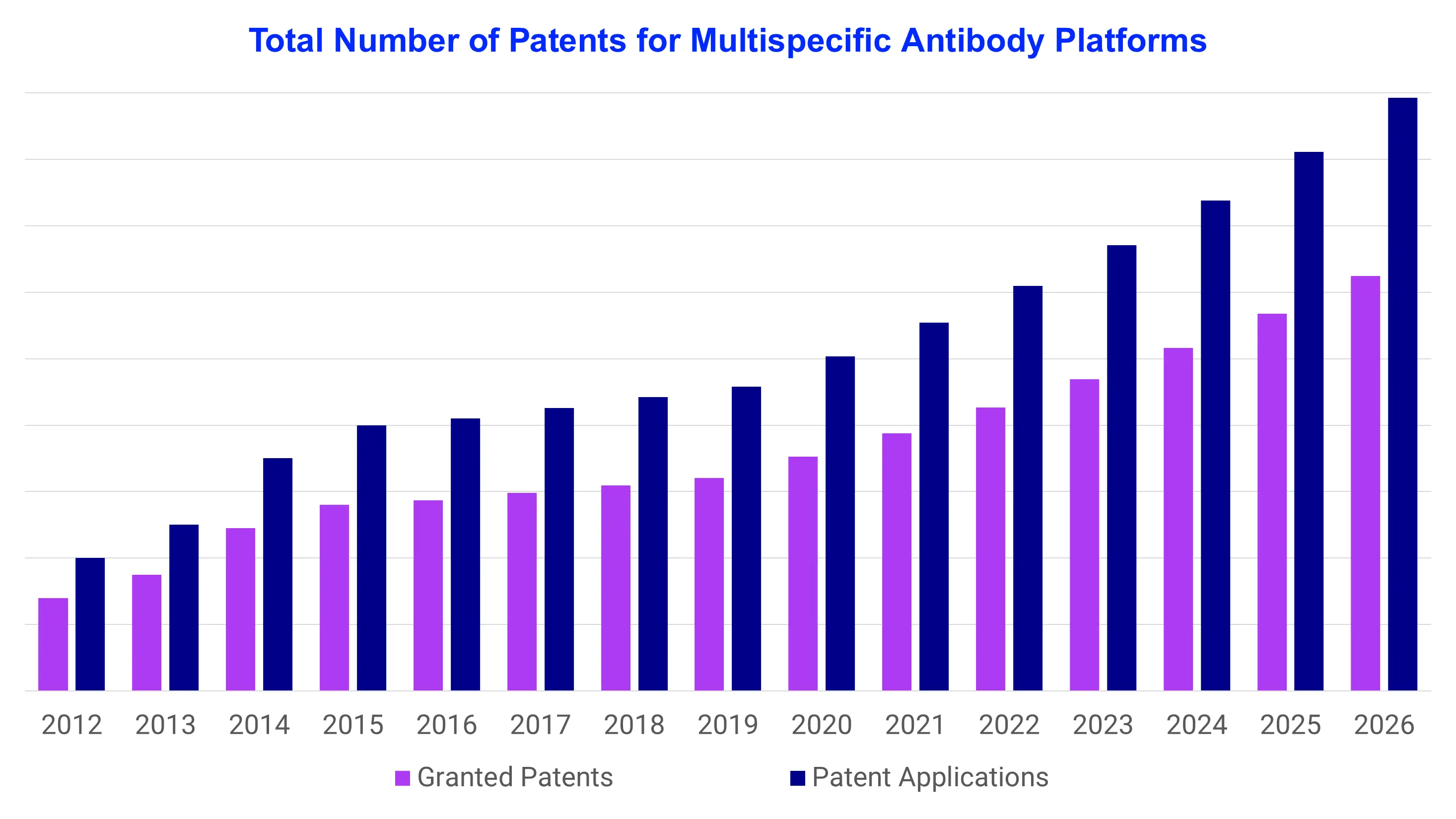
Filing intensity in multispecific antibody platforms has risen steadily since the mid-2010s, and the pace has increased as bispecific approvals demonstrated that complex antibody formats can be manufactured and dosed at commercial scale. Large companies now file continuation families around each format, while specialist platform firms file broadly on assembly methods and Fc scaffolds. Licensing deals and collaboration funding have closely followed this pattern, and companies with the most active clinical programmes tend to hold the deepest and most frequently updated portfolios.
More than 6,100 patent families were identified, with annual filings peaking in the 2021 to 2024 period as trispecific and cell-engager programmes entered the clinic. Main technology clusters include trispecific T-cell engagers combining CD3, costimulation and tumor antigen, trifunctional natural killer cell engagers, and multispecific single-domain antibody constructs. Smaller but fast-growing clusters cover broadly neutralising trispecific antibodies for infectious disease, brain-shuttle multispecific formats for neurological targets, and heterodimerisation and chain assembly control for three or more arms.
Growing clinical demand for antibodies that engage several targets at once has translated directly into broader and faster patent expansion across formats, assembly methods and target combinations.
This report covers patent filings worldwide, with detailed attention to the United States, China, Europe, South Korea, India and international filings under the Patent Cooperation Treaty administered by WIPO. Market coverage extends to the multispecific antibody platforms market as an emerging, largely pre-commercial segment, where revenue today consists mainly of collaboration, licensing and platform fees.
Technology scope covers multispecific formats including trispecific T-cell engagers, trifunctional immune cell engagers, tetraspecific and higher-order formats, single-domain multispecific constructs and multispecific IgG-like formats with added domains. Targeting strategies reviewed include tumor antigen pairing with CD3, costimulatory receptor engagement, natural killer and gamma delta cell engagement, multi-pathway cytokine or checkpoint blockade, and blood-brain barrier shuttle targeting. Therapeutic areas span hematologic malignancies, solid tumors, autoimmune and inflammatory diseases, infectious diseases and neurological disorders. Two-target bispecific antibodies are treated only as a technical starting point.
Entities covered include large biopharmaceutical companies with established bispecific franchises, specialist antibody engineering firms that license platforms, and venture-backed start-ups developing trispecific and tetraspecific candidates. Contract development and manufacturing organizations and antibody discovery platform companies are included where they hold relevant filings. Academic and clinical institutions, including cancer centers and university research groups that contribute early format designs and first-in-human studies, are also represented.
The report will cover the following sections in detail:
Analysis by Multispecific Format
Analysis by Targeting Strategy
Analysis by Therapeutic Area
Multispecific Antibody Platforms Patent Filing Trend Analysis
Patent filings for antibodies with three or more specificities have moved from an academic niche to an industrial activity within a decade. Early filings concentrated on how to combine more than two binding domains into a stable molecule. Recent filings put more weight on target combinations, dosing regimens and indication-specific claims, which shows that sponsors are now protecting clinical strategies as well as constructs. Applicants have also begun filing on brain-shuttle and single-domain designs, extending the technology beyond oncology.
Annual filings grew at an estimated 14 to 18 percent between 2020 and 2024 (approximate), faster than for the wider antibody engineering field. Three factors drove this rate. Clinical readouts from CD3 engagers in myeloma and lymphoma increased confidence in multi-arm designs. Platform companies broadened their families to cover trispecific variants of existing bispecific scaffolds. Chinese applicants also entered the field in larger numbers, adding single-domain and natural killer cell engager filings to the global total.
Among the players with multispecific antibody platforms patent families, new entrants have been identified, which can be either established companies or startups developing novel technology in the field. Some of the major companies mentioned in this report (a non-exhaustive list) are as follows:
Genentech, a member of the Roche Group, holds one of the broadest antibody-engineering portfolios in the field, covering knob-into-hole heterodimerisation, CrossMAb chain pairing and T-cell bispecific formats with variable valency. Its marketed bispecific antibodies include Hemlibra, Lunsumio, Columvi and Vabysmo, which supply real-world safety and manufacturing evidence that supports further development of higher-order formats. Genentech has multispecific candidates in clinical development, though no approved trispecific product exists in the industry. The company relies on layered filings that protect the format architecture, assembly method and individual molecules, and it pairs these with selective collaboration and licensing. Within the landscape, Genentech is positioned as a format originator whose assembly-control claims are frequently encountered by other developers working on three or more arms.
Janssen Biotech, the biotechnology arm of its parent pharmaceutical group, builds its multispecific portfolio on the DuoBody platform developed with Genmab and on internal programmes in T-cell redirection. Its marketed bispecific antibodies include Rybrevant, Tecvayli and Talvey, covering lung cancer and multiple myeloma. A trispecific candidate directed at BCMA, GPRC5D and CD3 is in clinical development for relapsed or refractory myeloma, and other multispecific constructs are in earlier stages. The company combines platform-level patents on controlled Fab-arm exchange with product-specific claims on each target combination and dosing regimen. Commercial positioning rests on a hematology and oncology franchise that gives Janssen the clinical infrastructure to move trispecific candidates quickly through development.
Other companies include Sanofi, Xencor, and Zymeworks.
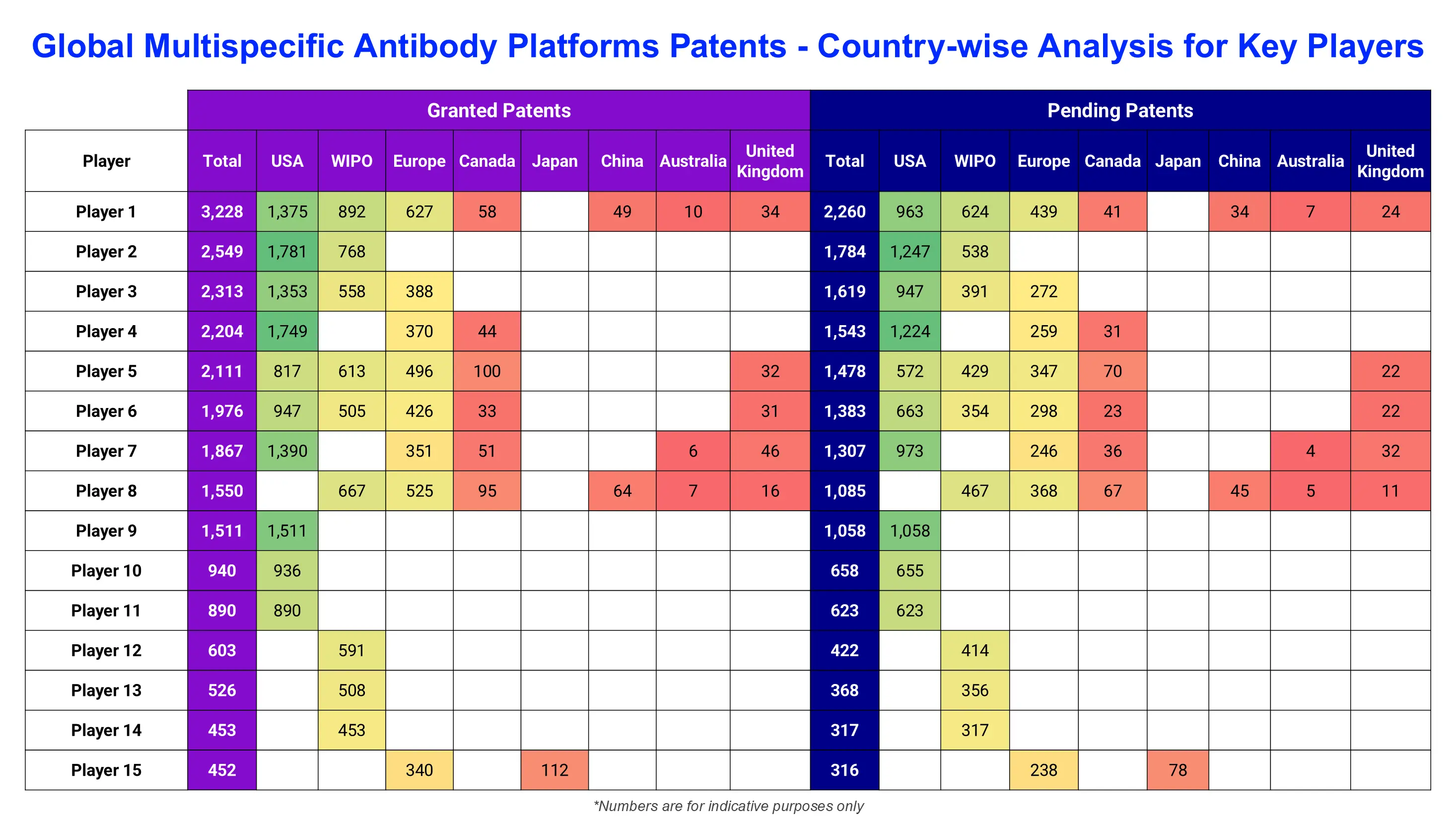
Patent ownership is moderately concentrated among five leading assignees: Genentech, Janssen Biotech, Sanofi, Xencor and Zymeworks. Genentech holds long-standing assembly and chain-pairing claims that underpin many heterodimeric formats. Janssen Biotech combines controlled Fab-arm exchange claims with product-specific filings on its myeloma and lung cancer programmes. Sanofi has built a position in trifunctional natural killer cell engagers and multispecific nanobody constructs, supported by an HIV-1 trispecific programme. Xencor and Zymeworks, both platform specialists, file around Fc heterodimer scaffolds and license them to partners. The remaining filings are spread across a long tail of mid-sized companies, start-ups and universities.
*Please note that this is only a partial list; the complete list of key players is available in the full report. Additionally, the list of key players can be customized to better suit your needs.*
The report assesses patent activity across major jurisdictions, including:
The United States leads in filing volume, reflecting the concentration of originator companies, platform specialists and cancer centers running first-in-human studies. China ranks second and is the fastest-growing jurisdiction, with domestic developers filing on single-domain, natural killer cell engager and T-cell engager constructs. Europe holds a substantial share through large pharmaceutical groups and the European Patent Office route. South Korea contributes filings from antibody engineering firms and academic groups, while India remains small, with filings concentrated in biosimilar-oriented manufacturers moving toward complex formats. WIPO international applications are widely used for strategic coverage.
Read more about this report - REQUEST FREE SAMPLE COPY IN PDF
The technology segmentation of the multispecific antibody platforms patent landscape is organised into five main areas:
Trispecific T-cell engager constructs lead patent activity, because they connect most directly to the validated CD3 bispecific class and to the largest clinical programmes in myeloma and lymphoma. Adding a costimulatory arm or a second tumor antigen is a natural extension that sponsors can protect with both format and target-pair claims. Trifunctional natural killer cell engagers follow, helped by large pharmaceutical commitment, while single-domain constructs are the fastest-growing area of filing.
Competition combines large pharmaceutical groups holding marketed bispecific antibodies with specialist platform firms whose value lies in licensing. Large groups protect formats, assembly methods and product candidates, while platform specialists seek broad coverage of Fc scaffolds that partners can license. Chinese developers and start-ups add a growing share of single-domain and natural killer cell engager filings. Because no trispecific antibody is approved yet, competitive position depends on clinical stage and freedom to operate over assembly methods.
Companies are focusing on:
Emerging themes include costimulation built into CD3 engagers to prolong T-cell activity, engagers that recruit natural killer and gamma delta cells to reduce reliance on conventional T cells, and conditional or masked designs that limit cytokine release. Broadly neutralising trispecific antibodies for HIV-1 and respiratory viruses are moving through early trials, and brain-shuttle formats aim to carry antibodies across the blood-brain barrier. Attention is also turning to autoimmune disease, where depletion of B cells by multispecific engagers is being tested as an alternative to cell therapy.
The patent landscape for multispecific antibody platforms shows a field in transition from format invention to clinical differentiation. Early claims on how to assemble three or more binding arms are maturing, while newer filings address target combinations, conditional activation and manufacturability. Understanding who holds which layer of protection helps developers judge freedom to operate before committing to a format.
The patent landscape provides actionable intelligence for the following uses:
Patent research was carried out across major patent databases, including national and regional office records and WIPO international applications, using keyword strings and Cooperative Patent Classification (CPC) codes relevant to antibodies with three or more binding specificities. Results were de-duplicated at patent family level.
Records were screened manually to remove two-target bispecific antibodies without a third specificity, unrelated antibody formats and non-therapeutic filings. Retained families were classified by multispecific format, targeting strategy, therapeutic area, assignee and jurisdiction.
Patent findings were compared with clinical trial registries, regulatory announcements and company disclosures to place filing activity in a commercial context. Market estimates for multispecific antibody platforms were prepared to support the patent analysis and reflect revenue from collaborations, licensing and platform fees.


Upto 15% Off
USD
$2699 $2429
$4299 $3869
$5799 $4949
$6999 $5949


*While we strive to always give you current and accurate information, the numbers depicted on the website are indicative and may differ from the actual numbers in the main report. At Expert Market Research, we aim to bring you the latest insights and trends in the market. Using our analyses and forecasts, stakeholders can understand the market dynamics, navigate challenges, and capitalize on opportunities to make data-driven strategic decisions.*
EMR's Multispecific Antibody Platforms Patent Landscape Analysis provides a comprehensive assessment of patent filings, innovation clusters, assignee portfolios, and geographic filing patterns across the multispecific antibody platforms landscape. The report identifies 6,100+ patent families, evaluates leading jurisdictions including the United States, China, and Europe, and profiles the top assignees by portfolio size.
The global multispecific antibody platforms market was valued at USD 0.42 Billion in 2025. The market is projected to reach USD 5.53 Billion by 2035, expanding at a CAGR of 29.40% during 2026 - 2035.
The report analyses approximately 6,100+ patent families related to multispecific antibody platforms. These include filings from the United States, China, Europe, and international WIPO filings.
Key companies operating within the landscape include Genentech, Janssen Biotech, Sanofi, Xencor, and Zymeworks, among others. These organisations collectively account for a significant portion of patent activity analysed in this report.
The report evaluates patent activity across the United States, Europe, China, Japan, South Korea, India, and international WIPO filings. The United States is the largest single jurisdiction in the multispecific antibody platforms patent landscape, with 2,900+ patents associated with it out of 6,100+ patent families analysed, reflecting the concentration of originator developers and venture-backed platform companies there.
Yes. The report scope can be customised based on geography, technology segment, assignee selection, time period, or specific innovation cluster focus. Readers who need a customised study, such as a narrower technology cluster, a specific assignee set or an additional jurisdiction, can contact the Expert Market Research team to scope the work and agree on deliverables.
Patent landscape analysis helps organisations understand innovation trends, competitive activity, technology whitespace, and IP risk across a defined domain. For multispecific antibody platforms, this report supports strategic decisions in R&D prioritisation, licensing evaluation, competitive benchmarking, and market entry planning.
Explore our key highlights of the report and gain a concise overview of key findings, trends, and actionable insights that will empower your strategic decisions.
|
Scope of the Report |
Details |
|
Analysis by Multispecific Format |
|
|
Analysis by Targeting Strategy |
|
|
Analysis by Therapeutic Area |
|
|
Analysis by End User |
|
|
Key Players Mentioned |
|
|
Geographies Covered |
|
Mini Report
One User
USD 2,699
USD 2,429
tax inclusive*
Single User License
One User
USD 4,299
USD 3,869
tax inclusive*
Five User License
Five User
USD 5,799
USD 4,949
tax inclusive*
Corporate License
Unlimited Users
USD 6,999
USD 5,949
tax inclusive*
*Please note that the prices mentioned below are starting prices for each bundle type. Kindly contact our team for further details.*
Flash Bundle
Small Business Bundle
Growth Bundle
Enterprise Bundle
*Please note that the prices mentioned below are starting prices for each bundle type. Kindly contact our team for further details.*
Flash Bundle
Number of Reports: 3
20%
tax inclusive*
Small Business Bundle
Number of Reports: 5
25%
tax inclusive*
Growth Bundle
Number of Reports: 8
30%
tax inclusive*
Enterprise Bundle
Number of Reports: 10
35%
tax inclusive*
How To Order

Select License Type
Choose the right license for your needs and access rights.

Click on ‘Buy Now’
Add the report to your cart with one click and proceed to register.

Select Mode of Payment
Choose a payment option for a secure checkout. You will be redirected accordingly.
Strategic Solutions for Informed Decision-Making
Gain insights to stay ahead and seize opportunities.

Get insights & trends for a competitive edge.

Track prices with detailed trend reports.

Analyse trade data for supply chain insights.

Leverage cost reports for smart savings

Enhance supply chain with partnerships.

Connect For More Information
Our expert team of analysts will offer full support and resolve any queries regarding the report, before and after the purchase.
Our expert team of analysts will offer full support and resolve any queries regarding the report, before and after the purchase.
We employ meticulous research methods, blending advanced analytics and expert insights to deliver accurate, actionable industry intelligence, staying ahead of competitors.
Our skilled analysts offer unparalleled competitive advantage with detailed insights on current and emerging markets, ensuring your strategic edge.
We offer an in-depth yet simplified presentation of industry insights and analysis to meet your specific requirements effectively.




