

Consumer Insights
Uncover trends and behaviors shaping consumer choices today
Procurement Insights
Optimize your sourcing strategy with key market data
Industry Stats
Stay ahead with the latest trends and market analysis.
The macrocyclic peptide therapeutics market was valued at USD 4.10 Billion in 2025 and is projected to reach USD 13.08 Billion by 2035, advancing at a CAGR of 12.30%. Growth is driven by clinical progress in oral macrocycles against PCSK9 and intracellular targets, wider use of complement-directed cyclic peptides, expansion of peptide radioligand and peptide-drug conjugate programmes, and the maturing of mRNA display and computational design platforms.
Patent activity is rising steadily across mRNA display and flexizyme based discovery, oral bioavailability and permeability engineering, bicyclic and stapled scaffolds, non-natural amino acids with backbone N-methylation, natural product derived cyclic peptides, and computational design. More than 10 patents were granted in 2025 within a family base above 9,600. Regulatory approvals such as zilucoplan in 2023 and the late-stage progress of the oral PCSK9 macrocycle enlicitide, together with continued platform partnerships between discovery specialists and large pharmaceutical groups, supply the commercial validation behind this filing momentum.
This Macrocyclic Peptide Therapeutics Patent Landscape Analysis Report provides a structured assessment of filing trends, jurisdiction coverage, technology clusters, leading assignees and competitive positioning across macrocyclic peptide discovery, optimisation and therapeutic development.
The macrocyclic peptide therapeutics market is experiencing strong growth, driven by oral macrocycle development, complement-directed cyclic peptides, and peptide radioligand programmes. Zilucoplan's 2023 US approval for generalized myasthenia gravis and the late-stage trials of enlicitide, an oral PCSK9 macrocycle, show the class moving from specialist injectables toward broader primary care indications.
Patent activity is accelerating, with 10+ macrocyclic peptide therapeutics patents granted in 2025, reflecting strong innovation momentum in mRNA display and flexizyme based discovery of macrocycles, oral bioavailability and permeability engineering of macrocyclic peptides, bicyclic and stapled peptide scaffolds, and non-natural amino acids and backbone N-methylation.
Top assignees in the macrocyclic peptide therapeutics patent landscape include Merck Sharp & Dohme, PeptiDream, Novartis, Genentech, and Bicycle Therapeutics, with the United States, Europe, and Japan as the dominant patent jurisdictions.
Macrocyclic peptides occupy a useful middle ground between small molecules and biologics. A ring structure holds the peptide in a defined shape, which improves binding to large, flat protein surfaces that conventional small molecules struggle to engage, while keeping manufacturing closer to chemical synthesis than to cell culture. Established products such as cyclosporine, octreotide, daptomycin and linaclotide have shown that the class can deliver durable commercial value in transplantation, endocrinology, infectious disease and gastroenterology. Demand is now shifting toward oral dosing, intracellular targets and complement-mediated disease, where payers and prescribers look for alternatives to injectable antibodies. Pharmaceutical developers therefore treat ring-constrained peptides as a distinct modality rather than a niche extension of peptide drugs.
Market growth is driven by the clinical progress of oral macrocyclic peptides against targets such as PCSK9, which widens the treatable population beyond patients willing to accept injections. Cardiovascular disease causes roughly 20 million deaths each year according to World Health Organization estimates, and many high-risk patients fail to reach LDL cholesterol goals on statins alone, so a once-daily oral option aimed at PCSK9 speaks to a very large unmet need. Zilucoplan, a macrocyclic C5 complement inhibitor, gained US approval in 2023 for generalized myasthenia gravis, confirming that self-injected macrocycles can enter established rare disease markets.
Peptide-based radioligands add a further demand channel. Lutathera, a lutetium-177 labelled somatostatin analogue approved by the US Food and Drug Administration in 2018, set a template for cyclic peptides as carriers of radioactive payloads, and developers now apply the same logic to new tumour targets. The commercial importance is that a validated targeting peptide can be reused across diagnostic and therapeutic isotopes, which lowers development risk for follow-on programmes. Antibiotic resistance supports a parallel line of demand, since daptomycin and rezafungin (approved in 2023) show that cyclic lipopeptides remain relevant against resistant Gram-positive and fungal infections, and early clinical work on Gram-negative macrocycles points to further expansion in this segment.
Read more about this report - REQUEST FREE SAMPLE COPY IN PDF
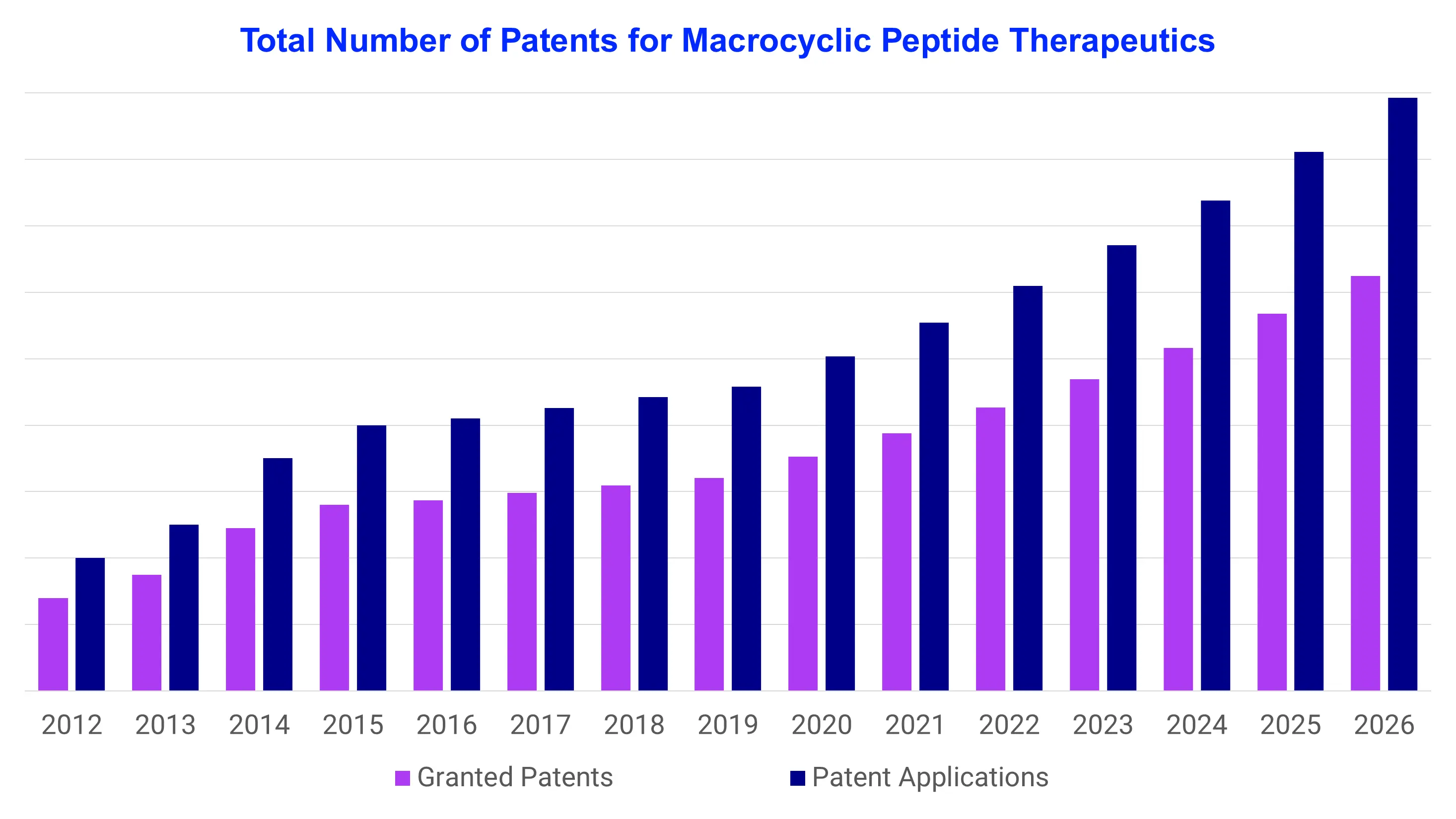
Filing intensity in macrocyclic peptide therapeutics has risen alongside commercial investment in oral peptides and platform deals. Large pharmaceutical groups have funded permeability engineering programmes since early clinical evidence showed that ring-constrained peptides could reach adequate oral exposure, and each programme generates composition-of-matter, formulation and method-of-use filings. Discovery specialists add to the volume by protecting library design, display chemistry and non-natural building blocks, often before a specific target is named. The resulting pattern is a steady rise in annual applications, with a bias toward platform and scaffold claims in the early years and toward product-specific claims as programmes enter clinical development.
The landscape covers more than 4,000 patent families, reflecting the breadth of discovery platforms and the number of target-specific programmes now active. Filing activity peaked between roughly 2021 and 2024, a period shaped by the first oral PCSK9 clinical readouts and by new platform collaborations between specialists and large pharmaceutical groups. The largest technology clusters are mRNA display and flexizyme based discovery, oral bioavailability and permeability engineering, and bicyclic and stapled scaffolds. Smaller but fast-growing clusters cover non-natural amino acids with backbone N-methylation, natural product derived cyclic peptides, and computational design.
Rising demand for oral cardiovascular therapies, complement inhibitors and peptide radioligands has pulled patent expansion into permeability engineering, bicyclic scaffolds and platform chemistry, as developers secure freedom to operate ahead of late-stage readouts.
This report covers patent filings published in the United States, Europe, Japan, South Korea, India and through international applications under the Patent Cooperation Treaty administered by WIPO. Market coverage is global, with attention to regions where macrocyclic peptide therapeutics are discovered, approved and commercialised, including North America, Europe, Japan and the wider Asia Pacific region. Jurisdictional findings are tied to the commercial footprint of the leading assignees, so that filing volume can be read against actual market access plans.
Technology scope spans macrocycle architecture, including head-to-tail cyclic peptides, disulfide and thioether bridged peptides, stapled and hydrocarbon-linked peptides, bicyclic peptides and natural product derived macrocycles. Discovery platform coverage includes mRNA display and RaPID, phage display, DNA-encoded libraries, natural product mining and computational and AI-based design. Therapeutic area scope covers cardiometabolic disorders, oncology, immunology and complement-mediated diseases, infectious diseases, and gastrointestinal and endocrine disorders. Linear peptides and half-life extension technologies are treated only as boundary topics.
Entities covered include large pharmaceutical developers that hold macrocycle portfolios, specialist discovery platform companies, bicyclic and stapled peptide developers, and emerging biotechnology start-ups built on display and computational design technology. Contract research and manufacturing organizations that supply solid-phase and hybrid synthesis capacity are included where they hold relevant filings. Academic and clinical institutions, notably university groups working on genetic code reprogramming, cyclisation chemistry and natural product biosynthesis, are tracked as sources of early-stage inventions that later move into licensed programmes.
The report will cover the following sections in detail:
Analysis by Macrocycle Architecture
Analysis by Discovery Platform
Analysis by Therapeutic Area
Macrocyclic Peptide Therapeutics Patent Filing Trend Analysis
Annual filings in macrocyclic peptide therapeutics have trended upward over the past decade, with the steepest gains since the middle of the last decade. Early patents concentrated on natural product analogues and on cyclisation chemistry, while recent applications increasingly describe oral delivery, intracellular target engagement and library technologies that generate hits against previously undruggable proteins. Grant volumes have followed the same direction, with more than 10 patents granted in 2025.
Annual filing growth between 2020 and 2024 is estimated at roughly 10 percent per year. Several developments drove this rate: the progress of oral PCSK9 macrocycles into late-stage trials, the 2023 approval of zilucoplan, a wave of partnerships built on mRNA display, and rising interest in bicyclic peptide conjugates for oncology. Computational design added a further layer of filings from 2022 onward, as machine learning models began to produce macrocycle sequences that applicants sought to protect.
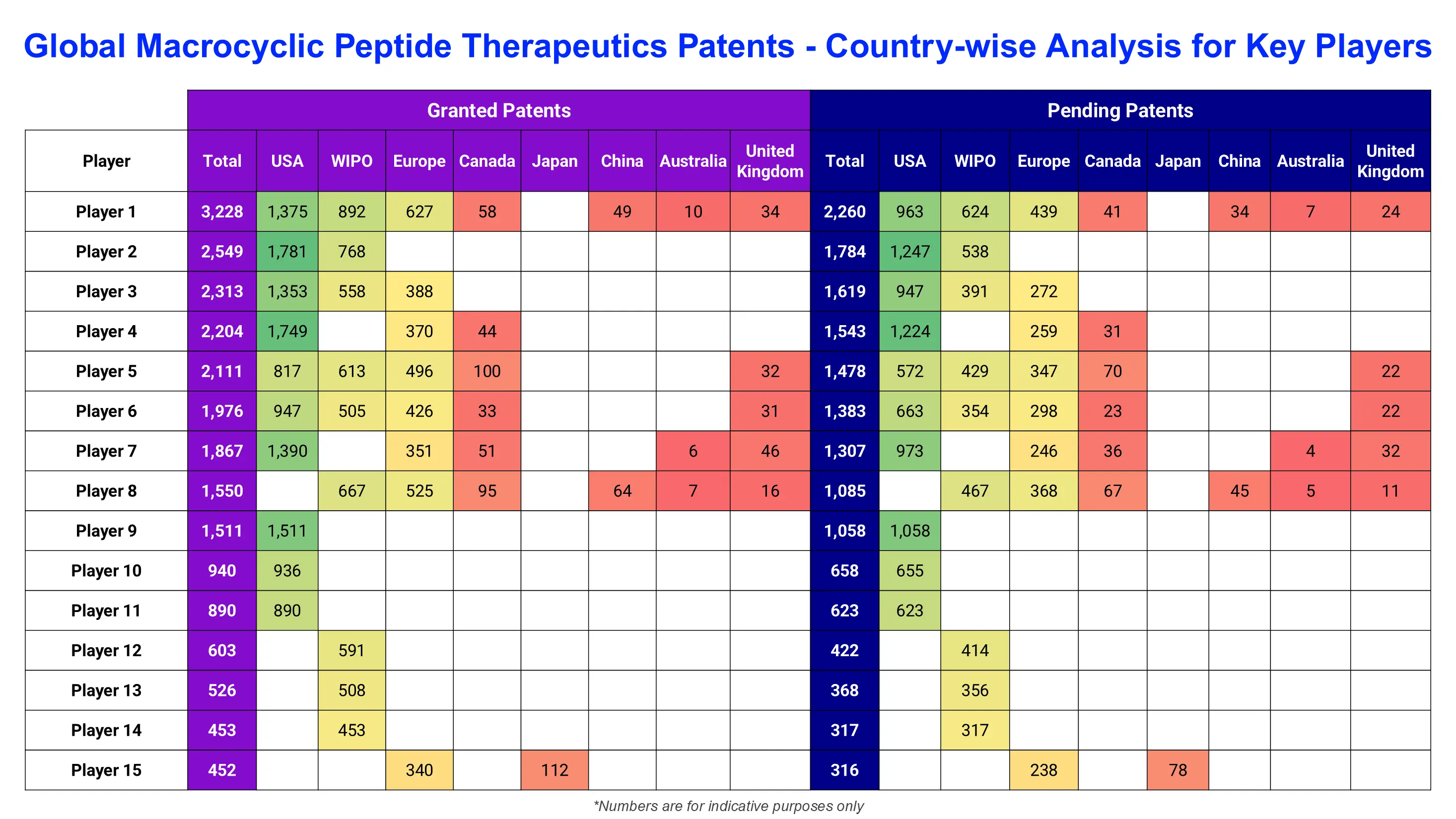
Among the players with macrocyclic peptide therapeutics patent families, new entrants have been identified, which can be either established companies or startups developing novel technology in the field. Some of the major companies mentioned in this report (a non-exhaustive list) are as follows:
Merck Sharp & Dohme holds one of the larger portfolios in oral and ring-constrained peptide therapeutics, with filings that cover permeability engineering, macrocycle scaffolds and formulation for oral delivery. Its flagship programme in the field is enlicitide (MK-0616), an oral macrocyclic peptide inhibitor of PCSK9 that has been in late-stage clinical trials for lowering LDL cholesterol and remains investigational. The company also holds the cyclic lipopeptide antibiotic daptomycin, marketed as Cubicin, which came with its 2015 acquisition of Cubist Pharmaceuticals and gives it direct commercial experience with an approved macrocyclic peptide. Intellectual property strategy centres on composition-of-matter coverage for lead macrocycles, supported by formulation and method-of-use filings that extend protection around oral delivery. Within the landscape it is positioned as the most advanced large pharmaceutical developer of an oral macrocycle against an extracellular target, and its cardiovascular trial outcomes are a reference point for the wider class.
PeptiDream is a Tokyo-based discovery company whose Peptide Discovery Platform System combines flexizyme-enabled genetic code reprogramming with mRNA display to screen very large libraries of non-natural macrocyclic peptides. The platform traces back to the academic work of Hiroaki Suga at the University of Tokyo, and the company is listed on the Tokyo Stock Exchange. Its commercial model rests on co-development and licensing agreements with large pharmaceutical groups, including Novartis, covering peptide-drug conjugates and radioligand therapeutics, rather than on a marketed product of its own. Patent filings protect the platform itself, non-natural amino acid chemistry and specific macrocycle hits against partnered targets. In the landscape PeptiDream acts as a platform supplier whose filings anchor the position of Japan and whose partnerships carry macrocyclic discovery into several therapeutic areas.
Other companies include Novartis, Genentech, and Bicycle Therapeutics.
The five leading assignees, Merck Sharp & Dohme, PeptiDream, Novartis, Genentech and Bicycle Therapeutics, hold a meaningful share of high-value families, although the remainder of the landscape is fragmented across academic institutions and smaller platform companies. Merck Sharp & Dohme concentrates on oral macrocycles and permeability engineering. PeptiDream protects its discovery platform and partnered hits. Novartis combines octreotide-derived heritage with radioligand and macrocycle programmes. Genentech files on oral and antibacterial macrocycles, and Bicycle Therapeutics builds around proprietary bicyclic scaffolds and toxin conjugates.
*Please note that this is only a partial list; the complete list of key players is available in the full report. Additionally, the list of key players can be customized to better suit your needs.*
The report assesses patent activity across major jurisdictions, including:
The United States leads in filing volume, supported by the concentration of large pharmaceutical developers, venture-funded platform companies and university groups. Europe ranks second, with strong contributions from the United Kingdom, Switzerland and Germany, where bicyclic peptide and natural product work is established. Japan ranks third and is closely tied to display platform inventions from academic and commercial groups in Tokyo. South Korea is growing from a smaller base through university and biotechnology filings in stapled and cyclic peptides, while India shows modest but rising activity in cyclic peptide synthesis and antimicrobial macrocycles. WIPO international applications give developers a route to protect priority claims across several of these markets at once.
Read more about this report - REQUEST FREE SAMPLE COPY IN PDF
The patent landscape for macrocyclic peptide therapeutics can be grouped into five major technology segments:
mRNA display and flexizyme based discovery leads patent activity, because a single library can screen billions of ring-constrained sequences containing non-natural residues, and one platform filing can underpin many target-specific programmes. Oral bioavailability and permeability engineering is the fastest-growing segment, following the clinical progress of oral PCSK9 macrocycles, and it is expected to narrow the gap with display discovery as more programmes reach the clinic.
Competition in macrocyclic peptide therapeutics divides into three groups. Large pharmaceutical developers such as Merck Sharp & Dohme, Novartis and Genentech pursue oral and late-stage programmes backed by large internal portfolios. Specialist platform companies, including PeptiDream and Bicycle Therapeutics, build position through proprietary discovery technology and partnered programmes. Academic groups and emerging biotechnology firms supply early inventions in cyclisation chemistry, stapled peptides and computational design. Partnerships between the second and first groups are common, so platform ownership and product ownership often sit with different companies.
Companies are focusing on:
Emerging innovation themes include chemical modifications that raise membrane permeability, such as backbone N-methylation and lipophilic side chains, and delivery systems that protect peptides through the gastrointestinal tract. Generative models that propose ring sequences with predicted permeability are appearing in recent filings, as are macrocycles directed at intracellular protein interactions long considered inaccessible. Antibacterial macrocycles active against resistant Gram-negative organisms, including a class developed by Genentech that has entered early clinical testing, form another growing theme.
The macrocyclic peptide therapeutics landscape combines a few large, product-focused portfolios with a long tail of platform and academic filings. Ownership of the discovery tools is as important as ownership of individual molecules, because tools determine which targets can be reached and who can license them. Clear differences in filing strategy between large pharmaceutical groups, which patent molecules and formulations, and platform companies, which patent technology and chemistry, shape licensing terms and the risk of overlapping claims.
The macrocyclic peptide therapeutics patent landscape provides actionable intelligence for the following nine uses:
Patent research for this report was carried out across major patent databases, covering applications and grants published by national and regional offices and international applications filed through WIPO. Search strategies combined Cooperative Patent Classification codes for cyclic peptides with keywords for macrocycle architectures, discovery platforms and named therapeutic programmes. Queries were refined iteratively against known reference patents from leading assignees, and the search window covered filings from the early 2000s through 2024, with the most recent publications reviewed for completeness.
Retrieved records were screened to remove irrelevant results and duplicates, and related filings were grouped into patent families. Each family was classified by technology cluster, therapeutic area, macrocycle architecture and assignee, and assignee names were harmonised across subsidiaries and name variants. Borderline records, such as linear peptide filings that mention cyclisation only as one embodiment, were reviewed individually before inclusion in the macrocyclic peptide therapeutics set.
Patent findings were read alongside published regulatory milestones, clinical trial registrations and company disclosures to support the market analysis. Filing trends were compared with approvals and late-stage programmes to show how commercial progress relates to innovation activity across jurisdictions. Where filing counts are shown as rounded figures or estimates, they reflect the family-level totals of the screened set and are intended to indicate relative scale rather than exact tallies.


Upto 15% Off
USD
$2699 $2429
$4299 $3869
$5799 $4949
$6999 $5949


*While we strive to always give you current and accurate information, the numbers depicted on the website are indicative and may differ from the actual numbers in the main report. At Expert Market Research, we aim to bring you the latest insights and trends in the market. Using our analyses and forecasts, stakeholders can understand the market dynamics, navigate challenges, and capitalize on opportunities to make data-driven strategic decisions.*
EMR's Macrocyclic Peptide Therapeutics Patent Landscape Analysis provides a comprehensive assessment of patent filings, innovation clusters, assignee portfolios, and geographic filing patterns across the macrocyclic peptide therapeutics landscape. The report identifies 4000+ patent families, evaluates leading jurisdictions including the United States, Europe, and Japan, and profiles the top assignees by portfolio size.
The global macrocyclic peptide therapeutics market was valued at USD 4.10 Billion in 2025. The market is projected to reach USD 13.08 Billion by 2035, expanding at a CAGR of 12.30% during 2026 - 2035.
The report analyses approximately 4000+ patent families related to macrocyclic peptide therapeutics. These include filings from the United States, Europe, Japan, and international WIPO filings.
Key companies operating within the landscape include Merck Sharp & Dohme, PeptiDream, Novartis, Genentech, and Bicycle Therapeutics, among others. These organisations collectively account for a significant portion of patent activity analysed in this report.
The report evaluates patent activity across the United States, Europe, China, Japan, South Korea, India, and international WIPO filings. More than 5,100 macrocyclic peptide therapeutics patents are associated with the United States, which makes it the largest single jurisdiction in the landscape, supported by the concentration of large pharmaceutical developers and discovery platform companies based there.
Yes. The report scope can be customised based on geography, technology segment, assignee selection, time period, or specific innovation cluster focus. Readers can contact the EMR team through the report enquiry channel to scope a customised macrocyclic peptide therapeutics study, including assignee-level deep dives, freedom-to-operate screening and technology-specific filing analysis.
Patent landscape analysis helps organisations understand innovation trends, competitive activity, technology whitespace, and IP risk across a defined domain. For macrocyclic peptide therapeutics, this report supports strategic decisions in R&D prioritisation, licensing evaluation, competitive benchmarking, and market entry planning.
Explore our key highlights of the report and gain a concise overview of key findings, trends, and actionable insights that will empower your strategic decisions.
|
Scope of the Report |
Details |
|
Analysis by Macrocycle Architecture |
|
|
Analysis by Discovery Platform |
|
|
Analysis by Therapeutic Area |
|
|
Analysis by End User |
|
|
Key Players Mentioned |
|
|
Geographies Covered |
|
Mini Report
One User
USD 2,699
USD 2,429
tax inclusive*
Single User License
One User
USD 4,299
USD 3,869
tax inclusive*
Five User License
Five User
USD 5,799
USD 4,949
tax inclusive*
Corporate License
Unlimited Users
USD 6,999
USD 5,949
tax inclusive*
*Please note that the prices mentioned below are starting prices for each bundle type. Kindly contact our team for further details.*
Flash Bundle
Small Business Bundle
Growth Bundle
Enterprise Bundle
*Please note that the prices mentioned below are starting prices for each bundle type. Kindly contact our team for further details.*
Flash Bundle
Number of Reports: 3
20%
tax inclusive*
Small Business Bundle
Number of Reports: 5
25%
tax inclusive*
Growth Bundle
Number of Reports: 8
30%
tax inclusive*
Enterprise Bundle
Number of Reports: 10
35%
tax inclusive*
How To Order

Select License Type
Choose the right license for your needs and access rights.

Click on ‘Buy Now’
Add the report to your cart with one click and proceed to register.

Select Mode of Payment
Choose a payment option for a secure checkout. You will be redirected accordingly.
Strategic Solutions for Informed Decision-Making
Gain insights to stay ahead and seize opportunities.

Get insights & trends for a competitive edge.

Track prices with detailed trend reports.

Analyse trade data for supply chain insights.

Leverage cost reports for smart savings

Enhance supply chain with partnerships.

Connect For More Information
Our expert team of analysts will offer full support and resolve any queries regarding the report, before and after the purchase.
Our expert team of analysts will offer full support and resolve any queries regarding the report, before and after the purchase.
We employ meticulous research methods, blending advanced analytics and expert insights to deliver accurate, actionable industry intelligence, staying ahead of competitors.
Our skilled analysts offer unparalleled competitive advantage with detailed insights on current and emerging markets, ensuring your strategic edge.
We offer an in-depth yet simplified presentation of industry insights and analysis to meet your specific requirements effectively.




