

Consumer Insights
Uncover trends and behaviors shaping consumer choices today
Procurement Insights
Optimize your sourcing strategy with key market data
Industry Stats
Stay ahead with the latest trends and market analysis.
Osteogenesis imperfecta (OI), or brittle bone disease, is a rare genetic disorder characterised by bone fragility, recurrent fractures, and skeletal deformities. An estimated 25,000–50,000 individuals in the United States are affected, with prevalence estimates relying largely on birth incidence and diagnostic patterns. According to Osteogenesis imperfecta (OI) Epidemiology Forecast by Expert Market Research (EMR), there is a global shortage of standardized, lifetime clinical consensus guidelines, making the application of common therapies (like bisphosphonates) highly variable across different regions.
Base Year
Historical Period
Forecast Period
Read more about this report - REQUEST FREE SAMPLE COPY IN PDF
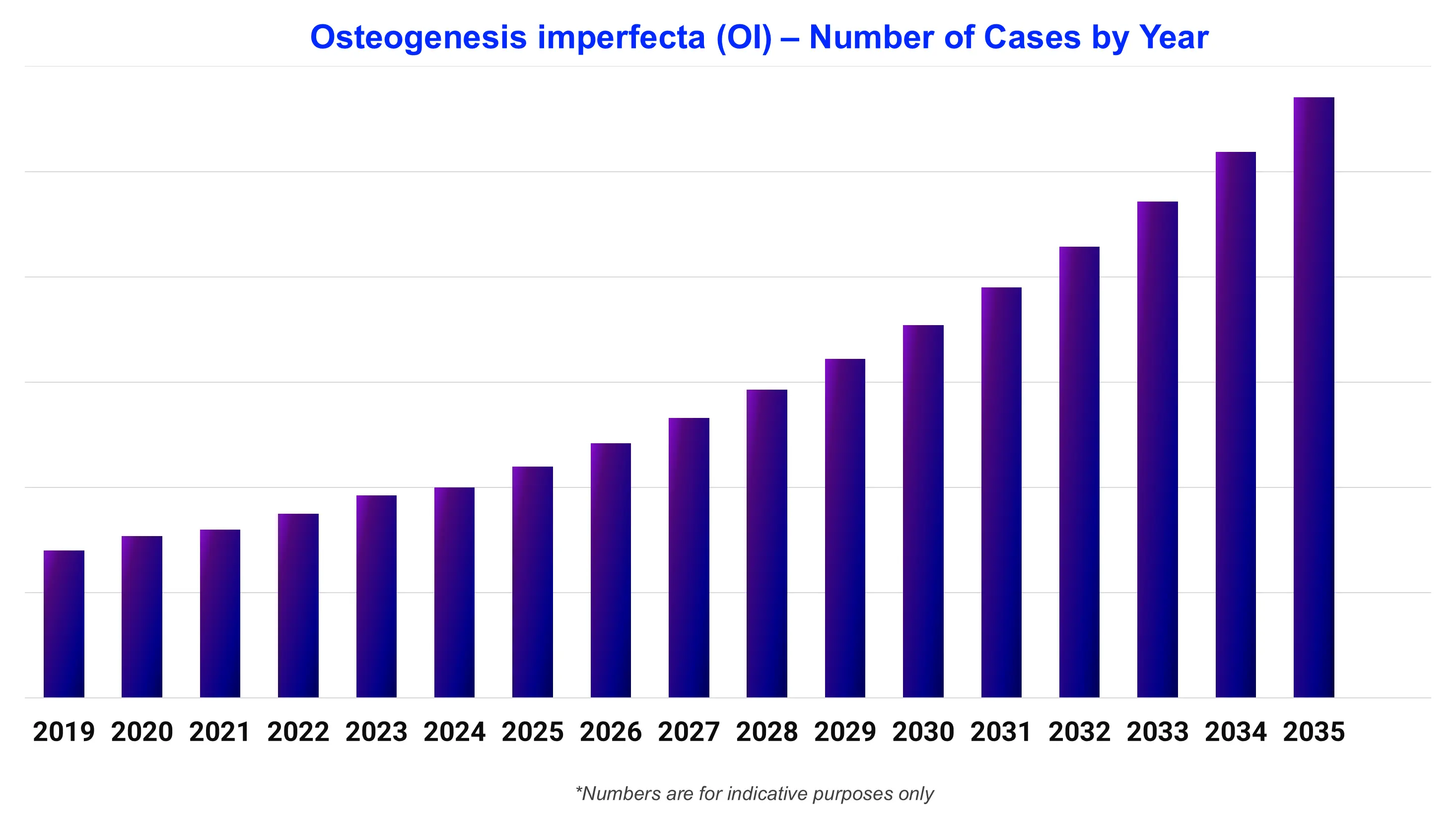
Expert Market Research's “Osteogenesis imperfecta (OI) Epidemiology Forecast Report 2026-2035” offers comprehensive information on the prevalence and demographics of Osteogenesis imperfecta (OI). It projects the future incidence and prevalence rates of Osteogenesis imperfecta (OI) cases across various populations. The study covers age, gender, and type as major determinants of the Osteogenesis imperfecta (OI) population. The report highlights patterns in the prevalence of Osteogenesis imperfecta (OI) over time and projects future trends based on multiple variables.
The report provides a comprehensive overview of the disease, as well as historical and projected data on the epidemiology of Osteogenesis imperfecta (OI) in the 8 major markets.
Regions Covered
Osteogenesis Imperfecta (OI), commonly known as brittle bone disease, is a rare genetic connective tissue disorder characterized by extreme bone fragility and a high risk of fractures from minimal or no apparent trauma. Approximately 85-90% of cases stem from pathogenic variants in the COL1A1 or COL1A2 genes, which provide instructions for making type I collagen, a vital structural protein that provides strength and framework to bones, teeth, skin, and ligaments. Most forms are inherited in an autosomal dominant pattern (a single altered gene copy from one parent or a spontaneous de novo mutation). Rarer, more severe types follow an autosomal recessive or X-linked inheritance pattern.
|
Parameter |
Insight |
|
Largest Patient Pool |
United States |
|
Fastest Growing Country |
United Kingdom |
|
High-Risk Population |
People with a pathogenic variant associated with OI are at risk of the disorder; it may be inherited from an affected parent or arise through a new genetic variant. Within the affected population, people with severe skeletal fragility, frequent fractures, progressive deformity or vertebral involvement require particular attention. |
|
Key Diagnostic Method |
Diagnosis combines clinical assessment, skeletal imaging and molecular genetic testing. A history of recurrent low-trauma fractures, characteristic bone deformities, short stature, blue sclerae or dentinogenesis imperfecta may prompt investigation. |
|
Major Risk Factor |
The principal underlying risk factor is a disease-causing genetic variant. Inherited and de novo variants can both cause OI, and the inheritance pattern depends on the specific gene and variant. For fracture burden, clinically important factors include disease severity, previous fractures, bone deformity and reduced bone strength. |
|
Major gap in the market |
A major gap is the lack of harmonized national data on diagnosed OI cases, fracture burden, treatment access and long-term outcomes across the eight countries. A 2023 European review found that registry practices and data elements varied, supporting the need for common, high-quality data systems. |
The Osteogenesis imperfecta (OI) epidemiology division offers information on the patient pool from history to the present as well as the projected trend for each of the 8 major markets. Expert Market Research provides both current and predicted trends for the Osteogenesis imperfecta (OI) epidemiology scenario by examining a wide range of studies. Additionally, the report covers the diagnosed patient pool for Osteogenesis imperfecta (OI) and their trends. The data is broken down into specific categories, such as total prevalent cases in males and females, and total diagnosed cases across different age groups and patient pools.
|
Epidemiology Segment |
Key Insights |
|
Diagnosed Prevalent Cases of the Disease |
On a macro level, the global population prevalence typically ranges between 2.35 and 4.7 cases per 100,000 individuals. Real-world European Delphi tracking indicates that the diagnosed prevalence changes across a patient's lifespan due to transition gaps in healthcare systems. For example, data maps a pediatric prevalence of 0.88 per 10,000 children, which drops to an adult prevalence of 0.50 per 10,000 individuals as mild adult cases frequently drift away from active clinical tracking. |
|
Gender-Specific Cases of the Disease |
Epidemiological data confirms that males and females inherit, manifest, and are diagnosed with the condition at a true 1:1 equal ratio globally. Large genetic epidemiology studies (such as those tracking European cohorts) have observed a unique gender skew regarding dental health. In patients with Type I OI (the mildest and largest patient pool), DI (brittle, discolored teeth) is significantly more prevalent in females than in males (affecting roughly 22% of females vs. 9% of males). |
|
Age-Specific Cases of the Disease |
Epidemiological data highlights a sharp decline in physical health-related quality of life (HR-QOL) in later years due to cumulative damage. Chronic pain (affecting 41.8% of adults), early-onset osteoarthritis from joint hypermobility, and restrictive pulmonary disease from childhood scoliosis culminate to reduce overall adult life expectancy. |
|
Ethnicity-Wise Cases of the Disease |
From a baseline genetic standpoint, Osteogenesis Imperfecta (OI) affects all racial and ethnic groups with equal biological frequency. Because 85% to 90% of cases are caused by spontaneous or inherited autosomal dominant mutations in the COL1A1 and COL1A2 genes, the condition lacks a primary ethnic or racial bias. |
|
Mortality and Survival Analysis of the Disease |
Comprehensive longitudinal cohort data published in the Journal of Bone and Mineral Research indicates that individuals with OI experience an all-cause mortality hazard ratio (HR) of 2.90. The median survival times reflect a notable reduction in lifespan, for males with OI: Median survival is 72.4 years, compared to 81.9 years in the reference population (a 9.5-year reduction) and for females with OI: Median survival is 77.4 years, compared to 84.5 years in the reference population (a 7.1-year reduction). |
|
Disease Type |
Prevalence |
|
Type I |
Most common form (50-60% of cases). Quantitative defect (underproduction of structurally normal collagen). Near-normal stature, low bone deformity, fractures typically peak before puberty. High rates of adult hearing loss (~50%). |
|
Type II |
Most severe form. Severe qualitative structural collagen defect. Marked by extreme bone fragility with multiple fractures occurring in utero or at birth, an abnormally small rib cage, and severe lung hypoplasia leading to death shortly after birth. |
|
Type III |
Most severe non-lethal form. Severe structural collagen deformation. Characterized by progressive limb bowing, very short stature, barrel chest, severe kyphoscoliosis, and multiple fractures present at birth. Most individuals require wheelchair assistance. |
|
Type IV |
A moderate clinical midpoint between Types I and III. Mild-to-moderate bone deformity, short stature, and frequent long-bone and vertebral compression fractures. Sclera color transitions to normal after infancy. |
Read more about this report - REQUEST FREE SAMPLE COPY IN PDF
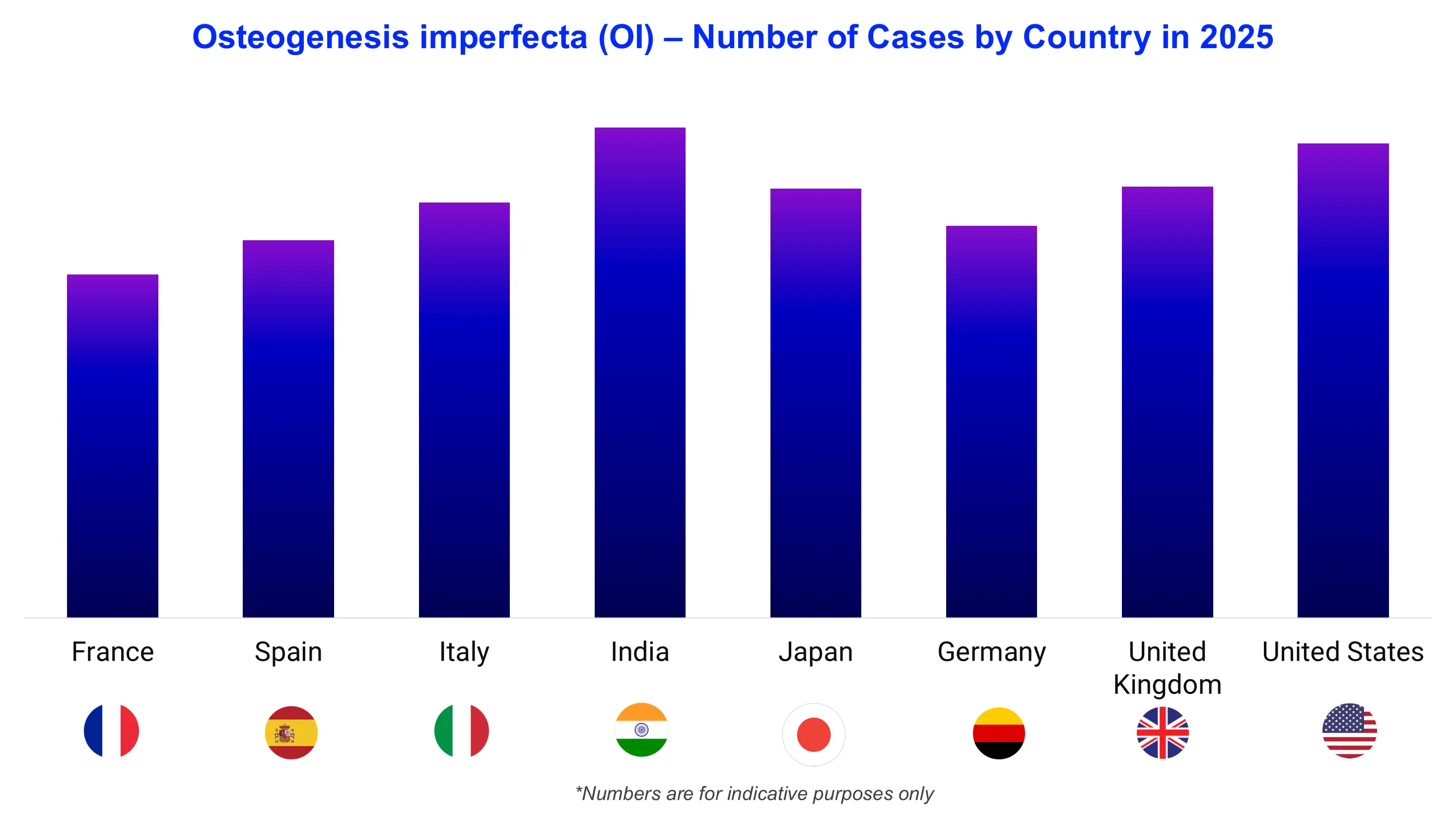
The Osteogenesis imperfecta (OI) epidemiology data and findings for the United States, Germany, Spain, Italy, France, the United Kingdom, Japan, and India are also provided in the epidemiology section.
|
Country |
Key Insights |
|
United States |
In the United States, the diagnosed prevalent population of Osteogenesis Imperfecta (OI) stands at approximately 40,000 cases, representing roughly 55% of all documented cases across the world's major pharmaceutical forecasting markets. Broad historical estimates mapping overall population parameters place the cumulative patient pool between 25,000 and 50,000 affected individuals. |
|
Germany |
In Germany, Osteogenesis Imperfecta (OI) represents a significant clinical cohort within the rare disease landscape. Centralized multi-market epidemiological analyses reveal that Germany holds the highest prevalence of OI among the major European nations. Germany accounts for the largest distinct slice at 25% to 26% of all European cases. France follows as the runner-up at roughly 20%. Germany's baseline population prevalence ranges between 0.50 and 0.80 per 10,000 inhabitants (or roughly 1 in 13,000 to 17,000 individuals). |
|
France |
In France, the epidemiological landscape of Osteogenesis Imperfecta (OI) is characterized by highly structured public registries and a well-coordinated national network for rare diseases. Epidemiological modeling tracks the total living pool of affected individuals in France at approximately 3,000 to 6,000 individuals. |
|
Italy |
Mirroring macro-European epidemiological data, Italy’s baseline population point prevalence matches the broader continental range of 0.50 to 0.70 per 10,000 inhabitants (or roughly 1 in 14,000 to 20,000 individuals). Italy comprises an estimated portion of the European pool, translated to approximately 3,500 to 4,500 diagnosed living individuals nationwide. |
|
Spain |
In Spain, the diagnosed prevalent population of Osteogenesis Imperfecta (OI) is estimated at 0.56 per 10,000 inhabitants, representing a total of 2,669 managed patients nationwide. Comprises 715 pediatric patients (prevalence rate of 0.88 per 10,000 children) and 1,954 adult patients (prevalence rate of 0.50 per 10,000 adults). |
|
United Kingdom |
In the United Kingdom, the epidemiology of Osteogenesis Imperfecta (OI) is robustly documented, primarily anchored by data from the National Health Service (NHS) and the Brittle Bone Society (BBS): the world's first registered OI charity. There are approximately 5,000 individuals actively living with diagnosed Osteogenesis Imperfecta across the United Kingdom. |
|
Japan |
Japan accounts for approximately 10% of the total 8MM prevalent cases. This positions Japan’s total diagnosed prevalent patient pool at approximately 7,200 individuals. In alignment with global baselines, the standard birth incidence in Japan stays uniform at 1 in 15,000 to 20,000 live births. |
|
India |
Public health data tracks the incidence of OI in India at approximately 1 in 15,000 to 1 in 20,000 live births. Because India lacks a single, mandatory rare-disease registry covering its entire population, calculations rely on macro epidemiological models. Given India’s vast population, the estimated living, diagnosed prevalent pool ranges between 70,000 and 95,000 individuals. |
Across the eight countries, the main unmet needs are stronger patient registries, more accessible molecular diagnosis, coordinated orthopedic and rehabilitation care, and better longitudinal evidence on fractures, mobility and quality of life. Treatment research is also exploring approaches beyond conventional antiresorptive therapy. Setrusumab, an investigational anti-sclerostin antibody, has progressed to Phase 3 evaluation; its clinical role depends on trial outcomes and regulatory review. More consistent reporting of treatment eligibility, fracture reduction and long-term safety would improve planning and cross-country comparisons.
OI management combines fracture care, orthopedic procedures when indicated, physiotherapy, rehabilitation, mobility support and monitoring for associated complications. Bisphosphonates such as pamidronate and zoledronic acid are used in selected patients, particularly those with more severe disease, although their effects on fracture reduction and long-term outcomes are not uniform. Genetic counselling and multidisciplinary follow-up are important. Setrusumab and other emerging approaches remain investigational rather than established routine treatments; access and regulatory status must be assessed separately in each country.


Upto 15% Off
USD
$2699 $2429
$4299 $3869
$5799 $4949
$6999 $5949


*While we strive to always give you current and accurate information, the numbers depicted on the website are indicative and may differ from the actual numbers in the main report. At Expert Market Research, we aim to bring you the latest insights and trends in the market. Using our analyses and forecasts, stakeholders can understand the market dynamics, navigate challenges, and capitalize on opportunities to make data-driven strategic decisions.*
Explore our key highlights of the report and gain a concise overview of key findings, trends, and actionable insights that will empower your strategic decisions.
|
Report Features |
Details |
|
Base Year |
2025 |
|
Historical Period |
2019-2025 |
|
Forecast Period |
2026-2035 |
|
Epidemiology Statistics Provided |
|
|
Segmentation Provided |
|
|
Geographies Covered |
|
Datasheet
One User
USD 2,699
USD 2,429
tax inclusive*
Single User License
One User
USD 4,299
USD 3,869
tax inclusive*
Five User License
Five User
USD 5,799
USD 4,949
tax inclusive*
Corporate License
Unlimited Users
USD 6,999
USD 5,949
tax inclusive*
*Please note that the prices mentioned below are starting prices for each bundle type. Kindly contact our team for further details.*
Flash Bundle
Small Business Bundle
Growth Bundle
Enterprise Bundle
*Please note that the prices mentioned below are starting prices for each bundle type. Kindly contact our team for further details.*
Flash Bundle
Number of Reports: 3
20%
tax inclusive*
Small Business Bundle
Number of Reports: 5
25%
tax inclusive*
Growth Bundle
Number of Reports: 8
30%
tax inclusive*
Enterprise Bundle
Number of Reports: 10
35%
tax inclusive*
How To Order

Select License Type
Choose the right license for your needs and access rights.

Click on ‘Buy Now’
Add the report to your cart with one click and proceed to register.

Select Mode of Payment
Choose a payment option for a secure checkout. You will be redirected accordingly.
Strategic Solutions for Informed Decision-Making
Gain insights to stay ahead and seize opportunities.

Get insights & trends for a competitive edge.

Track prices with detailed trend reports.

Analyse trade data for supply chain insights.

Leverage cost reports for smart savings

Enhance supply chain with partnerships.

Connect For More Information
Our expert team of analysts will offer full support and resolve any queries regarding the report, before and after the purchase.
Our expert team of analysts will offer full support and resolve any queries regarding the report, before and after the purchase.
We employ meticulous research methods, blending advanced analytics and expert insights to deliver accurate, actionable industry intelligence, staying ahead of competitors.
Our skilled analysts offer unparalleled competitive advantage with detailed insights on current and emerging markets, ensuring your strategic edge.
We offer an in-depth yet simplified presentation of industry insights and analysis to meet your specific requirements effectively.




