Environmental Advantages of Inland Waterway Freight Transport
Environmental performance has transitioned from a secondary issue to a measurable factor when making decisions in freight logistics. Bulk commodity shippers and industrial manufacturers have now included transportation emissions in their procurement discussions, investor disclosures, considering it for their long-term risk planning. The choice of barge transport, which used to be regarded mainly as a way to save costs and increase capacity, is now being seen as one of the most environmentally efficient means for the transport of heavy cargo. The shift is supported by measurable emissions data, fleet-level efficiency improvements, and strategic moves by major barge operators to align operations with tightening environmental standards.
Lower emissions per ton-mile reshape modal choices
One of the most notable environmental benefits of barge transportation is related to its greenhouse gas emissions profile. Compared to trucks and rail, inland barges release far less greenhouse gas emissions per ton-mile. According to the industry's assumptions, barges have the capability to transport one ton of freight for more than 600 miles on a single gallon of fuel.
Large-scale agricultural exporters and energy producers are currently assessing how much they can reduce their emissions by transferring their freight volumes from road to inland waterways. In some cases, companies have recorded significant logistics-related emission reductions after shifting their modal mix toward barge transport. These gains are increasingly highlighted in sustainability reports and investor presentations.
Operator investments in cleaner fleets
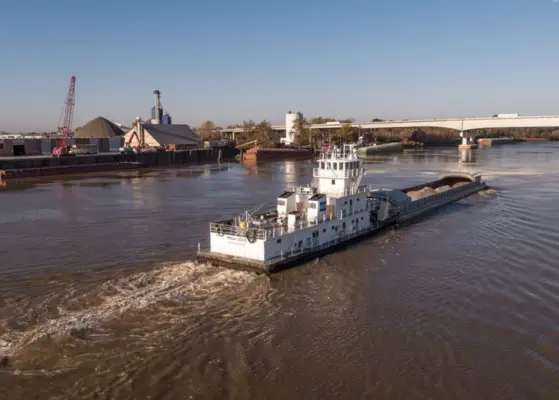
Barge operators are proactively consolidating these improvements by modernizing their fleets. Although barges have always been extremely durable, significant upgrades are being made to towboats. The latest towboat models are equipped with more efficient engines, are outfitted with optimized hull forms, and have digital engine monitoring systems installed, which help in reducing fuel consumption during long hauls.
Leading inland operators are retrofitting towboats with EPA Tier 4 compliant engines to reduce nitrogen oxide and particulate emissions. These upgrades come with a high capital cost, but operators consider them indispensable if they want to stay competitive in a market where environmental compliance is more of a necessity than a differentiator.
Besides that, a few companies are testing hybrid propulsion systems and also using alternative fuels like renewable diesel. Although the use is still quite limited, these efforts are a sign of a long-term transition pathway. Shippers appreciate the value of collaborating with operators who possess fleet strategies that are not only compliant but also forward-looking.
ESG alignment and reporting transparency
The carbon footprint of logistics is increasingly being linked to ESG reporting obligations. Listed manufacturers and commodity producers are being pushed to report Scope 3 emissions, including transport emissions. To address this, inland barge carriers are now providing customers with more detailed emissions information to help them incorporate barge transport into their carbon accounting. Emission intensity information, such as grams per ton-mile, is now being published by inland barge carriers, enabling customers to make objective comparisons between modes of transport. This information is not intended for end-consumers but for procurement, sustainability, and investment professionals who demand evidence. In May 2025, CMA CGM announced the launch of Vietnam's first fully electric container barge, a step to decarbonize transport in Southeast Asia.
Explore the Barge Transportation Market Report for insights on sustainability, fleet upgrades, and inland logistics trends.
Long-term positioning of inland waterways
The environmental advantages of barge transport are unlikely to diminish. They are becoming more relevant as regulatory scrutiny increases and carbon pricing mechanisms expand. Inland waterways offer a distinctive combination of large-scale capacity, high efficiency, and relatively low emissions that is far difficult for other transport modes to replicate for bulk cargo.
By continuing to invest in cleaner towboats, emissions reporting, and operational efficiency, operators are preparing themselves to be the long-term partners of the industrial shippers that navigate the complex sustainability requirements. Thus, for B2B customers, this not only helps their compliance risk reduction, but also their support of the wider environmental goals.
While logistics strategies change, inland barge transportation is increasingly being considered as a viable, low-emission mainstay option for bulk freight movement.











Share