Food Dyes in 2026: From Cost Center to Strategic Lever
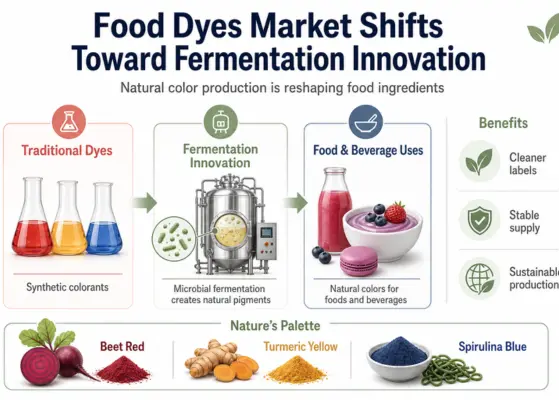
For years, food color was treated as a low-involvement commodity - something fixed at the end of formulation to achieve a target shade at the lowest possible cost. However, in 2026, this approach is changing. Regulatory pressure on petroleum-based dyes, increasing consumer demand for “no artificial colors,” and advancements in precision fermentation and microbial pigment innovations are transforming color into a strategic ingredient class that influences risk, brand positioning, and supply security.
For brand owners, ingredient suppliers, and investors, the key question is no longer whether the color portfolio will be rebuilt, but how quickly and with which technologies.
1. Regulatory Inflection: New Color Claims
Two significant regulatory shifts define the current landscape:
- First, the US FDA's communication in February 2026 regarding “no artificial colors” allows products to make this claim if they avoid petroleum-derived certified color additives, even if they still contain colors sourced from plants, algae, or fermentation. Legal and technical commentaries suggest that the FDA is signaling a more pragmatic enforcement stance, aligning claims with consumer expectations while maintaining scrutiny on safety and manufacturing practices.
- Second, this regulatory change builds on a broader policy trend: the complete ban of titanium dioxide (E171) as a food additive in the EU continues to reshape strategies for whitening and opacity in confectionery, bakery items, and supplements. Initiatives from the HHS and FDA to phase out petroleum-based synthetic dyes from the US food supply have led to public tracking of corporate commitments, putting timelines and reputations at stake for major retailers and consumer packaged goods (CPG) companies. For executives, this means color is now part of the regulatory risk register, rather than merely a technical detail in specifications.
2. Demand Shift: "No Artificial Colors" Gains Popularity
Consumer research reinforces the regulatory narrative. A wave of surveys conducted in 2024–25 by color houses and market analysts reveals that 70–80% of US shoppers consider natural colors important, especially parents of young children, who are particularly wary of synthetic dyes. Market forecasts predict high single- to low double-digit annual growth for natural colors through 2030, outpacing both overall food ingredients and several other "clean label" categories.
Moreover, sustainability and transparency are becoming integral to discussions about color. Industry-backed studies indicate that microbial and fermentation-derived pigments can potentially reduce land, water, and, in some cases, carbon footprints compared to agricultural sources, aligning with corporate environmental, social, and governance (ESG) narratives.
In practical terms, this means color choices now affect:
- Front-of-pack claims and storytelling.
- Retailer acceptance and private-label tender criteria.
- Alignment with corporate commitments to reduce synthetic additives.
3. Technology Landscape: Advancements in Fermentation and Microbial Pigments
On the technology front, three streams are converging to create a more comprehensive alternative toolbox:
- Microbial Pigments 2.0: Recent research highlights the variety of pigments available from bacteria, fungi, and microalgae, including carotenoids, phycobiliproteins, riboflavin, and melanins, alongside co-benefits such as antimicrobial and antioxidant properties. These sources have transitioned from academic interest to industrial applications in beverages, pasta, confectionery, and frozen desserts, although stability and standardization remain challenges.
- Precision Fermentation Platforms: An expanding body of work positions precision fermentation as a “horizontal” platform for food ingredients, placing colors alongside flavors, sweeteners, and bioactives. A 2026 review of synthetic biology for food colorants summarizes how metabolic engineering, AI-assisted pathway design, and improved bioprocessing are yielding higher pigment titers and more robust performance in microbial cell factories.
- Process and Formulation Innovation: New patents filed between 2022 and 2025 demonstrate efforts to address critical bottlenecks. Notably, yeast strains have been engineered with plant betalain genes to produce red-violet pigments like betanin, allowing for fermentation-based production with greater purity than traditional beet extraction. Additionally, processes are being developed to recycle spent microbial biomass as a nutrient source to enhance fermentation economics and sustainability. Microbially produced “pre-dispersed” colorants, where both pigment and biosurfactant are fermentation-derived, are also improving solubility and dispersion in complex food matrices.
Together, these trends indicate that alternatives are not only “natural” but are also increasingly engineered to meet real-world formulation challenges.
4. Market Signals: Who Is Setting the Pace
Several companies demonstrate how rapidly the field is transitioning from research and development to commercial viability:
- Michroma is utilizing CRISPR-edited filamentous fungi to produce heat- and pH-stable red pigments through precision fermentation. Their goal is to replace synthetic red colors in thermally processed products. A 2025 partnership with CJ CheilJedang aims to scale fermented colors globally, and their success in the 2026 Kraft Heinz-backed iFAB biomanufacturing challenge highlights significant interest from established players in the industry.
- Phytolon engineers baker’s yeast to secrete betalain pigments, which provide a variety of reds, pinks, yellows, and oranges at a cost competitive with botanical extracts. In March 2026, the company reached a significant milestone with FDA approval, allowing its fermentation-derived beetroot red to enter the U.S. market across multiple food categories, including products labeled as “no artificial colors”.
- Givaudan and Fermentalg have co-developed Everzure Galdieria Blue, a natural blue colorant produced by fermenting Galdieria sulphuraria and subsequently extracting it with water. With FDA approval in 2025 and positive feedback from the EU in 2026, it is recognized as an acid-stable solution suitable for low-pH beverages and confectionery, where traditional spirulina-based blues may not perform as well.
These developments are not isolated cases; they indicate a broader trend where large color portfolios may move away from petroleum-based dyes toward fermentation-derived “nature-identical” pigments. This shift also suggests stronger collaborations between ingredient suppliers and food brands.
5. Risk, Safety, and Governance
Discussions about engineered microbes and precision fermentation naturally raise questions about safety and regulation. The emerging consensus is both pragmatic and demanding.
A 2026 report from the FAO on precision fermentation and cell-based fats highlights that regulatory evaluations should focus on the final ingredient, including its impurities and intended use, rather than exclusively on the production organism or technology. Peer-reviewed studies on microbial pigments emphasize that while many pigments demonstrate favorable toxicology and functional benefits, each new strain and process requires thorough assessment and robust process controls.
As of 2026, food dyes have reached a critical turning point. What was once a straightforward formulation is now a high-stakes decision influenced by the FDA's shift toward a "no artificial colors" policy, EU restrictions on titanium dioxide, and growing consumer demand for transparency. Companies are under pressure to replace petroleum-based dyes, while precision fermentation platforms, like Michroma's fungal reds, Phytolon's yeast betalains, and Givaudan's Galdieria Blue, offer colors that meet the performance standards of synthetic dyes. This is not just a matter of reformulation; it represents the first significant commercial-scale test of biotech ingredients in the food industry, with far-reaching implications for the future of clean-label products. Brands that successfully navigate this transition in 2026 are poised to lead in ingredient innovation for the next decade.











Share