How Global LPG Supply Chains Support Clean Energy Access?
Liquefied petroleum gas is indispensable for fulfilling the energy requirements of the residential, commercial, and industrial sectors on a global scale. Each LPG cylinder or bulk delivery is only one aspect of a complicated supply chain, which links together the various parties involved, such as producers, transporters, storage facilities, and retailers. These networks make it possible for the LPG to be delivered to homes and businesses in a safe and reliable manner, even in areas that have a very limited energy infrastructure.
With the growth in the demand for cleaner fuels, the LPG supply chains are experiencing changes. There are investments being made in logistics, digital tools, and storage capacity that are not only helping to increase the reliability but also the access to these products in the developing economies. Tracing the path of the LPG from production to the final consumer underlines the reasons why it is still a very feasible energy solution in different market contexts.
From Production Facilities to Export Terminals
LPG is a byproduct of the processing of natural gas and refining of crude oil. After separation, it is kept in pressurized tanks at the production location before being shipped to regional distribution centers or export facilities. The major producing areas serve both local markets and foreign buyers, thus the formation of a global trading network that can balance the demand and supply on a regional basis.
Marine transport is predominant in the movement of LPG across borders. Large volumes are initially transported in specialized ships to importing countries. After that, LPG is offloaded into coastal terminals. These terminals double as focal points of distribution, supplying various inland markets via rail, road, or pipeline. This worldwide circulation enables countries with insufficient production capacity to rely on foreign LPG supplies.
At the same time, production diversification is another factor that stabilizes supply. Thus, importing nations cut back on dependence on a single supplier by bringing in LPG from different parts of the world. Therefore, such a course of action grants them the liberty to handle a situation of geopolitical disturbances or demand fluctuations simply and swiftly.
Storage Infrastructure Ensuring Continuous Availability
Storage facilities are the mainstay of LPG distribution. Big terminals are used to store imported or locally produced LPG prior to its release into domestic supply networks. Such facilities also keep an inventory of buffer stocks, which are used to meet short-term supply interruptions of the market.
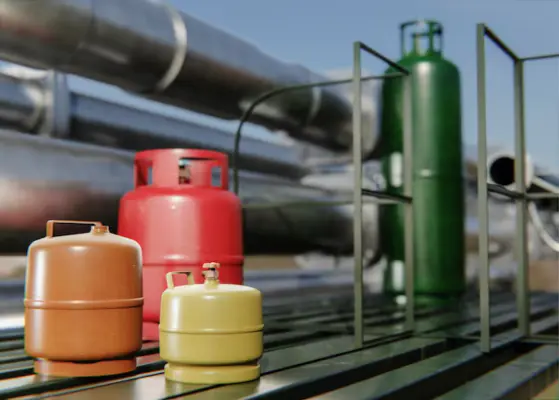
From terminals, LPG is transported to bottling plants for filling the cylinders or for preparing it for bulk delivery. Cylinders are distributed to retailers and customers, whereas bulk LPG is used by industrial and commercial customers. Each point of transition requires an elaborate safety regime and well-thought-out logistics to avoid loss through leaks and to guarantee timely delivery.
Investments to increase storage capacity are quite evident in many developing regions. New terminals and satellite depots also aid in the greater accessibility of LPG to the rural areas. These improvements are beneficial in supporting and growing demand from households and businesses alike.
Logistics Networks Connecting Last-Mile Consumers
Transportation plays a major role in the LPG supply networks. Various modes of transport, including trucks, railcars, and ships, are used to carry LPG over long distances. Local delivery fleets, on the other hand, are the last-mile distributors. Routing optimization and fleet management are very important in order to maintain low costs and high service levels.
Nowadays, digital tools are used to improve the performance of logistics. Vehicle movements can be tracked in real time, delivery routes can be optimized, and very accurate arrival times can be given. Inventory movement can be tracked by cylinder management platforms. Thus, there are fewer losses of cylinders, and asset utilization goes up. Using these technologies, distributors are able to respond to demand changes very quickly and can even manage to reduce delivery delays.
Local distributors are also very important in the process of getting the product to the end consumers. Small retailers and agents link central supply networks to the rest of the world, especially in rural and hard-to-reach urban areas. Their presence makes the market penetration easier and facilitates the achievement of the broader energy access goals.
Explore the Global LPG Market Report for insights on supply trends, infrastructure, and demand projections.
Adapting Supply Chains for Energy Transitions
As energy systems transform, LPG supply chains are changing to fit the new priorities. Environmental regulations call for storage and transport facilities to operate in a more environmentally friendly way. Bio-LPG and other renewable options are starting to be distributed through the existing network, which in turn requires an update in certification and tracking systems.
Supply chain resilience is a matter of concern as well. Firms are looking into different sourcing methods while also finding ways to deepen their relationships with suppliers to be less vulnerable to any supply chain disruptions. Automation and data analytics are great enablers of accurate forecasting and efficient inventory planning. Subsequently, suppliers have an easier time ensuring that their services remain uninterrupted even in the face of demand fluctuations.
In fact, these are essentially the kinds of changes that come along with the general move towards more intelligent energy networks. Suppliers of LPG are starting to pay attention to sustainability metrics just as much as to their operational performance. They therefore make the supply chain practices comply with the climate objectives.
Strengthening the Backbone of Clean Energy Delivery
Globally, LPG supply chains play a crucial role in supporting millions of households and businesses by providing them with reliable fuel through a combination of production, storage, and distribution systems that are deeply interconnected. Owing to their flexibility, LPG can be used even in those places where other energy sources are not available, thus making it a key element for clean energy access in many developing countries.
As the demand for this fuel continues to increase, more investments in infrastructure and digitalization will be the main factors that will help to further reinforce these networks. By increasing efficiency, safety, and transparency, LPG supply chains are transforming themselves to be in line with current energy requirements. Moreover, through this path, LPG can continually serve as a feasible solution that links to cleaner energy, thus enabling the region's economic development while at the same time helping the environment in a variety of places.









Share