How EV Charging Infrastructure Is Powering the Next Phase of Saudi Arabia’s Mobility Market?
As the Kingdom embarks on the implementation of its Vision 2030 objectives, transport electrification has gone from being an aspirational concept to a strategic industrial imperative. Saudi Arabia's government and private sector stakeholders have been stepping up investment in electric vehicle (EV) charging infrastructure in the recent years. This is not aimed merely at catering to early EV adopters, but to develop a sustainable, large-scale ecosystem that enables mass adoption within the next decade. For stakeholders along the value chain, from grid technology companies to real estate developers, this change brings a new level of opportunity.
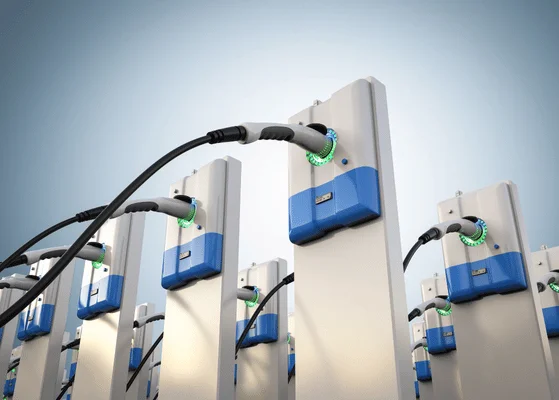
EV charging infrastructure refers to the network of hardware, software, and energy management systems that enable electric vehicles to be charged efficiently and safely. Public fast-charging stations, workplace charging, and private home charging units are all part of it. In a market like Saudi Arabia, where ambient temperatures, grid stability, and consumer driving habits are different from Europe or North America, deployment strategies need localization.
High-Speed Charging Networks Take the Lead
One of the more notable trends in Saudi Arabia's EV ecosystem is the deployment of high-speed DC fast charging along intercity highways and city corridors. The stations are able to charge most EVs, overcoming one of the most prevalent adoption hurdles, which is lengthy recharging times.
Oil and gas companies are reclaiming sections of their fuel retailing network to accommodate ultra-fast charging points. This provides double advantage: saving customer flow to filling stations while future-proofing assets in preparation for an eventual long-term downward trend in petrol demand.
Local energy service companies are also experimenting with solar-powered fast-charging hubs, reducing dependency on grid draw during peak hours. For investors, such hybrid systems not only lower operating costs over time but also align with ESG investment criteria increasingly favored in institutional funding.
Property and Hospitality Sectors Drive Urban Charging Solutions
Urban deployment is taking a slightly different route. In cities like Riyadh and Jeddah, commercial property developers are integrating EV chargers into shopping centers, residential complexes, and hotel car parks.
The hospitality sector, in particular, witnesses EV charging as a competitive amenity for high-value guests, especially as inbound tourism grows ahead of upcoming mega-events. Charging infrastructure in malls and business districts is also proving to be a traffic generator, encouraging visitors to dwell longer on-site, which in turn benefits retailers and food outlets.
Partnership models are emerging where equipment suppliers lease chargers to property owners, sharing both installation risk and long-term revenue. This lowers the entry barrier for smaller developers who want to offer charging facilities without heavy upfront capital expenditure.
Integration with Renewable Energy and Smart Grids
Perhaps the most strategically important trend for B2B players is the link between EV charging and the Kingdom’s renewable energy roadmap. With vast solar projects already under construction, there is growing interest in using surplus renewable generation to power EV charging networks.
Smart grid technologies, including demand response systems, are being trialed to manage charging loads during peak electricity demand. This ensures grid stability while allowing utilities to monetize flexible load capacity.
Some pilot projects are exploring Vehicle-to-Grid (V2G) capabilities, where EVs can feed stored energy back into the grid during high demand periods. If scaled, this could transform EVs from being pure consumers of energy into distributed storage assets, creating new business models for both utilities and fleet operators.
Regulatory Support and Investment Climate
Government policy is clearly inclining towards enabling a robust EV charging network. The Saudi Standards, Metrology and Quality Organization (SASO) has already issued technical specifications for charging connectors, safety standards, and installation practices.
Meanwhile, the Public Investment Fund (PIF) has been investing in both local manufacturing of EVs and the infrastructure to support them, signaling a strong alignment between national industrial policy and sustainable mobility.
For international equipment manufacturers and software providers, the Saudi market offers high purchasing power and a centralized policy environment that can accelerate decision-making compared to fragmented regulatory landscapes elsewhere.
Challenges Create Opportunities for Innovation
Ambient heat remains a technical challenge, particularly for maintaining charger efficiency and battery performance in extreme summer conditions. Grid connectivity in remote areas also requires costly upgrades before chargers can be deployed at scale.
These constraints are encouraging innovation in thermal management systems for chargers, as well as modular, containerized charging units that can be rapidly deployed in temporary or seasonal demand zones. International suppliers with expertise in arid climate engineering, off-grid renewable charging, or integrated payment platforms have a unique entry point into the Saudi market.
For full market insights and forecast data, explore our Saudi Arabia Fuel Stations Market
EV Charging Infrastructure as the Cornerstone of Mobility Transformation
EV charging infrastructure in Saudi Arabia is moving beyond pilot projects and into a commercially viable phase. The interplay between high-speed charging corridors, urban retail integration, renewable energy tie-ins, and strong policy support creates a mature ground for B2B collaboration.
As vehicle electrification scales, the companies that can deliver not just hardware but integrated, locally adapted charging solutions are best positioned to lead in the market. In this evolving market, infrastructure has become the foundation for the Kingdom’s next phase of mobility growth.











Share