40% of Blood Donations Serve 16% of the World’s Population: What World Blood Donor Day 2026 Reveals
Global Blood Supply at a Glance
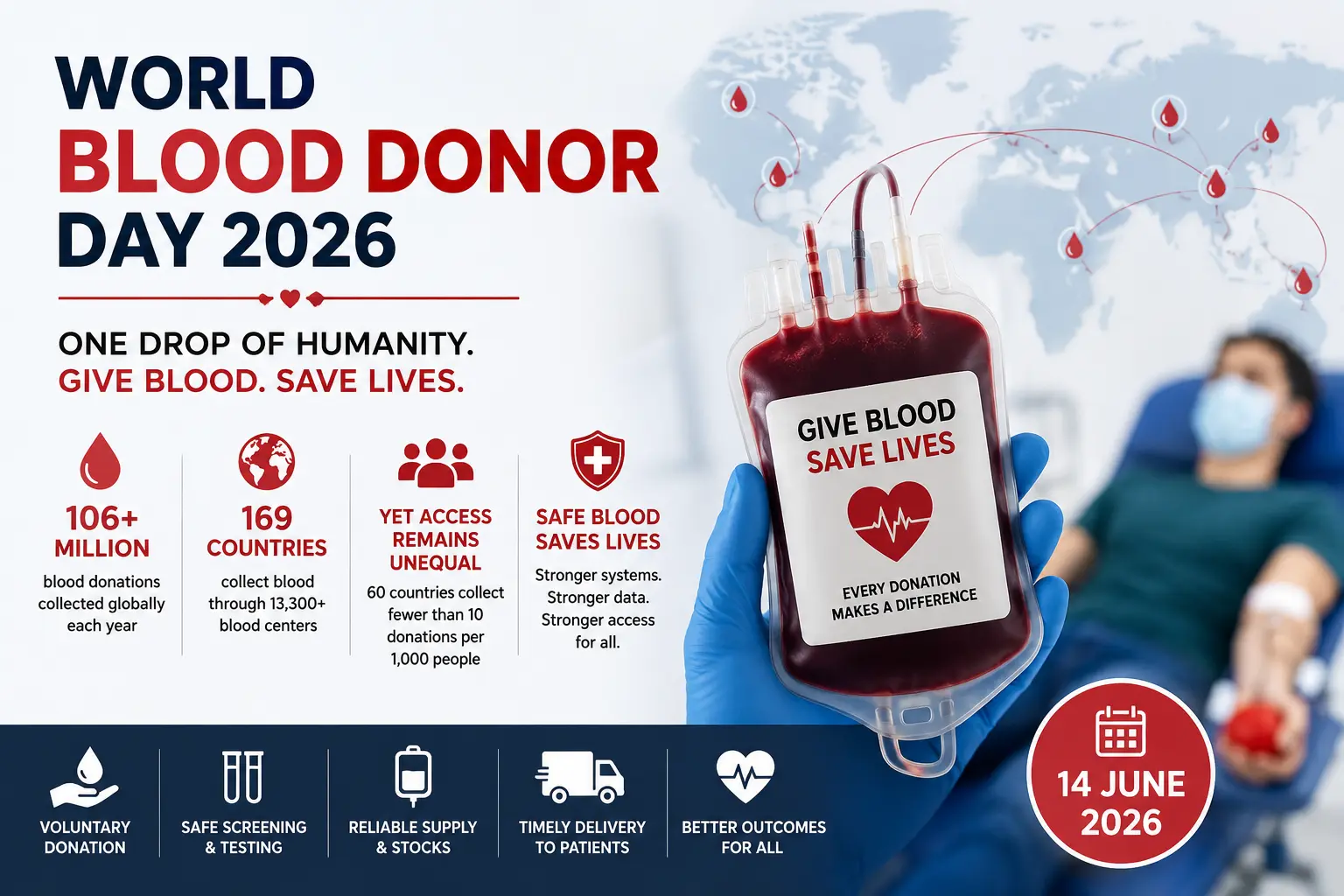
- World Blood Donor Day 2026 is observed on 14 June under WHO’s theme, “One Drop of Humanity. Give Blood. Save Lives.”, placing voluntary donations within a wider conversation on health-system reliability and patient access.
- WHO reports about 106 million blood donations collected through 13,300 blood centers in 169 countries, but access remains uneven across income groups and regions.
- The median blood donation rate is 31.5 per 1,000 people in high-income countries, compared with 6.6 in lower-middle-income countries and 5.0 in low-income countries; 60 countries collect fewer than 10 donations per 1,000 people.
- Donor models remain a major safety and continuity issue: 79 countries collect more than 90% of their blood supply from voluntary unpaid donors, while 54 countries still depend on family, replacement, or paid donors for more than half of supply.
- India’s annual blood collection rose from 12.6 million units in 2023 to 14.6 million units in 2024, with voluntary donation accounting for 74.55% of total collections, showing how public mobilization, policy support, and system coordination can lift supply.
- The evidence points to one practical message: stronger blood systems need more than awareness drives. They require donor retention, screening quality, stock visibility, cold-chain reliability, facility readiness, technology planning, and MERL systems that track whether access improves patient care.
World Blood Donor Day 2026 is observed on 14 June under the theme, “One Drop of Humanity. Give Blood. Save Lives.” The message is simple, but the system behind it is highly complex. Every safe unit of blood moves through a chain of trust that begins with a donor and continues through collection, screening, storage, transport, clinical decision-making, and timely transfusion. When that chain works, one donation can support emergency care, childbirth, cancer treatment, surgery, thalassemia care, trauma response, and severe anemia management. When it fails, the absence of blood can turn treatable conditions into preventable deaths.
This is why World Blood Donor Day matters beyond public awareness. It is a reminder that safe blood is not only a medical product. It is part of the core operating capacity of a health system. Blood services reveal how well a country can mobilize people, protect quality, use data, allocate scarce resources, and reach patients when time is limited. They also expose one of the most persistent divides in global health: the gap between where blood is collected and where clinical need is rising fastest.
WHO’s latest blood safety evidence shows that the global blood supply remains uneven. Around 106 million blood donations are collected through 13,300 blood centers across 169 countries, yet donation rates vary sharply by income group. High-income countries report 31.5 donations per 1,000 people, compared with 16.4 in upper-middle-income countries, 6.6 in lower-middle-income countries, and 5.0 in low-income countries. Sixty countries collect fewer than 10 donations per 1,000 people, a level often used as a basic signal that routine clinical demand may not be met.
The story is not only about volume. It is also about the type of donor, the reliability of supply, the safety of screening, and the ability to move blood to the right facility before a clinical window closes. Seventy-nine countries now collect more than 90% of their blood supply from voluntary unpaid donors, but 54 countries still depend on family, replacement, or paid donors for more than half of their blood supply. That dependence can make supply less predictable and can increase stress on families during medical emergencies.
For healthcare, pharmaceutical, medtech, public health, and development organizations, the lesson is direct: blood access is a high-value signal of system readiness. It shows whether policy, infrastructure, behavioral research, product adoption, digital systems, and monitoring are moving in the same direction. It also shows where evidence can convert public goodwill into lasting patient access.
Why 106 Million Annual Blood Donations Still Do Not Guarantee Equal Access
Blood donation is often discussed as an act of generosity. That is true, but generosity alone cannot sustain a blood system. Blood cannot be manufactured at scale for routine use, and most blood components have limited shelf lives. Platelets expire quickly, red cells must be managed within strict storage periods, and plasma requires reliable freezing and cold-chain capacity. A one-time donor campaign may fill a temporary gap, but the system needs repeat donors, dependable testing, predictable stock visibility, and trained staff across the year.
The uneven global donation rate captures only part of the access gap. In high-income settings, blood services often benefit from centralized planning, stronger donor retention systems, component separation, quality management, and a closer match between tertiary care capacity and blood availability. In lower-resource settings, blood demand is often shaped by emergency obstetrics, severe childhood anemia, trauma, and infectious disease patterns, yet supply may depend on fragmented donation drives and family replacement systems. The result is a mismatch between urgent clinical need and steady access.
WHO data also show that the patient groups most likely to receive transfusion vary by income level. In low-income countries, children under five account for up to 54% of transfusions. In high-income countries, people over 60 account for up to 76% of transfusions. This difference matters because planning cannot rely on a single global model. A blood service supporting pediatric anemia, obstetric emergencies, and road trauma has different demand cycles from a system serving older patients, complex surgery, oncology, and cardiovascular care.
A safe blood system must answer four practical questions every day: who is likely to donate, where will clinical demand arise, what level of screening and storage capacity is available, and how quickly can blood move from inventory to bedside? These questions are operational, but they are also research questions. They require disease burden analysis, donor behavior studies, facility readiness assessment, supply-chain mapping, and routine performance monitoring.
| Indicator |
Recent evidence |
Why it matters |
| Global collection |
About 106 million blood donations are collected through 13,300 blood centers in 169 countries. |
Global scale is large, but availability depends on where donations are collected, processed, stored, and used. |
| Donation rate by income group |
31.5 donations per 1,000 people in high-income countries, 16.4 in upper-middle-income, 6.6 in lower-middle-income, and 5.0 in low-income countries. |
Lower donation rates can limit emergency, surgical, obstetric, oncology, and pediatric care. |
| Low collection countries |
60 countries collect fewer than 10 donations per 1,000 people. |
This points to routine supply risk and the need for stronger donor retention and service planning. |
| Voluntary unpaid donation |
79 countries collect over 90% of their supply from voluntary unpaid donors. |
A stable voluntary donor base supports safer and more predictable supply. |
| Replacement or paid donation dependence |
54 countries collect more than half of their supply from family, replacement, or paid donors. |
This can shift pressure to families and weaken continuity during emergencies. |
Blood Deserts: Where Clinical Need Still Outpaces Supply
Recent work on “blood deserts” has sharpened the global debate. Blood deserts are areas where essential clinical demand for blood cannot be met at the point of care in a timely and affordable way. The term is useful because it moves attention from national totals to patient access. A country may appear close to meeting its total blood requirements, yet individual districts, facilities, or patient groups may still face severe delays.
Research led by global surgery and transfusion experts has estimated an annual shortage of about 102 million blood units across low- and middle-income countries. Every country in sub-Saharan Africa and South Asia is reported to face a deficit. In rural areas, a patient may be several hours away from a stocked blood bank, and the referral pathway may be weak. In emergencies such as postpartum hemorrhage, major trauma, ruptured ectopic pregnancy, severe anemia, or pediatric malaria, that distance can become a survival barrier.
This access problem is not limited to low-income settings. Recent local reporting from India shows how blood supply can tighten even where national collection is improving. In 2026, a major medical university blood bank in Lucknow reported critical shortages of A positive and AB positive blood types after donation camps were disrupted. Bengaluru blood banks reported a sharp post-COVID decline in voluntary donations linked to lower corporate and college camp participation, changing work patterns, health concerns, and donor eligibility issues. These examples underscore how fragile donor pipelines can become when routine mobilization slows down.
The operational lesson is clear: blood access depends on year-round resilience, not only on annual collection of totals. Stock-outs may emerge from low donor turnout, weak camp planning, poor inventory visibility, transport delays, testing bottlenecks, or mismatched component availability. The patient only experiences the final failure: blood was not available when needed.
- National collection totals can hide district-level shortages and facility-level delays.
- Replacement donations can create pressure on families at the exact moment they are managing a medical crisis.
- Corporate and institutional donor bases need active retention because work patterns, eligibility issues, and donor fatigue can quickly reduce turnout.
- Blood deserts require local solutions: decentralized storage, transport planning, donor mapping, referral links, and emergency transfusion protocols.
How Maternal Care, Trauma, Cancer, and Anemia Shape Blood Demand
Blood demand is shaped by disease patterns, care-seeking behavior, and the capacity of facilities to deliver transfusions safely. Maternal health is one of the most urgent examples. Postpartum hemorrhage can become fatal within a short period when blood is unavailable. Trauma care is another major driver, especially where road traffic injuries are rising, and emergency transport systems remain uneven. Severe childhood anemia, inherited blood disorders, cancer treatment, major surgery, burns, and chronic kidney disease also contribute to recurring demand.
The planning challenge is that these drivers do not behave in the same way. Obstetric demand is linked to births, referral systems, and emergency readiness. Trauma demand may spike with road safety patterns, seasonal travel, and incident clusters. Thalassemia and sickle cell disease create regular transfusion needs that require dependable scheduling. Oncology and surgery require component-level planning, including platelets, plasma, and red cells. A system that only counts total units collected may miss the actual mix of components and facilities required.
This is where epidemiology and service data become powerful. Disease burden analysis can estimate where transfusion demand is most likely to grow. Facility assessment can show whether blood banks, component separation units, testing capacity, cold storage, and trained staff are present. Social research can explain why eligible donors do not donate regularly, why some communities distrust blood services, and why awareness campaigns may produce short-term turnout but weak retention. Monitoring, Evaluation, Research, and Learning (MERL) can then track whether interventions are reducing delays, improving equity, and increasing safe supply over time.
A strong blood plan should join three streams of evidence: clinical need, donor behavior, and service readiness. Looking at any one of these in isolation can lead to poor investment choices. A new collection centre may not improve outcomes if testing capacity is weak. A digital inventory tool may not help if transport is unreliable. A donor campaign may underperform if it ignores local beliefs, workplace patterns, gender barriers, or eligibility concerns.
| Demand driver |
Typical blood-system pressure |
Evidence needed for planning |
| Maternal complications |
Rapid access to compatible blood during postpartum hemorrhage and obstetric emergencies. |
Birth volumes, referral time, emergency obstetric readiness, facility stock-outs, and mortality review data. |
| Trauma and emergency care |
Unpredictable spikes in blood use, often requiring fast transport and clear emergency protocols. |
Injury patterns, ambulance/referral data, facility-level demand, response time, and component use. |
| Pediatric anemia |
High pediatric transfusion needs in low-income settings, often linked to malaria, nutrition, and infection burden. |
Anemia prevalence, seasonal disease trends, pediatric admissions, donor availability, and safety screening data. |
| Cancer and surgery |
Higher need for components and advanced testing, especially platelets and plasma. |
Procedure volumes, oncology treatment pathways, component demand, wastage, and laboratory readiness. |
| Inherited blood disorders |
Predictable recurring transfusion needs and long-term patient follow-up. |
Patient registry data, scheduled transfusion demand, chelation needs, and geographic access. |
Recent Blood Supply Data and News Shaping the 2026 Agenda
The 2026 conversation is being shaped by two connected realities: public participation can grow, but service reliability still needs constant work. India offers a useful example. WHO reported that India’s annual blood collection increased from 12.6 million units in 2023 to 14.6 million units in 2024, with voluntary blood donation accounting for 74.55% of total collections. Separate government reporting for 2024-25 put collection at 14,601,147 units against an estimated annual requirement of about 14.6 million units. This signals progress in mobilization, policy attention, and digital reporting.
At the same time, recent state and city-level updates show why national progress cannot be treated as the end point. Haryana approved a 2026-27 plan to modernize blood transfusion services, including mobile collection and transport vans, testing kits, blood bags, expansion of component separation units, and training. The state reported rising collection through the e-RaktKosh digital platform and maintained a network of 154 blood centers. This type of investment reflects a shift from donation awareness to service capacity.
Local shortages reported in certain regions show the opposite side of the same story. Blood systems can suffer when familiar donor channels weaken. Corporate offices and colleges that once supported large camps may generate lower turnout as work patterns change. Donation camp approvals, administrative delays, and donor network disruption can also affect supply. These recent examples make the 2026 theme more practical: humanity must be supported by planning, technology, and feedback loops.
The news also shows that blood access is becoming a measurable performance issue. Governments and hospitals are being asked to show not only how many units are collected, but where the blood is available, how quickly it is issued, how much expires, whether components are separated efficiently, and whether underserved facilities receive timely supply. That shift is important for health programs, CSR work, philanthropic funding, and private-sector partnerships because it creates clearer metrics for impact.
From NAT Testing to Point-of-Care Tools: Innovation in Blood Systems
Technology is changing the way blood systems think about safety, quality, and reach. Screening for transfusion-transmissible infections remains a core requirement. WHO notes that 10 reporting countries are still not able to screen all donated blood for one or more key infections, and quality-assured screening procedures are less consistent in lower-income settings. Basic quality procedures were reported for 99.8% of donations in high-income countries and 99.9% in upper-middle-income countries, compared with 83% in lower-middle-income countries and 76% in low-income countries. This gap shows why equipment alone is not enough. Quality systems, training, reagents, financing, and routine supervision are just as important.
Advanced serology, nucleic acid testing, pathogen-reduction technologies, automated hematology systems, digital donor platforms, and inventory tools all have a role to play. Their value depends on fitness. Technology that works well in a tertiary center may not be suitable for a district facility without stable power, trained staff, reliable procurement, and maintenance support. A digital inventory tool can reduce wastage only if facilities report stock correctly and redistribution routes are practical. A mobile collection unit can expand reach only if donor mapping and appointment systems are strong enough to sustain turnout.
Point-of-care testing and decentralized models are especially relevant to remote areas. Blood deserts have pushed researchers and clinicians to examine approaches such as satellite storage, emergency donor panels, drones, rapid testing, and improved transport links. These options need careful evaluation. Their promise is real, but so are the questions around safety, regulation, affordability, and integration with national blood policy. The best adoption decisions are made when technology assessment is linked to service data and patient outcomes.
For pharmaceutical and medtech companies, the blood ecosystem is also a market access question. Screening assays, consumables, cold-chain equipment, collection bags, component separation systems, pathogen-reduction platforms, software, and diagnostic tools all operate in a market shaped by public tenders, donor funding, hospital budgets, regulation, and clinical protocols. A product may have strong technical value, yet face slow adoption if procurement, training, reimbursement, and service readiness are not understood.
| Technology or capability |
Where it can help |
What must be assessed before adoption |
| Advanced screening assays and NAT |
Improves safety margins and reduces window-period risk for major transfusion-transmissible infections. |
Test volumes, reagent supply, funding, lab infrastructure, maintenance, training, and regulatory requirements. |
| Pathogen-reduction platforms |
Adds a safety layer for selected blood components, especially plasma and platelets. |
Component demand, cost per treated unit, infrastructure, staff skills, and payer acceptance. |
| Digital donor and inventory systems |
Supports donor retention, stock visibility, redistribution, and reduced wastage. |
Data quality, facility reporting habits, interoperability, privacy rules, and field usability. |
| Mobile collection and transport units |
Extends access beyond fixed sites and supports underserved districts. |
Donor mapping, route planning, cold-chain controls, staffing, and camp approval processes. |
| Point-of-care and decentralised testing |
Can support emergency and remote settings where central labs are distant. |
Sensitivity, specificity, confirmatory pathways, regulation, training, and clinical governance. |
From Donation Data to Patient Access: Why Evidence Matters
Blood donation becomes lifesaving only when the system around it performs. Evidence is the difference between a well-intentioned activity and a reliable service. It shows where demand is concentrated, why donors return or drop out, where stock-outs occur, which facilities experience delays, which components expire, and which interventions are producing measurable change. It also helps health leaders avoid the common mistake of treating blood access as a single problem with a single solution.
A useful evidence base should cover the full donor-to-patient pathway. Donor research should examine awareness, trust, motivation, eligibility barriers, gender differences, workplace access, and repeat donation behavior. Health-system assessment should examine collection centers, storage capacity, blood bank distribution, transport, component separation, staffing, reagent supply, quality assurance, and referral links. Market and policy analysis should examine procurement rules, product availability, pricing, donor funding, regulation, and private sector participation. MERL should track whether interventions improve real outcomes, not just activity counts.
The most useful indicators are practical. They include repeat donor rate, donor deferral rate, units collected by site, component separation rate, screening completion rate, stock-out frequency, expiry and wastage rate, average request-to-issue time, emergency release time, facility-level utilization, and the share of supply reaching underserved areas. These measures can turn World Blood Donor Day from a single awareness moment into a year-long improvement cycle.
Data should also be interpreted with care. A rise in total blood collection may look positive, but it does not automatically mean access has improved obstetric emergencies, rural facilities, or patients needing regular transfusion. A low wastage rate may look efficient, but it could also indicate chronic understocking. A successful donor camp may collect many units, but if repeat donation remains low, the system may still be vulnerable. Good analysis reads the numbers alongside the operating reality.
- Map clinical needs by geography, facility level, disease burden, and patient group.
- Measure donor behavior, not just donor turnout, with specific attention to repeat donation.
- Track stock-outs, wastage, request-to-issue time, and redistribution performance.
- Assess technology readiness before investing in new platforms or devices.
- Use MERL to test whether the program is improving access, safety, equity, and patient outcomes.
Moving From Donation Awareness to Measurable Blood Access Gains
World Blood Donor Day 2026 rightly places humanity at the center of blood donation. Every donor carries compassion into the health system. Yet compassion reaches its full value only when the system can protect the donation and deliver it safely. This is where planning becomes a form of public service. Better data can show where facilities need support. Better donor research can improve retention. Better market analysis can guide technology adoption. Better evaluation can separate short-term activity from lasting change.
The next stage of blood system strengthening should focus on three shifts. The first is moving from campaign-led donations to retained donor communities. The second is moving from total collection numbers to facility-level access and component readiness. The third is moving from technology purchase to implementation to fit, with clear evidence on infrastructure, training, costs, maintenance, and patient impact. These shifts are not abstract. They decide whether a trauma patient receives blood in time, whether a mother survives severe bleeding, and whether a child with anemia can be treated before deterioration.
World Blood Donor Day is also a strong moment for healthcare and life-sciences organizations to examine how their work connects with public health delivery. Blood systems sit at the intersection of diagnostics, devices, logistics, hospital care, behavior change, health financing, and public trust. The same evidence disciplines used in healthcare and pharmaceutical consulting can help identify where innovation is needed, where a product can be adopted responsibly, where social barriers affect uptake, and where the program is delivering measurable benefit.
The theme, “One Drop of Humanity. Give Blood. Save Lives.”, is a call to people. The evidence behind it is a call to institutions. Donors make safe blood possible. Strong systems make it available.
How Claight Supports Evidence-Led Blood and Health Access Programs
Call to Action: Turn health-system questions into decisions that improve access. Claight supports evidence-led healthcare, pharma, public health, social and development research through custom consulting, market and policy analysis, primary and secondary research, program evaluation, and MERL support. For work linked to blood systems, diagnostics, transfusion technology, donor behavior, access, or program performance, explore Healthcare and Nutrition Research, Healthcare and Pharmaceuticals, and Consulting and Custom Solutions to build a clearer route from evidence to action.
Safe blood access is one of the clearest tests of health-system performance. It depends on people, but it also depends on evidence, capacity, quality, and accountability. On World Blood Donor Day 2026, the strongest tribute to donors is not only gratitude. It is the commitment to build systems that ensure every donated unit has the best possible chance of reaching the patient who needs it.







Share