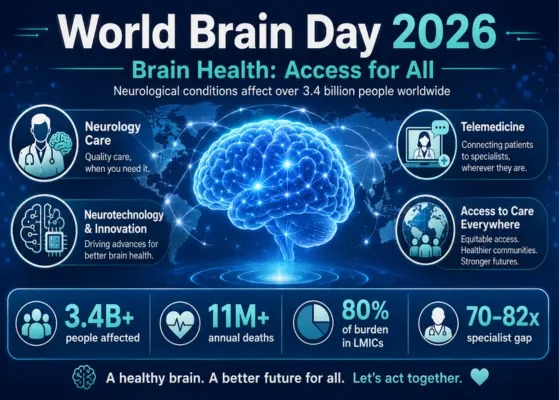
Every year on 22 July, the global neurology community marks World Brain Day. The date marks the anniversary of the World Federation of Neurology's founding in 1957, and the occasion has become the field's annual moment for reflection on progress and priorities.
This year's theme, “Brain Health: Access for All” reads as a public health message, but the data behind it tell a market story. Demand for neurological care continues to rise, innovation in the field continues to accelerate, and yet large parts of the world remain far from the specialists, diagnostics, and treatments that already exist.
This article sets out that gap in detail: the scale of the problem, the pace of innovation addressing it, and where we see the strongest opportunities for organizations working to close it.
The Scale of the Problem: 3.4 Billion People and a Widening Access Gap
Neurological conditions now represent the single leading cause of illness and disability worldwide, ahead of cardiovascular disease and cancer combined when measured across disability-adjusted life years (DALYs). This finding comes from the WHO's Global Status Report on Neurology, published in October 2025 using Global Burden of Disease (GBD) 2021 data. The following figures summarize the scale of the issue.
| Metric |
Figure |
Source |
| People living with a neurological condition (2021) |
Over 3.4 billion (40%+ of world population) |
WHO / GBD 2021 |
| Rise in neurological health loss since 1990 |
18% |
WHO Global Status Report on Neurology |
| Annual deaths linked to neurological conditions |
11+ million |
WHO |
| Share of neurological deaths/health loss in LMICs |
Over 80% |
WHO |
| Neurologist availability gap (high- vs low-income countries) |
70 to 82x more neurologists per 100,000 people |
WHO |
| Countries with a national neurology policy |
32% (63 of 194) |
WHO |
| Countries with dedicated neurology funding |
18% (34 of 194) |
WHO |
Three points stand out from this data. First, neurological disease is a mainstream health issue, not a niche one. More than one in three people worldwide already lives with a condition such as migraine, stroke, or dementia. Second, the burden and the resources to treat it sit in almost inverse proportion: the regions carrying 80% of the health loss hold only a fraction of the world's neurologists. Third, policy has not kept pace with either trend. Fewer than a third of countries report a national policy on neurological disorders, which points to an access and infrastructure challenge that additional treatments alone will not solve.
Condition-by-Condition: Where Neurological Burden Is Rising Fastest
The burden varies considerably by condition, and the pattern is shifting over time.
| Condition |
Share of DALYs / Prevalence |
Trend |
| Stroke |
~42% of neurological DALYs |
Largest single contributor to health loss |
| Migraine |
~1.1 billion cases; ~16% of DALYs |
Affects ~14% of global population annually |
| Tension-type headache |
~2 billion cases |
Most common condition by raw case count |
| Dementia (incl. Alzheimer's) |
~10% of DALYs |
Rising steadily with population ageing |
| Diabetic neuropathy |
206 million cases |
More than tripled since 1990; fastest-growing by prevalence |
| Parkinson's disease |
Case count rising |
Fastest-growing neurodegenerative disorder |
| Epilepsy |
~5% of DALYs |
Persistent treatment gap in LMICs |
Two conditions merit particular attention because their growth is outpacing the R&D attention they receive. Diabetic neuropathy is rising in close step with the global diabetes epidemic, and Parkinson's disease is accelerating as populations age. Both conditions currently attract a smaller share of R&D investment than Alzheimer's or epilepsy. This mismatch between where the burden is growing and where the funding is concentrated is one of the more useful signals for portfolio planning in this sector.
The Prevention Dividend: How Much of This Burden Is Actually Avoidable
A significant share of this burden is preventable through known interventions. WHO modelling points to several specific opportunities:
- Controlling high blood pressure and air pollution exposure could prevent up to 84% of stroke-related DALYs
- Reducing lead exposure could cut the burden of idiopathic intellectual disability by roughly 63%
- Normalizing high fasting plasma glucose could reduce dementia burden by around 15%
This finding carries a direct commercial implication. A meaningful share of future neurological demand originates upstream, in cardiometabolic and environmental health, rather than in neurology itself. This is precisely why blood pressure monitoring, continuous glucose monitoring, and air-quality technology are increasingly marketed with brain-health positioning, and we expect that trend to continue.
Inside the Neurology Pipeline: Where Clinical and R&D Investment Is Concentrated
The innovation pipeline in neurology is active and expanding across multiple therapeutic categories.
Alzheimer's Disease: A Crowded Pipeline Still Waiting on Its Next Approval
As of January 2026, 158 drugs are in 192 active clinical trials for Alzheimer's disease on clinicaltrials.gov, a rise of roughly 40% in trial and drug counts since 2017. Of these, 39% are small-molecule disease-targeting therapies, 34% are biologic disease-targeting therapies, and the remainder address cognitive enhancement or neuropsychiatric symptoms. Industry sponsors 59% of these trials overall, and 72% of Phase 3 trials specifically, which confirms strong commercial backing behind the pipeline. At the same time, the field has recorded no new Alzheimer's drug approvals since 2023, and failure rates across the pipeline remain high. Biomarker-driven trial design is becoming standard practice, which should improve the odds of future approvals over time.
Parkinson's Disease: The Shift from Symptom Management to Disease Modification
Research in Parkinson's disease is moving from symptom management toward disease modification. Gene therapy represents one of the most closely watched approaches: AB-1005, an AAV2-delivered gene therapy carrying the GDNF transgene, is currently in the Phase 2 REGENERATE-PD trial across sites in Germany, Poland, the United Kingdom, and the United States. No approved therapy currently shares its mechanism. Tavapadon, a D1-receptor-targeting therapy designed to improve motor control with fewer side effects than traditional dopaminergic drugs, is expected to reach an FDA decision in 2026. Additional research is targeting inflammation and alpha-synuclein pathology directly, alongside longer-acting, more stable dopaminergic formulations intended to reduce the motor fluctuations that significantly affect quality of life.
Multiple Sclerosis: New Options for a Historically Underserved Subtype
Tolebrutinib, a BTK inhibitor, has shown promise in delaying disability progression in non-relapsing secondary progressive MS, a form of the disease that has historically had limited treatment options.
Neurotechnology and Brain-Computer Interfaces: The Fastest-Moving Frontier
Neurotechnology represents the most structurally new area of innovation in the field. NeuroPace's RNS System, an FDA-approved closed-loop neurostimulation device for epilepsy, has been implanted in over 4,000 patients, with clinical data showing a median seizure reduction of 75% over time. In January 2026, French startup Naox Technologies received FDA 510(k) clearance for an in-ear EEG device designed to capture brain activity in everyday settings, with potential applications in epilepsy, Alzheimer's, and sleep disorders. In March 2026, China's drug regulator approved what was described as the world's first commercially approved brain-computer interface device, intended to restore hand-movement ability. The global neurotechnology market, spanning BCIs, neuromodulation, and related devices, is projected to exceed USD 20 billion by 2028.
Taken together, these developments show an innovation engine that continues to diversify, moving from small molecules and biologics into gene therapy, closed-loop neurostimulation, and consumer-adjacent neurotechnology. The central challenge is not invention. It is delivery: connecting proven technologies with the patients who need them.
Sizing the Opportunity: Neurology Market Growth by Segment and Geography
Capital allocation in this sector tracks the epidemiology, though unevenly, with investment concentrated in categories furthest removed from the access challenge that the WHO and WFN describe.
Alzheimer's disease alone is expected to represent close to a quarter of the total neurology drugs market by 2026, and antiepileptics lead by drug class with roughly 30% share. These figures indicate where clinical trial activity and R&D funding are currently concentrated, and they offer a useful comparison against the DALY data above: Alzheimer's disease attracts a larger share of investment relative to its share of global disease burden, while faster-growing conditions such as diabetic neuropathy attract proportionally less.
Within diagnostics, imaging technologies hold just over half the market by technology type, and hospitals and clinics capture roughly 43% share by end user. This reflects a centralized, specialist-dependent delivery model, which helps explain why diagnostics growth (4 to 9% CAGR) trails therapeutics growth. The more promising signal appears on the software side: roughly 40% of diagnostic manufacturers already integrate AI-based software to improve diagnostic speed and accuracy, and about 45% of healthcare providers report adopting advanced imaging systems specifically to catch neurological disease earlier.
Regional Concentration: Why Market Share and Disease Burden Point in Opposite Directions
North America holds roughly 40% of both the diagnostics and rare-disease therapeutics markets, with Europe a distant second at approximately 32%, and Asia-Pacific at roughly 18%. This distribution mirrors the epidemiological access gap closely: the regions carrying the least disease burden hold the largest market share. The more significant movement is occurring outside these established markets. China is projected to post the fastest CAGR (8.8%) in rare neurological disease treatment through 2035 as its regulatory review capacity for orphan conditions improves, and the Middle East is identified as the fastest-growing region for neurodegenerative disorder therapeutics more broadly.
Five Strategic Takeaways for Neurology, Diagnostics, and Digital Health Leaders
Reading the epidemiology, the pipeline, and the market data together produces several clear implications for strategy.
The addressable market is larger than current revenue suggests. Current market sizing weighs heavily toward North America and high-cost therapeutics. Given that 80% of the disease burden sits in under-resourced regions, this pattern likely understates long-term opportunity rather than overstating it. Access expansion, rather than price, represents the larger growth lever over the next decade.
Diagnostics and neurotechnology offer the more scalable near-term path to access. Training enough neurologists to close a 70 to 80x specialist gap would take decades. AI-assisted diagnostics, closed-loop neurostimulation, in-ear EEG, and remote monitoring scale in ways that specialist headcount cannot. Current adoption data already supports this direction, and regulatory and reimbursement receptivity is likely to move fastest in underserved markets, where existing care models present fewer barriers to change.
Prevention-adjacent categories hold a legitimate claim on brain-health spending. Because so much of the burden, stroke in particular, traces back to modifiable risk factors such as blood pressure and glucose control, companies in cardiometabolic monitoring and environmental health technology sit closer to this opportunity than their current category labels suggest.
Policy engagement now functions as a commercial variable, not simply a compliance requirement. With relatively few countries carrying funded national neurology policies, the WHO's Intersectoral Global Action Plan on Epilepsy and Other Neurological Disorders (IGAP) 2022 to 2031 is likely to shape reimbursement and procurement policy over the coming years. Early engagement with IGAP-aligned governments and NGOs offers a genuine strategic advantage.
The gap between burden growth and R&D concentration deserves close monitoring. Diabetic neuropathy and Parkinson's disease are growing fastest by prevalence, while Alzheimer's disease and epilepsy continue to command the largest share of R&D attention. This mismatch represents useful white space for portfolio and licensing strategy.
The Strategic Bottom Line: Access, Not Innovation, Is the Real Constraint
World Brain Day's 2026 theme presents a fair challenge to the organizations working in this space. Brain science continues to advance rapidly. Gene therapy, closed-loop neurostimulation, AI-assisted diagnostics, and next-generation biologics have all progressed considerably in just the past three years. The remaining gap lies in delivery infrastructure: connecting these advances with the roughly 3.4 billion people who need them, most of whom live in regions with a fraction of the specialists and considerably less policy support than wealthier markets currently enjoy.
The markets that appear most mature today, North American, hospital-centric, imaging-heavy, may not be the markets that generate the strongest growth over the next decade. The markets that appear underserved today may simply be waiting for a delivery model that has yet to be built, rather than reflecting an absence of demand. That distinction defines the opportunity.
Let's Talk Strategy
If your organization is evaluating market entry, R&D prioritization, or investment opportunities in neurology, neurodiagnostics, or brain health technology, we welcome the conversation. Contact our team to discuss how these trends apply to your specific market position and growth strategy and how we can help.








Share