

Consumer Insights
Uncover trends and behaviors shaping consumer choices today
Procurement Insights
Optimize your sourcing strategy with key market data
Industry Stats
Stay ahead with the latest trends and market analysis.
The AI in drug discovery market was valued at USD 2.80 Billion in 2025 and is projected to reach USD 25.25 Billion by 2035, advancing at a CAGR of 24.60%. Demand is driven by the high cost and long timelines of conventional discovery, the maturing of generative chemistry and protein structure prediction, growing pharmaceutical partnerships with computational platform companies, and regulatory interest in credible machine learning evidence for drug development.
Patent activity is dense and widening, with filings concentrated in generative molecule design, protein structure prediction and docking, virtual screening and hit identification, toxicity and pharmacokinetic property prediction, phenotypic screening with image analysis, and target identification and indication expansion from omic and literature data. Validation signals include the 2024 Nobel Prize in Chemistry for protein design and structure prediction, the entry of molecules designed with generative systems into human trials from around 2020, and phase 2a results reported in 2025 for a machine-learning-designed candidate in idiopathic pulmonary fibrosis.
This AI in Drug Discovery Patent Landscape Analysis Report provides a structured assessment of patent filing trends, technology clusters, leading assignees, jurisdictions and company profiles across target identification, molecule design, screening, property prediction and indication expansion.
The AI in drug discovery market is experiencing strong growth, driven by pressure to shorten discovery timelines, advances in generative chemistry and protein structure prediction, and expanding pharmaceutical collaborations with computational platform companies. Molecules designed with generative systems have been in human trials since around 2020, and a candidate for idiopathic pulmonary fibrosis reported phase 2a results in 2025, which shows that computational design has reached clinical testing.
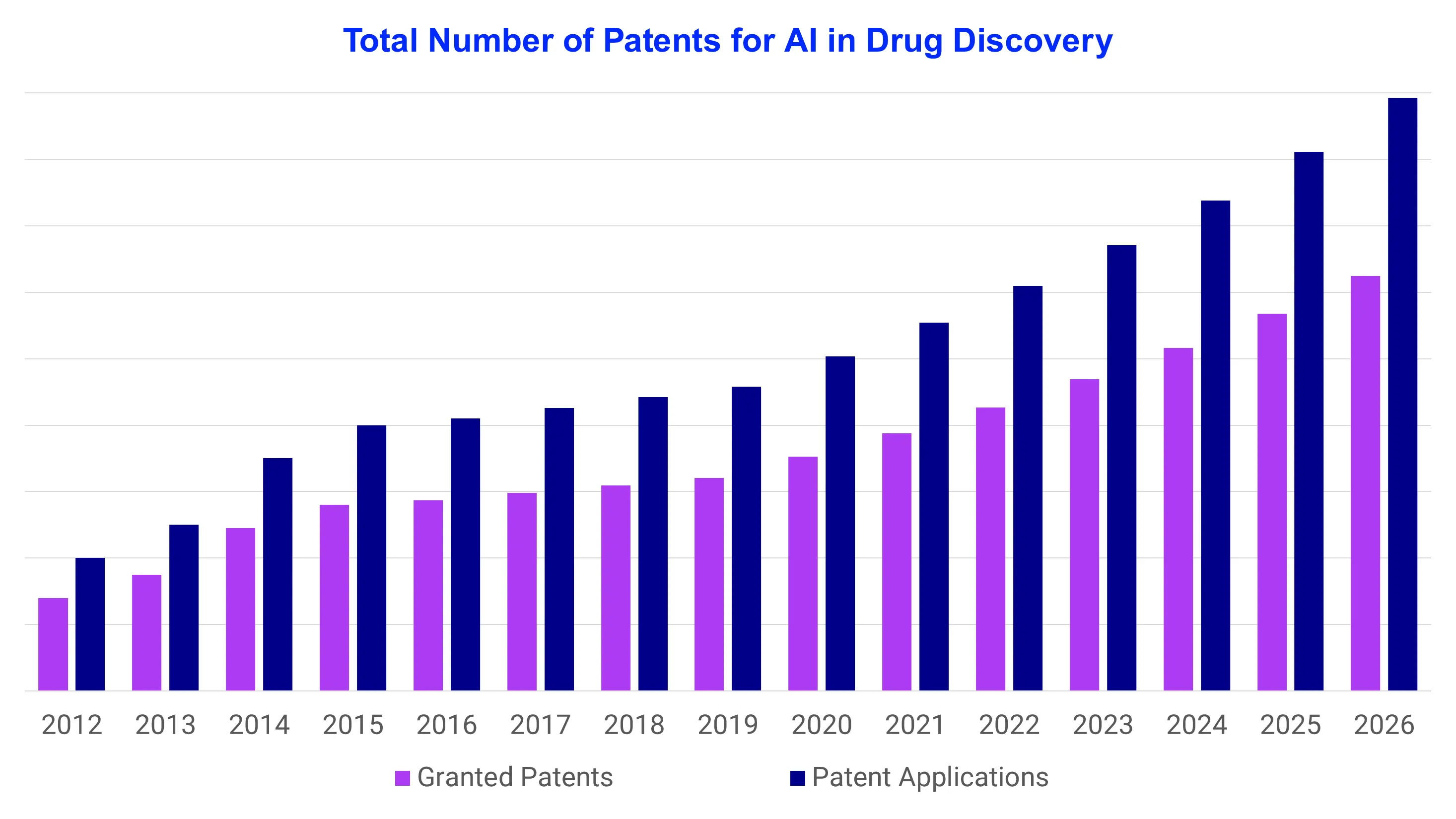
Patent activity is accelerating, with 700+ AI in drug discovery patents granted in 2025, reflecting strong innovation momentum in generative molecule design, protein structure prediction and docking, virtual screening and hit identification, and toxicity and pharmacokinetic property prediction.
Top assignees in the AI in drug discovery patent landscape include Insilico Medicine, Recursion Pharmaceuticals, Schrodinger, Exscientia, and Atomwise, with the United States, China, and Europe as the dominant patent jurisdictions.
Drug discovery remains slow and costly, with a typical programme running for ten to fifteen years and roughly nine in ten candidates that enter clinical testing failing to reach approval. That record has pushed pharmaceutical companies, biotechnology companies and contract research organisations to apply machine learning at the earliest stages, where a better target or a cleaner molecule changes the odds of success downstream. Demand centres on faster hit identification, fewer synthesis cycles in lead optimisation, earlier warning of toxicity and pharmacokinetic problems, and reuse of known compounds in new indications. Buyers include large pharmaceutical groups building internal teams, venture-backed platform companies that keep their own pipelines, and research institutes that release open models. Public structure databases built with tools such as AlphaFold now place predicted structures for hundreds of millions of proteins within reach of every team.
Market growth is driven by the shift of large pharmaceutical groups from pilot collaborations to funded discovery programmes, which turns platform access into recurring licence, milestone and software revenue. Generative systems have supplied molecules for human trials since around 2020, which shows that software-designed compounds can be made and dosed. The 2024 Nobel Prize in Chemistry for protein design and structure prediction raised the scientific standing of the field, and the 2025 phase 2a report for a machine-learning-designed candidate in idiopathic pulmonary fibrosis added an early mid-stage clinical data point. In January 2025 the US Food and Drug Administration issued draft guidance on artificial intelligence for regulatory decision-making on drugs, giving sponsors a credibility framework.
A candidate that reaches the clinic is still far more likely to fail than to succeed, so even a modest gain in the quality of targets and molecules chosen early has a large effect on programme economics, which is why sponsors fund discovery platforms ahead of clinical proof. The AlphaFold database holds predicted structures for more than 200 million proteins, which removes the wait for experimental structures and widens the set of targets open to structure-based design. In January 2024 Isomorphic Labs announced research agreements with Eli Lilly and Novartis, together valued at close to USD 3 billion including milestones, an indication that large sponsors will commit capital to platform access. Regulators are shaping adoption as well, since the European Medicines Agency adopted a reflection paper on artificial intelligence across the medicine lifecycle in 2024, giving sponsors a reference for documenting their models.
Read more about this report - REQUEST FREE SAMPLE COPY IN PDF
Filing intensity has risen in step with venture funding and pharmaceutical partnerships, since platform companies protect models, training workflows and designed molecules before results appear in papers or at conferences. Annual filings in generative molecule design and protein structure prediction have grown fastest since 2020, the year AlphaFold 2 performed strongly at the CASP14 assessment and the first generative-designed molecules entered human trials. Large pharmaceutical groups now file alongside platform companies, mainly on claims that tie a model to a specific target class or assay, which indicates that computational methods are being built into internal discovery programmes rather than bought as one-off services.
The landscape comprises 19,000+ patent families, with filing activity peaking between 2021 and 2024 as machine learning methods moved from academic prototypes into funded discovery platforms. Generative molecule design, protein structure prediction and docking, and virtual screening and hit identification account for the largest share of families. Toxicity and pharmacokinetic property prediction, phenotypic screening with image analysis, and target identification and indication expansion from omic and literature data make up the remainder. Many families combine several of these clusters, for example a generative model coupled to a property predictor that scores each proposed molecule.
Rising pharmaceutical demand for shorter discovery cycles and clinically credible candidates has translated directly into patent expansion, as platform companies and sponsors secure rights to models, training workflows and the molecules they generate.
This report covers patent families filed in the United States, China, Europe, Japan, South Korea, India and through WIPO, and follows the global market for computational methods applied across the drug discovery workflow. Market coverage includes platform and software licensing, discovery services, the internal pipelines of platform companies and collaboration agreements with pharmaceutical groups. Regional commentary draws out differences in examination practice for machine learning inventions and in the concentration of platform companies in North America, Europe and Asia.
Technology coverage runs across the discovery stage, from target identification and validation, hit identification and virtual screening, lead optimisation and de novo molecule design to toxicity and pharmacokinetic prediction and drug repurposing and indication expansion. Drug modalities include small molecules, antibodies and biologics, peptides and nucleic acid therapeutics. Technique coverage includes generative models, graph neural networks, protein structure prediction models, reinforcement learning, and large language and foundation models trained on sequence, chemistry and literature data. Claims on training data curation, model architectures, scoring functions and experimental feedback loops are included alongside claims on the resulting molecules.
Entities include pharmaceutical companies with internal machine learning groups, biotechnology companies built around computational platforms, specialist software vendors in physics-based and data-driven design, contract research organisations offering computational services, and technology platform providers supplying models and computing infrastructure. Start-ups with generative chemistry or phenotypic screening platforms are covered, as are academic and research institutes that file on structure prediction and molecular representation methods. Insilico Medicine, Recursion Pharmaceuticals, Schrodinger, Exscientia and Atomwise represent the platform-company group within this set.
The report will cover the following sections in detail:
Analysis by Discovery Stage
Analysis by Drug Modality
Analysis by AI Technique
AI in Drug Discovery Patent Filing Trend Analysis
Filing volumes rose steadily through the early 2010s, when deep learning first appeared in docking and property prediction, and then accelerated as generative models and graph neural networks became practical for molecule design. Applications publish about eighteen months after filing, so the most recent years are partly incomplete and the grant count for 2024 gives a cleaner read of examined activity. Granted patents concentrate on methods for generating and scoring molecules rather than on individual compounds.
Annual filings grew by an estimated 20 percent a year over 2020 to 2024 (approximate), supported by the release of AlphaFold 2 and its open database, falling cloud computing costs, the first human trials of generative-designed molecules and a steady rise in pharmaceutical collaboration agreements. Growth was strongest in generative molecule design and in protein structure prediction and docking. Toxicity and pharmacokinetic prediction grew more slowly because sponsors had worked on those models for longer.
Among the players with AI in drug discovery patent families, new entrants have been identified, which can be either established companies or startups developing novel technology in the field. Some of the major companies mentioned in this report (a non-exhaustive list) are as follows:
Insilico Medicine holds a portfolio that spans generative chemistry, target discovery and biological ageing models, with filings on molecule generation, scoring methods and the workflows that connect them. Its PandaOmics target discovery platform and Chemistry42 generative design engine are used internally and licensed to pharmaceutical partners. The company's lead candidate, rentosertib (ISM001-055), a TNIK inhibitor for idiopathic pulmonary fibrosis, reported phase 2a results in 2025, and no Insilico Medicine candidate had received marketing approval by that point. Its IP approach pairs composition-of-matter protection on candidate molecules with method and system claims on the platform, filed in several jurisdictions. Commercially, it is one of the few platform companies that combine a software offering with an internal clinical pipeline.
Recursion Pharmaceuticals, based in Salt Lake City, builds its portfolio around the Recursion OS platform, which links automated high-content cellular imaging, phenomic maps and machine learning models to identify targets and compounds. Its filings cover image-based screening methods, representation learning on cell morphology, and chemistry prediction tools added through the acquisitions of Cyclica and Valence Labs in 2023 and the combination with Exscientia in late 2024. The company runs oncology and rare disease programmes in clinical development and holds collaborations with large pharmaceutical groups, including Roche and Genentech, while none of its candidates had been approved for marketing by 2025. Its IP strategy combines claims on platform methods with protection of individual molecules and targets. Within the landscape it is positioned as a data-intensive platform company with one of the largest proprietary phenotypic image collections.
Other companies include Schrodinger, Exscientia, and Atomwise.
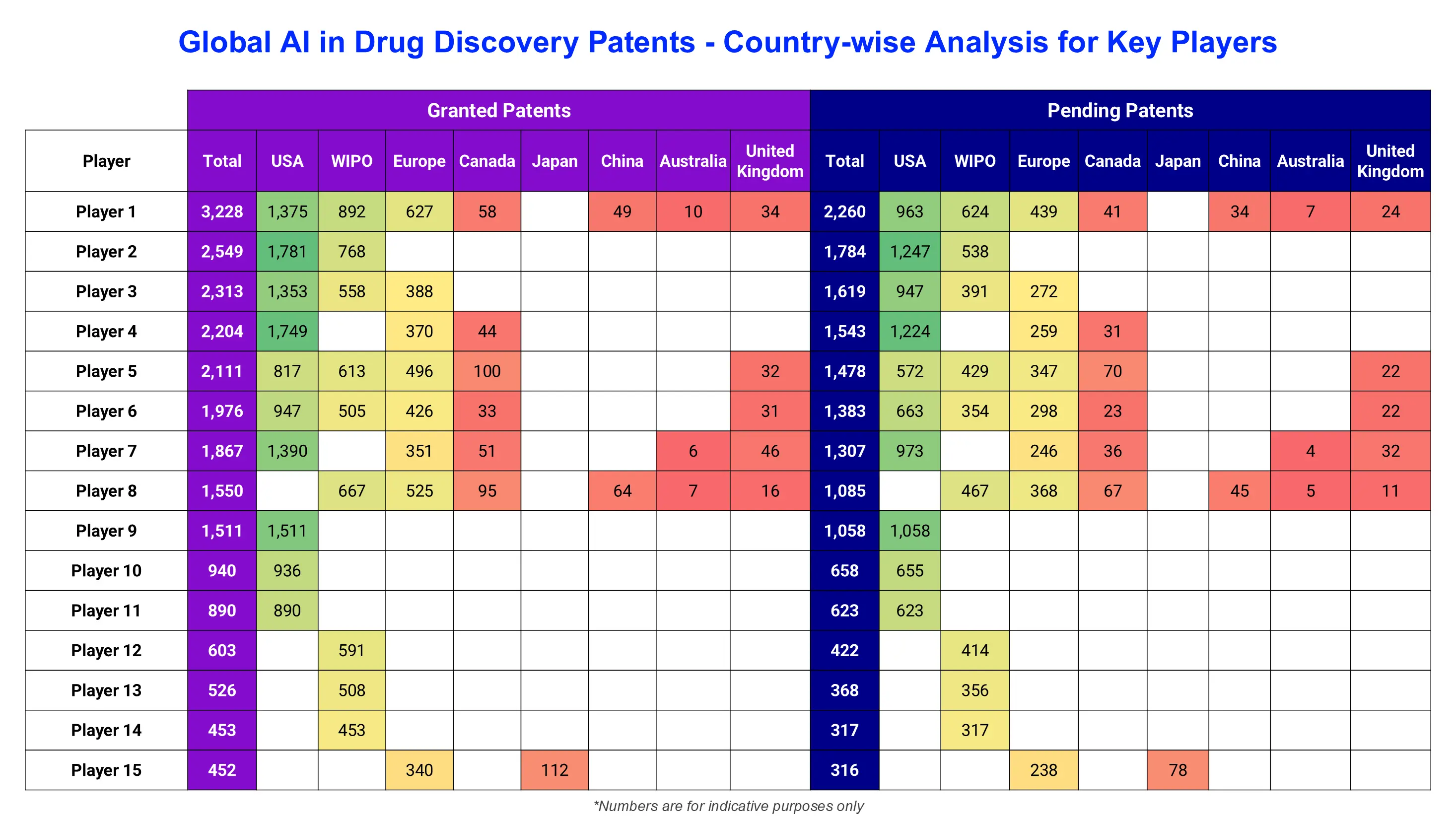
Leading assignees are a mix of platform companies and software vendors. Insilico Medicine and Recursion Pharmaceuticals hold broad portfolios spanning platform methods and candidate molecules, while Schrodinger files mainly on physics-based simulation and free-energy methods combined with machine learning. Exscientia's applications cover automated design cycles and molecule optimisation and now sit within the Recursion group following the late 2024 combination. Atomwise concentrates on neural-network scoring for structure-based screening. The top five groups hold a modest share of all families, because large pharmaceutical companies, technology groups and universities file widely across the clusters, so the field stays fragmented rather than dominated by a single holder.
*Please note that this is only a partial list; the complete list of key players is available in the full report. Additionally, the list of key players can be customized to better suit your needs.*
The report assesses patent activity across major jurisdictions, including:
The United States leads on filings and grants, supported by the venture-funded platform companies of Boston, San Francisco and Salt Lake City and by examination practice that accepts method claims tied to a technical effect. China is the second large jurisdiction, with filing from universities and platform companies in generative design and structure prediction, in line with national support for computational biology. Europe is led by the European Patent Office, where machine learning claims must show a technical purpose, which shapes drafting toward specific molecular or experimental applications. South Korea and India add smaller but growing counts from pharmaceutical and software groups, and WIPO filings through the Patent Cooperation Treaty route show where applicants expect to seek multi-country protection.
Read more about this report - REQUEST FREE SAMPLE COPY IN PDF
Patent activity divides into five technology segments:
Generative molecule design leads patent activity, since claims on model architectures, conditioning on target properties and scoring of proposed molecules apply to every discovery stage and every drug modality. Applicants file on both the model and the molecules it produces, so a single platform often yields several families. Protein structure prediction and docking follows closely, because the open release of AlphaFold 2 lowered the barrier to structure-based filings and docking claims now routinely build on predicted structures.
Competition spans venture-funded platform companies, software vendors, large pharmaceutical groups and technology firms. Insilico Medicine, Recursion Pharmaceuticals, Schrodinger, Exscientia and Atomwise anchor the first group, while Isomorphic Labs, part of Alphabet, represents the technology-firm entrant. Pharmaceutical groups such as Eli Lilly, Novartis, Sanofi and Roche build internal capability and also sign platform agreements. Differentiation rests on proprietary experimental data, since a model trained on in-house assays or phenotypic images is harder to copy than a published architecture, which explains why companies pair software with laboratory automation and clinical pipelines.
Companies are focusing on:
Emerging themes include large language and foundation models trained jointly on sequences, structures and chemistry, and reinforcement learning that rewards synthesisability and selectivity. Closed-loop laboratories, where robots execute designs and return results to the model, are attracting claims on scheduling and data capture. Generative design is extending from small molecules to antibodies, peptides and nucleic acid therapeutics, widening the addressable set of targets. Applicants are also filing on privacy-preserving training across pharmaceutical data holders and on methods that document model credibility for regulatory submissions, following the FDA draft guidance of January 2025.
The landscape shows a field in which software claims and laboratory claims are increasingly filed together. Platform companies hold the broadest portfolios, pharmaceutical groups add claims on specific targets and assays, and universities contribute methods in structure prediction and molecular representation. With 19,000+ families and 700+ patents granted in 2025, the record is large enough to benchmark applicants meaningfully, yet no single holder controls a core method, which leaves room for new entrants with distinctive data.
The landscape provides actionable intelligence for the nine uses listed below:
Patent research covered the databases of the United States Patent and Trademark Office, the China National Intellectual Property Administration, the European Patent Office, the Japan Patent Office, the Korean Intellectual Property Office, the Indian Patent Office and WIPO. Searches combined keywords with Cooperative Patent Classification codes, including classes under G16C and G16B, for machine learning applied to target identification, molecule generation, docking, property prediction and phenotypic screening.
Records were screened to remove duplicate family members, filings that mention machine learning only in passing and filings with no relevance to drug discovery. The remaining families were classified by discovery stage, drug modality, technique, assignee, jurisdiction, filing year and technology cluster, and legal status was checked to separate granted patents from pending applications. Family-level grouping was used so that the same invention filed in several jurisdictions is counted once in the family totals.
Patent counts were read alongside company disclosures, regulatory publications, clinical trial registries and partnership announcements to relate filing activity to commercial demand. Market size, growth and segment estimates were developed from these inputs and compared with known platform revenues and collaboration values, so that the patent and market views stay consistent. Where company disclosures were incomplete, estimates were stated as approximate and cross-checked against several independent public sources.


Upto 15% Off
USD
$2699 $2429
$4299 $3869
$5799 $4949
$6999 $5949


*While we strive to always give you current and accurate information, the numbers depicted on the website are indicative and may differ from the actual numbers in the main report. At Expert Market Research, we aim to bring you the latest insights and trends in the market. Using our analyses and forecasts, stakeholders can understand the market dynamics, navigate challenges, and capitalize on opportunities to make data-driven strategic decisions.*
EMR's AI in Drug Discovery Patent Landscape Analysis provides a comprehensive assessment of patent filings, innovation clusters, assignee portfolios, and geographic filing patterns across the AI in drug discovery landscape. The report identifies 19,000+ patent families, evaluates leading jurisdictions including the United States, China, and Europe, and profiles the top assignees by portfolio size.
The global AI in drug discovery market was valued at USD 2.80 Billion in 2025. The market is projected to reach USD 25.25 Billion by 2035, expanding at a CAGR of 24.60% during 2026 - 2035.
The report analyses approximately 19,000+ patent families related to AI in drug discovery. These include filings from the United States, China, Europe, and international WIPO filings.
Key companies operating within the landscape include Insilico Medicine, Recursion Pharmaceuticals, Schrodinger, Exscientia, and Atomwise, among others. These organisations collectively account for a significant portion of patent activity analysed in this report.
The report evaluates patent activity across the United States, Europe, China, Japan, South Korea, India, and international WIPO filings. The United States is the largest single jurisdiction in the AI in drug discovery patent landscape, with 7,600+ patents associated with it.
Yes. The report scope can be customised based on geography, technology segment, assignee selection, time period, or specific innovation cluster focus. The EMR team can be contacted through the report page to scope a customised study, such as a focused view of one discovery stage, drug modality, technique, assignee portfolio or jurisdiction.
Patent landscape analysis helps organisations understand innovation trends, competitive activity, technology whitespace, and IP risk across a defined domain. For AI in drug discovery, this report supports strategic decisions in R&D prioritisation, licensing evaluation, competitive benchmarking, and market entry planning.
Explore our key highlights of the report and gain a concise overview of key findings, trends, and actionable insights that will empower your strategic decisions.
|
Scope of the Report |
Details |
|
Analysis by Discovery Stage |
|
|
Analysis by Drug Modality |
|
|
Analysis by AI Technique |
|
|
Analysis by End User |
|
|
Key Players Mentioned |
|
|
Geographies Covered |
|
Mini Report
One User
USD 2,699
USD 2,429
tax inclusive*
Single User License
One User
USD 4,299
USD 3,869
tax inclusive*
Five User License
Five User
USD 5,799
USD 4,949
tax inclusive*
Corporate License
Unlimited Users
USD 6,999
USD 5,949
tax inclusive*
*Please note that the prices mentioned below are starting prices for each bundle type. Kindly contact our team for further details.*
Flash Bundle
Small Business Bundle
Growth Bundle
Enterprise Bundle
*Please note that the prices mentioned below are starting prices for each bundle type. Kindly contact our team for further details.*
Flash Bundle
Number of Reports: 3
20%
tax inclusive*
Small Business Bundle
Number of Reports: 5
25%
tax inclusive*
Growth Bundle
Number of Reports: 8
30%
tax inclusive*
Enterprise Bundle
Number of Reports: 10
35%
tax inclusive*
How To Order

Select License Type
Choose the right license for your needs and access rights.

Click on ‘Buy Now’
Add the report to your cart with one click and proceed to register.

Select Mode of Payment
Choose a payment option for a secure checkout. You will be redirected accordingly.
Strategic Solutions for Informed Decision-Making
Gain insights to stay ahead and seize opportunities.

Get insights & trends for a competitive edge.

Track prices with detailed trend reports.

Analyse trade data for supply chain insights.

Leverage cost reports for smart savings

Enhance supply chain with partnerships.

Connect For More Information
Our expert team of analysts will offer full support and resolve any queries regarding the report, before and after the purchase.
Our expert team of analysts will offer full support and resolve any queries regarding the report, before and after the purchase.
We employ meticulous research methods, blending advanced analytics and expert insights to deliver accurate, actionable industry intelligence, staying ahead of competitors.
Our skilled analysts offer unparalleled competitive advantage with detailed insights on current and emerging markets, ensuring your strategic edge.
We offer an in-depth yet simplified presentation of industry insights and analysis to meet your specific requirements effectively.




