

Consumer Insights
Uncover trends and behaviors shaping consumer choices today
Procurement Insights
Optimize your sourcing strategy with key market data
Industry Stats
Stay ahead with the latest trends and market analysis.
The women's health wearables and femtech devices market was valued at USD 41.25 Billion in 2025 and is projected to reach USD 188.67 Billion by 2035, growing at a CAGR of 16.42%. Growth is supported by continuous skin temperature sensing, digital contraception, perimenopause tracking and wearable maternal care.
Patent activity spans more than 6,870 families, with filings concentrated in temperature-based cycle prediction, fertility algorithms, wearable breast pumps and pregnancy monitoring. An FDA clearance for a digital contraceptive in March 2025 and the April 2025 acquisition of Elvie by Willow show regulatory and commercial consolidation.
This Women's Health Wearables and Femtech Devices Patent Landscape Analysis Report maps assignee portfolios, jurisdictional activity, technology clusters and white spaces to support R&D, licensing and freedom-to-operate decisions.
The women's health wearables and femtech devices market is experiencing strong growth, driven by continuous skin temperature sensing for cycle and fertility tracking, rising demand for perimenopause and menopause monitoring, and expanding pregnancy and postpartum self-monitoring. Natural Cycles received a Special 510(k) clearance from the FDA on 21 March 2025 for its contraceptive application, and in October 2025 it launched an overnight wristband that replaces the manual morning thermometer reading.
Patent activity is accelerating, with 1,020+ women's health wearables and femtech devices patents granted in 2025, reflecting strong innovation momentum in skin temperature algorithms for ovulation and cycle phase estimation, wearable breast pump hardware and milk-volume sensing, wrist and ring sensing of pregnancy and postpartum physiology, and pelvic floor biofeedback trainers with motion sensors.
Top assignees in the women's health wearables and femtech devices patent landscape include Samsung Electronics, Apple, Google, Oura Health, and Willow Innovations, with the United States, China, and Europe as the dominant patent jurisdictions.
Women's health wearables and femtech devices cover rings, wristbands, patches, breast pumps and pelvic trainers that collect physiological signals linked to the menstrual cycle, fertility, pregnancy, lactation, menopause and pelvic health. Consumers drive demand directly, since most products are bought online and paired with a smartphone application. Clinical use is growing as obstetric and fertility teams accept wearable data in care pathways.
The market growth is driven by the spread of overnight skin temperature sensing in rings and watches, which gives cycle and fertility applications daily data without a manual thermometer. WHO reported in 2023 that about one in six people of reproductive age experience infertility, a base of potential users for fertility tracking.
WHO estimates 13.4 million preterm births in 2020, which keeps maternal and fetal monitoring a priority for health systems and supports clinical interest in wearable pregnancy tools. The agency also projects 1.2 billion menopausal or postmenopausal women by 2030, a population now targeted by menopause scoring features from consumer wearable makers. Oura reported more than 5.5 million rings sold by October 2025, which shows that consumer sensor hardware reaches large audiences quickly and gives women's health features a ready installed base. The market page used covers the wider femtech category, so wearable sensing is one of several revenue pools.
Read more about this report - REQUEST FREE SAMPLE COPY IN PDF
Women's health wearables and femtech devices attract filings from consumer electronics groups, specialist femtech companies and academic laboratories. Each group files for a different layer: electronics groups cover sensors and signal processing, specialists cover algorithms and product form, and universities cover biomarkers.
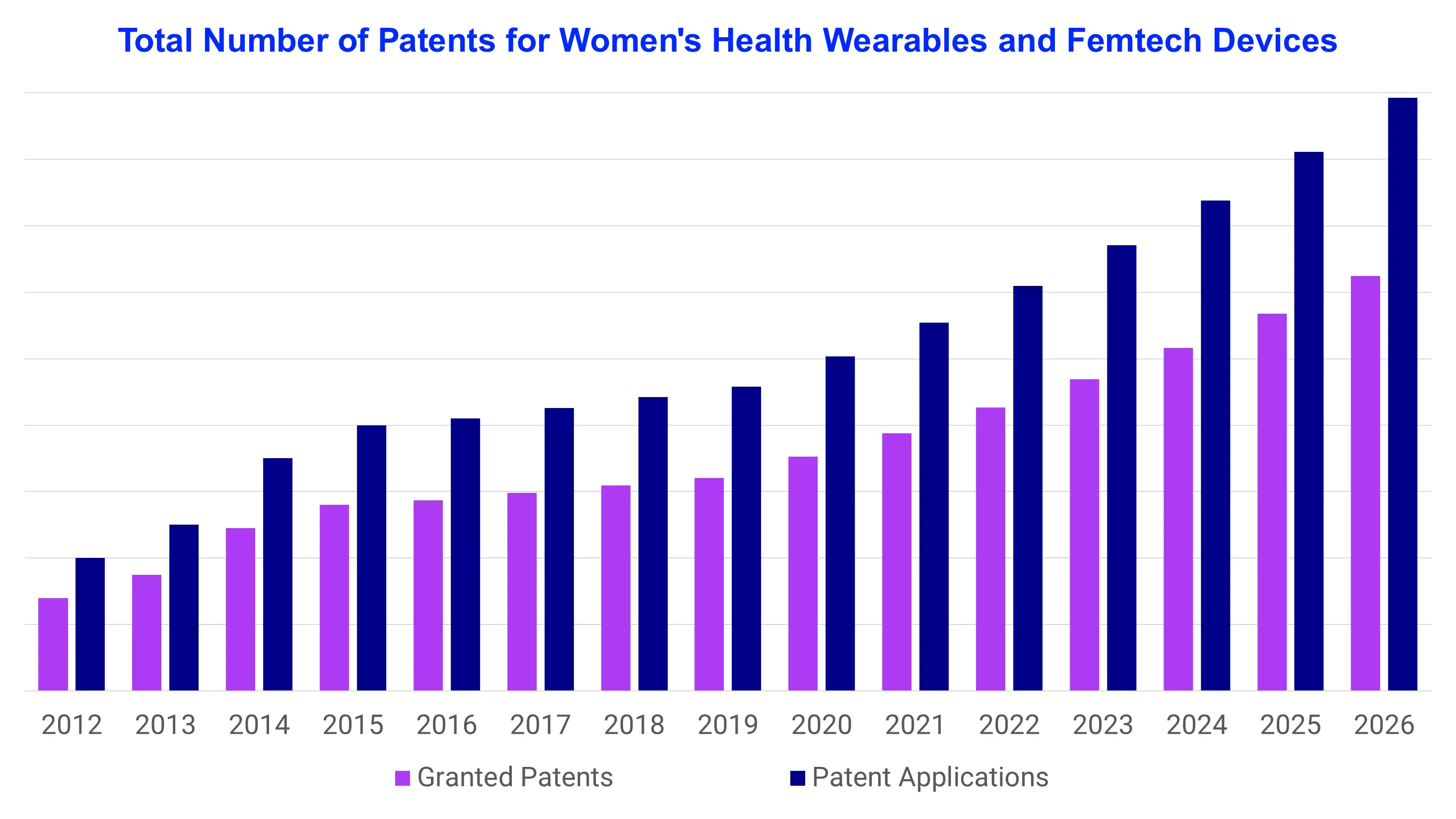
The dataset contains more than 6,870 patent families, with filing peaks in 2022 and 2023 after skin temperature sensors reached mainstream smartwatches and rings. Applications on pregnancy, perimenopause and hormone biosensing form the fastest growing share of recent filings.
Rising consumer adoption of cycle, fertility and pregnancy features has pushed assignees to protect sensing methods, algorithms and product forms in parallel.
The report covers granted patents and published applications for wearable and body-worn devices that monitor or support menstrual health, fertility and contraception, pregnancy and postpartum care, lactation, menopause and pelvic health. Included technologies cover temperature, heart rate, bioimpedance, pressure and biochemical sensing, together with the algorithms that convert signals into cycle phase, fertile window or symptom scores.
The scope centres on worn hardware for women's health, and in vitro fertilisation laboratory equipment, stand-alone mobile applications and drug therapies for gynaecological conditions sit at its edge. Hardware families are tracked together with their companion algorithms where both appear in the same family.
Assignees reviewed include consumer electronics companies, ring and wristband makers, breast pump and pelvic health specialists, medical device groups, hospitals and universities.
The report will cover the following sections in detail:
Analysis by Device
Analysis by Application
Analysis by Sensing Modality
Women's Health Wearables and Femtech Devices Patent Filing Trend Analysis
Filings in women's health wearables and femtech devices grew at an estimated 14% per year during 2020 to 2024. The main driver was the move of skin temperature sensing from clinical thermometers to rings and wrist devices, which opened cycle prediction and fertility claims to consumer hardware makers.
A second wave of filings followed from 2023, tied to pregnancy insights, perimenopause scoring and wearable breast pumps. Grants reached about 1,020 in 2025, and approvals from the FDA for digital contraception and hypertension alerts in 2025 encouraged continuation filings that extend claims into adjacent use cases.
Among the players with women's health wearables and femtech devices patent families, new entrants have been identified, which can be either established companies or startups developing novel technology in the field. Some of the major companies mentioned in this report (a non-exhaustive list) are as follows:
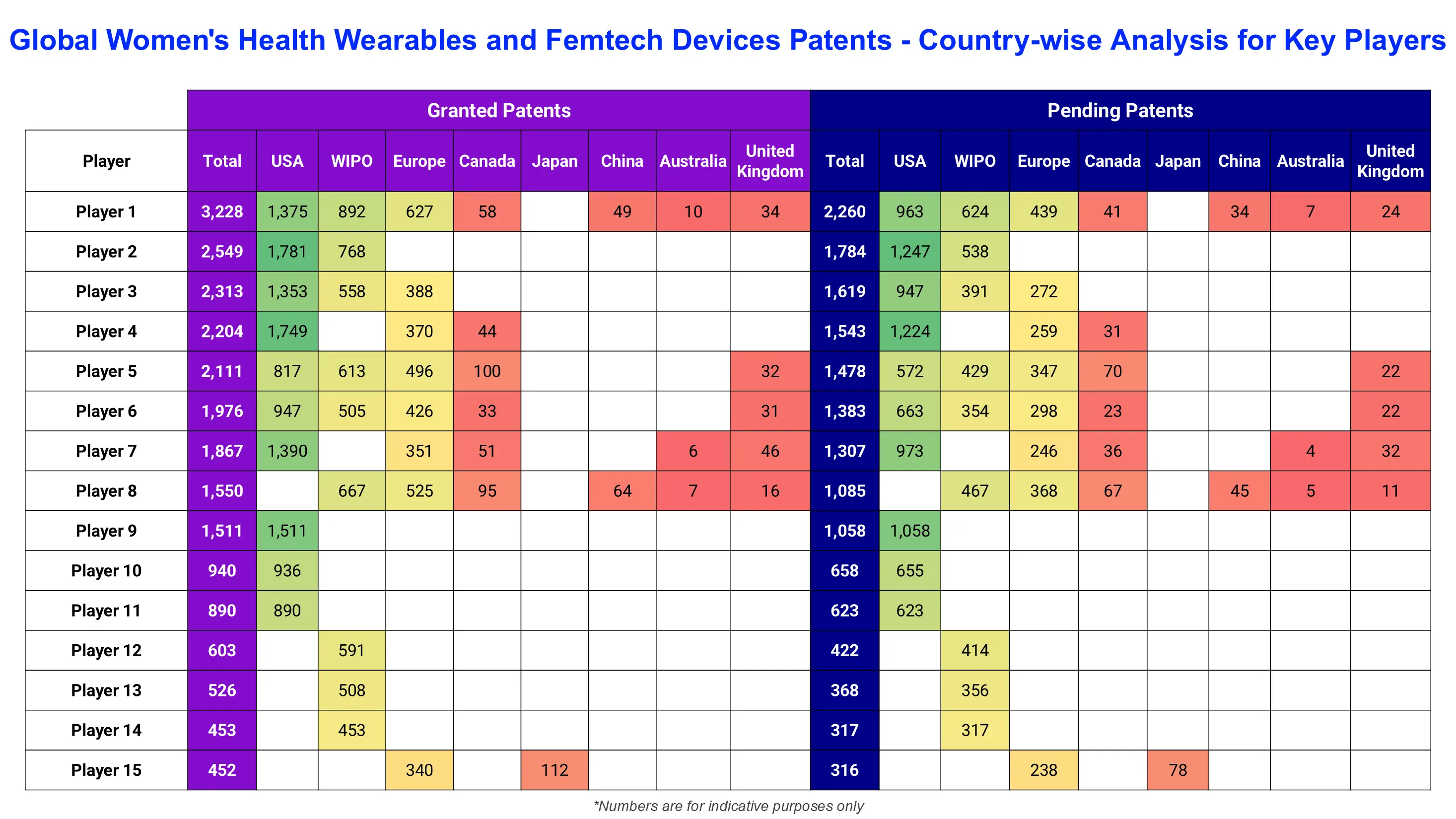
Samsung Electronics holds the largest women's health wearable portfolio in the dataset, built on sensor, algorithm and smartwatch hardware families that serve many health functions. Skin temperature based cycle tracking reached the Galaxy Watch5 series in 2022 and was extended to more countries in the following year through the Samsung Health application. The Galaxy Ring, launched in July 2024, added a second form factor for overnight temperature and heart rate capture. Filings are strongest in South Korea, the United States and China, with family-level coverage in Europe. Samsung treats cycle tracking as a feature of its broader health ecosystem, so claims cover sensing hardware, signal processing and on-device software together.
Apple holds the second-largest portfolio, with claims on wrist temperature sensing, cycle deviation analysis and pregnancy-related heart rate and sleep interpretation. Apple Watch Series 8 introduced a wrist temperature sensor in 2022 and supports retrospective ovulation estimates inside the Cycle Tracking feature of the Health app. The Apple Women's Health Study, begun in 2019 with Harvard T.H. Chan School of Public Health and the National Institute of Environmental Health Sciences, supplies a large longitudinal dataset for algorithm development. The FDA cleared the hypertension notification feature in September 2025, which extends the same sensor and algorithm claims into pregnancy-adjacent cardiovascular alerts. Apple files mainly in the United States, then China and Europe, and keeps its sensing and algorithm claims tied to its own platform.
Other companies include Google, Oura Health, and Willow Innovations.
The five leading assignees hold roughly a third of all families, with Samsung Electronics and Apple together near one fifth because of their broad sensor and algorithm coverage. Specialists such as Oura Health and Willow Innovations hold smaller counts but file densely around a single product form.
*Please note that this is only a partial list; the complete list of key players is available in the full report. Additionally, the list of key players can be customized to better suit your needs.*
The report assesses patent activity across major jurisdictions, including:
The United States leads filing volume at about 2,780 patents, supported by the FDA clearance route for contraceptive algorithms and the home of most platform owners. China follows with a high count of utility-model and device patents from electronics makers. Europe ranks third, with activity centred on Sweden, Germany, the United Kingdom and Switzerland, where several fertility and pump companies are based.
Read more about this report - REQUEST FREE SAMPLE COPY IN PDF
The report segments patent activity by the following technology areas:
Among these, skin temperature cycle prediction holds the largest share of families, because ring and watch makers apply the same sensor claims to several cycle and fertility functions.
Competition spans consumer electronics giants, ring specialists and focused femtech firms. Samsung Electronics, Apple and Google file around general-purpose wearables, while Oura Health and Natural Cycles concentrate on cycle intelligence. The April 2025 acquisition of Elvie by Willow combined two wearable pump portfolios and closed a patent dispute that began in 2023.
Companies are focusing on:
Emerging innovation themes include menopause impact scoring, hormonal birth control support within cycle insights, hormone-sensing patches and conversational advisers that interpret cycle data. Oura announced menopause insights and hormonal birth control support in May 2026, and Natural Cycles launched a perimenopause mode and wristband in October 2025.
The portfolio picture shows platform owners securing sensing and algorithm claims while specialists protect product form and clinical validation. White space remains in hormone biosensing, postpartum recovery monitoring and menopause symptom prediction, where family counts are still low.
Technology segments, assignee strategies and jurisdiction trends are analysed in the report. The report provides actionable intelligence supporting:
Patent data were collected from the USPTO, the European Patent Office, the China National Intellectual Property Administration, the Japan Patent Office, the Korean Intellectual Property Office and WIPO PATENTSCOPE. Searches ran on Cooperative Patent Classification codes A61B 5/00 (measurement for diagnostic purposes), A61B 10/00, A61B 5/48, A61H, A61F 5/44, A61M 1/06 (breast pumps) and G16H 50/20, combined with keyword strings on cycle, fertility, ovulation, pregnancy, lactation and menopause.
Records were screened for relevance, grouped into simple families, and tagged by device, application and sensing modality. Assignee names were harmonised across subsidiaries and acquired entities, including the Willow and Elvie portfolios.
The market side draws on FDA 510(k) and De Novo databases, company disclosures, clinical trial registries, WHO statistics and peer-reviewed literature. Regulatory events and product launches were matched to patent families to show how protection follows commercialisation.


Upto 15% Off
USD
$2699 $2429
$4299 $3869
$5799 $4949
$6999 $5949


*While we strive to always give you current and accurate information, the numbers depicted on the website are indicative and may differ from the actual numbers in the main report. At Expert Market Research, we aim to bring you the latest insights and trends in the market. Using our analyses and forecasts, stakeholders can understand the market dynamics, navigate challenges, and capitalize on opportunities to make data-driven strategic decisions.*
EMR’s Women's Health Wearables and Femtech Devices Patent Landscape Analysis provides a comprehensive assessment of patent filings, innovation clusters, assignee portfolios, and geographic filing patterns across the women's health wearables and femtech devices landscape. The report identifies 6,870+ patent families, evaluates leading jurisdictions including the United States, China, and Europe, and profiles the top assignees by portfolio size.
The global women's health wearables and femtech devices market was valued at USD 41.25 Billion in 2025. The market is projected to reach USD 188.67 Billion by 2035, expanding at a CAGR of 16.42% during 2026 - 2035.
The report analyses approximately 6,870+ patent families related to women's health wearables and femtech devices. These include filings from the United States, China, Europe, and international WIPO filings.
Key companies operating within the landscape include Samsung Electronics, Apple, Google, Oura Health, and Willow Innovations, among others. These organisations collectively account for a significant portion of patent activity analysed in this report.
The report evaluates patent activity across the United States, Europe, China, Japan, South Korea, India, and international WIPO filings. The United States leads, with about 2,780 patents associated with it, ahead of China and Europe.
Yes. The report scope can be customised based on geography, technology segment, assignee selection, time period, or specific innovation cluster focus. Please connect with the EMR team to define the customisation scope.
Patent landscape analysis helps organisations understand innovation trends, competitive activity, technology whitespace, and IP risk across a defined domain. For women's health wearables and femtech devices, this report supports strategic decisions in R&D prioritisation, licensing evaluation, competitive benchmarking, and market entry planning.
Explore our key highlights of the report and gain a concise overview of key findings, trends, and actionable insights that will empower your strategic decisions.
|
Scope of the Report |
Details |
|
Analysis by Device |
|
|
Analysis by Application |
|
|
Analysis by Sensing Modality |
|
|
Analysis by End User |
|
|
Key Players Mentioned |
|
|
Geographies Covered |
|
Mini Report
One User
USD 2,699
USD 2,429
tax inclusive*
Single User License
One User
USD 4,299
USD 3,869
tax inclusive*
Five User License
Five User
USD 5,799
USD 4,949
tax inclusive*
Corporate License
Unlimited Users
USD 6,999
USD 5,949
tax inclusive*
*Please note that the prices mentioned below are starting prices for each bundle type. Kindly contact our team for further details.*
Flash Bundle
Small Business Bundle
Growth Bundle
Enterprise Bundle
*Please note that the prices mentioned below are starting prices for each bundle type. Kindly contact our team for further details.*
Flash Bundle
Number of Reports: 3
20%
tax inclusive*
Small Business Bundle
Number of Reports: 5
25%
tax inclusive*
Growth Bundle
Number of Reports: 8
30%
tax inclusive*
Enterprise Bundle
Number of Reports: 10
35%
tax inclusive*
How To Order

Select License Type
Choose the right license for your needs and access rights.

Click on ‘Buy Now’
Add the report to your cart with one click and proceed to register.

Select Mode of Payment
Choose a payment option for a secure checkout. You will be redirected accordingly.
Strategic Solutions for Informed Decision-Making
Gain insights to stay ahead and seize opportunities.

Get insights & trends for a competitive edge.

Track prices with detailed trend reports.

Analyse trade data for supply chain insights.

Leverage cost reports for smart savings

Enhance supply chain with partnerships.

Connect For More Information
Our expert team of analysts will offer full support and resolve any queries regarding the report, before and after the purchase.
Our expert team of analysts will offer full support and resolve any queries regarding the report, before and after the purchase.
We employ meticulous research methods, blending advanced analytics and expert insights to deliver accurate, actionable industry intelligence, staying ahead of competitors.
Our skilled analysts offer unparalleled competitive advantage with detailed insights on current and emerging markets, ensuring your strategic edge.
We offer an in-depth yet simplified presentation of industry insights and analysis to meet your specific requirements effectively.




