

Consumer Insights
Uncover trends and behaviors shaping consumer choices today
Procurement Insights
Optimize your sourcing strategy with key market data
Industry Stats
Stay ahead with the latest trends and market analysis.
The wearable oxygen monitoring devices market was valued at USD 2.93 Billion in 2025 and is projected to reach USD 6.74 Billion by 2035, growing at a CAGR of 8.68%. Demand rises with sleep apnoea screening, home care for chronic lung disease, consumer smartwatch and smart ring adoption, and regulatory clearance of oximetry features.
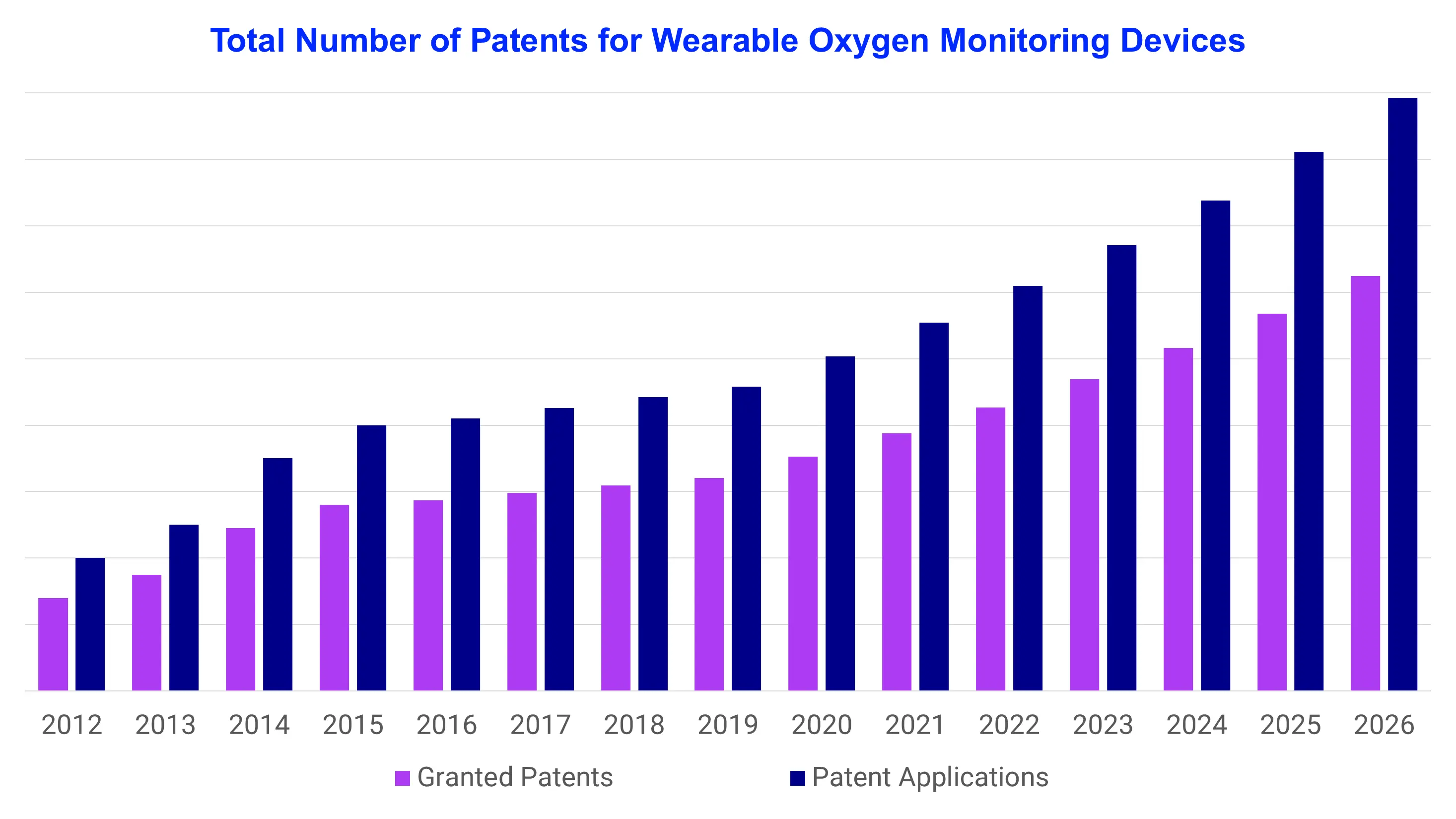
Patent activity covers about 5,870 families, with filings peaking between 2021 and 2023. Reflectance optical sensor design, motion artefact suppression and ring miniaturisation form the busiest clusters, while litigation between Masimo and Apple and the 2025 Oura enforcement actions show how closely claims track product availability.
This Wearable Oxygen Monitoring Devices Patent Landscape Analysis Report maps assignees, jurisdictions, technology clusters and filing trends to support licensing, freedom-to-operate and R&D decisions.
The wearable oxygen monitoring devices market is experiencing strong growth, driven by sleep apnoea screening demand, chronic respiratory disease monitoring outside hospitals, and clearance of oximetry features in consumer wearables. Apple restored Blood Oxygen on selected Apple Watch models in the United States on 14 August 2025, returning continuous oxygen tracking to a very large installed base of wrist-worn devices.
Patent activity is accelerating, with 340+ wearable oxygen monitoring devices patents granted in 2025, reflecting strong innovation momentum in reflectance optical sensor modules, motion artefact suppression algorithms, skin-tone compensation calibration, and multi-parameter sensor fusion.
Top assignees in the wearable oxygen monitoring devices patent landscape include Masimo, Apple, Samsung Electronics, Philips, and Google, with the United States, China, and Europe as the dominant patent jurisdictions.
Wearable oxygen monitoring devices track peripheral oxygen saturation and pulse rate continuously from the wrist, finger, ear, ring or an adhesive chest patch. Clinicians use the readings to spot nocturnal desaturation, early deterioration after discharge and exertional hypoxaemia in chronic lung disease. Consumer demand adds scale, as smartwatch and smart ring buyers treat overnight oxygen trends as a routine wellness metric. Cleared medical devices and consumer products now share the same reflectance optical building blocks.
The market growth is driven by sleep apnoea screening, home management of chronic lung disease and the arrival of cleared pulse oximetry in consumer wearables. Obstructive sleep apnoea affects an estimated 936 million adults, and many first notice it through an overnight oxygen trend.
The FDA draft guidance of January 2025 asks for clinical testing across skin tones, which raises development cost for new entrants and favours makers with large validation datasets. Apple restored Blood Oxygen in the United States on 14 August 2025 by moving the calculation to the paired iPhone, which returned a very large installed base to oxygen tracking. Danaher's February 2026 agreement to acquire Masimo for about USD 9.9 billion in cash shows the strategic value attached to oximetry intellectual property.
Read more about this report - REQUEST FREE SAMPLE COPY IN PDF
Patent filings for wearable oxygen monitoring devices concentrate on reflectance optical modules, signal conditioning and form-factor engineering. Applicants file first in the United States, China and South Korea, then extend through the Patent Cooperation Treaty to Europe and Japan. Smartwatch and smart ring makers have widened the applicant base beyond oximetry specialists, which lifted the share of consumer electronics claims.
The dataset holds roughly 5,870 patent families, with filings peaking between 2021 and 2023 as home oximetry demand and ring launches drove new applications. Grants in 2025 reached about 340, and the United States accounts for around 2,310 patents. Continuation practice at leading oximetry specialists keeps related grants arriving every year.
Rising demand for overnight and ambulatory oxygen tracking has pushed applicants to protect sensor placement, wavelength selection and motion-tolerant algorithms across several form factors.
The report covers patents on wearable devices that measure blood oxygen saturation non-invasively, including wrist-worn watches and bands, smart rings, finger and ear-clip sensors, adhesive patches and smart garments. Coverage extends to the optical front end, analogue signal chain, firmware algorithms, companion software and clinical alerting workflows.
Granted patents and published applications from 2005 to 2026 are mapped by assignee, jurisdiction, technology and clinical use. Bedside and bench-top oximeters enter the analysis when a claim covers a body-worn or ambulatory implementation.
Entities profiled include medical technology manufacturers, consumer electronics groups, smart ring start-ups, universities and research institutes, and contract sensor module suppliers.
The report will cover the following sections in detail:
Analysis by Sensor Technology
Analysis by Form Factor
Analysis by Clinical Use
Wearable Oxygen Monitoring Devices Patent Filing Trend Analysis
Annual filings grew at an estimated 9% between 2020 and 2024, led by reflectance sensor design and algorithms that correct for motion and skin tone. Smart ring and adhesive patch claims grew faster, at an estimated 14% a year, as makers shrank optical modules to fit smaller housings.
Regulatory attention to accuracy across skin tones, sharpened by the FDA draft guidance of January 2025, raised the number of filings on multi-wavelength calibration and perfusion-index compensation. Machine learning claims on hypoxaemia prediction and apnoea event detection now appear in a rising share of new families.
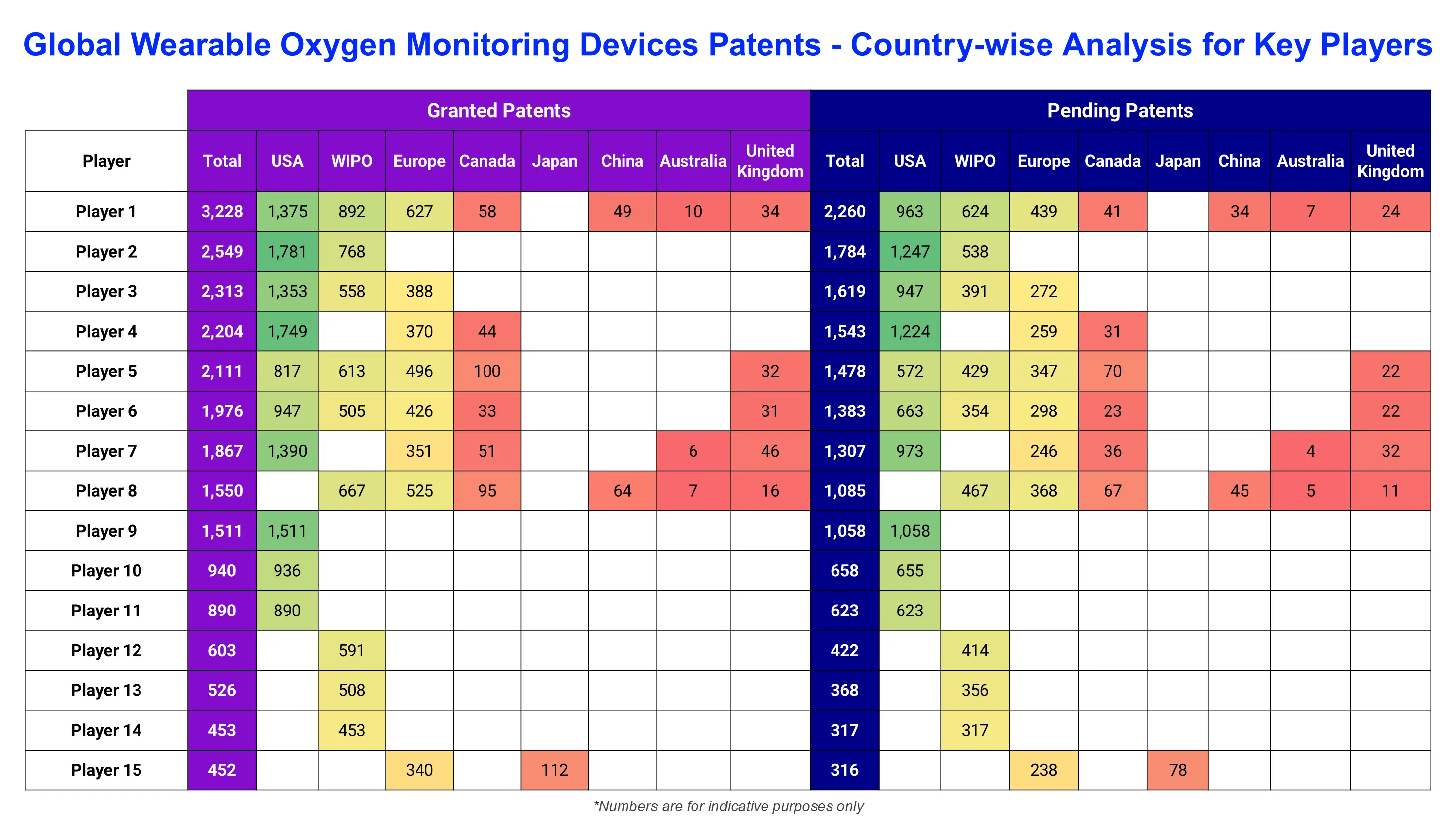
Among the players with wearable oxygen monitoring devices patent families, new entrants have been identified, which can be either established companies or startups developing novel technology in the field. Some of the major companies mentioned in this report (a non-exhaustive list) are as follows:
Masimo holds the deepest pulse oximetry portfolio in the dataset, built around Signal Extraction Technology for low-perfusion and motion conditions. Its wearable range covers the Radius PPG tetherless sensor, the MightySat fingertip device and the W1 medical watch, which received FDA 510(k) clearance for SpO2 and pulse rate in 2023. Continuation filings keep claims on sensor geometry and signal processing active, and the company enforced them against Apple, winning a USD 634 million jury verdict in November 2025. Danaher announced an agreement in February 2026 to acquire Masimo for about USD 9.9 billion in cash, which places the portfolio inside a diagnostics group. Commercial focus sits on hospital, home and sports channels, and the consumer audio business was sold to Harman in 2025.
Apple files on optical sensor placement in the watch back crystal, multi-wavelength LED and photodiode arrays, and health data pipelines on the paired iPhone. Blood Oxygen debuted on Apple Watch Series 6 in 2020 and is labelled for general wellness use. The feature left new US units in January 2024 after the ITC exclusion order, then returned on 14 August 2025 with the calculation moved to the iPhone. Apple plans to appeal the USD 634 million verdict won by Masimo in November 2025. Its IP strategy relies on broad system-level claims across hardware, algorithms and software. The Apple Watch installed base is the largest single route to consumer oxygen data.
Other companies include Samsung Electronics, Philips, and Google.
The five leading assignees hold an estimated 34% of families, a moderate concentration for a category that spans medtech and consumer electronics. Masimo leads in oximetry-specific claims, while Apple and Samsung Electronics hold broad portfolios on watch sensing. The remaining families spread across Asian electronics makers, ring start-ups and universities.
*Please note that this is only a partial list; the complete list of key players is available in the full report. Additionally, the list of key players can be customized to better suit your needs.*
The report assesses patent activity across major jurisdictions, including:
The United States leads filing volume, supported by the Masimo and Apple portfolios and active litigation that keeps claims under scrutiny. China ranks second as Huawei, Xiaomi and local sensor makers file on ring and watch optics. Europe ranks third, with Philips and university groups filing on clinical use cases, and South Korea and Japan follow.
Read more about this report - REQUEST FREE SAMPLE COPY IN PDF
The report segments technology activity into the following areas:
Among these, reflectance optical sensor modules hold the largest share of families, followed by motion artefact suppression.
Competition spans oximetry specialists, consumer electronics groups and monitoring platform companies. Masimo holds the deepest oximetry-specific portfolio, covering signal extraction and watch-based claims. Apple and Samsung Electronics file extensively on sensor placement in watch housings, and Philips and Google add clinical workflow and health platform claims. Litigation between Masimo and Apple ties portfolio strength directly to product availability.
Companies are focusing on:
Emerging innovation themes include multi-wavelength calibration for darker skin tones, ring-based clinical-grade oximetry, on-device machine learning for apnoea event detection and smart garment sensors. Cuffless blood pressure and hydration estimation are being combined with oxygen sensing on a single optical engine. Claims for ear-worn oximetry are also rising in hearable portfolios.
Strategic activity centres on securing optical sensing claims and defending them. The Masimo and Apple dispute produced a USD 634 million jury verdict in November 2025, and in April 2026 the US International Trade Commission declined to review a ruling that cleared Apple's redesigned feature. Oura won exclusion orders against Ultrahuman and RingConn in 2025, and RingConn then took a licence. Licensing and enforcement therefore shape entry for smaller ring makers.
Technology segments, assignee positions and jurisdictional trends are organised so that the report provides actionable intelligence supporting:
The patent search covered the United States Patent and Trademark Office, the European Patent Office, the World Intellectual Property Organization, the China National Intellectual Property Administration, the Korean Intellectual Property Office and the Japan Patent Office. Records from 2005 to 2026 were drawn from DOCDB and national full-text sources.
Queries combined CPC classes A61B 5/1455 (optical oximetry), A61B 5/6801 (wearable sensors), A61B 5/7203 (noise and artefact processing) and G16H 40/63 with keywords for photoplethysmography, SpO2, ring, patch and watch. Records were screened for claim relevance and consolidated into patent families, with legal status checked for each member.
The market side draws on FDA 510(k) and CE clearance records, company filings, ClinicalTrials.gov registrations and peer-reviewed literature on oximetry accuracy. Assignee names were normalised across subsidiaries, and segment shares were estimated from classified family counts.


Upto 15% Off
USD
$2699 $2429
$4299 $3869
$5799 $4949
$6999 $5949


*While we strive to always give you current and accurate information, the numbers depicted on the website are indicative and may differ from the actual numbers in the main report. At Expert Market Research, we aim to bring you the latest insights and trends in the market. Using our analyses and forecasts, stakeholders can understand the market dynamics, navigate challenges, and capitalize on opportunities to make data-driven strategic decisions.*
EMR’s Wearable Oxygen Monitoring Devices Patent Landscape Analysis provides a comprehensive assessment of patent filings, innovation clusters, assignee portfolios, and geographic filing patterns across the wearable oxygen monitoring devices landscape. The report identifies 5,870+ patent families, evaluates leading jurisdictions including the United States, China, and Europe, and profiles the top assignees by portfolio size.
The global wearable oxygen monitoring devices market was valued at USD 2.93 Billion in 2025. The market is projected to reach USD 6.74 Billion by 2035, expanding at a CAGR of 8.68% during 2026 - 2035.
The report analyses approximately 5,870+ patent families related to wearable oxygen monitoring devices. These include filings from the United States, China, Europe, and international WIPO filings.
Key companies operating within the landscape include Masimo, Apple, Samsung Electronics, Philips, and Google, among others. These organisations collectively account for a significant portion of patent activity analysed in this report.
The report evaluates patent activity across the United States, Europe, China, Japan, South Korea, India, and international WIPO filings. The United States leads with roughly 38% of patent filings, followed by China and Europe.
Yes. The report scope can be customised based on geography, technology segment, assignee selection, time period, or specific innovation cluster focus. Please connect with the EMR team to define the customisation scope.
Patent landscape analysis helps organisations understand innovation trends, competitive activity, technology whitespace, and IP risk across a defined domain. For wearable oxygen monitoring devices, this report supports strategic decisions in R&D prioritisation, licensing evaluation, competitive benchmarking, and market entry planning.
Explore our key highlights of the report and gain a concise overview of key findings, trends, and actionable insights that will empower your strategic decisions.
|
Scope of the Report |
Details |
|
Analysis by Sensor Technology |
|
|
Analysis by Form Factor |
|
|
Analysis by Clinical Use |
|
|
Analysis by End User |
|
|
Key Players Mentioned |
|
|
Geographies Covered |
|
Mini Report
One User
USD 2,699
USD 2,429
tax inclusive*
Single User License
One User
USD 4,299
USD 3,869
tax inclusive*
Five User License
Five User
USD 5,799
USD 4,949
tax inclusive*
Corporate License
Unlimited Users
USD 6,999
USD 5,949
tax inclusive*
*Please note that the prices mentioned below are starting prices for each bundle type. Kindly contact our team for further details.*
Flash Bundle
Small Business Bundle
Growth Bundle
Enterprise Bundle
*Please note that the prices mentioned below are starting prices for each bundle type. Kindly contact our team for further details.*
Flash Bundle
Number of Reports: 3
20%
tax inclusive*
Small Business Bundle
Number of Reports: 5
25%
tax inclusive*
Growth Bundle
Number of Reports: 8
30%
tax inclusive*
Enterprise Bundle
Number of Reports: 10
35%
tax inclusive*
How To Order

Select License Type
Choose the right license for your needs and access rights.

Click on ‘Buy Now’
Add the report to your cart with one click and proceed to register.

Select Mode of Payment
Choose a payment option for a secure checkout. You will be redirected accordingly.
Strategic Solutions for Informed Decision-Making
Gain insights to stay ahead and seize opportunities.

Get insights & trends for a competitive edge.

Track prices with detailed trend reports.

Analyse trade data for supply chain insights.

Leverage cost reports for smart savings

Enhance supply chain with partnerships.

Connect For More Information
Our expert team of analysts will offer full support and resolve any queries regarding the report, before and after the purchase.
Our expert team of analysts will offer full support and resolve any queries regarding the report, before and after the purchase.
We employ meticulous research methods, blending advanced analytics and expert insights to deliver accurate, actionable industry intelligence, staying ahead of competitors.
Our skilled analysts offer unparalleled competitive advantage with detailed insights on current and emerging markets, ensuring your strategic edge.
We offer an in-depth yet simplified presentation of industry insights and analysis to meet your specific requirements effectively.




