

Consumer Insights
Uncover trends and behaviors shaping consumer choices today
Procurement Insights
Optimize your sourcing strategy with key market data
Industry Stats
Stay ahead with the latest trends and market analysis.
The albumin-binding therapeutics market was valued at USD 4.20 Billion in 2025 and is projected to reach USD 14.77 Billion by 2035, advancing at a CAGR of 13.40%. Demand is driven by the scale of once-weekly incretin therapies built on fatty acid acylation, the expansion of long-acting insulins, the clinical adoption of albumin fusion clotting factors, and the entry of albumin-binding ligands into radioligand therapy.
Patent activity covers more than 7,400 families, led by fatty acid and diacid acylation with linker optimisation, albumin-binding domains, peptides and nanobodies, genetic fusion and chemical conjugation to human serum albumin, and albumin-binding small molecule ligands for radioligands and drug conjugates. Regulatory validation includes approved semaglutide, tirzepatide, insulin detemir and albutrepenonacog alfa, along with ozoralizumab, an albumin-binding nanobody approved in Japan. Commercial validation comes from the weekly incretin franchises, which keep originators filing on new linkers, regimens and formats.
This Albumin-Binding Therapeutics Patent Landscape Analysis Report provides a structured view of filing trends, leading assignees, jurisdictions, technology clusters and competitive positioning across acylation, binding domain, albumin fusion and ligand-based approaches.
The albumin-binding therapeutics market is experiencing strong growth, driven by weekly incretin and insulin regimens, approved albumin fusion clotting factors, and radioligand programs that use albumin binding to extend tumour exposure. Semaglutide and tirzepatide, both carrying a fatty acid side chain that binds serum albumin, support once-weekly dosing across type 2 diabetes and chronic weight management.
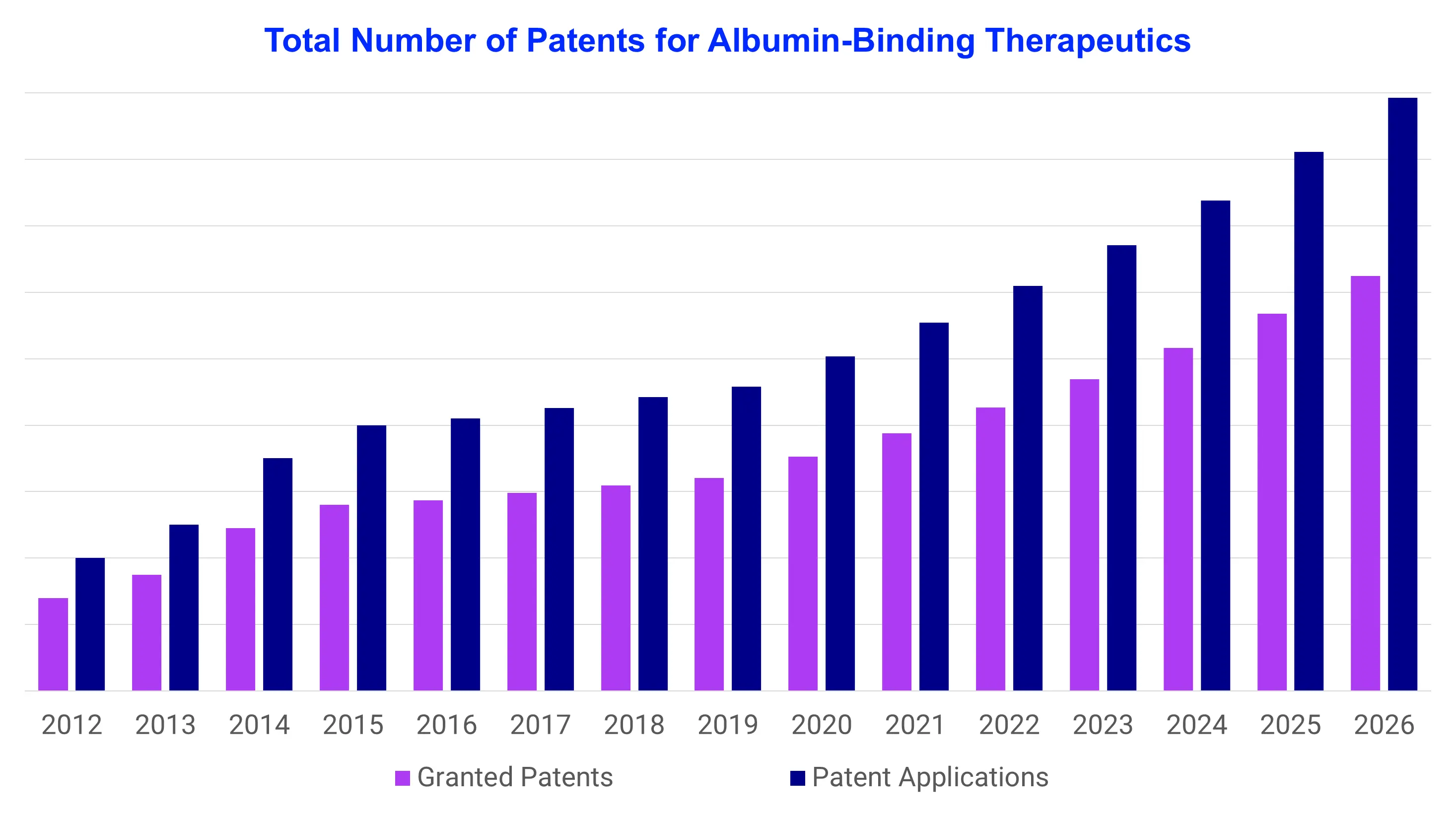
Patent activity is accelerating, with 140+ albumin-binding therapeutics patents granted in 2025, reflecting strong innovation momentum in fatty acid and diacid acylation with linker optimisation, albumin-binding domains, peptides and nanobodies, genetic fusion and chemical conjugation to human serum albumin, and albumin-binding small molecule ligands for radioligands and drug conjugates.
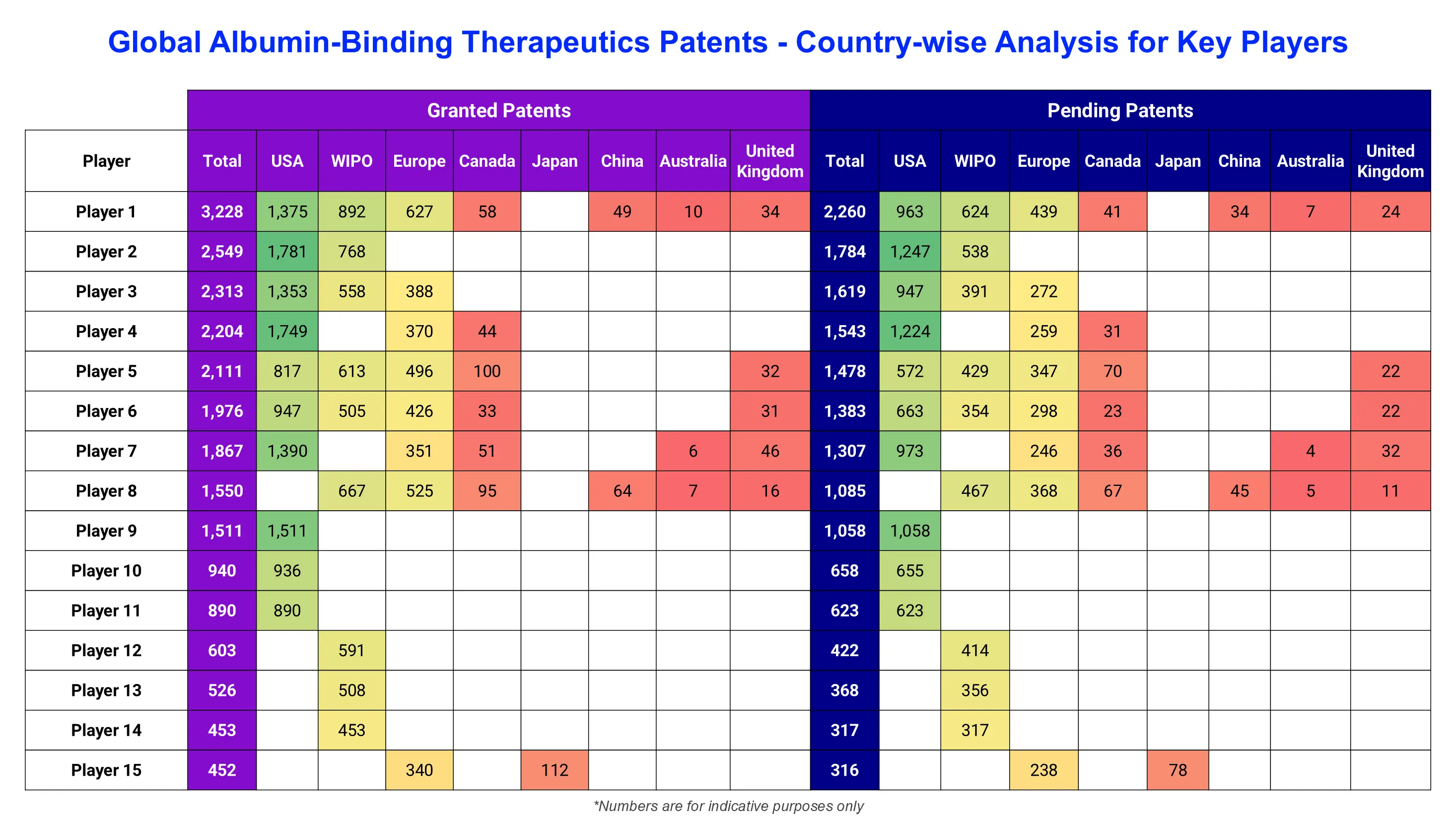
Top assignees in the albumin-binding therapeutics patent landscape include Novo Nordisk, Eli Lilly, Sanofi, CSL Behring, and Albumedix, with the United States, Europe, and China as the dominant patent jurisdictions.
Serum albumin is the most abundant protein in human plasma and circulates for roughly three weeks because it is recycled through the neonatal Fc receptor, which makes it a natural carrier for drugs that would otherwise be cleared within hours. Therapeutics designed to bind or fuse to albumin inherit that persistence, allowing weekly or less frequent dosing for peptides, proteins and small molecules. Clinical demand is strongest in metabolic disease, where long-acting insulins and incretin agonists serve very large chronic populations. Hemophilia care, inflammatory disease and radioligand oncology are secondary demand centres where fewer injections or longer tumour exposure carries direct clinical value. Adoption depends on balancing binding strength against tissue penetration, a trade-off that shapes how developers choose between acylation, nanobody and fusion approaches.
Market growth is driven by the commercial scale of once-weekly acylated incretin therapies, which have turned albumin binding from a formulation tactic into a standard design principle for metabolic drugs. More than 580 million adults are estimated to live with diabetes worldwide, a base large enough to sustain several competing weekly products. Semaglutide and tirzepatide are both approved for type 2 diabetes and chronic weight management, which widens the treated population beyond glycaemic control. Hemophilia B affects roughly 1 in 25,000 male births, and the 2016 approval of albutrepenonacog alfa showed that albumin fusion can support extended dosing intervals in a rare disease setting.
Weekly dosing cuts annual injections from 365 to 52, which improves adherence and persistence in chronic therapy and explains why prescribers and payers have favoured acylated products over daily peptides. Ozoralizumab, a trivalent anti-TNF nanobody that includes an albumin-binding domain, was approved in Japan in 2022 for rheumatoid arthritis, confirming that albumin binding can be built into a small antibody format and reach the clinic. Patent expiries on earlier semaglutide protection in several large markets from 2026 are opening generic entry, so originators are shifting investment toward new linkers, oral delivery and combination products. Radioligand developers add a further pull, since albumin-binding groups raise blood residence time and tumour uptake of small targeting molecules.
Read more about this report - REQUEST FREE SAMPLE COPY IN PDF
Filing activity in albumin-binding therapeutics has tracked the commercial trajectory of the products it protects. Each approval of an acylated peptide or insulin has been followed by a wave of applications on analogues, linkers and dosing regimens, and capital committed to weekly incretin and insulin programs has kept annual filings on a rising slope. Large originators file continuously across the lifecycle of a molecule, while specialist firms and universities concentrate on binding domains and albumin variants that can be licensed into several programs. Radioligand investment in recent years has added a newer stream of applications covering albumin-binding ligands.
The landscape covers more than 7,400 patent families. Filing volumes peaked between approximately 2019 and 2023, when incretin analogues, weekly insulins and radioligand conjugates were all in active development. Fatty acid and diacid acylation with linker optimisation forms the largest cluster, followed by albumin-binding domains, peptides and nanobodies and by genetic fusion and chemical conjugation to human serum albumin. Smaller groups cover albumin-binding small molecule ligands for radioligands and drug conjugates, binding affinity tuning to balance half-life and tissue exposure, and recombinant albumin variants engineered for FcRn recycling, several of which are growing faster than the core acylation cluster.
Rising demand for weekly metabolic therapies, extended-interval clotting factors and tumour-retained radioligands has translated directly into wider patent coverage of acylation chemistry, binding domains and albumin variants.
Geographic coverage includes granted and pending patents filed at the United States Patent and Trademark Office, the European Patent Office, the China National Intellectual Property Administration, the Japan Patent Office, the Korean Intellectual Property Office and the Indian Patent Office, together with WIPO international applications. Market coverage spans the global albumin-binding therapeutics market, with attention to diabetes and metabolic disorders, hemophilia and hematology, oncology and radioligand therapy, autoimmune and inflammatory diseases, and infectious diseases. Patent families are counted once across jurisdictions so that equivalents filed in several offices do not inflate totals.
Technology scope covers five albumin-binding mechanisms: fatty acid and lipid acylation, albumin-binding domains and nanobodies, albumin fusion proteins, albumin-binding small molecule ligands and albumin-binding peptides. Molecule classes include peptide hormones, recombinant proteins, antibody fragments and nanobodies, and radioligands and small molecule conjugates. Products whose half-life is extended mainly through PEGylation or Fc fusion are excluded and appear only as points of contrast, as do other half-life extension routes that do not rely on serum albumin.
Entities include large pharmaceutical manufacturers with approved acylated and albumin fusion products, specialist protein engineering firms and recombinant albumin suppliers. Start-ups developing albumin-binding nanobodies, peptides and radioligand ligands are covered alongside contract development and manufacturing organizations that supply lipidated peptides and recombinant albumin. Academic and clinical institutions are included where they hold patents on binding domains, linker chemistry or radiopharmaceutical applications, particularly university groups in Europe, the United States and China working on albumin-binding ligands for imaging and therapy.
The report will cover the following sections in detail:
Analysis by Albumin-Binding Mechanism
Analysis by Therapeutic Area
Analysis by Molecule Class
Albumin-Binding Therapeutics Patent Filing Trend Analysis
Patent filings in albumin-binding therapeutics have moved from a narrow set of acylated insulin and incretin applications to a broad portfolio that includes nanobodies, albumin variants and radioligand ligands. Grants follow filings with a lag of roughly three to four years, and more than 140 patents were granted in 2025. Applicant diversity has widened, with biotechnology companies and universities now filing alongside the established metabolic franchises.
Annual filings grew by approximately 9 percent per year between 2020 and 2024, based on estimated counts. Growth was driven by the commercial success of semaglutide and tirzepatide, which prompted competitors to file on new acyl chains, linkers and receptor combinations. Interest in radioligand therapy added applications on albumin-binding groups that tune blood clearance, while albumin variants engineered for FcRn recycling extended activity in protein therapeutics. Filings from China rose faster than the global rate, reflecting local incretin and weekly insulin programs.
Among the players with albumin-binding therapeutics patent families, new entrants have been identified, which can be either established companies or startups developing novel technology in the field. Some of the major companies mentioned in this report (a non-exhaustive list) are as follows:
Novo Nordisk holds the deepest portfolio in albumin-binding therapeutics, covering fatty acid and diacid acylation of insulins and glucagon-like peptide-1 analogues, side-chain linker chemistry and long-acting formulations. Commercial platforms include insulin detemir (Levemir), liraglutide (Victoza and Saxenda), insulin degludec (Tresiba) and semaglutide (Ozempic, Wegovy and Rybelsus), each relying on reversible albumin binding to prolong circulation. Once-weekly insulin icodec (Awiqli) has been approved in the European Union and several other markets, extending the same approach to basal insulin. The company protects each molecule through composition claims and then layers filings around linker structures, acyl chain length and dosing regimens, which extends coverage well beyond the original compound patents. Its position as the largest assignee reflects the scale of its incretin franchise and continuing filings on oral and combination formats.‑‑‑
Eli Lilly built its albumin-binding position around tirzepatide, a dual glucose-dependent insulinotropic polypeptide and GLP-1 receptor agonist that carries a C20 fatty diacid moiety to bind serum albumin and support once-weekly dosing. Tirzepatide is marketed as Mounjaro for type 2 diabetes, approved in 2022, and as Zepbound for chronic weight management, approved in 2023. Lilly's filings centre on peptide sequences, acylation patterns, linker structures and manufacturing of long-chain lipidated peptides, with continuing applications on combination and next-generation incretin products. The company has also added radioligand programs through acquisition, an area where albumin binding is an established tool for tuning blood residence. Its share of the landscape has risen quickly since 2022 as tirzepatide scaled, which places it as the principal challenger to Novo Nordisk.
Other companies include Sanofi, CSL Behring, and Albumedix.
Assignee concentration is moderate at the top and fragmented beyond it. Novo Nordisk and Eli Lilly hold the largest portfolios, anchored on fatty acid and diacid acylation of insulins and incretin peptides and supported by dense continuation filings on linkers and regimens. Sanofi contributes through nanobody technology associated with its Ablynx acquisition, while CSL Behring holds albumin fusion coagulation factor intellectual property built around its approved factor IX product. Albumedix, a recombinant albumin specialist, files on albumin variants and conjugation formats that are licensed to partners rather than commercialised directly. Beyond these five, smaller holders each account for a limited share of families.
*Please note that this is only a partial list; the complete list of key players is available in the full report. Additionally, the list of key players can be customized to better suit your needs.*
The report assesses patent activity across major jurisdictions, including:
The United States, Europe and China account for the largest share of albumin-binding therapeutics filings, matching the location of the largest diabetes populations, the main clinical development hubs and the most active originator headquarters. United States filings are dominated by acylated peptide, insulin and radioligand applications, while European filings reflect the home base of Novo Nordisk and several nanobody and albumin specialists. China has the fastest growing filing base, driven by domestic weekly incretin and insulin developers. South Korea and India contribute smaller but rising volumes tied to formulation and biosimilar work, and WIPO international applications remain the main route for originators seeking broad coverage.
Read more about this report - REQUEST FREE SAMPLE COPY IN PDF
Technology activity in albumin-binding therapeutics falls into five segments:
Fatty acid and lipid acylation leads patent activity, supported by the commercial scale of weekly semaglutide, tirzepatide, insulin detemir and insulin degludec. Acyl chain length, diacid design and linker chemistry each give room for separate claims, so originators and challengers keep filing around approved molecules. Albumin-binding small molecule ligands are the fastest growing segment from a smaller base, as radioligand developers adopt them to prolong blood residence and raise tumour uptake.
Competition is shaped by a small group of metabolic franchises and a wider field of platform specialists. Novo Nordisk and Eli Lilly compete directly in weekly incretin therapy, where patent portfolios on acylated peptides influence launch timing and formulation choices. CSL Behring holds the leading albumin fusion position in hemophilia B, while Albumedix and Sanofi supply albumin variant and nanobody technology that can be applied across indications. Start-ups focus on albumin-binding peptides, domains and radioligand ligands, often partnering with larger companies for late-stage development and manufacturing. Freedom to operate on linker and acyl chain claims is a recurring concern for new entrants.
Companies are focusing on:
Emerging themes include oral formulations of acylated peptides, where absorption enhancers and albumin binding are combined to support tablet dosing. Tunable affinity is attracting attention, since moderate binding can preserve tissue penetration that very tight binding would reduce, an important point for tumour-targeting radioligands. Multi-specific constructs that add an albumin-binding arm to trivalent formats are appearing in autoimmune and oncology filings, as shown by ozoralizumab. Conjugation of albumin-binding groups to anti-infective peptides is a smaller theme in infectious diseases. Manufacturing of recombinant albumin variants in yeast and other hosts also generates process claims.
The albumin-binding therapeutics patent landscape combines one mature, high-volume cluster in acylated metabolic drugs with several younger clusters in nanobodies, albumin variants and radioligand ligands. Mature claims on liraglutide, semaglutide and insulin detemir are moving through expiry in a number of markets, while protection for tirzepatide and weekly insulins extends well into the 2030s. The balance between expiring and newly filed rights defines where freedom to operate is opening and where it remains restricted. Geographic spread across the United States, Europe and China indicates that originators protect core compounds in all three regions.
Mapping these rights provides actionable intelligence for nine uses:
Patent research covered the major patent databases, including national and regional office records and WIPO publications, using CPC classes and keyword strings for fatty acid acylation, albumin-binding domains, albumin fusion proteins and albumin-binding ligands. Applications were grouped into families, and grant status and filing years were recorded for each family so that trends could be compared across jurisdictions and technology clusters.
Records were screened for relevance to albumin-mediated half-life or distribution, and documents focused only on PEGylation, Fc fusion or unrelated carriers were removed. Remaining families were classified by albumin-binding mechanism, therapeutic area, molecule class, assignee, jurisdiction and technology cluster, and ownership was harmonised across subsidiaries and acquired entities. Borderline records, such as multi-mechanism constructs that combine albumin binding with another half-life route, were retained only where albumin binding was claimed as a defining feature.
Patent findings were linked to market information on approved products, clinical pipelines and regulatory milestones to support estimates of market size and growth. Company disclosures, regulatory databases and clinical trial registries were used to confirm commercial status, and figures that rely on approximation are stated as such. Segment and jurisdiction shares were cross-checked against the number of approved products and active clinical programs in each area to keep the patent view consistent with commercial activity.


Upto 15% Off
USD
$2699 $2429
$4299 $3869
$5799 $4949
$6999 $5949


*While we strive to always give you current and accurate information, the numbers depicted on the website are indicative and may differ from the actual numbers in the main report. At Expert Market Research, we aim to bring you the latest insights and trends in the market. Using our analyses and forecasts, stakeholders can understand the market dynamics, navigate challenges, and capitalize on opportunities to make data-driven strategic decisions.*
EMR's Albumin-Binding Therapeutics Patent Landscape Analysis provides a comprehensive assessment of patent filings, innovation clusters, assignee portfolios, and geographic filing patterns across the albumin-binding therapeutics landscape. The report identifies 7,400+ patent families, evaluates leading jurisdictions including the United States, Europe, and China, and profiles the top assignees by portfolio size.
The global albumin-binding therapeutics market was valued at USD 4.20 Billion in 2025. The market is projected to reach USD 14.77 Billion by 2035, expanding at a CAGR of 13.40% during 2026 - 2035.
The report analyses approximately 7,400+ patent families related to albumin-binding therapeutics. These include filings from the United States, Europe, China, and international WIPO filings.
Key companies operating within the landscape include Novo Nordisk, Eli Lilly, Sanofi, CSL Behring, and Albumedix, among others. These organisations collectively account for a significant portion of patent activity analysed in this report.
The report evaluates patent activity across the United States, Europe, China, Japan, South Korea, India, and international WIPO filings. The United States is the largest single jurisdiction, with more than 4,300 albumin-binding therapeutics patents associated with it, reflecting the concentration of incretin, insulin and radioligand commercialisation in that market.
Yes. The report scope can be customised based on geography, technology segment, assignee selection, time period, or specific innovation cluster focus. Readers who need a narrower scope, such as a specific albumin-binding mechanism, molecule class or jurisdiction, can contact the EMR team to scope a customised study with tailored assignees, timelines and deliverables.
Patent landscape analysis helps organisations understand innovation trends, competitive activity, technology whitespace, and IP risk across a defined domain. For albumin-binding therapeutics, this report supports strategic decisions in R&D prioritisation, licensing evaluation, competitive benchmarking, and market entry planning.
Explore our key highlights of the report and gain a concise overview of key findings, trends, and actionable insights that will empower your strategic decisions.
|
Scope of the Report |
Details |
|
Analysis by Albumin-Binding Mechanism |
|
|
Analysis by Therapeutic Area |
|
|
Analysis by Molecule Class |
|
|
Analysis by End User |
|
|
Key Players Mentioned |
|
|
Geographies Covered |
|
Mini Report
One User
USD 2,699
USD 2,429
tax inclusive*
Single User License
One User
USD 4,299
USD 3,869
tax inclusive*
Five User License
Five User
USD 5,799
USD 4,949
tax inclusive*
Corporate License
Unlimited Users
USD 6,999
USD 5,949
tax inclusive*
*Please note that the prices mentioned below are starting prices for each bundle type. Kindly contact our team for further details.*
Flash Bundle
Small Business Bundle
Growth Bundle
Enterprise Bundle
*Please note that the prices mentioned below are starting prices for each bundle type. Kindly contact our team for further details.*
Flash Bundle
Number of Reports: 3
20%
tax inclusive*
Small Business Bundle
Number of Reports: 5
25%
tax inclusive*
Growth Bundle
Number of Reports: 8
30%
tax inclusive*
Enterprise Bundle
Number of Reports: 10
35%
tax inclusive*
How To Order

Select License Type
Choose the right license for your needs and access rights.

Click on ‘Buy Now’
Add the report to your cart with one click and proceed to register.

Select Mode of Payment
Choose a payment option for a secure checkout. You will be redirected accordingly.
Strategic Solutions for Informed Decision-Making
Gain insights to stay ahead and seize opportunities.

Get insights & trends for a competitive edge.

Track prices with detailed trend reports.

Analyse trade data for supply chain insights.

Leverage cost reports for smart savings

Enhance supply chain with partnerships.

Connect For More Information
Our expert team of analysts will offer full support and resolve any queries regarding the report, before and after the purchase.
Our expert team of analysts will offer full support and resolve any queries regarding the report, before and after the purchase.
We employ meticulous research methods, blending advanced analytics and expert insights to deliver accurate, actionable industry intelligence, staying ahead of competitors.
Our skilled analysts offer unparalleled competitive advantage with detailed insights on current and emerging markets, ensuring your strategic edge.
We offer an in-depth yet simplified presentation of industry insights and analysis to meet your specific requirements effectively.




