

Consumer Insights
Uncover trends and behaviors shaping consumer choices today
Procurement Insights
Optimize your sourcing strategy with key market data
Industry Stats
Stay ahead with the latest trends and market analysis.
The PROTAC drug delivery technologies market was valued at USD 0.35 Billion in 2025 and is projected to reach USD 4.30 Billion by 2035, advancing at a CAGR of 28.50%. Growth is supported by the progression of heterobifunctional degraders into mid and late-stage trials, the need to raise oral exposure of high-molecular-weight molecules, rising interest in tumor-selective degrader-antibody conjugates, and expanding pharmaceutical partnering around degrader platforms.
Patent activity is concentrated in degrader-antibody conjugates for tumor-selective delivery, oral formulation and amorphous dispersions for large degraders, lipid and polymeric nanoparticle carriers, caged and stimulus-activated prodrug degraders, brain-penetrant degrader design, and linker chemistry for permeability and stability. Filing momentum is reinforced by clinical-stage estrogen receptor, androgen receptor, IRAK4 and BTK degraders, which show that oral dosing of these molecules is achievable and have drawn large pharmaceutical collaborations into the field.
This PROTAC Drug Delivery Technologies Patent Landscape Analysis Report provides a structured view of patent families, assignees, jurisdictions and technology clusters covering the formulation, conjugation, carrier and prodrug approaches that make proteolysis-targeting chimeras viable as medicines.
The PROTAC drug delivery technologies market is experiencing strong growth, driven by clinical progress of orally dosed heterobifunctional degraders, demand for tumor-selective conjugate formats, and pharmaceutical partnering around degrader platforms. Several estrogen receptor, androgen receptor, IRAK4 and BTK degraders have advanced into mid to late-stage clinical trials, which has turned formulation and delivery from a secondary question into a development priority.
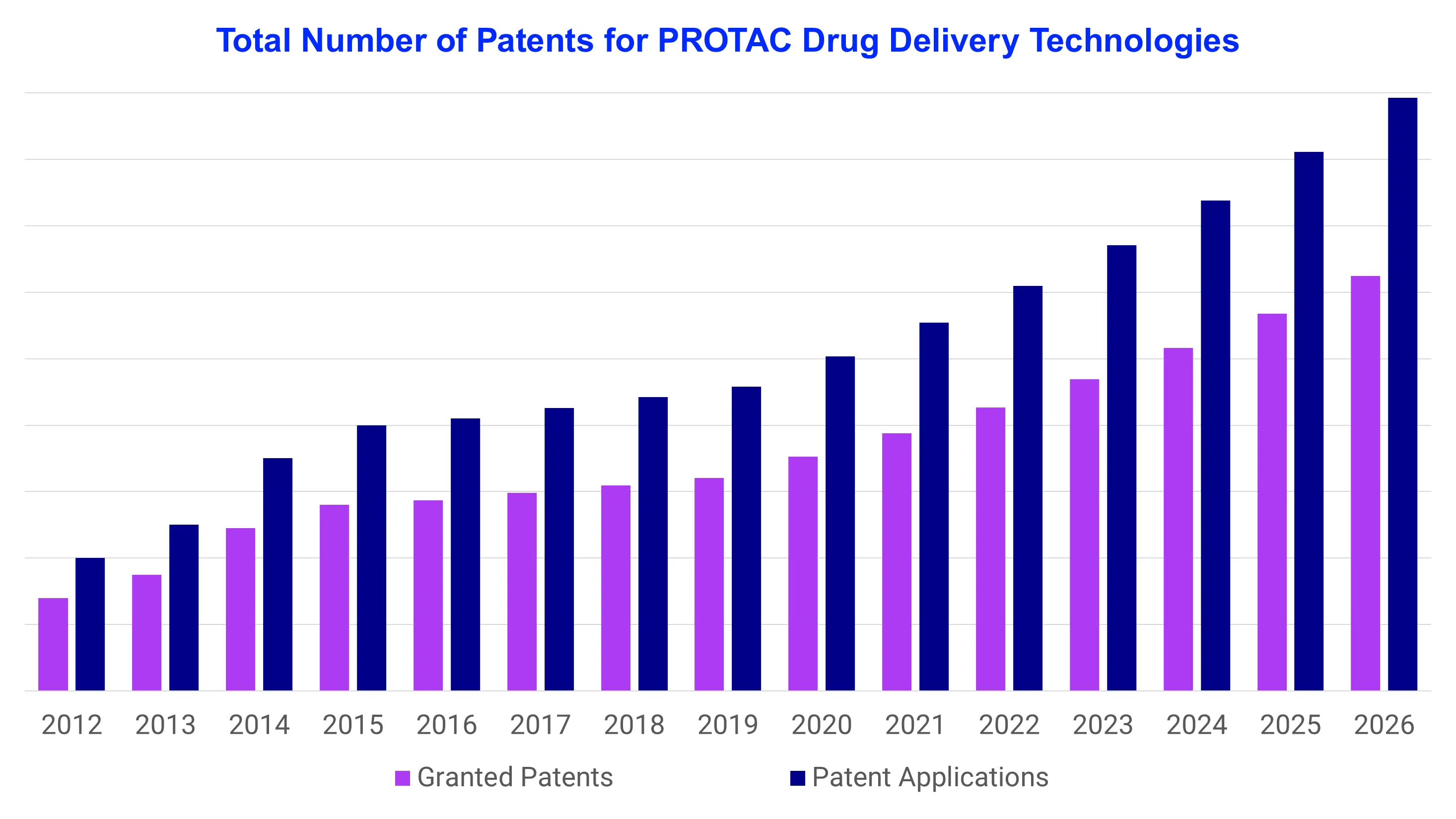
Patent activity is accelerating, with 6+ PROTAC drug delivery technologies patents granted in 2025, reflecting strong innovation momentum in degrader-antibody conjugates for tumor-selective delivery, oral formulation and amorphous dispersions for large degraders, lipid and polymeric nanoparticle carriers, and caged and stimulus-activated prodrug degraders.
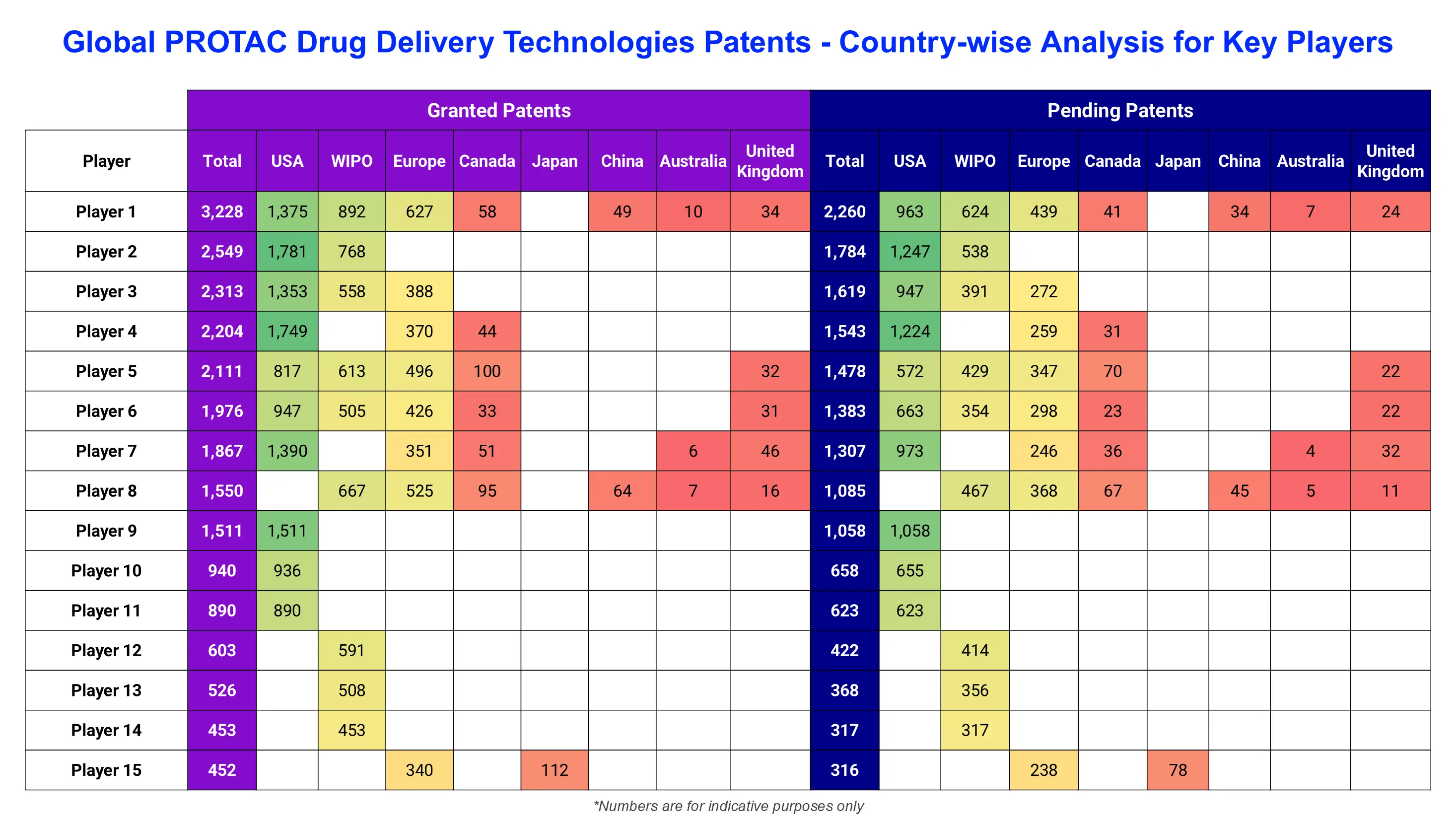
Top assignees in the PROTAC drug delivery technologies patent landscape include Arvinas, Kymera Therapeutics, Dana-Farber Cancer Institute, C4 Therapeutics, and Nurix Therapeutics, with China, the United States, and Europe as the dominant patent jurisdictions.
Proteolysis-targeting chimeras have moved from a laboratory concept to a clinical modality, but their physical properties still shape nearly every development decision. Most degraders sit well outside conventional oral drug space, with molecular weights that often exceed 800 daltons, many hydrogen bond donors and limited aqueous solubility. Demand for delivery solutions therefore comes from oncology developers seeking reliable oral exposure, from teams that want to restrict degrader activity to tumor tissue, and from neuroscience programs that need access to the central nervous system. The field remains largely pre-commercial, so activity centers on formulation science, conjugate design and carrier systems rather than on product sales.
Market growth is driven by the clinical validation of orally dosed heterobifunctional degraders, which has made bioavailability enhancement and targeted delivery a priority for sponsors with late-stage assets. Vepdegestrant, an estrogen receptor degrader developed by Arvinas and Pfizer, has been evaluated in Phase 3 trials in advanced breast cancer, which shows that an oral degrader can reach pivotal-stage development. Kymera's IRAK4 degrader KT-474 produced deep protein reduction in early studies in inflammatory skin disease, which extends the addressable setting beyond oncology.
More than 30 heterobifunctional degraders are in clinical development, a count that has grown steadily since first dosing in patients in 2019 and that signals a rising number of sponsors facing formulation questions. Most are given orally, which makes absorption of molecules far above the usual size limit the main technical constraint and explains why amorphous dispersions and lipid-based systems appear so often in recent filings. Antibody-conjugated degraders address a different constraint, off-target exposure, and the first examples reached clinical testing only in the last few years. Because these formats require separate conjugation chemistry, manufacturing and analytical work, contract development organizations are taking on a larger supply role.
Read more about this report - REQUEST FREE SAMPLE COPY IN PDF
Filing intensity has risen in step with commercial investment in degrader programs. Collaboration agreements between degrader developers and large pharmaceutical companies, together with venture financing of specialist platform companies, have funded dedicated formulation and delivery teams that now file separately from the core degrader composition patents. Grants of 5+ in 2025 show that applications lodged in the early 2020s are maturing, since examination of these cases commonly takes two to four years. Academic groups add to the volume with early-stage work on conjugates and carriers, often licensed to industry once proof of concept is established.
The landscape contains 4,300+ patent families, with filing activity peaking between approximately 2022 and 2024. Degrader-antibody conjugates for tumor-selective delivery and oral formulation with amorphous dispersions account for the largest share of recent families. Lipid and polymeric nanoparticle carriers, caged and stimulus-activated prodrug degraders, brain-penetrant degrader design, and linker chemistry for permeability and stability make up the remaining clusters, with linker work often filed together with the core degrader composition.
Rising clinical-stage degrader numbers and larger partnering budgets have created a direct need for delivery solutions, and patent filings on conjugates, formulations and carriers have expanded to meet it.
This report covers patent filings published through 2025 across major patent offices, with particular attention to China, the United States and Europe, and includes South Korea, India and applications lodged through the WIPO Patent Cooperation Treaty route. Market coverage is global, with sizing prepared for the delivery and formulation technologies that support proteolysis-targeting chimeras in development and early commercialization. Regional detail follows where the patent families are filed and where the main developers are based.
Technology scope covers oral formulation and bioavailability enhancement, degrader-antibody conjugates, nanoparticle and lipid carrier systems, prodrug and stimulus-activated degraders, and blood-brain barrier penetrant designs. Patent families are also classified by the E3 ligase recruited, including cereblon, Von Hippel-Lindau, inhibitor of apoptosis proteins, MDM2 and emerging E3 ligases, and by therapeutic area, covering breast and prostate cancer, hematologic malignancies, immunology and inflammation, neurodegenerative disorders, and other solid tumors and disorders. Molecular glue degraders are treated as a boundary and are excluded from the delivery scope.
Entities covered include degrader developers with clinical-stage programs, specialist platform and discovery companies, large pharmaceutical partners that license or co-develop degraders, and contract development and manufacturing organizations that supply formulation and conjugation services. Academic and clinical institutions, including cancer centers and universities that file on degrader chemistry and delivery concepts, are included alongside start-ups working on antibody conjugates, nanocarriers and activatable prodrugs. Hospitals and oncology centers are considered as the clinical setting in which these products are administered.
The report will cover the following sections in detail:
Analysis by Delivery Technology
Analysis by E3 Ligase Recruited
Analysis by Therapeutic Area
PROTAC Drug Delivery Technologies Patent Filing Trend Analysis
Patent filings on PROTAC drug delivery technologies have grown steadily since the first clinical degraders entered patient studies, with the pace increasing once oral candidates showed measurable target reduction. Early families were dominated by degrader structures, while later years show a shift toward formulation, conjugation and carrier claims. Granted patents are now building up in the United States and Europe, while Chinese applications continue to grow in number.
Annual filing growth for 2020 to 2024 is estimated at approximately 25 to 30 percent, well above the pace of general small-molecule drug delivery filings. The increase was driven by oral candidates entering mid to late-stage trials, the arrival of degrader-antibody conjugates, and a wave of Chinese applicants on nanocarriers and prodrugs. Applicants have also split their coverage, filing formulation, linker and delivery claims apart from composition-of-matter patents to extend protection.
Among the players with PROTAC drug delivery technologies patent families, new entrants have been identified, which can be either established companies or startups developing novel technology in the field. Some of the major companies mentioned in this report (a non-exhaustive list) are as follows:
Arvinas holds one of the earliest and broadest portfolios on proteolysis-targeting chimeras, spanning E3 ligase binders, linkers, degrader compositions, and the salt forms, formulations and dosing regimens needed to administer them by mouth. Its PROTAC discovery platform produced vepdegestrant, an oral estrogen receptor degrader developed with Pfizer that has reached late-stage clinical development and regulatory review, and ARV-766, an androgen receptor degrader licensed to Novartis. Regulatory status of each asset changes with agency decisions and should be confirmed against current records before it is cited. The company files continuously around its clinical candidates, adding formulation and use claims as programs mature rather than relying on composition patents alone. Commercially, Arvinas is positioned as the reference developer for oral heterobifunctional degraders and relies on large-company partners for late-stage development and launch.
Kymera Therapeutics builds its portfolio around its Pegasus platform, which pairs proprietary degrader design with a focus on targets in immunology and inflammation that conventional inhibitors have not addressed well. KT-474, an oral IRAK4 degrader developed with Sanofi, showed deep IRAK4 reduction in early clinical studies in inflammatory skin disease, and the company has advanced oral degraders against STAT3 and STAT6 into clinical testing. Its filings concentrate on degrader compositions, E3 ligase selection and clinical-candidate claims, with formulation and dosing coverage growing as programs move forward. No Kymera degrader should be treated as an approved product, and the lead programs remain in clinical development. Kymera is positioned as the leading immunology-focused degrader developer, and its use of oral dosing for non-oncology indications widens the commercial case for degrader delivery technologies.
Other companies include Dana-Farber Cancer Institute, C4 Therapeutics, and Nurix Therapeutics.
Leading assignees split into clinical-stage degrader developers and one academic institution. Arvinas, Kymera Therapeutics, C4 Therapeutics and Nurix Therapeutics hold portfolios built on proprietary E3 ligase binders, linkers and candidate compositions, and each has added formulation, salt form and dosing claims as programs advanced. Dana-Farber Cancer Institute contributes filings arising from academic degrader chemistry and target discovery, made available through licensing. Together the five hold a meaningful minority of families, with the balance spread across large pharmaceutical companies, Chinese biotechnology firms and universities, which points to a fragmented field below the top tier.
*Please note that this is only a partial list; the complete list of key players is available in the full report. Additionally, the list of key players can be customized to better suit your needs.*
The report assesses patent activity across major jurisdictions, including:
China leads by application volume, supported by a large number of domestic degrader developers, universities and contract research providers filing on nanocarriers, prodrugs and oral formulations. The United States follows closely and leads on cases tied to clinical-stage candidates and on degrader-antibody conjugates. Europe contributes through the European Patent Office, with filings from both large pharmaceutical groups and specialist biotechnology firms. South Korea shows activity from developers of degrader-antibody conjugates, India provides a smaller set focused on formulation and process claims, and WIPO filings serve as the common route for applicants seeking protection in several regions.
Read more about this report - REQUEST FREE SAMPLE COPY IN PDF
Patent activity in this landscape falls into five technology segments:
Oral formulation and bioavailability enhancement leads patent activity, because most clinical-stage degraders are dosed by mouth and their size and low solubility limit absorption. Degrader-antibody conjugates rank second and are the fastest-growing segment, as sponsors look for tumor-selective exposure that oral dosing cannot provide. Nanoparticle and lipid carrier systems and prodrug approaches follow, while blood-brain barrier penetrant designs remain the smallest segment but are growing with neurodegenerative programs.
The competitive field combines clinical-stage degrader developers, large pharmaceutical partners and a growing group of platform and delivery specialists. Arvinas, Kymera Therapeutics, C4 Therapeutics and Nurix Therapeutics each hold clinical programs and use partnerships with larger companies to fund late-stage work. Entrants focused on antibody conjugates, nanocarriers and activatable prodrugs are filing earlier than before, often with academic co-inventors. Competition centers on who can secure workable oral exposure and tissue selectivity for degraders that lie beyond conventional drug-like space.
Companies are focusing on:
Emerging themes include conjugates carrying new degrader payload classes, tissue-selective use of less common E3 ligases, and photo- and enzyme-activated prodrugs that switch on at the disease site. Formulation-aware degrader design is also gaining ground, with developers considering solubility and permeability while choosing linkers instead of fixing them afterwards. Brain delivery, including intranasal and carrier-mediated routes, is attracting attention for neurodegenerative targets. Molecular glue degraders are a separate modality and are tracked outside this delivery scope.
The PROTAC drug delivery technologies patent landscape maps who protects which delivery concept, where, and with what claim coverage across conjugates, formulations, carriers and prodrugs. It shows how portfolios are built around clinical candidates and how academic filings feed commercial programs. Jurisdictional coverage and clustering by delivery technology allow readers to identify crowded areas and open space.
The landscape provides actionable intelligence for the following uses:
Patent research was carried out across commercial and public patent databases, including national and regional patent office records and WIPO publications, using keyword and classification searches for degrader delivery concepts. Search strings covered oral formulation, antibody conjugation, nanocarriers, prodrugs and brain delivery, and were refined through iterative review of results. Queries combined Cooperative Patent Classification codes with terms for heterobifunctional degraders, so that delivery-specific families were separated from general degrader chemistry.
Retrieved records were screened for relevance, de-duplicated at patent family level and assigned to technology clusters, E3 ligase categories and therapeutic areas. Assignee names were standardized to combine subsidiaries and name variants. Jurisdiction, filing year and legal status fields were verified before counts were finalized. Borderline cases, such as families describing both molecular glues and bifunctional degraders, were reviewed manually and assigned only when delivery claims were present.
Market analysis drew on company disclosures, clinical trial registries, regulatory databases and published scientific literature to support sizing and outlook. Clinical status of degrader programs was checked against registry entries and company reports, and where information was unavailable it was left unstated. Market projections were then aligned with the patent trends so that filing growth in each delivery cluster could be read against commercial and clinical progress.


Upto 15% Off
USD
$2699 $2429
$4299 $3869
$5799 $4949
$6999 $5949


*While we strive to always give you current and accurate information, the numbers depicted on the website are indicative and may differ from the actual numbers in the main report. At Expert Market Research, we aim to bring you the latest insights and trends in the market. Using our analyses and forecasts, stakeholders can understand the market dynamics, navigate challenges, and capitalize on opportunities to make data-driven strategic decisions.*
EMR's PROTAC Drug Delivery Technologies Patent Landscape Analysis provides a comprehensive assessment of patent filings, innovation clusters, assignee portfolios, and geographic filing patterns across the PROTAC drug delivery technologies landscape. The report identifies 4,300+ patent families, evaluates leading jurisdictions including China, the United States, and Europe, and profiles the top assignees by portfolio size.
The global PROTAC drug delivery technologies market was valued at USD 0.35 Billion in 2025. The market is projected to reach USD 4.30 Billion by 2035, expanding at a CAGR of 28.50% during 2026 - 2035.
The report analyses approximately 4,300+ patent families related to PROTAC drug delivery technologies. These include filings from China, the United States, Europe, and international WIPO filings.
Key companies operating within the landscape include Arvinas, Kymera Therapeutics, Dana-Farber Cancer Institute, C4 Therapeutics, and Nurix Therapeutics, among others. These organisations collectively account for a significant portion of patent activity analysed in this report.
The report evaluates patent activity across the United States, Europe, China, Japan, South Korea, India, and international WIPO filings. China is the largest single jurisdiction in the PROTAC drug delivery technologies landscape, with more than 2,100 primary patents among the 4,300+ patent families analysed, supported by a large base of domestic degrader developers and universities.
Yes. The report scope can be customised based on geography, technology segment, assignee selection, time period, or specific innovation cluster focus. The Expert Market Research team can be contacted through the report page to scope a customised PROTAC drug delivery technologies study covering specific assignees, jurisdictions or delivery technologies.
Patent landscape analysis helps organisations understand innovation trends, competitive activity, technology whitespace, and IP risk across a defined domain. For PROTAC drug delivery technologies, this report supports strategic decisions in R&D prioritisation, licensing evaluation, competitive benchmarking, and market entry planning.
Explore our key highlights of the report and gain a concise overview of key findings, trends, and actionable insights that will empower your strategic decisions.
|
Scope of the Report |
Details |
|
Analysis by Delivery Technology |
|
|
Analysis by E3 Ligase Recruited |
|
|
Analysis by Therapeutic Area |
|
|
Analysis by End User |
|
|
Key Players Mentioned |
|
|
Geographies Covered |
|
Mini Report
One User
USD 2,699
USD 2,429
tax inclusive*
Single User License
One User
USD 4,299
USD 3,869
tax inclusive*
Five User License
Five User
USD 5,799
USD 4,949
tax inclusive*
Corporate License
Unlimited Users
USD 6,999
USD 5,949
tax inclusive*
*Please note that the prices mentioned below are starting prices for each bundle type. Kindly contact our team for further details.*
Flash Bundle
Small Business Bundle
Growth Bundle
Enterprise Bundle
*Please note that the prices mentioned below are starting prices for each bundle type. Kindly contact our team for further details.*
Flash Bundle
Number of Reports: 3
20%
tax inclusive*
Small Business Bundle
Number of Reports: 5
25%
tax inclusive*
Growth Bundle
Number of Reports: 8
30%
tax inclusive*
Enterprise Bundle
Number of Reports: 10
35%
tax inclusive*
How To Order

Select License Type
Choose the right license for your needs and access rights.

Click on ‘Buy Now’
Add the report to your cart with one click and proceed to register.

Select Mode of Payment
Choose a payment option for a secure checkout. You will be redirected accordingly.
Strategic Solutions for Informed Decision-Making
Gain insights to stay ahead and seize opportunities.

Get insights & trends for a competitive edge.

Track prices with detailed trend reports.

Analyse trade data for supply chain insights.

Leverage cost reports for smart savings

Enhance supply chain with partnerships.

Connect For More Information
Our expert team of analysts will offer full support and resolve any queries regarding the report, before and after the purchase.
Our expert team of analysts will offer full support and resolve any queries regarding the report, before and after the purchase.
We employ meticulous research methods, blending advanced analytics and expert insights to deliver accurate, actionable industry intelligence, staying ahead of competitors.
Our skilled analysts offer unparalleled competitive advantage with detailed insights on current and emerging markets, ensuring your strategic edge.
We offer an in-depth yet simplified presentation of industry insights and analysis to meet your specific requirements effectively.




