

Consumer Insights
Uncover trends and behaviors shaping consumer choices today
Procurement Insights
Optimize your sourcing strategy with key market data
Industry Stats
Stay ahead with the latest trends and market analysis.
The molecular glue therapeutics market was valued at USD 9.80 Billion in 2025 and is projected to reach USD 20.01 Billion by 2035, growing at a CAGR of 7.40%. Growth is supported by next-generation cereblon modulators in late-stage multiple myeloma and lymphoma trials, glue degraders directed at targets that conventional inhibitors cannot reach, expanding evidence in immunology, and combination regimens with bispecific antibodies. These drivers are partly absorbed by the erosion of lenalidomide and pomalidomide sales as unrestricted United States generic entry begins in 2026.
Patent activity in molecular glue therapeutics is building around six filing clusters: cereblon modulating compounds and next-generation degraders, glues engaging DCAF15, DCAF16 and other substrate receptors, degraders of GSPT1 and zinc finger transcription factors, immunophilin based glues, screening and proteomics for rational discovery, and oral formulation with bispecific antibody combinations. More than 5,200 patent families have been identified, and more than 10 patents were granted in 2025. Validation comes from marketed cereblon drugs, late-stage successors, early clinical data on GSPT1 and DCAF-directed degraders, and a steady run of discovery partnerships between platform companies and large pharmaceutical groups.
This Molecular Glue Therapeutics Patent Landscape Analysis Report provides a structured view of filing trends, leading assignees, jurisdictions, technology clusters and competitive positioning across E3 ligase classes, target classes and therapeutic areas, supported by market sizing to 2035.
The molecular glue therapeutics market is experiencing strong growth, driven by next-generation cereblon modulators, glue degraders against previously undruggable targets, and expanding use in immunology. Iberdomide and mezigdomide are in late-stage trials in relapsed multiple myeloma, positioning successors to replace revenue as lenalidomide faces unrestricted United States generic entry from 2026.
Patent activity is accelerating, with 10+ molecular glue therapeutics patents granted in 2025, reflecting strong innovation momentum in next-generation cereblon modulators, glue degraders recruiting DCAF family receptors, GSPT1 and zinc finger transcription factor degraders, and rational and proteomics-driven glue discovery.
Top assignees in the molecular glue therapeutics patent landscape include Celgene Corporation, Novartis, Monte Rosa Therapeutics, C4 Therapeutics, and Eisai, with the United States, China, and Europe as the dominant patent jurisdictions.
Molecular glue therapeutics are small molecules that induce or stabilise an interaction between two proteins that would not otherwise associate, allowing a ligase to tag a disease-driving protein for destruction or altering its function. The class entered clinical practice through thalidomide and its analogues, whose mechanism was only explained after cereblon was identified as their target in 2010. Demand remains concentrated in haematological malignancies, where oral dosing, long treatment durations and established reimbursement have supported sustained use. The pipeline is now widening toward transcription factors, translation factors and kinases that conventional inhibitors cannot engage, and toward immune-mediated disease. Commercial dynamics are shaped by the gap between ageing marketed products and a still maturing generation of successors.
Market growth is driven by next-generation cereblon modulators such as iberdomide and mezigdomide, which are in late-stage clinical development to extend responses in relapsed and refractory multiple myeloma after lenalidomide resistance and to carry revenue as older products lose protection. Lenalidomide, the largest legacy product, faces unrestricted generic entry in the United States from 2026, which shifts the revenue base toward successors and explains why expansion is moderate despite a busy pipeline. Multiple myeloma accounts for more than 170,000 new cases worldwide each year, and a growing share of patients receive combination regimens built around a cereblon modulator, which sustains per-patient drug exposure.
Generic entry is the main near-term headwind. Lenalidomide has been the best-selling product in the class for years, so even partial price erosion removes a large amount of revenue; the effect is gradual because volume entry was staged under settlement agreements, which gave successors time to reach patients. Pomalidomide faces a comparable transition on a smaller revenue base, so the legacy decline is spread across several years rather than concentrated in one. Against this, each new indication matters: a glue degrader approved in an earlier line of myeloma therapy or in lymphoma adds treated patient-years that older products never reached. Combinations with bispecific antibodies lengthen treatment duration, and early work in lupus extends the addressable population beyond cancer.
Read more about this report - REQUEST FREE SAMPLE COPY IN PDF
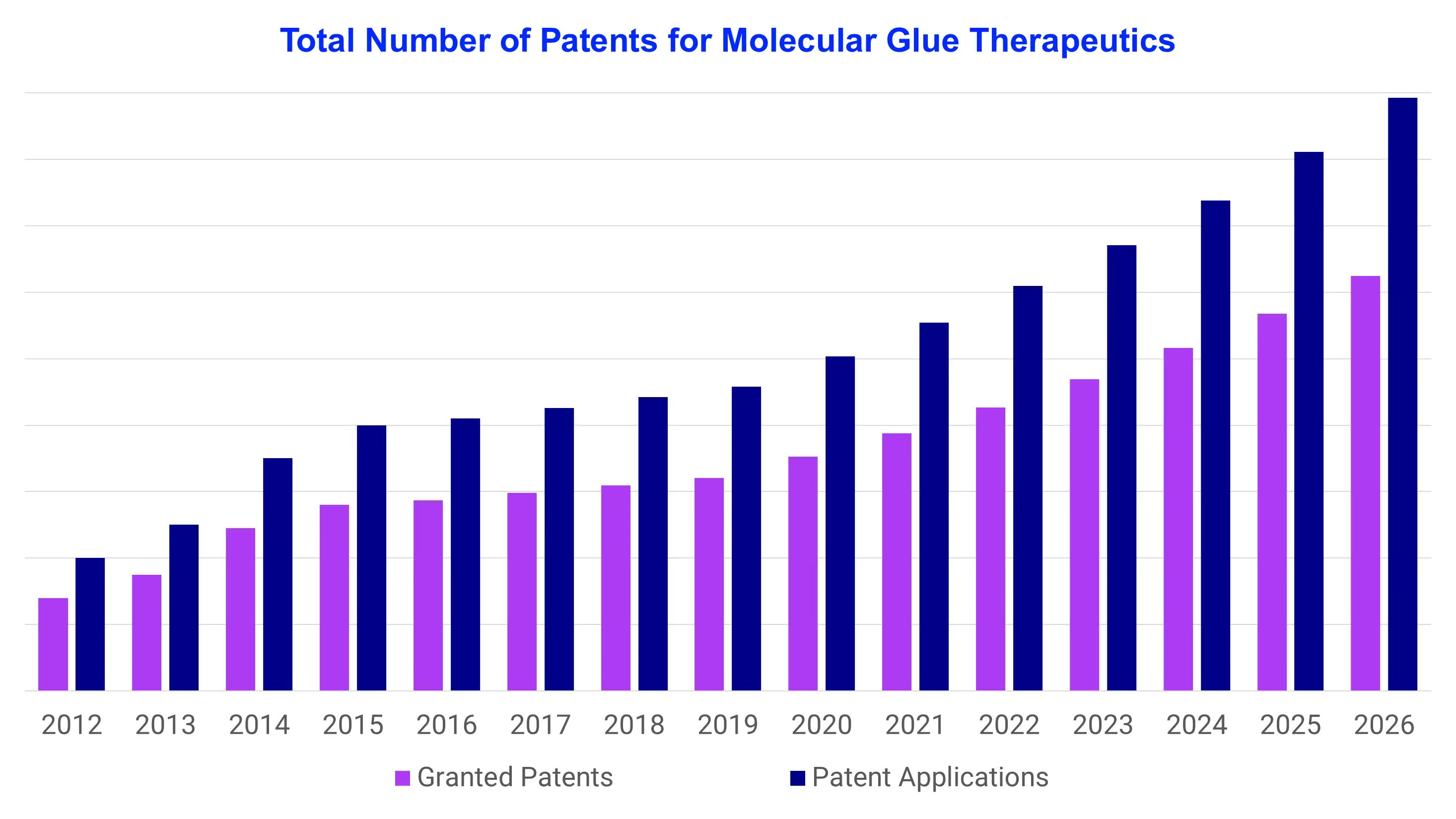
Filing intensity in molecular glue therapeutics has risen steadily since the clinical success of cereblon modulators was matched by structural insight into how glues remodel ligase surfaces. Large pharmaceutical groups have added internal programmes and paid for access to specialist discovery platforms, and each partnership tends to be followed by a new wave of composition-of-matter filings on scaffolds, degrons and substrate lists. Specialist biotechnology companies, many funded through venture rounds and public listings between 2020 and 2022, file early and broadly because patents are their principal balance sheet asset. Academic groups contribute filings on ligase biology and screening methods, though their share is smaller than that of industry.
The analysed set contains more than 5,200 patent families, grouped around six technology clusters: cereblon modulating compounds and next-generation degraders; glues engaging DCAF15, DCAF16 and other substrate receptors; degraders of GSPT1 and zinc finger transcription factors; immunophilin based glues such as rapamycin and tacrolimus analogues; screening and proteomics for rational glue discovery; and oral formulation and combination regimens with bispecific antibodies. Filings peaked between 2020 and 2024, when new family publications ran well above earlier years, led by cereblon compounds and by DCAF-directed chemistry. Cereblon related families remain the largest single group by count.
Rising treated populations in myeloma and lymphoma, together with growing evidence in immunology, have pushed companies to protect successor chemistry and new ligase and target pairs, so patent expansion follows demand that legacy products can no longer meet on their own.
The scope covers global patent filings in molecular glue therapeutics across the United States, China, Europe, Japan, South Korea and India, together with applications filed through the World Intellectual Property Organization. Market coverage spans legacy cereblon modulating drugs, clinical-stage glue degraders and preclinical programmes disclosed in published applications. Granted patents, pending applications and published families are all counted, with legal status used to separate enforceable rights from lapsed filings. The market view runs from 2025 to 2035 and links patent activity to revenue from marketed products and to the expected timing of late-stage readouts.
Technology scope is organised by E3 ligase class (cereblon, DCAF family substrate receptors, other Cullin-RING ligase receptors and non-degrader immunophilin glues), by target class (zinc finger transcription factors, GSPT1 and translation factors, kinases and signaling proteins, cell cycle regulators and other previously undruggable targets) and by therapeutic area (multiple myeloma, lymphomas and leukemias, solid tumors, immunology and inflammation, and neurodegenerative and other disorders). Small molecules that induce or stabilise protein-protein interactions are included. Heterobifunctional degraders are treated only as an adjacent technology boundary.
Entities covered include established pharmaceutical groups with legacy cereblon franchises, specialist biotechnology companies built on glue discovery platforms, Japanese and European oncology developers, and start-ups spun out of university laboratories. Academic and clinical institutions, such as cancer research centres and myeloma treatment networks, appear as applicants and as sites for early clinical work. Contract research organisations and screening technology providers are included where they hold filings on assay or proteomics methods.
The report will cover the following sections in detail:
Analysis by E3 Ligase Class
Analysis by Target Class
Analysis by Therapeutic Area
Molecular Glue Therapeutics Patent Filing Trend Analysis
Patent publications in molecular glue therapeutics have moved from a narrow base centred on thalidomide analogues to a broad, multi-company portfolio over the past decade. Early filings covered cereblon binding scaffolds; later waves added DCAF15 sulfonamides, GSPT1 degraders and screening methods, so the number of distinct chemical series has grown faster than the number of applicants. Grants lag filings by two to four years, and the more than 10 patents granted in 2025 reflect applications made in the early 2020s.
Annual filing growth between 2020 and 2024 is estimated at approximately 12 percent, driven by venture-backed platform companies, new partnerships with large pharmaceutical groups and sustained interest in cereblon successors. A smaller share of the increase comes from China, where domestic developers have raised filings on cereblon modulators and glue screening. Activity on immunophilin based glues has been steadier, in line with an older and narrower field.
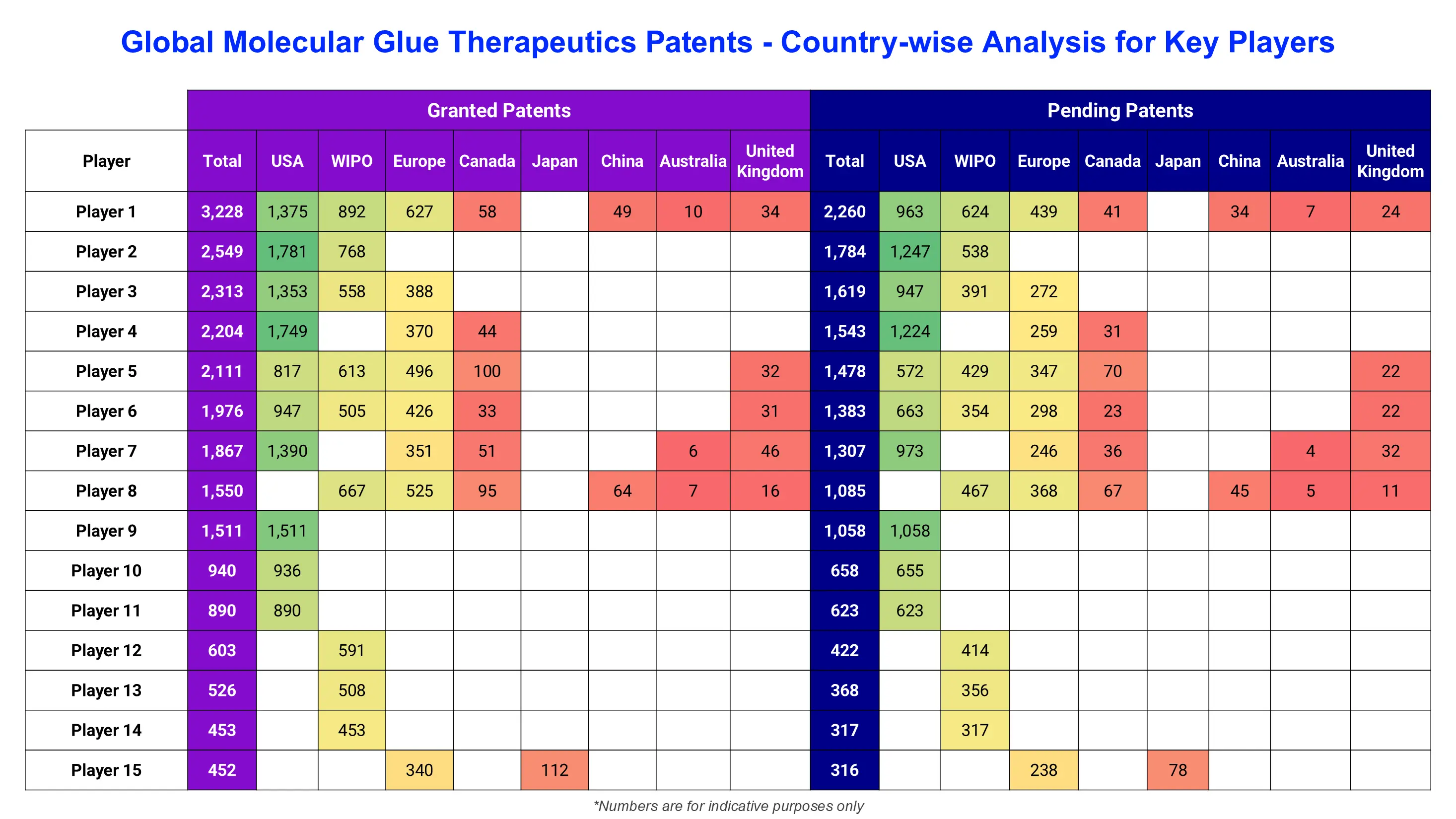
Among the players with molecular glue therapeutics patent families, new entrants have been identified, which can be either established companies or startups developing novel technology in the field. Some of the major companies mentioned in this report (a non-exhaustive list) are as follows:
Celgene Corporation holds the most extensive cereblon modulating portfolio in the field, covering thalidomide, lenalidomide and pomalidomide as well as later modulators and substrate-selective degraders. Its commercial platforms were Thalomid, Revlimid and Pomalyst, which established the immunomodulatory drug class in multiple myeloma and myelodysplastic syndromes with approvals in the United States, Europe and other major markets. Since 2019 the company has been part of Bristol Myers Squibb, which continues to advance iberdomide and mezigdomide in late-stage development alongside clinical-stage GSPT1 degraders. The IP approach layers compound, polymorph, formulation and method-of-use patents, then adds continuation and successor filings to preserve exclusivity as legacy products face generic entry. In commercial terms it is the reference position in the landscape, with the largest marketed revenue base and the deepest clinical pipeline.
Novartis combines a long-standing immunophilin franchise, built on ciclosporin (Sandimmune and Neoral), with an active internal programme in molecular glue degraders. Ciclosporin binds cyclophilin to inhibit calcineurin, a mechanism closely related to glue pharmacology, and the product family has been approved in transplantation and autoimmune indications for decades. Its newer glue and degrader programmes are in preclinical or early clinical stages, and it has pursued external access to discovery platforms through partnerships with specialist biotechnology companies. Patenting centres on composition-of-matter claims for discovery series, with partnership-linked filings added as programmes are licensed or co-developed. Novartis occupies the position of a large pharmaceutical entrant that relies on scale, internal chemistry and collaborations rather than a single flagship glue asset.
Other companies include Monte Rosa Therapeutics, C4 Therapeutics, and Eisai.
Leading assignees hold a meaningful but not dominant share of the portfolio, with a long tail of specialist biotechnology firms and universities making up the rest. Celgene Corporation holds the deepest cereblon estate, built on thalidomide analogues and later modulators, and now sits within Bristol Myers Squibb. Novartis pairs a long history in immunophilin chemistry with internal glue discovery and partnered programmes. Monte Rosa Therapeutics and C4 Therapeutics are platform-led, filing on discovery engines and clinical candidates directed at transcription factors and translation factors. Eisai is associated with the sulfonamide glues that engage DCAF15, exemplified by indisulam.
*Please note that this is only a partial list; the complete list of key players is available in the full report. Additionally, the list of key players can be customized to better suit your needs.*
The report assesses patent activity across major jurisdictions, including:
The United States leads filings, supported by the concentration of cereblon pioneers and venture-funded discovery platforms in Massachusetts and California. China ranks second by volume, with domestic biotechnology companies and universities filing on cereblon modulators and screening methods, while Europe is anchored by Swiss, German and British applicants. South Korea and India contribute smaller but growing numbers, largely from academic groups and firms working on lenalidomide process and formulation claims. WIPO filings under the Patent Cooperation Treaty remain the usual route for companies seeking staged entry across several markets.
Read more about this report - REQUEST FREE SAMPLE COPY IN PDF
Technology activity in molecular glue therapeutics is concentrated in five segments:
Cereblon modulating compounds lead patent activity because the target is clinically validated, structurally well characterised and tied to the largest marketed revenue base. Companies file on successor scaffolds to renew exclusivity as lenalidomide and pomalidomide lose protection, and each new substrate identified for cereblon generates further claims. DCAF family glues are the fastest growing segment from a smaller base, with interest in DCAF15 and DCAF16 chemistry rising as developers look beyond cereblon to reduce dependence on a single ligase.
Competition spans three groups: established pharmaceutical owners of cereblon franchises, platform biotechnology companies, and large developers that partner for access. The cereblon incumbents defend a mature estate while advancing successors in myeloma and lymphoma. Platform companies such as Monte Rosa Therapeutics and C4 Therapeutics compete on discovery speed and on the breadth of ligase and substrate pairs they can claim. Partnerships between large pharmaceutical groups and these specialists have become a common route, usually with milestone structures that tie value to clinical progress. New entrants, including firms from China and Japan, are filing on DCAF family glues and screening technologies, which extends the field beyond the original cereblon group.
Companies are focusing on:
Several themes are emerging. Monovalent degraders of IKZF1 and IKZF3 aim to deepen responses beyond lenalidomide, while GSPT1 degraders have been tested in acute myeloid leukaemia and MYC-driven solid tumours. Systematic mapping of ligase and substrate pairs, supported by chemoproteomics and structural biology, is turning serendipitous glue discovery into a design problem. Applications in lupus and other autoimmune disease are growing as Ikaros and Aiolos degradation is explored outside oncology. Claims on degron sequences and substrate selectivity profiles are also appearing alongside conventional compound claims, which will make freedom-to-operate reviews more detailed.
The molecular glue therapeutics patent landscape combines a mature cereblon estate with a fast-growing set of filings on new ligases, new substrates and discovery methods. Expiring exclusivity on legacy products, active partnerships and the first late-stage data on successors make the current period unusually informative for decisions on freedom to operate and portfolio gaps. Claims increasingly cover degron sequences, ligase binding motifs and combination use rather than composition alone, so reading the landscape means tracking several claim types at once.
The molecular glue therapeutics patent landscape provides actionable intelligence for:
Patent research covered the United States Patent and Trademark Office, the European Patent Office, the China National Intellectual Property Administration, the Japan Patent Office, the Korean Intellectual Property Office, the Indian patent office and WIPO PATENTSCOPE, supplemented by Espacenet and public legal status records. Search strategies combined Cooperative Patent Classification codes for cereblon and ubiquitin ligase chemistry with keywords for named modulators, ligase receptors and substrate proteins. Results were consolidated into patent families so that each invention is counted once across jurisdictions.
Records were screened for relevance to small molecules that induce or stabilise protein-protein interactions, and heterobifunctional degraders, antibody based degraders and unrelated immunosuppressant uses were removed. Remaining families were classified by E3 ligase class, target class, therapeutic area, assignee, jurisdiction and technology cluster. Assignee names were harmonised across subsidiaries and acquisitions so that portfolio sizes reflect corporate ownership as published.
Market analysis support draws on public regulatory approvals, clinical trial registries, company filings and published sales of marketed products to align patent activity with commercial progress. Patent counts are treated as indicators of innovation direction rather than commercial success, and estimates such as growth rates and shares are rounded and approximate. Findings were reviewed for internal consistency before inclusion in the report.


Upto 15% Off
USD
$2699 $2429
$4299 $3869
$5799 $4949
$6999 $5949


*While we strive to always give you current and accurate information, the numbers depicted on the website are indicative and may differ from the actual numbers in the main report. At Expert Market Research, we aim to bring you the latest insights and trends in the market. Using our analyses and forecasts, stakeholders can understand the market dynamics, navigate challenges, and capitalize on opportunities to make data-driven strategic decisions.*
EMR's Molecular Glue Therapeutics Patent Landscape Analysis provides a comprehensive assessment of patent filings, innovation clusters, assignee portfolios, and geographic filing patterns across the molecular glue therapeutics landscape. The report identifies 5,200+ patent families, evaluates leading jurisdictions including the United States, China, and Europe, and profiles the top assignees by portfolio size.
The global molecular glue therapeutics market was valued at USD 9.80 Billion in 2025. The market is projected to reach USD 20.01 Billion by 2035, expanding at a CAGR of 7.40% during 2026 - 2035.
The report analyses approximately 5,200+ patent families related to molecular glue therapeutics. These include filings from the United States, China, Europe, and international WIPO filings.
Key companies operating within the landscape include Celgene Corporation, Novartis, Monte Rosa Therapeutics, C4 Therapeutics, and Eisai, among others. These organisations collectively account for a significant portion of patent activity analysed in this report.
The report evaluates patent activity across the United States, Europe, China, Japan, South Korea, India, and international WIPO filings. The United States is the leading jurisdiction, with more than 3,000 molecular glue therapeutics patents associated with it, which makes it the largest single jurisdiction in the landscape.
Yes. The report scope can be customised based on geography, technology segment, assignee selection, time period, or specific innovation cluster focus. Organisations that need a customised molecular glue therapeutics study, such as a ligase-specific freedom-to-operate review or a competitor portfolio deep dive, can contact the EMR team and describe the targets, companies and jurisdictions of interest.
Patent landscape analysis helps organisations understand innovation trends, competitive activity, technology whitespace, and IP risk across a defined domain. For molecular glue therapeutics, this report supports strategic decisions in R&D prioritisation, licensing evaluation, competitive benchmarking, and market entry planning.
Explore our key highlights of the report and gain a concise overview of key findings, trends, and actionable insights that will empower your strategic decisions.
|
Scope of the Report |
Details |
|
Analysis by E3 Ligase Class |
|
|
Analysis by Target Class |
|
|
Analysis by Therapeutic Area |
|
|
Analysis by End User |
|
|
Key Players Mentioned |
|
|
Geographies Covered |
|
Mini Report
One User
USD 2,699
USD 2,429
tax inclusive*
Single User License
One User
USD 4,299
USD 3,869
tax inclusive*
Five User License
Five User
USD 5,799
USD 4,949
tax inclusive*
Corporate License
Unlimited Users
USD 6,999
USD 5,949
tax inclusive*
*Please note that the prices mentioned below are starting prices for each bundle type. Kindly contact our team for further details.*
Flash Bundle
Small Business Bundle
Growth Bundle
Enterprise Bundle
*Please note that the prices mentioned below are starting prices for each bundle type. Kindly contact our team for further details.*
Flash Bundle
Number of Reports: 3
20%
tax inclusive*
Small Business Bundle
Number of Reports: 5
25%
tax inclusive*
Growth Bundle
Number of Reports: 8
30%
tax inclusive*
Enterprise Bundle
Number of Reports: 10
35%
tax inclusive*
How To Order

Select License Type
Choose the right license for your needs and access rights.

Click on ‘Buy Now’
Add the report to your cart with one click and proceed to register.

Select Mode of Payment
Choose a payment option for a secure checkout. You will be redirected accordingly.
Strategic Solutions for Informed Decision-Making
Gain insights to stay ahead and seize opportunities.

Get insights & trends for a competitive edge.

Track prices with detailed trend reports.

Analyse trade data for supply chain insights.

Leverage cost reports for smart savings

Enhance supply chain with partnerships.

Connect For More Information
Our expert team of analysts will offer full support and resolve any queries regarding the report, before and after the purchase.
Our expert team of analysts will offer full support and resolve any queries regarding the report, before and after the purchase.
We employ meticulous research methods, blending advanced analytics and expert insights to deliver accurate, actionable industry intelligence, staying ahead of competitors.
Our skilled analysts offer unparalleled competitive advantage with detailed insights on current and emerging markets, ensuring your strategic edge.
We offer an in-depth yet simplified presentation of industry insights and analysis to meet your specific requirements effectively.




