

Consumer Insights
Uncover trends and behaviors shaping consumer choices today
Procurement Insights
Optimize your sourcing strategy with key market data
Industry Stats
Stay ahead with the latest trends and market analysis.
The global peptide half-life extension technologies market was valued at USD 7.30 Billion in 2025 and is projected to reach USD 22.88 Billion by 2035, advancing at a CAGR of 12.10%. Demand is driven by the rapid expansion of once-weekly incretin therapies for type 2 diabetes and obesity, patient preference for fewer injections, the migration of peptide hormone replacement toward long-acting analogues, and the use of depot formulations that stretch dosing to monthly and quarterly intervals.
Patent activity reflects this commercial pull, with filings concentrated in lipidation with fatty acids and diacids, polyethylene glycol conjugation and site-specific attachment, Fc and albumin fusion of peptide hormones, recombinant polypeptide extension such as XTEN and PASylation, sustained-release microsphere and depot formulations, and protease-resistant analogues built with non-natural amino acids. Validation signals include approved once-weekly products such as semaglutide, dulaglutide and tirzepatide, a growing set of weekly and monthly candidates in late-stage trials, and steady licensing of platform technologies between specialist developers and large pharmaceutical sponsors.
This Peptide Half-Life Extension Technologies Patent Landscape Analysis Report provides a structured view of filing trends, leading assignees, jurisdiction coverage, technology clusters and competitive positioning across extension strategies, peptide classes and target dosing intervals.
The peptide half-life extension technologies market is experiencing strong growth, driven by once-weekly incretin therapies, rising obesity and type 2 diabetes prevalence, and sponsor demand for less frequent dosing across endocrine and oncology peptides. Semaglutide, whose fatty diacid side chain supports a half-life of roughly one week, illustrates how extension chemistry converts a peptide with a minutes-long native half-life into a mass-market weekly injection.
Patent activity is accelerating, with 100+ peptide half-life extension technologies patents granted in 2025, reflecting strong innovation momentum in lipidation with fatty acids and diacids, polyethylene glycol conjugation and site-specific attachment, Fc and albumin fusion of peptide hormones, and recombinant polypeptide extension such as XTEN and PASylation.
Top assignees in the peptide half-life extension technologies patent landscape include Novo Nordisk, Eli Lilly, Hanmi Pharmaceutical, Sanofi, and Nektar Therapeutics, with the United States, Europe, and China as the dominant patent jurisdictions.
Peptides sit between small molecules and large biologics, offering high target specificity but suffering from rapid renal clearance and enzymatic breakdown that confine natural sequences to circulating half-lives measured in minutes. Half-life extension technologies address that limitation and have become the commercial core of modern peptide drug development, most visibly in the incretin class, where once-weekly injections have replaced daily and twice-daily regimens. Clinical demand is anchored in type 2 diabetes and obesity, yet endocrine, oncology, renal and anti-infective peptides are adopting the same toolkit. Prescribers and payers increasingly treat dosing frequency as a determinant of persistence, so development programmes now set weekly, monthly or quarterly administration as a design target from the outset.
Market growth is driven by the broad uptake of once-weekly incretin and multi-agonist peptides, which has turned long-acting peptide injections from a niche diabetes option into a mass-market chronic therapy for obesity. An estimated 589 million adults were living with diabetes worldwide in 2024, and more than one billion people are affected by obesity, a treatable population large enough to sustain several competing platforms. Insulin icodec, a once-weekly basal insulin, gained European approval in 2024, which shows the same extension logic reaching insulin. Approved reference products for lipidation, Fc fusion and PEGylation also lower regulatory uncertainty for new entrants.
Native GLP-1 is degraded by dipeptidyl peptidase-4 within a couple of minutes, so a peptide without modification cannot support a practical dosing schedule. Acylation with a fatty acid gave liraglutide a half-life of about 13 hours and once-daily use, while the longer diacid chain on semaglutide pushed the half-life to roughly one week; the difference in albumin affinity explains why the second product reshaped prescribing. Fc fusion in dulaglutide reaches a similar weekly interval by a different route, which gives sponsors two validated options and keeps royalty and licensing costs competitive. Longer intervals reduce injection burden, improve adherence and widen the eligible patient pool, and that in turn supports the large-scale manufacturing investments now under way at the leading incretin sponsors.
Read more about this report - REQUEST FREE SAMPLE COPY IN PDF
Filing intensity in peptide half-life extension tracks the revenue growth of incretin products closely. As weekly semaglutide and tirzepatide moved into the largest prescription categories in the United States, sponsors responded with multibillion-dollar manufacturing expansions and broader research budgets for next-generation peptides. Each new programme brings fresh filings on linkers, side chains, sequence variants and delivery devices. Smaller firms add to the volume by patenting platform chemistry that they can license to larger developers, which keeps the annual flow of applications well above what the number of marketed products alone would suggest.
The landscape comprises approximately 13,800+ patent families, with filing activity peaking between roughly 2019 and 2024 as incretin programmes scaled and multi-agonist peptides entered late-stage development. Lipidation with fatty acids and diacids forms the largest cluster, followed by polyethylene glycol conjugation and site-specific attachment, and Fc and albumin fusion of peptide hormones. Recombinant polypeptide extension such as XTEN and PASylation, sustained-release microsphere and depot formulations, and protease-resistant analogues built with non-natural amino acids make up the remaining clusters. Several families span more than one cluster, for example a lipidated analogue formulated as a weekly depot.
Rising prescription volumes for weekly peptide therapies, together with sponsor ambitions for monthly dosing, continue to pull patent filings into every extension chemistry.
This report covers patent families published worldwide, with detailed analysis of the United States, Europe and China, and additional commentary on South Korea, India and filings made through the World Intellectual Property Organization. The market coverage links patent activity to the global peptide half-life extension technologies market, so that innovation trends can be read against the commercial adoption of weekly and longer-acting peptide products from 2026 to 2035.
The technology scope spans extension strategies, including lipidation and fatty acid conjugation, PEGylation, Fc and albumin fusion, recombinant polypeptide extension and sustained-release depot systems. Peptide classes include incretin and metabolic peptides, endocrine hormone analogues, oncology and radiopharmaceutical peptides, antimicrobial and antiviral peptides, and cardiovascular and renal peptides. Target dosing intervals run from daily dosing through weekly, biweekly and monthly regimens to quarterly and longer schedules. Albumin-binding ligand design as a stand-alone field is covered in a separate report and appears here only where it supports a lipidated peptide.
Entities in the landscape include large pharmaceutical manufacturers with marketed long-acting peptides, specialist platform companies that license extension chemistry, and biotechnology start-ups developing new polypeptide extension sequences and depot systems. Contract development and manufacturing organisations hold process filings for peptide synthesis, conjugation and microsphere production. Academic and clinical institutions contribute early-stage work on stabilised sequences and protease-resistant analogues, often through university spin-outs that later enter partnership agreements with larger sponsors.
The report will cover the following sections in detail:
Analysis by Extension Strategy
Analysis by Peptide Class
Analysis by Target Dosing Interval
Peptide Half-Life Extension Technologies Patent Filing Trend Analysis
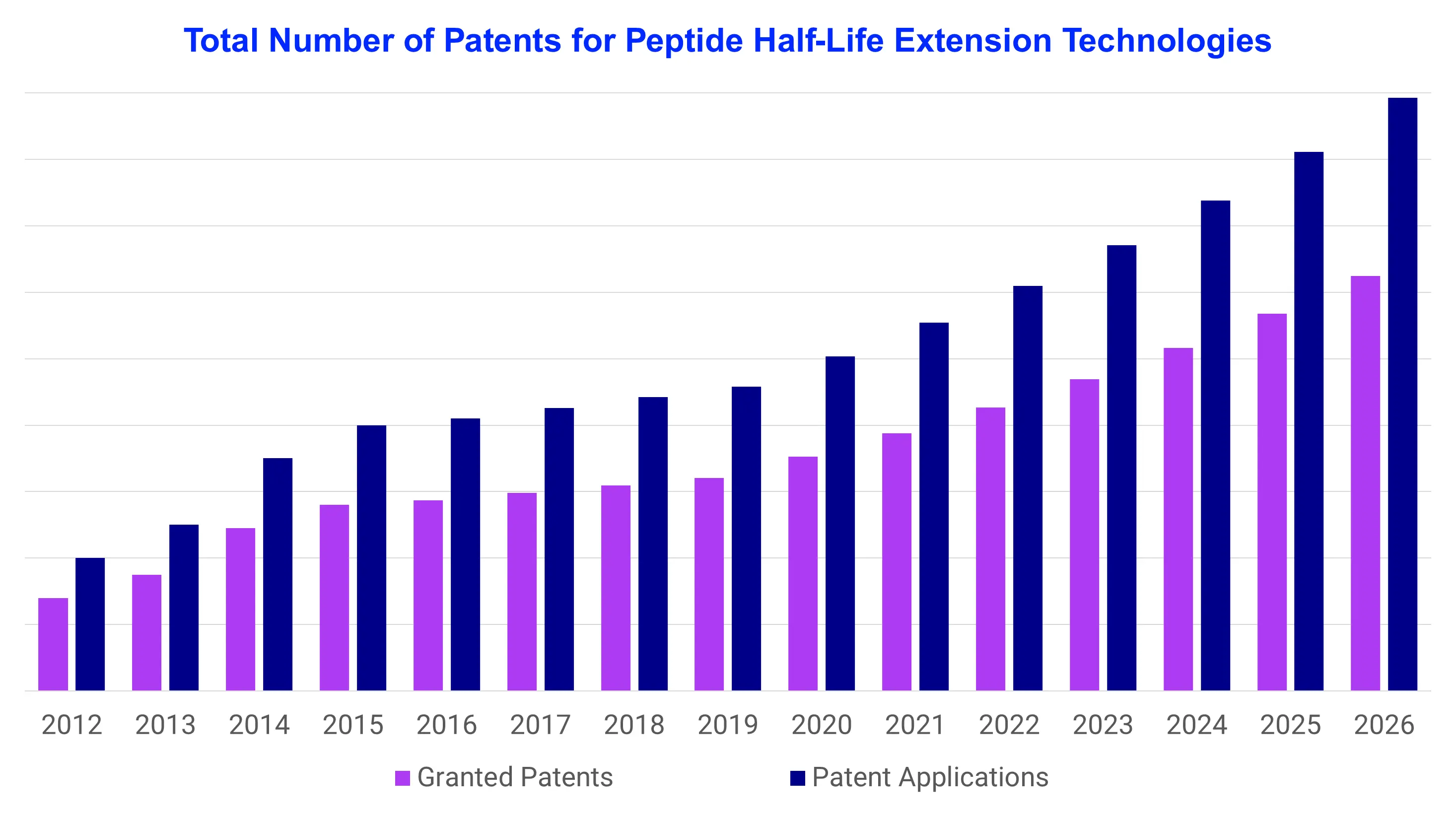
Patent filings in peptide half-life extension have risen steadily over the past decade, moving from a base dominated by insulin analogues and pegylated hormones toward a broad portfolio centred on incretin and multi-agonist peptides. Grant volumes follow filings with a lag of three to four years, which is why 100+ patents were granted in 2025 against a filing wave that began in the late 2010s. The balance of activity has also shifted from single-modification claims to combined strategies that pair lipidation, sequence engineering and formulation in one family.
Annual filing growth between 2020 and 2024 is estimated at roughly 9 to 10 percent, a pace that outstrips the wider peptide patent base. The main driver was the commercial success of weekly semaglutide and tirzepatide, which prompted competitors in the United States, Europe, China and South Korea to file their own acylation, Fc fusion and depot programmes. Interest in monthly dosing for obesity added a further layer of applications, particularly for microsphere and in-situ forming depot systems that promise intervals beyond one week.
Among the players with peptide half-life extension technologies patent families, new entrants have been identified, which can be either established companies or startups developing novel technology in the field. Some of the major companies mentioned in this report (a non-exhaustive list) are as follows:
Novo Nordisk holds the broadest portfolio in acylated peptides, built on attaching fatty acids or fatty diacids to a peptide backbone so that the molecule binds serum albumin and circulates for days rather than minutes. Its commercial platforms include insulin detemir (Levemir), liraglutide (Victoza and Saxenda), semaglutide (Ozempic, Wegovy and the oral tablet Rybelsus) and insulin degludec (Tresiba), which applies a related fatty-acid design to ultra-long insulin action. Most of these products carry FDA and European Medicines Agency approval, and the once-weekly basal insulin icodec has received European approval. The IP strategy layers composition claims on specific side-chain linkers with formulation, dosing-regimen and device filings, then extends protection through combinations such as cagrilintide with semaglutide. Within the landscape the company is the reference point against which other lipidation and weekly-dosing programmes are positioned.
Eli Lilly combines two distinct extension routes, Fc fusion and fatty diacid acylation, across its incretin franchise. Dulaglutide (Trulicity) fuses a GLP-1 analogue to a modified immunoglobulin Fc fragment and has been approved for once-weekly use since 2014, while tirzepatide (Mounjaro for type 2 diabetes and Zepbound for chronic weight management) pairs a dual GIP and GLP-1 agonist sequence with a C20 fatty diacid. Both are approved by the FDA and in other major markets, and further multi-agonist peptides and a once-weekly Fc-based insulin are in late-stage development. Patent strategy centres on sequence and linker claims for multi-agonist peptides, supported by dosing-regimen and device filings. The company holds the second-largest position in the landscape and is the principal challenger to Novo Nordisk in weekly metabolic peptides.
Other companies include Hanmi Pharmaceutical, Sanofi, and Nektar Therapeutics.
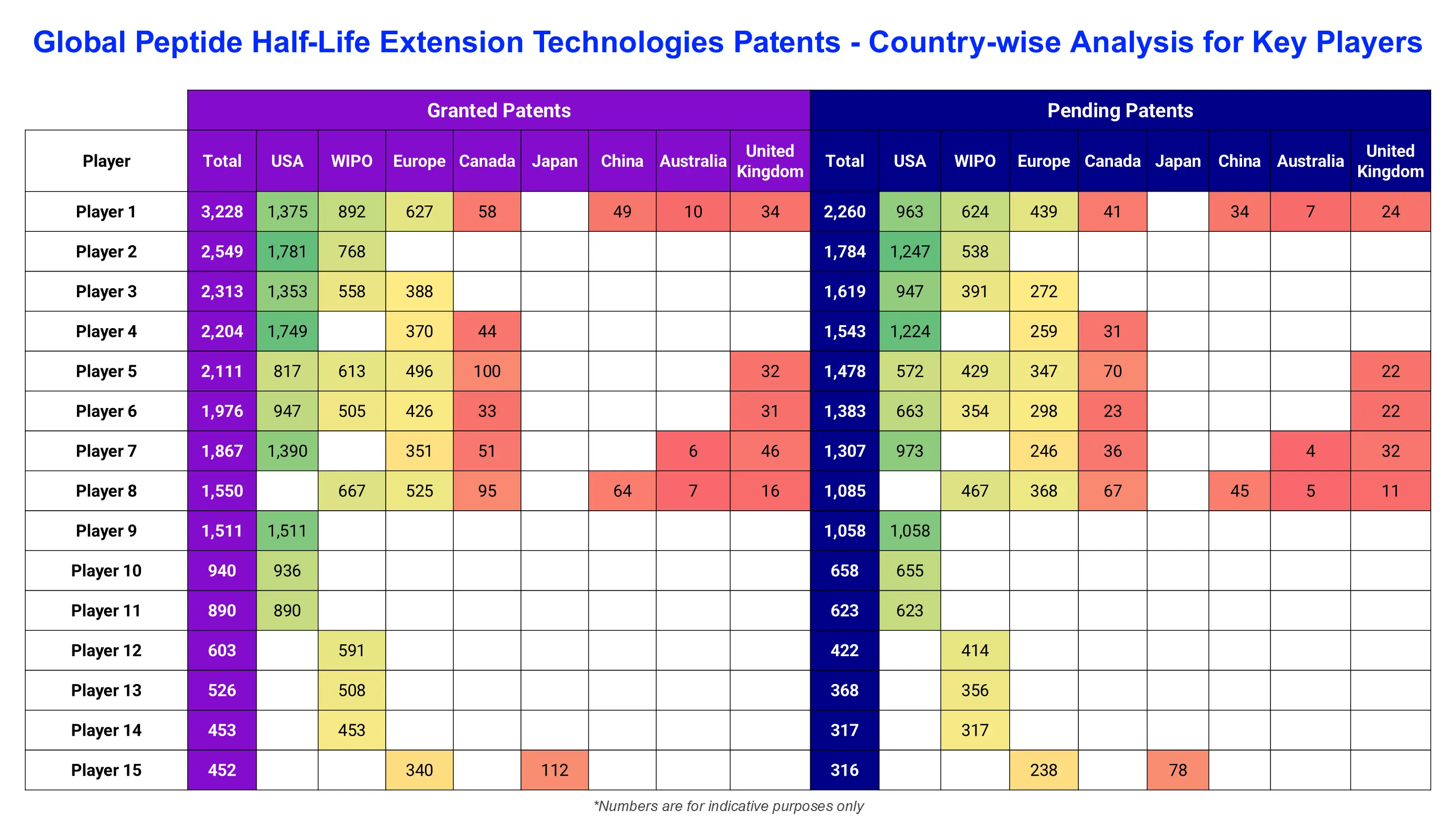
Patent ownership is moderately concentrated, with Novo Nordisk, Eli Lilly, Hanmi Pharmaceutical, Sanofi and Nektar Therapeutics holding a large share of the family count among the leading assignees. Novo Nordisk and Eli Lilly build dense portfolios around acylation chemistry, multi-agonist sequences and dosing regimens, defending their weekly franchises with layered claims. Hanmi Pharmaceutical concentrates on its long-acting platform and the licensing of that technology to partners. Sanofi combines legacy insulin and incretin filings with recombinant polypeptide extension assets, while Nektar Therapeutics maintains a focused position in polyethylene glycol conjugation chemistry that supports partnered products.
*Please note that this is only a partial list; the complete list of key players is available in the full report. Additionally, the list of key players can be customized to better suit your needs.*
The report assesses patent activity across major jurisdictions, including:
The United States leads in both filing volume and commercial relevance, reflecting the size of its diabetes and obesity treatment market and the presence of the principal incretin sponsors. Europe follows, anchored by Danish, French and German applicants and by the European Patent Office route for regional protection. China has grown quickly as domestic developers advance their own weekly GLP-1 programmes and depot formulations. South Korea contributes a notable share through Hanmi Pharmaceutical and other platform developers. India shows smaller but rising activity tied to peptide manufacturing and biosimilar-oriented work, and WIPO filings serve as the main vehicle for multinational families seeking staged national entry.
Read more about this report - REQUEST FREE SAMPLE COPY IN PDF
The landscape divides into five principal technology segments:
Lipidation and fatty acid conjugation leads patent activity, because acylated analogues underpin the best-selling weekly products and allow dosing intervals to be tuned through chain length and linker design. The approach also suits small peptides that would lose activity if fused to a large carrier. Fc and albumin fusion follows, with a steady flow of filings on modified Fc fragments and half-life tuned linkers, while depot systems attract growing interest as sponsors pursue monthly and quarterly regimens.
The competitive field is led by a small group of incretin sponsors with deep portfolios in lipidation and fusion, supported by platform companies that hold specialised extension chemistry and a widening group of Chinese and South Korean developers. Competition is moving from single weekly products toward multi-agonist peptides and longer intervals, so newer filings tend to combine sequence design, extension chemistry and formulation. Licensing agreements remain common, since smaller platform owners often lack the clinical and manufacturing scale to take a peptide through late-stage development alone.
Companies are focusing on:
Emerging themes include peptides engineered for monthly and quarterly injection, genetically encoded polypeptide tails that replace chemical conjugation, and in-situ forming depots that avoid the burst release seen with early microsphere products. Another theme is the pairing of extension chemistry with multi-agonist sequences, as seen in tirzepatide and in candidates that target glucagon, GIP and amylin receptors. Oral peptide delivery, exemplified by semaglutide tablets with an absorption enhancer, is also drawing filings that combine permeation technology with extended systemic exposure.
The patent landscape for peptide half-life extension technologies maps where sponsors have concentrated protection, which extension chemistries remain open, and how quickly new peptide classes are adopting proven approaches. It shows that incretin products dominate filings, while endocrine, oncology and renal peptides are beginning to follow, offering clearer white space for developers outside the metabolic field.
The patent landscape provides actionable intelligence for the following strategic uses:
Patent research drew on global patent databases, including those of the United States Patent and Trademark Office, the European Patent Office, the China National Intellectual Property Administration and WIPO, using keyword, classification code and assignee searches built around peptide half-life extension. Searches covered lipidation, PEGylation, Fc and albumin fusion, recombinant polypeptide extension and depot formulations across published applications and granted patents.
Records were screened to remove duplicates, merge related applications into patent families and exclude documents that mention extension only in passing. Remaining families were classified by extension strategy, peptide class, target dosing interval, assignee, jurisdiction and filing year, with technology clusters assigned on the basis of claim language and cooperative patent classification codes. Families with unclear scope were reviewed manually against claim text, and assignee names were harmonised so that subsidiaries and licensing partners were grouped under a single parent entity.
Market analysis support came from regulatory approval records, company disclosures, clinical trial registries and published scientific literature. These inputs were used to align patent activity with commercial adoption of long-acting peptides, to identify products and platforms associated with leading assignees, and to place filing trends within the broader peptide therapeutics market. Estimates of annual filing growth and peak filing periods are approximate and are presented as directional indicators of innovation activity.


Upto 15% Off
USD
$2699 $2429
$4299 $3869
$5799 $4949
$6999 $5949


*While we strive to always give you current and accurate information, the numbers depicted on the website are indicative and may differ from the actual numbers in the main report. At Expert Market Research, we aim to bring you the latest insights and trends in the market. Using our analyses and forecasts, stakeholders can understand the market dynamics, navigate challenges, and capitalize on opportunities to make data-driven strategic decisions.*
EMR's Peptide Half-Life Extension Technologies Patent Landscape Analysis provides a comprehensive assessment of patent filings, innovation clusters, assignee portfolios, and geographic filing patterns across the peptide half-life extension technologies landscape. The report identifies 13,800+ patent families, evaluates leading jurisdictions including the United States, Europe, and China, and profiles the top assignees by portfolio size.
The global peptide half-life extension technologies market was valued at USD 7.30 Billion in 2025. The market is projected to reach USD 22.88 Billion by 2035, expanding at a CAGR of 12.10% during 2026 - 2035.
The report analyses approximately 13,800+ patent families related to peptide half-life extension technologies. These include filings from the United States, Europe, China, and international WIPO filings.
Key companies operating within the landscape include Novo Nordisk, Eli Lilly, Hanmi Pharmaceutical, Sanofi, and Nektar Therapeutics, among others. These organisations collectively account for a significant portion of patent activity analysed in this report.
The report evaluates patent activity across the United States, Europe, China, Japan, South Korea, India, and international WIPO filings. The United States is the largest single jurisdiction in the landscape, with 7,700+ associated patents out of 13,800+ patent families analysed, reflecting the concentration of incretin and insulin commercialisation in that market.
Yes. The report scope can be customised based on geography, technology segment, assignee selection, time period, or specific innovation cluster focus. Readers who need a customised study, such as a narrower technology cluster, additional jurisdictions or a defined set of assignees, can contact the EMR team to scope the work and agree deliverables.
Patent landscape analysis helps organisations understand innovation trends, competitive activity, technology whitespace, and IP risk across a defined domain. For peptide half-life extension technologies, this report supports strategic decisions in R&D prioritisation, licensing evaluation, competitive benchmarking, and market entry planning.
Explore our key highlights of the report and gain a concise overview of key findings, trends, and actionable insights that will empower your strategic decisions.
|
Scope of the Report |
Details |
|
Analysis by Extension Strategy |
|
|
Analysis by Peptide Class |
|
|
Analysis by Target Dosing Interval |
|
|
Analysis by End User |
|
|
Key Players Mentioned |
|
|
Geographies Covered |
|
Mini Report
One User
USD 2,699
USD 2,429
tax inclusive*
Single User License
One User
USD 4,299
USD 3,869
tax inclusive*
Five User License
Five User
USD 5,799
USD 4,949
tax inclusive*
Corporate License
Unlimited Users
USD 6,999
USD 5,949
tax inclusive*
*Please note that the prices mentioned below are starting prices for each bundle type. Kindly contact our team for further details.*
Flash Bundle
Small Business Bundle
Growth Bundle
Enterprise Bundle
*Please note that the prices mentioned below are starting prices for each bundle type. Kindly contact our team for further details.*
Flash Bundle
Number of Reports: 3
20%
tax inclusive*
Small Business Bundle
Number of Reports: 5
25%
tax inclusive*
Growth Bundle
Number of Reports: 8
30%
tax inclusive*
Enterprise Bundle
Number of Reports: 10
35%
tax inclusive*
How To Order

Select License Type
Choose the right license for your needs and access rights.

Click on ‘Buy Now’
Add the report to your cart with one click and proceed to register.

Select Mode of Payment
Choose a payment option for a secure checkout. You will be redirected accordingly.
Strategic Solutions for Informed Decision-Making
Gain insights to stay ahead and seize opportunities.

Get insights & trends for a competitive edge.

Track prices with detailed trend reports.

Analyse trade data for supply chain insights.

Leverage cost reports for smart savings

Enhance supply chain with partnerships.

Connect For More Information
Our expert team of analysts will offer full support and resolve any queries regarding the report, before and after the purchase.
Our expert team of analysts will offer full support and resolve any queries regarding the report, before and after the purchase.
We employ meticulous research methods, blending advanced analytics and expert insights to deliver accurate, actionable industry intelligence, staying ahead of competitors.
Our skilled analysts offer unparalleled competitive advantage with detailed insights on current and emerging markets, ensuring your strategic edge.
We offer an in-depth yet simplified presentation of industry insights and analysis to meet your specific requirements effectively.




