

Consumer Insights
Uncover trends and behaviors shaping consumer choices today
Procurement Insights
Optimize your sourcing strategy with key market data
Industry Stats
Stay ahead with the latest trends and market analysis.
The Fc-engineered antibody therapeutics market was valued at USD 12.40 Billion in 2025 and is projected to reach USD 41.35 Billion by 2035, advancing at a CAGR of 12.80% over the forecast period. Demand is shaped by the shift toward long-acting biologics that reduce dosing frequency, the use of enhanced effector function to improve tumour cell killing, the growth of FcRn-directed therapies in autoantibody-driven disease, and the adoption of extended half-life antibodies for infectious disease prophylaxis. Marketed products such as obinutuzumab, benralizumab, ravulizumab and nirsevimab show how deliberate changes to the Fc region translate into clinical and commercial differentiation.
Patent activity is concentrated in FcRn binding engineering for longer half-life and dosing intervals, afucosylation and glycoengineering for enhanced cell killing, Fc silencing to remove unwanted effector activity, and complement activity modulation through C1q and Fc gamma receptor tuning. Further clusters cover pH-dependent antigen binding and recycling antibodies, and Fc fragment and Fc fusion formats that act as FcRn antagonists. Commercial validation is visible in the 2021 approval of efgartigimod, in long-acting antibodies such as ravulizumab and nirsevimab, and in a growing set of T-cell engaging antibodies that depend on silenced Fc regions. Filing volumes remain high across the United States, Europe and Japan.
This Fc-Engineered Antibody Therapeutics Patent Landscape Analysis Report provides a structured view of patent filing trends, leading assignees, jurisdiction-level activity, technology clusters and competitive positioning across Fc engineering strategies, therapeutic areas and antibody formats.
The Fc-engineered antibody therapeutics market is experiencing strong growth, driven by demand for longer dosing intervals, the clinical value of enhanced effector function in oncology, and the expansion of FcRn-targeted treatment in autoimmune disease. Ravulizumab, for example, is given every eight weeks in maintenance therapy, compared with every two weeks for the earlier antibody eculizumab.
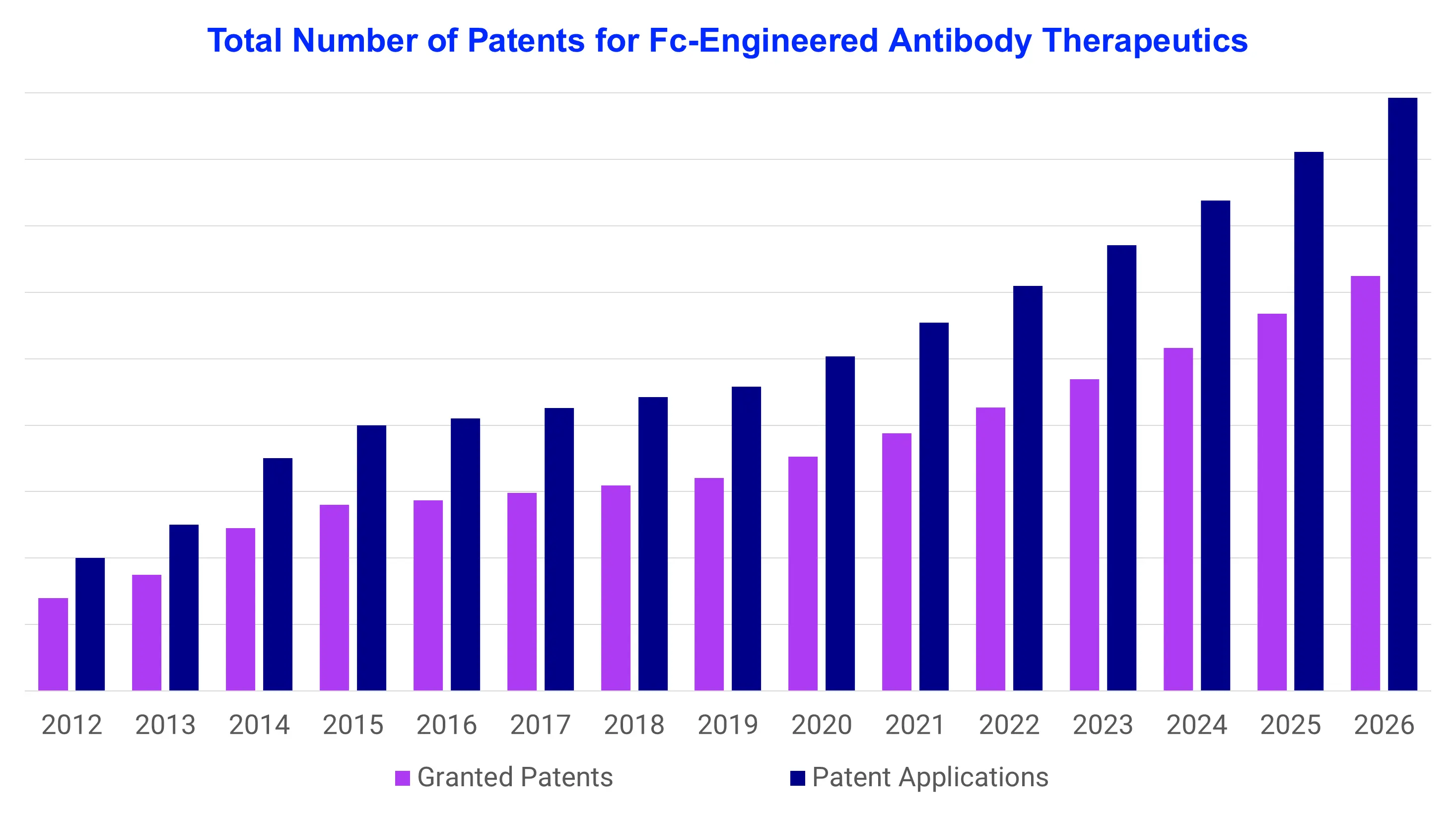
Patent activity is accelerating, with 100+ Fc-engineered antibody therapeutics patents granted in 2025, reflecting strong innovation momentum in FcRn binding engineering for longer half-life and dosing intervals, afucosylation and glycoengineering for enhanced cell killing, Fc silencing to remove unwanted effector activity, and complement activity modulation through C1q and Fc gamma receptor tuning.
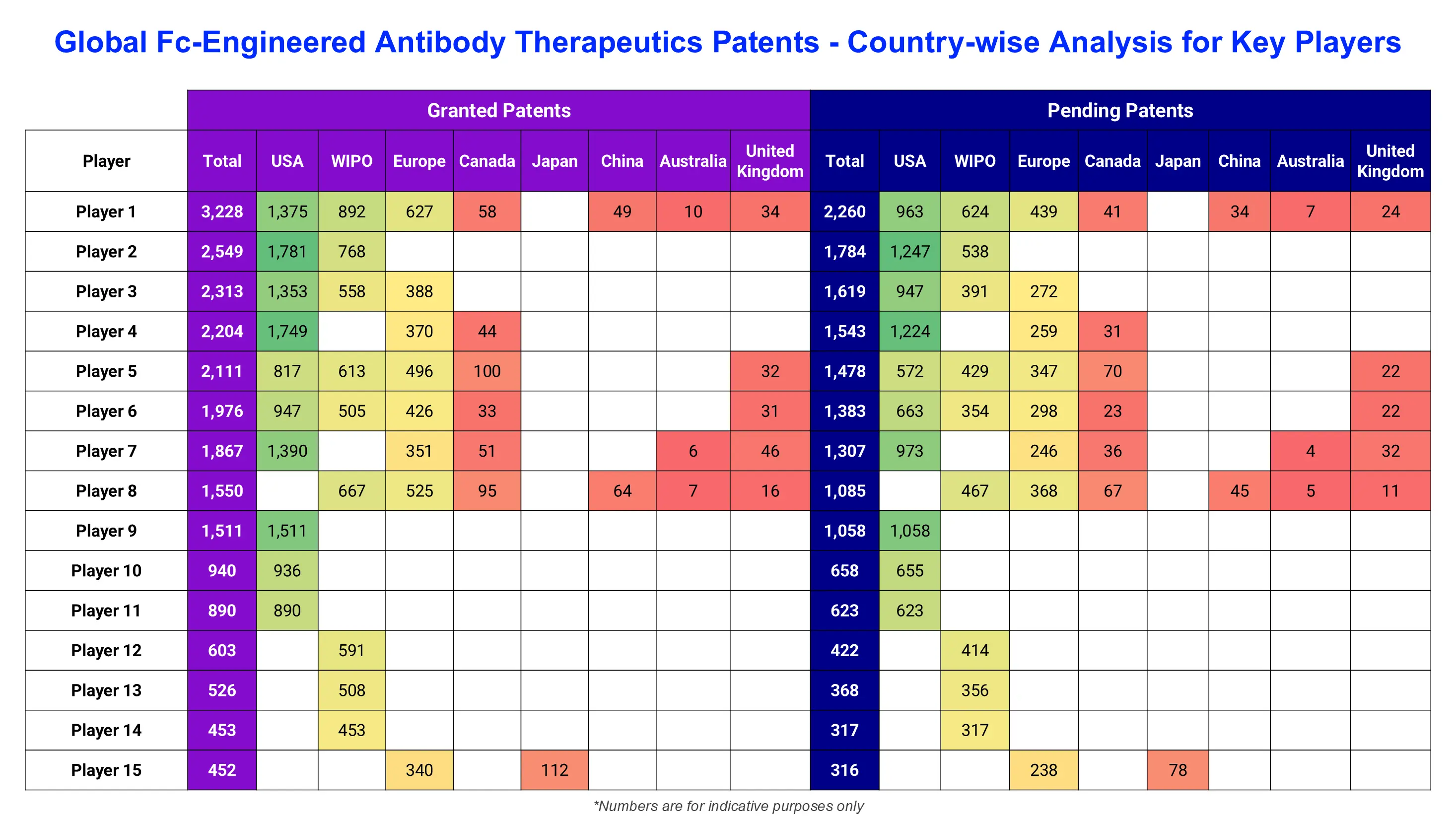
Top assignees in the Fc-engineered antibody therapeutics patent landscape include Genentech, Xencor, Chugai Pharmaceutical, Kyowa Kirin, and AstraZeneca, with the United States, Europe, and Japan as the dominant patent jurisdictions.
Fc-engineered antibody therapeutics have moved from a refinement of immunoglobulin G to a core design principle in modern biologics development. Changes to the Fc region let developers tune how long an antibody stays in circulation, how strongly it recruits natural killer cells and complement, and whether it triggers any immune activity at all. Oncology, autoimmune disease, rare complement-mediated disorders and infectious disease prophylaxis each draw on a different part of that toolkit. Clinicians and payers value fewer infusions, less frequent injections and targeted depletion of diseased cells, while developers use Fc design to extend product life cycles and set their antibodies apart from biosimilar entrants.
Market growth is driven by the clinical and commercial advantage of long-acting antibodies, which reduce dosing frequency and improve adherence in chronic and rare diseases. Nirsevimab, an extended half-life antibody given as a single dose per respiratory syncytial virus season, targets a virus that causes an estimated 33 million lower respiratory infections in children under five each year, so the prophylaxis opportunity is large. Efgartigimod, approved in 2021 for generalised myasthenia gravis, showed that an Fc fragment can act as the drug itself and opened a separate FcRn antagonist class.
Obinutuzumab, mogamulizumab and benralizumab carry glycoengineered or afucosylated Fc regions that bind Fc gamma receptor IIIa on natural killer cells more tightly, which raises antibody-dependent cellular cytotoxicity and supports activity in lymphoid malignancies and eosinophilic disease. Benralizumab is dosed every eight weeks after an initial loading phase in severe eosinophilic asthma, so Fc design shapes convenience as well as mechanism. Ravulizumab is given every eight weeks in maintenance, against every two weeks for eculizumab, showing how FcRn engineering can lengthen intervals in ultra-rare complement-mediated disease. These examples explain why originators now treat Fc modification as a routine life-cycle tool, and why biosimilar developers face a harder comparability task for engineered molecules.
Read more about this report - Request a Free Sample
Filing intensity in Fc-engineered antibody therapeutics stays high because each approved product tends to generate follow-on claims on variants, glycoforms, formulations and dosing regimens. Applications have clustered after commercial milestones, including the approvals of obinutuzumab and benralizumab, the arrival of extended half-life antibodies in respiratory virus prophylaxis, and the 2021 approval of efgartigimod. Large developers fund broad Fc variant families to secure freedom to operate for bispecific and multispecific programmes, while specialist platform companies file to support licensing income. Clinical investment and patent filing therefore move together, with claims on Fc mutations often filed years before a first pivotal study reports.
The landscape covers more than 11,200 patent families, counted at family level so that a single invention filed in several jurisdictions is not counted twice. Filing activity peaked between roughly 2019 and 2023, an estimate based on earliest priority dates, as FcRn antagonists, silenced Fc backbones and recycling antibodies entered late-stage development. The largest technology clusters are FcRn binding engineering for longer half-life and dosing intervals, afucosylation and glycoengineering for enhanced cell killing, and Fc silencing to remove unwanted effector activity. Complement modulation through C1q and Fc gamma receptor tuning, pH-dependent antigen binding, and Fc fragment and Fc fusion formats form the remaining clusters.
Rising demand for long-acting, effector-tuned and FcRn-targeted antibodies carries directly into patent expansion, because every new clinical use creates a fresh need to protect Fc variants, formats and dosing regimens.
The scope covers patent families published worldwide, with detailed assessment of the United States, Europe and Japan as the principal jurisdictions, supported by coverage of South Korea, India and international applications filed through WIPO. Market coverage spans the global Fc-engineered antibody therapeutics market, from clinical-stage candidates to marketed products such as obinutuzumab, benralizumab, ravulizumab and nirsevimab. More than 11,200 patent families are analysed, and more than 100 patents granted in 2025 form the most recent grant reference point. Families are grouped by earliest priority year to show how filing waves relate to clinical and regulatory events.
The technology scope covers five Fc engineering strategies: effector function enhancement, effector function silencing, FcRn engineering for half-life extension, glycoengineering and afucosylation, and complement activity modulation. Therapeutic coverage includes oncology, autoimmune and inflammatory diseases, complement-mediated and rare diseases, infectious diseases and neurology. Antibody formats range from full-length IgG1 antibodies and IgG2 and IgG4 antibodies to Fc fusion proteins and isolated Fc fragments. Bispecific and multispecific constructs are included only where the Fc region itself has been deliberately modified, which keeps the scope centred on Fc design and not on antigen-binding format.
Entities within scope include large integrated biopharmaceutical groups such as Genentech, AstraZeneca and Chugai Pharmaceutical, specialist platform companies such as Xencor, and Japanese antibody engineering leaders such as Kyowa Kirin. Emerging biotechnology start-ups developing FcRn antagonists, silenced Fc formats and recycling antibodies are also covered. Contract development and manufacturing organisations that supply glycoengineered cell lines and Fc-modified production capacity form a further group. Academic and clinical institutions that publish Fc variant structures and run early trials of engineered antibodies complete the entity set.
The report will cover the following sections in detail:
Analysis by Fc Engineering Strategy
Analysis by Therapeutic Area
Analysis by Antibody Format
Fc-Engineered Antibody Therapeutics Patent Filing Trend Analysis
Annual filing activity has risen since the mid-2010s, and granted patents reached more than 100 in 2025. Early filings centred on amino acid substitutions that alter Fc gamma receptor binding and on afucosylated production cell lines. Later applications added pH-dependent FcRn binding, silenced Fc backbones for bispecific antibodies and Fc fragments with antagonist activity. Because grant lags filing by several years, the 2025 total reflects applications made around 2019 to 2021, when interest in FcRn-directed and effector-silenced formats was building.
Annual filing growth between 2020 and 2024 is estimated at approximately 6% per year. Growth was driven by the clinical success of efgartigimod and the wave of FcRn antagonist programmes that followed, by demand for silenced Fc regions in T-cell engaging antibodies, and by extended half-life antibodies for respiratory virus prevention. Glycoengineering filings grew more slowly from a mature base. A steadier contribution came from academic groups and smaller biotechnology firms filing on receptor-selective Fc variants.
Among the players with Fc-engineered antibody therapeutics patent families, new entrants have been identified, which can be either established companies or startups developing novel technology in the field. Some of the major companies mentioned in this report (a non-exhaustive list) are as follows:
Genentech holds one of the broadest Fc engineering portfolios in the landscape, covering glycoengineered effector enhancement, Fc silencing and heterodimeric Fc formats used in bispecific antibodies. Obinutuzumab (Gazyva), the glycoengineered anti-CD20 antibody developed within the Roche group and first approved in the United States in 2013, remains the clearest commercial proof of its afucosylation work. Silenced Fc backbones support newer bispecific products from the same group, including faricimab and T-cell engaging antibodies such as mosunetuzumab and glofitamab. Its IP approach combines platform-level claims on Fc mutations and glycan composition with product-specific claims on antibody sequences and dosing, filed across the United States, Europe and Japan. Genentech is positioned as both a platform owner and an end-product developer, which makes its families a standard reference point for freedom-to-operate reviews.
Xencor built its business on the XmAb Fc platform, which includes Fc variants for extended half-life, enhanced cytotoxicity and immune inhibition, together with bispecific Fc formats. Tafasitamab (Monjuvi), which carries an engineered Fc domain for stronger cell killing, received accelerated approval in the United States in 2020 for relapsed or refractory diffuse large B-cell lymphoma in combination with lenalidomide, and is commercialised through a collaboration. The Xtend half-life technology has been licensed to several partners, and royalty income arises from marketed antibodies that use it. Its IP strategy relies on dense families of Fc variant claims that are licensed outward while an internal pipeline of bispecific and immunology candidates is advanced. Xencor occupies the specialist platform position in the landscape, in contrast to the larger integrated developers around it.
Other companies include Chugai Pharmaceutical, Kyowa Kirin, and AstraZeneca.
Leading assignees hold a large share of high-value Fc families, yet the landscape is less concentrated than a single-platform field because many mid-sized firms and universities hold narrow variant claims. Genentech and Chugai Pharmaceutical, both within the Roche group, file across glycoengineering, silencing and recycling antibody technology. Xencor concentrates on licensable Fc variant platforms, and Kyowa Kirin anchors its position on afucosylation through its POTELLIGENT technology. AstraZeneca builds on half-life extension technology inherited from MedImmune and on the complement franchise gained with Alexion. Taken together, these five groups pair platform claims with product-specific claims, so cross-licensing and freedom-to-operate review are routine parts of development.
*Please note that this is only a partial list; the complete list of key players is available in the full report. Additionally, the list of key players can be customized to better suit your needs.*
The report assesses patent activity across major jurisdictions, including:
The United States leads filing activity in Fc-engineered antibody therapeutics, supported by large biopharmaceutical sponsors, a deep pool of clinical trials and broad allowance of claims to engineered antibody variants. Europe, filed mainly through the European Patent Office, follows closely. Japan holds a position larger than its market share would suggest, because Kyowa Kirin and Chugai Pharmaceutical have run antibody engineering programmes for many years. South Korea has a growing base of next-generation antibody and biosimilar developers, and India shows rising filings from biologics manufacturers and research institutes. WIPO international applications are used by most leading assignees to keep options open in several jurisdictions at once.
Read more about this report - Request a Free Sample
Patent activity in Fc-engineered antibody therapeutics is organised into five technology segments:
FcRn binding engineering leads patent activity because half-life extension applies across oncology, autoimmune disease, rare disease and infectious disease, and because longer dosing intervals are valued by both patients and payers. Ravulizumab and nirsevimab are the best-known marketed examples. Glycoengineering holds a strong second position, anchored by obinutuzumab, mogamulizumab and benralizumab. Fc silencing is the fastest-growing segment, driven by the need for clean Fc backbones in T-cell engaging and bispecific antibodies.
Competition centres on who owns the Fc mutations, glycan profiles and formats that regulators have already reviewed in approved products. Large integrated groups defend broad families around marketed antibodies, while specialist platform companies license Fc technologies to many partners, so one approved product can sit on several overlapping rights. Efgartigimod, developed by argenx, created a separate competitive cluster around Fc fragment FcRn antagonists, and several other developers are advancing FcRn-directed biologics in clinical studies. University groups also file on Fc variants with altered receptor selectivity, and these later reach company portfolios through licensing.
Companies are focusing on:
Several themes are emerging at the edge of the landscape. Fc engineering is being combined with bispecific and multispecific designs, where silenced backbones help limit cytokine release. Antibodies with pH-dependent binding and Fc modifications that clear antigen from circulation are being explored to cut dosing frequency. Subcutaneous delivery of Fc-engineered antibodies, supported by hyaluronidase co-formulation, is gaining attention, as are Fc variants designed to improve transport into the brain in neurology and mucosal protection against respiratory infection. Computational design and machine learning are increasingly used to predict Fc variant stability and receptor binding before laboratory work begins.
The Fc-engineered antibody therapeutics patent landscape maps who holds rights over FcRn binding variants, afucosylation methods, silenced Fc backbones, complement-modulating mutations and Fc fragment formats across more than 11,200 patent families. It shows how portfolios are distributed among Genentech, Xencor, Chugai Pharmaceutical, Kyowa Kirin and AstraZeneca, and how smaller entrants position around narrower claims. Jurisdiction patterns across the United States, Europe and Japan indicate where protection is strongest. Technology clusters, grant trends and commercial anchors such as obinutuzumab, ravulizumab and efgartigimod give context for assessing which areas remain open and which are crowded.
The landscape provides actionable intelligence for the following nine uses:
Patent research was carried out across major patent databases, including those covering the United States Patent and Trademark Office, the European Patent Office, the Japan Patent Office, and WIPO international applications. Queries combined keywords on Fc region modification, FcRn binding, afucosylation, Fc silencing and complement modulation with related antibody classification codes. Results were collected at the publication level and then grouped into families so that each invention is counted once.
Records were screened for relevance to deliberate modification of the Fc region, and filings that mention Fc only as a generic antibody component were excluded. Retained families were classified by Fc engineering strategy, therapeutic area, antibody format and technology cluster. Assignee names were harmonised across subsidiaries and name variants, and jurisdiction was assigned from the filing office and priority data.
Patent findings were set against market information from regulatory records, company disclosures, clinical trial registries and published scientific literature. This allowed filing waves to be linked to approvals, pipeline progress and licensing activity in Fc-engineered antibody therapeutics. Market figures in the report follow the standard EMR forecasting framework, and patent counts that are estimates are stated as approximate.


Upto 15% Off
USD
$2699 $2429
$4299 $3869
$5799 $4949
$6999 $5949


*While we strive to always give you current and accurate information, the numbers depicted on the website are indicative and may differ from the actual numbers in the main report. At Expert Market Research, we aim to bring you the latest insights and trends in the market. Using our analyses and forecasts, stakeholders can understand the market dynamics, navigate challenges, and capitalize on opportunities to make data-driven strategic decisions.*
EMR's Fc-Engineered Antibody Therapeutics Patent Landscape Analysis provides a comprehensive assessment of patent filings, innovation clusters, assignee portfolios, and geographic filing patterns across the Fc-engineered antibody therapeutics landscape. The report identifies 11,200+ patent families, evaluates leading jurisdictions including the United States, Europe, and Japan, and profiles the top assignees by portfolio size.
The global Fc-engineered antibody therapeutics market was valued at USD 12.40 Billion in 2025. The market is projected to reach USD 41.35 Billion by 2035, expanding at a CAGR of 12.80% during 2026 - 2035.
The report analyses approximately 11,200+ patent families related to Fc-engineered antibody therapeutics. These include filings from the United States, Europe, Japan, and international WIPO filings.
Key companies operating within the landscape include Genentech, Xencor, Chugai Pharmaceutical, Kyowa Kirin, and AstraZeneca, among others. These organisations collectively account for a significant portion of patent activity analysed in this report.
The report evaluates patent activity across the United States, Europe, China, Japan, South Korea, India, and international WIPO filings. The United States is the largest single jurisdiction, with more than 6,300 Fc-engineered antibody therapeutics patents associated with it, set against more than 11,200 patent families analysed across the landscape.
Yes. The report scope can be customised based on geography, technology segment, assignee selection, time period, or specific innovation cluster focus. Clients can contact the EMR team through the report enquiry channel to scope a customised Fc-engineered antibody therapeutics study, covering specific assignees, jurisdictions, Fc engineering strategies or antibody formats.
Patent landscape analysis helps organisations understand innovation trends, competitive activity, technology whitespace, and IP risk across a defined domain. For Fc-engineered antibody therapeutics, this report supports strategic decisions in R&D prioritisation, licensing evaluation, competitive benchmarking, and market entry planning.
Explore our key highlights of the report and gain a concise overview of key findings, trends, and actionable insights that will empower your strategic decisions.
|
Scope of the Report |
Details |
|
Analysis by Fc Engineering Strategy |
|
|
Analysis by Therapeutic Area |
|
|
Analysis by Antibody Format |
|
|
Analysis by End User |
|
|
Key Players Mentioned |
|
|
Geographies Covered |
|
Mini Report
One User
USD 2,699
USD 2,429
tax inclusive*
Single User License
One User
USD 4,299
USD 3,869
tax inclusive*
Five User License
Five User
USD 5,799
USD 4,949
tax inclusive*
Corporate License
Unlimited Users
USD 6,999
USD 5,949
tax inclusive*
*Please note that the prices mentioned below are starting prices for each bundle type. Kindly contact our team for further details.*
Flash Bundle
Small Business Bundle
Growth Bundle
Enterprise Bundle
*Please note that the prices mentioned below are starting prices for each bundle type. Kindly contact our team for further details.*
Flash Bundle
Number of Reports: 3
20%
tax inclusive*
Small Business Bundle
Number of Reports: 5
25%
tax inclusive*
Growth Bundle
Number of Reports: 8
30%
tax inclusive*
Enterprise Bundle
Number of Reports: 10
35%
tax inclusive*
How To Order

Select License Type
Choose the right license for your needs and access rights.

Click on ‘Buy Now’
Add the report to your cart with one click and proceed to register.

Select Mode of Payment
Choose a payment option for a secure checkout. You will be redirected accordingly.
Strategic Solutions for Informed Decision-Making
Gain insights to stay ahead and seize opportunities.

Get insights & trends for a competitive edge.

Track prices with detailed trend reports.

Analyse trade data for supply chain insights.

Leverage cost reports for smart savings

Enhance supply chain with partnerships.

Connect For More Information
Our expert team of analysts will offer full support and resolve any queries regarding the report, before and after the purchase.
Our expert team of analysts will offer full support and resolve any queries regarding the report, before and after the purchase.
We employ meticulous research methods, blending advanced analytics and expert insights to deliver accurate, actionable industry intelligence, staying ahead of competitors.
Our skilled analysts offer unparalleled competitive advantage with detailed insights on current and emerging markets, ensuring your strategic edge.
We offer an in-depth yet simplified presentation of industry insights and analysis to meet your specific requirements effectively.




