

Consumer Insights
Uncover trends and behaviors shaping consumer choices today
Procurement Insights
Optimize your sourcing strategy with key market data
Industry Stats
Stay ahead with the latest trends and market analysis.
The gastroretentive drug delivery systems market was valued at USD 1.15 Billion in 2025 and is projected to reach USD 2.70 Billion by 2035, growing at a CAGR of 8.90%. Demand rises with drugs that absorb only in the upper small intestine, the move toward once-daily and once-weekly oral regimens, and the need to improve adherence in chronic neurological and metabolic disease. Formulation advances in expandable polymers and mucoadhesive carriers add to the pull.
Patent activity is led by China, the United States and India, with floating matrix, expandable frame and mucoadhesive filings forming the main clusters. Clinical validation of a once-weekly oral risperidone capsule in 2025 and long-standing commercial tablets for gabapentin and metformin give the field proof of concept across several indications.
This Gastroretentive Drug Delivery Systems Patent Landscape Analysis Report maps filing trends, leading assignees, jurisdictions and technology clusters to support portfolio, partnering and freedom-to-operate decisions.
The gastroretentive drug delivery systems market is experiencing strong growth, driven by narrow absorption window drug candidates, once-weekly oral dosing programmes, and adherence needs in chronic therapy. In 2025, Lyndra Therapeutics published Phase 3 data in The Lancet Psychiatry showing that a once-weekly star-shaped gastric residence capsule held risperidone levels in the target range in 83 enrolled schizophrenia patients.
Patent activity is accelerating, with 285+ gastroretentive drug delivery systems patents granted in 2025, reflecting strong innovation momentum in floating matrix tablets, expandable polymer frames, mucoadhesive gastric carriers, and once-weekly oral depot capsules.
Top assignees in the gastroretentive drug delivery systems patent landscape include Sun Pharmaceutical Industries, Assertio, Lyndra Therapeutics, Massachusetts Institute of Technology, and Intec Pharma, with China, the United States, and India as the dominant patent jurisdictions.
Gastroretentive systems extend the time a dosage form stays in the stomach, which gives drugs with a narrow absorption window in the upper small intestine more time to dissolve and cross the gut wall. Interest comes from formulators who handle weakly basic drugs, locally acting agents and compounds that degrade in the colon. Demand is also shaped by the shift from daily tablets to weekly and monthly oral regimens, where stomach residence for days replaces a short gastric transit of one to four hours.
Market growth is driven by the pipeline of drugs that need prolonged gastric residence and by the commercial track record of gastric retentive tablets for metformin and gabapentin. Around 830 million people live with diabetes worldwide according to the World Health Organization, and metformin remains first-line therapy for most of them.
North America holds the largest share because the first FDA approvals for gastric retentive tablets came from United States companies, and the region carries high diabetes and neuropathic pain prescribing volumes. The 2025 Lancet Psychiatry report on a once-weekly risperidone capsule shows that stomach-resident devices can sustain therapeutic levels for seven days, which opens psychiatric, contraceptive and infectious disease uses that a standard tablet cannot serve. Asia Pacific is expanding quickly as Chinese and Indian formulators file floating and swelling tablets for generic extended-release drugs, lifting volume and sharpening price competition.
Read more about this report - REQUEST FREE SAMPLE COPY IN PDF
Patent filing in gastroretentive drug delivery systems has moved from simple floating tablets toward engineered devices and drug-polymer composites. Early families from the 1990s and 2000s covered effervescent floating matrices and swelling hydrogels. Recent filings address folded frames, shape-memory polymers and ingestible depots designed for residence of days.
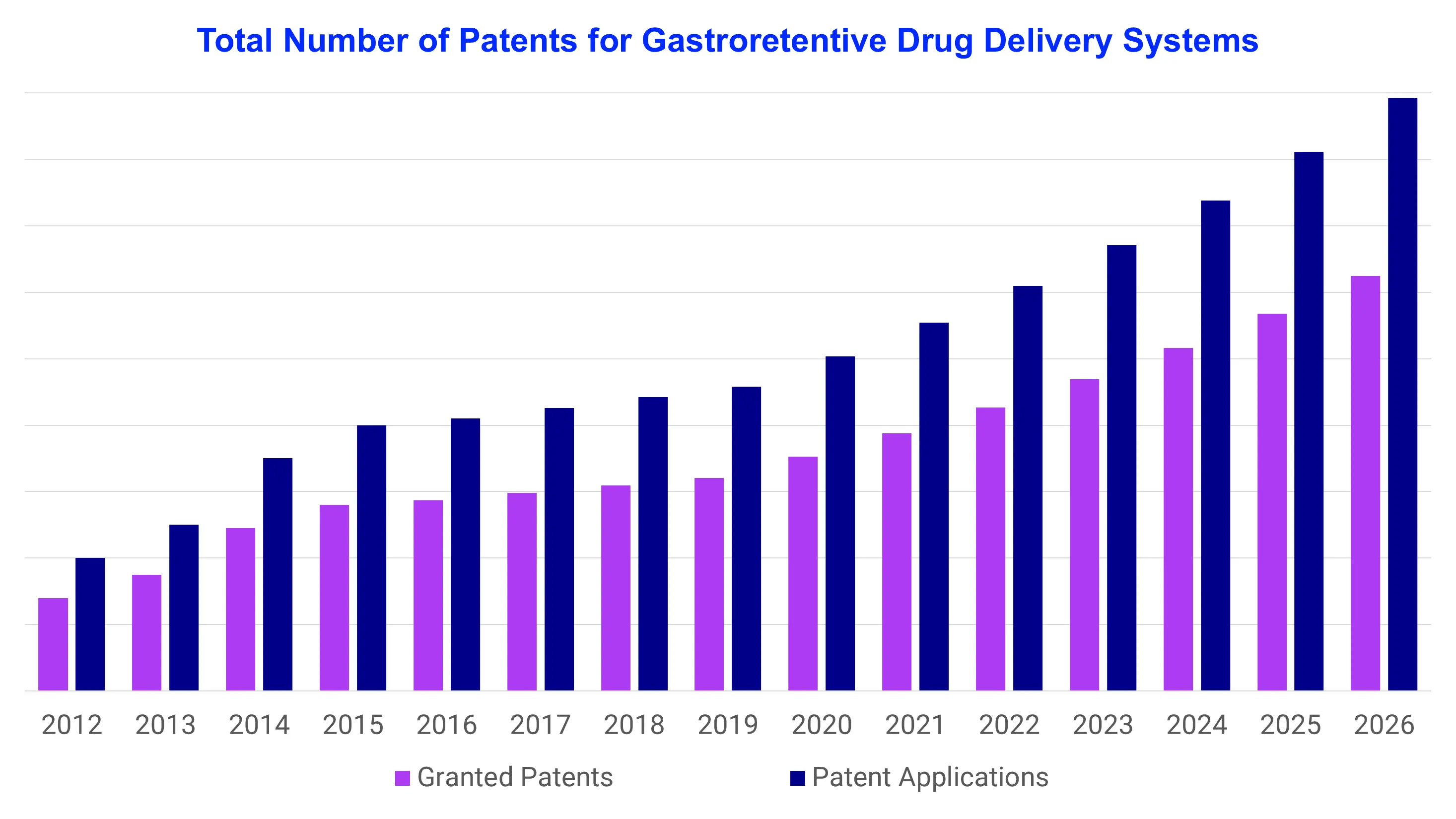
The dataset holds about 3,400 patent families, with filing peaks between 2008 and 2013 around swelling tablets and a second rise after 2018 around expandable devices. Chinese universities and generic firms contribute a large share of the volume, while United States filers hold the more heavily cited device claims.
Rising demand for weekly oral dosing and for absorption-window drugs shows up in the patent record as sustained growth in expandable frame and depot capsule families.
This report covers granted patents and published applications on dosage forms and devices that prolong gastric residence of an active ingredient. It includes floating, swelling, expandable, mucoadhesive, high-density and magnetic approaches, together with the polymers, gas-generating agents and delivery capsules that support them.
Coverage spans formulation compositions, device geometry, manufacturing methods and methods of treatment tied to gastric retention. Entries are consolidated by patent family and tracked by assignee, priority year, jurisdiction and technology cluster.
The assignee analysis includes pharmaceutical manufacturers, specialty delivery companies, generic firms, universities and research institutes that hold gastroretentive families.
The report will cover the following sections in detail:
Analysis by Technology
Analysis by Dosage Form
Analysis by Therapeutic Area
Gastroretentive Drug Delivery Systems Patent Filing Trend Analysis
Filing volume for gastroretentive drug delivery systems grew at an estimated annual rate of about 6% between 2020 and 2024. Growth came from Chinese academic output on floating and mucoadhesive carriers and from United States filings on expandable devices that hold drugs for a week.
Grants in 2025 reached roughly 285 patents, a modest share of the more than 1,420 patents linked to the primary jurisdiction. Examination of polymer-matrix claims is slower because prior art on floating tablets is dense, so applicants increasingly move claims toward device geometry, release linkers and indication-specific dosing.
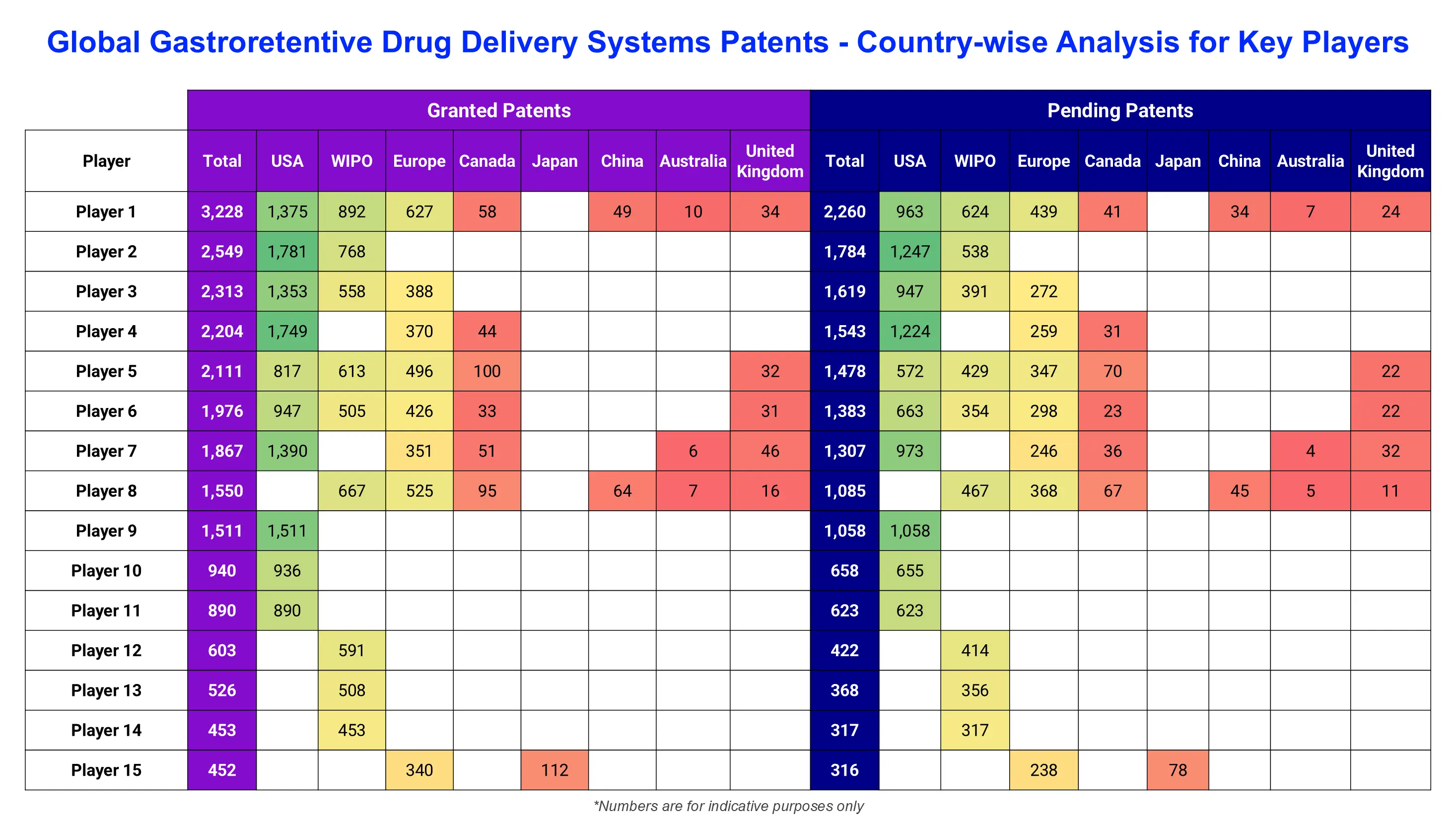
Among the players with gastroretentive drug delivery systems patent families, new entrants have been identified, which can be either established companies or startups developing novel technology in the field. Some of the major companies mentioned in this report (a non-exhaustive list) are as follows:
Sun Pharmaceutical Industries holds one of the largest industrial portfolios in gastric retentive oral dosage forms, built through internal formulation research and the acquired Ranbaxy development base. Its filings centre on floating and swelling matrix tablets for extended-release generics and 505(b)(2) products. Products reach patients across the United States, India and emerging markets through its generics and specialty channels. The company protects formulations with layered claims on polymer ratios, gas-generating agents and release profiles, which lengthens exclusivity beyond the first compound patent. Gastric retention supports its positioning in difficult-to-copy oral generics where bioequivalence barriers limit competition.
Assertio inherited the AcuForm gastric retention platform from Depomed, which swells in the stomach and releases drug over eight to twelve hours. The platform underpinned Glumetza (metformin extended release) and Gralise (once-daily gabapentin for postherpetic neuralgia), both approved by the FDA and both reliant on fed-state gastric residence. The portfolio spans matrix composition, swelling polymer grades and dosing-with-meal claims. Assertio built its position through licensing the platform to larger pharmaceutical partners and defending Orange Book listed patents in Paragraph IV litigation. Its filing pace has slowed as core families matured, while the expired and expiring claims shape the generic entry map for gastric retentive tablets.
Other companies include Lyndra Therapeutics, Massachusetts Institute of Technology, and Intec Pharma.
The top five assignees together hold a minority of families, since several hundred universities, generic firms and regional manufacturers file only a few patents each. Sun Pharmaceutical Industries and Assertio lead among commercial holders, while the device-oriented portfolios of Lyndra Therapeutics and Massachusetts Institute of Technology carry heavier citation counts.
*Please note that this is only a partial list; the complete list of key players is available in the full report. Additionally, the list of key players can be customized to better suit your needs.*
The report assesses patent activity across major jurisdictions, including:
China leads by filing volume, driven by university research on floating and mucoadhesive carriers and by domestic generic developers. The United States follows with the commercially validated platforms and the device-focused families. India ranks third, reflecting formulation work by generic manufacturers on extended-release tablets with gastric retention.
Read more about this report - REQUEST FREE SAMPLE COPY IN PDF
The technology segments covered in this report include:
Among these, floating and effervescent matrix systems account for the largest share of patent families because of their low manufacturing cost and long record in extended-release tablets.
Competition combines legacy platform holders, generic manufacturers and device-focused entrants. Sun Pharmaceutical Industries and Assertio own formulation-level claims that anchor commercial tablets, while Lyndra Therapeutics and Massachusetts Institute of Technology hold device claims behind weekly oral depots. Licensing from academic groups to spinouts is a recurring route to market.
Companies are focusing on:
Emerging innovation themes include once-weekly oral antipsychotic capsules, ingestible depots for malaria prophylaxis, and expandable frames loaded with antiretrovirals. Magnetically guided retention and three-dimensional printed floating tablets are gaining early filings. Computational models of gastric emptying are also being claimed to personalise dose design.
The competitive position in gastroretentive drug delivery systems depends on device geometry claims, polymer grade know-how and clinical evidence of residence time. Established tablet platforms are maturing as core families expire, which opens generic entry. New value is shifting toward weekly oral depots and combination products.
Technology segments, assignee positions and jurisdictional trends in gastroretentive drug delivery systems are analysed in nine areas, and the report provides actionable intelligence supporting:
The study searches patent databases at the USPTO, the European Patent Office, the China National Intellectual Property Administration, the Indian Patent Office, the Japan Patent Office and WIPO PATENTSCOPE. Records cover publications from 2000 to 2025.
Queries combine keywords on gastric retention, floating, swelling, mucoadhesion and expandable devices with CPC classes A61K 9/0065, A61K 9/0004 and A61K 9/20, plus IPC A61K 9/22 and A61J 3/07. Results are screened manually, deduplicated and consolidated at patent family level before assignee normalisation.
The market side draws on FDA and EMA approval records, company filings, clinical trial registries and peer-reviewed literature. Patent trends are cross-checked against product launches and licensing disclosures.
Controlled Release Drug Delivery Market


Upto 15% Off
USD
$2699 $2429
$4299 $3869
$5799 $4949
$6999 $5949


*While we strive to always give you current and accurate information, the numbers depicted on the website are indicative and may differ from the actual numbers in the main report. At Expert Market Research, we aim to bring you the latest insights and trends in the market. Using our analyses and forecasts, stakeholders can understand the market dynamics, navigate challenges, and capitalize on opportunities to make data-driven strategic decisions.*
EMR’s Gastroretentive Drug Delivery Systems Patent Landscape Analysis provides a comprehensive assessment of patent filings, innovation clusters, assignee portfolios, and geographic filing patterns across the gastroretentive drug delivery systems landscape. The report identifies 3,400+ patent families, evaluates leading jurisdictions including China, the United States, and India, and profiles the top assignees by portfolio size.
The global gastroretentive drug delivery systems market was valued at USD 1.15 Billion in 2025. The market is projected to reach USD 2.70 Billion by 2035, expanding at a CAGR of 8.90% during 2026 - 2035.
The report analyses approximately 3,400+ patent families related to gastroretentive drug delivery systems. These include filings from China, the United States, India, and international WIPO filings.
Key companies operating within the landscape include Sun Pharmaceutical Industries, Assertio, Lyndra Therapeutics, Massachusetts Institute of Technology, and Intec Pharma, among others. These organisations collectively account for a significant portion of patent activity analysed in this report.
The report evaluates patent activity across the United States, Europe, China, Japan, South Korea, India, and international WIPO filings. China holds the largest share of gastroretentive drug delivery systems patent activity, supported by its university research base and domestic generic developers.
Yes. The report scope can be customised based on geography, technology segment, assignee selection, time period, or specific innovation cluster focus. Please connect with the EMR team to define the customisation scope.
Patent landscape analysis helps organisations understand innovation trends, competitive activity, technology whitespace, and IP risk across a defined domain. For gastroretentive drug delivery systems, this report supports strategic decisions in R&D prioritisation, licensing evaluation, competitive benchmarking, and market entry planning.
Explore our key highlights of the report and gain a concise overview of key findings, trends, and actionable insights that will empower your strategic decisions.
|
Scope of the Report |
Details |
|
Analysis by Technology |
|
|
Analysis by Dosage Form |
|
|
Analysis by Therapeutic Area |
|
|
Analysis by End User |
|
|
Key Players Mentioned |
|
|
Geographies Covered |
|
Mini Report
One User
USD 2,699
USD 2,429
tax inclusive*
Single User License
One User
USD 4,299
USD 3,869
tax inclusive*
Five User License
Five User
USD 5,799
USD 4,949
tax inclusive*
Corporate License
Unlimited Users
USD 6,999
USD 5,949
tax inclusive*
*Please note that the prices mentioned below are starting prices for each bundle type. Kindly contact our team for further details.*
Flash Bundle
Small Business Bundle
Growth Bundle
Enterprise Bundle
*Please note that the prices mentioned below are starting prices for each bundle type. Kindly contact our team for further details.*
Flash Bundle
Number of Reports: 3
20%
tax inclusive*
Small Business Bundle
Number of Reports: 5
25%
tax inclusive*
Growth Bundle
Number of Reports: 8
30%
tax inclusive*
Enterprise Bundle
Number of Reports: 10
35%
tax inclusive*
How To Order

Select License Type
Choose the right license for your needs and access rights.

Click on ‘Buy Now’
Add the report to your cart with one click and proceed to register.

Select Mode of Payment
Choose a payment option for a secure checkout. You will be redirected accordingly.
Strategic Solutions for Informed Decision-Making
Gain insights to stay ahead and seize opportunities.

Get insights & trends for a competitive edge.

Track prices with detailed trend reports.

Analyse trade data for supply chain insights.

Leverage cost reports for smart savings

Enhance supply chain with partnerships.

Connect For More Information
Our expert team of analysts will offer full support and resolve any queries regarding the report, before and after the purchase.
Our expert team of analysts will offer full support and resolve any queries regarding the report, before and after the purchase.
We employ meticulous research methods, blending advanced analytics and expert insights to deliver accurate, actionable industry intelligence, staying ahead of competitors.
Our skilled analysts offer unparalleled competitive advantage with detailed insights on current and emerging markets, ensuring your strategic edge.
We offer an in-depth yet simplified presentation of industry insights and analysis to meet your specific requirements effectively.




