

Consumer Insights
Uncover trends and behaviors shaping consumer choices today
Procurement Insights
Optimize your sourcing strategy with key market data
Industry Stats
Stay ahead with the latest trends and market analysis.
The IVF and assisted reproductive technologies market was valued at USD 26.80 Billion in 2025 and is projected to reach USD 64.62 Billion by 2035, advancing at a CAGR of 9.20%. Growth is supported by later age at first childbirth, wider insurance and public funding for fertility treatment, rising use of frozen embryo transfer and embryo genetic testing, and expanding private clinic networks across Asia, Europe and North America.
Patent activity is broad and still building, with more than 9,300 patent families analysed and over 100 patents granted in 2025. Filings concentrate in embryo culture media and time-lapse incubators, preimplantation genetic testing of embryos, embryo selection and ranking software, oocyte and embryo vitrification, sperm selection and micromanipulation, and ovarian stimulation and luteal support regimens. Commercial validation comes from regulator-cleared culture media and devices, national insurance coverage in Japan since April 2022, and the routine use of imaging software in embryology laboratories.
This IVF and Assisted Reproductive Technologies Patent Landscape Analysis Report provides a structured view of patent filing trends, leading assignees, jurisdiction activity, technology clusters and company profiles across the full range of fertility treatment technologies.
The IVF and assisted reproductive technologies market is experiencing strong growth, driven by later parenthood, wider reimbursement of fertility treatment, and the shift toward frozen embryo transfer supported by better embryo selection. Japan introduced national insurance coverage for fertility treatment from April 2022, which opened treatment to a large group of couples who had previously paid in full.
Patent activity is accelerating, with 100+ IVF and assisted reproductive technologies patents granted in 2025, reflecting strong innovation momentum in embryo culture media and time-lapse incubators, preimplantation genetic testing of embryos, embryo selection and ranking software, and oocyte and embryo vitrification.
Top assignees in the IVF and assisted reproductive technologies patent landscape include CooperSurgical, Vitrolife Group, Merck KGaA, Ferring Pharmaceuticals, and FUJIFILM Irvine Scientific, with the United States, China, and Europe as the dominant patent jurisdictions.
Fertility treatment has moved from a specialist procedure to an established part of reproductive healthcare in most high-income countries and a fast-developing service in several middle-income ones. The first baby born after in vitro fertilisation arrived in 1978, and intracytoplasmic sperm injection followed in the early 1990s, extending treatment to couples with severe male factor infertility. Births from assisted reproduction are now estimated to exceed twelve million worldwide. Demand comes from later parenthood, wider recognition of infertility as a medical condition, use of treatment by single parents and same-sex couples, and fertility preservation before cancer therapy. Clinics increasingly compete on laboratory quality, embryo selection tools and cumulative outcomes per egg retrieval, which keeps spending on culture systems, imaging software and cryopreservation steady.
The market growth is driven by the move toward single embryo transfer backed by better embryo selection and freezing, which raises the value of each retrieval cycle and lifts demand for culture media, incubators and testing. Japan brought national insurance coverage for fertility treatment from April 2022, lowering the cost barrier for a large patient pool. Frozen embryo transfer has grown as a share of cycles in many countries, and that shift adds demand for vitrification devices, storage and endometrial preparation drugs.
Cycle mix helps explain where spending is moving. The rising share of frozen embryo transfer in many countries, encouraged by genetic testing and freeze-all strategies, means one retrieval can yield several transfers over time, so spending extends from stimulation drugs to storage, thawing and hormonal support. A debated clinical value for genetic testing of embryos for aneuploidy keeps adoption uneven, yet steady testing volumes sustain demand for sequencing-based assays and biopsy tools while professional bodies refine guidance. Public coverage decisions such as the Japanese reform of 2022 draw younger patients into earlier treatment, which tends to raise oocyte yield and shorten the path to a live birth, and that in turn lifts throughput in embryology laboratories.
Read more about this report - REQUEST FREE SAMPLE COPY IN PDF
Filing intensity follows commercial investment in clinic networks, laboratory automation and genetic services. Companies that run large clinic groups or sell consumables to them file steadily on culture media formulations, incubator design and vitrification devices, because each refinement can be tied to better blastocyst development or survival after warming. Pharmaceutical groups add filings on recombinant gonadotropin formulations, injection pens and luteal support products, while software developers file on image analysis and embryo ranking. This mix of regulated drugs, devices and software gives the patent record a wider spread than most single-modality fields.
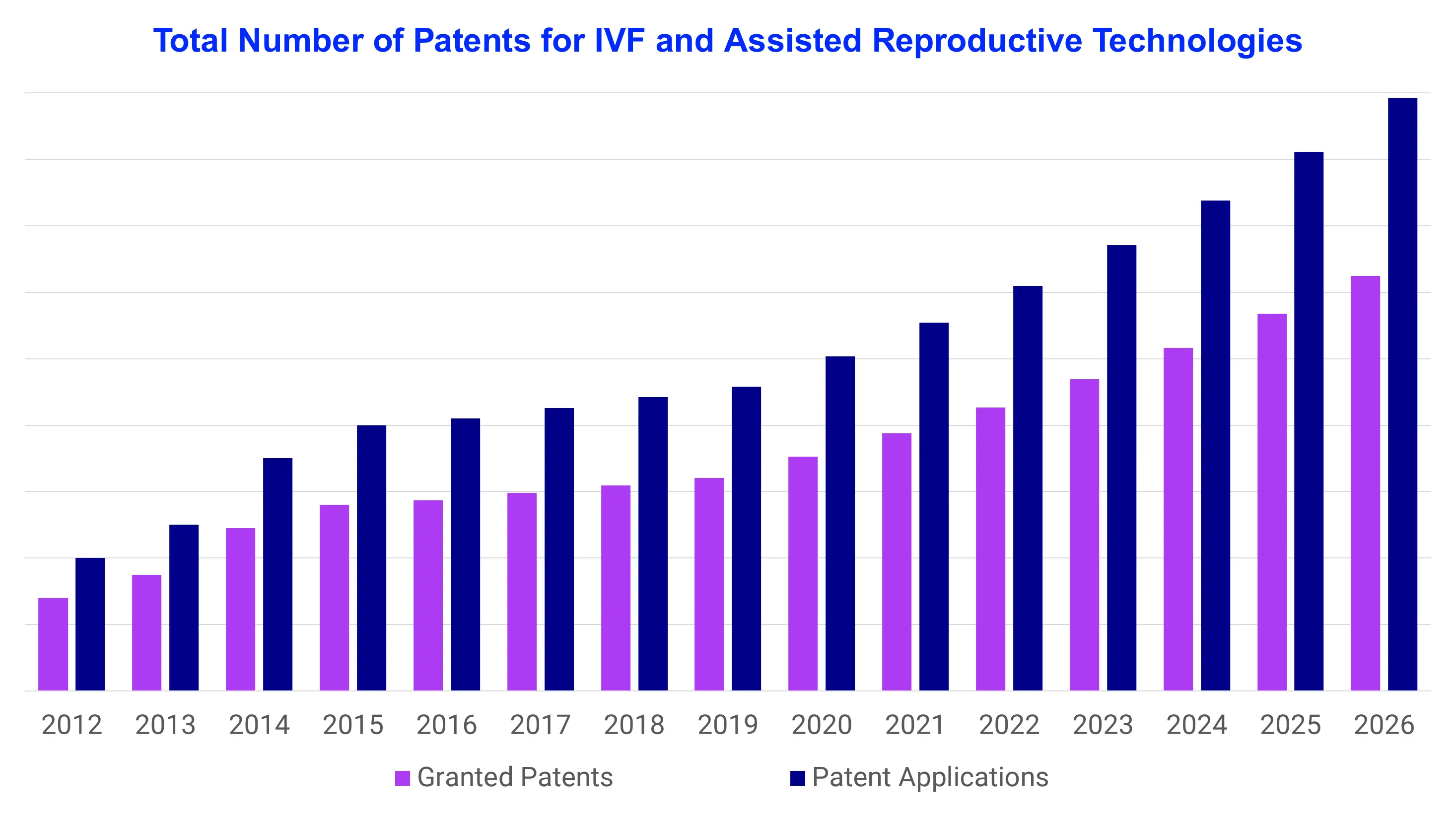
The landscape comprises 9,300+ patent families, with filing growth most pronounced between roughly 2020 and 2024 as clinics invested in time-lapse imaging, genetic testing capacity and freezing infrastructure. Embryo culture media and time-lapse incubators and preimplantation genetic testing of embryos form the largest clusters, followed by embryo selection and ranking software, oocyte and embryo vitrification, sperm selection and micromanipulation, and ovarian stimulation and luteal support regimens. Peak-period counts are approximate, because recent filings remain unpublished for up to eighteen months.
Rising treatment volumes, broader reimbursement and the shift toward frozen cycles have pushed manufacturers, drug makers and clinics to protect new culture, testing and selection technology through a steadily growing set of patent families.
This report covers patent families published worldwide, with detailed review of the United States, China and Europe and additional coverage of Japan, South Korea, India and filings made through WIPO. Market coverage spans procedure types from in vitro fertilisation and intracytoplasmic sperm injection to intrauterine insemination, frozen embryo transfer, and donor egg and surrogacy programmes. Settings considered include fertility clinics, hospitals, cryobanks and gamete banks, embryology laboratories, and academic and research institutes. Patent families are grouped by earliest priority year, and grant counts are tracked to 2025.
Technology scope spans embryo culture media and incubators, preimplantation genetic testing, embryo selection imaging software, micromanipulation and injection systems, and cryopreservation and vitrification systems. Product coverage includes instruments and equipment, culture media and reagents, disposables and consumables, fertility drugs, and software and genetic tests. Claims reviewed address media composition, incubator gas and temperature control, time-lapse image capture, biopsy and sequencing workflows, automated sperm immobilisation, injection pipettes, cooling carriers and gonadotropin formulations, from first-line stimulation to storage and thawing of embryos and gametes.
Entities covered include fertility drug producers, culture media and consumables manufacturers, incubator and imaging developers, genetic testing laboratories, and specialist firms in micromanipulation and laboratory automation. Software start-ups developing embryo ranking tools are included alongside large clinic groups, cryobanks and gamete banks that file on storage and handling methods. University reproductive medicine units, teaching hospitals and public research institutes also appear as applicants, particularly for non-invasive embryo assessment and sperm selection methods.
The report will cover the following sections in detail:
Analysis by Procedure Type
Analysis by Technology Type
Analysis by Product Category
IVF and Assisted Reproductive Technologies Patent Filing Trend Analysis
Annual filings in the field have risen steadily over the past decade, with the steepest gains in embryo selection software, time-lapse systems and sequencing-based embryo testing. Hardware and media patents form a stable base of continuing families, while software and genetic testing claims account for most of the newer growth. Grants have kept pace with filings, reaching 100+ in 2025, which points to a field where examiners are allowing claims across both device and method categories.
Annual filing growth is estimated at roughly 7 percent between 2020 and 2024 (approximate), with the pace set by three factors. Clinics added time-lapse incubators and imaging software after post-pandemic recovery in treatment volumes. Sequencing costs fell, which widened the use of embryo genetic testing and encouraged new assay and biopsy claims. Public funding reforms in Asia and Europe raised cycle numbers, which in turn supported investment in vitrification and automation.
Among the players with IVF and assisted reproductive technologies patent families, new entrants have been identified, which can be either established companies or startups developing novel technology in the field. Some of the major companies mentioned in this report (a non-exhaustive list) are as follows:
CooperSurgical holds one of the broadest fertility portfolios among device and consumable suppliers, covering embryo culture media, handling and vitrification products, micromanipulation tools, laboratory equipment and embryo genetic testing services offered under the CooperGenomics name. Its fertility business was strengthened by the 2016 purchase of Origio, and it is part of CooperCompanies, which has also built a presence in gamete and cord blood banking. Culture media and devices are marketed under regulatory clearance or CE marking in the relevant regions, while genetic tests are offered through accredited laboratories. Patent activity centres on media formulations, embryo biopsy and testing workflows, and procedure-specific disposables, which protects both the products and the recurring consumable revenue tied to them. Commercially, the company is positioned as a one-stop supplier to fertility clinics, a role that favours portfolio breadth over single-technology depth.
Vitrolife Group is a Swedish fertility specialist whose portfolio is organised around culture media and consumables, laboratory technologies and genetic services. Its commercial platforms include the G-Series family of culture media, EmbryoGlue transfer medium, the RapidVit and RapidWarm vitrification products, and the EmbryoScope time-lapse incubators with associated image analysis software. The company added genetic testing capacity through the acquisition of Igenomix in 2021, linking embryo culture and embryo testing in one group. Products carry CE marking and, where required, regional regulatory clearance. Its IP strategy combines patent protection for incubator hardware, software and media composition with trade secrets and brand-level know-how in media manufacturing. In the landscape, Vitrolife Group is placed as an integrated embryology laboratory supplier with a strong position in time-lapse imaging and culture systems.
Other companies include Merck KGaA, Ferring Pharmaceuticals, and FUJIFILM Irvine Scientific.
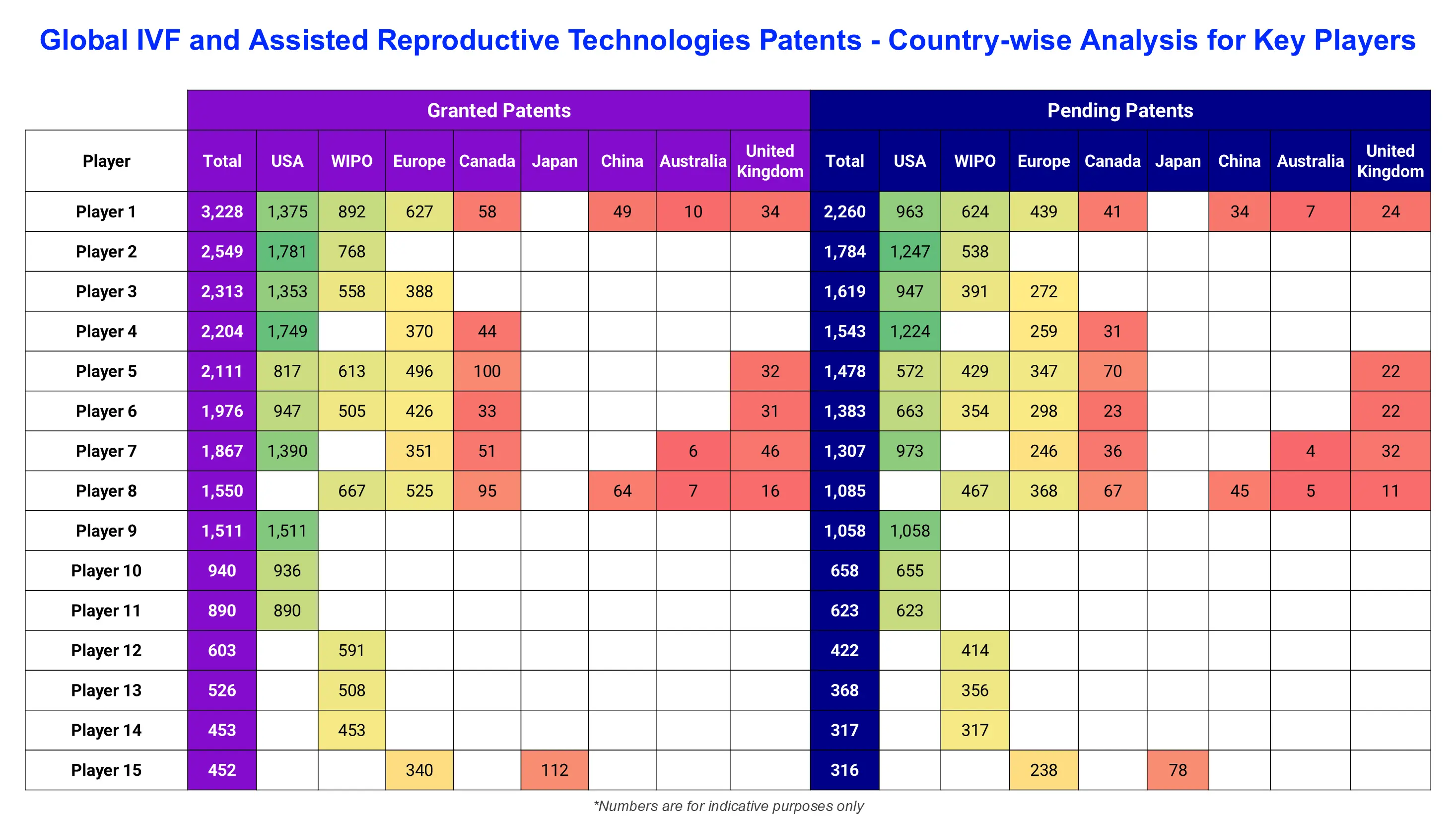
Leading assignees hold a meaningful but not dominant share of the 9,300+ families, which reflects the mix of drug, device and laboratory players. CooperSurgical and Vitrolife Group build portfolios around media, incubators, vitrification products and genetic testing, giving them broad coverage of the embryology laboratory. Merck KGaA and Ferring Pharmaceuticals concentrate on gonadotropin formulations, delivery devices and luteal support, where regulatory data packages add a second layer of protection. FUJIFILM Irvine Scientific focuses on culture media and handling solutions, pairing formulation patents with manufacturing know-how. Beyond these five groups, ownership is fragmented across clinics, universities and smaller technology firms.
*Please note that this is only a partial list; the complete list of key players is available in the full report. Additionally, the list of key players can be customized to better suit your needs.*
The report assesses patent activity across major jurisdictions, including:
The United States leads in patent volume, supported by large private clinic groups, an active consumables industry and a mature market for genetic testing services. China follows with fast-rising filings from domestic device makers, hospitals and universities, helped by expanding assisted reproduction capacity. Europe contributes through regional filings at the European Patent Office, where Nordic, Danish, German and Swiss firms are well represented. South Korea adds activity in embryo culture and imaging, India shows growing but smaller filing counts linked to its expanding clinic base, and WIPO filings provide a route to multi-country protection for firms planning global launches.
Read more about this report - REQUEST FREE SAMPLE COPY IN PDF
Patent activity in the field is organised around five technology segments:
Embryo culture media and incubators lead patent activity, because every treatment cycle depends on laboratory culture and each incremental gain in blastocyst development applies to the whole patient base. Time-lapse incubation also links hardware to imaging software, so one platform can generate claims across several categories. Preimplantation genetic testing of embryos follows, supported by falling sequencing costs, while cryopreservation filings rise with the growth of frozen embryo transfer.
Competition combines specialist fertility suppliers, global pharmaceutical groups and an increasing number of software and automation start-ups. CooperSurgical and Vitrolife Group compete across culture, handling and incubation, while Merck KGaA and Ferring Pharmaceuticals compete in stimulation and luteal support drugs. FUJIFILM Irvine Scientific supplies media to laboratories worldwide, and regional manufacturers in China, South Korea and India are building their own portfolios. Consolidation of clinic networks gives large purchasers more influence over supplier choice, which pushes suppliers to protect integrated systems rather than single products.
Companies are focusing on:
Emerging themes include analysis of spent culture media as a non-invasive route to embryo assessment, microfluidic devices that sort sperm by motility and integrity, and automated micromanipulation that reduces variation between operators. Artificial intelligence applied to time-lapse images is moving from research into commercial software, while closed vitrification systems address contamination concerns during storage. Home-based ovulation and hormone monitoring tied to clinic protocols is also appearing in newer filings, extending patent coverage beyond the laboratory.
The patent landscape for IVF and assisted reproductive technologies shows a field where drug, device and software innovation advance together. Culture and incubation hold the largest share of filings, genetic testing and selection software supply most of the recent growth, and freezing technology is rising with frozen embryo transfer. Concentration among the leading assignees is moderate, leaving room for specialist entrants in automation, non-invasive assessment and sperm selection.
The patent landscape provides actionable intelligence for nine areas of decision-making:
Patent research was carried out across major patent databases, including national and regional office records and WIPO publications, using keyword and classification searches built around in vitro fertilisation, intracytoplasmic sperm injection, intrauterine insemination, embryo culture, embryo genetic testing, vitrification, micromanipulation and fertility drug terms. Search strings were refined through several rounds to reach 9,300+ patent families.
Retrieved records were screened for relevance, and duplicate families and filings with no connection to fertility treatment were removed. Remaining families were classified by technology cluster, procedure type, product category, assignee and jurisdiction, with grant status and priority year recorded for each family. Assignee names were standardised across subsidiaries and name variants so that portfolio sizes could be compared on a consistent basis.
Patent findings were reviewed alongside market information on treatment volumes, regulatory approvals, reimbursement changes and company announcements. Filing trends, assignee positions and technology clusters were compared with commercial developments in clinics, laboratories and drug supply, so that the patterns reported reflect real activity and not isolated filing spikes.


Upto 15% Off
USD
$2699 $2429
$4299 $3869
$5799 $4949
$6999 $5949


*While we strive to always give you current and accurate information, the numbers depicted on the website are indicative and may differ from the actual numbers in the main report. At Expert Market Research, we aim to bring you the latest insights and trends in the market. Using our analyses and forecasts, stakeholders can understand the market dynamics, navigate challenges, and capitalize on opportunities to make data-driven strategic decisions.*
EMR's IVF and Assisted Reproductive Technologies Patent Landscape Analysis provides a comprehensive assessment of patent filings, innovation clusters, assignee portfolios, and geographic filing patterns across the IVF and assisted reproductive technologies landscape. The report identifies 9,300+ patent families, evaluates leading jurisdictions including the United States, China, and Europe, and profiles the top assignees by portfolio size.
The global IVF and assisted reproductive technologies market was valued at USD 26.80 Billion in 2025. The market is projected to reach USD 64.62 Billion by 2035, expanding at a CAGR of 9.20% during 2026 - 2035.
The report analyses approximately 9,300+ patent families related to IVF and assisted reproductive technologies. These include filings from the United States, China, Europe, and international WIPO filings.
Key companies operating within the landscape include CooperSurgical, Vitrolife Group, Merck KGaA, Ferring Pharmaceuticals, and FUJIFILM Irvine Scientific, among others. These organisations collectively account for a significant portion of patent activity analysed in this report.
The report evaluates patent activity across the United States, Europe, China, Japan, South Korea, India, and international WIPO filings. The United States is the largest single jurisdiction in the landscape, with 3,200+ patents associated with it across the 9,300+ patent families analysed, reflecting the depth of its private clinic networks and its position as a primary filing venue for drug, device and software developers.
Yes. The report scope can be customised based on geography, technology segment, assignee selection, time period, or specific innovation cluster focus. To scope a customised study on IVF and assisted reproductive technologies, such as a deeper review of a single technology cluster, a specific assignee or an additional jurisdiction, the Expert Market Research team can be reached through the contact options on this report page.
Patent landscape analysis helps organisations understand innovation trends, competitive activity, technology whitespace, and IP risk across a defined domain. For IVF and assisted reproductive technologies, this report supports strategic decisions in R&D prioritisation, licensing evaluation, competitive benchmarking, and market entry planning.
Explore our key highlights of the report and gain a concise overview of key findings, trends, and actionable insights that will empower your strategic decisions.
|
Scope of the Report |
Details |
|
Analysis by Procedure Type |
|
|
Analysis by Technology TypeAnalysis by Technology Type |
|
|
Analysis by Product Category |
|
|
Analysis by End User |
|
|
Key Players Mentioned |
|
|
Geographies Covered |
|
Mini Report
One User
USD 2,699
USD 2,429
tax inclusive*
Single User License
One User
USD 4,299
USD 3,869
tax inclusive*
Five User License
Five User
USD 5,799
USD 4,949
tax inclusive*
Corporate License
Unlimited Users
USD 6,999
USD 5,949
tax inclusive*
*Please note that the prices mentioned below are starting prices for each bundle type. Kindly contact our team for further details.*
Flash Bundle
Small Business Bundle
Growth Bundle
Enterprise Bundle
*Please note that the prices mentioned below are starting prices for each bundle type. Kindly contact our team for further details.*
Flash Bundle
Number of Reports: 3
20%
tax inclusive*
Small Business Bundle
Number of Reports: 5
25%
tax inclusive*
Growth Bundle
Number of Reports: 8
30%
tax inclusive*
Enterprise Bundle
Number of Reports: 10
35%
tax inclusive*
How To Order

Select License Type
Choose the right license for your needs and access rights.

Click on ‘Buy Now’
Add the report to your cart with one click and proceed to register.

Select Mode of Payment
Choose a payment option for a secure checkout. You will be redirected accordingly.
Strategic Solutions for Informed Decision-Making
Gain insights to stay ahead and seize opportunities.

Get insights & trends for a competitive edge.

Track prices with detailed trend reports.

Analyse trade data for supply chain insights.

Leverage cost reports for smart savings

Enhance supply chain with partnerships.

Connect For More Information
Our expert team of analysts will offer full support and resolve any queries regarding the report, before and after the purchase.
Our expert team of analysts will offer full support and resolve any queries regarding the report, before and after the purchase.
We employ meticulous research methods, blending advanced analytics and expert insights to deliver accurate, actionable industry intelligence, staying ahead of competitors.
Our skilled analysts offer unparalleled competitive advantage with detailed insights on current and emerging markets, ensuring your strategic edge.
We offer an in-depth yet simplified presentation of industry insights and analysis to meet your specific requirements effectively.




