

Consumer Insights
Uncover trends and behaviors shaping consumer choices today
Procurement Insights
Optimize your sourcing strategy with key market data
Industry Stats
Stay ahead with the latest trends and market analysis.
The left ventricular assist devices market was valued at USD 2.45 Billion in 2025 and is projected to reach USD 5.39 Billion by 2035, growing at a CAGR of 8.20% over the forecast period. Demand is supported by the rising burden of advanced heart failure, the persistent shortage of donor hearts, better survival with fully magnetically levitated pumps, and wider use of percutaneous support in cardiogenic shock.
Patent activity is concentrated in magnetically levitated centrifugal pump design, percutaneous and short-term ventricular support pumps, driveline, power, and transcutaneous energy transfer, and haemocompatibility and thrombosis reduction, with further filings on pump speed control and remote monitoring. More than 2,400 patent families reflect sustained innovation momentum. The Food and Drug Administration approvals of the HeartMate 3 in 2017 and 2018, backed by the MOMENTUM 3 trial, gave the field clinical and commercial validation that continues to attract new filers.
This Left Ventricular Assist Devices Patent Landscape Analysis Report provides a structured view of patent filing trends, leading assignees, jurisdictions, technology clusters and competitive positioning across implantable and percutaneous pumps for advanced heart failure and cardiogenic shock.
The left ventricular assist devices market is experiencing strong growth, driven by the growing pool of patients with advanced heart failure, the limited supply of donor hearts, and improved outcomes with fully magnetically levitated pumps. The MOMENTUM 3 trial, which supported Food and Drug Administration approval of the HeartMate 3 for bridge to transplant in 2017 and destination therapy in 2018, showed lower rates of pump thrombosis and disabling stroke than the earlier axial flow design.
Patent activity is accelerating, with 1,400+ left ventricular assist devices patents granted in 2025, reflecting strong innovation momentum in magnetically levitated centrifugal pump design, percutaneous and short-term ventricular support pumps, driveline, power, and transcutaneous energy transfer, and haemocompatibility and thrombosis reduction.
Top assignees in the left ventricular assist devices patent landscape include Abbott, Medtronic, Abiomed, Berlin Heart, and Jarvik Heart, with the United States, Europe, and China as the dominant patent jurisdictions.
Left ventricular assist devices occupy a distinct position in the treatment of advanced heart failure, where medication, resynchronisation therapy and surgical repair have reached their limits. Implantable pumps now sustain patients who are waiting for a donor heart, patients who are not transplant candidates, and patients whose cardiac function may recover with temporary unloading. Clinical demand is shaped by an ageing population, by better survival after myocardial infarction that leaves more people living with weakened hearts, and by a donor supply that cannot match need. Commercial activity is concentrated in specialist heart failure programmes, where patient selection, surgical expertise and long-term outpatient follow-up determine how widely the technology is used.
The market growth is driven by the shift from first-generation axial flow pumps to fully magnetically levitated centrifugal designs, which lowered pump thrombosis and stroke and made implantation a more acceptable option for patients and referring cardiologists. Heart failure affects an estimated six million or more adults in the United States, and a minority progress to advanced disease, so the eligible pool is sizeable even though only a fraction receive a pump. The Food and Drug Administration approved the HeartMate 3 in 2017 for bridge to transplant and in 2018 for destination therapy, and the MOMENTUM 3 trial supplied the survival and stroke-free evidence behind those decisions.
Donor hearts available for transplant in the United States number roughly four thousand a year, far below the number of patients with advanced heart failure, which leaves durable mechanical support as the main option for many of them. Medtronic stopped distribution of its HVAD system in June 2021 after safety communications, and that withdrawal concentrated the durable implant market around one dominant platform while sharpening attention on thrombosis and neurological event rates. Growth is steady rather than rapid because the base is mature, and implant numbers are held back by strict patient selection and by the capacity of implanting centres. Newer uses such as bridge to candidacy and percutaneous support in cardiogenic shock are widening the treated population and keep the market expanding.
Read more about this report - REQUEST FREE SAMPLE COPY IN PDF
Filing intensity in left ventricular assist devices follows the pace of clinical and commercial investment by a small group of device makers. Pump redesign programmes that led to the HeartMate 3 and its approvals in 2017 and 2018 were followed by a wave of continuation filings on rotor suspension, flow paths and controller logic. Funding for percutaneous support, together with the entry of early-stage companies working on less invasive implantation and driveline-free power, has kept annual filings above levels recorded before 2015. Hospital demand for shorter recovery after implantation has also pushed applicants to protect surgical tools and cannula designs.
More than 2,400 patent families are included in the landscape. Filing peaked between approximately 2018 and 2022, when magnetically levitated pump designs, percutaneous support pumps and driveline and power concepts were all moving through clinical programmes. Magnetically levitated centrifugal pump design and haemocompatibility and thrombosis reduction account for the largest share of families, followed by pump speed control and physiological algorithms and by remote monitoring and heart failure data from the device. Families on driveline, power and transcutaneous energy transfer form a smaller but growing group, driven by interest in removing the exit-site infection risk.
Because the pool of patients with advanced heart failure far exceeds the supply of donor hearts, demand for durable and temporary mechanical support keeps drawing new patent families into pump design, power transfer and monitoring.
The scope covers patent families published at the major filing offices, including the United States, Europe, China, Japan, South Korea and India, together with international applications filed through WIPO. Coverage follows the left ventricular assist devices market serving advanced heart failure and cardiogenic shock, and runs across grants and published applications from the past two decades so that early axial flow designs and recent magnetically levitated and percutaneous concepts appear in a single view. Results are organised by jurisdiction, assignee, technology cluster, filing year and legal status.
The technology scope spans Centrifugal Flow Pumps, Axial Flow Pumps, Percutaneous Ventricular Assist Devices, Paediatric Ventricular Assist Devices and Pulsatile Flow Pumps, along with the therapy strategies of Bridge to Transplant, Destination Therapy, Bridge to Candidacy and Bridge to Recovery. Component coverage includes Pump and Rotor Systems, Controllers and Software, Power Systems and Batteries, Drivelines and Cannulae, and Monitoring and Accessories. Patents on blood-contacting materials, implantation tools, speed control algorithms and remote monitoring of device data are included wherever they support the left ventricle.
Entities include large cardiovascular device manufacturers such as Abbott and Medtronic, percutaneous support specialists such as Abiomed, long-standing specialist firms including Berlin Heart and Jarvik Heart, and venture-backed start-ups working on fully implantable and driveline-free systems. University hospitals, transplant programmes and research institutes also file on pump hydrodynamics, anticoagulation protocols and monitoring methods. Academic engineering groups contribute applications on computational fluid dynamics, blood damage models and wireless energy transfer.
The report will cover the following sections in detail:
Analysis by Pump Technology
Analysis by Therapy Strategy
Analysis by Component
Left Ventricular Assist Devices Patent Filing Trend Analysis
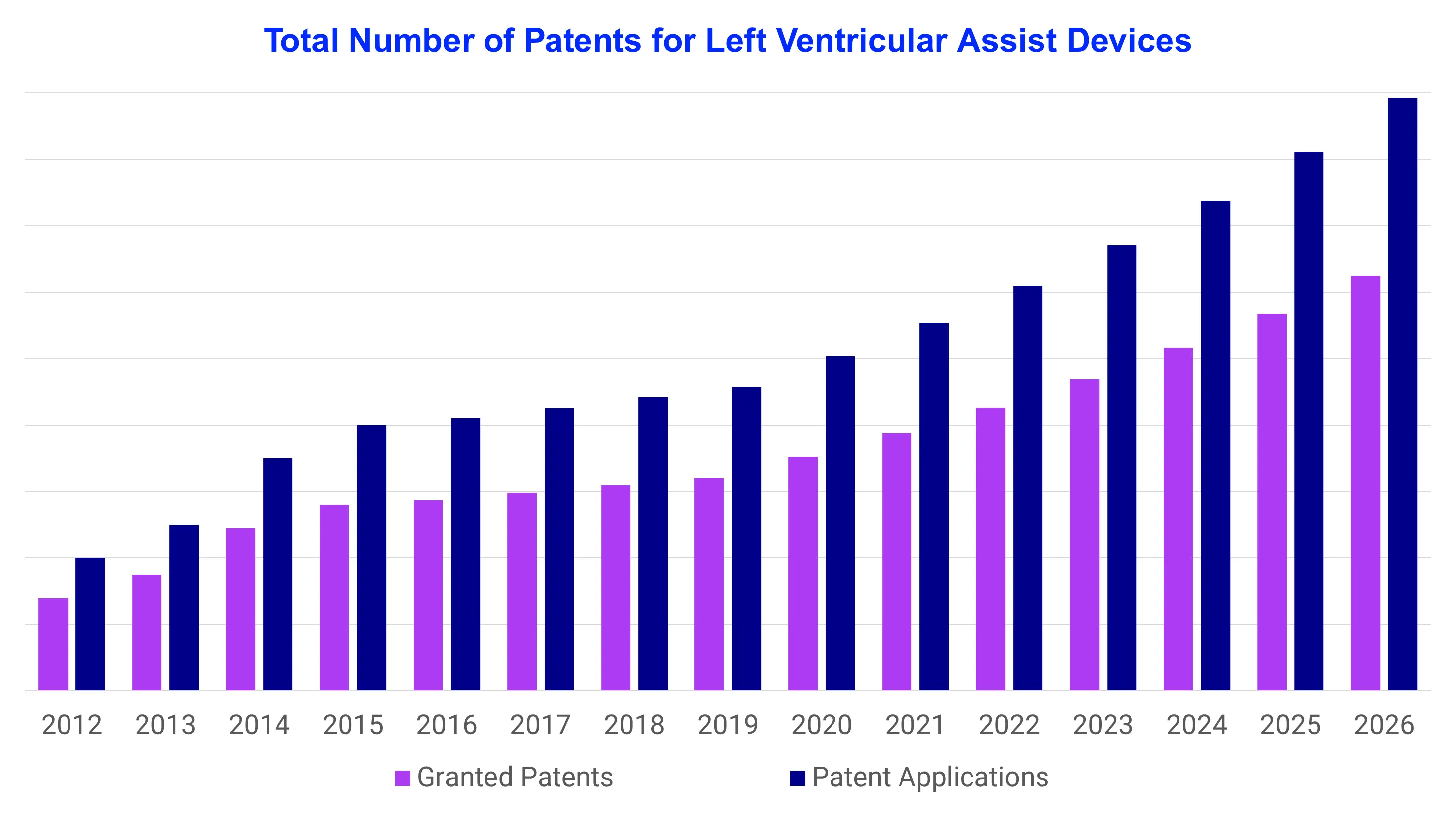
Annual patent filings rose steadily over the past decade, with a clear step up after the 2017 and 2018 approvals of the HeartMate 3 showed that fully magnetically levitated pumps could improve outcomes. Grants followed a similar curve, and more than 260 patents were granted in 2024, which confirms that earlier applications are converting into enforceable rights. A lag of two to four years between filing and grant means recent peaks in percutaneous support and wireless power filings will carry into the grant data over the next few years.
Filing growth between 2020 and 2024 is estimated at approximately 7 percent a year, and three factors explain most of it. Percutaneous and short-term pump development gained momentum as clinical evidence in cardiogenic shock strengthened. Applicants also extended protection to speed modulation algorithms and remote monitoring as pump controllers became sources of clinical data. Medtronic's decision in 2021 to stop distributing its HVAD system redirected research toward haemocompatibility, with newcomers filing on blood-contacting surfaces and rotor geometry.
Among the players with left ventricular assist devices patent families, new entrants have been identified, which can be either established companies or startups developing novel technology in the field. Some of the major companies mentioned in this report (a non-exhaustive list) are as follows:
Abbott holds the largest left ventricular assist devices portfolio in the landscape, covering rotor and bearing design, pump housings, controllers, power systems and surgical implantation tools. The portfolio traces back to the Thoratec business, which came to Abbott through the acquisition of St. Jude Medical, and supports the HeartMate II and HeartMate 3 platforms. The Food and Drug Administration approved the HeartMate 3 in 2017 for bridge to transplant and in 2018 for destination therapy, following the MOMENTUM 3 trial, and the system is also CE marked in Europe. Abbott's IP strategy relies on continuation filings that protect the fully magnetically levitated rotor, the speed modulation feature that creates an artificial pulse, and accessory components across the United States, Europe and Asia. Commercially, the HeartMate 3 is widely regarded as the leading durable pump, which gives Abbott a dominant position among implanting centres.
Medtronic built its left ventricular assist devices position through the 2016 acquisition of HeartWare, whose portfolio centres on the HVAD system, a compact centrifugal pump designed for placement within the pericardial space. Patent families cover the hybrid magnetic and hydrodynamic impeller suspension, the wide-blade flow path, controller and driveline connectors, and a less invasive implantation approach. The HVAD system received Food and Drug Administration approval for bridge to transplant in 2012 and for destination therapy in 2017, supported by the ENDURANCE trial. Medtronic stopped distribution of the system in June 2021 after safety communications and continues to support patients with implanted devices. Its remaining patent families still carry weight in the landscape as prior art and as potential licensing assets in pump design and controller logic.
Other companies include Abiomed, Berlin Heart, and Jarvik Heart.
Patent ownership is concentrated among a small group of device makers. Abbott holds the largest position, built on the Thoratec heritage and on HeartMate 3 continuations covering rotor suspension, flow paths and pump controllers. Medtronic's holdings come mainly from the HeartWare acquisition and describe a compact intrapericardial centrifugal pump, and they remain relevant for licensing and prior-art purposes after the 2021 withdrawal of the HVAD system. Abiomed concentrates on percutaneous micro-axial pumps, their controllers and purge systems. Berlin Heart and Jarvik Heart keep narrower portfolios, the former in paediatric pulsatile support and the latter in small axial flow pumps. Remaining filings are dispersed across start-ups, hospitals and universities.
*Please note that this is only a partial list; the complete list of key players is available in the full report. Additionally, the list of key players can be customized to better suit your needs.*
The report assesses patent activity across major jurisdictions, including:
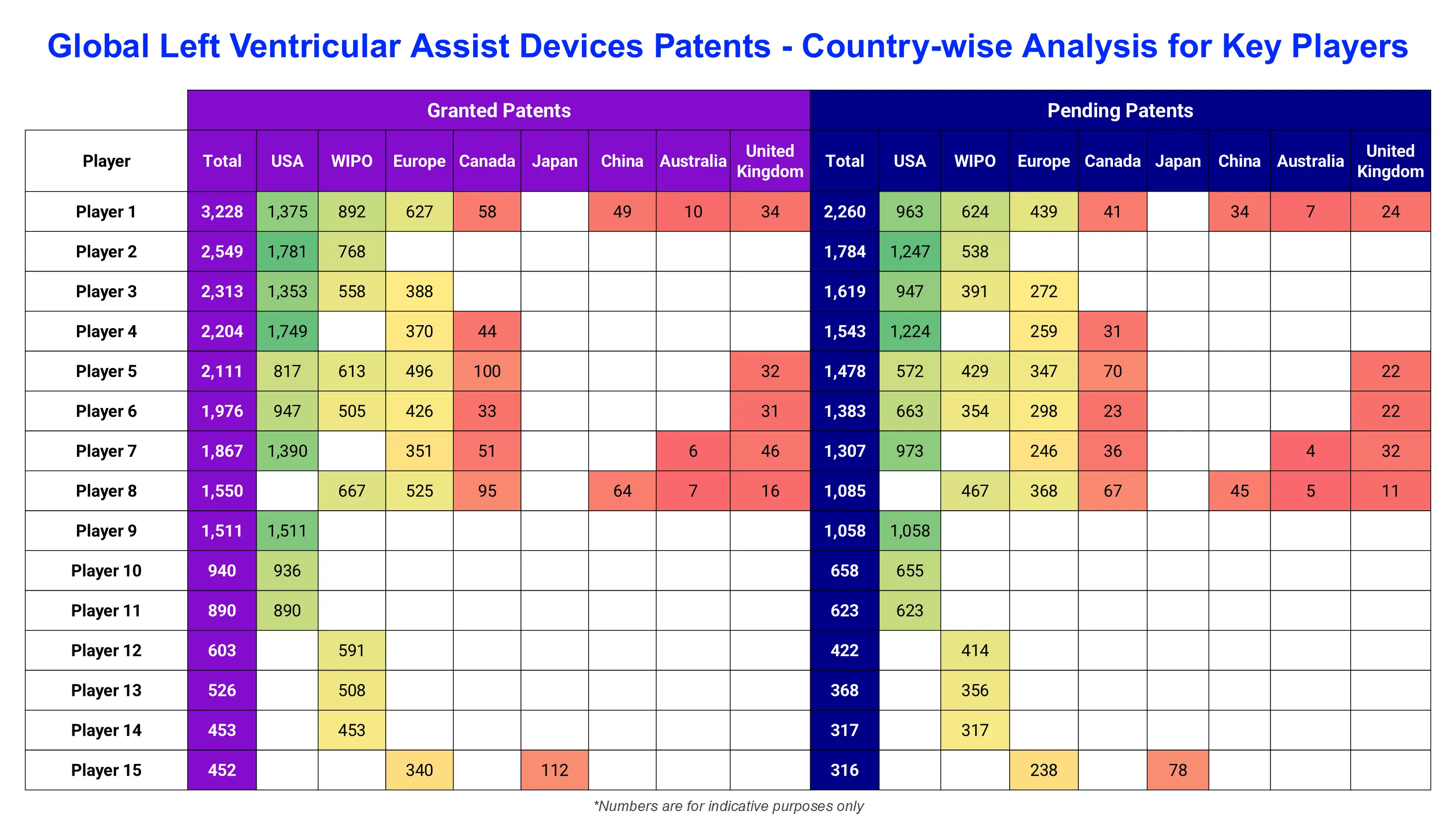
The United States leads in filing volume because of the size of its heart failure population, the presence of the main manufacturers and the Food and Drug Administration pathway that most developers pursue first. Europe follows, supported by early CE-marked systems and a strong base of academic transplant centres in Germany, the Netherlands and the United Kingdom. China has grown quickly as domestic developers advance locally designed magnetically levitated pumps. South Korea contributes through university and hospital-led work. India remains at an early stage, with few filings and most coming from research institutes. WIPO international applications are the route larger companies use to hold options across several markets.
Read more about this report - REQUEST FREE SAMPLE COPY IN PDF
Patent activity in left ventricular assist devices falls into five technology segments:
Magnetically levitated centrifugal pumps lead patent activity because the rotor, bearing and flow path decide thrombosis, stroke and bleeding rates, which are the clinical outcomes that govern patient survival and implant volumes. The HeartMate 3 showed that a fully magnetically levitated rotor with wide blood gaps can improve outcomes, and applicants have since filed extensively on rotor geometry, suspension control and housing design. Haemocompatibility filings are closely tied to this segment and often share the same claims.
Competition is led by Abbott, whose HeartMate 3 sets the benchmark for durable support, and by Abiomed, whose Impella family dominates percutaneous support in cardiogenic shock and high-risk coronary intervention. Medtronic retains a large legacy portfolio from its HVAD system, while Berlin Heart and Jarvik Heart compete in paediatric support and in niche pump designs. Smaller developers are filing on fully implantable concepts and on pumps intended to avoid anticoagulation, which keeps pressure on incumbents to extend their claims.
Companies are focusing on:
Emerging themes include fully implantable systems with transcutaneous energy transfer that remove the driveline and its infection risk, and physiological control that adjusts pump speed to exercise and posture. Sensors for pressure and flow inside the pump are being used to predict thrombosis, bleeding and decompensation before symptoms appear. Percutaneous pumps with longer support durations aim to bridge patients to a durable implant or to recovery. Smaller paediatric pumps are another growing area, since few durable options exist for children.
The left ventricular assist devices patent landscape shows a field in which a few large manufacturers hold deep portfolios on durable pumps, while percutaneous support and wireless power attract newer entrants. Filings are tied closely to clinical evidence and regulatory decisions, so approvals, trial readouts and safety communications leave a visible mark on filing patterns. Reading assignee, jurisdiction and cluster data together shows where protection is dense and where room remains.
The landscape provides actionable intelligence for the following nine uses:
Patent research was run across national and regional patent databases covering the United States, Europe, China, Japan, South Korea and India, along with international applications published through WIPO. Search strategies combined keywords for ventricular assist, rotor, impeller, cannula, driveline and controller concepts with Cooperative Patent Classification codes for cardiac assist devices, blood pumps and implantable energy transfer. Coverage extends to granted patents and published applications over the past two decades.
Retrieved records were screened to remove duplicate families and filings with no relevance to left ventricular assist devices. The remaining families were grouped at family level and classified by pump technology, therapy strategy, component, assignee, jurisdiction and technology cluster. Assignee names were harmonised so that subsidiaries and acquired entities appear under a single owner, and legal status was checked for granted, pending and lapsed filings.
Patent findings were read alongside regulatory approvals, clinical trial publications, company disclosures and transplant and heart failure statistics. This linkage ties filing patterns to commercial position, shows which technology clusters have clinical validation and supports the market sizing and forecast included in the wider report. Commercial context, including product launches, withdrawals and centre-level implant capacity, is used to explain why activity rises or falls in particular clusters.


Upto 15% Off
USD
$2699 $2429
$4299 $3869
$5799 $4949
$6999 $5949


*While we strive to always give you current and accurate information, the numbers depicted on the website are indicative and may differ from the actual numbers in the main report. At Expert Market Research, we aim to bring you the latest insights and trends in the market. Using our analyses and forecasts, stakeholders can understand the market dynamics, navigate challenges, and capitalize on opportunities to make data-driven strategic decisions.*
EMR's Left Ventricular Assist Devices Patent Landscape Analysis provides a comprehensive assessment of patent filings, innovation clusters, assignee portfolios, and geographic filing patterns across the left ventricular assist devices landscape. The report identifies 2,400+ patent families, evaluates leading jurisdictions including the United States, Europe, and China, and profiles the top assignees by portfolio size.
The global left ventricular assist devices market was valued at USD 2.45 Billion in 2025. The market is projected to reach USD 5.39 Billion by 2035, expanding at a CAGR of 8.20% during 2026 - 2035.
The report analyses approximately 2,400+ patent families related to left ventricular assist devices. These include filings from the United States, Europe, China, and international WIPO filings.
Key companies operating within the landscape include Abbott, Medtronic, Abiomed, Berlin Heart, and Jarvik Heart, among others. These organisations collectively account for a significant portion of patent activity analysed in this report.
The report evaluates patent activity across the United States, Europe, China, Japan, South Korea, India, and international WIPO filings. The United States is the largest single jurisdiction, with more than 950 patents associated with it among the more than 2,400 patent families analysed, reflecting the size of its heart failure population, the concentration of leading manufacturers and its role as the first approval pathway for most developers.
Yes. The report scope can be customised based on geography, technology segment, assignee selection, time period, or specific innovation cluster focus. Readers can contact the EMR team to scope a customised study, such as a deeper review of a specific assignee, technology cluster or jurisdiction within the left ventricular assist devices landscape.
Patent landscape analysis helps organisations understand innovation trends, competitive activity, technology whitespace, and IP risk across a defined domain. For left ventricular assist devices, this report supports strategic decisions in R&D prioritisation, licensing evaluation, competitive benchmarking, and market entry planning.
Explore our key highlights of the report and gain a concise overview of key findings, trends, and actionable insights that will empower your strategic decisions.
|
Scope of the Report |
Details |
|
Analysis by Pump Technology |
|
|
Analysis by Therapy StrategyAnalysis by Therapy Strategy |
|
|
Analysis by Component |
|
|
Analysis by End User |
|
|
Key Players Mentioned |
|
|
Geographies Covered |
|
Mini Report
One User
USD 2,699
USD 2,429
tax inclusive*
Single User License
One User
USD 4,299
USD 3,869
tax inclusive*
Five User License
Five User
USD 5,799
USD 4,949
tax inclusive*
Corporate License
Unlimited Users
USD 6,999
USD 5,949
tax inclusive*
*Please note that the prices mentioned below are starting prices for each bundle type. Kindly contact our team for further details.*
Flash Bundle
Small Business Bundle
Growth Bundle
Enterprise Bundle
*Please note that the prices mentioned below are starting prices for each bundle type. Kindly contact our team for further details.*
Flash Bundle
Number of Reports: 3
20%
tax inclusive*
Small Business Bundle
Number of Reports: 5
25%
tax inclusive*
Growth Bundle
Number of Reports: 8
30%
tax inclusive*
Enterprise Bundle
Number of Reports: 10
35%
tax inclusive*
How To Order

Select License Type
Choose the right license for your needs and access rights.

Click on ‘Buy Now’
Add the report to your cart with one click and proceed to register.

Select Mode of Payment
Choose a payment option for a secure checkout. You will be redirected accordingly.
Strategic Solutions for Informed Decision-Making
Gain insights to stay ahead and seize opportunities.

Get insights & trends for a competitive edge.

Track prices with detailed trend reports.

Analyse trade data for supply chain insights.

Leverage cost reports for smart savings

Enhance supply chain with partnerships.

Connect For More Information
Our expert team of analysts will offer full support and resolve any queries regarding the report, before and after the purchase.
Our expert team of analysts will offer full support and resolve any queries regarding the report, before and after the purchase.
We employ meticulous research methods, blending advanced analytics and expert insights to deliver accurate, actionable industry intelligence, staying ahead of competitors.
Our skilled analysts offer unparalleled competitive advantage with detailed insights on current and emerging markets, ensuring your strategic edge.
We offer an in-depth yet simplified presentation of industry insights and analysis to meet your specific requirements effectively.




