

Consumer Insights
Uncover trends and behaviors shaping consumer choices today
Procurement Insights
Optimize your sourcing strategy with key market data
Industry Stats
Stay ahead with the latest trends and market analysis.
The neural implants market was valued at USD 6.20 Billion in 2025 and is projected to reach USD 24.87 Billion by 2035, growing at a CAGR of 14.90% over the forecast period. Demand is shaped by the rising burden of Parkinson's disease, chronic pain, and drug-resistant epilepsy, wider acceptance of neuromodulation as an alternative to long-term drug therapy, and the shift from fixed-output devices to sensing-enabled, adaptive systems. Early clinical progress in brain-computer interface implants and expanding reimbursement for spinal cord and sacral stimulation add further momentum.
Patent activity reflects this momentum, with filings concentrated in adaptive and closed-loop neurostimulation, high channel count electrode arrays, rechargeable implantable pulse generators, and spinal cord and peripheral nerve stimulation. Brain-computer interface signal decoding and biocompatible lead and electrode materials are the fastest-growing technical themes. Regulatory validation, including FDA approval of a deep brain stimulation system with brain sensing and early human studies of high-density brain interfaces, is steering corporate research budgets toward devices that record neural activity as well as deliver stimulation.
This Neural Implants Patent Landscape Analysis Report provides a structured view of patent filing trends, leading assignees, jurisdiction activity, technology segmentation and competitive positioning across implanted brain, spinal cord and nerve interfaces.
The neural implants market is experiencing strong growth, driven by the rising prevalence of movement disorders and chronic pain, the clinical shift toward closed-loop stimulation, and early progress in brain-computer interface implants. Deep brain stimulation is already an established therapy for Parkinson's disease and essential tremor, and systems that sense brain activity and adjust stimulation automatically are now reaching the clinic.
Patent activity is accelerating, with 4,800+ neural implants patents granted in 2025, reflecting strong innovation momentum in adaptive and closed-loop neurostimulation, high channel count electrode arrays, rechargeable implantable pulse generators, and spinal cord and peripheral nerve stimulation.
Top assignees in the neural implants patent landscape include Medtronic, Boston Scientific, Abbott Laboratories, LivaNova, and Neuralink, with the United States, China, and Europe as the dominant patent jurisdictions.
Neural implants occupy a distinct position within implantable medical devices because they act directly on the electrical circuitry of the brain, spinal cord and peripheral nerves. Clinical use is anchored in deep brain stimulation for movement disorders, spinal cord stimulation for chronic pain, vagus nerve stimulation for epilepsy and depression, and cochlear implants for hearing loss. Demand is influenced by ageing populations, the limits of drug therapy in neurological disease, and growing neurosurgical capacity. Treatment is also moving from fixed, open-loop stimulation toward systems that sense neural signals and adjust therapy automatically, while brain-computer interface implants are opening a new category aimed at restoring communication and movement in people with severe paralysis.
Market growth is driven by the adoption of spinal cord and deep brain stimulation as established second-line therapies, which converts a large pool of drug-refractory patients into implant candidates. Parkinson's disease alone affects more than 8 million people worldwide, and only a small share of eligible patients currently receive deep brain stimulation, which indicates substantial untreated demand. Chronic pain is similarly widespread, and spinal cord stimulation is increasingly used before long-term opioid therapy is considered.
Regulatory events have shaped the pace of adoption. The FDA approval of an adaptive deep brain stimulation system with brain sensing in the mid-2020s showed that closed-loop therapy can reach routine practice, and that encourages hospitals to favour pulse generators with built-in recording. Rechargeable pulse generators matter in the same way, because a battery life of ten years or more lowers the number of replacement surgeries and the long-term cost to payers. Brain-computer interface implants remain in early clinical trials with a small number of participants, so their commercial contribution is limited today; however, each successful demonstration raises investor interest and pulls electrode and decoding research forward.
Read more about this report - REQUEST FREE SAMPLE COPY IN PDF
Filing intensity in neural implants has risen steadily as device makers move from single-purpose stimulators to platforms that combine sensing, stimulation, wireless programming and analytics. Large neuromodulation companies file continuously on leads, pulse generators and programming software, while newer entrants concentrate on electrode density and signal decoding. This pattern follows commercial investment, since product launches in spinal cord stimulation, deep brain stimulation and sacral neuromodulation are normally preceded by clusters of filings on waveform design, lead geometry and battery architecture. Venture funding for brain-computer interface developers has added a second stream of applications from companies with little earlier patent history.
The landscape covers approximately 69,000+ patent families, with filing activity peaking between 2019 and 2024 as closed-loop and brain interface programmes matured. Adaptive and closed-loop neurostimulation, high channel count electrode arrays and rechargeable implantable pulse generators account for the largest share of recent applications. Spinal cord and peripheral nerve stimulation forms a large and stable base of filings, supported by an established commercial market. Brain-computer interface signal decoding and biocompatible lead and electrode materials are smaller clusters but are growing faster as clinical studies advance.
Rising clinical demand for sensing-enabled stimulation, together with early evidence from brain-computer interface studies, has widened the field of protectable inventions and pushed filing activity well beyond the mature stimulator segments.
The patent landscape covers filings published across the major patent offices and international systems, with attention to the United States, China, Europe, South Korea, India and applications filed through the World Intellectual Property Organization (WIPO). Market coverage includes implanted systems used in neurology, neurosurgery, pain management and sensory restoration, in both established and emerging care settings. The geographic scope supports a comparison of where inventions are first filed, where they are protected, and where commercial deployment is concentrated.
Technology scope includes implant types such as deep brain stimulation systems, spinal cord stimulation systems, vagus and peripheral nerve stimulators, sacral and cranial nerve stimulators, brain-computer interface implants, and cochlear and retinal implants. Clinical applications span movement disorders, chronic pain, epilepsy, psychiatric disorders, and sensory and motor restoration. Technology features examined include closed-loop sensing and stimulation, rechargeable power systems, high-density electrode arrays, wireless programming and data transfer, and artificial intelligence signal decoding. Cardiac rhythm devices are excluded and are addressed in separate reports.
Entities in the landscape include large neuromodulation manufacturers, specialist hearing and vision implant companies, and start-ups developing high channel count brain interfaces and endovascular neural interfaces. Academic and clinical institutions, including university neurosurgery programmes, research hospitals and neural engineering laboratories, contribute early-stage inventions in electrode design, decoding algorithms and surgical technique. Component and materials suppliers working on leads, hermetic packaging and biocompatible coatings are also included, together with university spin-outs that license core technology to commercial developers.
The report will cover the following sections in detail:
Analysis by Implant Type
Analysis by Clinical Application
Analysis by Technology Feature
Neural Implants Patent Filing Trend Analysis
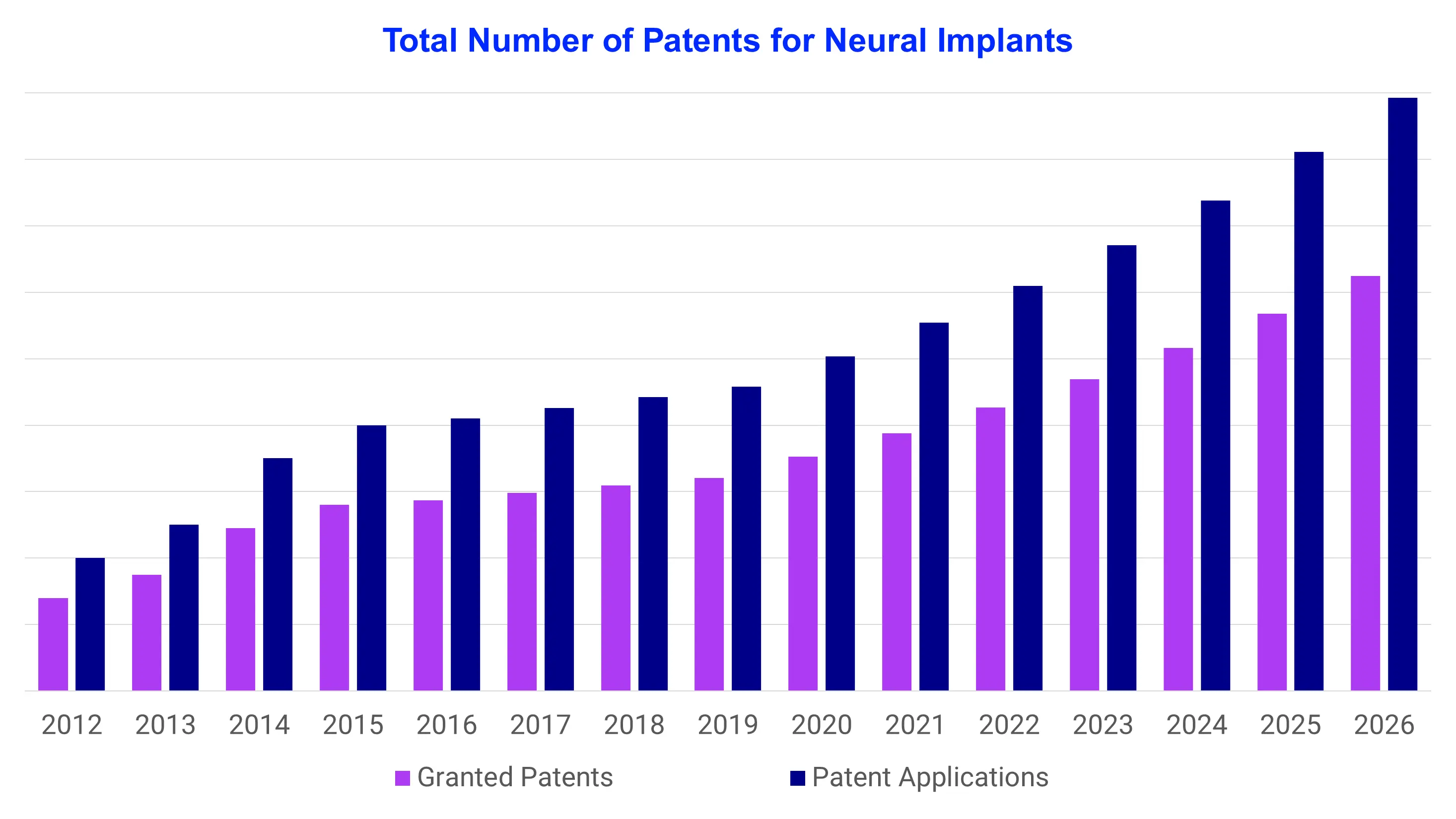
Patent filings in neural implants have grown consistently over the past decade, led by stimulation control, electrode design and implant power management. Established neuromodulation companies keep a steady flow of continuation and improvement filings, which gives the trend a stable base. Sensing-enabled pulse generators and brain interface electrodes have added a faster-growing layer on top of this base, and academic spin-outs have become a visible source of new families. Granted patents have followed filings with the usual lag of two to four years, so the volume of grants in 2024 reflects applications from the early 2020s.
Annual filing growth is estimated at approximately 9 to 11 percent between 2020 and 2024, which is above the long-run pace of the broader implantable device sector. Closed-loop therapy programmes at the leading manufacturers, larger funding rounds for brain-computer interface companies, and strong clinical evidence for adaptive deep brain stimulation drove most of the increase. Rechargeable pulse generators and wireless programming added further applications as manufacturers refreshed their spinal cord and sacral stimulation lines.
Among the players with neural implants patent families, new entrants have been identified, which can be either established companies or startups developing novel technology in the field. Some of the major companies mentioned in this report (a non-exhaustive list) are as follows:
Medtronic holds one of the largest neuromodulation portfolios in the field, spanning deep brain stimulation, spinal cord stimulation, sacral neuromodulation and the associated leads, programmers and software. Its commercial platforms include the Percept family of deep brain stimulation systems with BrainSense sensing technology and the Intellis and Inceptiva systems for spinal cord stimulation. Deep brain stimulation from the company has been approved in the United States for Parkinson's disease, essential tremor and dystonia, with approvals or conditional pathways for some obsessive-compulsive and epilepsy indications. Its adaptive deep brain stimulation capability received FDA approval in the mid-2020s, which strengthens the position of its sensing-enabled pulse generators. The IP strategy relies on layered families covering hardware, sensing algorithms and programming workflows, protected across the United States, Europe and Asia. This breadth gives the company a central position in clinical neuromodulation and a base from which to license or defend closed-loop concepts.
Boston Scientific operates a neuromodulation business built around spinal cord stimulation and deep brain stimulation, supported by acquisitions that broadened its nerve stimulation reach. Its commercial platforms include the WaveWriter spinal cord stimulator family and the Vercise deep brain stimulation systems, the latter built on directional leads and multiple independent current control. The company also expanded into sacral neuromodulation through its acquisition of Axonics, which closed in 2024. Its devices carry FDA approval and CE marking for their principal indications in chronic pain and movement disorders. The IP approach combines in-house filings on waveform programming, lead design and software with patents acquired through deals, producing a portfolio that is strongest in stimulation control and electrode geometry. Commercially, it competes directly with Medtronic and Abbott Laboratories in pain management and is a smaller but technically active participant in deep brain stimulation.
Other companies include Abbott Laboratories, LivaNova, and Neuralink.
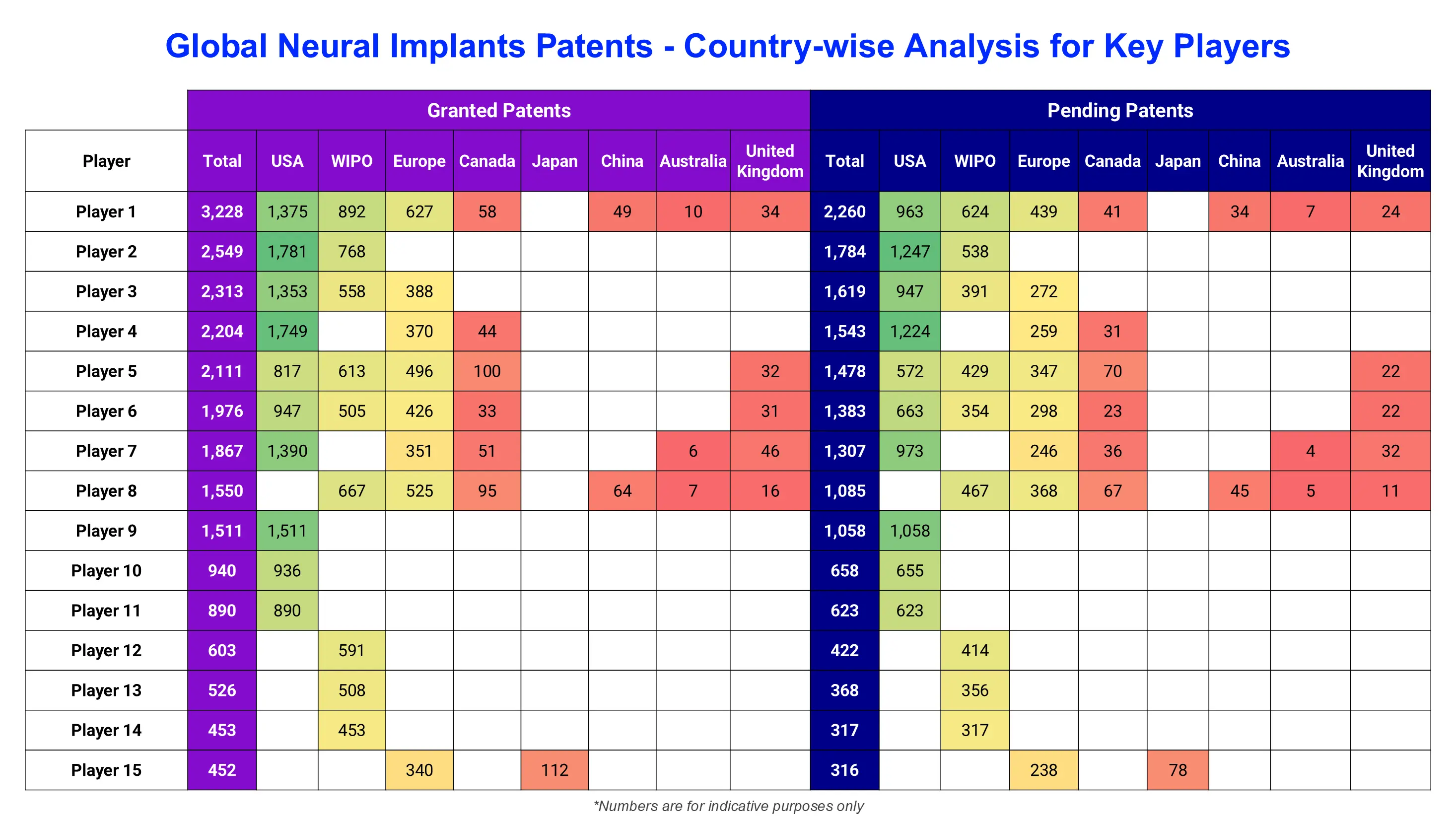
Patent ownership is moderately concentrated among five assignee groups: Medtronic, Boston Scientific, Abbott Laboratories, LivaNova and Neuralink. Medtronic, Boston Scientific and Abbott Laboratories hold broad portfolios covering pulse generators, leads, programming systems and clinical software, built over decades of neuromodulation product cycles. LivaNova concentrates on vagus nerve stimulation and the related sensing and control methods. Neuralink is a younger filer focused on high channel count electrode threads, implantation hardware and signal processing, and its portfolio is smaller but highly specialised. Beyond these groups, filings are spread across hearing implant makers, academic institutions and start-ups.
*Please note that this is only a partial list; the complete list of key players is available in the full report. Additionally, the list of key players can be customized to better suit your needs.*
The report assesses patent activity across major jurisdictions, including:
The United States is the leading jurisdiction, reflecting the size of its neuromodulation market, the presence of the main device makers and the early regulatory pathway for new implants. China ranks second, supported by a large domestic filing base from universities, hospitals and emerging device companies working on deep brain stimulation and brain interfaces. Europe follows, with filings through the European Patent Office linked to the region's CE mark pathway and strong clinical research centres. South Korea and India show smaller but expanding activity, driven by local device developers and academic groups. WIPO filings under the Patent Cooperation Treaty indicate which inventions applicants expect to commercialise across several markets.
Read more about this report - REQUEST FREE SAMPLE COPY IN PDF
Technology activity in the neural implants patent landscape can be grouped into five main segments:
Closed-loop sensing and adaptive stimulation leads patent activity, because it extends the clinical value of established deep brain stimulation, spinal cord stimulation and vagus nerve stimulation platforms and gives manufacturers a route to differentiate products in mature segments. High-density electrode arrays are the second most active area, driven by brain interface developers, while rechargeable and wireless pulse generators form a large and steady third group.
Competition in neural implants combines a mature group of large neuromodulation manufacturers with a fast-moving set of brain interface developers. The established companies defend their positions through broad families on leads, pulse generators and programming systems, and through long clinical track records in deep brain stimulation, spinal cord stimulation and vagus nerve stimulation. Newer entrants file on electrode density, flexible substrates, surgical insertion and signal decoding, often in partnership with academic centres. Acquisitions have also reshaped the field, as larger firms add nerve stimulation and sacral neuromodulation portfolios to complement existing pain and movement disorder franchises.
Companies are focusing on:
Emerging themes include fully implanted wireless brain interfaces, endovascular electrodes delivered through blood vessels, and flexible thin-film materials that reduce tissue response. Stimulation of the spinal cord to restore movement after injury, and vagus nerve stimulation for conditions beyond epilepsy and depression, are attracting growing numbers of applications. Machine learning models that interpret neural signals in real time are also appearing in filings, alongside work on lowering power use so that sensing and stimulation can run together within a small implant.
The neural implants patent landscape shows a field where mature stimulation franchises and early brain interface programmes sit side by side. Five leading assignees account for a large share of high-value families, while the fastest filing growth comes from sensing, electrodes and decoding, where smaller companies and research groups are active. Patent data therefore points to the technical areas that are likely to define the next product generation, as well as the segments where freedom to operate is already crowded.
The patent landscape provides actionable intelligence for the following uses:
Patent research drew on global patent databases and international filing systems, covering published applications and granted patents related to implanted systems that stimulate or record from the brain, spinal cord and peripheral nerves. Search strategies combined keywords, classification codes under the Cooperative Patent Classification (CPC) system, and assignee names, and results were consolidated at the patent family level to avoid double counting of equivalent filings.
Screening removed records outside the defined scope, including cardiac rhythm devices, external stimulators and non-implanted interfaces. The remaining families were classified by implant type, clinical application, technology feature, jurisdiction and assignee. Technology clusters were assigned on the basis of claims and abstracts, and ambiguous cases were reviewed manually to keep the categories consistent. Duplicate families and records without a clear implanted application were excluded before counts were finalised.
Market analysis supported the interpretation of filing trends by relating them to clinical adoption, regulatory approvals and commercial activity among device manufacturers. Published regulatory records, company disclosures and clinical literature were used to place patent growth in a commercial context. Estimated growth rates and relative shares are approximate and are presented to indicate direction rather than exact counts.


Upto 15% Off
USD
$2699 $2429
$4299 $3869
$5799 $4949
$6999 $5949


*While we strive to always give you current and accurate information, the numbers depicted on the website are indicative and may differ from the actual numbers in the main report. At Expert Market Research, we aim to bring you the latest insights and trends in the market. Using our analyses and forecasts, stakeholders can understand the market dynamics, navigate challenges, and capitalize on opportunities to make data-driven strategic decisions.*
EMR's Neural Implants Patent Landscape Analysis provides a comprehensive assessment of patent filings, innovation clusters, assignee portfolios, and geographic filing patterns across the neural implants landscape. The report identifies 69,000+ patent families, evaluates leading jurisdictions including the United States, China, and Europe, and profiles the top assignees by portfolio size.
The global neural implants market was valued at USD 6.20 Billion in 2025. The market is projected to reach USD 24.87 Billion by 2035, expanding at a CAGR of 14.90% during 2026 - 2035.
The report analyses approximately 69,000+ patent families related to neural implants. These include filings from the United States, China, Europe, and international WIPO filings.
Key companies operating within the landscape include Medtronic, Boston Scientific, Abbott Laboratories, LivaNova, and Neuralink, among others. These organisations collectively account for a significant portion of patent activity analysed in this report.
The report evaluates patent activity across the United States, Europe, China, Japan, South Korea, India, and international WIPO filings. The United States is the largest single jurisdiction in the neural implants patent landscape, with more than 9,500 patents associated with it out of 69,000+ patent families analysed.
Yes. The report scope can be customised based on geography, technology segment, assignee selection, time period, or specific innovation cluster focus. Readers who need a customised study, such as a narrower technology cut, a specific assignee benchmark or a regional filing review, can contact the EMR team to scope the work.
Patent landscape analysis helps organisations understand innovation trends, competitive activity, technology whitespace, and IP risk across a defined domain. For neural implants, this report supports strategic decisions in R&D prioritisation, licensing evaluation, competitive benchmarking, and market entry planning.
Explore our key highlights of the report and gain a concise overview of key findings, trends, and actionable insights that will empower your strategic decisions.
|
Scope of the Report |
Details |
|
Analysis by Implant Type |
|
|
Analysis by Clinical Application |
|
|
Analysis by Technology Feature |
|
|
Analysis by End User |
|
|
Key Players Mentioned |
|
|
Geographies Covered |
|
Mini Report
One User
USD 2,699
USD 2,429
tax inclusive*
Single User License
One User
USD 4,299
USD 3,869
tax inclusive*
Five User License
Five User
USD 5,799
USD 4,949
tax inclusive*
Corporate License
Unlimited Users
USD 6,999
USD 5,949
tax inclusive*
*Please note that the prices mentioned below are starting prices for each bundle type. Kindly contact our team for further details.*
Flash Bundle
Small Business Bundle
Growth Bundle
Enterprise Bundle
*Please note that the prices mentioned below are starting prices for each bundle type. Kindly contact our team for further details.*
Flash Bundle
Number of Reports: 3
20%
tax inclusive*
Small Business Bundle
Number of Reports: 5
25%
tax inclusive*
Growth Bundle
Number of Reports: 8
30%
tax inclusive*
Enterprise Bundle
Number of Reports: 10
35%
tax inclusive*
How To Order

Select License Type
Choose the right license for your needs and access rights.

Click on ‘Buy Now’
Add the report to your cart with one click and proceed to register.

Select Mode of Payment
Choose a payment option for a secure checkout. You will be redirected accordingly.
Strategic Solutions for Informed Decision-Making
Gain insights to stay ahead and seize opportunities.

Get insights & trends for a competitive edge.

Track prices with detailed trend reports.

Analyse trade data for supply chain insights.

Leverage cost reports for smart savings

Enhance supply chain with partnerships.

Connect For More Information
Our expert team of analysts will offer full support and resolve any queries regarding the report, before and after the purchase.
Our expert team of analysts will offer full support and resolve any queries regarding the report, before and after the purchase.
We employ meticulous research methods, blending advanced analytics and expert insights to deliver accurate, actionable industry intelligence, staying ahead of competitors.
Our skilled analysts offer unparalleled competitive advantage with detailed insights on current and emerging markets, ensuring your strategic edge.
We offer an in-depth yet simplified presentation of industry insights and analysis to meet your specific requirements effectively.




