

Consumer Insights
Uncover trends and behaviors shaping consumer choices today
Procurement Insights
Optimize your sourcing strategy with key market data
Industry Stats
Stay ahead with the latest trends and market analysis.
The polymeric nanoparticle drug delivery market was valued at USD 6.85 Billion in 2025 and is projected to reach USD 22.44 Billion by 2035, growing at a CAGR of 12.60%. Growth stems from the expanding oncology pipeline, the need for targeted and sustained release of poorly soluble drugs, rising investment in nucleic acid and vaccine delivery, and scalable microfluidic manufacturing.
Patent activity covers more than 11,870 families, with filings concentrated in PLGA formulations, block copolymer micelles, ligand-targeted carriers and stimuli-responsive polymers. Academic institutions in China and the United States supply a large share of early-stage filings, while pharmaceutical and polymer suppliers file on manufacturing and clinical formulations. Paclitaxel micelle approvals in Asia and late-stage tolerogenic nanoparticle programmes in gout confirm commercial validation.
This Polymeric Nanoparticle Drug Delivery Patent Landscape Analysis Report maps filing trends, leading assignees, jurisdictions and technology clusters to support R&D, licensing and freedom-to-operate decisions.
The polymeric nanoparticle drug delivery market is experiencing strong growth, driven by rising oncology drug pipelines, demand for targeted and sustained release, and expansion of nucleic acid therapeutics. Sobi started a rolling biologics license application with the FDA in 2025 for SEL-212, a pegadricase and tolerogenic polymeric nanoparticle combination for chronic refractory gout, giving the platform a late-stage regulatory reference.
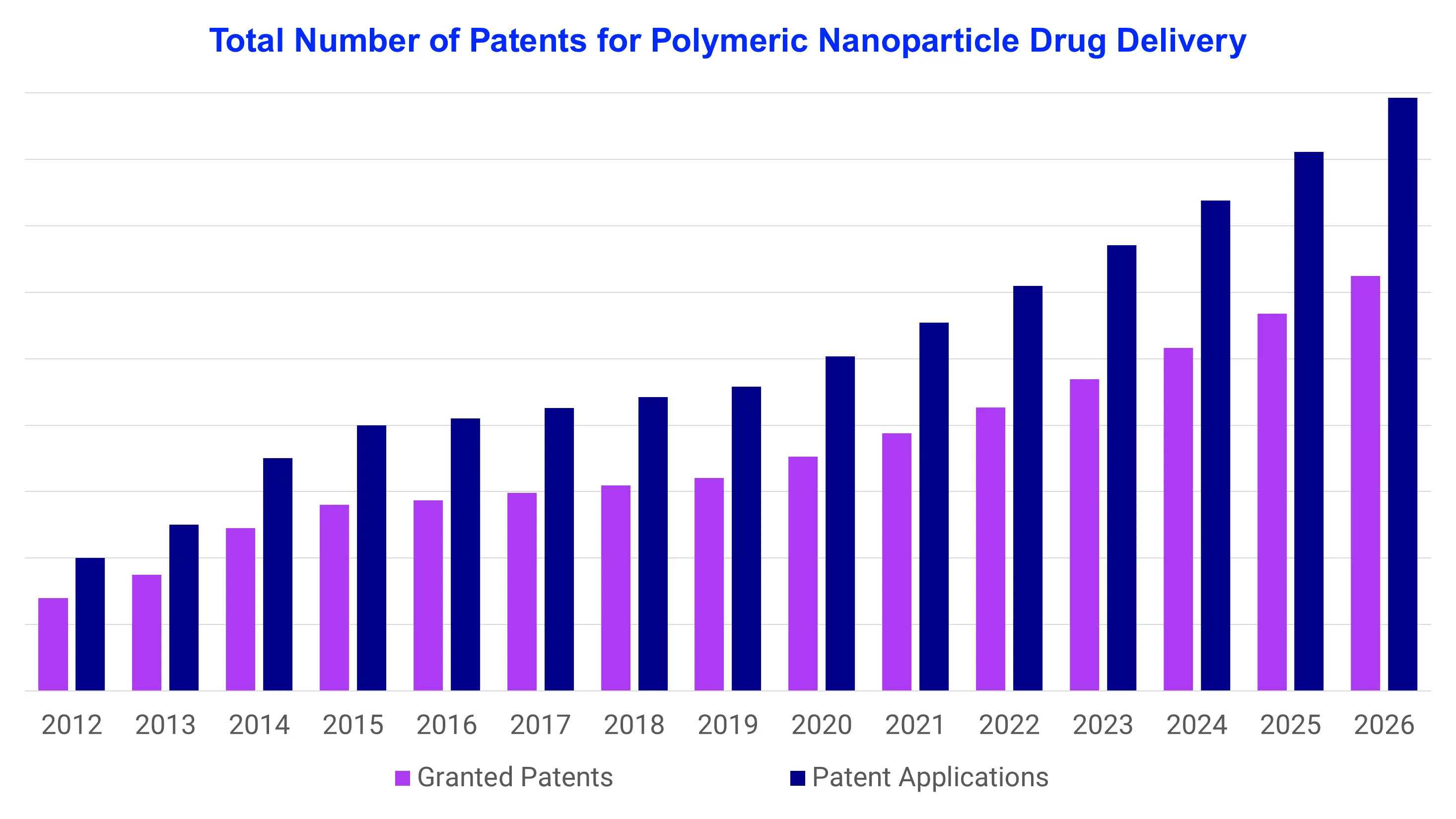
Patent activity is accelerating, with 230+ polymeric nanoparticle drug delivery patents granted in 2025, reflecting strong innovation momentum in stimuli-responsive polymer carriers, ligand-targeted nanoparticles, polymer-based nucleic acid delivery, and microfluidic nanoparticle manufacturing.
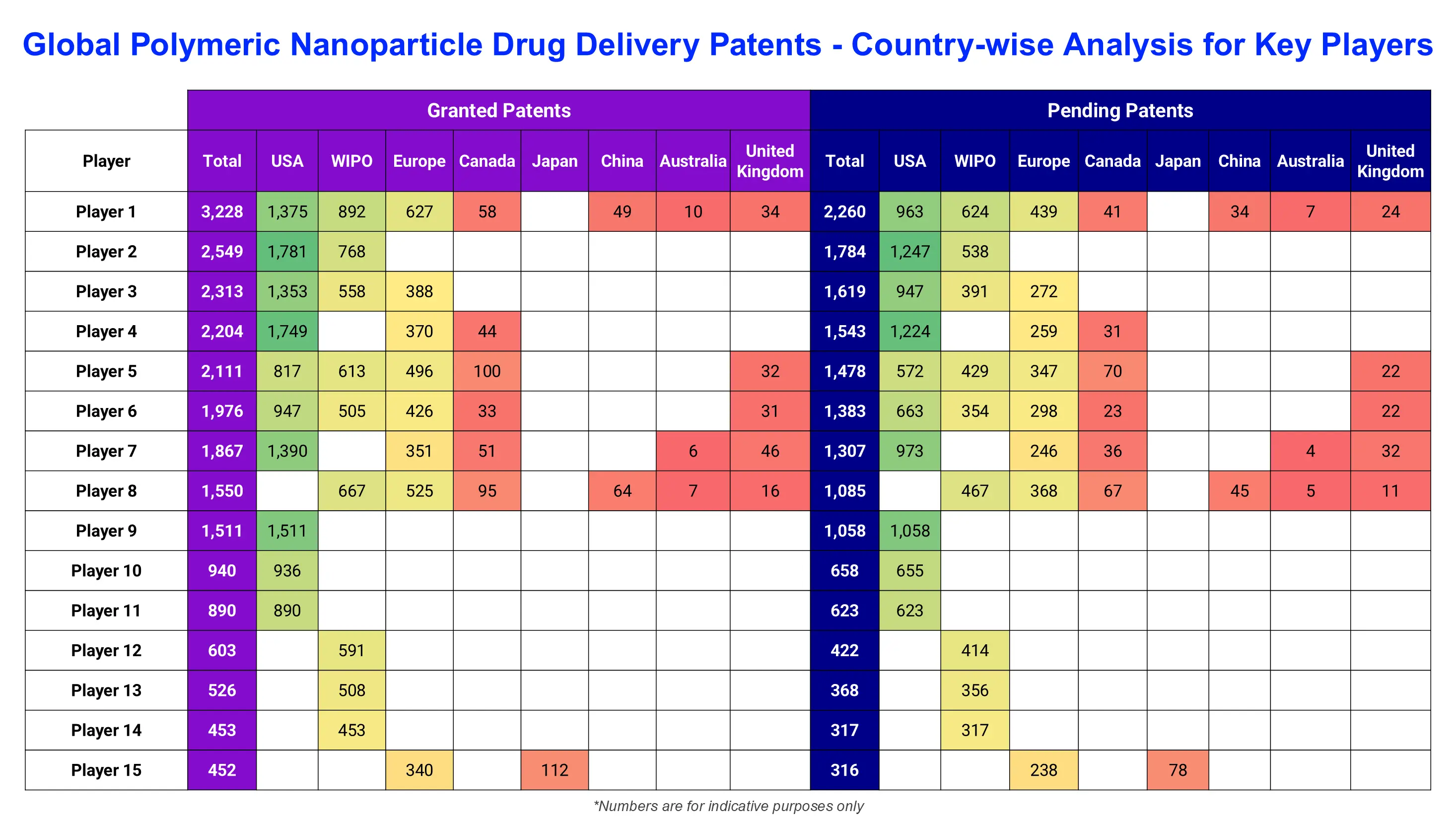
Top assignees in the polymeric nanoparticle drug delivery patent landscape include Massachusetts Institute of Technology, Pfizer, Samyang Holdings, Harvard University, and Evonik, with China, the United States, and Europe as the dominant patent jurisdictions.
Polymeric nanoparticles carry drugs inside biodegradable shells of PLGA, polycaprolactone, block copolymers or natural polymers such as chitosan. They improve the solubility of hydrophobic molecules, extend circulation time and release payloads over days or weeks. Demand comes mainly from oncology, where the carriers reduce solvent-related toxicity, and from nucleic acid and vaccine programmes that need stable, tunable delivery vehicles. Polymer supply, formulation know-how and sterile manufacturing capacity shape the competitive field.
The market growth is driven by the oncology pipeline, where reformulated taxanes and targeted particles offer lower toxicity and better tumour exposure. Global cancer incidence reached about 20 million new cases in 2022, and projections point to roughly 35 million by 2050. Paclitaxel polymeric micelles have reached patients in South Korea and China, and several protein and nucleic acid programmes have entered mid-stage trials.
Asia Pacific leads commercial use because paclitaxel micelle injections gained approvals early in South Korea and later in China, which created hospital familiarity and local polymer supply chains. North America leads clinical innovation, since academic spin-outs and large pharmaceutical groups run most targeted-particle and tolerogenic trials there. The growth rate sits in the upper-middle range because approvals are still few, yet each validated polymer platform can be reused across payloads, which raises the value of every new clinical readout.
Read more about this report - REQUEST FREE SAMPLE COPY IN PDF
Patent filings in polymeric nanoparticle drug delivery follow the shift from cytotoxic reformulation to targeted, immune-modulating and nucleic acid carriers. Chinese universities file at high volume on micelles and PLGA systems for tumour therapy, while United States applicants file more on platform chemistry and manufacturing.
The report covers more than 11,870 patent families, with filing peaks between 2021 and 2023 and a partial dip in 2025 because of the 18-month publication lag. Co-filings between universities, hospitals and start-ups account for a visible share of families.
Rising oncology and nucleic acid demand has moved filings from basic polymer synthesis toward clinical formulations and scalable manufacturing methods.
The report covers granted patents and published applications on polymeric nanoparticles used to deliver therapeutic, vaccine and imaging payloads, including PLGA particles, polymeric micelles, polymersomes, dendrimers and natural polymer carriers. Compositions, preparation processes, targeting moieties and methods of treatment fall within scope.
Lipid nanoparticles, inorganic nanoparticles and microsphere depots above one micrometre fall outside the analysis, except where a claim combines them with a polymer shell. Filings from 2010 to 2026 are assessed, with 2025 and 2026 publications treated as incomplete.
Assessed entities include pharmaceutical and biotechnology companies, polymer and excipient suppliers, contract manufacturers, universities, research institutes and hospital-affiliated inventors.
The report will cover the following sections in detail:
Analysis by Polymer Platform
Analysis by Application
Analysis by Payload
Polymeric Nanoparticle Drug Delivery Patent Filing Trend Analysis
Annual family filings grew by an estimated 9% per year between 2020 and 2024. Growth came from cancer nanomedicine programmes in China, mRNA and siRNA polyplex research after 2020, and tolerogenic nanoparticle work for autoimmune and enzyme-replacement settings.
Granted patents in 2025 reached about 230, with a rising share of claims on manufacturing, such as microfluidic mixing, flash nanoprecipitation and lyophilisation stability. Claims on targeting ligands and stimuli-responsive linkers remain frequent in early filings, while later families emphasise reproducibility and sterile scale-up.
Among the players with polymeric nanoparticle drug delivery patent families, new entrants have been identified, which can be either established companies or startups developing novel technology in the field. Some of the major companies mentioned in this report (a non-exhaustive list) are as follows:
Massachusetts Institute of Technology holds one of the most cited portfolios in polymeric nanoparticle drug delivery, built around the Langer and Anderson laboratories. Its claims cover biodegradable polymer libraries, PLGA-PEG block copolymers, poly(beta-amino ester) carriers for nucleic acids and self-assembled targeted nanoparticles. Platform rights have been licensed to spin-out companies such as BIND Therapeutics and Selecta Biosciences, and the latter's ImmTOR system supports the SEL-212 gout programme now with Sobi. The institute files jointly with Harvard-affiliated hospitals and extends core families through continuation filings. Commercial positioning is that of an upstream technology originator that earns value through exclusive licences and sponsored research.
Pfizer built its polymeric nanoparticle position largely through the 2016 acquisition of BIND Therapeutics assets, which brought the Accurin platform of PSMA-targeted PLGA-PEG docetaxel nanoparticles and the related MIT and Harvard licences. The portfolio covers controlled-polymer composition, ligand density, drug loading and manufacturing processes for self-assembled particles. Clinical results from the docetaxel programme in prostate and lung cancer shaped later design rules for targeted particles. Pfizer maintains the families as part of an oncology and vaccine delivery estate and files improvement patents on conjugation chemistry and scale-up. Its strategy favours internal option value and selective partnering over broad external licensing.
Other companies include Samyang Holdings, Harvard University, and Evonik.
The five leading assignees hold a modest share of all families, since thousands of universities and small companies file in the field. Academic applicants account for a larger proportion than in most drug delivery technologies, and the top corporate holders concentrate on platform chemistry and manufacturing claims.
*Please note that this is only a partial list; the complete list of key players is available in the full report. Additionally, the list of key players can be customized to better suit your needs.*
The report assesses patent activity across major jurisdictions, including:
China leads in family volume, driven by university filings on micelles and PLGA carriers for oncology. The United States follows with strong platform and clinical-stage filings from institutes and companies. Europe contributes polymer chemistry and manufacturing filings, supported by EMA guidance on block copolymer micelle medicinal products.
Read more about this report - REQUEST FREE SAMPLE COPY IN PDF
Technology segments covered in the report include:
Among these, PLGA and polyester nanoparticle formulation holds the largest share of patent families, owing to its long regulatory history and wide payload compatibility.
Competition spans academic originators, large pharmaceutical groups, Asian micelle developers and polymer suppliers. Universities hold the broadest chemistry claims, while Pfizer and Samyang Holdings protect clinical formulations. Suppliers such as Evonik file on polymer grades and purification methods used by formulators.
Companies are focusing on:
Emerging innovation themes include polymeric carriers for mRNA and gene editing payloads, tolerogenic particles for autoimmune disease, brain-penetrating coatings for glioma, inhaled polymeric particles for lung delivery and continuous microfluidic production with in-line size control.
The field combines early academic chemistry with a small number of clinical assets. Freedom-to-operate review is most relevant for PEGylated block copolymers, targeting ligands and mixing processes, where overlapping claims from MIT, Harvard and licensee families are common.
Technology segments, assignee portfolios and jurisdiction trends are mapped to the commercial needs of developers, licensors and investors. The report provides actionable intelligence supporting:
Patent data were drawn from the USPTO, EPO Espacenet, WIPO PATENTSCOPE, CNIPA, JPO and KIPO, with families consolidated at the INPADOC level. Queries combined CPC classes A61K 9/51, A61K 47/34 and A61K 9/107 with polymer, micelle and nanoparticle keywords.
Records were screened to remove lipid-only, inorganic and microsphere depot patents. Assignee names were harmonised across subsidiaries and university systems, and legal status was checked for granted, pending and lapsed families.
The market view draws on FDA and EMA guidance on nanomaterial-containing drug products, NMPA and Korean approvals, ClinicalTrials.gov registrations, company filings and peer-reviewed journals.
Non-Viral Drug Delivery Market


Upto 15% Off
USD
$2699 $2429
$4299 $3869
$5799 $4949
$6999 $5949


*While we strive to always give you current and accurate information, the numbers depicted on the website are indicative and may differ from the actual numbers in the main report. At Expert Market Research, we aim to bring you the latest insights and trends in the market. Using our analyses and forecasts, stakeholders can understand the market dynamics, navigate challenges, and capitalize on opportunities to make data-driven strategic decisions.*
EMR’s Polymeric Nanoparticle Drug Delivery Patent Landscape Analysis provides a comprehensive assessment of patent filings, innovation clusters, assignee portfolios, and geographic filing patterns across the polymeric nanoparticle drug delivery landscape. The report identifies 11,870+ patent families, evaluates leading jurisdictions including China, the United States, and Europe, and profiles the top assignees by portfolio size.
The global polymeric nanoparticle drug delivery market was valued at USD 6.85 Billion in 2025. The market is projected to reach USD 22.44 Billion by 2035, expanding at a CAGR of 12.60% during 2026 - 2035.
The report analyses approximately 11,870+ patent families related to polymeric nanoparticle drug delivery. These include filings from China, the United States, Europe, and international WIPO filings.
Key companies operating within the landscape include Massachusetts Institute of Technology, Pfizer, Samyang Holdings, Harvard University, and Evonik, among others. These organisations collectively account for a significant portion of patent activity analysed in this report.
The report evaluates patent activity across the United States, Europe, China, Japan, South Korea, India, and international WIPO filings. China holds the largest share of polymeric nanoparticle drug delivery patent families, supported by high university filing volumes in oncology nanomedicine.
Yes. The report scope can be customised based on geography, technology segment, assignee selection, time period, or specific innovation cluster focus. Please connect with the EMR team to define the customisation scope.
Patent landscape analysis helps organisations understand innovation trends, competitive activity, technology whitespace, and IP risk across a defined domain. For polymeric nanoparticle drug delivery, this report supports strategic decisions in R&D prioritisation, licensing evaluation, competitive benchmarking, and market entry planning.
Explore our key highlights of the report and gain a concise overview of key findings, trends, and actionable insights that will empower your strategic decisions.
|
Scope of the Report |
Details |
|
Analysis by Polymer Platform |
|
|
Analysis by Application |
|
|
Analysis by Payload |
|
|
Analysis by End User |
|
|
Key Players Mentioned |
|
|
Geographies Covered |
|
Mini Report
One User
USD 2,699
USD 2,429
tax inclusive*
Single User License
One User
USD 4,299
USD 3,869
tax inclusive*
Five User License
Five User
USD 5,799
USD 4,949
tax inclusive*
Corporate License
Unlimited Users
USD 6,999
USD 5,949
tax inclusive*
*Please note that the prices mentioned below are starting prices for each bundle type. Kindly contact our team for further details.*
Flash Bundle
Small Business Bundle
Growth Bundle
Enterprise Bundle
*Please note that the prices mentioned below are starting prices for each bundle type. Kindly contact our team for further details.*
Flash Bundle
Number of Reports: 3
20%
tax inclusive*
Small Business Bundle
Number of Reports: 5
25%
tax inclusive*
Growth Bundle
Number of Reports: 8
30%
tax inclusive*
Enterprise Bundle
Number of Reports: 10
35%
tax inclusive*
How To Order

Select License Type
Choose the right license for your needs and access rights.

Click on ‘Buy Now’
Add the report to your cart with one click and proceed to register.

Select Mode of Payment
Choose a payment option for a secure checkout. You will be redirected accordingly.
Strategic Solutions for Informed Decision-Making
Gain insights to stay ahead and seize opportunities.

Get insights & trends for a competitive edge.

Track prices with detailed trend reports.

Analyse trade data for supply chain insights.

Leverage cost reports for smart savings

Enhance supply chain with partnerships.

Connect For More Information
Our expert team of analysts will offer full support and resolve any queries regarding the report, before and after the purchase.
Our expert team of analysts will offer full support and resolve any queries regarding the report, before and after the purchase.
We employ meticulous research methods, blending advanced analytics and expert insights to deliver accurate, actionable industry intelligence, staying ahead of competitors.
Our skilled analysts offer unparalleled competitive advantage with detailed insights on current and emerging markets, ensuring your strategic edge.
We offer an in-depth yet simplified presentation of industry insights and analysis to meet your specific requirements effectively.




