

Consumer Insights
Uncover trends and behaviors shaping consumer choices today
Procurement Insights
Optimize your sourcing strategy with key market data
Industry Stats
Stay ahead with the latest trends and market analysis.
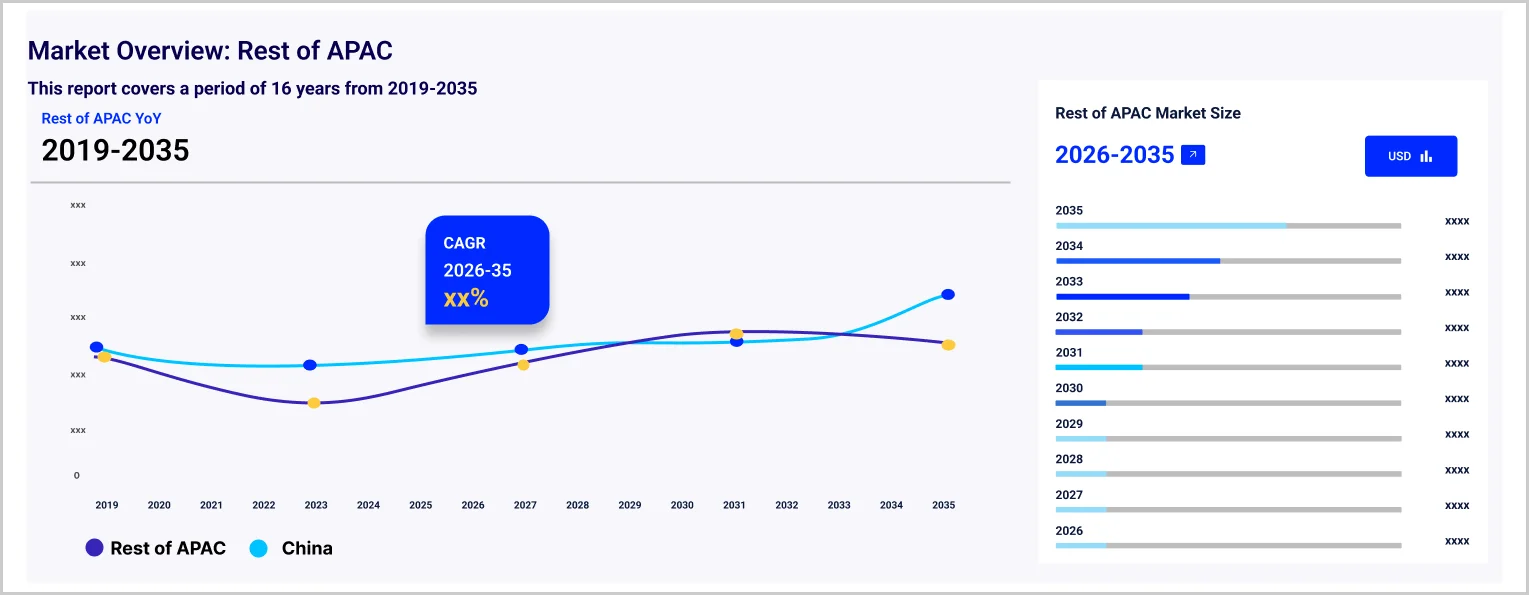
The Asia Pacific automotive relay market attained a value of USD 8.27 Billion in 2025 and is projected to expand at a CAGR of 6.80% through 2035. The market is further expected to achieve USD 15.97 Billion by 2035. Smart solid-state relays are emerging as an innovative driving factor, offering faster switching, reduced mechanical wear, improved diagnostics, and precise power control. Their integration into zonal architectures, intelligent power distribution, and software-defined vehicles is creating new opportunities for automotive relay manufacturers, particularly as Asia Pacific accelerates vehicle electrification and advanced electronic architectures.
Vehicle electrification is creating an additional requirement for high-voltage switching components. According to the IEA, China produced around 16 million electric cars in 2025, accounting for nearly three-quarters of global electric-car production. Southeast Asian electric-car sales more than doubled in 2025, while India’s electric-car sales increased by 75% to 165,000 units. These developments broaden the addressable requirement for high-voltage, protective, PCB, signal, and power relays. Meanwhile, conventional vehicle functions such as lighting, locking, ABS, engine management, and body electronics continue to support demand for low- and medium-current relays, thereby boosting the Asia Pacific automotive relay market value.
In 2026, automotive relay innovation is increasingly centred on high-current, high-voltage switching technologies designed for electric and hybrid vehicles. The EV-B relay produced by Panasonic has a capacity of 2,000A at 500VDC, thereby greatly increasing the capabilities of its switch. The use of a hydrogen gas-filled chamber allows for the prevention of arc discharge from the contacts and ensures increased efficiency and reliability of the relay during the switching of high currents. Furthermore, the relay keeps the same footprint as Panasonic's 250A EV-A relay, which is a sign that attempts are being made to improve power handling abilities without increasing the size of components. This type of development is especially important in Asia-Pacific countries, such as China, Japan, India, and Southeast Asia, where EV manufacturing is experiencing rapid growth.
Increasing technical complexity in high-voltage switching systems is creating challenges for the Asia Pacific automotive relay market. The EV relay systems have to ensure safety in handling larger currents and voltages and also be compact in size with low contact resistance, adequate arc quenching ability, and good longevity. The growing battery capacity and charging capability mean that there is more pressure on the manufacturers to ensure effective thermal management, insulation, sealing, and electrical endurance. Automotive companies are also looking for affordable products that ensure safety and reliability. This will result in increased product development and testing expenses, especially for companies moving from electromechanical relays to high voltage systems. Furthermore, rapidly evolving EV architectures require continuous product upgrades, forcing relay manufacturers to invest consistently in research, engineering capabilities, and advanced manufacturing technologies to remain competitive, thus aiming more towards the Asia Pacific automotive relay market developments.
Compound Annual Growth Rate
6.8%
Value in USD Billion
2026-2035
Read more about this report - Request a Free Sample
Panasonic Automotive Systems announced that its greenhouse-gas reduction targets had received validation from the Science Based Targets initiative. The targets are aligned with efforts to limit global warming to 1.5°C. Although the announcement concerns sustainability rather than relay products directly, it is relevant to automotive component suppliers because environmental performance is increasingly becoming part of OEM supplier evaluation and manufacturing strategy. Sustainability requirements can increasingly influence supplier selection, manufacturing investment and product-development priorities across automotive component supply chains.
Mazda selected Panasonic Automotive Systems' cockpit domain controller for the all-new CX-5. The announcement demonstrates the continued integration of vehicle electronics into centralised computing architectures. Increasing electronic integration changes the surrounding electrical architecture and creates demand for reliable switching, power-management and protection components. Greater vehicle-electronics integration supports demand for sophisticated relay and electrical-control solutions designed for increasingly centralised vehicle architectures.
Mitsuba outlined plans to strengthen its Indian four-wheel business through greater local procurement and production, an R&D centre and relocation of production lines. The company stated that the initiatives are intended to support increased orders from customers including Maruti Suzuki, Tata Motors, Mahindra & Mahindra and Honda. Greater component localisation in India can expand opportunities for domestic automotive electrical-component manufacturing and supplier partnerships.
TE Connectivity announced the acquisition of EV charging inlet assets from Phoenix Contact, expanding its electric-vehicle charging solutions portfolio. The transaction strengthens TE's position across the broader e-mobility electrical ecosystem and complements its existing automotive relay and contactor portfolio. Expansion across EV charging technologies can strengthen supplier capabilities around high-voltage vehicle electrical systems and adjacent switching applications.
The shift towards battery-electric and plug-in hybrid vehicles is changing relay requirements from conventional low-voltage switching toward components capable of handling higher electrical loads. Panasonic’s range of automotive products include high capacity DC contactors and automotive relays for use in EVs, while Panasonic’s TF series of relays is aimed at automotive AC loads that include onboard charging as well as vehicle to load applications. This shift opens up opportunities for manufacturers who can design products that integrate electrical isolation, small form factor packaging and reliable switching capability. It is not only about manufacturing relays but developing architectures around battery, charging, and power distribution.
The IEA estimates that China produced about 16 million electric cars in 2025, representing nearly 75% of global electric-car production. The Chinese exports of electric cars also surpassed 2.5 million, while the exports from Southeast Asia and its sales saw a rapid growth. This provides for relay makers a huge local customer base in the form of OEMs and Tier-1 customers, along with exports. The competition will hence shift to volume manufacturing. Suppliers with established production and engineering relationships in China's automotive ecosystem are positioned to capture demand from both domestic and export-oriented vehicle programmes, thus shaping the Asia Pacific automotive relay market trends.
Electric-car sales in Southeast Asia more than doubled during 2025, with Vietnam, Indonesia and Thailand among the leading growth markets. The region is also becoming more important for automotive manufacturing as governments seek greater domestic production and supply-chain localisation. Indonesia, for example, is moving towards greater local production of EVs, while Thailand and Vietnam have developed sizeable electric-mobility ecosystems. This creates opportunities for relay suppliers beyond the established Japanese and Chinese markets. Component manufacturers can benefit from supplying both conventional vehicle programmes and new EV platforms as regional assembly capacity develops.
Modern vehicle electrical systems require higher functionality within increasingly constrained packaging environments. Panasonic's TC and TG relay families, for example, are designed for high-load switching in smart junction boxes, while the company's TM series combines a compact form factor with 35A capacity. This points to an important product-development direction: suppliers are competing not simply on current capacity but on the combination of current handling, dimensions, thermal performance, sealing and manufacturing compatibility. Such requirements favour suppliers capable of co-engineering components with vehicle electrical-system manufacturers.
India recorded 165,000 electric-car sales in 2025, up 75% from the previous year, while the number of electric models available increased from 33 to 45. At the component level, localisation is becoming strategically relevant as OEMs and suppliers seek shorter supply chains and greater domestic manufacturing. Mitsuba's May 2026 earnings briefing specifically highlighted plans to expand local procurement and production, establish local R&D capabilities and relocate production lines in India to strengthen competitiveness. For relay suppliers, India's expanding automotive production base therefore offers opportunities in both OEM supply and locally manufactured electrical components.
The Expert Market Research’s report titled "Asia Pacific Automotive Relay Market Report and Forecast 2026-2035” offers a detailed analysis of the market based on the following segments:
Market Breakup by Relay Type
Key Insight: The different kinds of relays used in the Asia Pacific region have been gaining popularity because of the increase in the electrical and electronics content of vehicles. Relays on printed circuit boards are becoming popular due to their compact size as well as the increased level of integration with the electronic control units and body control modules. Plug-in relays are still very popular owing to the ease of installation and maintenance. High-voltage relays are becoming increasingly popular because of the rise in electric vehicles and hybrid vehicles, catering to battery, charging, and power management systems. Protective relays are becoming increasingly necessary in protecting electrical components against overloads and faults, thus boosting the Asia Pacific automotive relay market growth.
Market Breakup by Vehicle Type
Key Insight: Passenger cars, commercial vehicles, and electric vehicles are all gaining traction in Asia Pacific as vehicle production, electrification, and electronic content increase. Passenger cars remain a major demand base due to widespread use of relays across lighting, comfort, safety, body control, and power-management systems. Commercial vehicles are benefiting from expanding logistics, construction, and transportation activity, which increases demand for reliable switching components across heavy-duty electrical systems. Electric vehicles represent the fastest-growing opportunity as battery-powered and hybrid platforms require additional switching for battery packs, charging systems, power distribution, and thermal management. China produced around 16 million electric cars in 2025, while Southeast Asian EV sales more than doubled, strengthening regional demand for high-voltage relays and contactors.
Market Breakup by Ampere
Key Insight: The 5A-15A relay range has gained prominence through extensive use in low current applications such as lighting, body electronics, lockings, comfort, and auxiliary control circuits. The 16A-35A range of relays is gradually becoming popular in automobiles where there is increased use of electrical features that require moderate current switching. These include air conditioning systems, power seats, pumps, and other auxiliary systems. Relays greater than 35A are anticipated to have strong growth potential due to the increasing demand for automobile electrification. The rapid expansion of EV production in Asia Pacific, particularly China, is therefore creating additional opportunities for high-current relay and contactor suppliers.
Market Breakup by Application
Key Insight: Across Asia Pacific, automotive relays are gaining traction across locking systems, ABS controls, engine management modules, lamps/lights, and other electrical applications as vehicle electronics become more sophisticated. Locking systems continue to require reliable switching for central locking, power doors, and access functions. ABS control applications benefit from increasing vehicle safety requirements and electronic braking integration. Engine management modules remain an important relay application across internal-combustion and hybrid vehicles, supporting power distribution to engine-related systems. Lamps and lights are gaining importance as vehicles adopt LED lighting, adaptive lighting, and electronically controlled illumination. Meanwhile, Others is expanding with applications in HVAC, power seats, pumps, charging systems, battery management, and other electrically operated functions, particularly as vehicle electrification increases.
Market Breakup by Country
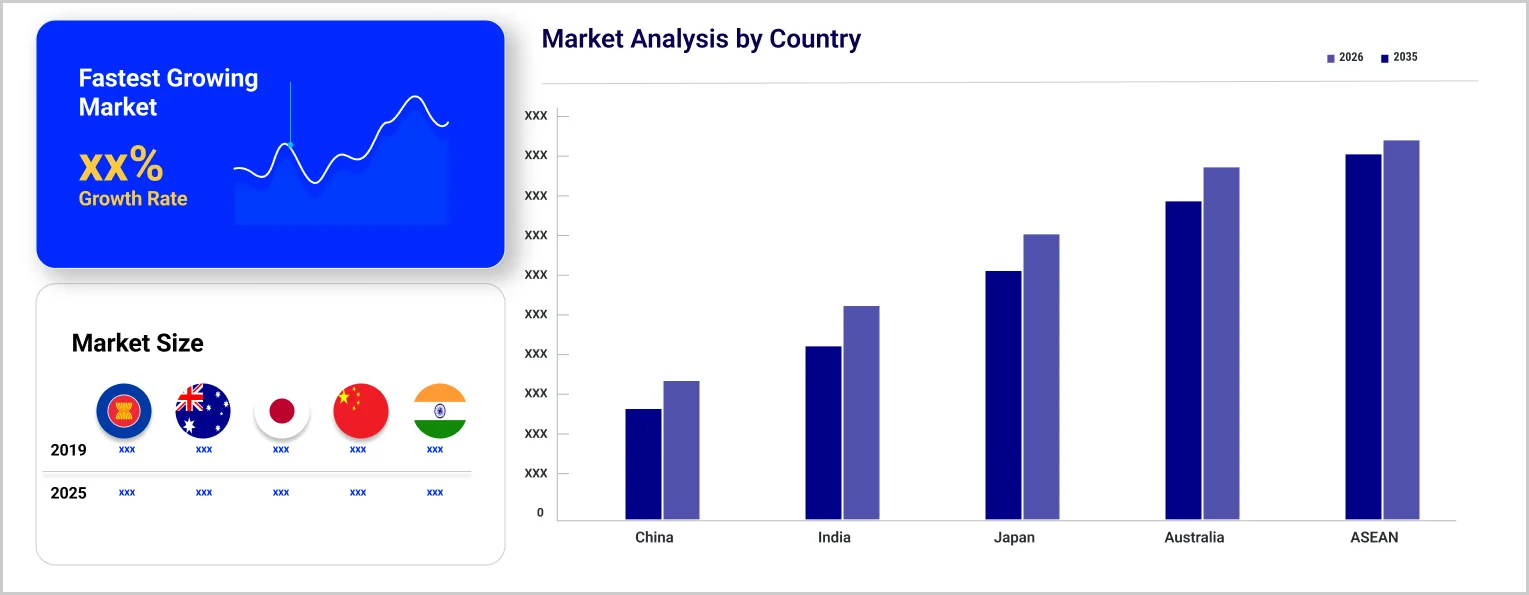
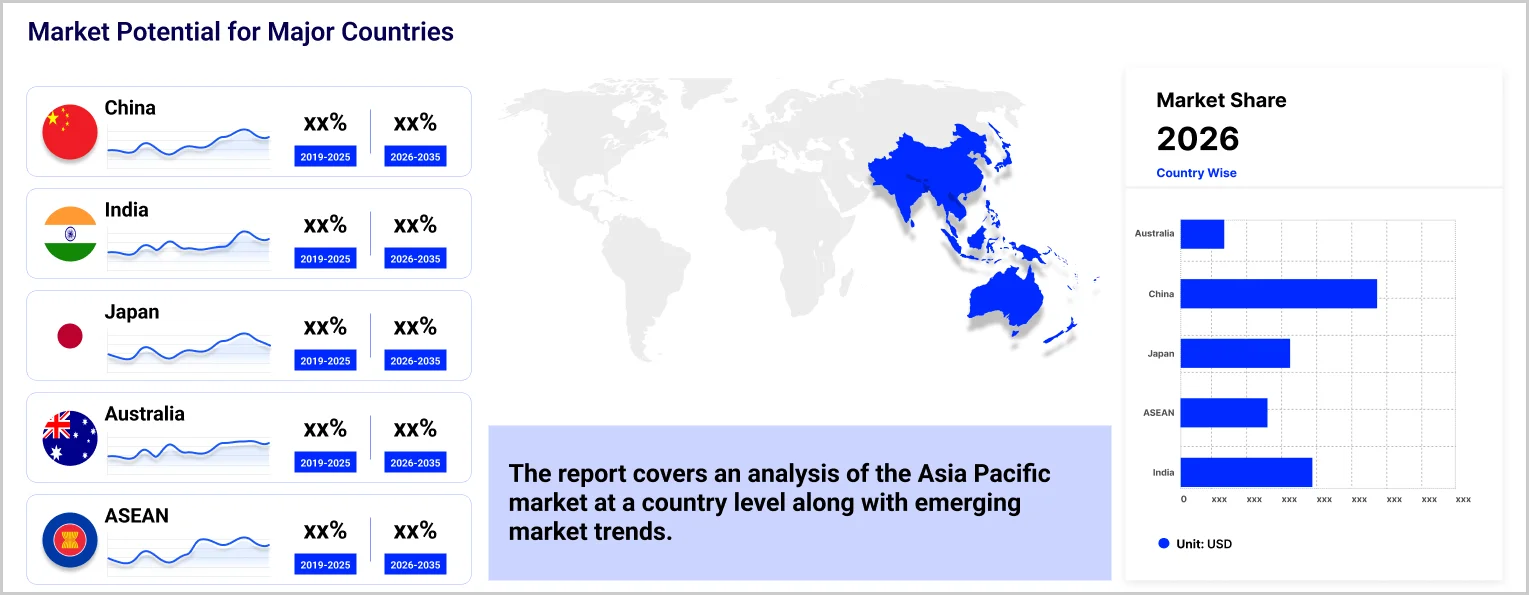
Key Insight: In the Asia Pacific region, China continues to be the major market for automotive relays owing to their vehicle production capacity, automotive components industry and increased production of electric vehicles. The Japanese market capitalizes on their existing automotive OEMs, sophisticated vehicle electronics and need for robust relay technology. India is catching up because of the increase in production of passenger and commercial vehicles and vehicle electrification and higher electronic content. The ASEAN region continues to emerge as an important manufacturing and consumption destination due to vehicle production in Thailand, Indonesia, Vietnam among others and adoption of electric vehicles. Australia offers a small yet advanced market due to vehicle imports, aftermarket requirements and vehicle electrification.
By relay type, high-voltage relays offer the strongest electrification-led expansion opportunity
PCB relays are expected to remain a leading relay category because they integrate directly with electronic control units, circuit boards and vehicle electrical modules. Such a design allows space-efficient architecture for vehicles along with switchability in the lighting, body electricals, comfort, and controls segments. The rise in the electronics content in passenger vehicles and commercial vehicles maintains the relevancy of these systems in traditional as well as electrified vehicles. This is due to the rise in the number of vehicles which are becoming electrified. According to IEA, there were almost 22 million cars produced around the globe in 2025, increasing by more than 25% year-on-year. As vehicle electrical architectures become more sophisticated, PCB-mounted switching components can address a wide range of compact electronic modules. Such developments will thus boost the Asia Pacific automotive relay market dynamics and trends in the long run.
High-voltage relays are positioned for strong expansion as battery-electric and hybrid vehicles increase across Asia Pacific. Electrified powertrains require specialised switching and isolation for battery packs, charging systems and high-voltage power distribution. Panasonic's automotive portfolio includes high-capacity DC contactors and relay solutions designed for EV-related applications, demonstrating supplier investment in this technology. The growth opportunity is reinforced by Asia Pacific's exceptionally strong EV manufacturing base. China alone produced around 16 million electric cars in 2025, accounting for nearly 75% of global EV production. Southeast Asia also recorded EV sales growth of more than 100% in 2025, with electric cars reaching nearly 20% of regional car sales. These trends are increasing demand for high-voltage switching and contactor technologies.
By vehicle type, passenger cars are anticipated to dominate recurring aftermarket demand
Passenger cars represent the broadest application base for automotive relays because each vehicle incorporates numerous electrical and electronic functions requiring switching components. Lighting, locking, comfort systems, safety electronics and power-management functions create recurring relay requirements across conventional, hybrid and electric passenger vehicles. The passenger vehicle manufacturing sector in the Asia Pacific region also helps to stimulate demand from the OEMs and Tier-1 suppliers. Another source of demand stimulus is the electrification of passenger vehicles. The IEA states that more than 20 million electric cars were sold worldwide in 2025, accounting for one-quarter of all car sales. This expanding installed base increases opportunities for relay suppliers across both conventional and electrified passenger-car architectures, thereby bolstering the Asia Pacific automotive relay demand.
Electric vehicles represent the strongest structural growth opportunity within the vehicle-type segmentation as Asian markets accelerate electrification. China produced approximately 16 million electric cars in 2025, while global EV production approached 22 million units, up more than 25% from 2024. China also recorded more than 13 million electric-car sales in 2025, with EVs accounting for almost 55% of new-car sales. Meanwhile, Southeast Asian EV sales more than doubled in 2025 to around 500,000 units, representing nearly 20% of regional car sales. Electrified platforms require additional high-voltage switching and power-management components, creating significant opportunities for relay and contactor suppliers.
By ampere, lower-current relays retain scale while high-current products gain strategic importance
The 5A–15A category benefits from the wide range of lower-load electrical functions incorporated into modern vehicles. Such relays can help facilitate the operation of many body-electronics and auxiliary functions without needing to meet the requirements associated with higher current switchings. The applicability is not limited to passenger cars and commercial vehicles with varying types of powertrains. The use of electronic control modules, lighting, lock mechanisms, and other electrically operated devices helps provide various opportunities for their usage. Therefore, lower current relays still remain commercially valuable, despite all efforts to electrify high-voltage vehicles, and thereby bolstering the demand of the Asia Pacific automotive relay market.
Relays above 35A have increasing strategic relevance as vehicle electrical systems handle higher loads and electrification expands. EV and hybrid architectures introduce demanding power-management requirements around batteries, charging equipment and electrically driven systems, increasing the need for robust switching components. The scale of electrification supports this transition: global electric-car production reached nearly 22 million units in 2025, while China alone produced 16 million electric cars, representing nearly three-quarters of global output. Higher-current products require stronger contact performance, thermal management and electrical endurance, creating opportunities for technically differentiated suppliers. Panasonic's automotive portfolio includes high-capacity switching products designed for electrified applications, illustrating the industry's movement toward higher-load solutions.
By application, established powertrain functions coexist with emerging electrification applications
Engine management modules remain an important automotive relay application because internal-combustion and hybrid vehicles continue to represent a substantial portion of Asia Pacific's vehicle fleet and production. Relay functions within these systems support electrical control and power distribution for engine-related components and auxiliary systems. The segment benefits from established automotive architectures, large installed vehicle populations and ongoing electronic integration. Although pure battery-electric vehicles eliminate conventional engine-management requirements, hybridisation and continued ICE vehicle production preserve the application base. Suppliers therefore continue to serve this established category alongside emerging EV applications. Importantly, the IEA notes that EV sales represented nearly 55% of new-car sales in China in 2025, indicating rapid electrification while also leaving a substantial non-EV vehicle base in the wider Asia Pacific market.
The Others category offers emerging opportunities as vehicle electrical architectures develop beyond traditional relay applications. The electrification process will introduce new demands related to batteries and electric drive systems, which will not always correspond to the existing classifications related to engine management, lighting, or locking systems. The magnitude of this shift is quite large: China made up 70% of global electric car production in 2025, whereas China, Europe, and North America collectively produced 95% of global battery production in 2023-2025. However, publicly available evidence does not provide sufficient quantitative data to definitively identify the Others category as the fastest-growing application. It is therefore more appropriate to describe it as an emerging opportunity rather than assign an unsupported growth ranking.
Read more about this report - Request a Free Sample
China leads Asia Pacific’s automotive relay market due to strong vehicle production and EV manufacturing
China is the most strategically significant country within the Asia Pacific automotive relay landscape because of its combination of vehicle production, EV manufacturing, component supply chains and domestic demand. The IEA estimates that China produced approximately 16 million electric cars in 2025 and accounted for nearly 75% of global electric-car production. Its large domestic automotive ecosystem supports demand for both conventional relays and high-voltage products. China's export expansion also gives component manufacturers opportunities to participate in vehicle programmes serving overseas markets, thereby directly boosting the Asia Pacific automotive relay market regional growth.
Japan and India provide different growth profiles. Japan remains an important automotive engineering and manufacturing centre, with established suppliers and vehicle-electronics expertise. India, meanwhile, offers a localisation-led expansion opportunity. Electric-car sales increased 75% in 2025, while manufacturers and suppliers are expanding local capabilities. ASEAN is becoming increasingly important as EV sales and local manufacturing expand. Southeast Asian electric-car sales more than doubled in 2025, with Vietnam, Indonesia and Thailand leading regional growth. Australia and other Asia Pacific markets contribute through vehicle imports, aftermarket requirements and emerging electrification demand.
Competition in the Asia Pacific automotive relay market is increasingly shaped by the ability to support both established vehicle electrical systems and rapidly changing electrified architectures. Asia Pacific automotive relay market players with broad product portfolios can address PCB, plug-in, high-current and high-voltage requirements across multiple vehicle platforms. TE Connectivity, for example, offers plug-in, PCB, high-current and high-voltage automotive relays, including automotive contactors. Panasonic similarly combines conventional automotive relays with high-capacity DC contactors and products for EV charging-related applications.
Asia Pacific automotive relay companies are also competing through localisation, application engineering and integration with OEM and Tier-1 development programmes. Mitsuba's India strategy demonstrates the importance of local procurement, manufacturing and engineering capabilities, while Panasonic Automotive Systems' 2026 vehicle-electronics wins show the value of participation in broader vehicle electrical architectures. As vehicle architectures become more centralised and electrified, relay suppliers are increasingly required to provide reliability, compact packaging, thermal performance and application-specific engineering rather than commodity switching components alone.
Panasonic Holdings Corporation traces its foundation to 1918 and is headquartered in Kadoma, Osaka, Japan. Its automotive relay portfolio includes conventional automotive relays, PCB and plug-in configurations, high-capacity relays and DC contactors. Panasonic identifies applications spanning EVs, charging stations, headlamps, electric mirrors and smart junction boxes. Its relevance to the Asia Pacific relay market stems from its combination of electrical-component expertise and participation in vehicle-electronics systems.
Fujitsu Limited was established in 1935 and has its corporate headquarters in Kawasaki, Kanagawa, Japan. Fujitsu Components has historically supplied automotive relay products, including compact 25A-class relay families designed for automotive electrical applications. Its automotive component relevance is supported by its long-standing relay engineering portfolio and Japanese automotive supply-chain relationships. Within the regional market, Fujitsu represents the established Japanese component-manufacturing base serving specialised electrical and electronic applications.
Nidec Corporation was founded in 1973, in Kyoto, Japan, and remains headquartered in Kyoto. Its business spans small precision motors, automotive motors, industrial products and related electronic and optical components. Nidec entered the automotive electric business in 1983 and has expanded its automotive component capabilities since then. Its relevance to the automotive relay ecosystem is associated with its broader automotive-electrical component capabilities and extensive Asian manufacturing presence.
TE Connectivity, established in 1941 and headquartered in Ireland, provides automotive relays designed for passenger comfort, infotainment, body control, powertrain and other vehicle systems. Its portfolio includes plug-in, PCB, high-current and high-voltage relays, including automotive contactors. In February 2026, TE Connectivity expanded its EV charging portfolio through the acquisition of EV charging inlet assets from Phoenix Contact. This strengthens its relevance to vehicle electrification and adjacent high-voltage electrical architectures.
Other key players in the market include Denson Corp., Robert Bosch GmbH, Mitsuba Corp., Zettler Group, BETA Electric Industry Co. Ltd., Hongfa Technology Co. Ltd., and Song Chuan Group Company, among others.
*Please note that this is only a partial list; the complete list of key players is available in the full report. Additionally, the list of key players can be customized to better suit your needs.*
Access the sample report to understand the Asia Pacific Automotive Relay Market Size, competitive structure and emerging opportunities. The report provides detailed Asia Pacific Automotive Relay Market trends 2026, segmentation, regional analysis and competitive developments, alongside the Asia Pacific Automotive Relay Market forecast 2026-2035. Explore the full market analysis to evaluate demand drivers, technology shifts, EV-related opportunities and the evolving competitive landscape.


Upto 15% Off
USD
$2499 $2249
$3999 $3599
$4999 $4249
$5999 $5099


*While we strive to always give you current and accurate information, the numbers depicted on the website are indicative and may differ from the actual numbers in the main report. At Expert Market Research, we aim to bring you the latest insights and trends in the market. Using our analyses and forecasts, stakeholders can understand the market dynamics, navigate challenges, and capitalize on opportunities to make data-driven strategic decisions.*
The market is projected to grow at a CAGR of 6.80% between 2026 and 2035.
The different relay types in the market include printed circuit board (PCB) relays, plug-in relays, high voltage relays, protective relays, time relays, and signal relays.
The different types of vehicles in the market include passenger cars, commercial vehicles, and electric vehicles.
The different applications of automotive relays in the market include locking System, ABS control, engine management modules, and lamps/lights, among others.
The major countries in the market include China, Japan, India, ASEAN, and Australia, among others.
The major players in the market are Denson Corp., Panasonic Holdings Corp., Fujitsu Ltd., Nidec Corporation, Robert Bosch GmbH, TE Connectivity Ltd., Mitsuba Corp., Zettler Group, BETA Electric Industry Co. Ltd., Hongfa Technology Co. Ltd., and Song Chuan Group Company, among others.
In 2025, the market reached an approximate value of USD 8.27 Billion.
Key challenges include fluctuating raw material costs, intense pricing competition, stringent automotive safety and reliability standards, complex relay integration in advanced vehicle electronics, supply chain disruptions, and the shift toward electric vehicles, which can alter traditional relay demand.
Key strategies include investing in advanced relay technologies, expanding production capacity, developing compact and energy-efficient products, strengthening automotive OEM partnerships, localising supply chains, pursuing cost optimisation, and adapting relay designs to meet growing electric and hybrid vehicle requirements across Asia Pacific.
Explore our key highlights of the report and gain a concise overview of key findings, trends, and actionable insights that will empower your strategic decisions.
| REPORT FEATURES | DETAILS |
| Base Year | 2025 |
| Historical Period | 2019-2025 |
| Forecast Period | 2026-2035 |
| Scope of the Report |
Historical and Forecast Trends, Industry Drivers and Constraints, Historical and Forecast Market Analysis by Segment:
|
| Breakup by Relay Type |
|
| Breakup by Vehicle Type |
|
| Breakup by Ampere |
|
| Breakup by Application |
|
| Breakup by Region |
|
| Market Dynamics |
|
| Competitive Landscape |
|
| Companies Covered |
|
Datasheet
One User
USD 2,499
USD 2,249
tax inclusive*
Single User License
One User
USD 3,999
USD 3,599
tax inclusive*
Five User License
Five User
USD 4,999
USD 4,249
tax inclusive*
Corporate License
Unlimited Users
USD 5,999
USD 5,099
tax inclusive*
*Please note that the prices mentioned below are starting prices for each bundle type. Kindly contact our team for further details.*
Flash Bundle
Small Business Bundle
Growth Bundle
Enterprise Bundle
*Please note that the prices mentioned below are starting prices for each bundle type. Kindly contact our team for further details.*
Flash Bundle
Number of Reports: 3
20%
tax inclusive*
Small Business Bundle
Number of Reports: 5
25%
tax inclusive*
Growth Bundle
Number of Reports: 8
30%
tax inclusive*
Enterprise Bundle
Number of Reports: 10
35%
tax inclusive*
How To Order

Select License Type
Choose the right license for your needs and access rights.

Click on ‘Buy Now’
Add the report to your cart with one click and proceed to register.

Select Mode of Payment
Choose a payment option for a secure checkout. You will be redirected accordingly.
Strategic Solutions for Informed Decision-Making
Gain insights to stay ahead and seize opportunities.

Get insights & trends for a competitive edge.

Track prices with detailed trend reports.

Analyse trade data for supply chain insights.

Leverage cost reports for smart savings

Enhance supply chain with partnerships.

Connect For More Information
Our expert team of analysts will offer full support and resolve any queries regarding the report, before and after the purchase.
Our expert team of analysts will offer full support and resolve any queries regarding the report, before and after the purchase.
We employ meticulous research methods, blending advanced analytics and expert insights to deliver accurate, actionable industry intelligence, staying ahead of competitors.
Our skilled analysts offer unparalleled competitive advantage with detailed insights on current and emerging markets, ensuring your strategic edge.
We offer an in-depth yet simplified presentation of industry insights and analysis to meet your specific requirements effectively.




