

Consumer Insights
Uncover trends and behaviors shaping consumer choices today
Procurement Insights
Optimize your sourcing strategy with key market data
Industry Stats
Stay ahead with the latest trends and market analysis.
The Australia car rental market attained a value of USD 3.70 Billion in 2025 and is projected to expand at a CAGR of 2.20% through 2035. The market is further expected to achieve USD 4.60 Billion by 2035. Increasing demand for long-term rental subscriptions by corporate clients is pushing operators to come up with flexible fleet ownership options, which will not only enhance their fleet usage but also help them in considerably minimizing their capital expenditure risks.
The Australia car rental market is becoming increasingly influenced by the electrification of fleets, which is a strategy of global operators. For instance, in February 2023, BYD partnered with Sixt Australia to supply over 500 Atto 3 electric SUVs for rental fleet, promoting EV adoption and sustainable mobility. Besides, rental market players capitalize on the burgeoning corporate segment, as most companies are interested in low-emission mobility options.
Beyond electrification, several structural shifts continue to shape post-pandemic demand patterns, particularly in tourism recovery and corporate travel. According to the Australia car rental market analysis, the number of international visitors to the country exceeded 8 million by December 2025, which is close to the pre-pandemic levels, and this has stimulated demand for car rentals. On the other hand, corporate travelers are leasing their vehicles rather than buying them. Moreover, rental companies are coming up with subscription-based leasing contracts, offering insurance within rental packages while deploying digitally managed fleets that minimize idle vehicles and optimize utilization across diverse geographic locations. For instance, RentalMatics integrated with Renteon platform, enabling real-time fleet tracking, automation, damage detection, and data-driven optimization to enhance rental operations, in January 2026.
Another factor that is pushing the Australia car rental market forward is the growth in domestic travel coupled with the development of infrastructure-related sectors. Intercity travel demand is further influenced by government-supported tourism promotional activities and the refurbishment of regional airports. Moreover, as a growing number of companies adopt asset-light strategies, rental services are gaining traction, particularly among SMEs seeking cost-effective transportation solutions without the burden of long-term ownership commitments.
Compound Annual Growth Rate
2.2%
Value in USD Billion
2026-2035
The entry of Surprice into Australia increased the company’s global presence by providing affordable rental solutions for tourists, thus increasing competition in the country’s major airport locations. This demonstrates the potential for firms to reach untapped categories in the tourism industry and increase competition in the Australia car rental market.
CarTrawler partnered with Virgin Australia in integrating car rental into the airline’s platform, thus increasing customer convenience by bundling travel and mobility services. This demonstrates the opportunity for firms to partner with various organizations to increase sales in the country’s tourism industry.
RentalsCar introduced premium and luxury car rental services. This strategy involved targeting high-end clients with diverse options in the fleet. This improved the customer experience and created new avenues for generating income. The strategy offers companies the opportunity to target high-end travelers. This helps in diversification and the creation of new income streams in the evolving car rental market in Australia.
Toyota Motor Corporation expanded its KINTO mobility services, integrating traditional car rentals with flexible car-sharing solutions. This hybrid model enables companies operating in the Australia car rental market to innovate their service offerings by blending short-term rentals with on-demand access.
Fleet electrification has ceased to be a mere experiment in the Australia car rental market. Prominent companies like Sixt Australia that have been consistently adding EVs to their rental fleets, are working with charging station providers to guarantee smooth functioning of operations. Companies are enthusiastically adopting EVs and hybrid vehicles to meet both their corporate ESG norms and government decarbonization goals. Besides, government incentives such as benefits tax exemptions for electric vehicles are further encouraging companies to switch to electric or hybrid vehicles. Aligning with this trend, in March 2026, Suzuki announced plans to launch hybrid and electric models to attract fleet buyers, including upcoming eVitara EV, enhancing sustainability and broadening commercial fleet appeal.
Optimization of operations through use of advanced analytics and AI-based fleet management systems is becoming the norm. To reduce unproductive time and to get the most out of their vehicle lifecycle costs, car rental firms are implementing predictive maintenance tools. They are using dynamic pricing engines to modify rental prices as per changes in demand, location, and vehicle availability, redefining the Australia car rental market dynamics. Leading companies are making use of telematics data not only to adjust driving habits and behavior but also to improve their insurance pricing models. This move to data-centric operations helps firms to increase their profits while simultaneously providing both individuals and corporate clients with more dependable and tailored services. For instance, in March 2026, CarCloud launched AI agent platform enabling automated bookings, real-time customer interactions, multilingual support, upselling features, and seamless integration with rental reservation systems.
Subscription car rental services are rapidly gaining popularity, especially among young city dwellers and businesses. This new service model enables users to switch vehicles based on their needs, extend rental durations with greater flexibility, and bundle essential services such as insurance and maintenance into a single monthly subscription fee, enhancing convenience and cost predictability. Companies such as Carly and Hertz My Car are broadening their offerings to include customers who seek flexibility rather than ownership, boosting the demand in the Australia car rental market. For example, in March 2023, Toyota introduced KINTO Flex nationwide, offering monthly car subscription with insurance, maintenance, and digital access, enhancing flexible mobility and customer convenience.
Rental companies are intensifying collaborations with airlines, airports, and tourism operators in order to tap into the demand of incoming travelers. For example, alliances with airport authorities are facilitating the vehicle pick-up and drop-off processes for international visitors without any hassle. Besides that, partnerships with hotels and travel agencies are enabling car rental companies to offer their services as a part of the travel packages. Rental companies are increasing their vehicle fleets in non-urban zones, thus ensuring the vehicle availability in the new tourist centers. Aligning with this Australia car rental market trend, in October 2025, Turo introduced month-to-month car access with flexible bookings, upfront pricing, and no ownership costs, addressing rising demand for low-commitment mobility solutions.
Digital transformation is playing a huge role in the Australia car rental market. Businesses are rolling out a range of fully contactless rental procedures, including reservations through a mobile application, digital key access, and automated check-ins. Besides, operators are integrating digital wallets and features of real-time customer support into their platforms. Technological changes of this kind are attractive to young travelers and corporate customers who value efficient, transparent, and contactless transactions. For instance, in February 2026, Woop Drive launched fully app-based, desk-free car rentals, enabling booking, unlocking, and returns via smartphones, eliminating queues, paperwork, and delays.
The EMR’s report titled “Australia Car Rental Market Report and Forecast 2026-2035” offers a detailed analysis of the market based on the following segments:
Market Breakup by Booking Type
Key Insight: Booking type segmentation in the Australia car rental market reflects a dual-channel evolution where online platforms lead through efficiency and scalability, while offline channels sustain value through personalization. Online travel systems are highly integrated and capable of dynamic pricing; besides, the operational cost is much lower as compared to the offline one. These factors combined together make a strong case for the online travel system that attracts mostly frequent and tech-savvy users. In contrast to online booking, the offline mode exhibits demand in cases which require human interaction, complex itineraries, or premium service customization.
Market Breakup by Vehicle Type
Key Insight: As per the Australia car rental market report, economy cars hold a strong position in the market, largely because of their affordability, low running cost, and steady demand from various customer segments. SUVs and MUVs not only offer comfortable space for group travels but also provide regional mobility by optimally combining capacity and performance. On the other hand, high-end vehicles are increasingly being prioritized, as companies capitalize on premiumization trends while simultaneously benefiting grom higher-margin offerings, creating a dual growth strategy.
Market Breakup by Application
Key Insight: Application segmentation in the Australia car rental market scope indicates a major change in mobility solutions that are designed for various users. Travel for leisure continues to accelerate demand of car rental through flexible travel, self-drive preference, and combined travel that improve the customer experience. Besides that, business applications are getting popular as an increasing number of companies are outsourcing fleet requirements to reduce capital burden and increase operational agility. Car rental companies are adapting their services to these changes by creating tailored corporate leasing programs in parallel with experience-guided tourism products.
Market Breakup by Region
Key Insight: Regional segmentation reflects different demand dynamics in the Australia car rental market, that have been influenced by factors such as urban density, tourism flows, and infrastructure development. New South Wales and Victoria, with their solid corporate activities as well as well-established rental networks, are boosting demand growth. For example, Simba Car Hire expanded east coast presence by launching new branches across major cities, strengthening national footprint, and improving customer accessibility, in August 2024. However, Queensland and Western Australia are leveraging their tourism-driven growth as well as expanding regional connectivity while the Australian Capital Territory represents a small but steady market that is mainly supported by government and institutional travel programs. Other parts of the country are making up the difference through localized demand and new tourism opportunities.
Online booking dominates the market due to seamless mobile integration and pricing transparency
Online booking is the biggest trend noticed in the Australia car rental market as operators are increasingly investing in app-based ecosystems and direct-to-consumer platforms. They are integrating AI-led pricing engines, real-time fleet availability and digital identity verification into their systems to make the booking process more seamless and less time-consuming. Hertz and Sixt, for example, are enhancing their mobile-first approaches to give corporate clients a platform to manage multi-city reservations via centralized dashboards. Besides, the checkout process including insurance, GPS and EV charging options is propelling upselling opportunities. In July 2024, Uber launched in-app car rental service in Australia, enabling users to compare providers, book vehicles easily, and access nationwide pickup locations.
Offline booking is also gaining momentum in the Australia car rental market, especially in remote parts of the country and among high-value corporate clients who want more personalized rental agreements. Operators are strengthening their physical presence at airports and city centers while simultaneously introducing tailored offerings such as chauffeur-driven rentals, long-term leasing options, and vehicle personalization, enhancing both customer experience and service differentiation. Companies are revamping offline touchpoints by training staff with digital tools that help them get real-time access to centralized inventory and pricing models.
By vehicle type, economy cars account for the dominant share of the market due to cost efficiency and high utilization rates
Economy and budget cars make up the majority of rental fleets in Australia mainly because they have high usage. Apart from focusing on these factors, the companies are also increasing the availability of small cars to serve travelers who are sensitive to prices as well as gig economy drivers. They are adding hybrid and conventional fuel variants as they are trying to meet sustainability goals without compromising affordability. By standardizing the fleet in this segment, companies are able to simplify carrying out maintenance and also minimize the time when the vehicles are not operational. Aligning with this trend, in March 2026, CARS24 introduced 30-day return policy allowing buyers to return used cars within 30 days or 999 km, improving trust and purchase confidence.
Luxury and premium cars represent the fastest-growing segment across the Australia car rental market dynamics, mainly due to an increase in business travel as well as tourism by wealthy individuals. Car rental firms are opting for electrified luxury vehicles as well as sporty models to upgrade their premium fleets. This segment is typically associated with corporate travel contracts, as companies prioritize employee comfort while also reinforcing their brand image during business travel.
By application, leisure travel registers a substantial market share driven by tourism recovery and flexible itineraries
Leisure and tourism applications dominate the Australia car rental market as the country experiences strong recovery in both domestic and international travel. Rental companies are aligning fleets and pricing strategies with seasonal tourism flows, particularly in coastal and regional destinations. Operators are also offering bundled travel packages and are integrating car rentals with accommodation and local experiences. The rise of road trip culture and self-drive tourism is further boosting demand for flexible rental options. In March 2026, Rentsy launched a unified rental marketplace connecting multiple hire categories, enabling seamless bookings, supporting small businesses, and promoting cost-effective access over ownership.
Business applications are steadily contributing to the Australia car rental market revenue as companies increasingly outsource mobility requirements to rental providers. Corporate clients are opting for long-term rental agreements and subscription models to avoid capital expenditure on vehicle ownership. Rental firms are responding to this trend by offering customized fleet solutions, centralized billing systems, and dedicated account management services. This segment is also benefiting from the rise of project-based work and remote operations, where employees require temporary mobility solutions across different locations.
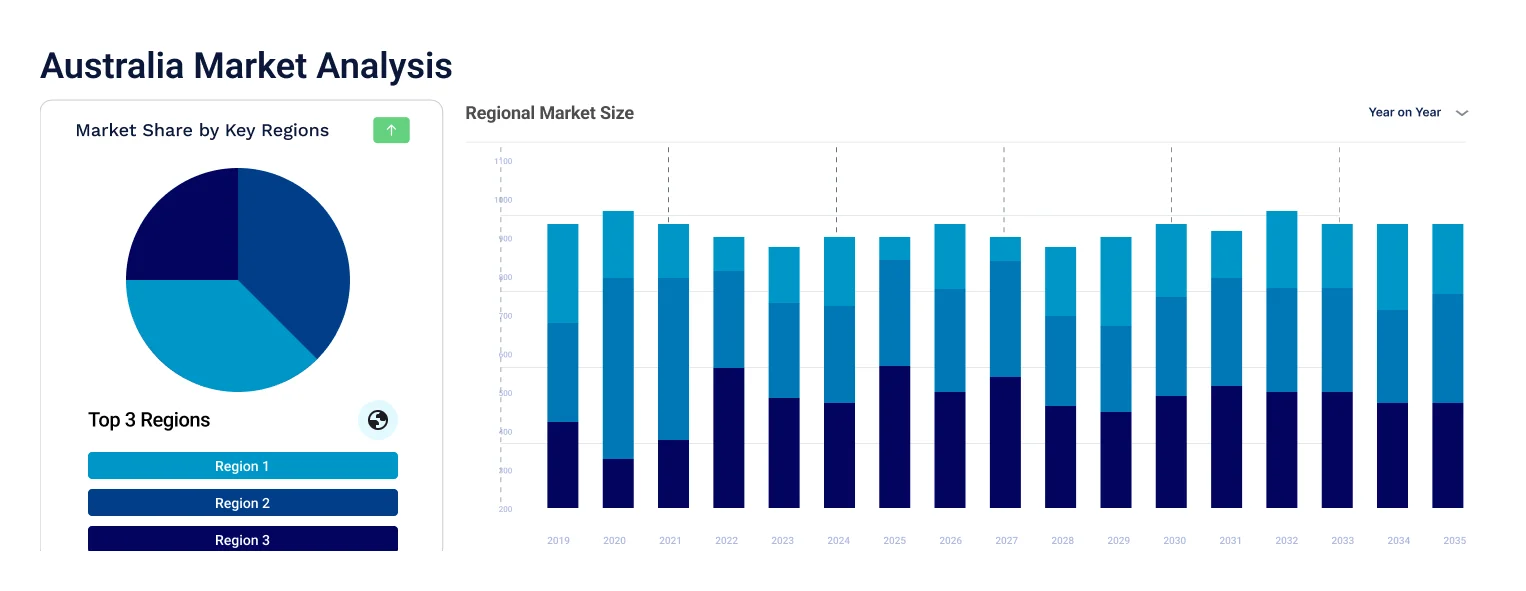
New South Wales clocks in the largest share of the largest share of the market due to dense urban mobility demand and tourism hubs
New South Wales accounts for the largest share of the Australia car rental market, largely due to a combination of factors such as the state's high population density, the strong presence of corporates, and Sydney being a major tourist attraction. Car rental companies have made New South Wales their major hub where they have established extensive airport and city-based networks. As a result, these players are prioritizing the upgrading of their premium fleets and the launch of digital booking platforms to serve both business and leisure travelers. Their presence is further strengthened by the concentration of multinational corporations in the region, where consistent business travel drives sustained demand for long-term rentals and subscription-based mobility solutions. In August 2025, Toyota KINTO expanded Melbourne network by adding multiple on-street car share locations, increasing vehicle accessibility, availability, and convenience through app-based, keyless rental services.
Queensland is gradually establishing itself as the fastest-growing regional market. Besides the major urban centers of Brisbane and Gold Coast, other popular tourist destinations such as Cairns are also contributing to the Australia car rental market growth. Car rental operators already have a significant presence at regional airports and tourist hotspots, and these locations are their main focus. Furthermore, the government's investment in tourism infrastructure and the launch of promotional campaigns have collectively given an impetus to the growth of this market.
Major Australia car rental market players are now focusing on electrification of their fleets, development of digital booking ecosystems, and offering corporate mobility solutions in order to differentiate their services. Incorporating electric vehicles in the fleet, providing app-based rentals and introducing subscription-led services are some of the ways companies are trying to secure long-term contracts with corporate clients. Collaborations with airlines, hotels, and fintech companies are leading to bundled offerings which in turn pave paths for new customer acquisition and better customer retention.
Besides that, Australia car rental companies are also committing funds for the purchase of AI-driven fleet optimization systems with an intention to improve profitability. The mid-sized companies are targeting segments such as luxury tourism and issuance of long-term leases whereas well-known players are benefiting from their scale and brand recognition. Carbon emission reduction, contactless rental solutions, and personalized service offerings have emerged as key priorities, compelling companies to innovate continuously and shaping a dynamic, opportunity-rich competitive landscape across Australia.
Budget was founded in the year 1958 and its head office is in Parsippany, New Jersey, United States. Budget aims at providing economical mobility options in Australia. The company is focusing on enhancing its digital booking platforms, extending economy fleets, and through the introduction of flexible pricing models and bundled service offerings, targeting SMEs and budget travelers.
Established in 1946 and based in Parsippany, New Jersey, United States of America, Avis offers high-quality customer experience and is undergoing a digital transformation. For the Australia car rental market, the company is working to improve app-based rentals, launch an integrated loyalty program, and aim corporate clients with tailored leasing and mobility solutions available in major urban areas.
Hertz was founded in 1923 and is currently based in Estero, Florida, United States. The company is heavily focusing on the electrification of its vehicle fleets and the digitalization of the rental process. In Australia, the company collaborates with the manufacturers of EVs and the operators of battery charging points, at the same time, it rolls out subscription-based services to tap into the needs of corporate and eco-conscious customers.
Established in 1949 and based in Paris, France, Europcar mainly focuses on sustainable mobility while offering flexible rental solutions. Within Australia, the company is increasingly collaborating with travel platforms and engaging corporate clients to deliver integrated, sustainable, and environmentally responsible rental solutions.
*Please note that this is only a partial list; the complete list of key players is available in the full report. Additionally, the list of key players can be customized to better suit your needs.*
Other key players in the market include Alpha Car Hire Trading Pty Ltd., Acorn Rentals, Enterprise Holdings, Inc., Sixt SE, East Coast Car Rentals, and JUCY Group Limited, among others.
Unlock the latest insights with our Australia car rental market trends 2026 report. Discover regional growth patterns, consumer preferences, and key industry players. Stay ahead of competition with trusted data and expert analysis. Download your free sample report today and drive informed decisions in the Australia car rental market.
South Korea Car Rental Market
Car Rental Market
Brazil Car Rental Market
Germany Car Rental Market
Europe Car Rental Market
United States Car Rental Market
North America Car Rental Market
Vietnam Car Rental Market
United Kingdom Car Rental Market
India Car Rental Market


Upto 15% Off
USD
$2499 $2249
$3999 $3599
$4999 $4249
$5999 $5099


*While we strive to always give you current and accurate information, the numbers depicted on the website are indicative and may differ from the actual numbers in the main report. At Expert Market Research, we aim to bring you the latest insights and trends in the market. Using our analyses and forecasts, stakeholders can understand the market dynamics, navigate challenges, and capitalize on opportunities to make data-driven strategic decisions.*
In 2025, the market reached an approximate value of USD 3.70 Billion.
The market is projected to grow at a CAGR of 2.20% between 2026 and 2035.
The market is estimated to witness a healthy growth in the forecast period of 2026-2035 to reach USD 4.60 Billion by 2035.
Expanding EV fleets, forming regional tourism partnerships, integrating AI pricing tools, enhancing app-based customer journeys, and developing subscription models are helping companies improving utilization, margins, and long-term client retention effectively.
Key trends aiding the market expansion include the increasing demand for car-sharing services, the adoption of advanced IT platforms to enhance service delivery and rise of online booking platforms.
Regions considered in the market are New South Wales, Victoria, Queensland, Western Australia, and Australian Capital Territory, among others.
Different applications of car rental are leisure/tourism and business.
Based on vehicle type, the market segmentations include luxury/premium cars, economy/budget cars, SUVs, and MUVs.
Online and offline booking are considered in the report.
The key players in the market include Budget Rent a Car System Inc., Avis Rent a Car System LLC, The Hertz Corporation, Europcar International S.A.S.U., Alpha Car Hire Trading Pty Ltd., Acorn Rentals, Enterprise Holdings, Inc., Sixt SE, East Coast Car Rentals, and JUCY Group Limited, among others.
High fleet acquisition costs, EV infrastructure gaps, fluctuating tourism demand, and intense pricing competition are pressuring margins, while managing fleet utilization efficiently across regions remains a persistent operational challenge.
Explore our key highlights of the report and gain a concise overview of key findings, trends, and actionable insights that will empower your strategic decisions.
| REPORT FEATURES | DETAILS |
| Base Year | 2025 |
| Historical Period | 2019-2025 |
| Forecast Period | 2026-2035 |
| Scope of the Report |
Historical and Forecast Trends, Industry Drivers and Constraints, Historical and Forecast Market Analysis by Segment:
|
| Breakup by Booking Type |
|
| Breakup by Vehicle Type |
|
| Breakup by Application |
|
| Breakup by Region |
|
| Market Dynamics |
|
| Competitive Landscape |
|
| Companies Covered |
|
Datasheet
One User
USD 2,499
USD 2,249
tax inclusive*
Single User License
One User
USD 3,999
USD 3,599
tax inclusive*
Five User License
Five User
USD 4,999
USD 4,249
tax inclusive*
Corporate License
Unlimited Users
USD 5,999
USD 5,099
tax inclusive*
*Please note that the prices mentioned below are starting prices for each bundle type. Kindly contact our team for further details.*
Flash Bundle
Small Business Bundle
Growth Bundle
Enterprise Bundle
*Please note that the prices mentioned below are starting prices for each bundle type. Kindly contact our team for further details.*
Flash Bundle
Number of Reports: 3
20%
tax inclusive*
Small Business Bundle
Number of Reports: 5
25%
tax inclusive*
Growth Bundle
Number of Reports: 8
30%
tax inclusive*
Enterprise Bundle
Number of Reports: 10
35%
tax inclusive*
How To Order

Select License Type
Choose the right license for your needs and access rights.

Click on ‘Buy Now’
Add the report to your cart with one click and proceed to register.

Select Mode of Payment
Choose a payment option for a secure checkout. You will be redirected accordingly.
Strategic Solutions for Informed Decision-Making
Gain insights to stay ahead and seize opportunities.

Get insights & trends for a competitive edge.

Track prices with detailed trend reports.

Analyse trade data for supply chain insights.

Leverage cost reports for smart savings

Enhance supply chain with partnerships.

Connect For More Information
Our expert team of analysts will offer full support and resolve any queries regarding the report, before and after the purchase.
Our expert team of analysts will offer full support and resolve any queries regarding the report, before and after the purchase.
We employ meticulous research methods, blending advanced analytics and expert insights to deliver accurate, actionable industry intelligence, staying ahead of competitors.
Our skilled analysts offer unparalleled competitive advantage with detailed insights on current and emerging markets, ensuring your strategic edge.
We offer an in-depth yet simplified presentation of industry insights and analysis to meet your specific requirements effectively.




