

Consumer Insights
Uncover trends and behaviors shaping consumer choices today
Procurement Insights
Optimize your sourcing strategy with key market data
Industry Stats
Stay ahead with the latest trends and market analysis.
The Europe car rental market attained a value of USD 16.52 Billion in 2025 and is projected to expand at a CAGR of 11.00% through 2035. The market is further expected to reach USD 46.91 Billion by 2035. Rising tourism, growing business travel, and wider use of online booking apps are strengthening rental demand across the region. Fleet expansion, electric vehicle adoption, and flexible subscription offers are further encouraging rental companies to widen their services in every segment.
Car rental refers to the short- and long-term hire of passenger vehicles from rental companies, offered through airport counters, city branches, apps, and online platforms. Leisure and tourism travel supports a large share of the Europe car rental market, while business travellers and corporate accounts add steady demand for flexible mobility. Rising international arrivals, digital booking, and a shift toward access over ownership continue to widen the customer base among tourists, commuters, and companies.
Demand is concentrating around operators able to combine wide station networks with strong digital booking. In March 2026, Eurostat reported that nearly 3.1 billion nights were spent in EU tourist accommodation in 2025, a 2.2 percent increase, with nights by international guests rising 3.4 percent. This tourism driven positioning is converting rising visitor numbers directly into expanded adoption across the Europe car rental market.
Companies across the Europe car rental market are converging on a common development direction, widening from simple vehicle hire toward integrated mobility, loyalty, and fleet services. Rental groups are increasingly pursuing app-based booking, electric vehicles, and partnerships to broaden their customer base. This shift is reshaping competitive dynamics among rental providers, favouring companies that can demonstrate wide coverage, digital convenience, and flexible fleets over those offering conventional counter-based hire alone.
Compound Annual Growth Rate
11%
Value in USD Billion
2026-2035
Read more about this report - Request a Free Sample
| Europe Car Rental Market Report Summary | Description | Value |
| Base Year | USD Billion | 2025 |
| Historical Period | USD Billion | 2019-2025 |
| Forecast Period | USD Billion | 2026-2035 |
| Market Size 2025 | USD Billion | 16.52 |
| Market Size 2035 | USD Billion | 46.91 |
| CAGR 2019-2025 | Percentage | XX% |
| CAGR 2026-2035 | Percentage | 11.00% |
| CAGR 2026-2035 - Market by Country | UK | 17.5% |
| CAGR 2026-2035 - Market by Booking Type | Online | 13.5% |
| CAGR 2026-2035 - Market by Length Type | Short-Term | 13.1% |
Hertz reported in May 2026 the launch of Oro Mobility, an affiliated operating company that manages driver led and autonomous fleets, with Uber announced as a partner, which extends Hertz beyond conventional rental mobility. Car rental groups across the Europe car rental market can use their fleet, maintenance, and facility management skills to serve ride hailing and autonomous vehicle operators, which opens revenue beyond traditional rentals.
Sixt launched its SIXT ONE rewards programme in Germany, Austria, and Switzerland in March 2026, with other European markets following by the end of the month, after a United States pilot that drew hundreds of thousands of signups. Rental operators across the Europe car rental market can use loyalty programmes built into their apps to raise repeat and direct bookings from business and leisure customers.
Europcar and vMobility launched the vHire vehicle replacement service in January 2026, giving drivers a rental vehicle while their own car is off the road for repair. Rental companies across the Europe car rental market can use replacement services to build steady volumes from insurance and fleet customers outside the peak tourist season, which smooths fleet use across the year and raises average utilisation of vehicles.
Kinsen Hellas acquired Europcar Mobility Group's subsidiary in Austria and Hungary in November 2025, adding rental operations in two Central European countries to its Greek based mobility business and widening its regional footprint. Regional rental operators can use acquisitions of national subsidiaries to enter new countries with an established brand, fleet, and customer base, and avoid building stations from scratch.
Rental groups are increasingly expanding through franchise partnerships, which add stations without the cost of owning every branch and let local partners handle fleet, staff, and customer service under a known brand. Franchise models speed up entry into new countries and lower capital needs. This is widening brand reach across the Europe car rental market and neighbouring regions, since travellers recognise established names when booking abroad. In August 2026, Sixt announced its expansion to Tunisia through a new franchise partnership.
Travellers are increasingly booking trips through online platforms, which shortens the path from trip planning to car reservation. This is lifting digital demand across the Europe car rental market. Comparison sites and travel apps now increasingly bundle car hire with flights and hotels, which raises visibility for major rental brands. In July 2026, Germany's Federal Statistical Office reported that guests booked 68.3 million nights in holiday homes through Airbnb, Booking.com, and Expedia in 2025, 13.0 percent more than in 2024.
Airports are increasingly reporting slower passenger growth as fuel costs and geopolitical disruption weigh on capacity, which affects airport pickup volumes. This is shaping fleet planning across the Europe car rental market. In July 2026, ACI Europe reported that passenger traffic rose 2.6 percent between January and June 2026, slowing sharply from 4.3 percent between January and March to 1.3 percent between April and June, while Heathrow, Europe's busiest airport, welcomed a record 40 million passengers in the same period.
Border control processes are increasingly slowing arrivals at busy airports, which delays travellers reaching rental counters. This is shaping pickup timing across the Europe car rental market. In June 2026, ACI Europe reported that April traffic fell 0.7 percent, the first yearly decline since the pandemic recovery began, and criticised passenger disruption linked to the Schengen Entry/Exit System. Long airport queues push travellers to collect vehicles later, which raises the value of app-based check in and flexible pickup windows.
Rental groups are increasingly using recycled vehicle parts in repairs to cut costs and waste, since large fleets need frequent maintenance and body repairs. This is supporting circular practices across the market and helps operators meet sustainability targets set by corporate customers. Recycled parts shorten repair times when new parts face supply delays. In November 2025, Europcar partnered with The Green Parts Specialists to supply recycled vehicle parts for its fleet repairs, supporting repairs with reused components.
The Expert Market Research's report titled "Europe Car Rental Market Report and Forecast 2026-2035" offers a detailed analysis of the market based on the following segments:
Market Breakup by Booking Type
Key Insight: Offline booking dominates the booking type segment of the Europe car rental market through airport counters, city branches, and phone reservations that suit travellers who value personal service. Online booking is registering the fastest growth as apps, travel platforms, and comparison sites offer real time availability and simple payment. Offline channels sustain steady demand from corporate accounts and older travellers, while online channels widen reach among younger and international customers.
Market Breakup by Rental Length Type
Key Insight: Short-Term rentals dominate the rental length type segment of the Europe car rental market given holiday trips, airport pickups, and weekend travel, and they are also registering the fastest growth. Long-Term rentals sustain steady demand from corporate clients, expatriates, and remote workers who seek flexible alternatives to ownership through monthly plans and subscriptions.
Market Breakup by Application Type
Key Insight: Leisure/Tourism dominates the application type segment of the Europe car rental market as holidaymakers rent cars for regional travel and airport transfers. In August 2026, Eurostat reported that hotels and similar accommodation recorded 4.7 million more nights between April and June 2026 than a year earlier, and international guest nights rose 18.5 percent in Ireland. Business demand sustains steady volumes through corporate accounts, client visits, and conference travel.
Market Breakup by Vehicle Type
Key Insight: Luxury/Premium Cars dominate the vehicle type segment of the Europe car rental market as travellers seek comfort and prestige for business trips and special occasions, while SUVs are registering the fastest growth through demand for space and versatility. Economy/Budget Cars sustain steady demand among price sensitive leisure travellers, and MUVs serve families and groups that need seating capacity.
Market Breakup by Region
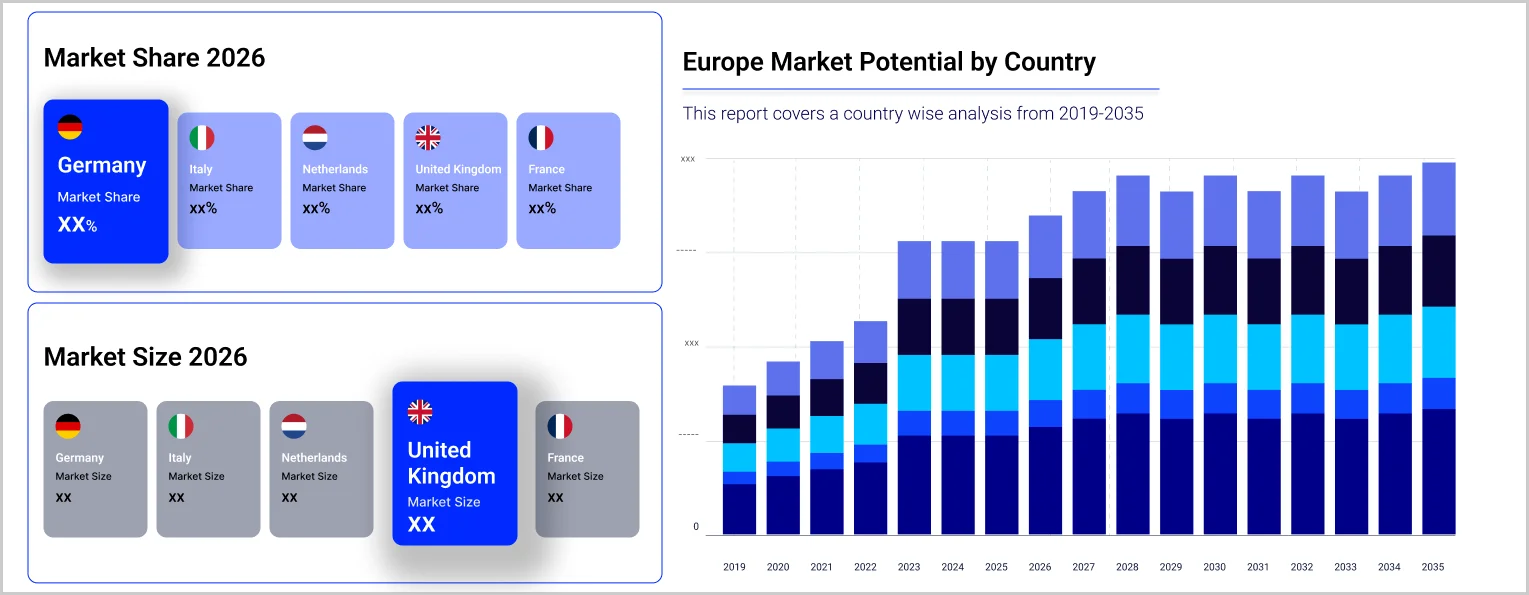
Key Insight: Germany dominates the country breakup of the Europe car rental market through its large tourist base and strong business travel, while the United Kingdom is registering the fastest growth. In February 2026, ACI Europe reported that airports in the United Kingdom, France, and Germany grew 1.7 percent, 2.1 percent, and 3.2 percent in 2025, trailing the wider European average. France and Italy sustain steady demand through tourism, and Others, including Spain and the Nordic countries, add regional volumes.
Read more about this report - Request a Free Sample
By booking type, offline dominates the market owing to airport counters and personal service, while online is the fastest growing channel through app-based booking
Offline booking dominates the booking type segment of the Europe car rental market through airport counters, city branches, and phone reservations that suit travellers who value personal service. Operators serving this category continue to prioritise counter staffing and airport presence, since travellers arriving on late flights, needing a change of vehicle, or paying with cash often prefer speaking to an agent before collecting keys. Offline channels also serve corporate accounts that book through travel managers and walk in customers who decide on arrival.
Online booking is registering the fastest booking type growth as apps and travel platforms offer real time availability, simple comparison, and quick payment. In April 2026, Duffel launched Duffel Cars, giving travel businesses access to rentals from 40 providers, including Avis, Sixt, Enterprise, Hertz, and Europcar, across more than 40,000 locations, which shows how rental supply is moving into digital booking flows. Online channels also let operators’ price dynamically and promote upgrades, which raises the value of every single reservation.
By rental length type, short-term rentals dominate the market owing to holiday trips and airport pickups across the region
Short-term rentals dominate the rental length type segment of the Europe car rental market given holiday trips, weekend travel, and airport pickups that typically last a few days. In August 2026, Sixt reported its 20th consecutive record quarter, with revenue between January and June up 11.3 percent currency adjusted to more than EUR 2 billion. Operators serving this category continue to prioritise fleet turnaround, staffing, and airport station capacity, since fast cleaning and available vehicles decide whether travellers return for their next trip.
Long-term rentals sustain steady demand from corporate clients, expatriates, and remote workers who seek monthly plans and subscriptions as an alternative to owning a vehicle. In November 2025, subscription provider FINN joined the Probonio benefits platform to offer its JobAuto car subscription under a salary sacrifice model, with employees saving up to 40 percent on the monthly rate. Operators continue to prioritise contract flexibility and included maintenance. Insurers also use extended rentals as bridging solutions, which adds steady weekday volumes.
By application type, leisure and tourism dominates the market owing to rising international arrivals and holiday travel
Leisure and tourism dominate the application type segment of the Europe car rental market as holidaymakers rent cars for regional travel, coastal trips, and airport transfers. In June 2026, Eurostat reported 471.1 million overnight stays in EU tourist accommodation between January and March 2026, up 3.4 percent from the same months of 2025, which shows how rising visitor numbers support rental demand. Operators continue to prioritise airport stations. Coastal and mountain regions add seasonal peaks as visitors rent vehicles for multi day trips.
Business demand sustains steady volumes through corporate accounts, client visits, and conference travel that need flexible, reliable vehicles. In August 2026, the Global Business Travel Association projected global business travel spending at a record USD 1.71 trillion for 2026, up 7.2 percent, with Asia and Europe generating the highest number of trips. Operators serving this category continue to prioritise corporate contracts and digital invoicing. Corporate travel programmes also favour providers with consistent service, clear invoicing, and coverage in several countries.
By vehicle type, luxury and premium cars dominate the market owing to demand for comfort and prestige on business and special occasion trips
Luxury and premium cars dominate the vehicle type segment of the Europe car rental market as travellers seek comfort, performance, and prestige for business trips and special occasions. In August 2026, Avis Budget Group reported higher quarterly earnings and said it had expanded Avis First, its premium car rental service. Operators serving this category continue to prioritise premium brands and airport lounges, since executives and high spending tourists value fast pickup and consistent service. Premium fleets earn higher rates, lifting revenue per rental.
SUVs are registering the fastest vehicle type growth as families and groups seek space, higher seating, and versatility for mountain, coastal, and city trips. In November 2025, Europcar launched a Skoda subscription in Germany covering the Scala, Elroq, and Enyaq, with guaranteed model choice for three, six, or twelve months at 21 locations. Operators continue to prioritise fleet mix and pricing, since SUVs earn higher daily rates than compact cars. Manufacturers keep widening SUV ranges, giving operators more electric models.
Germany leads the market through its large tourist base and the airport and business travel demand of its major cities
Germany dominates the country breakup of the Europe car rental market through its large tourist base, major airports, and strong business travel. In February 2026, the Federal Statistical Office reported a record 497.5 million overnight stays in 2025, 0.3 percent above the previous record year, which supports rental demand around airports, trade fair cities, and holiday regions. Operators continue to prioritise airport stations and corporate accounts. Munich, Frankfurt, and Berlin drive airport pickups, while trade fairs create short bursts of corporate rental demand.
United Kingdom is registering the fastest country growth, given strong inbound tourism and business travel demand from overseas visitors and domestic holidaymakers alike. In November 2025, the Global Business Travel Association reported that business travellers in the United Kingdom spend the most per trip in Europe, at almost EUR 1,305, which points to strong demand for premium and flexible rentals. Operators continue to prioritise airport and city locations. London and Manchester airports anchor demand for airport pickups and premium vehicles.
Competition combines global rental groups, European specialists, leasing firms, and online travel platforms that sell rentals to travellers. Europe car rental companies are adding loyalty programmes, replacement vehicle services, and franchise partners, while acquisitions and disposals of national subsidiaries continue to reshape country coverage. Airport counters remain a key battleground, since many travellers collect vehicles on arrival and compare providers on price, fleet, and pickup speed.
Europe car rental market players are also responding to electric vehicle demand, autonomous fleet management, and digital booking through apps and comparison platforms. Opportunities are emerging in subscription and long-term rentals, insurance replacement vehicles, and airport mobility hubs. Operators that combine wide station networks with strong apps and flexible fleets are expected to strengthen their competitive position over the coming years.
Founded in 1946 and headquartered in Parsippany, New Jersey, United States, Avis Budget Group Inc. supports the market through its Avis, Budget, and Zipcar brands, offering car and van rental, and car sharing across European cities and airports. The company continues to widen its connected fleet and app-based services. Avis Budget draws on its position as one of the world's largest rental groups to serve leisure travellers, business customers, and partners.
Founded in 1957 and headquartered in Clayton, Missouri, United States, Enterprise Holdings, Inc. contributes to the market through its Enterprise Rent-A-Car, National Car Rental, and Alamo brands, with rental, car sharing, and fleet management services. The company continues to build partnerships in European car sharing and van rental. Enterprise draws on its position as one of the largest rental groups in the world to serve airport, insurance, and corporate customers.
Founded in 1918 and headquartered in Estero, Florida, United States, Hertz Global Holdings, Inc. supports the market through its Hertz, Dollar, and Thrifty brands, with premium, standard, and electric vehicle rentals. The company continues to widen its digital services, and new mobility offers through its affiliated company Oro Mobility. Hertz draws on its position as one of the oldest rental brands to serve leisure and business travellers across Europe.
Founded in 1912 and headquartered in Pullach, Germany, Sixt SE contributes to the market through its Sixt rent, Sixt+ subscription, Sixt share, and Sixt ride services, with a premium fleet and a single app. The company continues to expand its digital services, fleet, and station network across Europe. Sixt draws on its position as a premium mobility provider with a presence in more than 100 countries to serve business and leisure customers.
Other key players in the market include Europcar International S.A.S.U, Economy Car Hire Ltd. (Zest Car Rental), ALD Automotive Limited, Edel & Stark AG, Booking Holdings Inc. (Momondo), fourdrive GmbH, and Wucherpfennig & Krohn GmbH, among others.
*Please note that this is only a partial list; the complete list of key players is available in the full report. Additionally, the list of key players can be customized to better suit your needs.*
Unlock the latest insights with our Europe car rental market trends 2026 report. Discover country growth patterns, booking and vehicle type economics, and key industry players. Stay ahead of the competition and identify emerging opportunities in the evolving market landscape.
South Korea Car Rental Market
Philippines Car Rental Market
Brazil Car Rental Market
Germany Car Rental Market
North America Car Rental Market
Vietnam Car Rental Market
India Car Rental Market


Upto 15% Off
USD
$2499 $2249
$3999 $3599
$4999 $4249
$5999 $5099


*While we strive to always give you current and accurate information, the numbers depicted on the website are indicative and may differ from the actual numbers in the main report. At Expert Market Research, we aim to bring you the latest insights and trends in the market. Using our analyses and forecasts, stakeholders can understand the market dynamics, navigate challenges, and capitalize on opportunities to make data-driven strategic decisions.*
In 2025, the market reached an approximate value of USD 16.52 Billion.
The market is projected to grow at a CAGR of 11.00% between 2026 and 2035.
The car rental market is categorised according to booking type, which includes online modes of booking and offline modes of booking.
The key players in the market include Avis Budget Group Inc., Enterprise Holdings, Inc. (Alamo), Hertz Global Holdings, Inc., Sixt SE, Europcar International S.A.S.U, Economy Car Hire Ltd. (Zest Car Rental), ALD Automotive Limited, Edel & Stark AG, Booking Holdings Inc. (Momondo), fourdrive GmbH, and Wucherpfennig & Krohn GmbH, among others.
Based on the end use, the market is divided into leisure/tourism and business.
The market is broken down into Germany, the United Kingdom, France, Italy, and others.
The revenue generated from the car rental market is expected to reach USD 46.91 Billion in 2035.
Operators in the market face high fleet costs, electric vehicle transition costs, airport disruption, price competition from online platforms, and shifting travel demand.
Expanding loyalty and app services, adding franchise and acquisition partners, electrifying fleets, and building subscription and replacement rental offers are key strategies driving the market.
Explore our key highlights of the report and gain a concise overview of key findings, trends, and actionable insights that will empower your strategic decisions.
| REPORT FEATURES | DETAILS |
| Base Year | 2025 |
| Historical Period | 2019-2025 |
| Forecast Period | 2026-2035 |
| Scope of the Report |
Historical and Forecast Trends, Industry Drivers and Constraints, Historical and Forecast Market Analysis by Segment:
|
| Breakup by Booking Type |
|
| Breakup by Rental Length Type |
|
| Breakup by Application Type |
|
| Breakup by Vehicle Type |
|
| Breakup by Region |
|
| Market Dynamics |
|
| Competitive Landscape |
|
| Companies Covered |
|
Datasheet
One User
USD 2,499
USD 2,249
tax inclusive*
Single User License
One User
USD 3,999
USD 3,599
tax inclusive*
Five User License
Five User
USD 4,999
USD 4,249
tax inclusive*
Corporate License
Unlimited Users
USD 5,999
USD 5,099
tax inclusive*
*Please note that the prices mentioned below are starting prices for each bundle type. Kindly contact our team for further details.*
Flash Bundle
Small Business Bundle
Growth Bundle
Enterprise Bundle
*Please note that the prices mentioned below are starting prices for each bundle type. Kindly contact our team for further details.*
Flash Bundle
Number of Reports: 3
20%
tax inclusive*
Small Business Bundle
Number of Reports: 5
25%
tax inclusive*
Growth Bundle
Number of Reports: 8
30%
tax inclusive*
Enterprise Bundle
Number of Reports: 10
35%
tax inclusive*
How To Order

Select License Type
Choose the right license for your needs and access rights.

Click on ‘Buy Now’
Add the report to your cart with one click and proceed to register.

Select Mode of Payment
Choose a payment option for a secure checkout. You will be redirected accordingly.
Strategic Solutions for Informed Decision-Making
Gain insights to stay ahead and seize opportunities.

Get insights & trends for a competitive edge.

Track prices with detailed trend reports.

Analyse trade data for supply chain insights.

Leverage cost reports for smart savings

Enhance supply chain with partnerships.

Connect For More Information
Our expert team of analysts will offer full support and resolve any queries regarding the report, before and after the purchase.
Our expert team of analysts will offer full support and resolve any queries regarding the report, before and after the purchase.
We employ meticulous research methods, blending advanced analytics and expert insights to deliver accurate, actionable industry intelligence, staying ahead of competitors.
Our skilled analysts offer unparalleled competitive advantage with detailed insights on current and emerging markets, ensuring your strategic edge.
We offer an in-depth yet simplified presentation of industry insights and analysis to meet your specific requirements effectively.




