

Consumer Insights
Uncover trends and behaviors shaping consumer choices today
Procurement Insights
Optimize your sourcing strategy with key market data
Industry Stats
Stay ahead with the latest trends and market analysis.
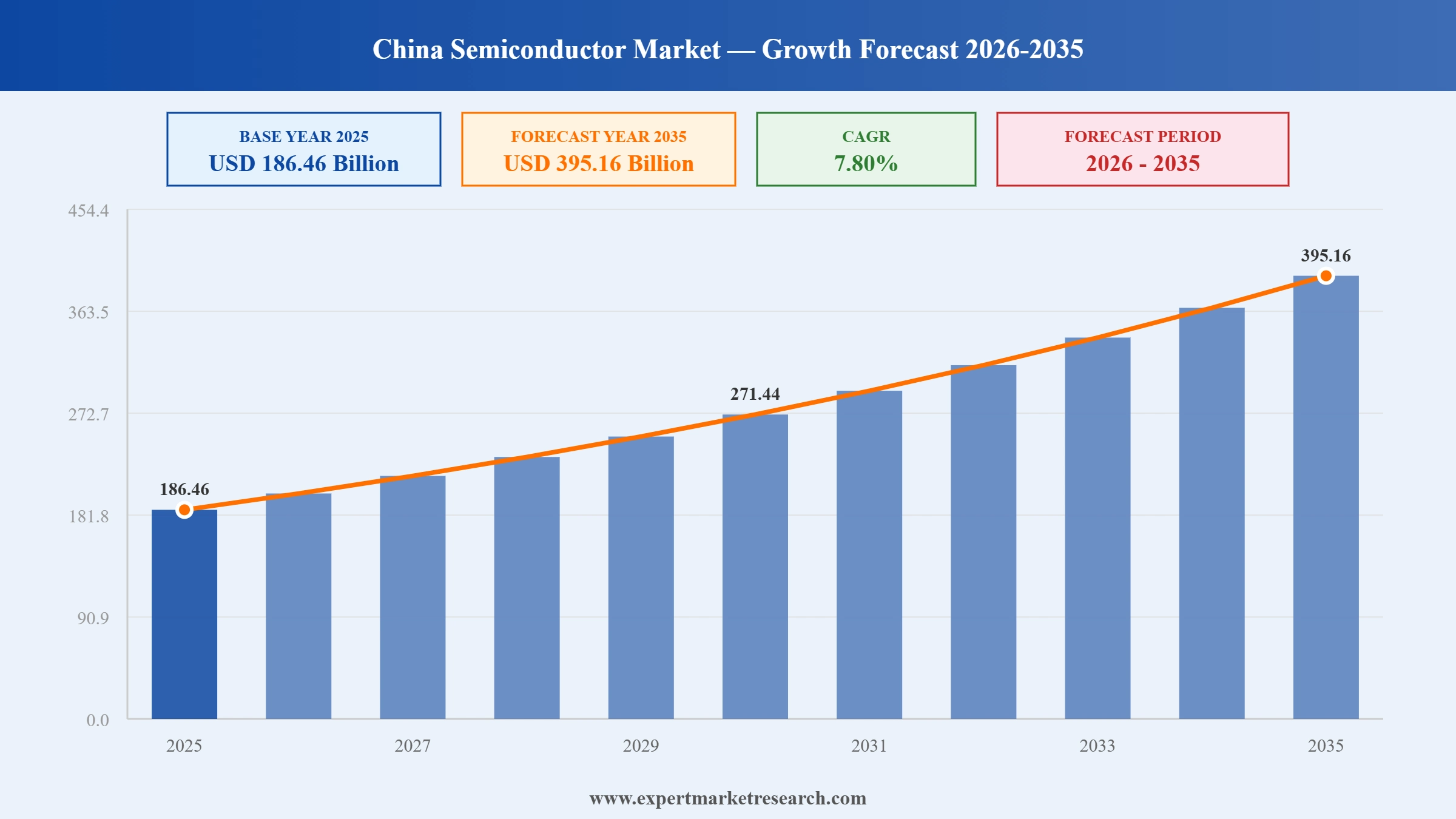
The China semiconductor market attained a value of USD 186.46 Billion in 2025 and is projected to expand at a CAGR of 7.80% through 2035. The market is further expected to achieve USD 395.16 Billion by 2035. The increased use of AI servers, industrial robots, and electric vehicles is increasing the demand for power devices, specialized semiconductors, and advanced packaging, motivating constant domestic innovations and localization within the semiconductor industry.
Cloud service providers and AI infrastructure developers increasingly use locally developed accelerators and network components, driving companies to improve performance while making supply more reliable and boosting demand in the China semiconductor market. Second, the rapid growth of silicon carbide and gallium nitride semiconductors is enabling producers to meet increasing demand from the electric vehicle, renewable energy, and industrial power electronics sectors. Such specialized semiconductors offer higher margins for producers and help them diversify their business models beyond traditional consumer electronics sectors.
The China semiconductor market continues to be influenced by innovations taking place within the country, with high-density advanced packaging emerging as one of the areas of competitiveness. For example, in July 2026, JCET Group increased its capability in heterogeneous integration through the introduction of high-density advanced packaging products suitable for AI accelerators, high-performance computing processors, and automotive chips. This move has shown that one of the strategies that the country is employing is to increase value creation in addition to wafer fabrication.
In addition, the China semiconductor market is being influenced by investments made in mature-node manufacturing, specialty semiconductors, and equipment localization. Foundries are continuing to increase manufacturing capability for power semiconductors, analog ICs, display driver ICs, and automotive microcontrollers, despite geopolitics restricting the use of advanced manufacturing technology. For example, in June 2026, Chinese chip firms launched a RMB 577 million semiconductor fund, accelerating long-term R&D and domestic technology self-sufficiency initiatives.
Read more about this report - REQUEST FREE SAMPLE COPY IN PDF
|
China Semiconductor Market Report Summary |
Description |
Value |
|
Base Year |
USD Billion |
2025 |
|
Historical Period |
USD Billion |
2019-2025 |
|
Forecast Period |
USD Billion |
2026-2035 |
|
Market Size 2025 |
USD Billion |
186.46 |
|
Market Size 2035 |
USD Billion |
395.16 |
|
CAGR 2019-2025 |
Percentage |
XX% |
|
CAGR 2026-2035 |
Percentage |
7.80% |
|
CAGR 2026-2035 - Market by Region |
South Western China |
8.9% |
|
CAGR 2026-2035 - Market by Region |
East China |
8.0% |
|
CAGR 2026-2035 - Market by Type |
Sensors |
8.6% |
|
CAGR 2026-2035 - Market by Tourism Type |
Automotive |
8.6% |
|
Market Share by Country 2025 |
North East China |
9.5% |
China began manufacturing its own immersion DUV lithography equipment, increasing localization of semiconductor equipment, and decreasing dependency on foreign production technologies. Companies can localize their semiconductor equipment, spare parts, and maintenance through localized supply chains and technology adoption, following such trends in the China semiconductor market.
DFSX is an AI startup in China that released a high-end AI chip to further improve China's domestic computing power and use in artificial intelligence and semiconductor application. Companies can develop AI accelerators and processors for the country’s growing domestic AI infrastructure, capitalizing on such trends in the China semiconductor market.
An initiative of a national artificial intelligence partnership was announced in China, which will enhance cooperation among technology companies, scientists, and manufacturers of semiconductors that use artificial intelligence.
VanEck announced the SMHC ETF, allowing focused investment in the growing semiconductor manufacturing, equipment, and technology sector of China. Companies can obtain investment from institutions by increasing their capabilities for semiconductor manufacturing and technology partnerships.
The fast growth of China's artificial intelligence infrastructure results in significant investments into AI chips, high bandwidth memory, chiplet technology, and advanced packaging of semiconductors. Companies in the China semiconductor market that manufacture semiconductors create processors specifically designed for large language models, cloud computing, and industry AI solutions to minimize dependency on imported hardware. In July 2025, Huawei presented its CloudMatrix 384 AI computing solution, featuring domestically made AI processors for large-scale enterprise workloads. Meanwhile, the Ministry of Industry and Information Technology in China promotes intelligent computing centers within China's national digital infrastructure programs.
Increasing localization of equipment used in semiconductor manufacturing changes China's supply chain strategy as companies develop their capacities in lithography support equipment, etching, deposition, testing, and wafer inspection technologies. Manufacturers are no longer focusing solely on chip fabrication; they are investing across the entire semiconductor production ecosystem to strengthen supply chain resilience and reduce dependence on external suppliers. Aligning with this trend in the China semiconductor market, in April 2024, NAURA announced the development of the country’s first advanced lithography tools, strengthening domestic semiconductor equipment innovation and manufacturing independence.
China's dominance of electric car manufacturing is sustaining demands for silicon carbide power devices, automotive microcontrollers, battery management chips, and cockpit intelligence processors. Chipmakers are growing their production capacities while releasing products specially tailored for the requirements of high voltage electric drivetrains and driver assistive systems, boosting demand in the China semiconductor market. For example, in January 2025, BYD Semiconductor sped up the commercialization of silicon carbide MOSFET technologies aimed at enhancing the efficiency of vehicles' energy consumption and charging.
Chipmakers are increasingly focused on advanced semiconductor packaging technologies that would allow boosting the performance of computing devices without solely relying on leading-edge manufacturing nodes, thus redefining the China semiconductor market dynamics. Such semiconductor packing technologies as chiplet integration, 2.5D packing, 3D stacking, and heterogenous integration are gaining prominence as product development priorities for AI, automotive, and data center applications. For example, in April 2026, JCET achieved record advanced packaging revenue, expanding high-end semiconductor packaging capacity for AI, HPC, and automotive applications.
China is steadily building self-reliance in semiconductors through concerted efforts involving industrial policy, research investments, and manufacturing development programs for integrated circuits throughout the whole value chain. Public funding is now more oriented towards developing semiconductor materials, electronic design automation software, memory technology, compound semiconductors, and advanced manufacturing technologies. With the help of the 14th Five-Year Plan, the government continues to focus on innovation in integrated circuits through financing, industrial parks, and joint research projects between universities and firms in the China semiconductor market. For example, in May 2026, CUHK established the CHIP research center, advancing heterogeneous semiconductor integration, advanced packaging, precision manufacturing, and next-generation electronic materials research.
The Expert Market Research’s report titled “China Semiconductor Market Report and Forecast 2026-2035” offers a detailed analysis of the market based on the following segments:
Market Breakup by Products
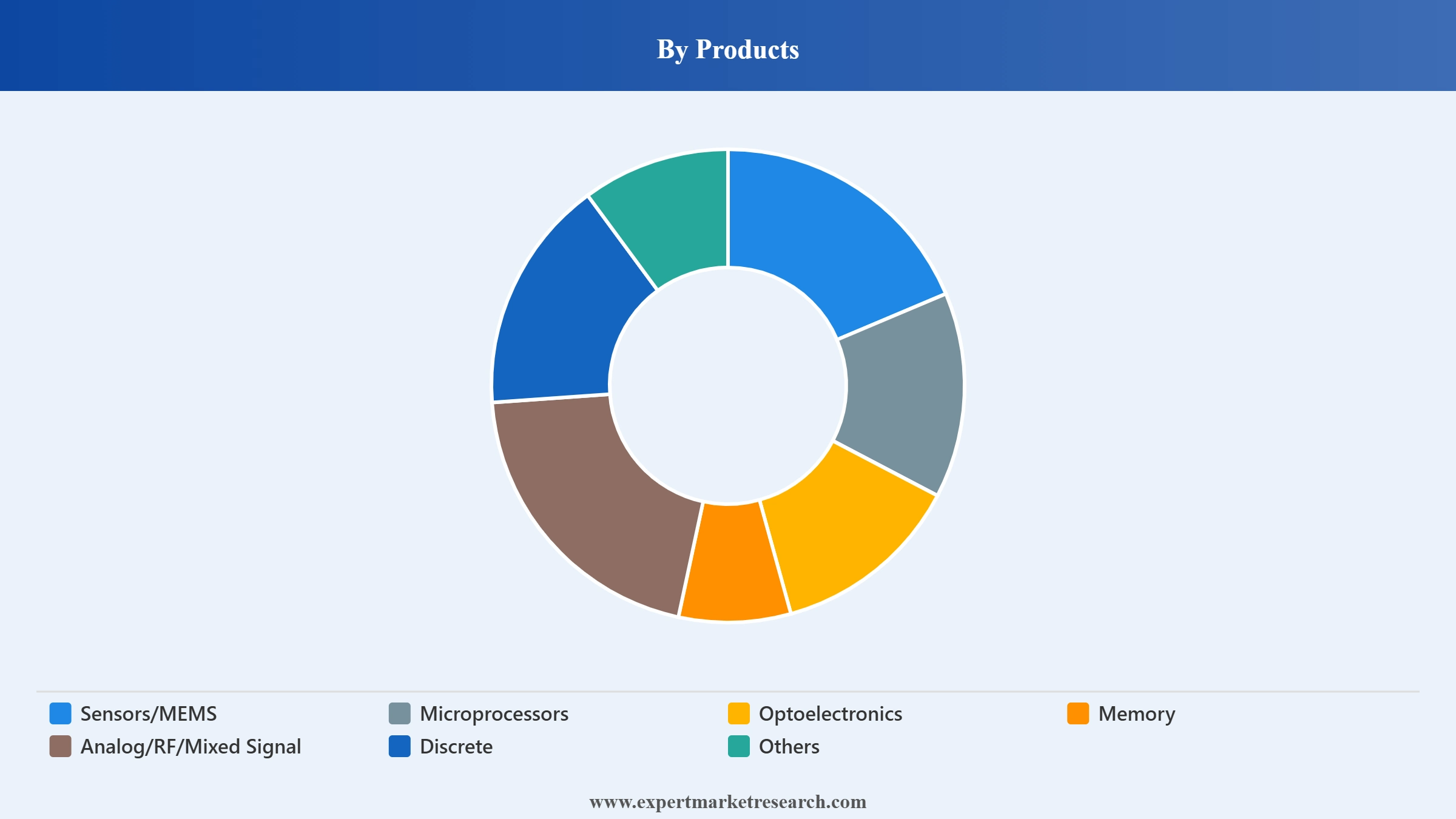
Key Insight: The China semiconductor market largely relies on its technological strength in all categories of products. Sensors and MEMS are driven by industrial automation and intelligent mobility, while microprocessors are developed based on AI computing and enterprise digitalization. The field of optoelectronics continues to grow with optical communication and display. The memory category continues to be the biggest segment due to its demand in the cloud and smart device sectors. Analog, RF, and mixed signals are developing fast via automotive and industrial applications. Discrete semiconductors help build power systems and renewable energy machinery, while other types of semiconductor products keep providing their services for diversified applications. In May 2026, Analog Devices acquired Empower Semiconductor, expanding AI-focused high-density power solutions with advanced integrated voltage regulator technologies.
Market Breakup by Application
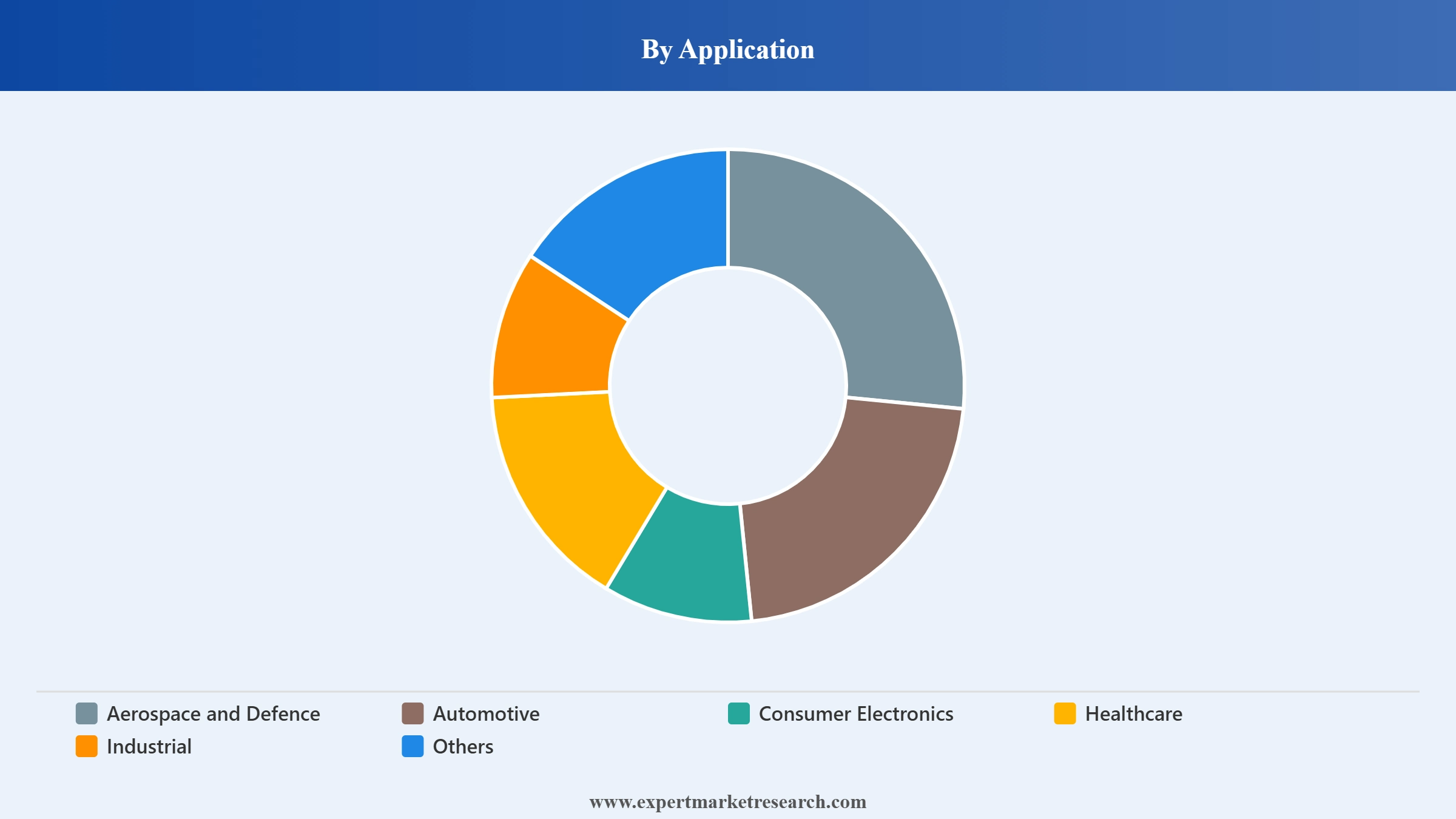
Key Insight: The semiconductor consumption of China is dispersed across different industries of application that have their own needs of technological specifications. The aerospace and defense sector needs chips that are highly reliable and secure to use in their mission-critical applications. On the other hand, automobiles are leading the innovation of power electronics and intelligent mobility. Consumer electronics continues to be the biggest demand driving segment by virtue of new product developments and large production volumes. The healthcare industry is increasingly boosting the China semiconductor market revenue with the ongoing demand for imaging, wearables, and medical devices.
Market Breakup by Region
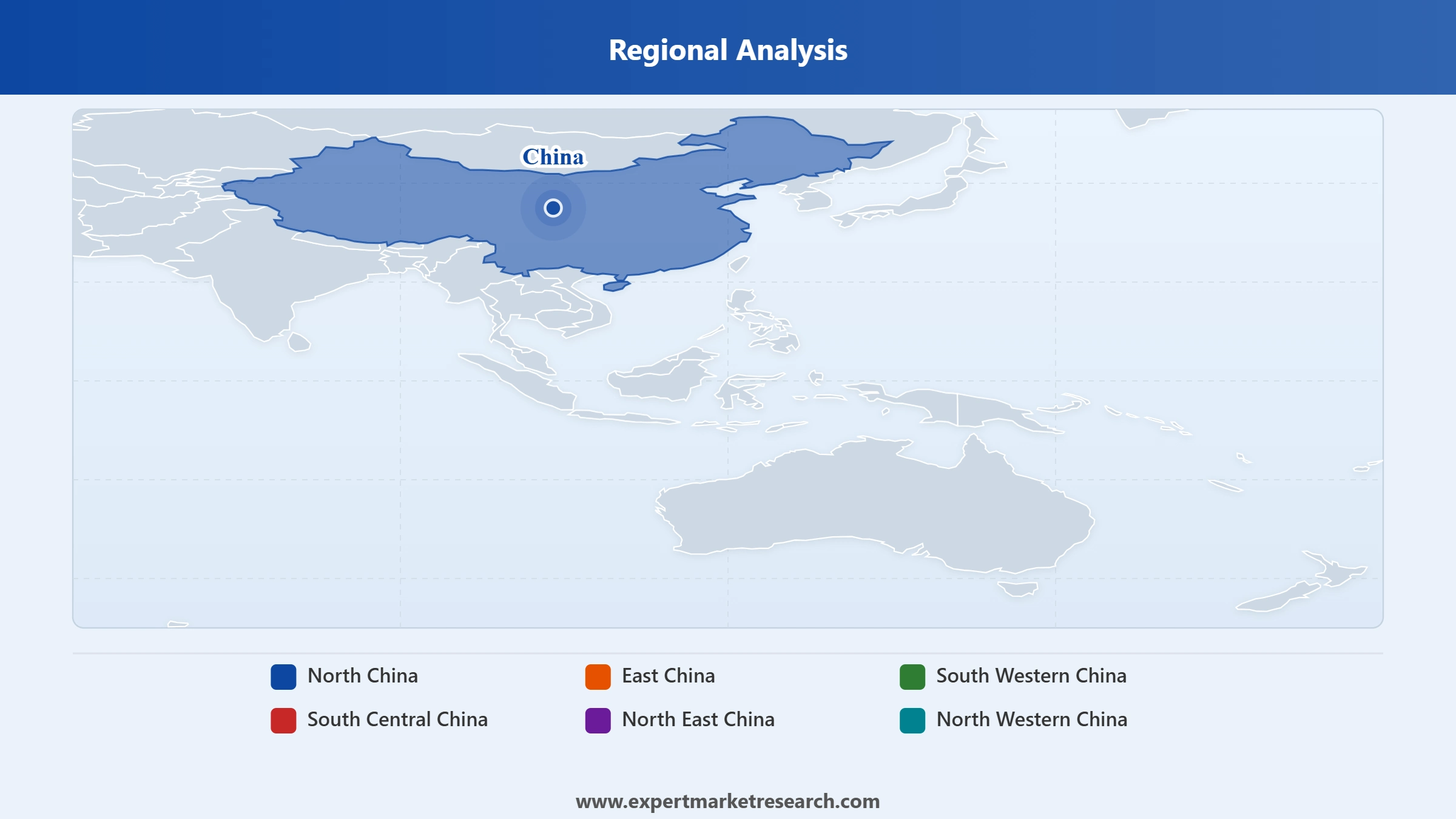
Key Insight: The development of the overall China semiconductor market is based on complementary specialization. The northern regions of China gain from the research institutes, the policies, and the IC designing expertise. The eastern part of China succeeds owing to its advanced manufacturing facilities and advanced semiconductor industry supply chain. Southwest China develops its electronics manufacturing facilities and special semiconductor facilities. The southern central part of China attracts investments in fabrication and technology. Northeast China fulfills the needs of industrial semiconductors through manufacturing development, while Northwest China develops its semiconductor industry gradually.
Memory products accelerate market growth due to strong demand from AI servers and consumer electronics
Memory products dominate the China semiconductor market, as the country further builds up its internal capacity of DRAM, NAND flash, and new-generation memory components, which can be essential for the future development of AI systems, cloud computing, smartphones, and enterprise storage arrays. The Chinese companies are developing vertical integration as well as investing into memory production and packaging in order to increase supply chain flexibility. The rapid deployment of AI servers, intelligent consumer devices, and industrial computers keeps driving large-scale memory demand, and this makes this product segment the biggest contributor to semiconductor production and internal technological development. Further, CXMT's blockbuster market debut in July 2026 strengthened China's memory chip ambitions, accelerating DRAM expansion, investor confidence, and domestic semiconductor competitiveness.
Read more about this report - REQUEST FREE SAMPLE COPY IN PDF
Analog/Radio Frequency/Mixed Signal semiconductors demonstrate the highest rates of growth in the China semiconductor market as they are required for use in electric vehicles, industrial equipment, renewable energy infrastructure, and advanced telecommunication network. The domestic producers of semiconductors are developing their products lines that include power management ICs, RF front-end, battery management systems, and sensors interfaces. Increased investments into 5G infrastructure, intelligent manufacturing, and connected cars keep providing long-term opportunities for analog semiconductors producers to develop higher value-added applications. For instance, in July 2026, UMS introduced a 2W GaN power amplifier, enabling high-performance SatCom, 5G, and electronic warfare applications with enhanced efficiency.
By application, the consumer electronics category accounts for the largest market share due to China's electronics manufacturing leadership
Consumer electronics is one of the leading market segments due to the country’s position as a manufacturing center for smartphones, tablets, wearables, smart home products, televisions, and personal computing. The constant introduction of new products encourages semiconductor providers to offer chips for efficient processors, memory, display drivers, sensors, and connectivity functions. Companies are working together with local semiconductor companies to improve the safety of their supply chain and increase development speed for high-end electronic products for both the domestic and international markets. In June 2026, VanEck launched the SMHC ETF, providing pure-play exposure to China's expanding domestic semiconductor manufacturing and equipment ecosystem.
Read more about this report - REQUEST FREE SAMPLE COPY IN PDF
The automotive sector is expected to grow at the fastest rate in the semiconductor market due to quick adoption of solutions such as advanced driver assistance systems, intelligent cockpits, battery management systems, and autonomous driving systems by Chinese automakers. The consumption of power semiconductors, automotive microcontrollers, radar chips, image sensors, and communication processors is growing alongside the development of electric vehicles in China. Companies in the China semiconductor market are developing automotive components according to strict reliability standards, thus forming closer cooperation with carmakers. In May 2026, BYD debuted China's most advanced EV chip, strengthening intelligent driving capabilities and accelerating autonomous vehicle semiconductor innovation.
Read more about this report - REQUEST FREE SAMPLE COPY IN PDF
East China accounts for the largest market share due to its comprehensive semiconductor manufacturing ecosystem
The East China semiconductor market dominates the overall industry owing to the number of wafer fabs, IC design companies, packaging factories, research institutes, and manufacturing clusters in this region. Cities such as Shanghai, Suzhou, Wuxi, Nanjing have mature semiconductor ecosystems with good talent, good logistics, and supply chains which facilitate faster commercialization of innovations and encourage collaboration among foundries, fabless companies, semiconductor equipment providers, and materials suppliers in the semiconductor value chain. In July 2026, a Shanghai state-backed firm developed domestic immersion DUV lithography systems, strengthening China's semiconductor equipment self-reliance and manufacturing capabilities.
The South-Central China semiconductor market is showing the most impressive growth as the local authorities keep drawing semiconductor investments in the form of industrial parks, manufacturing investments, and research collaborations. Cities such as Wuhan, Changsha and their adjacent tech centers are developing capacity in memory production, optical semiconductors, IC design, and testing. The increase in infrastructure investments, workforce training, and university-industry collaboration is making this region more competitive and contributing to the diversity of the overall manufacturing in the country.
Read more about this report - REQUEST FREE SAMPLE COPY IN PDF
The industry continues to be highly competitive considering the growing investments from both local and foreign firms into automotive semiconductors, industrial automation, artificial intelligence computation and power electronics. Leading China semiconductor companies increasingly focus on the localization of research and development activities, application-specific chip production, innovative packaging techniques, and collaborations with auto OEMs and industrial equipment firms. Competitors in the market are not only competing on the basis of production capacity but also through integration of software, energy-efficient architecture of chips, and use of silicon carbide technology.
Another emerging area of opportunity for China semiconductor market players is that of edge AI processors and smart factories where there is an increasing demand in manufacturing and logistics industries. Foreign companies are continuing to increase their technical service and design collaboration facilities in China whereas domestic ecosystems for collaboration are proving to be beneficial for commercialization of products. It appears that semiconductor security, certifications for automotive and customized ICs for industrial customers are becoming the emerging trends in the market.
Founded in 1999 and headquartered in Neubiberg, Germany, Infineon Technologies AG provides China with energy-efficient semiconductors including power semiconductors, automotive microcontrollers, silicon carbide products, and factory automation. Infineon Technologies AG continues developing semiconductor technologies for energy efficient applications in electric vehicles, renewable energy, factory automation, and intelligent mobility while establishing closer cooperation with Chinese automotive and industrial suppliers.
Founded in 1965 and headquartered in Massachusetts, United States, Analog Devices, Inc. is involved in providing China with high-performance semiconductors including analog, mixed-signal, power management, and signal processing semiconductors. The company specializes in industrial automation, medical devices, intelligent manufacturing, and automotive electronic products while developing software semiconductor platforms.
Microchip Technology Inc., founded in 1987 and based in Chandler, Arizona, United States, offers microcontrollers, embedded processors, FPGA solutions, memory, and connectivity semiconductors in China. Microchip focuses on the development of embedded control platforms in fields such as industrial automation, smart infrastructure, electric vehicles, aerospace, and secure connected systems.
Founded in 2006 and having its headquarters in Eindhoven, Netherlands, NXP Semiconductors NV supplies automotive processors, radar chips, secure ID technologies, wireless connectivity, and industrial semiconductors in China. NXP Semiconductors NV focuses on intelligent transport, vehicle networking, smart factories, and secure IoT applications, enhancing its cooperation with Chinese car makers and electronics manufacturers creating new generations of connected products.
Other key players in the market include Texas Instruments Inc., ON Semiconductor Corp., Skyworks Solutions Inc., Renesas Electronics Corp., Qorvo Inc., and MediaTek Inc, among others.
*Please note that this is only a partial list; the complete list of key players is available in the full report. Additionally, the list of key players can be customized to better suit your needs.*
Unlock the latest insights with our China semiconductor market trends 2026 report. Discover regional growth patterns, consumer preferences, and key industry players. Stay ahead of competition with trusted data and expert analysis. Download your free sample report today and drive informed decisions in the market.


Upto 15% Off
USD
$2499 $2249
$3999 $3599
$4999 $4249
$5999 $5099


*While we strive to always give you current and accurate information, the numbers depicted on the website are indicative and may differ from the actual numbers in the main report. At Expert Market Research, we aim to bring you the latest insights and trends in the market. Using our analyses and forecasts, stakeholders can understand the market dynamics, navigate challenges, and capitalize on opportunities to make data-driven strategic decisions.*
In 2025, the market reached an approximate value of USD 186.46 Billion.
The market is projected to grow at a CAGR of 7.80% between 2026 and 2035.
The market is estimated to witness a healthy growth in the forecast period of 2026-2035 to reach about USD 395.16 Billion by 2035.
Expanding localized R&D, strengthening automotive partnerships, investing in advanced packaging, developing AI-focused semiconductor solutions, improving supply chain resilience, and increasing application-specific chip innovation are creating sustainable competitive advantages.
The key trends aiding the market expansion include the increasing demand for electronics, industrial automation and smart manufacturing and rapid industrial automation.
As per the EMR report, the different applications of semiconductors in the market are aerospace and defence, automotive, consumer electronics, healthcare, and industrial, among others.
The major regions considered in the market are Shanghai, Zhejiang, Guangdong, Jiangsu, and Beijing, among others.
The key players in the market include Infineon Technologies AG, Analog Devices, Inc., Microchip Technology Inc., NXP Semiconductors NV, Texas Instruments Inc., ON Semiconductor Corp., Skyworks Solutions Inc., Renesas Electronics Corp., Qorvo Inc., and MediaTek Inc, among others.
Geopolitical restrictions, technology export controls, supply chain localization requirements, rising R&D costs, rapid product cycles, talent shortages, and increasing competition from domestic semiconductor companies continue challenging market participants.
Explore our key highlights of the report and gain a concise overview of key findings, trends, and actionable insights that will empower your strategic decisions.
| REPORT FEATURES | DETAILS |
| Base Year | 2025 |
| Historical Period | 2019-2025 |
| Forecast Period | 2026-2035 |
| Scope of the Report |
Historical and Forecast Trends, Industry Drivers and Constraints, Historical and Forecast Market Analysis by Segment:
|
| Breakup by Products |
|
| Breakup by Application |
|
| Breakup by Region |
|
| Market Dynamics |
|
| Competitive Landscape |
|
| Companies Covered |
|
Datasheet
One User
USD 2,499
USD 2,249
tax inclusive*
Single User License
One User
USD 3,999
USD 3,599
tax inclusive*
Five User License
Five User
USD 4,999
USD 4,249
tax inclusive*
Corporate License
Unlimited Users
USD 5,999
USD 5,099
tax inclusive*
*Please note that the prices mentioned below are starting prices for each bundle type. Kindly contact our team for further details.*
Flash Bundle
Small Business Bundle
Growth Bundle
Enterprise Bundle
*Please note that the prices mentioned below are starting prices for each bundle type. Kindly contact our team for further details.*
Flash Bundle
Number of Reports: 3
20%
tax inclusive*
Small Business Bundle
Number of Reports: 5
25%
tax inclusive*
Growth Bundle
Number of Reports: 8
30%
tax inclusive*
Enterprise Bundle
Number of Reports: 10
35%
tax inclusive*
How To Order

Select License Type
Choose the right license for your needs and access rights.

Click on ‘Buy Now’
Add the report to your cart with one click and proceed to register.

Select Mode of Payment
Choose a payment option for a secure checkout. You will be redirected accordingly.
Strategic Solutions for Informed Decision-Making
Gain insights to stay ahead and seize opportunities.

Get insights & trends for a competitive edge.

Track prices with detailed trend reports.

Analyse trade data for supply chain insights.

Leverage cost reports for smart savings

Enhance supply chain with partnerships.

Connect For More Information
Our expert team of analysts will offer full support and resolve any queries regarding the report, before and after the purchase.
Our expert team of analysts will offer full support and resolve any queries regarding the report, before and after the purchase.
We employ meticulous research methods, blending advanced analytics and expert insights to deliver accurate, actionable industry intelligence, staying ahead of competitors.
Our skilled analysts offer unparalleled competitive advantage with detailed insights on current and emerging markets, ensuring your strategic edge.
We offer an in-depth yet simplified presentation of industry insights and analysis to meet your specific requirements effectively.




