

Consumer Insights
Uncover trends and behaviors shaping consumer choices today
Procurement Insights
Optimize your sourcing strategy with key market data
Industry Stats
Stay ahead with the latest trends and market analysis.
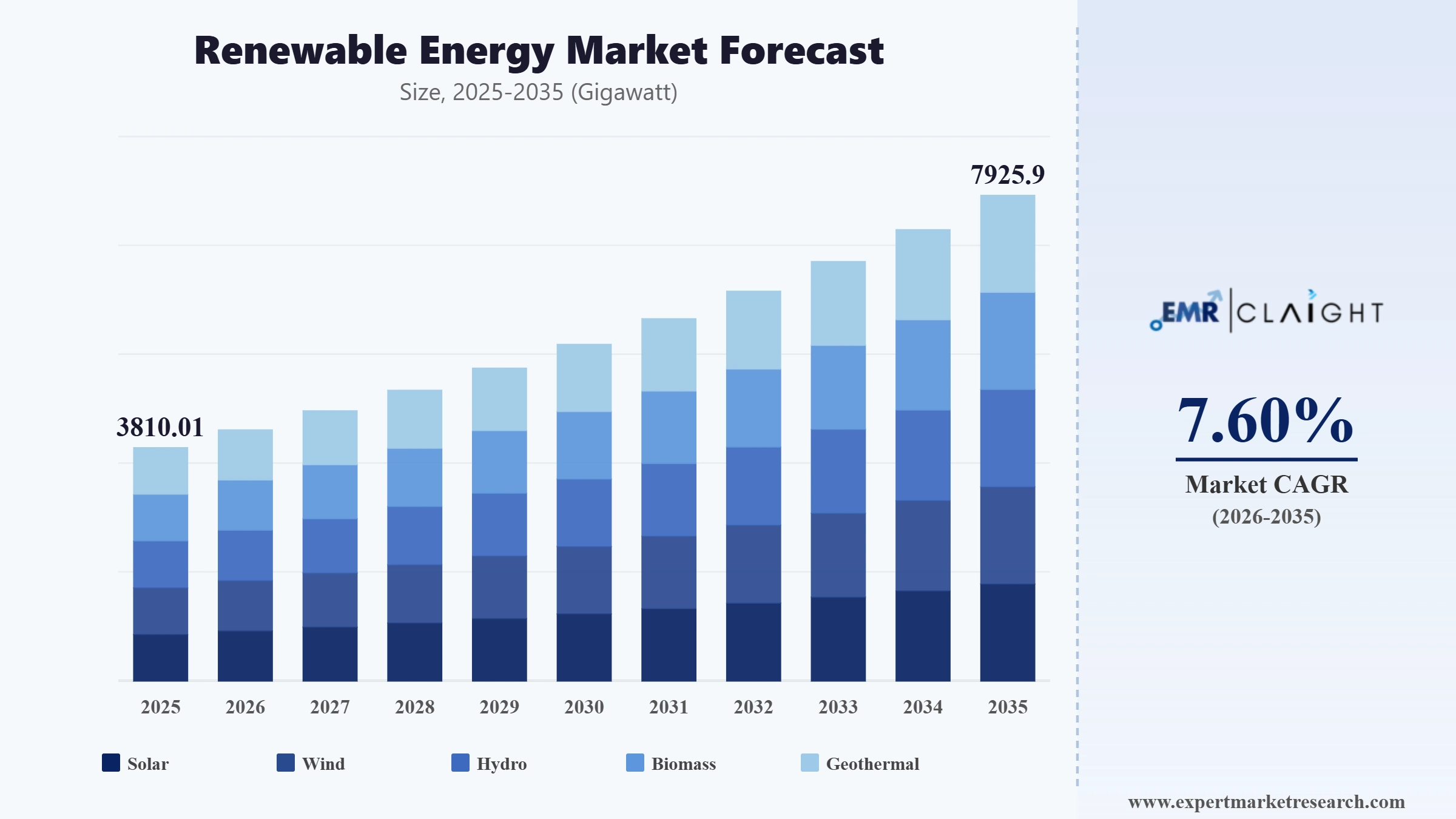
The global renewable energy market achieved a volume of 3810.01 Gigawatt in 2025. The market is expected to grow at a CAGR of 7.60% during the forecast period of 2026-2035 to reach a volume of 7925.90 Gigawatt by 2035. This growth is attributed to the structural shift toward hybrid energy systems that integrate solar, wind, and battery storage into unified generation solutions, propelling the overall demand.
According to IRENA's Renewable Capacity Statistics 2026, released on April 1, 2026, global renewable power capacity reached 5,149 GW at the end of 2025 after a record 692 GW was added during the year, representing a 15.5% annual increase. Solar accounted for 511 GW of those additions, nearly three-quarters of all new renewable capacity, while wind contributed 159 GW. Renewable energy now represents 85.6% of all new power generating capacity added globally, confirming that the structural shift away from fossil fuels is accelerating across both developed and emerging markets.
Increasing digitalization of energy systems and the growth of grid-scale integration of energy storage are driving the development of the global renewable energy market. State-of-the-art digital technologies, such as AI-based prediction and smart grid solutions, are harmonizing demand and supply more efficiently and increasing the efficiency of renewable energy sources. At the same time, the increased use of grid-scale battery storage facilities is improving energy reliability by storing surplus generation and delivering power during peak load. All of these developments are minimizing curtailment losses, enhancing the economics of projects, and enabling seamless incorporation of renewables into existing power infrastructure.
Moreover, the renewable energy market is observing a surging demand for a continuous flow of clean power, so the trend is being shifted towards industrial and commercial consumers who require baseload-equivalent renewable energy solutions. The solution to the intermittency problem and to improve grid reliability can be achieved by increasing the availability of bundled energy products, in which developers are integrating multiple sources of generation with storage. These systems also improve project economics by enabling more efficient use of assets and reducing curtailment risks, making them highly attractive for large-scale deployment. The rise in the commercialization of hybrid renewables is thereby boosting the long-term capacity building and decarbonization of key industries. For example, in December 2024, Amplus Solar released the first commercial-scale integrated solar-wind-battery hybrid project in India, a breakthrough in the implementation of hybrid renewable energy.
The United States is reinforcing its position as one of the world's most active renewable energy markets. The US Energy Information Administration's February 2026 Electric Power Monthly report projected that developers plan to add a record 86 GW of new utility-scale generating capacity to the US grid in 2026, with solar accounting for 51% of additions at 43.4 GW, battery storage at 28%, and wind at 14%. In March 2026, for the first time in recorded history, US renewable electricity generation exceeded gas generation over the course of a full calendar month, according to the Union of Concerned Scientists. India is the fastest-growing major national market, with IRENA reporting a projected CAGR of 9.8% for India's renewable capacity through 2035, supported by the National Infrastructure Pipeline and aggressive solar manufacturing expansion programmes.
Read more about this report - REQUEST FREE SAMPLE COPY IN PDF
| Global Renewable Energy Market Report Summary | Description | Value |
| Base Year | Gigawatt | 2025 |
| Historical Period | Gigawatt | 2019-2025 |
| Forecast Period | Gigawatt | 2026-2035 |
| Market Size 2025 | Gigawatt | 3810.01 |
| Market Size 2035 | Gigawatt | 7925.90 |
| CAGR 2019-2025 | Percentage | XX% |
| CAGR 2026-2035 | Percentage | 7.60% |
| CAGR 2026-2035 - Market by Region | Asia Pacific | 8.6% |
| CAGR 2026-2035 - Market by Country | India | 9.8% |
| CAGR 2026-2035 - Market by Country | Canada | 8.2% |
| CAGR 2026-2035 - Market by Type | Geothermal | 8.4% |
| Market Share by Country 2025 | Italy | 3.4% |
According to independent energy think tank Ember, wind and solar generated 531 terawatt-hours of electricity in April 2026, exceeding gas generation of 477 TWh for the first time in recorded history, with renewable output growing 13% year-on-year across major markets including China, the EU, the UK, the US, Australia, Chile, and Brazil.
The US Energy Information Administration confirmed that in March 2026, US renewable electricity generation exceeded gas generation over the course of a full calendar month for the first time, with EIA forecasting solar generation to grow 17% and wind 5% across 2026 as the country prepares to add a record 86 GW of new utility-scale generating capacity.
The US Energy Information Administration's February 20, 2026 Electric Power Monthly report projected that developers and operators plan to add a record 86 GW of new utility-scale generating capacity to the US grid in 2026, with solar accounting for 51% of additions at 43.4 GW, battery storage at 28% with 24.3 GW, and wind at 14% with 11.8 GW.
Governor Gavin Newsom announced that California became the first subnational entity to join the Global Energy Storage and Grids Pledge, which targets 1,500 GW of global energy storage, doubled global grid investment, and 25 million kilometres of new transmission by 2030, as California's installed battery storage capacity reached 16,942 MW, a 2,100% increase since 2019.
The renewable energy market is on a booming growth trajectory as ultra-large renewable energy parks are being formed to consolidate solar and wind resources in one location. These megaprojects are facilitating economies of scale, decreasing unit costs of generation, and enhancing efficiency in grid integration. To satisfy utility-scale demand and the long-term clean energy goals, developers are progressively opening such parks. In July 2024, Adani Green Energy started operating its wind turbines at its Khavda renewable energy park, which is one of the largest hybrid renewable plants globally.
Due to the deployment of utility-scale renewable projects that provide industrial and grid consumers with long-term energy supply assets, the global renewable energy market is expanding at an exponential rate. Businesses are increasingly using gigawatt-sized solar and wind projects to support sustainable energy portfolios and create a steady stream of income. In places where the demand for electricity is rising, these are also being used to enhance energy security. For example, in December 2025, ArcelorMittal announced that it would roll out about 1 GW of renewable energy projects in India, which would drastically increase its captive clean power.
The changing needs of consumers for flexible renewable electricity products, as compared to traditional power generation, significantly impact the renewable energy market dynamics. These services enable businesses to tap into renewable energy sources without committing to infrastructure in the long run, further consolidating their market presence. Additionally, small-scale industrial clients are discovering that their energy providers are offering more clean power solutions, like modular or subscription-based electricity. For instance, in May 2025, Sasol and Discovery Green introduced Ampli Energy, a flexible renewable electricity product that provides businesses in South Africa with month-to-month access to clean power.
The continuous advancements in wind turbine technology, including higher capacity and improved efficiency, is contributing significantly to the renewable energy market value. Wind projects are becoming more competitive around the world, with manufacturers developing new turbine platforms to increase energy generation while lowering lifecycle costs. The advances help speed installations, as developers can earn from larger projects and faster installs. For instance, in April 2025, Suzlon was awarded a 378 MW wind project contract by NTPC Green Energy, where it utilized its new high-tech turbine to improve the efficiency and output performance of its projects.
The market continues to grow into new technologies that are going beyond traditional solar and wind systems. Startups and established firms are working on disruptive renewable technologies that could help enhance energy production and open new opportunities in the renewable energy market for new forms of energy delivery. These inventions are drawing research funding and commercialization efforts at an early stage. For instance, to change the current state of innovation in renewable energy, in October 2024, Aetherflux announced that they are working on space-based solar power technology, which will transmit energy generated in orbit to the Earth with the help of advanced transmission systems.
The Expert Market Research's report titled “Global Renewable Energy Market Report and Forecast 2026-2035” offers a detailed analysis of the market based on the following segments:
Market Breakup by Type
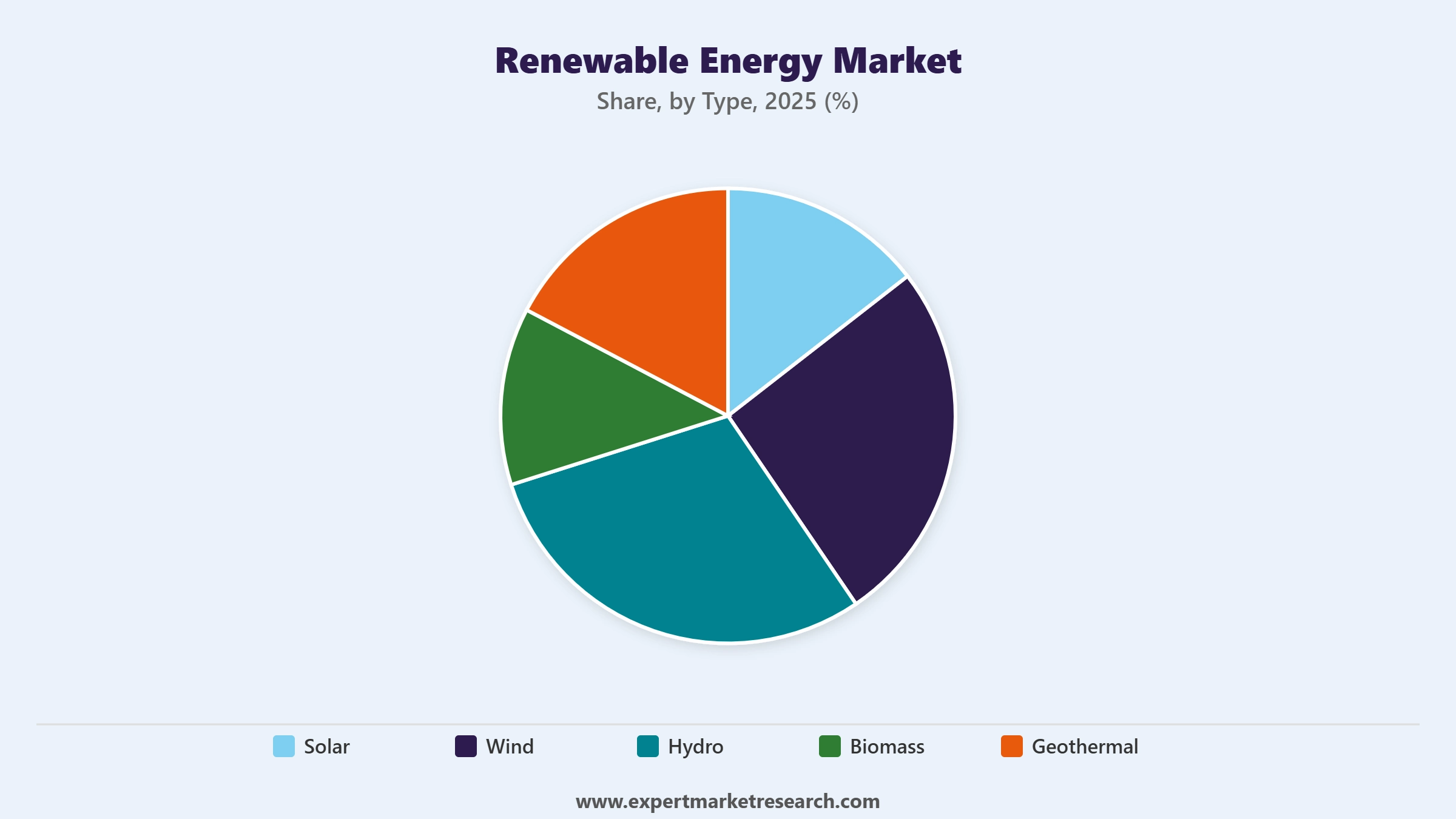
Key Insight: The global renewable energy market scope comprises solar, wind, hydro, biomass, and geothermal, demonstrating varied growth. Solar and wind are both seeing favorable trends due to lower module and utility-scale project costs, as well as superior turbine technology and offshore development. Hydro renewable energy is a dependable, steady source of baseload; biomass is enabling localized energy solutions based on agricultural and forestry residues. Furthermore, geothermal energy is gaining rapid popularity in geologically appropriate places to ensure consistent output. For instance, in March 2025, NextEra Energy expanded its solar-plus-storage portfolio in the United States, highlighting the growing importance of large-scale hybrid projects as key driving factors of the industry development.
Market Breakup by Region
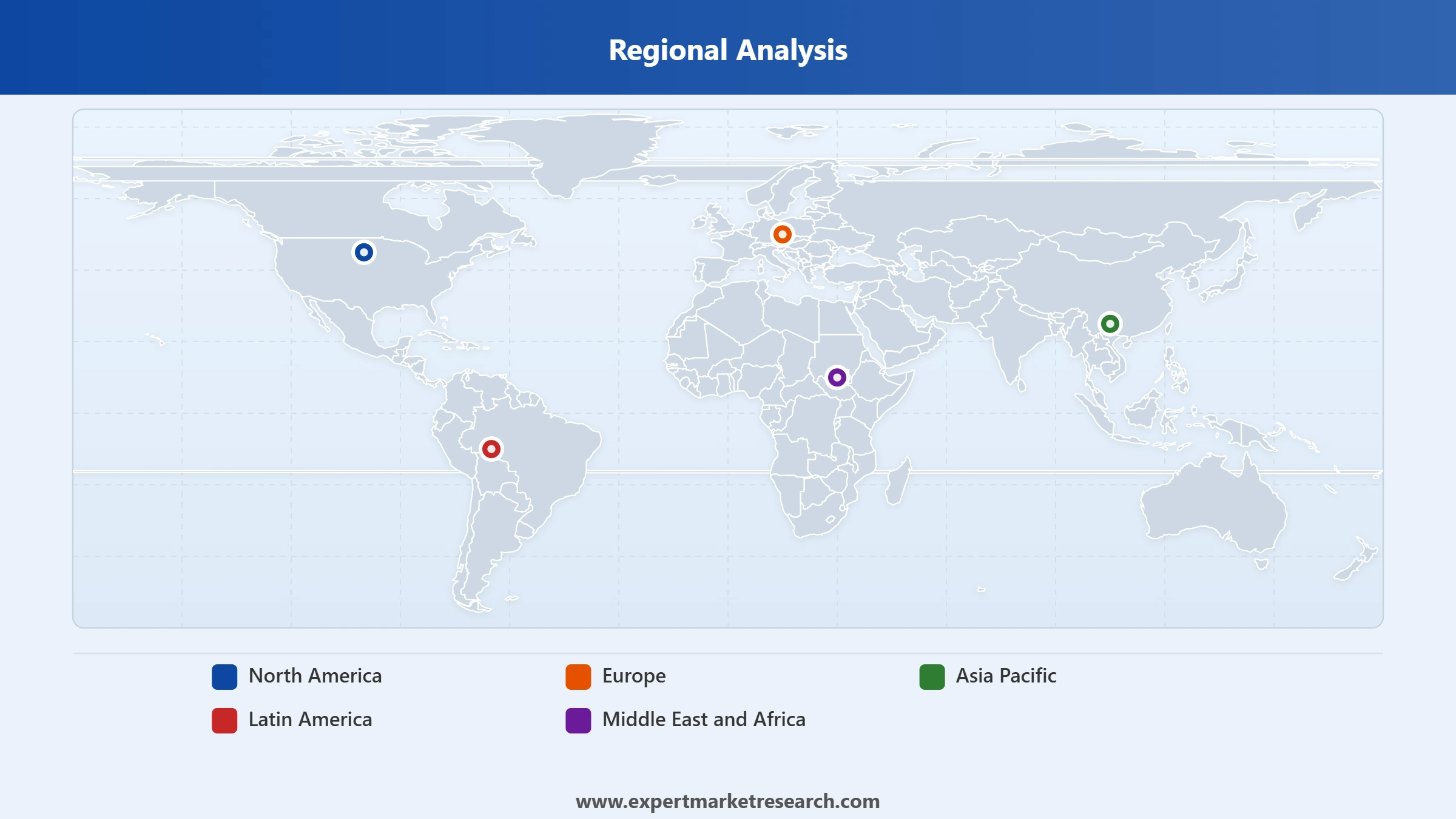
Key Insight: Asia Pacific accounts for the largest share of the global renewable energy market, with a strong emphasis on large-scale solar and wind projects. Meanwhile, North America focuses on utility-scale solar, storage, and hybrid projects. Europe is moving forward with offshore wind and hydrogen-connected renewables. For example, in July 2025, Iberdrola and Masdar announced substantial offshore wind projects in the United Kingdom and Germany, enhancing Europe's renewable infrastructure and facilitating the sustainable development of the European clean energy market, respectively. On the other hand, Latin America is developing hydropower and distributed solar power, and the Middle East and Africa are investing in utility-scale solar parks in large numbers.
By type, the solar renewable energy category witnesses the highest preference owing to the high-efficiency module innovation and utility expansion
The solar renewable energy market continues to dominate, driven by significant improvements in efficiency, the decreasing cost of modules, and the massive use of state-of-the-art photovoltaic technology. Producers are also introducing higher-output modules designed for utility-scale applications that are more efficient in terms of land use and energy yield. In addition, utility developers are combining solar and storage to improve dispatchability and grid stability. For instance, in August 2024, JinkoSolar announced its Tiger Neo TOPCon upgrade to the module series, which enhances the conversion efficiency of large-scale solar projects in the global markets.
The wind sector is observing booming growth in the renewable energy industry, due to the continuous development of next-generation offshore wind farms and high-capacity turbines that increase the potential for generating electricity while costing less per megawatt. Developers are working on larger rotor sizes and floating wind platforms to tap into further offshore resources. These developments are reinforcing the viability of projects in Europe and Asia. For instance, in March 2025, Vestas introduced its V236-15.0 MW offshore wind turbine for commercial use, increasing the amount of energy produced by a single turbine, and it was even expected to hasten the scalability of offshore wind projects globally.
Read more about this report - REQUEST FREE SAMPLE COPY IN PDF
By region, Asia Pacific leads the market growth, driven by large-scale solar manufacturing and gigawatt deployment
Asia Pacific is leading the growth of the renewable energy market by producing large amounts of solar manufacturing capacity and rapid developments of utility-scale solar parks. Governments are facilitating ecosystems of domestic clean energy production to lessen import reliance and to bolster energy security. Both solar and wind, along with integrated storage renewable clusters, are growing in India and China. For instance, in July 2024, Trina Solar unveiled its Vertex S+ residential and utility solar module series, which aims at improving efficiency and facilitating the large-scale implementation of global renewable efforts.
Vision 2030 and Gigawatt-Scale Solar Parks Position Middle East and Africa as a High-Growth Market
The Middle East and Africa is one of the fastest-growing regions in the global renewable energy market, supported by national diversification strategies, vast solar resources, and large-scale government-backed investment programmes. Saudi Arabia's Vision 2030 and the UAE's Net Zero by 2050 roadmap are accelerating investment in utility-scale solar parks, wind farms, and emerging green hydrogen projects, with Saudi Arabia allocating USD 2.5 billion for renewable energy and clean infrastructure under its national strategy. In October 2024, Masdar unveiled Phase II of the Al Dhafra solar project in the UAE, one of the largest solar installations in the world, reinforcing the Gulf Cooperation Council's position as a global leader in utility-scale photovoltaic deployment. Across Sub-Saharan Africa, the focus is on off-grid and mini-grid renewable systems to address rural electrification challenges, with international climate funding, development bank support, and cross-sector partnerships facilitating clean energy access in underserved communities.
Government Mandates and Record Capacity Additions Anchor North America's Renewable Energy Market
North America is one of the most active regions in the global renewable energy market, led by the United States which accounted for the largest national market share in 2025. The US Energy Information Administration projected that developers plan to add a record 86 GW of new utility-scale generating capacity to the US grid in 2026, with solar accounting for 51% of additions at 43.4 GW, battery storage at 28%, and wind at 14%, representing the largest single-year capacity addition in over two decades. In March 2026, US renewable electricity generation exceeded gas generation over the course of a full calendar month for the first time in recorded history, according to the Union of Concerned Scientists. Canada is expanding its renewable base through provincial clean energy programmes, including a high-speed rail and green infrastructure investment corridor, while federal net-zero commitments continue to drive utility-scale solar and wind procurement across the country.
European Green Deal and Offshore Wind Expansion Drive Europe's Renewable Energy Market
Europe is a global leader in renewable energy policy and deployment, driven by the European Green Deal, the REPowerEU strategy, and Stage V emission compliance frameworks that are collectively accelerating the phase-out of fossil fuels across the power sector. According to IRENA's Renewable Capacity Statistics 2026, Europe expanded its renewable capacity by 76.8 GW in 2025, a 9% increase, with Germany, France, and the United Kingdom representing the largest national markets in the region. Offshore wind is the fastest-growing technology segment in Europe, with Iberdrola and Masdar announcing substantial offshore wind projects in the United Kingdom and Germany in July 2025. The region also benefits from advanced grid infrastructure, strong public-private collaboration, and a mature regulatory environment that enables rapid deployment of utility-scale renewable projects and distributed solar installations.
Hydropower, Solar, and Nearshoring Investment Fuel Latin America's Renewable Energy Market
Latin America is a growing market for renewable energy, anchored by Brazil, Mexico, and Chile as the three most active national markets in the region. Brazil leads in hydropower and wind energy, with its vast river systems and strong wind corridors in the northeast supporting large-scale clean power generation, while solar capacity is expanding rapidly across the country's high-irradiance interior regions. Mexico is accelerating renewable energy deployment alongside nearshoring-related industrial construction activity, with corporate power purchase agreements driving demand for utility-scale solar and wind capacity. Chile is among the global leaders in solar energy potential, with the Atacama Desert offering some of the highest solar irradiance levels on earth, and the country is actively developing green hydrogen export projects that will require large-scale renewable generation as a feedstock, adding a new long-term demand dimension to the regional market.
Read more about this report - REQUEST FREE SAMPLE COPY IN PDF
Leading renewable energy market players are actively working on the integration and hybridization of technologies to improve efficiency and reliability. Companies are integrating solar, wind, and battery storage into a single energy source to solve intermittency issues and enhance dispatchability. Ongoing capital spending on high-efficiency units, state-of-the-art wind turbines, and computerized energy management systems is improving project performance. Concurrently, renewable energy companies are developing diversified renewable portfolios in utility-scale and distributed generation segments to gain expanded demand and enhance revenue stability over the long term.
Participants in the market are actively seeking strategic partnerships, mergers, and asset monetization efforts to speed up renewable energy implementation. The developer-utility-industrial consumer collaboration is facilitating acceleration in project implementation and ensuring long-term power purchase contracts. Firms are also realizing operational assets to reinvest capital in new developments, which enhances the ability to improve liquidity and scaling capacity. Moreover, geographic diversification into emerging markets across Asia Pacific, Latin America, and the Middle East is enabling renewable energy companies to tap into high-growth regions while mitigating regulatory and demand-related risks.
First Solar, Inc. is a major solar technology manufacturer based in the United States, with a focus on highly developed thin-film photovoltaic modules and utility-scale solar solutions. The company, which was established in 1999, aims at providing high-performance, low-carbon solar energy systems.
Suzlon Energy Ltd. is a leading supplier of renewable energy solutions that designs, manufactures, and assembles wind turbine generators. The company, which has its headquarters in Pune, India, was established in 1995 and has been instrumental in enhancing the use of wind energy in the global markets.
Vestas Wind Systems A/S is a global leader in the renewable energy industry, especially wind energy solutions, which include the design, manufacturing, installation, and servicing of wind turbines. The company was established in 1945 and is headquartered in Aarhus, Denmark, with a robust presence in onshore and offshore wind markets around the world.
Conergy Energy Systems is a green energy company that focuses on solar development projects, EPC, and system integration. It was established in 1998 and is based in Hamburg, Germany. It specializes in providing scalable solar energy infrastructure in the global markets.
Other key players in the market include Senvion S.A., Ørsted A/S, Vattenfall AB, JinkoSolar Holding Co., Ltd, Tata Power Solar Systems Ltd., and Enel Green Power S.p.A., among others.
*Please note that this is only a partial list; the complete list of key players is available in the full report. Additionally, the list of key players can be customized to better suit your needs.*
Explore the latest trends shaping the global renewable energy market 2026-2035 with our in-depth report. Gain strategic insights, future forecasts, and key market developments that can help you stay competitive. Download a free sample report or contact our team for customized consultation on global renewable energy market trends 2026.
Philippines Renewable Energy Market


Upto 15% Off
USD
$3999 $3599
$2499 $2249
$4999 $4249
$5999 $5099


*While we strive to always give you current and accurate information, the numbers depicted on the website are indicative and may differ from the actual numbers in the main report. At Expert Market Research, we aim to bring you the latest insights and trends in the market. Using our analyses and forecasts, stakeholders can understand the market dynamics, navigate challenges, and capitalize on opportunities to make data-driven strategic decisions.*
In 2025, the global renewable energy market reached an approximate volume of 3810.01 Gigawatt.
Key strategies include large-scale solar and wind capacity expansion, rising adoption of hybrid renewable systems with storage integration, and investments in advanced technologies. Companies are strengthening long-term PPAs to ensure revenue stability while expanding strategic partnerships, vertical integration, and geographic diversification into emerging markets to accelerate deployment and competitiveness.
The increasing environmental consciousness, rapid technological innovations, and the rising expenditure in the development of renewable energy plants are the key trends propelling the market growth.
The major regions in the market are North America, Latin America, the Middle East and Africa, Europe, and the Asia Pacific.
On the basis of type, the global renewable energy market is divided into solar, wind, hydro, biomass, and geothermal.
The key players in the market include First Solar, Inc., Suzlon Energy Ltd., Vestas Wind Systems A/S, Conergy Energy Systems, Senvion S.A., Ørsted A/S, Vattenfall AB, JinkoSolar Holding Co., Ltd, Tata Power Solar Systems Ltd., and Enel Green Power S.p.A., among others.
The market is projected to grow at a CAGR of 7.60% between 2026 and 2035.
The market is estimated to witness a healthy growth in the forecast period of 2026-2035 to install 7925.90 Gigawatt of renewable energy by 2035.
Key challenges include intermittency in solar and wind generation requiring storage and grid balancing, high upfront capital costs, and complex financing structures. Players also face regulatory uncertainty, land acquisition delays, limited grid infrastructure in developing regions, and supply chain constraints that lead to cost volatility and project execution delays.
Explore our key highlights of the report and gain a concise overview of key findings, trends, and actionable insights that will empower your strategic decisions.
| REPORT FEATURES | DETAILS |
| Base Year | 2025 |
| Historical Period | 2019-2025 |
| Forecast Period | 2026-2035 |
| Scope of the Report |
Historical and Forecast Trends, Industry Drivers and Constraints, Historical and Forecast Market Analysis by Segment:
|
| Breakup by Type |
|
| Breakup by Region |
|
| Market Dynamics |
|
| Competitive Landscape |
|
| Companies Covered |
|
| Report Price and Purchase Option | Explore our purchase options that are best suited to your resources and industry needs. |
| Delivery Format | Delivered as an attached PDF and Excel through email, with an option of receiving an editable PPT, according to the purchase option. |
Single User License
One User
USD 3,999
USD 3,599
tax inclusive*
Datasheet
One User
USD 2,499
USD 2,249
tax inclusive*
Five User License
Five User
USD 4,999
USD 4,249
tax inclusive*
Corporate License
Unlimited Users
USD 5,999
USD 5,099
tax inclusive*
*Please note that the prices mentioned below are starting prices for each bundle type. Kindly contact our team for further details.*
Flash Bundle
Small Business Bundle
Growth Bundle
Enterprise Bundle
*Please note that the prices mentioned below are starting prices for each bundle type. Kindly contact our team for further details.*
Flash Bundle
Number of Reports: 3
20%
tax inclusive*
Small Business Bundle
Number of Reports: 5
25%
tax inclusive*
Growth Bundle
Number of Reports: 8
30%
tax inclusive*
Enterprise Bundle
Number of Reports: 10
35%
tax inclusive*
How To Order

Select License Type
Choose the right license for your needs and access rights.

Click on ‘Buy Now’
Add the report to your cart with one click and proceed to register.

Select Mode of Payment
Choose a payment option for a secure checkout. You will be redirected accordingly.
Strategic Solutions for Informed Decision-Making
Gain insights to stay ahead and seize opportunities.

Get insights & trends for a competitive edge.

Track prices with detailed trend reports.

Analyse trade data for supply chain insights.

Leverage cost reports for smart savings

Enhance supply chain with partnerships.

Connect For More Information
Our expert team of analysts will offer full support and resolve any queries regarding the report, before and after the purchase.
Our expert team of analysts will offer full support and resolve any queries regarding the report, before and after the purchase.
We employ meticulous research methods, blending advanced analytics and expert insights to deliver accurate, actionable industry intelligence, staying ahead of competitors.
Our skilled analysts offer unparalleled competitive advantage with detailed insights on current and emerging markets, ensuring your strategic edge.
We offer an in-depth yet simplified presentation of industry insights and analysis to meet your specific requirements effectively.




